Staghorn Fern Mounting Guide: Sculpting the Perfect Platycerium Aesthetic
Stop killing your Staghorn fern in a pot. Learn the science of mounting, proper orientation, and how to sculpt Platycerium into symmetrical living wall art.
Summary
Staghorn ferns are epiphytes that must be mounted vertically on boards with sphagnum moss to mimic their natural arboreal habitat, rather than suffocating in potting soil.
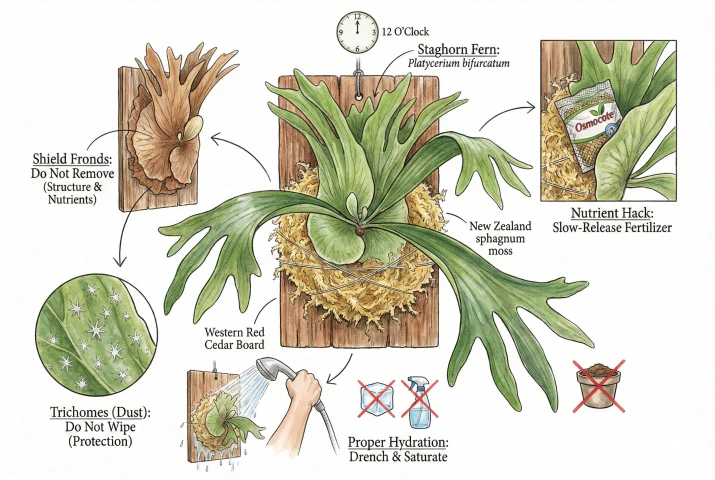
Achieving a symmetrical, architectural shape requires positioning the central growth bud exactly at the 12 o’clock position and using deep soaking methods to maintain turgor pressure.
Essential care involves preserving the structural brown shield fronds and protective white trichomes while avoiding damaging practices like ice cube watering or leaf wiping.
Key Takeaways
The 12 O’Clock Rule: Always orient the growth bud vertically (at the top center) when mounting. If positioned sideways, the fronds will twist and snarl as they fight gravity to reorient themselves.
Mounting Over Potting: Use rot-resistant wood (Western Red Cedar) and premium New Zealand Sphagnum Moss. This prevents root rot by allowing the rhizome to breathe as it would in the wild.
Proper Hydration: Drench the mount in the shower to fully saturate the moss and maintain frond rigidity. Never use ice cubes, which shock the tropical roots, and do not rely solely on misting, which provides insufficient hydration.
Anatomy Preservation: Never remove the brown “dead-looking” shield fronds, as they provide critical structure and nutrient storage. Never wipe the white “dust” (trichomes) off the leaves, as this strips the plant’s protection against sun and dehydration.
Nutrient Hack: Tuck a mesh bag of slow-release fertilizer (like Osmocote) behind the shield frond to mimic the constant, low-dose nutrient trickle found in the rainforest canopy.
1. Introduction
you didn’t buy a staghorn fern because you wanted a houseplant. You bought one because you saw a photo on Pinterest of a perfect, gravity-defying botanical sculpture exploding from a wall like the mounted antlers of a mythical Green Man. It looked architectural, prehistoric, and effortlessly cool.
Then you bought one at the garden center.
Now, you have a plastic pot sitting on your windowsill filled with what looks like a depressed, floppy salad. The “antlers” are drooping, the base looks like a pile of dead leaves, and the whole thing has the aesthetic appeal of a compost heap in training. Or perhaps you tried to mount it, and now the fronds are twisting in bizarre, agonizing spirals, looking less like art and more like a biological cry for help.
Here is the hard truth that most nursery tags won’t tell you: Staghorn ferns do not want to grow in pots. And they certainly don’t care about your interior design goals unless you force them to through superior biological engineering.
You are trying to tame an epiphyte—a plant that evolved over millions of years to cling to the side of a rainforest tree canopy, scavenging bird droppings and rainwater for survival. To get that museum-quality, symmetrical form, you have to stop treating it like a pothos or a fiddle leaf fig. You need to stop gardening and start engineering. This requires a nuanced understanding of botany, physics, and a little bit of “street-smart” horticulture. We are going to dismantle the myths, look at the cellular machinery of the Platycerium genus, and build a habitat that tricks this plant into thinking it’s thriving in the canopies of Borneo rather than dying in your living room.
2. The Science (The “Why”)
Before you grab a hammer, fishing line, or a watering can, you need to understand the machinery you are operating. If you treat a staghorn fern like a terrestrial plant, you will fail. The structural integrity and aesthetic shape of the plant are strictly dictated by its anatomy and evolutionary history.
The Epiphytic Imperative and Gravitropism
Platycerium species are epiphytes, meaning they grow upon other plants (phytor) but are not parasitic. In their native habitats—spanning tropical Africa, Southeast Asia, Australia, and South America—they anchor themselves to tree crotches or vertical rock faces. This is critical for two reasons: drainage and gravity.
First, their roots are not designed for the heavy, anaerobic conditions of potting soil. They are evolved for “air capture”—rapidly absorbing moisture from humid air and rain runoff while breathing freely. When you bury them in dense soil, you suffocate the rhizome, leading to weak, etiolated growth that lacks the turgor pressure to hold itself upright.
Second, the plant’s aesthetic form is a direct response to gravity (gravitropism) and light (phototropism). In the wild, the plant orients itself so the shield fronds catch debris falling from above, while the fertile fronds cascade or arch outward to release spores into the wind. If you disrupt this orientation—by potting it flat or mounting it upside down—the plant will expend massive amounts of energy twisting its petioles to reorient itself, resulting in a messy, snarled appearance rather than a clean, architectural fan.
The Two-Engine System: Frond Dimorphism
To shape the plant, you must distinguish between its two distinct biological engines. The staghorn fern is “dimorphic,” meaning it produces two completely different types of leaves with distinct physiological functions.
The Basal Frond (Shield Frond)
This is the flat, round, kidney-shaped leaf at the base of the plant. To the uninitiated, this often looks like the “dead” part of the plant because it turns brown and papery as it matures.
Physiological Function: This frond acts as a literal shield for the rhizome and roots, protecting them from desiccation and physical damage. More importantly, it functions as a nutrient trap. In nature, it creates a “basket” that catches falling leaves, insect carcasses, and bird droppings. As this detritus decays, it creates a rich, composted humus directly against the roots.
Aesthetic Reality: These fronds differ significantly by species. In Platycerium bifurcatum, they form a mound. In Platycerium superbum, they form a massive, upright catch-basin. Do not remove brown shield fronds. This is a rookie mistake. The brown layers build up over years, creating the “mound” that gives the fern its majestic bulk. Removing them destroys the plant’s hydration reservoir and structural anchor.
The Foliar Frond (Fertile/Antler Frond)
These are the showstoppers—the long, green, bifurcated (forked) leaves that extend outward.
Physiological Function: These perform the bulk of photosynthesis and, crucially, reproduction. On the underside of mature tips, you will often see brown, fuzzy patches. These are not pests; they are sporangia, clusters of spores used for reproduction.
Aesthetic Reality: The shape of these fronds is determined by light intensity. In low light, they grow long, strappy, and droopy (etiolated) as they reach for the sun. In bright, indirect light, they remain compact, thick, and upright, creating that desirable “antler” look.
The “Zipper” of Growth: The Apical Meristem
This is the single most important concept for aesthetic mounting. The staghorn fern grows from a central rhizome tip called the apical meristem or “bud.” New fronds emerge from this center in a precise geometric sequence, alternating left and right, similar to the teeth of a zipper or a woven braid.
If you look closely at the bud, you will see it has a distinct “up” and “down.” The new fronds emerge and unfold in a specific plane. If you mount the plant with this bud rotated 90 degrees (sideways), the new fronds will emerge growing sideways, then twist 90 degrees upward to fight gravity. This twisting creates the chaotic, tangled look that ruins the symmetry of a specimen. For a clean, symmetrical display, the bud must be positioned exactly at the “12 o’clock” position relative to the previous season’s growth.
Trichomes: The Moisture Regulators
If you look closely at the green fronds, you will see they are covered in a fine, white fuzz or “dust.” These are trichomes (stellate hairs). They serve a critical dual function: they reduce water loss by trapping a boundary layer of humid air against the leaf surface, and they protect the leaf from intense solar radiation.
Street-Smart Warning: Do not wipe the leaves to “clean” them. Unlike a Ficus or a Monstera, where wiping dust aids photosynthesis, wiping a staghorn fern removes the trichomes permanently. Once removed, they do not grow back. A “clean” shiny staghorn is a naked, vulnerable staghorn that will dehydrate rapidly and burn in the sun.
3. The Setup / Process
To achieve an aesthetically pleasing form, we must move the plant from a horizontal potting environment to a vertical mounting environment. This mimics nature and allows the fronds to drape and arch naturally. This process is effectively a transplant surgery, and precision is key.
Recommended Gear
You cannot build a cathedral with mud, and you cannot build a showcase vivarium mount with cheap craft supplies. Quality materials prevent rot and ensure the mount lasts for years.
Mounting Substrate: Besgrow Spagmoss (Premium New Zealand Sphagnum Moss)
Why: Do not use the cheap “sheet moss” or “Spanish moss” from the floral aisle; these are often dead, dyed green, and lack water-holding capacity. You need Long-Fiber Sphagnum Moss (LFSM). The New Zealand variety is the gold standard because its fibers are incredibly long, strong, and hold up to 20 times their weight in water while maintaining acidity that inhibits bacterial rot. It provides the structural mesh needed to hold the plant to the board.
Mounting Line: Clear Monofilament Fishing Line (20-30lb test)
Why: Many guides suggest twine or wire. Twine rots within a year, causing your 20lb fern to crash to the floor. Wire (even copper) can oxidize and poison the plant or cut into the fleshy shields. Heavy-duty fishing line is invisible, rot-proof, and elastic enough to hold the plant tight without slicing it if you use a thicker gauge.
Why: You need rot resistance. Pine will rot under the constant moisture a fern requires. Pressure-treated lumber contains copper and arsenic which can harm sensitive epiphytes. Cedar contains natural oils (thujaplicin) that prevent rot and fungal decay. Cork bark is the most naturalistic, mimicking the tree trunk exactly, but a flat cedar plank is easier for beginners to secure.
Hydrate the Medium: Begin by soaking your long-fiber sphagnum moss in a bucket of water. Allow it to absorb water for at least 20 minutes. Once saturated, wring it out firmly. You want it damp (like a wrung-out sponge), not dripping wet. If it’s too wet, you invite immediate fungal issues.
Prepare the Anchors: Lay your board flat. visualizing where the fern will sit (usually slightly below center to allow for upward growth). Drive 6-8 screws or nails into the board in a circle roughly 1-2 inches wider than the fern’s root ball. Leave the heads sticking up about 1/4 to 1/2 inch. These will serve as the capstans for your fishing line.
The “Surgery” (Unpotting and Root Reduction): Remove the fern from its nursery pot. You will likely find a dense root ball.
Root Pruning: Unlike terrestrial plants, you can be aggressive here. Gently loosen the old soil. You want to remove as much of the heavy nursery peat/soil as possible without destroying the core rhizome. The goal is to replace that anaerobic soil with your airy moss.
The Separation: If the pot contains multiple plants (pups), this is the time to separate them. A single-specimen mount looks more architectural than a cluttered colony. Use a sterile knife to slice through the rhizome connections if necessary.
Critical Orientation (The 12 O’Clock Rule): This is where 90% of people fail. You must identify the “up” direction of the plant.
Look for the bud (the fuzzy center).
Look at the most recent antler fronds. They should emerge with the “V” shape facing up or out, not down.
Look at the shield fronds. The top of the shield usually has lobed “fingers” that point up to catch water, while the bottom is rounder.
The Check: If you draw a line from the center of the old fronds to the new fronds, that line should point vertically to 12 o’clock.
The “Sandwich” Assembly:
Place a bed of damp moss on the board between your screws.
Place the fern on the moss bed, ensuring the orientation is correct.
Pack more moss around the root ball. Tuck moss behind the shield fronds if they are loose, or over the root ball if the shields are small. You are sculpting a mound that mimics a burl on a tree. Crucial: Do not cover the central growth bud with moss or wire. It must see light and air.
Lashing it Down:
Tie your fishing line to one screw.
Begin crisscrossing the line over the plant, moving from screw to screw. Go over the brown shield fronds (they are tough and hold the plant in place) but try to go under the green antler fronds to avoid pinning them down.
Pull tight. Tighter than you think. The plant relies on firm contact between the rhizome and the moss to root. If the plant wobbles when you shake the board, it is too loose.
Continue wrapping until the moss is securely contained and the plant is immobile. Tie off the line securely.
Comparison of Mounting Substrates
Substrate
Water Retention
Rot Resistance
Aesthetic
Verdict
NZ Sphagnum Moss
High (20x weight)
High (Acidic)
Clean, blonde/tan
Best Overall
Peat Moss (Soil)
High
Low (Compacts)
Dark, dirty
Avoid (Suffocates roots)
Coco Coir
Medium
High
Brown, fibrous
Acceptable (needs more watering)
Sheet/Green Moss
Low
Low
Artificial Green
Decorative Only (Use as top dressing)
4. Deep Dive / Tips
You have built the habitat. Now you must maintain it. This section goes beyond basic “water once a week” advice and delves into the physics of how light and water shape the plant tissues.
1. Phototropism and Symmetry Management
Staghorn ferns are intensely phototropic. They do not just need light to eat; they need light to know which way is “up.”
The Problem: If you hang your fern on a wall adjacent to a window, the light hits it from the side. The fronds will physically bend and stretch toward the window (etiolation), creating a lopsided, reaching plant.
The Fix: The “Rotisserie” Method isn’t viable for wall mounts. Instead, you must manage the light source.
Placement: The ideal spot is on a wall opposite a large window, receiving bright, filtered light head-on.
Correction: If side-lighting is your only option, you must take the board down during watering and hang it in a bright, neutral spot (like a shower with a skylight or outdoors in shade) for a day to help balance the growth. Alternatively, supplemental grow lights mounted directly above or in front of the fern can force symmetrical upright growth.
2. Turgor Pressure and the “Shower” Method
Watering a mounted fern is physically different from watering a pot. In a pot, water sits. On a board, gravity pulls water away instantly.
The Myth of Misting: Misting increases humidity slightly (for about 5 minutes), but it does not water the plant. You cannot hydrate a massive fern by spritzing it. The roots need saturation to maintain turgor pressure—the internal water pressure that keeps the fronds rigid and upright. Without deep watering, fronds will droop and look sad.
The Proper Technique: Take the board off the wall. Place it in the shower or a bathtub. Run lukewarm water over the shield fronds and the moss ball. Allow the water to fill the “pockets” of the shields. Let it soak for 2-3 minutes until the moss is heavy and saturated.
Drying: Let it drip dry vertically for 30 minutes before rehanging to protect your walls and floors. This cycle—deep saturation followed by total aeration—mimics the tropical storm cycle they evolved in.
3. Epiphytic Nutrition (Feeding the Monster)
In the wild, staghorns eat rotting leaves and bug poop. In your house, they starve.
The “Tea Bag” Hack: This is a trade secret for specimen growers. Take a slow-release fertilizer pellet (like Osmocote 14-14-14). Put a tablespoon of pellets into a small mesh bag (an empty tea bag or a piece of pantyhose works). Tuck this bag behind the top of the shield frond, between the moss and the plant.
Why it works: Every time you water, a small, dilute amount of nutrients dissolves and trickles down through the root ball. This provides a consistent, low-level feed that mimics the nutrient trickle of a rainforest canopy. It prevents fertilizer burn while fueling massive frond growth.
4. Species Selection for Aesthetics
Not all Staghorns look the same. Choosing the right species is half the battle.
Species
Growth Habit
Difficulty
Aesthetic Note
P. bifurcatum
Clustering / Colonial
Easy
Produces many “pups.” Forms a large, chaotic green ball over time. Best for beginners.
P. superbum
Solitary / Giant
Hard
Does not produce pups. Grows one massive shield and giant, drooping antlers. Very architectural but intolerant of overwatering.
P. ridleyi
Compact / Upright
Expert
Small, intricate, cabbage-like growth. Fronds stand straight up. The “Bonsai” of staghorns.
Video Tutorial: “How to Mount a Staghorn Fern” by SerpaDesign
Why: Tanner from SerpaDesign is a master of vivarium construction. His visual guide is technically precise regarding root placement and demonstrates the aesthetic difference between a sloppy mount and a showcase mount.
5. Troubleshooting (Q&A): Busting the Myths
There is a lot of “grandma’s wisdom” circulating in plant groups that is actually “botanical homicide.” Let’s use science to clear the air.
Myth 1: “Feed it a banana peel to provide potassium.”
The Reality: Stop doing this.
This is one of the most persistent and damaging myths. While bananas do contain potassium, placing a whole rotting fruit inside your fern is a recipe for disaster. The decaying sugar attracts ants, fruit flies, and fungus gnats. Worse, the rot can transfer to the fern’s rhizome, causing Erwinia (bacterial soft rot) or fungal issues. The potassium in a banana peel is not immediately bioavailable to the plant until it is fully composted, which takes months.
The Fix: Use science, not groceries. A balanced synthetic fertilizer (like Osmocote or a liquid orchid fertilizer) provides immediately available potassium without turning your living room into a fruit fly breeding ground.
Myth 2: “Water with ice cubes to prevent overwatering.”
The Reality: Absolute garbage advice.
Staghorn ferns are tropical plants. They evolved in climates that rarely, if ever, drop below 50°F (10°C). Placing 32°F (0°C) ice directly onto the roots or shield fronds causes immediate cellular shock. The extreme cold can rupture plant cells (necrosis), leading to dead patches in the roots and shields. Furthermore, 3 ice cubes amounts to roughly 3 tablespoons of water. This is nowhere near enough to saturate a dry moss ball, leading to chronic dehydration and salt buildup in the substrate.
The Fix: Drench the plant with lukewarm water. Tropical plants expect tropical temperatures. If you wouldn’t take a freezing cold shower, don’t make your fern take one.
Myth 3: “Wipe the white dust off the leaves to clean them.”
The Reality: You are skinning the plant.
That “dust” is actually a layer of trichomes—specialized star-shaped hairs that help the plant retain moisture and reflect harsh sunlight. Unlike the waxy cuticle of a Ficus or Philodendron, where wiping dust aids photosynthesis, wiping a staghorn fern strips away its protective layer. These hairs do not regenerate. A “clean,” shiny staghorn is a damaged, vulnerable staghorn that will dehydrate rapidly and burn in the sun.
The Fix: If the plant is dusty, rinse it gently in the shower. Never wipe, rub, or use leaf shine products.
6. Conclusion
Growing a show-stopping staghorn fern isn’t about magic or luck; it’s about respecting the engineering of the organism. You are dealing with a plant that defies gravity, eats from the air, and protects itself with a coat of hair and a shield of armor.
To achieve that sculptural perfection:
Mount it to mimic its arboreal home.
Orient it with the growth bud at 12 o’clock to prevent twisting.
Hydrate it deeply to maintain turgor pressure (no ice cubes!).
Respect it by leaving the trichomes and brown shields intact.
Do this, and that sad little potted fern will eventually become a massive, wall-dominating beast that looks less like a houseplant and more like a trophy from the Jurassic period. Now, go find a cedar board and get to work.



Leave a Reply