Platycerium Ridleyi Rot Prevention: The Ultimate Care & Mounting Guide
Stop killing your Platycerium ridleyi! Discover the science of root rot, the ’12 O’Clock’ mounting rule, and the expert watering secrets to keep your staghorn fern thriving.
Summary
Root Hypoxia is the Killer:Platycerium ridleyi rot is primarily caused by anaerobic conditions (lack of oxygen) in waterlogged substrates, which suffocates roots and invites pathogens like Erwinia and Pythium.
Structure Dictates Care: The plant’s unique ‘cabbage’ shield frond structure traps water easily; therefore, it must be mounted vertically with the growth bud strictly at the 12 o’clock position to allow gravity to drain excess moisture.
Environment Imitation: Prevention requires mimicking the epiphytic canopy environment by using a porous substrate (moss mixed with perlite/chips), ensuring high airflow, and allowing the root zone to dry out slightly between waterings.
Key Takeaways
The “12 O’Clock” Rule: Always orient the growth bud vertically at the top center. Mounting it sideways or upside down forces the plant to expend energy twisting, creating water traps that lead to rot.
Mounting Over Potting: Never plant a ridleyi in standard soil. Mount it on a board using a mix of Long-Fiber Sphagnum Moss and aeration amendments (like perlite or coco chips) to ensure rapid drainage.
Watering Discipline:
Do not water directly into the center of the shield frond (the “heart”).
Do soak the root ball or water from the back/sides.
Do not use ice cubes, as the cold shocks the tropical roots.
Airflow is Non-Negotiable: Stagnant air combined with moisture is the primary trigger for Erwinia (Bacterial Soft Rot). Use a fan to ensure air circulates around the shield fronds.
Preserve the “Dead” Parts: Never peel off the brown shield fronds or wipe the white fuzz (trichomes) off the leaves. The brown shields provide structural support and nutrients, while the trichomes protect against dehydration.
1. Why Your “Cabbage” is Turning into Compost
The P. ridleyi—affectionately known as “Ridley’s Staghorn” or simply “The Ridleyi”—is notorious. It is the heartbreaker of the genus. One day it’s a stunning, corrugated green sculpture; the next, the center turns to black mush, smells like a sewer, and falls off the wall. That’s rot. It is the silent assassin of the Platycerium world, and it is almost entirely preventable if you stop listening to generic “houseplant tips” and start understanding the actual biology of an epiphytic ant-fern native to the high canopies of Southeast Asia.
You are likely here because you’re paranoid about losing your investment—these aren’t cheap—or you’re already staring at a dark, squishy spot on your fern’s shield. Put down the watering can. Step away from the mister. We need to talk about fluid dynamics, cellular respiration, and why your love is suffocating your plant. We are going to go deep—past the “water once a week” advice and into the biochemistry of decay.
2. The Science (The “Why”): Biology, Botany, and the Chemistry of Decay
To prevent rot, you must understand what this plant is. It is not a terrestrial plant. It does not want soil. It does not want “wet feet.” It is an evolutionary marvel designed to live where water is fleeting and air is abundant. To understand the mechanism of rot in Platycerium ridleyi, we must first dissect its evolutionary adaptations, its anatomical structures, and the microbiological warfare that occurs in its root zone.
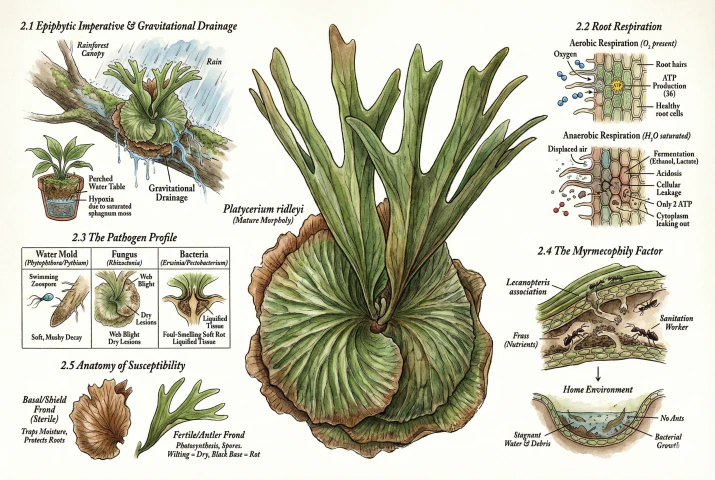
2.1 The Epiphytic Imperative and Gravitational Drainage
Platycerium ridleyi is an epiphyte. In the wild—specifically in the tropical rainforests of Thailand, Malaysia, Sumatra, and Borneo—it grows high in the canopy, often on the upper branches of tall trees. It is not a parasite; it takes nothing from the host tree but physical support.
The defining characteristic of this habitat is drainage. In the canopy, rain can be torrential, but it passes through the root mass instantly. Gravity pulls water away immediately. There is no saucer, no pot, and no stagnant pool. The roots are exposed to the open air, covered only by layers of leaf litter or moss. This means the roots have evolved to function in a high-oxygen environment.
When we pot a ridleyi or mount it with excessive sphagnum moss that stays saturated, we violate this fundamental evolutionary constraint. We create a “perched water table” where gravity cannot pull the water out of the substrate because the capillary forces of the dense moss hold it there. This leads to hypoxia (low oxygen).
2.2 Root Respiration: The Biochemistry of Drowning
Roots do not just drink water; they breathe oxygen. This is a concept called root respiration. Plant roots absorb O₂ from the air pockets in the substrate to convert sugars (from photosynthesis) into energy (ATP) via the Krebs cycle (aerobic respiration). This energy is required to actively transport nutrients across cell membranes.
If you saturate the substrate with water 24/7, you displace the air. The diffusion rate of oxygen in water is approximately 10,000 times slower than in air. Without oxygen, roots cannot respire aerobically. They switch to anaerobic respiration (fermentation).
Inefficiency: Anaerobic respiration produces only 2 ATP per glucose molecule, compared to 36 ATP in aerobic respiration. The roots essentially starve for energy.
Toxicity: The byproducts of fermentation in plant roots include ethanol and lactate (lactic acid). These compounds accumulate in the cytoplasm, lowering the intracellular pH (acidosis) and damaging lipid membranes.
Cellular Leakage: As cell membranes degrade, the cell loses its ability to regulate what comes in and out. Cytoplasm—rich in sugars and amino acids—leaks out of the root cells into the surrounding soil/moss.
This leaking cytoplasm is a dinner bell for opportunistic pathogens. It changes the chemical signaling in the rhizosphere (the zone surrounding the roots), attracting zoospores of water molds and bacteria.
2.3 The Pathogen Profile: Fungi and Bacteria
Rot is rarely just “water.” It is a biological attack facilitated by water. The ridleyi is susceptible to a specific rogue’s gallery of microorganisms.
Pathogen Type
Organism Name
Mechanism of Attack
Primary Symptom
Favored Conditions
Water Mold (Oomycete)
Phytophthora & Pythium
Produces motile zoospores that swim through wet substrate to infect root tips. Secretes enzymes to digest cell walls.
Soft, mushy, black roots that disintegrate when touched. “Melting” decay.
High moisture, low oxygen, cool to moderate temps.
Fungus
Rhizoctonia solani
Soil-borne fungus that attacks the stem/rhizome interface. Forms “web blight.”
Dry, sunken brown/black lesions on basal fronds; reddish-brown cankers near the rhizome.
Warm, humid conditions; “damping off” in young plants.
Bacteria
Erwinia (now Pectobacterium)
Secretes pectinolytic enzymes (pectinases) that dissolve the middle lamella (glue) between plant cells.
Foul-smelling, slimy soft rot. The tissue turns to liquid mush rapidly.
Stagnant water sitting in the crown/bud; high heat.
Bacterial Soft Rot (Erwinia) is particularly devastating for P. ridleyi due to its morphology. The “cabbage” shape can trap water in the center. If water sits on the apical meristem (growth bud) without airflow, bacteria multiply. The “fishy” or “rotten vegetable” smell is the hallmark of bacterial rot. Once the meristem turns to mush, the plant is effectively dead, even if the antlers look green for another month.
2.4 The Myrmecophily Factor (The Ant Connection)
P. ridleyi is a specialized myrmecophyte, or “ant-plant”. Those deeply corrugated, cabbage-like shield fronds aren’t just for looks. In the wild, they are evolved to create hollow chambers that house colonies of ants (often Lecanopteris species associations).
Why does this matter for your living room?
Sanitation: In nature, ants patrol the deep recesses of the plant. They remove fungal spores, debris, and dead tissue. They essentially act as the plant’s immune system and janitorial staff.
Nutrients: The ants leave behind waste (frass) and bring in organic matter, which composts inside the shield, feeding the plant nitrogen.
The Home Implication: You (probably) do not have a colony of symbiotic ants cleaning your fern. Without them, debris and water can accumulate in the deep ridges of the shield fronds. In the high humidity of a home, water that gets trapped in those deep ridges sits there. Stagnant water in the “heart” combined with a lack of janitorial ants creates a petri dish for bacterial growth. This explains why top-watering a ridleyi is often a death sentence—it mimics the rain, but lacks the wind and biological symbionts to manage the aftermath.
2.5 Anatomy of Susceptibility: Shield vs. Antler
The plant possesses two distinct frond types, and understanding their function is critical to preventing rot.
Basal/Shield Fronds (Sterile Fronds): These are the round, plate-like leaves at the base. They turn brown and dry with age. This is a normal physiological process. They are supposed to be brown and papery eventually. They act as a shield to protect the root ball and a sponge to hold moisture.
The Trap: Because ridleyi shields are so tight, rigid, and deeply veined, they trap moisture too well compared to other Platycerium species like bifurcatum. If the moss behind them is saturated, the shield prevents evaporation, keeping the rhizome in a sauna of humidity.
Fertile/Antler Fronds: These are the upright, forked leaves that perform the bulk of photosynthesis and bear spores.
The Signal: When these wilt, the plant is dry. When they yellow or blacken at the base, the rot has already traveled up from the rhizome.
3. The Setup / Process: Building a Rot-Proof Environment
You cannot just stick this plant in a pot and hope for the best. “Potting” a ridleyi in soil is asking for trouble unless you are extremely skilled with substrate aeration and moisture management. Mounting is the superior method because it mimics the plant’s natural vertical orientation, utilizing gravity to assist drainage and exposing the maximum surface area to airflow.
Here is the protocol for establishing a Platycerium ridleyi that resists rot from day one.
3.1 The Materials Checklist
You need materials that are rot-resistant and promote gas exchange.
The Mount: Western Red Cedar (naturally rot-resistant), Cork Bark (natural epiphyte host), or a slatted teak basket. Avoid treated lumber (chemicals) or soft pine (rots too fast).
The Substrate: A mix is better than pure moss.
Long-Fiber Sphagnum Moss: The gold standard for water retention.
Coco Husk Chips: For aeration. They don’t break down as fast as moss and keep the structure open.
Perlite: Can be added for extra drainage, though it looks unsightly on a mount.
The Hardware: Monofilament fishing line (15-30lb test). It is invisible and does not rot. Do not use cotton twine (it rots and breaks) or copper wire (copper is toxic to many plants, specifically causing toxicity in bromeliads and ferns). Stainless steel screws.
3.2 The Substrate Strategy: Porosity is King
Stop using pure peat moss. Stop using standard potting soil. You need macroporosity—large air gaps.
Recommended Substrate Mix for Ridleyi:
Base: 60% High-Quality Long-Fiber Sphagnum Moss (holds water but stays fluffy).
Aeration: 40% Perlite or Medium Coco Husk Chips (physically creates air pockets).
Why: Pure sphagnum can become a dense, soggy brick if packed too tight. Coco chips resist decomposition longer and keep the mix open, preventing the anaerobic conditions described earlier.
Recommended Gear: Besgrow Spagmoss (Premium New Zealand Sphagnum)
Why: It has long, strong strands that don’t compress into mud like cheaper Chilean or Chinese mosses. It allows for maximum airflow around the rhizome, which is the primary defense against Pythium.
If your ridleyi is currently in a plastic nursery pot with black, heavy soil, you are in the danger zone. You need to perform a transplant.
Step 1: Prep the Board.
If using a flat board, drill multiple holes in the center where the plant will sit. This allows air to reach the back of the rhizome, a critical vector for drying out the core.
Install screws in a circle slightly larger than the plant’s shield diameter to act as anchor points for your line.
Step 2: Clean the Roots.
Gently remove the plant from its pot. Remove as much of the nursery soil as possible without tearing the fine roots.
If the roots are encased in a dense, sponge-like plug (common in tissue-cultured imports), break it up. You want the roots to breathe.
Step 3: The “12 O’Clock” Rule.
Locate the growth bud (the fuzzy center point where fronds emerge). This must point straight up (12 o’clock).
If you mount it sideways, the plant will expend energy twisting its new fronds to fight gravity, weakening it and creating water traps in the twisting petioles.
Visual Check: The shield fronds usually have a “seam” or opening at the top; the bud sits just below this.
Step 4: The Sphagnum Nest.
Place a bed of your moss/chip mix on the board.
Place the fern on top.
Pack more moss lightly around the roots and behind the shields if they are open.
CRITICAL WARNING: Do not pack the moss too tight! If you compress sphagnum, you destroy the air pockets. It should be firm enough to hold the plant, but springy—like a firm sponge, not a brick.
Step 5: Secure It.
Tie your fishing line to a screw.
Zig-zag the line across the plant, catching the screws.
Go over the brown shield fronds (they are tough) but be extremely careful near the green shield fronds and the center bud. Do not slice the tissue.
Pull tight enough to immobilize the plant—if it wiggles, roots won’t attach—but not so tight you crush it.
3.4 The Airflow Mandate
In the wild, ridleyi lives in the “breezy” part of the forest. In your home, air is typically stagnant. Stagnant air + Wet Moss = Rot.
The Solution: You need active airflow. A small USB fan aimed near (not directly blasting at point-blank range, which causes desiccation) the plant disrupts the “boundary layer” of humidity. This encourages evaporation of excess water from the leaf surface and the crown, preventing bacterial enzymes from initiating the rot process.
4. Deep Dive / Tips: The “Street-Smart” Expert Advice
I’ve seen people rot ridleyi in deserts and I’ve seen them rot in greenhouses. The common denominator is always water management and light. You have to balance turgor pressure (keeping the plant hydrated) against hypoxia (drowning the roots).
4.1 The Watering “Squeeze”
Stop watering on a schedule. “Once a week” is a myth that kills plants. Watering needs change based on temperature, light, and humidity.
The Weight Test: Lift the board. If it feels light, like balsa wood, it’s dry. If it has heft, walk away.
The Texture Test: Touch the moss at the bottom of the mount. Is it “crispy” dry? If yes, water. Is it “cool” and slightly damp? Wait.
The Technique:
Do NOT spray water directly into the center of the shield frond “cabbage.” You are just filling a bucket with no drain.
Do water from the sides/back. Let the water run through the moss behind the shield.
Soaking: If the mount is very dry, dunk the board and moss (not the whole foliage) in a tub of room-temp water for 5-10 minutes. This rehydrates the core without drowning the bud.
Video Tutorial: “Mounting Staghorn Fern on Board – Platycerium Ridleyi” by Urban Fermor
Why: This video specifically deals with ridleyi. Watch how he positions the plant and, most importantly, observe the density of the moss packing. Note the orientation of the growth bud.
(Note: While SerpaDesign is great for general mounting, specific ridleyi tutorials are rare and valuable for seeing the unique shield handling.)
4.2 Water Quality: The Hidden Poison
Ferns are salt-sensitive. Tap water often contains chlorine, chloramines, and dissolved minerals (calcium/magnesium carbonates). This is often overlooked in rot diagnoses.
TDS (Total Dissolved Solids): If your tap water is “hard” (over 200ppm), you are slowly calcifying the roots. This mineral buildup burns the root tips.
The Mechanism: Salt burn kills the root meristem. Dead root tissue becomes necrotic. Necrotic tissue is the entry point for saprophytic fungi and pathogenic Pythium.
The Fix: Use rainwater, distilled water, or RO (Reverse Osmosis) water. If you must use tap water, let it sit for 24 hours to off-gas chlorine (though this doesn’t remove the stable chloramines used by many modern water municipalities).
Water Source
Risk Level
Notes
Rainwater
Low
Ideal. Slightly acidic (pH 6-6.5), oxygenated, no salts.
Reverse Osmosis (RO)
Low
Pure. Requires remineralization with fertilizer eventually.
Distilled
Low
Pure. Flat oxygen content unless aerated.
Tap Water (Soft)
Moderate
Chlorine presence is the main issue. Use dechlorinator.
Tap Water (Hard)
High
Calcium carbonate buildup will eventually kill root tips.
4.3 Fertilization: Don’t Burn the Baby
Rot often follows root burn. Over-fertilizing creates high salt concentrations in the moss. When the moss dries, those salts crystallize and draw water out of the roots (reverse osmosis), killing them.
The “Weakly Weekly” Rule: Use a balanced liquid fertilizer (like 10-10-10) diluted to 1/4 strength. Apply it only during the growing season (warm months).
Slow Release: Some growers tuck a few pellets of slow-release fertilizer (like Osmocote) behind the shield frond. This is safer as it releases nutrients slowly with each watering.
Organic Options: Seaweed extract (Kelpak) or fish emulsion are excellent, low-burn options that stimulate root growth via auxins and cytokinins.
4.4 The “Black Spot” Intervention
If you see a black, watery spot appearing on the shield frond or near the bud, you are in a code red situation.
Stop Watering immediately.
Increase Airflow: Point a fan directly at the plant to dry it out.
Chemical Warfare: Apply a fungicide.
Physan 20: A broad-spectrum disinfectant (bactericide and fungicide). It works on contact to sterilize surfaces. Use it to wipe down infected areas.
Systemics: For deep rot, surface sprays won’t work. You need a systemic fungicide that the plant absorbs. Thiophanate-methyl is effective against Rhizoctonia.
Cinnamon? Cute, but for a serious ridleyi infection, you want actual science. Cinnamon acts as a mild desiccant and has weak antifungal properties. It is fine for a small cut, but it will not stop Erwinia.
4.5 Light: The Metabolic Engine
Rot is often a function of metabolism.
Low Light = Low Metabolism: If the plant isn’t getting enough light, it isn’t photosynthesizing efficiently. If it isn’t photosynthesizing, it isn’t using water. If it isn’t using water, the moss stays wet.
The Requirement:Ridleyi needs bright, indirect light. It can take some gentle morning sun, but harsh noon sun will scorch it.
PAR Meters: If you are a tech nerd, aim for a PPFD (Photosynthetic Photon Flux Density) of roughly 100-200 µmol/m²/s. Without enough light, no amount of airflow will save a wet plant.
5. Troubleshooting (Q&A): Busting the Myths
Here is where I debunk the nonsense you read on random Pinterest boards. There is a lot of “old wives’ tales” in fern care that actively contributes to rot.
Myth #1: “You should mist your fern every day to keep humidity high.”
Fact Check:FALSE. Misting increases humidity for about 5 to 10 minutes. Then it evaporates. What misting actually does is leave liquid water droplets on the fronds.
The Science: If those droplets sit on the trichomes (the fuzzy white hairs) or roll into the bud crevices without evaporating, they create a micro-environment for fungal spores to germinate. Rhizoctonia loves wet leaves.
The Truth: Raise ambient humidity with a humidifier, not a spray bottle. If you must mist, do it in the morning so it dries by noon. Never mist at night when evaporation rates are low.
Myth #2: “The brown shield fronds are dead; I should peel them off to make it look clean.”
Fact Check:CRIMINAL. Do not touch them! The brown shields are the plant’s structural foundation. They protect the root ball, hold the plant to the tree (or board), and compost down to provide nutrients.
The Consequence: Peeling them exposes the delicate rhizome to dry air and mechanical damage. If you remove the shield, you essentially skin the plant alive. The “dead” fronds are functioning as a mulch layer.
Myth #3: “Ice cubes are a safe way to water slowly and prevent overwatering.”
Fact Check:HARD NO.Platycerium ridleyi is a tropical plant. It evolved in 80°F (27°C) rainforests.
The Science: Putting a 32°F (0°C) block of ice on its roots sends the plant into thermal shock. This damages the root cell membranes, causing them to leak cytoplasm and die. Dead roots = Rot entry point. Just use a watering can like a civilized human.
Myth #4: “My plant smells mushroomy, that’s just nature.”
Fact Check:FALSE. Healthy soil/moss smells earthy, like a forest floor. A “mushroomy,” sour, ammonia-like, or rotting vegetable smell indicates anaerobic decay.
The Diagnosis: If your plant smells, it is actively rotting. Unmount it, cut away the mushy black roots, soak the remaining healthy roots in a hydrogen peroxide solution (1 part 3% H2O2 to 3 parts water), and remount in fresh, fluffy moss.
Myth #5: “Trichomes are dust.”
Fact Check:FALSE. You will notice your ridleyi is covered in a fine white fuzz. These are trichomes (stellate hairs).
The Function: They help the plant reduce water loss (by trapping a boundary layer of air) and protect it from intense sun.
The Mistake: NEVER wipe the leaves. If you wipe them to “clean” the plant, you remove this protective layer. It does not grow back. A bald ridleyi is a dehydrated, sunburned ridleyi that is more susceptible to infection.
Cut out tissue if possible. Apply bactericide. Pray.
White fuzz on soil/moss
Saprophytic Fungus (Mold)
Too wet + Poor airflow. Not necessarily pathogenic, but a warning sign.
Yellowing of oldest fronds
Natural Senescence
Do nothing. This is normal.
Yellowing of NEW fronds
Root Rot or Nutrient Lockout
Check roots immediately.
6. Conclusion: The “Ridleyi” Survival Manifesto
Keeping a Platycerium ridleyi alive and rot-free isn’t about luck; it’s about discipline and understanding the physics of the environment you have created. You are trying to replicate a Malaysian tree canopy in a living room. That requires compromise and vigilance.
Mount it correctly: Vertical orientation (12 o’clock bud), porous substrate, secure attachment.
Respect the airflow: Stagnant air is the enemy. Move the air, and you move the moisture.
Water deeply, but infrequently: Let it dry. The “wet-dry cycle” is what triggers root growth. Constant moisture triggers rot.
Protect the Crown: Never let water sit in the central bud. It is the Achilles’ heel of this species.
If you follow this protocol, your ridleyi won’t just survive; it will produce those spectacular, upright antlers that make it the king of the ferns. If you ignore the science and drown it in love (and tap water), well… there’s always the compost bin.
Good luck. You’re going to need it.
Detailed Appendix: Advanced Pathogen Diagnostics
(Since we are going deep, let’s break down the specific enemies you are fighting in detail.)
The Fungal Axis of Evil
Rhizoctonia: The “Web Blight.” Look for web-like mycelium near the soil line or black, sunken spots on the basal fronds. It thrives in warm, wet conditions.
Pythium/Phytophthora: The “Water Molds.” These aren’t technically fungi (they are Oomycetes), but they act like it. They swim in water. If your moss is waterlogged, their zoospores swim to the roots and infect them. Symptoms include “melting” roots and a rapid collapse of the plant.
Treatment: Prevention is key (drainage). Chemical treatment is difficult once established; Etridiazole is effective but hard for hobbyists to get. Hydrogen peroxide drench can help knock back populations in early stages.
The Bacterial Blitz
Erwinia (Soft Rot): This bacteria produces enzymes that dissolve the middle lamella of plant cells. The result is a slimy, wet mush that spreads rapidly, often turning the whole center of the ridleyi into a foul-smelling soup within 48 hours.
Trigger: Water sitting in the crown + heat.
Treatment: Usually fatal. If caught early, cut out the infected tissue with a sterile knife (sterilize with flame between cuts), dust the wound with sulfur powder (as a desiccant), and keep the plant bone dry.



Leave a Reply