
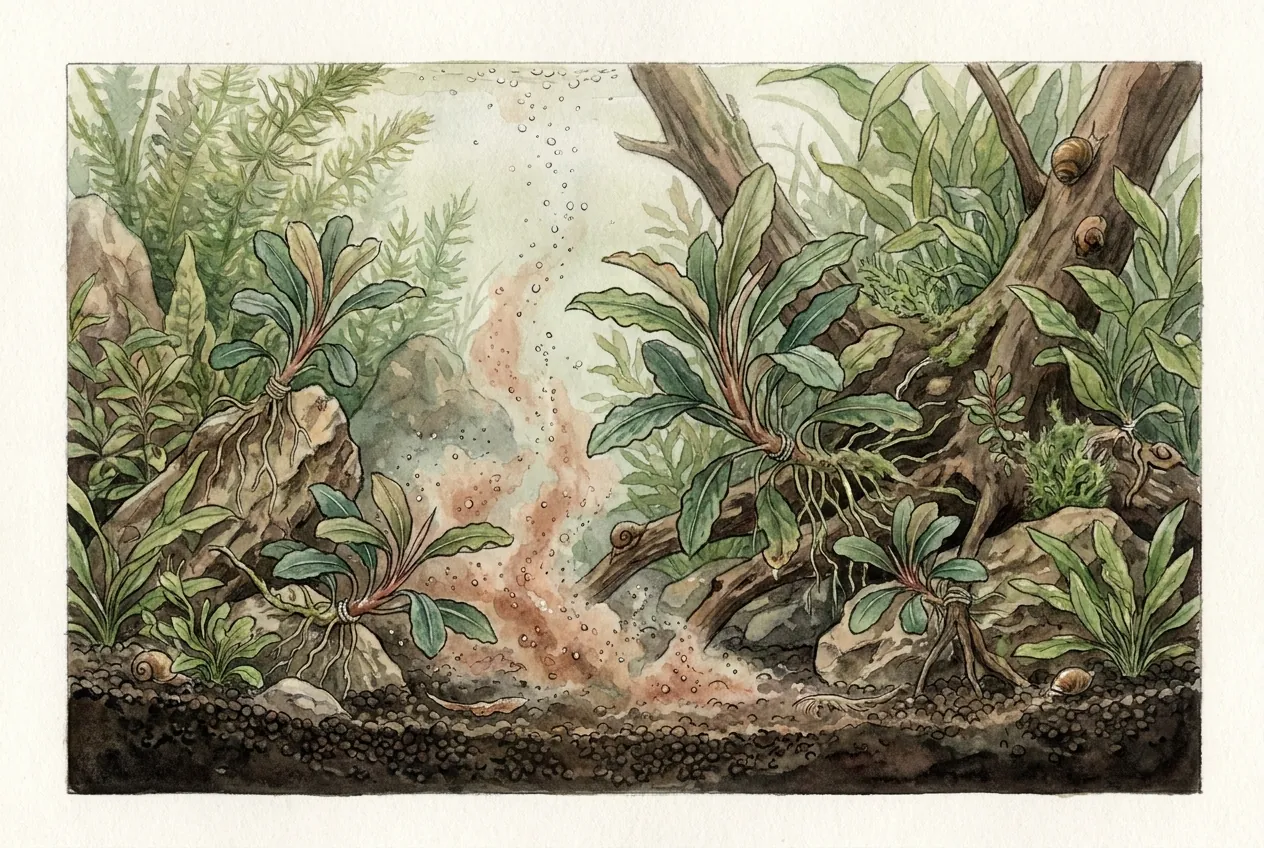
A fresh bag of ADA Amazonia v3 hits your tank and within 48 hours your API kit is green-yellow at 4 ppm Total Ammonia Nitrogen. Standard advice says wait it out, run 50% water changes, and the plants will be fine.
Standard advice has been killing Bucephalandra for ten years.
This guide pins down the actual chemistry and the brand-by-brand leach data for 2026 batches. Then it gives you the exact 3-day blackout plus 80% daily water change protocol that holds free NH3 below the 0.05 mg/L Bucephalandra-safe ceiling. No pure ammonia, no bottled bacteria, no pulling your plants into a stress-cascade hospital tank.
What is actually leaching out of aquasoil in week 1?
Aquasoil granules are kiln-fired clay coated with composted organic material. The ADA line uses bark, peat, and proprietary humic ferments. The granules don’t have ammonia sitting in them — they make ammonia.
Once submerged, aerobic and anaerobic decomposition convert the protein and amine nitrogen in the coating into NH4+. That NH4+ then exchanges onto and off of the clay’s negatively charged cation-exchange-capacity (CEC) sites. The substrate is an active ammonia factory for 3 to 8 weeks.
Field-documented week-1 TAN peaks for ADA Amazonia v1 and v2 sit at 2 to 6 ppm by day 3. The 2026 v3 batches are running hotter — 4 to 10 ppm sustained through the first 7 days, per active US and UK forum threads.
Tropica Aquarium Soil peaks milder at 1 to 3 ppm. Fluval Stratum often shows under 1 ppm. Dennerle Scaper’s Soil sits at 0.5 to 2 ppm.
The substrate keeps producing TAN long after the column reading drops. That is why daily water changes during week 1 don’t fix the leach — they only drag down the column TAN.
Simultaneous with the ammonia release, the organic acids and humics co-released by the substrate pull tank pH down. From the tap baseline (often 7.4 to 7.8) into the 6.2 to 6.8 band by day 3 to 5. This pH drop is the chemistry working for you, and the next section explains why.
Why does aquasoil keep leaching for weeks instead of all at once?

The leach is bacterial mineralization of protein nitrogen, not a single-shot dump. Decomposing organics on the granule coating release NH4+ slowly as enzymes break down amine groups.
The clay’s CEC then buffers the column TAN — adsorbing NH4+ when concentrations are high, releasing it when concentrations drop. This is why a 100% water change on day 2 doesn’t reset the cycle. The substrate immediately re-leaches into the fresh water from its loaded CEC sites.
Note The practical consequence is that wait until the leach stops, then plant is not a real strategy. The leach stops only when the organic coating is depleted, which takes 3 to 8 weeks. Heavy planting from day 0 plus controlled water changes is the only approach that respects the chemistry.
How aggressive is the 2026 ADA Amazonia v3 batch compared to v1 and v2?

Reports from r/PlantedTank, UKAPS, and ScapeCrunch threads from April through June 2026 consistently report v3 peaks 1.5 to 2× higher than the historical v1/v2 baseline. Multiple long-time aquascapers report TAN readings stuck at 4 to 6 ppm through day 7 even with daily 50% water changes — well above what older protocols assumed. The cause is likely a richer organic coating in the v3 formulation aimed at extended growth performance.
The actionable implication is direct. If you’re starting a Bucephalandra-heavy scape on v3 in 2026, you need the 80% daily WC protocol described below, not the 50% protocol that worked on v1 and v2.
Proper way to dark start AquaSoil — ScapeCrunch
Why does TAN reading mislead and what should you measure instead?
The number on your API test kit is Total Ammonia Nitrogen — the sum of NH3 (free, toxic) and NH4+ (ionized, ~1000× less toxic). Only the free NH3 fraction acutely damages plant tissue. The fraction is set by pH and temperature via the Emerson equation:
pKa = 0.09018 + 2729.92 / (T + 273.15)
At pH 6.5 and 25 °C, only about 0.07% of TAN is free NH3. A 4 ppm TAN reading delivers roughly 0.003 mg/L NH3 — well below EPA’s 1.9 mg/L chronic threshold.
At pH 7.8 and 28 °C, that same 4 ppm reading delivers about 0.21 mg/L NH3 — 70× more toxic. This is why a low-pH aquasoil tank survives readings that would scorch a neutral-pH inert-substrate tank.
Important The 10× toxicity multiplier per pH unit is the most important number in this whole protocol. For every one-unit rise in pH, free NH3 multiplies by 10. Temperature contributes a 2× multiplier per 10 °C rise. Tropical 26 to 28 °C is already at the higher end of that curve.
Aquatic Life Ambient Water Quality Criteria for Ammonia – Freshwater (2013) — EPA
Calculation on Un-ionized NH3 in Fresh — Florida DEP SOP
What fraction of TAN is free NH3 at typical aquascape pH and temperature?

Here is the working table. Use it to translate your test kit reading into actual toxicity before you panic.
| TAN reading | pH 6.5, 25 °C (Aquasoil week 1) | pH 7.0, 25 °C | pH 7.5, 27 °C | pH 7.8, 28 °C |
|---|---|---|---|---|
| 1 ppm | 0.0007 mg/L NH3 | 0.0022 mg/L | 0.0095 mg/L | 0.052 mg/L |
| 2 ppm | 0.0014 mg/L | 0.0044 mg/L | 0.019 mg/L | 0.104 mg/L |
| 4 ppm | 0.003 mg/L | 0.009 mg/L | 0.038 mg/L | 0.208 mg/L |
| 8 ppm | 0.006 mg/L | 0.018 mg/L | 0.076 mg/L | 0.416 mg/L |
The Bucephalandra-safe free NH3 ceiling is approximately 0.05 mg/L. That means 8 ppm TAN at pH 6.5, 25 °C is still operationally survivable. At pH 7.8, 28 °C, even 2 ppm crosses the line.
How does Seachem Prime actually neutralize ammonia?

Prime complexes free NH3 into a sulfite-aminal-like adduct that is bioavailable to nitrifying bacteria but not acutely toxic to plants or fish. The binding window is approximately 24 to 48 hours per Seachem’s technical FAQ. After that window, if the biofilter hasn’t consumed the bound nitrogen, NH3 is released back into the water.
The practical consequence is that Prime is a 48-hour insurance policy, not a permanent fix. Re-dose at every water change during week 1. Don’t trust it to hold past day 2 without renewal.
What product handles this and what’s the dose?
You want a complexing dechlorinator that binds free NH3 plus removes chlorine and chloramine in one shot. Seachem Prime 500 mL is the standard pick. Dose at 1 mL per 40 L of new water at each WC, plus a half-dose re-application at 24 h if TAN remains elevated.
The 500 mL bottle covers approximately 18,000 L of treated water, enough for the entire week-1 protocol and several months beyond.
Seachem Prime 500 mL: https://www.amazon.com/dp/B00025703M?tag=ariumology-20
Honest tradeoff: not a permanent fix — if TAN doesn’t drop, the bound NH3 is released when Prime degrades after 48 hours. Skip if you’d rather rely on dilution and substrate biofilter colonization alone.
For testing, you need a salicylate-based TAN kit that reads correctly when Prime is in the column. The API Freshwater Master Test Kit is the standard hobby pick — salicylate chemistry, reads within 60 seconds, lower detection at 0.25 ppm TAN. It tests ammonia, nitrite, nitrate, and high+low range pH all in one box.
API Freshwater Master Test Kit: https://www.amazon.com/dp/B000255NCI?tag=ariumology-20
Honest tradeoff: pH range tops out at 7.6 on the low-range card and is hard to read precisely in the 6.4 to 6.8 band where aquasoil tanks sit. Pair with a calibrated pH pen if you need precision below 6.6.
FAQ — How long does Seachem Prime stay bound — Seachem Support
5.5.3.2.1 Prime, Safe and Ammonia — Aquarium Science
Why is Bucephalandra the canary in the aquasoil mine?
Bucephalandra is a Borneo-endemic rheophyte from oligotrophic, low-pH (5.0 to 7.0) fast-flowing forest streams. Wild populations grow under near-zero ambient TAN, TDS below 50 mg/L, and constant 5 to 10× tank-volume-equivalent turnover. They are physiologically built for the exact opposite of an uncycled aquasoil tank — stagnant, high-nutrient, parameter-swinging chaos.
Multiple aquatic-plant authorities specify NH3 and NH4+ equal to zero as the baseline for Bucephalandra, with melt risk rising sharply above approximately 0.5 ppm TAN at near-neutral pH. Sustained free NH3 above 0.05 mg/L triggers leaf-edge translucence within 48 hours, full leaf melt within 5 to 7 days, and rhizome rot within 10 to 14 days. The rhizome-rot stage is generally non-recoverable.
Why is Bucephalandra more ammonia-sensitive than other common aquascape plants?

The oligotrophic-blackwater origin is the answer. Wild streams have near-zero dissolved N because lotic flow strips nutrients faster than they accumulate. Bucephalandra’s NH4+ uptake machinery (root and leaf AMT transporters) is calibrated for trace concentrations.
Drop the plant into 4 ppm TAN at neutral pH and the membrane transporters are overwhelmed. NH3 diffuses passively into leaf cells, and cytoplasmic NH3 disrupts the chloroplast pH gradient. Translucent leaf edges follow within hours to days.
Compare this with Hygrophila or Vallisneria, which evolved in nutrient-rich Asian floodplain habitats. Those plants are NH4+ sinks — they happily absorb 2 to 3 ppm TAN as fast as you can provide it. Bucephalandra is the opposite.
Which Bucephalandra cultivars survive an aquasoil cycle?

Hardy cultivars handle the protocol with moderate mortality. Premium delicate cultivars do not.
| Cultivar tier | Examples | Cycle survival |
|---|---|---|
| Hardy | Wavy Green, Kedagang, Red Mini | Moderate with protocol |
| Mid | Brownie Phantom, Lamandau Mini Red | Lower; week-3 add preferred |
| Delicate | Pygmaea Bukit Kelam, Velvet, Theia, Black Pearl | Add post-cycle only |
If you want Bucephalandra in week 1, pick a hardy cultivar like Wavy Green tissue culture and accept that some leaf loss is normal. Save the $80-per-rhizome premium cultivars for a stable tank.
What does early NH3 damage on Bucephalandra look like vs nutrient deficiency?

NH3 burn starts at the leaf edge — translucent, mid-green band that progresses inward. Rhizome stays firm and green-cream during the early phase.
Nutrient deficiency presents as pale, uniform leaf coloration (N), pinholes between veins (K), or interveinal chlorosis (Mg, Fe) — not edge translucence. Algae burn from high light + low CO2 shows as crusty filament growth on the leaf surface, not internal tissue change.
The diagnostic move is to scrape the rhizome with a thumbnail. Green inside means recoverable; brown and mushy means rhizome rot and the plant is gone.
What is the week-1 Bucephalandra-safe protocol?
Lights off for days 1 to 3. Sides covered with black panels or trash bags. 80% daily water change with temperature-matched RO/DI water remineralized to GH 4, KH 3, EC 200 µS/cm.
Seachem Prime dosed at every change. Plants stay in — do not pull Bucephalandra to rescue them into a holding tank.
The blackout starves the cyanobacteria and filamentous algae that thrive on the leached NH4+ pulse before plants can absorb it. The 80% WC drops TAN approximately 70 to 75% per change. That holds the column below the 0.5 ppm Bucephalandra ceiling once peak production passes at day 4 to 5.
Partial 50% changes drop TAN only 35 to 40%, leaving 2 ppm residual from a 4 ppm peak. That puts free NH3 in the 0.018 to 0.022 mg/L range at pH 6.5, 25 °C.
That is the orange zone where hardy plants survive but Pygmaea melts. The math is unforgiving.
How much water change per day during week 1?

80% daily for days 1 through 7 if you’re running a heavy-leach substrate (ADA Amazonia v3). 50% daily if you’re on a moderate leacher (Tropica AS, UNS Controsoil). Skip daily WCs entirely if you picked Dennerle Scaper’s Soil or Fluval Stratum — those leach mildly enough that the substrate’s own pH buffering plus plant uptake handles the load.
Temperature match is non-negotiable. Cold tap water shocks Bucephalandra independent of TAN; the wild populations live in stable-temperature streams and short-term 4 to 5 °C swings trigger leaf drop. Mix RO/DI with a kettle’s hot pour to land at tank temp ±1 °C before adding.
What does the day-by-day plan look like?

Day 0 — Fill and dechlorinate
- Fill the tank
- Dechlorinate with Seachem Prime at 1 mL per 40 L of fill water
- Lights OFF; cover the tank sides
- Test TAN at hour 6, 12, 24
- Plants in
Day 1 to 3 — Blackout phase
- 80% WC daily with temp-matched RO/DI remin
- Full Prime dose at each change
- Lights stay off
- Test TAN and pH before each change
- Do not feed, do not run CO2
Day 4 — Light-on test
- 50% WC
- Lights ON for 4 hours
- Test TAN before and after
- If TAN <0.5 ppm, proceed
- If still 1+ ppm, return to 80% WC for 2 more days
Day 5 to 7 — Transition phase
- 50% WC daily
- Lights 5 to 6 hours
- Monitor for algae regrowth and plant pearling
- Algae regrowth means light is back too fast — pull back 1 hour
Why is 80% the right WC volume and not 50% or 100%?

The math drives the answer. Starting from a 4 ppm TAN peak with substrate re-leaching 0.5 to 1 ppm per day:
| WC volume | Post-WC TAN | Pre-next-WC TAN | Free NH3 at pH 6.5 |
|---|---|---|---|
| 50% | 2.0 ppm | 2.5-3.0 ppm | 0.018-0.022 mg/L |
| 80% | 0.8 ppm | 1.3-1.8 ppm | 0.009-0.013 mg/L |
| 95% | 0.2 ppm | 0.7-1.2 ppm | 0.005-0.009 mg/L |
At 80%, free NH3 stays under the 0.05 mg/L Bucephalandra ceiling with a comfortable safety margin.
At 95%, you gain marginal NH3 reduction at the cost of higher pH and TDS instability. RO/DI refills strip the column harder and may crash KH below 2 °dKH. 80% is the math sweet spot.
Can you cycle a planted tank with no fish and no pure ammonia?
Yes. The substrate is already producing 2 to 6 ppm TAN — that IS the cycle fuel. Higher plants absorb NH4+ directly via root and leaf AMT (ammonium transporter) proteins.
In heavily-planted tanks, those uptake rates often outpace bacterial nitrification entirely. Nitrosomonas and Nitrospira colonize fresh substrate within 3 to 8 weeks at 25 °C, with Nitrospira doubling times of 12 to 32 hours.
Of 33 aquarium plants tested in Walstad’s biofiltration review, 29 prefer NH4+ over NO3- as N source. Plants take up NH4+ both day and night via constitutively-expressed AMT genes; NO3- uptake requires light-driven nitrate reductase. The practical consequence is that heavy planting from day 0 lets the plants shortcut the cycle for the volume they can reach.
From — dianawalstad.com Table 1. N Preference of Aquatic Plants — Diana Walstad
How do plants actually absorb NH4+ directly?

Roots express AMT family transporters (LeAMT1 in tomato is the model gene) that pull NH4+ into root cells against a concentration gradient. The transporters are constitutively expressed and downregulated when NO3- is abundant. The cost is one ATP per NH4+ molecule transported — far cheaper than the 8 ATP needed to reduce NO3- back to NH4+ before assimilation.
In aquarium plants specifically, leaf uptake of dissolved NH4+ (via stomata when emergent, via cuticle and epidermal AMTs when submerged) is often more efficient than root uptake. This is why floaters — Amazon frogbit, red root floater, water lettuce — are the highest-rate NH4+ vacuums in a tank. A small mat in a 20-gal can pull 0.5 to 1 ppm TAN per day off the column.
How long does Nitrospira take to colonize fresh aquasoil at 25 °C?

Three to eight weeks unseeded. Two to four weeks with even 1 mL of squeezed filter media from an established tank.
Optimum growth temperature is 25 to 30 °C. The 12 to 32 hour doubling time means a starting population of ~100 cells reaches functional density (10^8 cells per gram media) in approximately 18 to 32 doublings. That’s 9 to 43 days depending on temperature and substrate quality.
The leverage move is filter seeding. Bring a small plastic baggie to a friend’s established tank and squeeze 5 to 10 mL of filter floss or sponge gunk into it.
Drop in your new filter on day 4 (after the worst TAN spike passes). Cycle reaches completion 50% faster.
Should you dose pure ammonia or Dr. Tim’s on top of an aquasoil cycle?

No. The substrate is already overdosing TAN. Adding pure ammonia pushes free NH3 into the lethal zone for Bucephalandra and bottom-fed plants like Cryptocoryne.
Bottled bacteria supplements are unnecessary when you can seed with seasoned media. The exception is if you have no access to seasoned media at all. In that case, Seachem Stability at 5 mL per 40 L daily for 7 days is the backup option.
What about week 2 — when do you fertilize and what EC do you target?
Seven days of 80% daily WCs strip the water column to near-zero K, Mg, and Ca even when remin salts are added at fill. The substrate’s CEC sites absorb cations during equilibration. EC drops 50 to 80% below the level Bucephalandra and stem plants need for stable growth.
Week 2 restart:
- Reduce WC to 30 to 50% every other day
- Start dosing macro and micro fert at 50% the manufacturer’s planted-tank dose (aquasoil still leaches N)
- Target EC 200 to 300 µS/cm above the RO-remin baseline
GH 4 to 6 °dGH, KH 3 to 4 °dKH, TDS 150 to 250 ppm is the Bucephalandra-friendly band.
When should you start dosing macro fert again?

Day 8 at 50% recommended planted-tank dose. The aquasoil still contributes 0.5 to 1 ppm TAN per day at this point — a full EI dose would overshoot.
By day 14, ramp to 75%. By day 21, full dose with weekly WCs.
Use a nitrogen-light fert during the transition (Tropica Premium has no N; Tropica Specialised has ~3% N as urea). If your tap or remin water is already high-N, Tropica Premium is the safer pick until aquasoil leach stops.
How to set GH and KH for Bucephalandra recovery
Target GH 4 to 6 °dGH with a remineralization product. Salty Shrimp Bee Shrimp Mineral GH+ at 1.5 g per 10 L of RO/DI lifts GH to roughly 6 °dGH. EC lands at approximately 250 µS/cm with no added KH (you add KH separately).
The 850 g tub lasts approximately 5,600 L of refill — months of regular WCs.
Salty Shrimp Bee Shrimp Mineral GH+: https://www.amazon.com/dp/B009MJZ988?tag=ariumology-20
Honest tradeoff: the shrimp-blend skews Ca:Mg toward shrimp shell needs (roughly 4:1). Fine for plants, but a generic Seachem Equilibrium GH+ might be cheaper per liter if you do not keep shrimp.
KH 3 to 4 °dKH from a separate buffer or a crushed coral mesh bag. This soft-but-buffered profile mimics the Sarawak limestone-stream chemistry Bucephalandra evolved in.
If KH crashes below 2 °dKH (pH drift toward 5.5), add baking soda at 1/4 teaspoon per 10 gallons to lift KH by approximately 1 °dKH. Do this slowly — instant KH swings stress shrimp and the more delicate Bucephalandra cultivars.
What happens if EC stays low at day 10?

Diagnosis
Substrate is still aggressively adsorbing cations. The remin in your refill water isn’t enough to overcome substrate uptake.
Fix
Bump GH to 5 to 6 °dGH with another half-dose of remin, then recheck in 24 hours. If still low at day 12, you may have a high-CEC batch that needs an extra week of equilibration. Dose macros at the 50% level meanwhile.
Which substrate should you pick for a Bucephalandra-heavy scape?
ADA Amazonia v3 wins for stem-plant growth but requires the full protocol. Dennerle Scaper’s Soil or Fluval Stratum let Bucephalandra go in week 1 with minimal intervention. The choice is between maximum growth ceiling and minimum effort.
| Substrate | Week-1 TAN peak | Bucephalandra-safe day 1? | 2026 price (9 L bag) |
|---|---|---|---|
| ADA Amazonia v3 | 4-10 ppm | No, protocol required | ~$45 |
| Tropica AS | 1-3 ppm | Marginal, mild protocol | ~$40 |
| UNS Controsoil | 1-3 ppm | Marginal | ~$35 |
| Fluval Stratum | <1 ppm | Yes | ~$28 |
| Dennerle Scaper’s | 0.5-2 ppm | Yes on low-end batches | ~$50 |
Should you mix substrates to create a low-TAN refuge for Bucephalandra?

No. TAN diffuses across the column in hours. A Stratum zone in the front of an Amazonia tank reads the same TAN as the Amazonia zone within 24 hours of fill.
Substrate mixing affects localized root-zone chemistry but does not create a column refuge. Pick one substrate that matches your protocol tolerance.
The exception is dosing local root tabs into an inert substrate — that does create localized fertilization without TAN release. But that’s a different choice than running aquasoil at all.
Why does ADA Amazonia v3 still get picked despite the leach?

The 18 to 24 months of high-performance growth. The deep substrate color that stays consistent through years of replanting. The durable granule shape that resists compaction better than Stratum’s softer pellets.
For high-end stem plants (Rotala, Ludwigia, Tonina), Amazonia outperforms anything else in the category. The protocol cost is acceptable when growth ceiling matters.
For a Bucephalandra-and-Anubias scape on hardscape rocks with no carpeting, Amazonia is overkill. Stratum or Dennerle does the job at half the protocol intensity.
Troubleshooting — what to do when it goes wrong
Three failure modes show up in week 1:
- API kit reads ammonia despite Prime (usually accurate)
- TAN won’t drop below 1 ppm by day 7 (substrate over-leach)
- Bucephalandra melt crosses into rhizome rot (recovery point passed)
The biggest unforced error is panic-pulling Bucephalandra mid-cycle into a hospital tank with unstable parameters. They recover better in-place under protocol than in a new pH/TDS environment.
Why does my API kit show ammonia when I’m dosing Prime?

Because it’s reading correctly. API salicylate kits measure Total Ammonia Nitrogen (NH3 + NH4+).
Prime complexes the toxic NH3 fraction into a non-toxic adduct, but TAN is still present and the test reports it accurately. This is not a kit error — the chemistry is working as designed.
Nessler-based kits (the older API freshwater kit, not the master) DO produce false-high readings with Prime because Prime’s reducing agent disrupts the Nessler reaction. Use the salicylate-based master kit and read within 60 seconds for the cleanest result.
Ammonia Test Kits — Nessler vs Salicylate — Nippy Fish
What if TAN won’t drop below 1 ppm by day 7?

Extend the protocol. Run 80% WC for 3 more days. Verify your dechlorinator is dosed correctly — residual chloramine reads as TAN on salicylate kits.
Add 5 to 10 mL of seasoned filter media if you can get it. If TAN is still 1+ ppm at day 10, you have a high-leach batch. Extend the 50% WC schedule another 7 days and ride it out.
Warning Do NOT dose carbon source (sugar, vodka, vinegar). Do NOT overdose Prime past 5× normal. Do NOT pull plants. The only safe lever past the protocol’s ceiling is patience.
How do I diagnose Bucephalandra rhizome rot vs a normal melt-and-recover?

Pull the plant gently. Scrape the rhizome with a thumbnail. Green inside means recoverable — replant in low-flow corner, maintain protocol, new leaves emerge in 3 to 4 weeks.
Brown and mushy inside means rhizome rot — discard. The smell test confirms: healthy rhizome smells earthy; rotted rhizome smells sulfurous. Sulfur means dead.
If most of the rhizome is healthy but a small section is rotted, run the partial rescue:
- Cut with a sterilized blade (alcohol-wiped razor) at least 1 cm into healthy tissue
- Dip the cut surface in dilute hydrogen peroxide (1 mL of 3% H2O2 per 20 mL of water for 30 seconds)
- Replant the healthy portion
Recovery rate from this rescue is approximately 60 to 70% if done before more than half the rhizome is affected.
What if my Bucephalandra leaves are coming in deformed or stunted week 3?

Probably a calcium or boron deficiency from week-1 stripping. Bump GH to 5 to 6 °dGH with the remin product.
Dose Tropica Premium or another full-trace micro fert at 25% strength to restore B, Cu, Zn, Mn. New leaves form correctly within 2 to 3 weeks once the micronutrient pool is restored.
If new leaves are pale green or yellow specifically, that’s Mg or Fe. Add Epsom salt (MgSO4) at 1/8 teaspoon per 10 gallons and increase the Fe-containing micro fert dose.
Key Takeaways
- Aquasoil ammonia leach is bacterial mineralization, not a one-shot dump; ADA Amazonia v3 2026 batches run 4 to 10 ppm TAN through week 1.
- Free NH3 toxicity scales 10× per pH unit and 2× per 10 °C — a low-pH aquasoil tank survives readings that would scorch a neutral-pH inert tank.
- The Bucephalandra-safe protocol: 3-day blackout, 80% daily WC with temp-matched RO/DI remin, Seachem Prime at every change, plants stay in.
- 50% WC math doesn’t hold the 0.5 ppm TAN ceiling for delicate cultivars; 80% is the math sweet spot.
- Cycle the tank with plants and seeded filter media — no pure ammonia, no Dr. Tim’s, no panic.
Some links in this post are Amazon affiliate links. If you buy through them, ariumology.com earns a small commission at no extra cost to you. We only recommend products we have used or that meet the technical specs discussed above.

Leave a Reply