
Aquarium Power Outage Kit Product Chooser: Air, Heat, Backup
An aquarium power outage kit product chooser that ranks battery aeration, monitoring, insulation, and a power station by oxygen and heat math.
Marcus Hale · Published 2026-11-03 · 20 min read
Key Takeaways
- Buy a battery air pump that switches itself on first, because warm water holds the least oxygen.
- A logging probe thermometer shows which clock is running, oxygen or heat, before you act.
- A closed lid, foil wrap, and blanket slow heat loss and make any battery heater time last longer.
- For long outages, run the filter from a power station in EPS mode, and add heat only after wrapping the tank.
- Never run a fuel generator indoors, and keep every aquarium cord on GFCI with a drip loop.
A blackout starts two clocks in a fish tank. One counts down the dissolved oxygen, the other counts down the heat, and the season decides which runs out first.
Outage gear is easy to buy backward, starting with the biggest battery and ending with a thermometer nobody checks.
The order below follows the physiology instead, so the first dollars protect against the fastest killer.
The buying verdict, in role order
Buy by role, in this sequence, before you compare any brand.
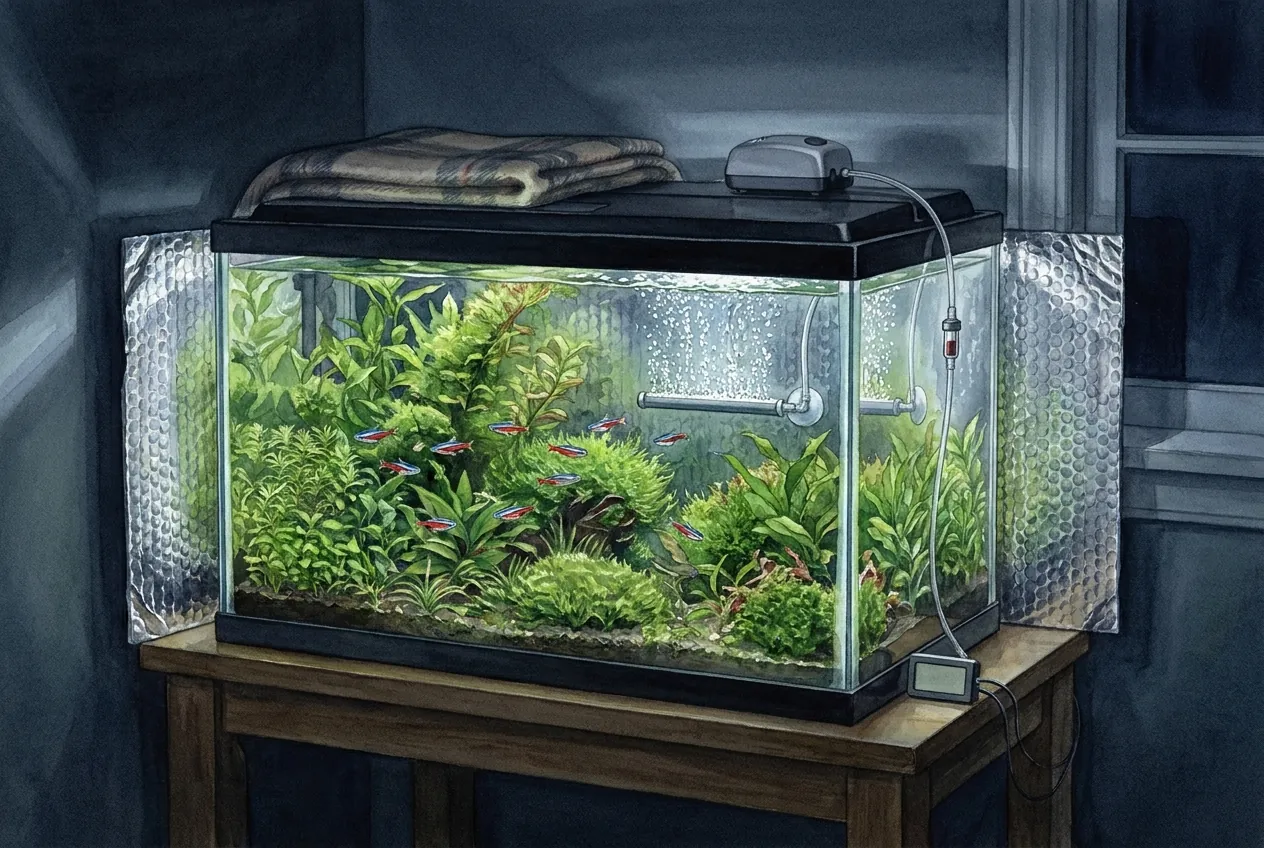
- Aeration backup first, meaning a battery air pump that switches itself on when wall power drops.
- Monitoring second, meaning a battery thermometer with a water probe, a log, and an alarm.
- Heat retention third, meaning a closed lid, reflective foil wrap, and a blanket for cold-room outages.
- A power bridge last, sized to run filtration first and a heater only after the tank is insulated.
Spend on oxygen first, information second, insulation third, and stored electricity last.
One safety rule sits above every purchase. During an outage, the CDC says never to use generators, grills, or other gasoline-, propane-, or charcoal-burning devices inside a home, garage, or carport.
Generators belong outside, at least 20 feet from doors, windows, and vents, which is why this whole kit runs on batteries indoors.
Why oxygen and heat are the two clocks
When the filter and heater stop, supply stops but the tank’s demand carries on. The numbers below show how much margin a typical tank has.
Warm water starts the outage with less oxygen
Warm water simply holds less dissolved oxygen. UF/IFAS gives saturation at 7.4 mg/L for 90 F water versus 11.9 mg/L at 45 F. USGS describes the same inverse link between temperature and oxygen.
The thresholds are tight. UF/IFAS recommends 5 mg/L or more for fish health and notes that most species are distressed at 2 to 4 mg/L. Deaths usually occur below 2 mg/L.
A planted tank does not rescue itself in the dark. UF/IFAS explains that plants and algae make oxygen only in light but keep consuming it through respiration. A blacked-out planted tank therefore behaves like a pond at night.
A warm tank enters an outage with the least oxygen headroom, which is why the air pump is the first purchase.
Demand keeps running after the pump stops
Fish burn more oxygen in warmer water. Within single species acclimated to warmer water, resting oxygen use rose a median 2.4 times per 10 C. Across 69 species from different climates, the factor was about 1.8.
The filter is a second consumer. SRAC describes the bacteria that turn ammonia into nitrite and nitrate as aerobic. The biofilm keeps drawing oxygen, so a still canister soon has none left to give.
That makes a summer outage the oxygen worst case and a winter outage the heat worst case. The same kit has to cover both.
How fast a tank loses heat in a cold room
Newton’s law of cooling says a tank loses heat faster the wider the gap between the water and the room.
The first hours of a cold-room outage therefore cost the most heat.
The open top is a second leak. USGS explains that evaporation pulls heat from its surroundings and leaves a net cooling. A closed lid is the cheapest insulation a tank can get.
How cold tropical fish can get, and for how long
Tropical fish have some cold margin, but only for a while. NC State’s aquatic veterinarian notes that most tropical fish tolerate the low 60s F, or even the high 50s, for several hours.
The same guidance says to add heat once water nears the mid-50s.
It also advises insulating the tank with a blanket or sleeping bag in winter and skipping feeding, since digestion uses oxygen.
Cold fish eat little anyway, a pattern covered in why fish stop eating in cold water.
After a long outage, NC State recommends testing ammonia and changing 10 to 30 percent of the water if it rises above 1 ppm. Its suggestion of propane or kerosene heaters runs against the CDC warning above, so this kit keeps portable fuel heaters out of the house.
Treat the low 60s as a few-hour limit, not a comfort zone, and act long before the water reaches the mid-50s.
The specs that decide each purchase
Every role has one or two numbers that separate a useful product from a shelf ornament. Compare these before price.
| Role | Spec to compare | What to look for | Why it decides the outcome |
|---|---|---|---|
| Aeration backup | Battery runtime in hours, automatic switching | Rated hours at your flow setting that exceed your usual outage, plus a hands-free switch to battery | Air starts the moment power drops, even when nobody is home |
| Monitoring | Battery power, water probe, log, alarm | A liquid probe, a stored log, and a low-temperature alarm | Every later decision depends on the measured temperature trend |
| Heat retention | Material and coverage | Foil and bubble layers cut to cover the back, both sides, and the lid | Lower heat transfer stretches every hour of the outage |
| Power bridge | Watt-hours, continuous watts, waveform, switchover | Filter watts times outage hours, divided by 0.7, plus pure sine AC and an automatic switch to battery | Heaters draw far more than pumps, so runtime collapses if heat comes first |
The waveform line matters more than it looks. Some cheaper inverters make a stepped modified sine wave instead of the smooth wave a wall outlet delivers.
Pump and filter motors are designed to run on wall power, so pure sine output is the safer default.
Size the power bridge for the filter first, then see what is left for heat.
Aeration backup that starts itself
The aeration role must keep the water surface moving from the first minute of an outage, with no one flipping a switch or loading batteries.
The right design runs on wall power every day and drops to its internal battery the instant the grid fails.
The hygger HG199 4W air pump meets that spec. Its maker lists a 4800 mAh battery that gives 12 hours of continuous air at maximum flow and up to 37 hours at minimum. It switches from AC to battery automatically and charges over USB-C.
The kit ships with two airstones and two check valves, and the maker rates it for 10 to 120 gallon tanks.
The Amazon listing rates maximum flow at 64 gallons of air per hour.
The limit is pressure. A small pump pushing two stones near the bottom of a deep tank loses flow. Set the stones a few inches under the surface, where rolling water does most of the gas exchange anyway.
One unit is not enough for a very large or very deep tank. Run two, or use a dedicated backup air supply sized for the system.
Monitoring that records the trend
A single reading tells you where the tank is. A logged trend tells you where it will be in two hours, and that decides whether to wrap, heat, or wait.
The Inkbird IBS-TH1 with probe fits that role on AAA batteries, with an external probe built for liquids.
Inkbird lists storage of 30,000 readings, about 20 days at one reading per minute, with alarms and history in a phone app. Its logging interval is adjustable from 10 seconds to 30 minutes.
That stored history is what makes the cooling drill below possible.
The tradeoff is reach. Alarms travel over Bluetooth to a phone in the house, so they will not reach you at work without a separate gateway.
Inkbird’s product page gives no accuracy figure for the probe, so read the slope across several readings rather than single tenths.
Heat retention that slows the leak
Insulation is the cheapest hour you can buy. It lowers the rate at which the tank sheds heat, so every later decision gets easier, including how long a battery can hold a heater.
Lid first, then foil and a blanket
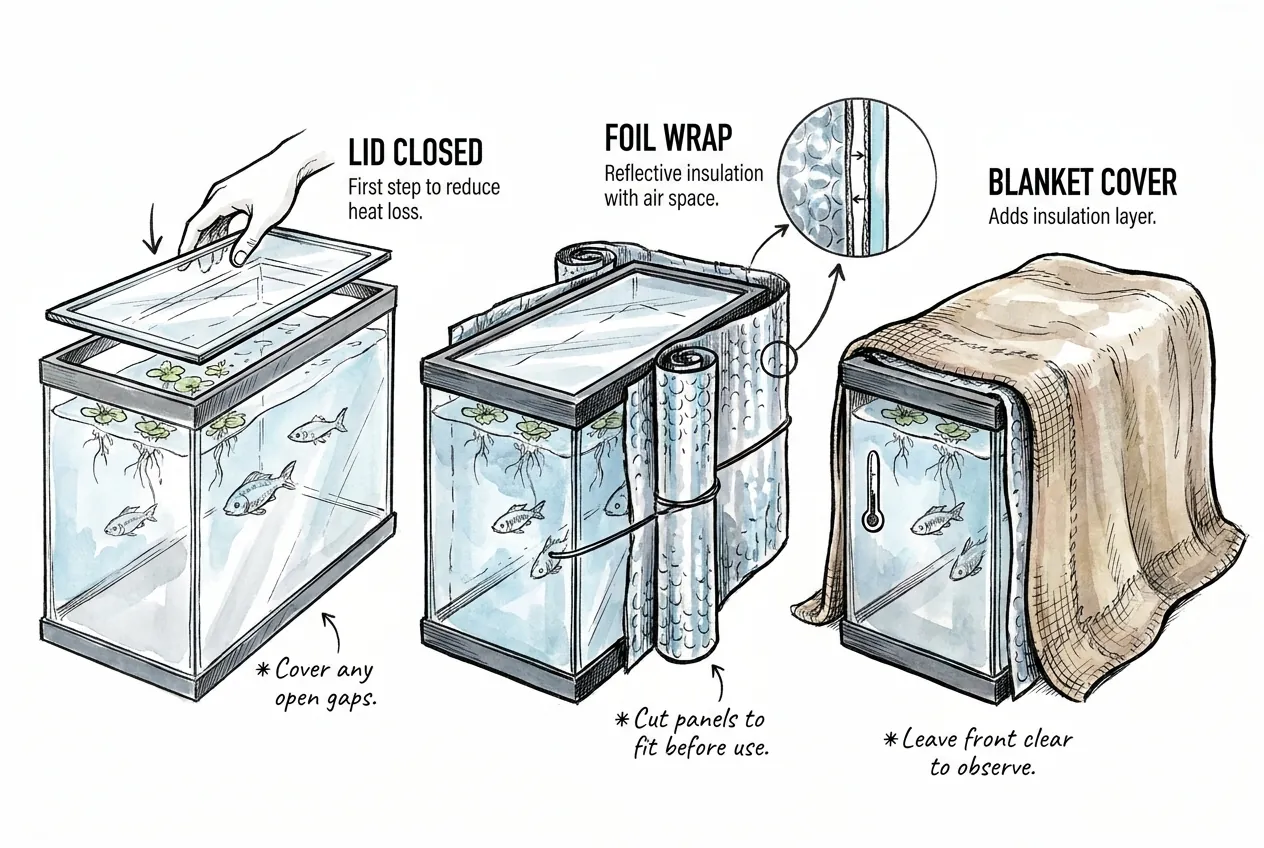
Close the lid and cover any gaps first to stop evaporative heat loss. Then wrap the back and sides and lay a sheet over the lid, leaving the front clear to watch the fish.
The Reflectix ST16025 foil roll is a 16 inch by 25 foot double-reflective foil and bubble roll.
Cut it into panels that fit your tank before the season, and label them by side.
Reflective insulation has a catch. Virginia Cooperative Extension notes that a reflective surface needs an air space beside it to block heat well.
Foil pressed flat on glass therefore works mostly through its bubble layer.
A blanket over the foil adds insulation but does not restore the reflective effect, since the foil still lacks an air space.
Keep the wrap clear of plugs, cords, and light fixtures, and remove it once normal heating returns.
Avoid chemical heat packs or hot water poured into the tank, since neither gives a controlled rise.
For a heater that struggles even on normal days, the aquarium heater buying guide covers sizing.
The power bridge and the one purchase over $100
The power bridge is the most expensive role, so it comes last and gets the hardest math.
Heaters are the problem, because a heater’s watt rating is typically many times an air pump’s.
What a UPS can and cannot do
A small computer UPS switches over by itself, but it is a short bridge. Its battery is sized for minutes of computer runtime, so it suits a filter through a brief flicker, not a cold night.
Choose a pure sine model, since some small units make a stepped wave on battery.
Never plug a heater into a UPS or power station whose continuous rating it exceeds. Even under the rating, a heater drains a small battery quickly, so the heater stays off the UPS entirely.
The station that earns the bigger budget
Where outages last many hours, a portable power station is the one item worth triple digits.
The EcoFlow RIVER 2 power station stores 256 Wh in lithium iron phosphate (LFP) cells.
It delivers 300 W of continuous pure sine AC, with a 600 W surge.
Its manual also lists a USB-C port up to 60 W, which can recharge the air pump without AC inverter losses.
EcoFlow rates the cells at 80 percent or more capacity after 3000 cycles and lists the unit at $239.
In its emergency power supply (EPS) mode, the station stays plugged into the wall with the filter plugged into it.
In a sudden blackout, it can switch to battery within 30 ms.
The manual calls this a basic UPS feature without 0 ms switching and recommends one device under 600 W, tested first.
The filter is that device, since the air pump has its own battery. The heater stays off the station until the tank is wrapped.
Keep the station ventilated and away from water. Stored unplugged, it needs a discharge to 0 percent and a recharge to 60 percent every three months.
Charge it to full before storm season, since the table below starts from the full 256 Wh.
Runtime math for this station
Until the cooling drill below measures the real runtime, I plan on only 70 percent of a station’s label watt-hours. That deliberately conservative allowance covers inverter losses. On this station it leaves about 179 Wh.
| Example load | Watts drawn | Planning runtime |
|---|---|---|
| Small hang-on filter | 10 W | About 18 hours |
| Canister filter | 30 W | About 6 hours |
| Heater running nonstop | 100 W | Under 2 hours |
Use the wattage printed on your own equipment, not these examples.
A 256 Wh station can carry filtration through a long night. A nonstop 100 W heater can empty it in under 2 hours, so wrap the tank before any heater goes on it.
Setting up the kit before the season
The kit only works if it is wired safely and tested on your own tank, well before any storm.
Wire every cord safely first
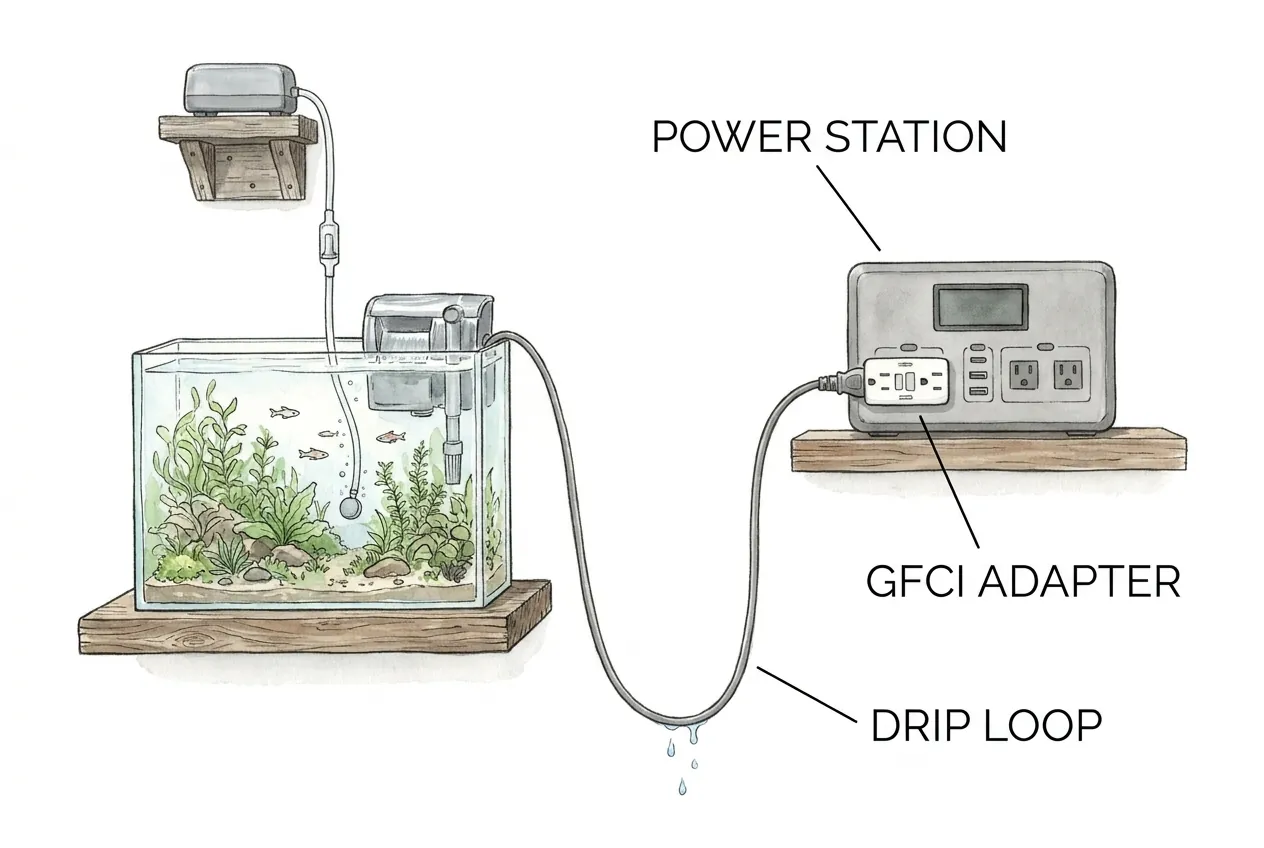
Water and mains power meet at aquarium cords, and an outage adds temporary cords. The University of Washington safety office notes that outlets in wet areas need GFCI protection under the National Electrical Code.
A plug-in GFCI adapter adds that protection where the wall outlet lacks it.
Use one of those adapters on the power station’s AC outlet as well. Aqueon recommends a drip loop on every cord. The cord dips below the outlet, so water running down it drips off before reaching the plug.
Portable GFCIs come in manual-reset and automatic-reset versions. Legrand’s manual-reset model needs its reset button pressed after any loss of power, while its automatic-reset model re-energizes by itself.
Choose automatic reset, or the station can stay on battery after the grid returns and the filter can stay off after the switch.
Run a two-hour cooling drill
My drill copies an outage without stopping the filter. I run it on a cold evening with the room near its usual winter low, and note the starting gap between water and room.
If the gap is smaller than a winter night brings, the drill understates the drop, so that result counts as a minimum.
I unplug only the heater, then pull the station’s plug at the wall outlet itself so any GFCI adapter loses power too.
That switches the filter to battery while the air pump keeps running. With the lid closed, the probe logs every 5 minutes, and a second thermometer beside the tank gives the room reading.
The result is how far the probe’s water reading falls in the two hours after the heater is unplugged.
A loss of 2 F or more makes insulation mandatory before I plan any heater runtime.
The low alarm goes at 4 F below the start, and if it sounds, the heater and wall power go back on at once.
Both cutoffs are my own conservative rules, kept far above the low-60s range NC State describes. Any sick, new, or breeding fish means no drill that season.
The same two hours test the switchover, the GFCI adapters, and the battery. If the filter stalls at the switch, its adapter’s power light gets checked first, since a tripped adapter looks like a failed filter.
A filter that still stalls fails the manual’s compatibility test, goes back on wall power, and in a real outage moves onto the station by hand.
When the plug goes back in, any adapter that needs a reset press is a manual-reset model, so I swap it for an automatic-reset one.
For the battery, I note the station’s charge percent when wall power goes and again when the drill ends.
Dividing that drop by the hours on battery gives the percent used per hour. Runtime from full is 100 divided by that figure.
Multiplying that runtime by the filter’s label watts gives a ceiling on usable watt-hours, since labels can overstate real draw, and it replaces the 70 percent allowance.
For heater hours, set aside the filter’s watts times your expected outage hours, then divide what remains by the heater’s watts.
On the 179 Wh planning figure, for example, a 10 W filter for 8 hours leaves 99 Wh, at most about 1 hour of a nonstop 100 W heater.
Decide the first hour of a real outage
When the power actually fails, the air pump and a pre-wired filter are already on battery.
Read the probe twice, 30 minutes apart, and pick the single row that matches the second reading.
Falling means at least 1 F below the first reading. A tank whose drill lost 2 F or more counts as falling from the start, whatever the first pair shows.
| Probe reading | Action |
|---|---|
| Above 68 F and not falling | Air pump running, filter running on the station, lid propped open for gas exchange, no wrap, no feeding |
| Above 68 F and falling | Lid closed, foil and blanket on, air pump running, filter running on the station |
| 68 F or below | Everything in the row above, plus the heater plugged into the station, with heater and filter together under its continuous rating |
Keep reading every 30 minutes against that first reading until power returns, and move down a row as soon as one matches.
Once wall power is back, the heater returns to its own outlet so only the filter stays on EPS.
If the station was not pre-wired or the filter failed the switch test, plug the filter in by hand within the first hour, well before the two-hour restart line below.
The 68 F trigger, the 1 F margin, and a 20 percent reserve are my own rules.
The margin ignores a drift of a few tenths, and the trigger spends heat while the fish are still well above the low-60s band.
At 20 percent charge I unplug the heater and keep the filter running, which holds the last fifth for filtration.
Who should not buy each class
The fastest way to overspend is to buy a role your climate never tests.
Skip the power station when
Outages in your area are usually short and the tank room stays near tank temperature. The battery air pump alone covers oxygen for many hours.
Skip the insulation when
The house never gets cold. In a summer outage the job is gas exchange, so a propped-open lid matters more than foil.
Skip the battery air pump when
Very few stocked tanks qualify. The exception is a large or deep system that already has a dedicated backup air supply sized for it.
Skip the logging thermometer when
A logging probe already lives in the tank. A stick-on strip does not count, because it cannot alarm or show the slope.
Maintenance, failure modes, and replacement
Outage gear fails quietly while it waits.
Batteries
Put every battery device on one calendar. Start with the station, which needs its quarterly storage cycle if stored unplugged and a full charge before storm season.
Charge the air pump the same day, and fit fresh AAA cells in the thermometer before each cold season.
Airstones, check valves, and a UPS
Airstones clog with biofilm and mineral scale, which raises back-pressure, and a small battery pump loses flow first.
Replace a stone when its bubble column visibly shrinks at the same setting. Keep both check valves in place so water cannot siphon back into the pump.
A small computer UPS deserves the same suspicion. Its sealed lead-acid battery ages even when unused, so treat a failed self-test as a replacement signal.
Restarting a filter after a long outage
A canister sits still when it had no station or the station’s battery ran out, and its bacteria strip the trapped water of oxygen.
I decide by elapsed no-flow time, and under two hours I restart it normally.
At two hours or more, I unplug it and empty the standing water from the canister body.
Then I rinse the media gently in tank water and restart. The two-hour line is my own cautious cutoff, because trapped water cannot regain oxygen while flow is stopped.
For two days afterward I test ammonia daily, and a reading above the NC State action line of 1 ppm triggers the water change it recommends.
A cooling tank can push ammonia up on its own, as the cold tank ammonia spike guide explains.
Gentle rinsing technique is covered in the filter media chooser.
Can I just run the heater from the power station all night?
Only on a small, well-wrapped tank, and only for the heater hours the drill’s arithmetic leaves.
Those come from the usable watt-hours ceiling minus the filter’s share, and the heater still comes off at 20 percent charge.
Putting the kit together
A power station earns its price only where outages run long, after the air pump, probe, and wrap are in place.
Left on the wall in EPS mode behind automatic-reset GFCIs, it takes over the filter by itself.
Run the cooling drill on battery once before winter, then write the resulting usable watt-hours ceiling on the station. The next blackout then becomes a checklist instead of a guess.
Affiliate Disclosure
This article contains Amazon affiliate links. As an Amazon Associate I earn from qualifying purchases. If you use these links, the site may earn a commission at no extra cost to you. Product availability, price, and specifications can change. Check the current listing before buying.