
Aquarium Heater Stuck On? Stop Thermal Runaway
An aquarium heater stuck on can cook a tank in hours. Learn to catch thermal runaway early and add a controller cutout that stops it in winter.
Elena Vargas · Published 2026-10-09 · 13 min read
Key Takeaways
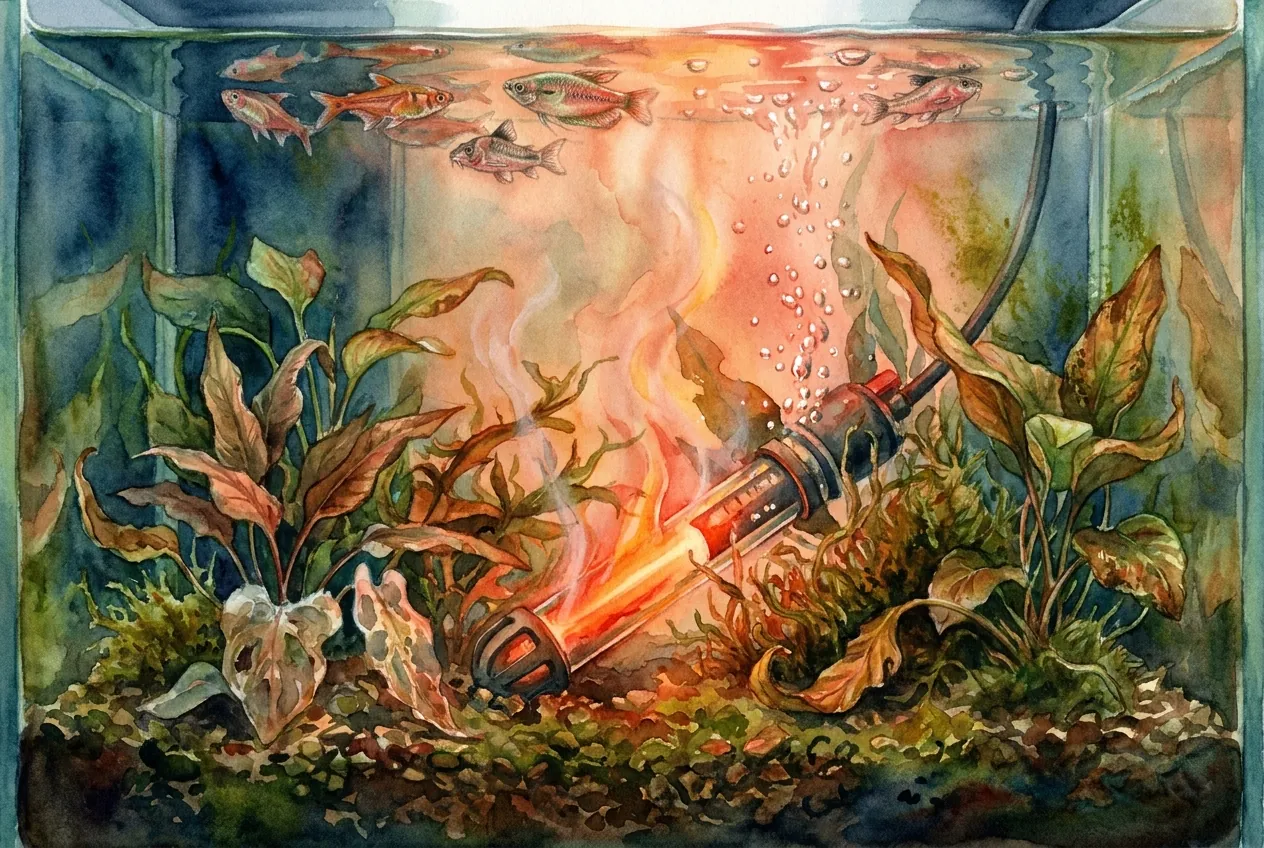
- A reactivated heater can weld its thermostat closed and heat with no off switch.
- A nano tank can pass 90 °F within a few hours, so detection speed matters most there.
- Heat kills twice, nearing the thermal limit while oxygen falls and demand rises.
- Run the heater through an external controller and offset the setpoints as a backup.
- Test a reactivated heater over 48 hours before leaving the tank unattended on it.
The heater that kept your tank steady all last winter is not a permanent safety device. It is a mechanical contact that wears out. The most dangerous moment in its life is the one you just created by cranking it back up for the heating season.
When a summer-idle heater is reactivated and its thermostat fails stuck closed, the element heats until something stops it.
On a small tank, that can mean lethal water within a few hours.
The failure is not random, and it is not unpreventable. It is a predictable wear-out with clear early signals and a simple redundancy fix.
Why a Reactivated Heater Fails Stuck On
A stuck-on heater has welded its thermostat closed, so the element now heats whenever it has power, ignoring the dial completely. Almost every aquarium heater regulates the same way. A bimetallic strip or a simple electronic thermostat opens a contact when the water reaches the set temperature, cutting power to the element.
The problem is what that contact does over years of use. Each time it opens and closes, it arcs slightly. Over thousands of cycles the metal pits, and eventually the two faces can weld together.
This is a cumulative wear-out failure, which means it is predictable and preventable rather than a freak accident.
Reactivation after an idle summer is a high-risk moment. A heater that sat unpowered for months is an aged mechanism being asked to cycle again, often with mineral scale on the element and dried-out seals.
Scale, heat, and age all accelerate contact welding, and cheap crude bimetal thermostats fail this way soonest.
Where the Cutout Lives Matters
Glass and plastic heaters carry the thermostat inside a sealed tube you cannot service, so the welding risk and the heating element share one point of failure.
Titanium heaters often ship without an internal thermostat and are designed to run on an external controller, which moves the cutout into a separate, replaceable device.
Buying titanium does not eliminate the failure. What eliminates the danger is separating the cutout from the element, so a stuck element is caught by a device that is still working.
How Fast a Stuck Heater Can Cook the Tank
Time-to-danger is set mostly by water volume, because water is a large heat sink. A litre of water needs about 4,186 joules of energy to rise by 1 °C, so a bigger tank is slower to overheat and a nano tank is fastest.
That buffering is the whole story. A 30 L nano tank on a warm windowsill can overheat within a few hours, while a 300 L tank in the same room may take a full day.
On a tank of roughly 19 litres, a stuck heater can push the water past 90 °F within a few hours, and higher if left overnight.
A nano tank gives you a window measured in hours, so detection speed matters most where the water volume is smallest.
Standard sizing shows how much power keeps pushing once a heater sticks on. Small tanks are often run near 5 watts per gallon and large tanks near 3 watts per gallon.
That means a nano tank has both less thermal mass and a higher power density working against it.
Rough time-to-danger by tank size in the same warm room
| Tank volume | Thermal buffer | Approximate time to overheat |
|---|---|---|
| 30 L nano | Very low | A few hours |
| 300 L display | High | Up to about a day |
Why Overheating Kills Two Ways at Once
Heat does not have to reach a fish’s lethal limit to do harm, because it attacks on two fronts at the same time.
It drives the water toward each species’ upper thermal limit, and it simultaneously lowers how much oxygen the water can hold while the fish’s oxygen demand rises.
The Thermal Safety Margin Is Narrow
Common tropical fish are comfortable roughly between 75 and 86 °F. For many ornamental species the critical thermal maximum, the point where they lose equilibrium, sits only a handful of degrees above that comfortable band.
These fish evolved in warm, stable water and already live near their ceiling, so chronic stress begins well below the lethal number. Treat a sustained climb past about 86 °F as a real problem, not a curiosity, long before the water approaches any lethal figure.
Warm Water Starves Fish of Oxygen
As water warms, it physically holds less dissolved oxygen, exactly when hot fish need more of it.
Water at 20 °C (about 68 °F) holds about 9.1 mg/L of oxygen at saturation.
That ceiling falls to about 7.0 mg/L at 35 °C (about 95 °F) and near 6.6 mg/L at 38 °C (about 100 °F).
Metabolic rate roughly doubles for every 10 °C rise, so a fish at 32 °C may use 40 to 75% more oxygen than at 24 °C. Supply falls while demand climbs. Below 5 mg/L stresses most fish, and below 2 mg/L is hypoxic enough to cause die-offs.
Surface gasping in a hot tank is an oxygen emergency, not only a heat reading, so cooling and aeration have to happen together.
Dissolved oxygen at saturation falls as water warms
| Water temperature | Oxygen at saturation |
|---|---|
| 20 °C (about 68 °F) | 9.1 mg/L |
| 35 °C (about 95 °F) | 7.0 mg/L |
| 38 °C (about 100 °F) | 6.6 mg/L |
Catching a Stuck Heater Before the Fish Do
A stuck heater gives three signals, and only the first two arrive in time to matter.
The indicator light stops cycling and stays lit, an independent thermometer reads above target, and finally the fish show distress.
The Daily Far-Corner Thermometer Check
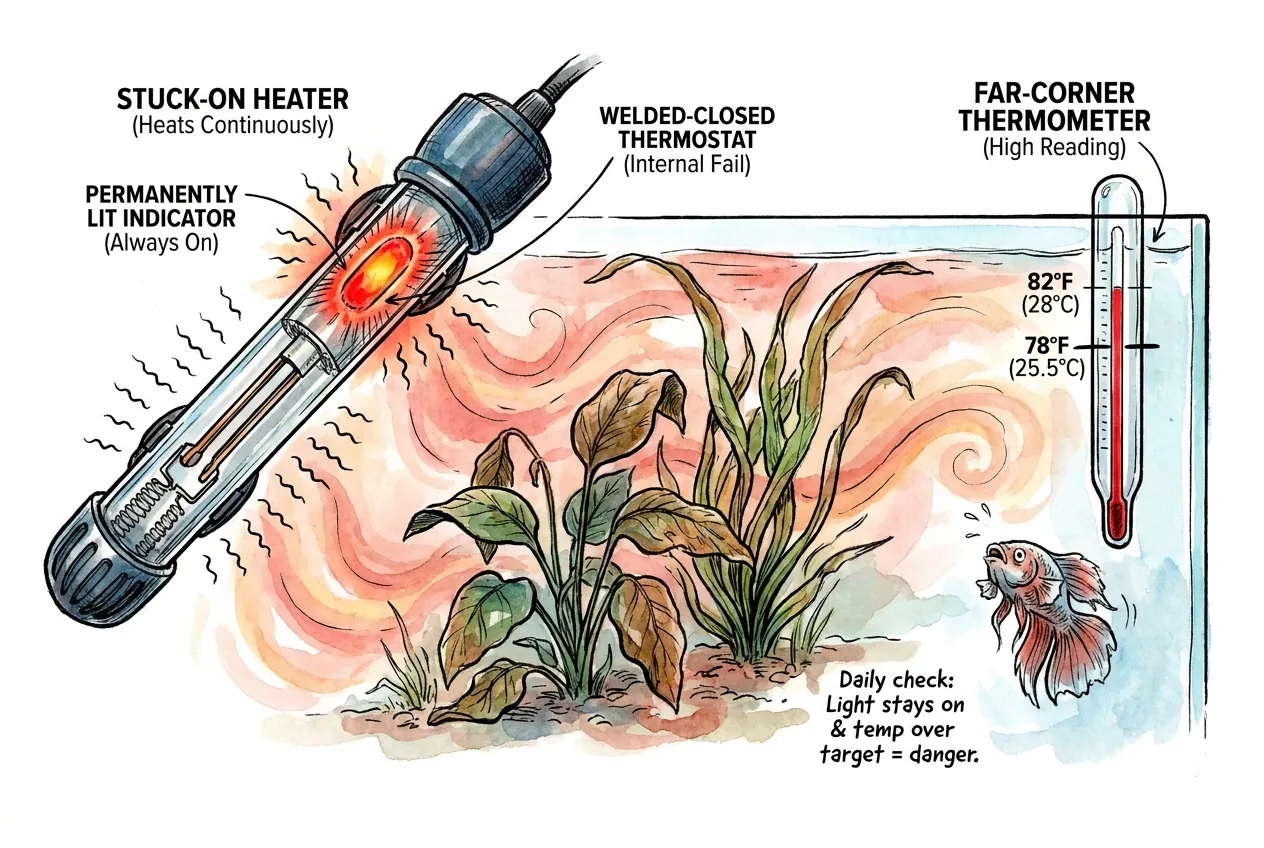
The indicator light is your first-glance screen. A healthy heater’s light glows only during a heating cycle and goes dark once the water reaches the set point.
A light that stays permanently lit means the element is not resting, the classic external sign of a welded-closed thermostat.
The reliable measurement is an independent thermometer, because the heater’s own dial reflects what its thermostat thinks, and that is exactly the part that fails.
I keep a separate thermometer at the end of the tank farthest from the heater. There bulk water temperature shows a whole-tank drift rather than the local warmth next to the element.
Once a day I read that thermometer against the target first, then glance at the heater light.
A sustained reading 2 °F or more over target is my trigger to unplug and verify immediately.
The same goes for a light that never goes dark when the water should be at temperature.
That 2 °F margin is my own working rule, not a published standard. I use it because it catches a real climb above the comfortable band before fish stress, and it matches the small offset reputable controllers use.
Fish behavior does not belong in this routine at all. By the time fish hang near the surface gasping at the film, the tank is already in danger territory.
I treat gasping only as an emergency trigger, never as a monitor.
Building a Stack That Cuts Power in Time
The reliable fix is to put the cutout in a device that does not depend on the heating element.
An external temperature controller senses water temperature with its own probe and switches the heater’s power outlet, so a welded element no longer means a cooked tank.
How the Setpoint Offset Turns the Heater Into a Backup
The controller becomes the primary switch when you offset the three temperatures. Set the controller a couple of degrees above your target, then set the heater’s own dial a couple of degrees above the controller.
A common pattern is a target near 76 °F, a controller at 78 °F, and the heater dial at 80 °F.
With the heater dial above the controller setpoint, the heater never reaches its own cutout in normal use, so the controller does all the cycling.
If the controller relay sticks or its probe fails, the heater’s thermostat still provides an upper limit. Run the heater through an external controller and offset the setpoints so the controller does the switching and the heater thermostat only acts as a backup.
A worked setpoint offset
| Role | Setpoint | Job |
|---|---|---|
| Target | 76 °F | The temperature you actually want |
| External controller | 78 °F | Primary cutout, does the normal cycling |
| Heater dial | 80 °F | Backup limit if the controller fails |
Layer Only What the Tank Needs
For most tanks, a controller plus an independent thermometer is enough. A backup heater set low, for example near 74 °F, covers the opposite failure where a heater dies off.
A WiFi controller can send a phone alert that turns a silent failure into a warning.
Add those extra layers for sensitive or high-value livestock rather than building a tower of parts that each add a failure point.
When you reach the question of which controller or heater to actually buy, that is a purchasing decision rather than a diagnostic one.
Hand it off to the aquarium heater buying guide and keep any mains heater or controller on a GFCI-protected outlet.
Testing a Heater When You Set It for the Season
Because contact welding is an age-and-cycle failure, a heater that worked last season can fail on its first cycles this season.
Reactivation is the right moment to prove it still cuts out, before the tank is left unattended on it.
I treat the first days back as a monitored burn-in. I set the heater and, if I am using a controller, its setpoint, then place an independent thermometer at the opposite end of the tank.
I watch the first full heating cycle to confirm the light actually goes dark, then I keep watching across a 48-hour window that includes at least one cold night.
A single cutout could be luck. Repeated cutouts across two days that include the coldest part of the daily swing show the thermostat is really regulating.
The test passes only if the independent thermometer holds within about 2 °F of target and the light cycles off during the window.
If the thermometer runs 2 °F or more over target, or the light never goes dark across a full cycle, I treat the thermostat as suspect. I do not leave the tank unattended on that heater.
When a controller is in the stack, the same window verifies the offset. If the light cycles with the controller relay rather than with the heater’s own dial, the offset is correct.
Throughout the test I keep my hands out of the water while power is applied and keep the outlet on a GFCI.
This is a function check of an installed consumer heater, not an electrical repair.
What to Do the Moment You Catch an Overheat
When you find the tank overheating, work in a fixed order. Stop the heat input first, defend oxygen second, and cool slowly third.
Cooling Safely Without Thermal Shock
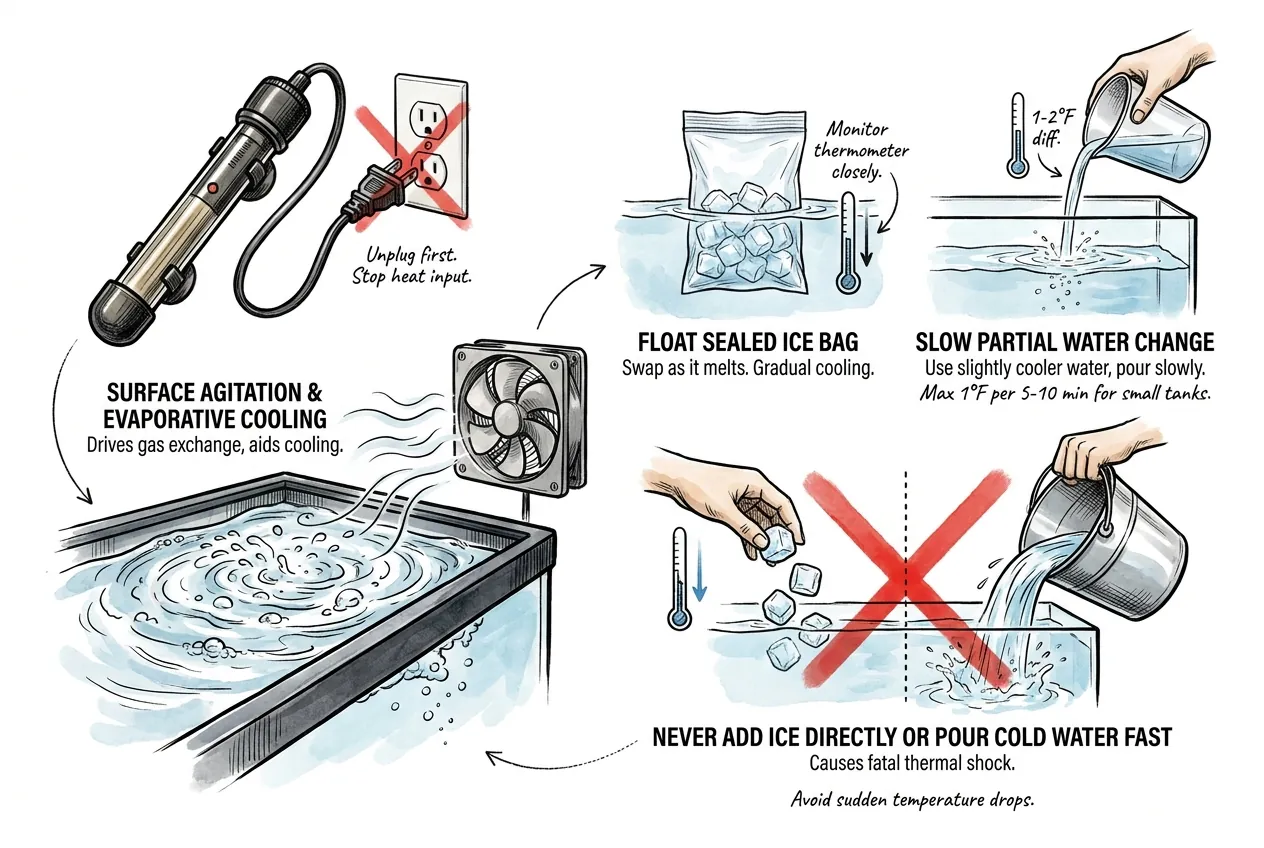
Unplug the heater first, because until the power is off every cooling action is fighting a continuing input.
Do not reach into the water with the heater still powered. Next, maximize surface agitation and aim a fan across the water surface, which both drives gas exchange and cools by evaporation.
Then cool gradually. Float a sealed bag of ice and swap it as it melts, or do a partial water change with water only a few degrees below the tank, going slowly. Never add ice directly or pour cold water in fast, because thermal shock kills as effectively as the heat you are fighting.
On a nano tank, keep the rate to about 1 °F every five to ten minutes and watch the thermometer as you go.
A large tank will mostly coast down on its own once the heater is unplugged, so aggressive cooling there is both unnecessary and risky.
Electrical Safety Around Every Heater Action
Every step above happens around mains power next to water, so the safety frame matters as much as the temperature control. Two physical protections cover most of the risk.
A GFCI outlet cuts power in milliseconds on a ground fault. A drip loop, a U-shaped dip in the cable with its lowest point below the socket, lets water drip off the cable instead of tracking into the plug.
Two handling rules prevent most of the rest. Unplug the heater before a water change and never let it run dry. A heater built to run submerged overheats in air, which can break its seals and create a shock risk.
For the same reason, let a hot heater cool before it meets air or a cold-water change, since a steep temperature gradient across the glass can crack the tube.
Unplug every appliance before your hands go into the water and treat a GFCI as a backup, not as permission to work live.
Key Takeaways
- A reactivated heater can weld its thermostat closed and heat with no off switch.
- A nano tank can pass 90 °F within a few hours, so detection speed matters most there.
- Heat kills twice, nearing the thermal limit while oxygen falls and demand rises.
- Run the heater through an external controller and offset the setpoints as a backup.
- Test a reactivated heater over 48 hours before leaving the tank unattended on it.