
Aquarium Heater Size for the Autumn Temperature Drop
A flat watts-per-gallon rule hides the room-temperature gap. Size from volume and the measured overnight low, then audit two comparable cold nights.
Samuel Reed · Published 2026-08-30 · 15 min read
Key Takeaways
- Size from both tank volume and the water-to-room temperature gap, not gallons alone.
- Measure your coldest overnight room low with a min/max thermometer.
- Use gallons times the gap times one-half only as a stress check, then choose from the heater manufacturer’s chart.
- Above about 200 watts, split into two heaters to limit one-heater failures, and add a controller or alarm when failure detection matters.
- Audit two comparable cold nights with an independent thermometer before changing wattage.
Every autumn the same message shows up in aquarium forums. The tank held a rock-steady 78 all summer, and now it sags a degree or two before dawn.
The heater did not break, the room changed, and the popular watts-per-gallon rule never accounted for that.
The heater workload depends on tank size, exposed surface, lid, and the gap between the water target and the coldest room temperature.
A flat summer chart hides that last input, which is why the same tank can drift cool after the room changes.
Why watts-per-liter rules quietly fail once the room cools
The flat rule is not really watts per gallon. It is watts per gallon at one assumed temperature lift, and that assumption breaks when autumn arrives.
The most-quoted version ties 5 watts per gallon to heating the water about 10 degrees Fahrenheit above the room, with a lid on the tank. Yet the same published guidance recommends 100 watts for a 29 gallon example, which is only about 3.4 watts per gallon rather than 5.
I treat that mismatch as a warning that a prose rule and a product chart are not interchangeable. When the room low drops and the lift grows to 15 or 18 degrees, neither flat number can be carried over unchanged.
That is why an identical tank needs more power in a cold room than a warm one.
A home sitting at 65 degrees that needs a 15 degree lift is already the point where guidance says to add a second heater. The flat single number was never meant to cover that case.
The rule also ignores shape, lid, and evaporation. A tall tank and a wide tank of the same volume expose different surface areas, and surface area drives loss.
An open-top tank loses extra energy to evaporation, which is exactly why the standard figure assumes a lid is present.
Treat any watts-per-gallon number as a chart-specific starting point, record the temperature lift it assumes, and verify the selected heater at your own coldest room low.
What a heater actually fights: heat loss and the water-to-room gap
A heater has exactly one job. It replaces heat that leaks through the tank surfaces and evaporating water. For the same tank and setup, that loss rises as the water-to-room temperature gap grows.
This is Newton’s law of cooling in plain terms. The rate of heat loss is proportional to the difference between the water and its surroundings, so the larger the difference, the faster the heat escapes.
At steady state, the watts going in equal the watts leaking out.
Why the temperature gap changes the workload
Gallons establish the scale of the tank, while the temperature gap decides how much harder that same tank is to hold.
With the other conditions unchanged, doubling the gap roughly doubles the continuous power needed.
Picture a tank held at 78 degrees. In a 68 degree room it fights a 10 degree gap. But in a 60 degree overnight room it fights an 18 degree gap and needs on the order of 80 percent more continuous power for the very same water.
Nothing about the tank changed, only the room did.
Required watts track the water-to-room gap, so you must know your coldest room low before any sizing math means anything.
How surface area, lids, and volume change the picture
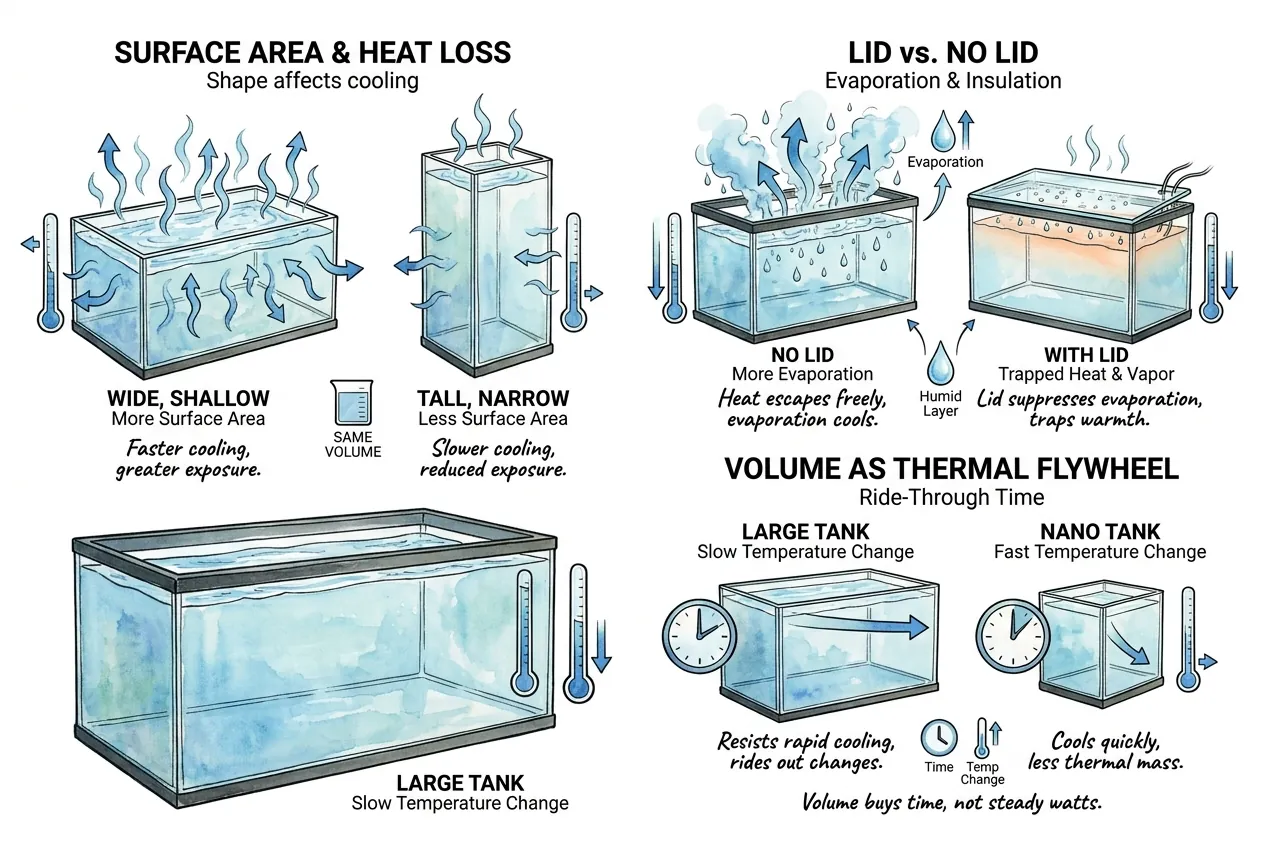
Two tanks of the same volume can lose heat at very different rates because heat escapes across surfaces, not through water in bulk.
A wide, shallow tank exposes more glass and more open water than a tall column of the same gallons, so it loses more at the same gap.
A lid is the cheapest fix for that loss. It suppresses evaporation, which carries away a large amount of heat, and it traps a warm humid layer above the water.
That is why the standard wattage figure assumes a lid, and why adding one often steadies the overnight low without any new hardware.
Volume still matters. It usually comes with more heat-losing surface and it sets the thermal mass, so a larger tank needs more total power but cools and warms more slowly.
Gallons alone cannot predict steady heat loss because two tanks with the same volume can have different surface area, lids, and evaporation.
Measuring your real temperature gap: the overnight room low
Here is the input almost everyone gets wrong. People size to the comfortable daytime room temperature, but the heater’s hardest moment is the coldest hour of the night.
In autumn the furnace may not be running yet, and many homes drop several degrees on a night setback.
The true room minimum often arrives before dawn rather than at 8 pm when you last glanced at a thermometer.
Size to the recorded minimum instead of assuming a clock time.
A single glance cannot catch a low you slept through. A min/max thermometer can, because it latches and stores the coldest reading since you last reset it. That stored extreme is exactly the number heater sizing needs.
To capture my own worst-case room low, I set a min/max air thermometer at tank height right beside the tank.
I keep it away from any heat vent, window, or direct sun so it reads the air the tank actually sits in.
Each morning I record the overnight low, then reset it. I do this for at least three consecutive nights chosen to include the coldest one in the forecast.
I use the single lowest reading of that window as my sizing input, not the average.
The heater has to hold on the worst night rather than the typical one.
If the last night still sets a new record low, I keep going until two nights in a row fail to set a new minimum.
That gives me a settled measurement window, not a promise that winter cannot get colder. I repeat the check whenever the forecast drops below the recorded room low.
Use the single lowest overnight reading at tank height as your room-low input, because the heater must survive the coldest night, not the average one.
Turning your temperature gap into a wattage band
Once you know your tank volume and your worst-case gap, you can turn a rule of thumb into a real estimate.
The honest output is a band with a little headroom, not a single false-precise number.
The half-watt reality-check formula
Pentair’s quick guide starts with 4 watts per gallon for each 9 degree Fahrenheit lift, or about 0.44 watt per gallon per degree, for a large uninsulated tank. The same guide warns that a small glass tank can need 8 watts per gallon for that lift and that strong surface agitation can raise demand further.
I round the lower relationship to 0.5 only as a stress check that exposes how quickly the room gap increases the load. I never use it by itself to choose a home-aquarium heater.
Work a real case. A 40 gallon tank targeting 78 degrees with a measured room low of 60 has an 18 degree gap.
The stress check is 40 times 18 times 0.5, or 360 watts. I carry that number to the exact heater model’s chart, but I do not install 360 or 400 watts merely because the arithmetic produced it. If the chart recommends a very different total, I compare its assumed room gap, lid, tank construction, and flow with my setup or ask the manufacturer before buying.
At a 10 degree gap, the formula lands at 5 watts per gallon, the top of the familiar 3 to 5 watts-per-gallon band. At smaller gaps it can fall inside that band. In a colder room it rises above it.
The gap method and the flat band are cross-checks, not the same rule.
I compute the gap-based stress number first, then the plain 3 to 5 watts per gallon band.
I look at the two numbers side by side only to see whether the cold room pushes the setup outside the flat rule’s assumptions.
When the gap number comes out higher, I carry the measured gap to the manufacturer’s size chart and select the next listed configuration that explicitly covers both my volume and lift. When it comes out below the flat band, I still use the manufacturer’s minimum rather than treating the stress check as permission to undersize.
If the chart does not state a room-to-water gap, I ask the manufacturer or use the cold-night audit on the current heater instead of guessing from watts alone.
Rounding up within a manufacturer’s chart is my conservative choice to keep a little recovery headroom.
It is not permission to jump to the stress-check wattage when that chart does not support it.
Use gallons times your measured gap times one-half to flag a demanding setup, but choose the actual heater from a chart that covers both volume and temperature lift.
A quick stress-check table for common tanks
The table below shows what the lower 0.5 relationship produces at three temperature gaps. These are comparison numbers, not purchase recommendations. Read your gap off the min/max thermometer, find the volume, then check whether the heater manufacturer’s own chart explicitly supports the resulting configuration.
| Tank volume | Small gap (8F) | Moderate gap (14F) | Large gap (20F) |
|---|---|---|---|
| 10 gallons | ~40 W | ~70 W | ~100 W |
| 20 gallons | ~80 W | ~140 W | ~200 W |
| 40 gallons | ~160 W | ~280 W | ~400 W |
| 55 gallons | ~220 W | ~385 W | ~550 W |
| 75 gallons | ~300 W | ~525 W | ~750 W |
These come straight from gallons times gap times 0.5, so they show how strongly the gap changes the screening result. They are neither a target nor a guaranteed floor.
The table also does not decide whether to use one heater or split a manufacturer-supported total across two units. That choice belongs to the failure and placement check below.
Oversizing versus undersizing: two different failures
Both extremes carry real risk, so bigger is not automatically safer. Undersizing shows up as a slow cold sag, and oversizing shows up as a fast, dangerous overshoot if a thermostat sticks on.
What an undersized heater looks like
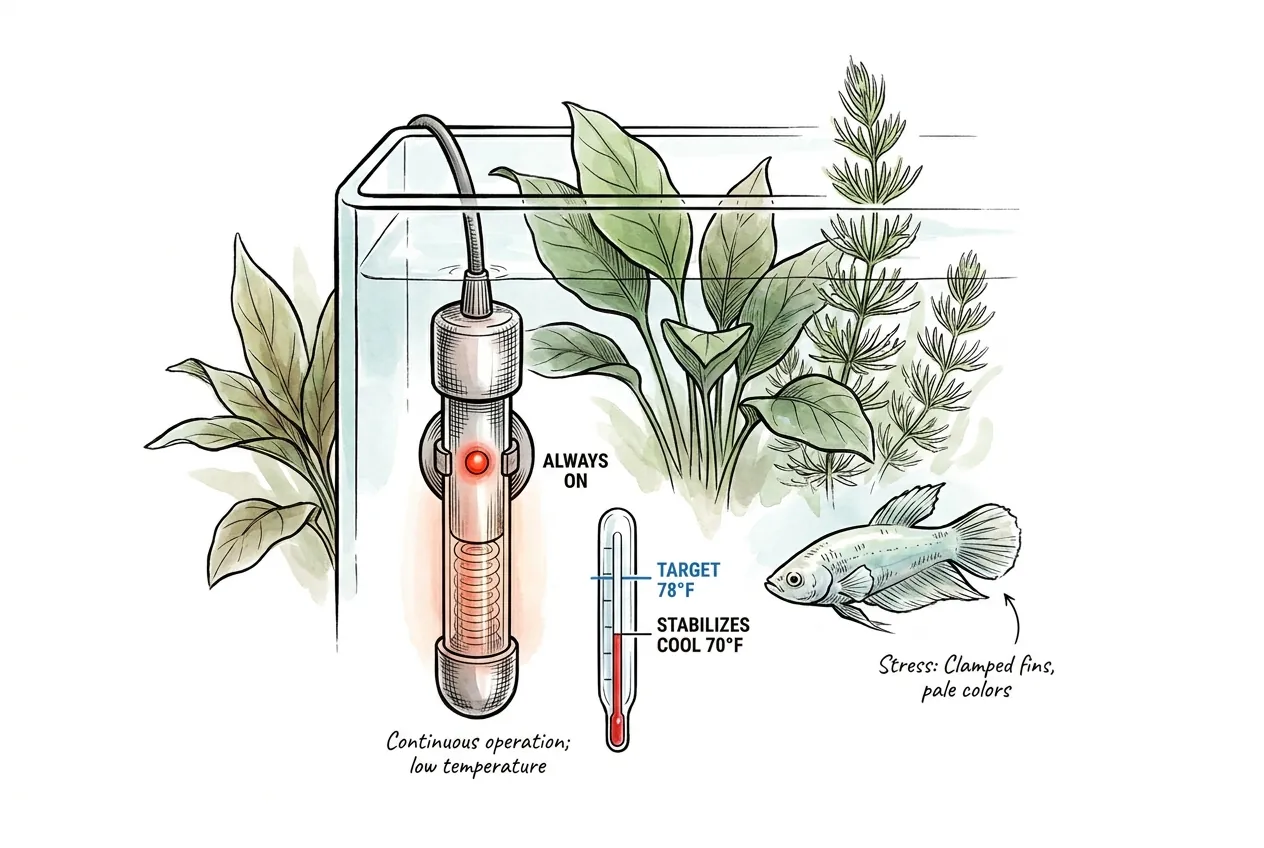
An undersized heater runs continuously and still loses ground on a cold night. Its thermostat never gets to switch off, so the duty cycle approaches 100 percent, yet the water settles below target.
The reason is simple balance. Water warms only until the heat leaking out equals the heater’s maximum output. If that balance point sits below your target, the tank just stabilizes cool with the heater always on, and the fish endure a slow chill that stresses their immune systems.
What an oversized heater risks
If a heater thermostat fails on, oversizing bites. The heater keeps delivering its full rated power with no cutoff, and a larger unit raises temperature faster before anyone notices.
Small tanks are the least forgiving here. The same stuck-on wattage changes a small volume much faster than a large one, so a nano gives you less time to catch the rise.
This is the core reason not to simply buy the biggest heater on the shelf.
Keep headroom modest and split large requirements across two heaters, because a single oversized heater is the higher-damage failure when its thermostat sticks on.
Auditing your current heater before winter
A product chart chooses a new heater, but the behavior of an installed heater on a cold night tells you whether the current setup has spare capacity.
The check is free and catches room, lid, flow, and placement differences that a generic chart cannot see.
Most heaters have an indicator light that is on while heating and off once the water reaches the setpoint. That light is a live duty-cycle gauge. A light that pulses off and on means the heater has spare capacity, while a light that never turns off means it is maxed out for the current load.
The signal that matters is the combination of that light and a real thermometer. Trust the light alone and you can be fooled, because a built-in dial can read a couple of degrees off the actual water.
To audit my own heater before the cold sets in, I choose a night whose forecast low is within 2 degrees Fahrenheit of the lowest hourly forecast in the next seven days. I put an independent thermometer in good flow and note its stated accuracy.
During the forecast’s coldest three-hour window, I record water temperature and the heater indicator every 15 minutes.
My temperature allowance is whichever is larger, either 1 degree Fahrenheit or twice the thermometer’s stated accuracy.
I mark a failure when the indicator stays on and the water remains below target by more than that allowance for at least 30 minutes.
I call the heater undersized only when the same failure repeats on a second qualifying cold night.
If the heater cycles off at least once while the water stays inside the allowance, I leave the wattage alone.
If it cycles but the water remains low, I check calibration, placement, and circulation before blaming capacity.
A heater that holds target but never switches off is marginal, so I repeat the audit rather than upsizing from one night.
A heater is undersized when it stays on while water remains beyond the measured tolerance for 30 minutes, and that failure repeats on a second comparable cold night.
Two heaters, redundancy, and placement
Splitting a manufacturer-supported wattage across two smaller heaters can limit the effect of one malfunction.
It reduces risk, but it does not detect a failure or guarantee a safe temperature.
Why two heaters beat one
A single heater has two ways to fail, stuck on or dead off, and two smaller heaters can soften both when the selected models are approved for the planned total and installation.
Smaller multiple heaters can reduce the damage from one malfunction, but the exact split must still follow each model’s sizing and placement instructions.
If one of a pair sticks on, its lower wattage usually raises temperature more slowly than one full-power heater would.
The tank can still overheat, so an independent high-temperature alarm or external controller is still needed when nobody is watching.
If one dies, the survivor supplies only part of the planned output and may slow the cooling.
How low the tank settles, and how long livestock remain safe, depends on the room low, lid, insulation, surviving wattage, and species.
Treat the second heater as response time, not an overnight guarantee.
Where to put the heaters
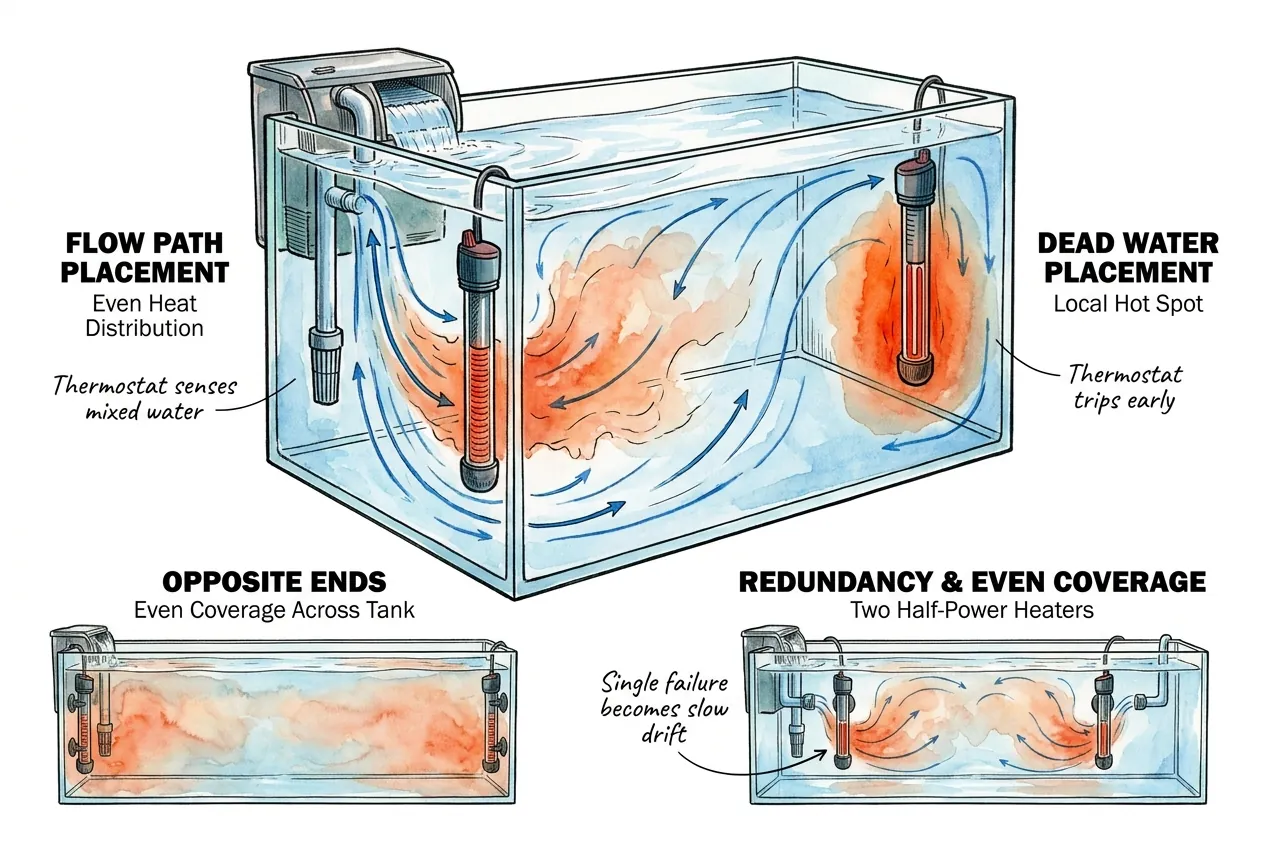
Heat only helps where water carries it, so placement decides whether your rated watts actually count.
A heater tucked into dead water heats a local pocket, trips its own thermostat early, and leaves the far end cold.
Put each heater in the flow path, near the filter intake or return, so warmed water spreads and the thermostat senses mixed water rather than a stagnant hot spot.
With two heaters, place them toward opposite ends for even coverage across the tank.
Above about 200 manufacturer-supported watts, split the load in the flow path to reduce one-heater damage, then use a controller or alarm to make the failure detectable.
Thermostats, controllers, and getting the number honest
The number on your heater dial is not the temperature of your water. Bench testing found built-in thermostats reading anywhere from about 0.2 degrees to nearly 3 degrees off their setpoint, and concluded no heater should be trusted out of the box.
A 3 degree error is enough to push a tropical tank out of a species’ comfortable range, so the dial reading needs a check.
The fix is an independent reference thermometer placed in good flow, which tells you what the water is really doing.
An external controller tightens things further and adds a safety cutoff. It runs its own probe, switches the heater’s power, and in the same testing held temperature to about 1 degree swings, while also cutting power if the heater sticks on.
Many controllers can be calibrated against a trusted reference so the number you set finally matches the water.
Verify every heater against an independent reference thermometer, and add an external controller when you want tighter control plus a stuck-on cutoff.
Key Takeaways
- Size from both tank volume and the water-to-room temperature gap, not gallons alone.
- Measure your coldest overnight room low with a min/max thermometer, and use the single lowest reading.
- Use gallons times the gap times one-half only as a stress check, then choose from a chart that covers both volume and lift.
- Above about 200 watts, split into two heaters to limit one-heater failures, without assuming the survivor can hold overnight.
- Audit two comparable cold nights with an independent thermometer before changing wattage.