
Iwagumi Rock Selection: Seiryu, Ohko, and the KH Catch
Odd-number stone rules are easy. The real trap is that Seiryu is carbonate limestone that raises KH, GH, and pH. Here is how to choose and test rock.
Priya Patel · Published 2026-08-18 · 15 min read
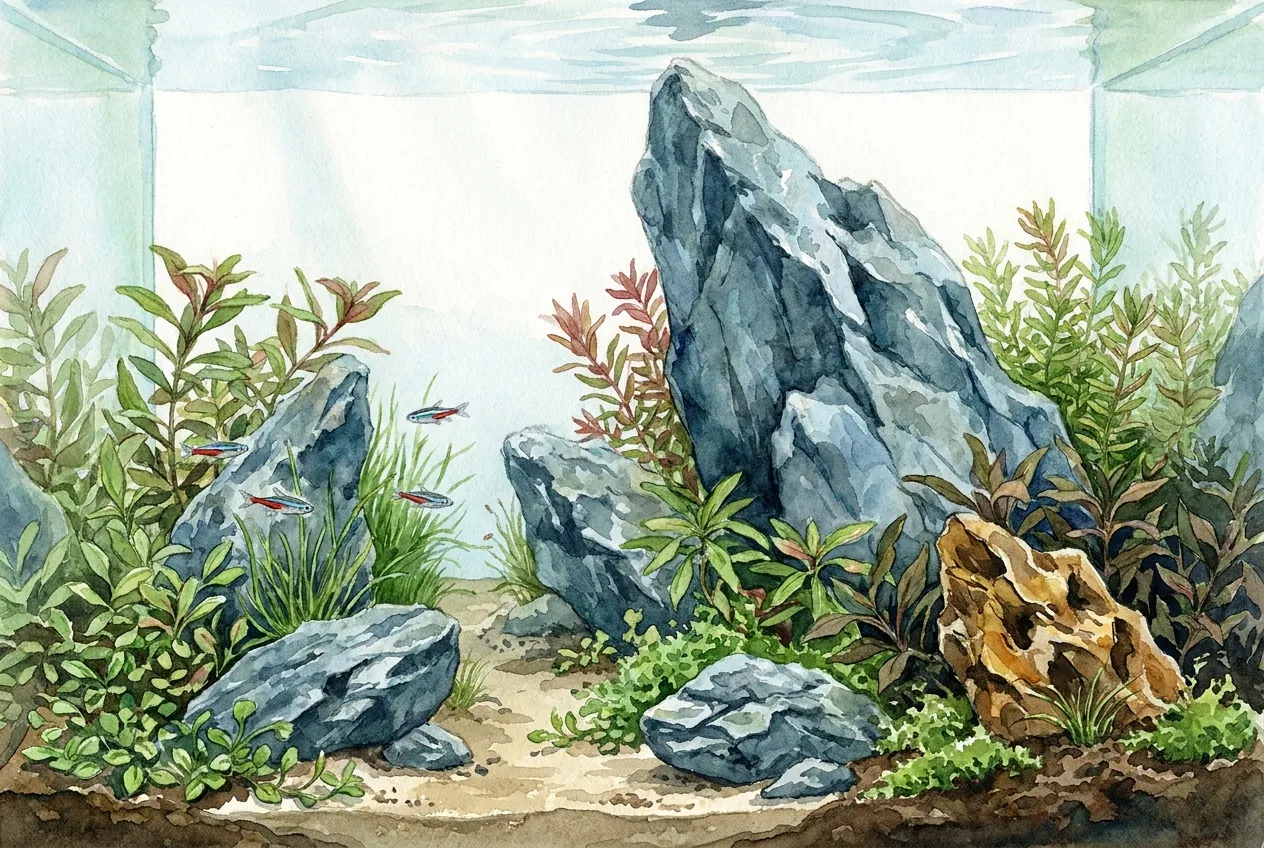
Key Takeaways
- Use only 3, 5, or 7 stones, with one Oyaishi at about two-thirds tank height off-center.
- Seiryu is carbonate limestone that raises KH, GH, and pH. Dragon stone stays inert.
- Rising KH fights CO2 and pH control, and is a hard no for Caridina shrimp.
- Fizz-test any unknown stone, then bucket-test in RO water for seven days.
- Decide in order: water target first, then stone type, then count and placement.
Most iwagumi guides teach you to count stones and place the big one off-center, then go quiet exactly where it matters.
The stone that gives you those dramatic blue-grey peaks is often carbonate limestone. It quietly rewrites your water chemistry for the life of the tank.
Get the count and composition right, and you still lose if the rock fights the plants and shrimp you wanted.
Start with the composition rules that actually work, then test the stone against your water and livestock.
Seiryu and Ohko dragon stone make different trade-offs. Carbonate hardness determines whether your favorite-looking rock belongs in the tank at all.
Why Iwagumi Uses an Odd Number of Stones
An iwagumi layout uses only an odd number of stones, almost always 3, 5, or 7. The reason is compositional, not superstition. Odd counts make symmetry hard to fall into, and symmetry is what the eye reads as artificial.
Two equal stones invite the eye to pair them and find a mirror line, and the scene goes static.
An odd group has no clean pairing, so one stone must dominate and the rest must support it. That is exactly how natural rock formations look.
Count scales with tank size, not with the number of focal points. Use 3 stones for nano tanks under about 60 cm and 5 for standard tanks. Reserve 7 for long tanks where a single triad would look sparse.
Whatever the total, there is still only ever one main stone.
I wet every candidate stone and photograph it together on a neutral board under the aquarium light. Dry shop lighting hides color differences and veins that become dominant underwater.
Each stone’s intended role goes on the photo before I buy more. This prevents collecting several attractive main stones that compete instead of forming one hierarchy.
For mineral testing, I soak 100 grams of cleaned representative stone in one liter of source water and keep a covered water-only blank beside it. I record KH, pH, and conductivity at zero, 24, and 72 hours and seven days at the same temperature. The fixed one-to-ten ratio exposes early and continuing drift, and I never acid-test unknown rock near the finished aquarium or livestock.
The Four Stone Roles
Every stone is cast in one of four roles, and the hierarchy never changes.
The main stone, the Oyaishi, is the single focal point, set to roughly two-thirds of the tank height.
The Fukuishi is the secondary stone that balances it, placed to one side.
The Soeishi are smaller accent stones grouped near the primaries. The Suteishi are the smallest throwaway stones, often buried to their shoulders so larger stones look naturally embedded.
| Role | Job | Relative size | Placement |
|---|---|---|---|
| Oyaishi (main) | Single focal point | ~2/3 tank height | Golden-ratio point, off-center |
| Fukuishi (secondary) | Balances the main stone | Smaller than Oyaishi | To one side of the Oyaishi |
| Soeishi (accent) | Adds texture and detail | Small | Grouped near the primaries |
| Suteishi (throwaway) | Grounds the composition | Smallest | Partly buried in substrate |
Scale a layout up by adding supports, never a second big stone. Two dominant stones split attention and destroy the calm, single-subject feel iwagumi is prized for. Pick your best, largest rock as the Oyaishi and place it first, alone, before anything else.
Placing the Main Stone with Golden Ratio, Tilt, and Grain
Place the Oyaishi off-center at a golden-ratio point, not in the middle. Its peak should sit near the one-third or two-thirds mark of the tank length, roughly the golden ratio of about 1.6 to 1.
A centered focal stone splits the frame into two equal halves and reads as static. Offsetting it leaves one larger open span of negative space and one denser side, which the eye reads as dynamic.
In a 60 cm tank that puts the main peak near the 20 cm or 40 cm mark. That leaves a sweep of open foreground for a carpet.
Tilt Every Stone the Way Current Would
Set the stones at a slight angle rather than bolt upright. A tilt of roughly 10 to 15 degrees mimics the way flowing water would have laid the rock in nature.
Perfectly vertical stones look placed by hand. A consistent lean implies a directional force acted on all of them, which unifies the composition.
Lean the Oyaishi first, then set every support stone leaning the same way.
Align the Grain to a Single Flow
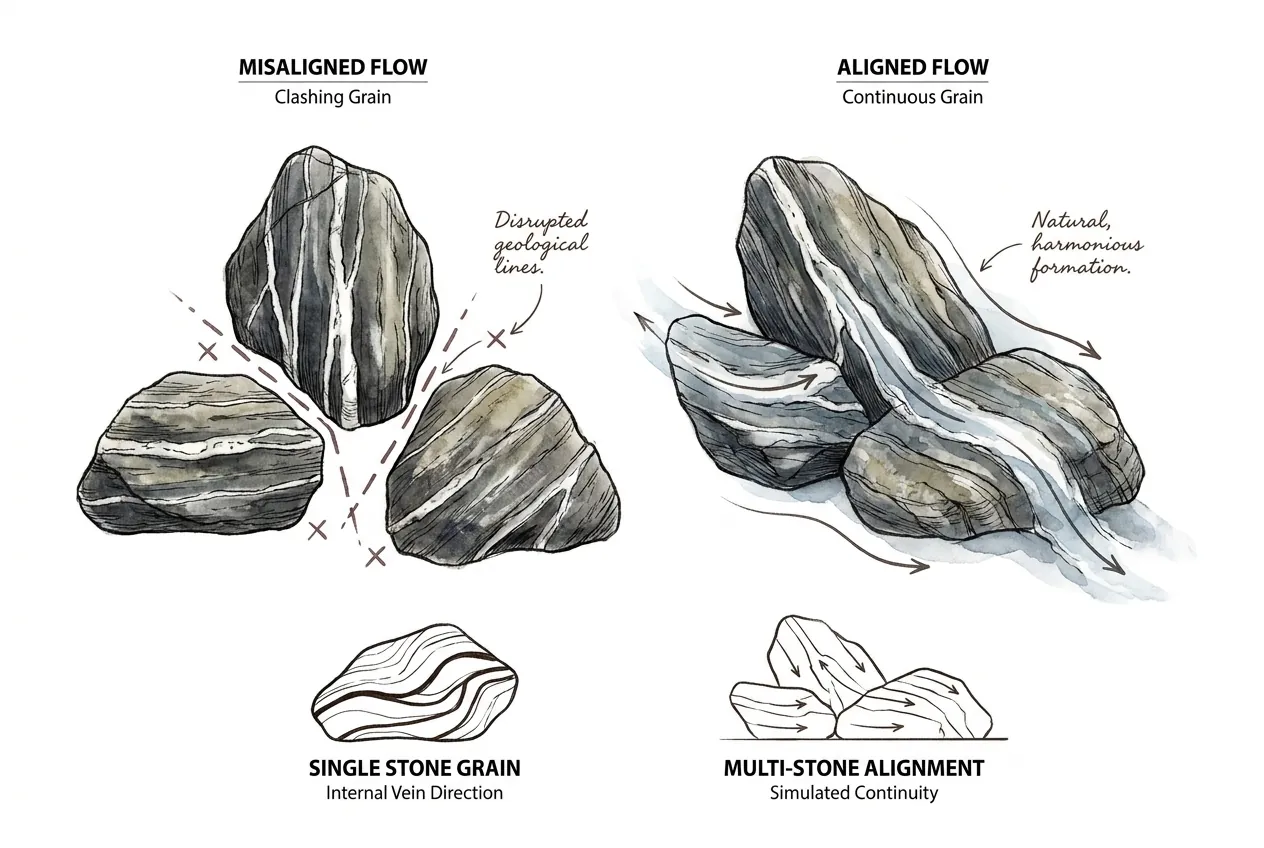
Stone faces carry grain, veins, or striation lines. When those lines run in the same direction across all the stones, the group reads as one continuous formation instead of separate rocks dropped in.
Real rock strata are continuous, and matching the visual grain fakes that geological continuity across physically separate pieces.
Seiryu’s bright white calcite veins make this especially easy to see, and especially punishing when mismatched.
Dry-lay the stones and rotate each one to echo the Oyaishi before you fix anything in place.
Seiryu Versus Ohko Dragon Stone, the Real Trade-off
The choice between Seiryu and Ohko dragon stone looks like an aesthetic one, but it is really a water-chemistry decision wearing a costume.
Seiryu gives sharper, more dramatic scenery and moves your water. Dragon stone is softer-looking and leaves your water alone.
What Seiryu Actually Is
Seiryu is a sedimentary carbonate limestone shot through with bright white calcite veins. Those veins are calcium carbonate, and calcium carbonate dissolves into aquarium water.
As it dissolves it releases calcium, which raises general hardness, and carbonate and bicarbonate, which raise carbonate hardness and buffer the pH upward. The rise is not a one-time bump. Sources describe carbonate and calcium levels continuing to climb, so the effect is ongoing for as long as the stone is in the tank.
The look is why people accept that trade. Seiryu shows a striking blue-grey color, jagged ridged faces, and high-contrast veins that read as knife-edge mountain scenery.
Its veins also reinforce grain direction, so it is unusually good at looking like one continuous formation.
What Ohko Dragon Stone Actually Is
Ohko, sold as dragon stone, is a clay-based argillaceous rock that does not influence water hardness.
Multiple sources describe it as one of the few naturally inert stones, one that will not shift pH, KH, or GH.
Its body is clay mineral rather than carbonate, so there is little to no exposed calcium carbonate to dissolve.
The surface is tan-brown, deeply pitted, and cavernous, giving the dragon-scale texture.
The clay body is relatively soft and breaks easily, so thin projections snap if you handle them roughly.
Fine clay dust can also cloud the water briefly until you rinse it off.
| Property | Seiryu stone | Ohko / dragon stone |
|---|---|---|
| Rock type | Carbonate limestone with calcite veins | Clay-based (argillaceous) sedimentary |
| Water chemistry | Raises KH, GH, and pH (ongoing) | Inert. No measurable change |
| Color | Blue-grey with white veins | Tan-brown |
| Texture | Sharp, jagged, ridged | Soft, pitted, cavernous |
| Body | Hard, durable | Soft, breaks easily |
| Best for | Hard-water tanks. Dramatic peaks | Soft-water, CO2, and shrimp scapes |
The KH Catch Nobody Mentions
Here is the part most rock guides skip. Carbonate hardness, or KH, is your water’s buffering capacity, its ability to resist a change in pH.
It is set by dissolved carbonates and bicarbonates, which are exactly the ions a calcareous stone like Seiryu releases.
One degree of KH corresponds to roughly 17.8 ppm of calcium carbonate.
Raising KH does not just harden the water. It buffers the pH upward and blunts any acid you add, and that is where the trouble starts for planted and shrimp tanks.
Why Rising KH Fights CO2 and Soft-Water Plants
Injected CO2 forms carbonic acid and lowers pH, but it does not lower KH. The carbonate buffer keeps neutralizing that acid, so higher KH means you must inject more CO2 to reach the same pH drop.
A stone that keeps feeding carbonate into the water keeps raising KH, which quietly pushes your target out of reach.
For CO2 planted tanks, most guidance targets a KH of roughly 3 to 6 degrees.
That gives enough buffer to avoid a pH crash but stays low enough to hit the pH drop that yields useful dissolved CO2.
A KH range of about 2 to 7 keeps roughly 97 percent of aquatic plants in good condition.
An uncontrolled rise walks you out of that window, and chasing the pH drop with ever more CO2 is how livestock get gassed.
A drop checker sidesteps this by using a fixed reference solution rather than your tank water.
That is exactly why a moving KH makes stone-driven tanks so hard to dial in by color.
Why Calcareous Stone Is a Hard No for Caridina Shrimp
Caridina shrimp, the crystal and bee shrimp, need very soft, acidic water. Their target KH is about 0 to 1 degree and general hardness around 4 to 6.
Total dissolved solids sit near 100 to 120 ppm and pH near 5.4 to 6.5.
These shrimp evolved in low-mineral water and struggle to osmoregulate when carbonate and TDS climb. A stone that pushes KH up and buffers pH above 7 is simply incompatible with keeping them, let alone breeding them.
Neocaridina shrimp, the cherry and Sakura types, tolerate harder tap water far better, so a mild KH bump is a much smaller risk.
Not every tank fears a KH rise. Rift Lake cichlids and livebearers actually prefer harder, more alkaline water, so for those tanks Seiryu’s buffering is a feature, not a bug.
Test the Stone Before You Commit
Two cheap tests catch a leaching stone before it ruins your water target. The fizz test screens for carbonate, and the bucket test measures how much a stone actually adds.
The Acid Fizz Test
Clean a spot on the stone, add a few drops of acid, and watch for fizzing.
Vinegar is the weak, safe option and muriatic acid is the strong one. Any sustained bubbling means calcium carbonate is present.
The bubbles are CO2 released as acid reacts with the carbonate. Muriatic acid is sensitive enough to fizz even on low-carbonate rock, so a vinegar non-reaction is weaker proof than a muriatic non-reaction.
A drop of vinegar on Seiryu’s white veins bubbles visibly, while the same drop on dragon stone does essentially nothing.
If you work with muriatic acid, treat it as a concentrated acid. Test outdoors or with ventilation and wear eye protection and gloves. Always add acid to the stone rather than water to acid, and keep it away from children and pets.
The 7-Day Bucket Test
A fizz test tells you carbonate is present, not how much it will move your tank. The bucket test fills that gap.
Soak the stone in a known volume of RO or distilled water, measure KH and GH before, wait about seven days, and measure again.
Starting from near-zero KH gives the clearest signal, because a small rise is easy to miss in already-hard water.
A meaningful climb over the week means the stone will drive your tank chemistry at your real rock-to-water ratio.
Read the result against your water target, not a generic safe number. For a hard-water or cichlid tank, a rise is fine or even welcome.
For a CO2 soft-water scape, a rise that would push tank KH past about 6 degrees is a manage-or-reject signal.
For a Caridina tank, essentially any measurable KH rise is a reject.
The right test kit makes this reliable, and a liquid KH and GH test is the tool that actually resolves these small differences.
Our aquarium water test kit product chooser walks through picking one without over-buying.
Managing a Reactive Stone, and When to Just Replace It
If your stone leaches and you still want to keep it, the honest options offset the rise rather than stop it.
If soft water is non-negotiable, replacement with inert stone is the only guaranteed fix.
Options That Offset the Rise
The simplest management is routine water changes. Small weekly changes can offset a mild alkaline shift, but because the stone keeps dissolving, this is ongoing maintenance rather than a cure.
Each change swaps buffered water for fresh under-saturated water, which lowers KH but also lets the stone dissolve a little faster.
You can also fight the pH rise with acidity. Cutting your source water with RO, dosing CO2, and using acidic influences like aquasoil or botanicals all push pH back down.
Injected CO2 is itself an acid in water and helps nudge pH toward neutral.
None of these stop the source. There is a persistent myth that acid-treating Seiryu neutralizes it, and it is not true.
The stone will keep raising pH gently or quickly depending on the acidity around it, and any coating that dissolves or cracks stops working.
Using less rock and burying more of it slows the rate but never reaches zero.
If you manage rather than replace, the reliable way to hold a KH and GH target is to build up RO water to spec.
Our RO water remineralization product chooser covers the unit, meter, and salts to hit a measured number instead of guessing.
When Replacement Is the Honest Answer
For a Caridina tank or a soft-water carpet, stop fighting chemistry and switch to inert dragon stone.
Removing the carbonate source is the only move that guarantees the water stays where those plants and shrimp need it.
This is not a defeat. Dragon stone gives a different but genuinely beautiful cavernous look. It also lets you run tight CO2 and pH control without watching KH creep every week.
Putting It Together and Choosing in the Right Order
The reliable way to pick iwagumi rock is to decide in the order the chemistry demands.
Choose the water target first, then the stone type that fits it, and only then the count and placement.
Water Target First
Your water target is the first filter because it eliminates half the stones instantly. A Caridina or soft-water carpet tank should default to inert dragon stone. A hard-water tank with Rift Lake cichlids or livebearers can use Seiryu freely and even benefit from it.
Write down your KH, GH, and pH target, then cross off any stone that would push you out of it.
The plant and livestock windows are non-negotiable biology, and aesthetics can flex around them, not the other way round.
Then Stone Type, Then Count and Placement
With a chemistry-safe shortlist, pick the stone form you want, sharp Seiryu peaks or soft dragon-stone mounds. Only then apply the composition rules. Use an odd count of 3, 5, or 7, one Oyaishi at two-thirds height on a golden-ratio point, and all stones sharing tilt and grain.
| Your tank | KH target | Stone choice |
|---|---|---|
| CO2 soft-water carpet | ~3 to 6 dKH | Inert dragon stone, or Seiryu with RO-managed KH |
| Caridina (bee/crystal) shrimp | ~0 to 1 dKH | Inert dragon stone only |
| Neocaridina (cherry) shrimp | Flexible, moderate | Either. A mild KH bump is low risk |
| Rift Lake cichlids / livebearers | Higher, alkaline | Seiryu is a feature |
Let Flow and Substrate Feed Back Into the Choice
Stone count and placement interact with water flow and substrate slope. Stones can form hidden dams that trap detritus, so plan rock hierarchy, substrate slope, and filter flow together, and keep a path to siphon debris.
A back-corner throwaway stone that dams flow becomes a detritus trap, and angling it or leaving a gap keeps the substrate cleanable.
Sometimes that means slightly fewer or more-open stones than pure aesthetics would suggest.
Our iwagumi rock layout and flow guide goes deeper on avoiding dead spots. The companion on iwagumi stones raising KH covers the testing and keep-or-replace call in detail.
Key Takeaways
- Use only 3, 5, or 7 stones, with one Oyaishi at about two-thirds tank height on a golden-ratio point.
- Seiryu is carbonate limestone that raises KH, GH, and pH, while dragon stone is inert and holds soft water.
- Rising KH fights CO2 and pH control (target roughly 3 to 6 dKH) and is a hard no for Caridina shrimp at 0 to 1 dKH.
- Fizz-test any unknown stone, then bucket-test in RO water for 7 days to measure the real leach.
- Decide in order of water target first, then stone type, then count and placement.