
Ich After an Autumn Temperature Swing: Treat It Safely
Aquarium ich after an autumn temperature swing has one weak point in its life cycle. Learn the timing that makes salt or medication actually cure it.
Elena Vargas · Published 2026-10-03 · 17 min read
Key Takeaways
- An autumn swing drops fish immunity and warms water into ich’s range, turning a hidden infection visible.
- Only the free-swimming theront stage can be killed in water, so you cannot treat the spots you see directly.
- Temperature sets cure time. Warm water speeds the cycle, cold water drags it out for weeks.
- Raise temperature gradually within species limits, add aeration, and keep heaters on a GFCI outlet.
- Treat several days past the last visible spot, and prevent repeats with stable heat and quarantine.
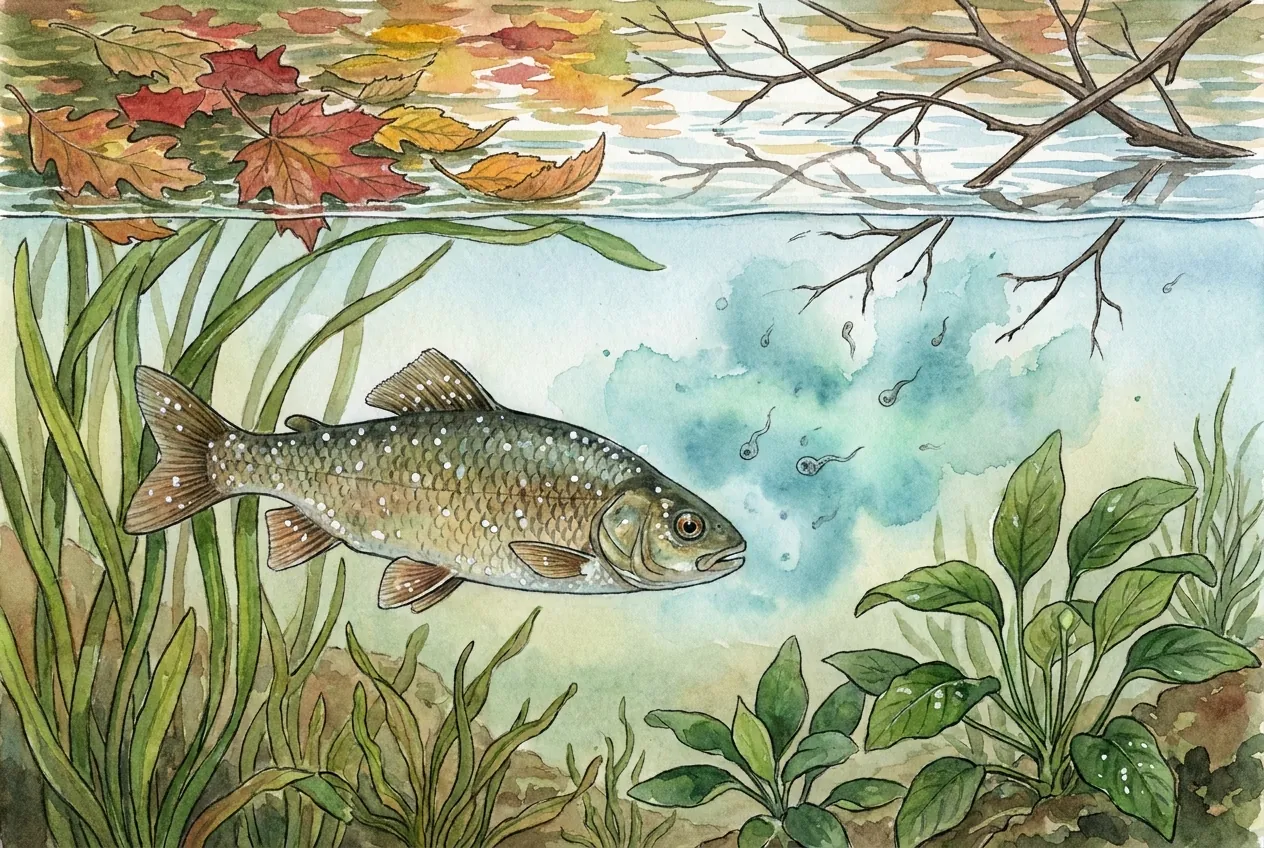
The white specks showed up a few days after the first cold snap, and that timing is not a coincidence. An autumn temperature swing does two things at once. It stresses your fish into dropping their immune guard, and it pushes the water into the range where a low-level parasite erupts into a full outbreak.
This is white spot disease, caused by the ciliate Ichthyophthirius multifiliis. The good news is that the parasite has one weak point in its life cycle, and water temperature controls exactly when that weak point appears.
Once you understand that, the whole treatment plan stops being a guessing game.
Why an autumn temperature swing sets off white spot disease
An autumn swing rarely introduces ich. It flips an already-present or newly-carried parasite into a visible outbreak by stressing the fish at the worst moment.
A sudden temperature change is a classic stressor, and stress is the real trigger here. A sharp drop in temperature impairs the fish’s ability to quickly release antibodies against an invading organism.
Cold stress can also halt the activity of the immune system’s killer cells, removing an important first line of defense.
The delay is what gives the parasite its opening. The time a fish needs to mount an antibody response lets the invader reproduce and build numbers, which can overwhelm the fish before its defenses catch up.
So the cold snap does not create the parasite. It removes the guard that was keeping the parasite in check.
An autumn swing is a double hit, because it both suppresses fish immunity and moves the water into the parasite’s favored range at the same time.
The parasite was probably already there
Ich is often present at low, below-notice levels or arrives riding on a newly added fish.
When the host’s defenses are intact, these infections stay suppressed. When stress drops those defenses, the parasite multiplies into the outbreak you can see.
The temperature band matters too. Ich commonly infects fish between 68 and 77 F, and infections can occur at water as cold as 33 F. An autumn tank drifting down into the 60s F sits right in the parasite’s favored range while the fish are least able to fight back.
The specific autumn events that trigger it
Four common household events produce the same downward or oscillating temperature move. Each one both stresses the fish and nudges the water toward the parasite’s range.
Common autumn triggers
- A delayed or undersized heater that lets the tank track a cooling room.
- Large cold water changes, since tap water runs colder in autumn than in summer.
- Cold drafts from an open window or a spot near an exterior door.
- Brief power interruptions that stop the heater for hours.
If one of these matches your week, you have likely found the switch that flipped a quiet infection into a visible one.
The temperature-driven life cycle that controls your treatment
I. multifiliis has three stages, and only one of them can be killed by anything you put in the water.
Knowing which is which is the whole key to timing treatment correctly.
The three stages and the one you can actually kill
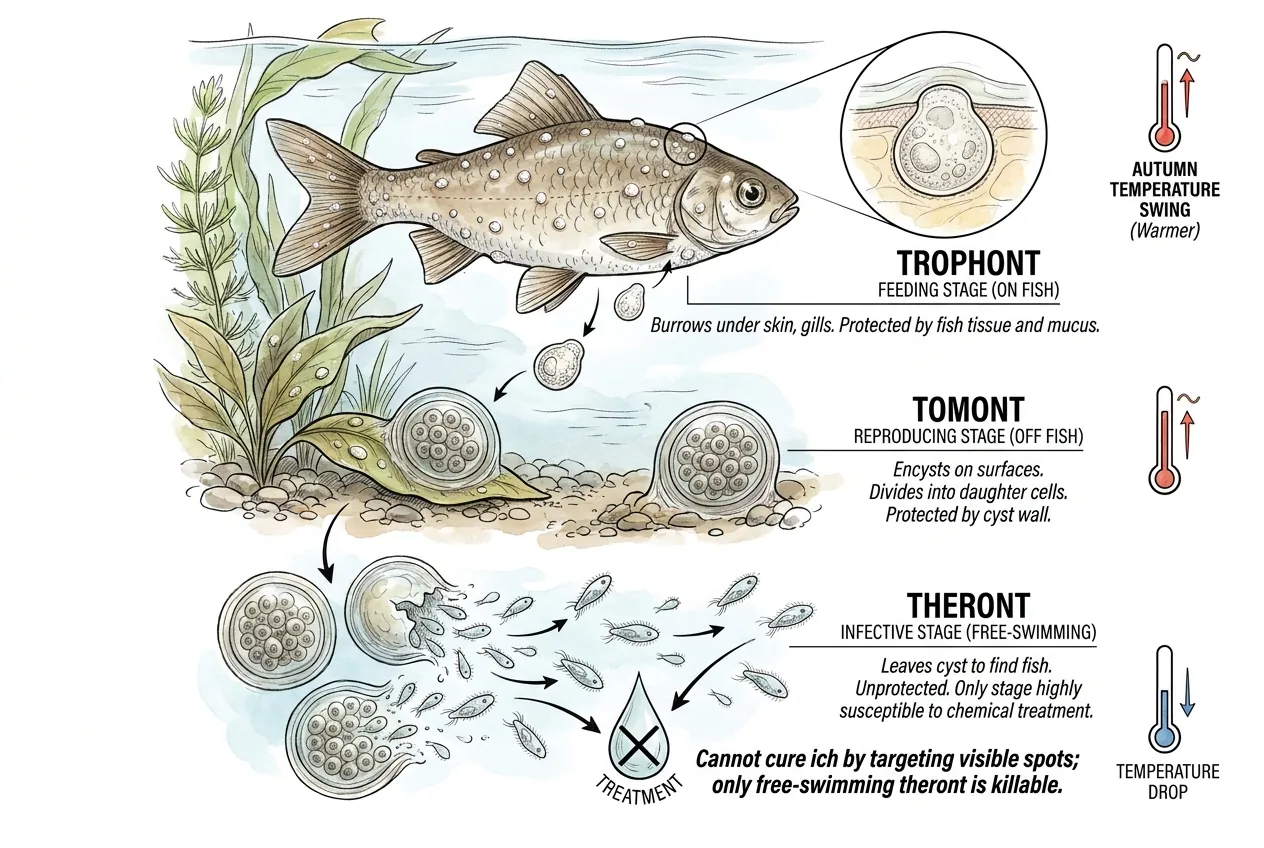
The parasite moves through a feeding stage on the fish, a reproducing stage off the fish, and a short free-swimming stage in between.
Trophont, tomont, and theront
- Trophont is the on-fish feeding stage that burrows under the skin and gills. This is the visible white spot, and it is protected from treatment by the fish’s own tissue and mucus.
- Tomont is the reproducing stage. The mature trophont leaves the fish, encysts on a surface, and divides inside a gelatinous wall into as many as 1024 daughter cells. That wall protects it from treatment too.
- Theront is the free-swimming infective stage that leaves the cyst to find a fish. This stage is unprotected and is the only one highly susceptible to chemical treatment.
Only the free-swimming theront can be killed by in-water treatment, which is why you cannot cure ich by targeting the spots you can see.
How temperature sets the clock
Temperature controls how fast every stage runs, which is why it also controls how long treatment takes.
Warm water speeds the cycle, so theronts emerge sooner and more synchronously. Cold water stretches the cycle out over weeks.
The published range is wide. The full life cycle completes in under 4 days above 75 F, but can take more than 5 weeks below 45 F. At typical warm aquarium temperatures of 75 to 79 F, the whole cycle runs in about 3 to 6 days.
The free-swimming window is short and that is exactly what treatment exploits. Warm the water so cysts release theronts sooner, then have salt or medication already present to kill those theronts before they reinfect a fish.
Life cycle and treatment timing by temperature
| Water temperature | Full life cycle | Treatment rhythm |
|---|---|---|
| Above 75 F (24 C) | Under 4 days | Daily dosing, usually 3 to 5 minimum |
| 75 to 79 F (24 to 26 C) | About 3 to 6 days | Daily dosing |
| 60 F (16 C) | Prolonged | Space doses 3 to 5 days apart, 5 minimum |
| Below 45 F (7 C) | More than 5 weeks | Very slow, long campaign |
Confirming it is ich before you treat
Before you dose anything, make sure you are looking at ich and not a look-alike. Treating the wrong problem wastes time your stressed fish do not have.
What ich actually looks like

Ich appears as discrete white specks on the skin and fins, as if the fish were sprinkled with salt or sugar grains.
The spots are raised, pinhead-sized nodules, not a continuous film or a hazy coating.
Watch the behavior too, since it often shows up first. Before spots appear, infected fish commonly show irritation, flashing, increased mucus, weakness, loss of appetite, and reduced activity. Flashing means darting and scraping the body against decor or substrate.
One trap worth knowing. A gill-only infection may show no body spots at all, while the gills look pale and swollen, so an otherwise clean fish breathing hard still deserves suspicion.
How I confirm it over 48 hours before medicating
When I suspect ich, I count spots before I reach for any treatment, because the count behaves differently from static marks.
I pick one reference fish and look at it under front lighting, with the light source in front of me rather than behind the tank. I check it at the same time each morning and evening.
My reference is a baseline photo taken earlier in the season when the tank was warm and the fish was clear.
If I have no photo, I use the fish’s own appearance earlier that same day. I keep my hands out of the tank and never net a heavily infected fish just to inspect it, since handling adds stress that makes the outbreak worse.
My decision rule is simple. If the discrete raised white dots increase over about 48 hours, I treat it as an active ich cycle, because a turning life cycle keeps adding new trophonts.
If the spots are flat, static, or look like a powdery film, I stop and reconsider before medicating.
A rising count of discrete raised white dots over about two days is the reader-visible signature that separates active ich from static marks or a different disease.
Telling ich apart from look-alikes
| Condition | Appearance | Key difference from ich |
|---|---|---|
| Velvet | Fine gold to rust powdery dusting | Diffuse film, not discrete raised dots |
| Fungus | Cottony fuzzy tufts on a wound | Larger and localized, not uniform grains |
| Breeding tubercles | Symmetric white bumps on gill covers and fins | Seasonal and normal, do not multiply |
| Bruising or stress marks | Flat irregular marks | Not raised, do not multiply |
Raising temperature safely to shorten the cycle
Warming the water is the single most useful lever you have, but it works by speeding the parasite’s clock, not by cooking the parasite off the fish.
Handled carefully, it brings the killable theront stage out sooner and in a tighter window.
Why warmth helps and where its limit sits
Warmer water makes tomont cysts divide and release theronts sooner and more synchronously. That is the dependable mechanism. It compresses the treatment calendar so salt or medication meets more theronts in less time.
Broad aquarium and aquaculture guidance commonly reports that the parasite cannot complete reproduction at sustained water around 86 F. Treat that as the commonly cited ceiling rather than a guarantee, because heat-tolerant strains have been reported and holding every species at that ceiling is often unsafe.
The reliable play is to use heat as an accelerant alongside salt or medication, not as a standalone cure.
A commonly used tropical treatment target is about 86 F, raised gradually, which most tropical community species tolerate for a treatment period.
This is a hobby-standard target, not a universal safe value. Coldwater species such as goldfish, and some sensitive or scaleless fish, may not tolerate it, so the ceiling must stay inside the documented tolerance of the fish you actually keep.
Use warmth to speed theront release alongside salt or medication, and keep the temperature inside the tolerance of every species in the tank.
The oxygen tradeoff you cannot skip
Warm water physically holds less dissolved oxygen, and warmth also raises fish metabolism and oxygen demand.
Water holds about 9 mg/L of dissolved oxygen at 68 F but only about 7.5 mg/L at 86 F, down from 14.6 mg/L near freezing. So the supply falls exactly as the demand climbs.
The fix is to increase surface agitation whenever you raise temperature. An air stone, a raised spray bar, or a slightly lowered water line all boost gas exchange at the surface where oxygen actually enters.
Vigorous aeration matters even more during chemical treatment, especially if the gills are already damaged.
How fast to change temperature
Change temperature gradually so you do not stack a second thermal shock on top of the outbreak.
A conservative working rule is to raise no more than about 1 to 2 F per hour until you reach the target.
Hold that temperature through treatment, then return to normal just as slowly. Tie the final hold temperature and duration to your medication label and the life-cycle timing above.
A heater is mains power sitting in water. Plug every heater and controller into a GFCI-protected outlet, and verify the real water temperature on an independent, checked thermometer rather than trusting the heater dial.
When you discover your heater is undersized for the room or lacks a failsafe, the fix is a buying decision.
Hand it off to the aquarium heater buying guide rather than guessing.
Treatment options and how each one works
Every in-water treatment does the same job. It kills free-swimming theronts during their short window and cannot touch trophonts on the fish or tomonts in cysts.
That is why a single dose never cures ich and why treatment must repeat across the cycle.
Aquarium salt
Salt is accessible and also eases the osmoregulatory stress on infected fish. Published aquaculture dosing uses a prolonged bath of 4 to 5 grams per liter for 7 to 10 days at 75 to 79 F in smaller systems.
Treat that as the sourced upper reference, not an automatic setting for your living room tank.
The caveats are not optional. Some scaleless fish are sensitive and need a reduced dose, and invertebrates such as shrimp and snails, along with many soft-leaved plants, do not tolerate salt at treatment strength. Remove sensitive tankmates or treat them in a separate hospital tank.
The safe way to apply salt is to start conservative and dose by the actual measured water volume rather than the tank’s rated size.
Dissolve it in a cup of tank water before adding it so it never lands directly on a fish. Do not improvise above published rates.
Proprietary ich medications
Malachite green, formalin, and copper-based or combination products target the theront. Published aquaculture rates exist, for example formalin at 25 mg/L with a half dose of 12.5 mg/L in sensitive settings, but these are commercial figures and not a home prescription.
Do not improvise a medication dose, because the exact product label is the binding authority for the home aquarist.
Follow the label for the medication you actually buy, including its species warnings. Many list reduced doses or exclusions for scaleless fish and require removing invertebrates and carbon filtration. For valuable or sensitive stock, consult a veterinarian.
Handle formalin and malachite green per label with ventilation, and never inhale, taste, or skin-contact the concentrate, since formalin also consumes oxygen in the water.
Water changes and gravel vacuuming
Mechanical removal is the quiet workhorse of treatment. Daily gravel vacuuming and partial water changes physically remove tomont cysts settled on substrate and decor before they can release theronts. That lowers the load the chemical phase has to handle.
Water changes also dilute dissolved organics and help keep oxygen and water quality steady through the warm, treated period.
Match the new water to tank temperature so the change itself does not become another swing.
How long until it is cured
Cure time is set by temperature, not by a fixed number of days, and the single biggest mistake is stopping when the fish look clean.
A fish can look spotless while fresh cysts are dividing on the glass, about to release the next wave.
Why you cannot stop at the first clear day
The visible spots are trophonts, and when they mature they leave the fish to encyst on surfaces.
A single treatment only kills theronts already in the water, so stopping early leaves the protected next generation to hatch unopposed.
This is also why a relapse is usually not a new infection. It is the same cohort completing a cycle you stopped treating too soon.
My rule for when to actually stop
I continue the full treatment for several days after the last visible spot drops off, and I extend that margin when the tank is running cool. The reason is mechanical. A cooler tank lengthens the span over which hidden cysts keep releasing theronts, so the killing agent has to stay present longer.
I scale the margin to temperature rather than to a fixed number. A few days past the last spot is reasonable when the tank sits near 75 to 79 F. I allow noticeably longer when it is stuck in the 60s F.
Because I cannot see the cysts, the only safe endpoint is well past the last spot I can see.
Keep the theront-killing treatment running for several days past the last visible spot, and longer in a cool tank, because hidden cysts keep hatching after the fish looks clean.
Water chemistry and oxygen while you treat and recover
Warm, medicated water during an autumn cold spell puts three things under pressure at once. Oxygen falls, the biofilter slows, and the fish are already stressed. Managing those keeps the treatment from creating a second problem.
Keep oxygen and the nitrogen cycle stable
Oxygen is the first thing to manage when you heat, for the reasons covered above, so raise aeration before you raise the thermostat. The biofilter needs watching too.
Cooler water slows nitrifying bacteria, and medications plus reduced feeding during treatment can disturb the colony, so ammonia or nitrite can creep up mid-campaign.
Test your water through the treatment, especially if you have cut back water changes or removed carbon.
The mechanism behind the autumn spike is covered in the companion guides on the cold-tank ammonia spike and the heating-season pH swing.
If you still need a test kit, the water test kit chooser covers that buying decision.
Return to normal temperature without a second swing
Once the full temperature-scaled course is done and no new spots have appeared for your margin, bring the temperature back down gradually.
A fast drop is itself a temperature swing and can restress fish whose immune systems are still recovering.
Resume normal feeding and water-change cadence slowly, keep handling to a minimum, and watch for the pre-spot signs for a couple of weeks.
Clean, steady, well-oxygenated water is the background the fish’s own immune recovery depends on once the parasite load is dropping.
Preventing the next autumn outbreak
Ich becomes an outbreak when stress opens the door, and in autumn the door is a temperature swing.
The highest-leverage prevention is keeping temperature stable through the heating season and closing the route new parasites travel in on.
Stable heat removes the stress window
Remove the swing and you remove the opening the parasite needs. In practice that means a correctly sized heater for the gap between your tank and a cooling room, kept away from drafts and exterior walls.
It also means a thermostat or controller so one stuck heater cannot overshoot. The same controller keeps a cooling room from quietly dragging the tank down.
That equipment choice is a buying decision, not a disease question, so hand it off by internal link to the aquarium heater buying guide. Keep any mains heater or controller on a GFCI-protected outlet.
Gentle water changes matter here too. A large cold water change in autumn is a swing you created, so match new water to tank temperature and change smaller volumes more often through the heating season.
Quarantine breaks the introduction route
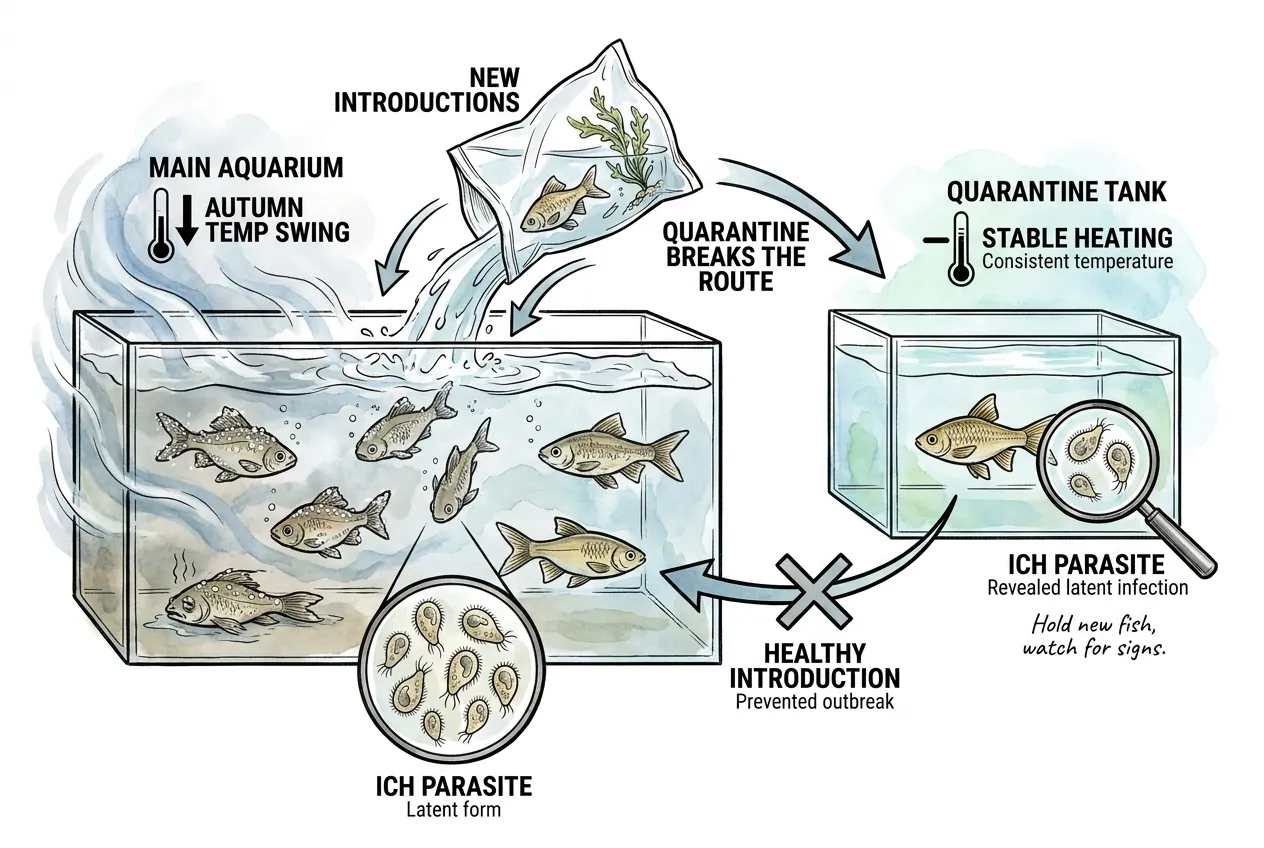
New fish, plants, and even bag water are the usual way ich arrives. Quarantining new fish in a separate tank before they join the display lets a latent infection reveal itself where it cannot spread.
My quarantine rule is to hold new fish for a few weeks at a stable temperature.
That is long enough for at least one full warm-water ich cycle to complete and show itself.
I tie that duration to the temperature-dependent cycle length rather than a fixed number. I also watch new arrivals for the pre-spot signs of flashing, increased mucus, and clamped fins as well as visible spots.
Stable heating and a quarantine period long enough to reveal a latent infection are the two highest-leverage ways to prevent the next autumn outbreak.
Key Takeaways
- An autumn swing drops fish immunity and warms water into ich’s range, turning a hidden infection visible.
- Only the free-swimming theront stage can be killed in water, so you cannot treat the spots you see directly.
- Temperature sets cure time. Warm water speeds the cycle, cold water drags it out for weeks.
- Raise temperature gradually within species limits, add aeration, and keep heaters on a GFCI outlet.
- Treat several days past the last visible spot, and prevent repeats with stable heat and quarantine.