
Cold-Tank Ammonia Spike: Why Heating Season Slows Your Cycle
A cold tank ammonia spike hits when heating season slows nitrification. Learn the mechanism, a transition testing cadence, and how to warm back safely.
Priya Patel · Published 2026-09-30 · 13 min read
Key Takeaways
- Cold water does not dirty the tank. It slows the bacteria that clean it, so waste outruns the filter.
- Nitrification is efficient near 77 to 86 F and drops sharply as water cools toward the low 60s.
- Test ammonia and nitrite every few days through the temperature transition, not just monthly.
- When ammonia appears, dilute with a water change first, then warm slowly at about 1 to 2 F per day.
- Skip deep filter cleans in the cold, treat new water for chlorine and chloramine, and feed lightly.
Your tank was fine all summer. Then the nights turned cold, and suddenly the fish are gasping and the ammonia test reads a color it has not shown since the tank first cycled.
The water did not get dirtier. The invisible cleaning crew that lives in your filter got slower, because it runs on temperature, and autumn quietly turned it down.
This is the cold-tank ammonia spike, and it is one of the most common autumn problems in freshwater fishkeeping.
The good news is that it follows a predictable mechanism, so once you understand why it happens you can prevent most of it with small, unglamorous habits.
The Nitrogen Cycle Is a Two-Step Bacterial Relay
Your aquarium stays safe because two groups of bacteria convert fish waste into progressively less toxic compounds. Fish, uneaten food, and decaying plants release ammonia.
Ammonia-oxidizing bacteria turn that ammonia into nitrite. Nitrite-oxidizing bacteria then turn nitrite into nitrate.
Ammonia and nitrite are the dangerous links in that chain. Both are acutely toxic to fish even at low concentrations. Nitrate, the end product, is far less toxic and is removed by your routine water changes and by live plants.
The bacteria that run this relay are what actually protect your fish, and they are the first thing to fail when conditions turn against them. They live as a biofilm coating your filter media, substrate, and hardscape, not as free cells drifting in the water.
They also grow slowly, so a colony that gets knocked back cannot rebuild in a day.
That is why the whole strategy in cold weather is to protect the colony you already have rather than scramble to regrow one after a crash.
Why Cold Water Slows the Biofilter Down
Nitrification is enzyme-driven metabolism, so its speed rises and falls with temperature like almost every biological reaction. Warm water within a safe range means fast processing. Cold water means slow processing, even though the bacteria are still alive and still there.
The Efficient Band and the Drop-Off
Nitrifying bacteria work best in roughly the 77 to 86 F range (about 25 to 30 C), and their rate falls as the water cools below that.
This is why a tropical tank held at 78 F keeps its cycle humming while the same tank drifting toward the low 60s starts to struggle.
The slowdown is steep, not gentle. Reported figures put nitrifier activity at around 10 C (50 F) at roughly a quarter of its warm-water rate.
Activity does not fully stop until the water is near freezing, but it is heavily depressed long before that point.
A tank that slides from 78 F down into the mid 60s has already lost a large share of its waste-processing capacity. That happens even though 65 F does not feel cold to you.
The fish still eat, the waste still arrives, but the filter can no longer keep up.
| Approx. water temperature | Nitrification status | What it means for your tank |
|---|---|---|
| 77 to 86 F (25 to 30 C) | Efficient band | Biofilter keeps pace with normal stocking |
| 68 to 77 F (20 to 25 C) | Working but slower | Reduced margin, watch heavy feeding |
| Around 50 to 60 F (10 to 15 C) | Heavily reduced | Processing roughly a quarter of warm-water rate |
| Near 32 F (0 C) | Effectively stalled | Little to no nitrification |
The Two Steps Do Not Slow at the Same Rate
Here is the detail that catches people out. The nitrite-oxidizing bacteria are more sensitive to cold than the ammonia-oxidizing bacteria. When water cools, the nitrite-to-nitrate step falters before the ammonia-to-nitrite step does.
The practical result is a nitrite problem that can trail behind the ammonia. You may correct the ammonia and still watch nitrite climb, because that second group of bacteria is lagging further behind in the cold.
In laboratory cooling studies, nitrite accumulated once temperatures fell below about 15 C even while some nitrate was still being produced.
Test for both ammonia and nitrite in cold weather, because the nitrite step is the one that recovers slowest.
Why the Spike Lands Specifically in Autumn
The autumn spike is a mismatch between a falling supply of processing capacity and a steady supply of waste.
As the room cools, an unheated or under-heated tank drifts down in temperature and its biofilter slows.
Meanwhile you are still feeding, the fish are still producing waste, and plant matter is still decaying.
Waste input stays roughly constant while processing capacity drops, so ammonia accumulates, and then nitrite follows. Nothing got dirtier. The tank simply lost the ability to keep up with its own normal load.
The Feeding Trap in Cool Water
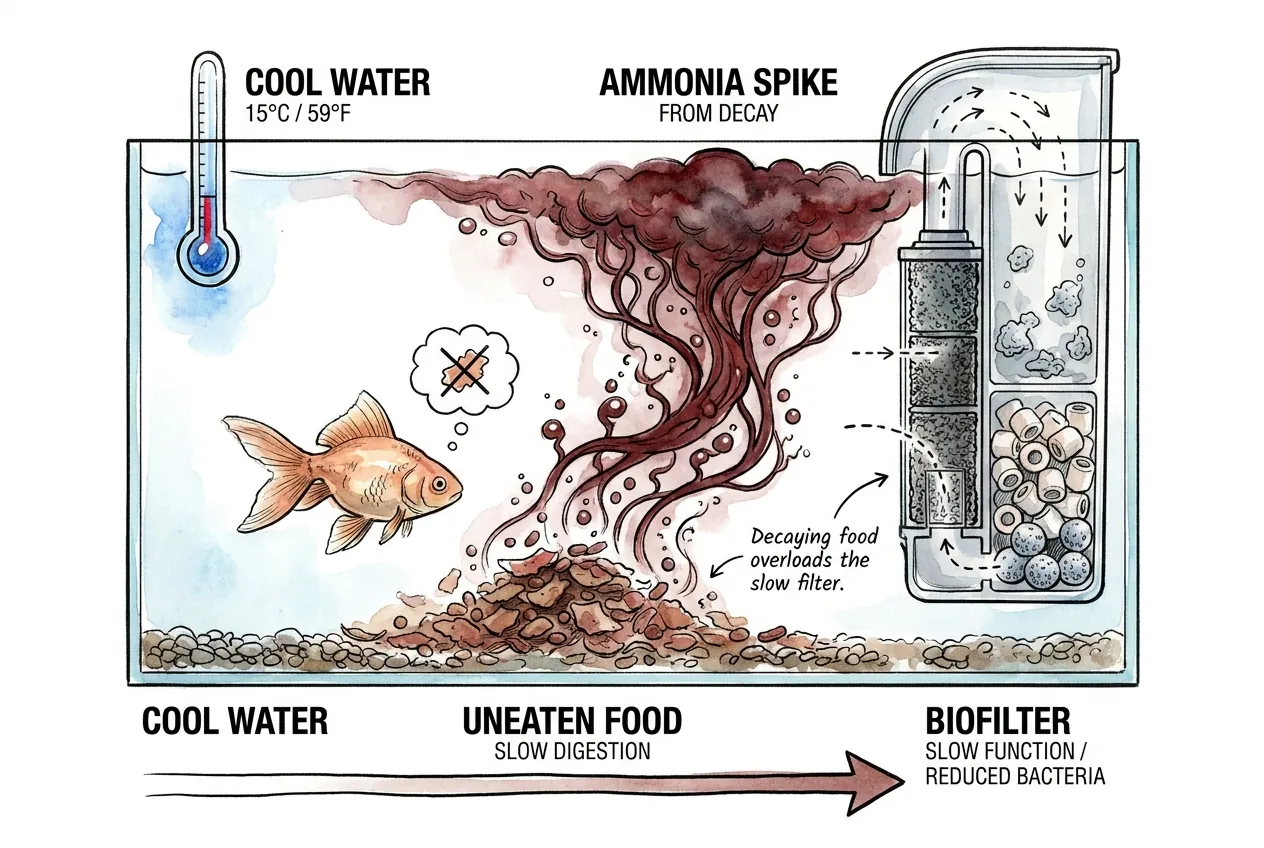
Fish are ectotherms, so their metabolism slows as the water cools. They eat less and digest more slowly, which means food you drop out of habit is more likely to sit uneaten and rot.
That decaying food becomes yet another ammonia source, arriving at the exact moment the biofilter is least able to handle it.
In cool water, feed less, because both the fish and the filter are running slower than they were in summer.
The Heater Switch-On Twist
Turning the heat back on helps the bacteria recover, but it can briefly raise the danger first.
Warming the water speeds bacterial metabolism, which is what you want. It also shifts more of any ammonia already present into its toxic form and lowers the amount of oxygen the water can hold.
So warming a tank that already shows detectable ammonia can increase the immediate risk to the fish before the recovering biofilter catches up.
This is why the order of operations matters, and we will come back to it.
Autumn storms and power cuts make this worse by leaving heaters and filters off for hours.
That chills the tank and starves the aerobic biofilm of flow and oxygen at the same time.
How pH and Temperature Decide How Dangerous Your Reading Is
The same total ammonia reading is not equally dangerous in every tank. Total ammonia exists as two forms in water, un-ionized ammonia and ionized ammonium, and only the un-ionized form is strongly toxic to fish. The balance between the two shifts with pH and temperature.
The toxic fraction rises as pH rises and as temperature rises. That means a given test result is more dangerous in warm, higher-pH water than in cool, lower-pH water.
One extension example makes the scale clear. At 82 F, about 2 percent of total ammonia is in the toxic form at pH 7.5, compared with about 18 percent at pH 8.5.
Below pH 7.0, more than 95 percent stays as the non-toxic ammonium form.
Because warming increases the toxic fraction, dilute an ammonia reading with a water change first and raise the temperature slowly second. Reported guidance treats un-ionized ammonia as harmful starting around 0.05 mg/L, well below the levels that feel alarming on a total-ammonia card.
Your priority when you see ammonia is to lower the total amount, then bring warmth back gently so you are not amplifying whatever remains.
| Condition | Share of ammonia in toxic form | Reader takeaway |
|---|---|---|
| 82 F, pH 7.5 | About 2 percent | Same reading, lower immediate danger |
| 82 F, pH 8.5 | About 18 percent | Same reading, much higher danger |
| Below pH 7.0 | Over 95 percent stays non-toxic | Acidic water buffers ammonia toxicity |
Catch the Spike Early: A Testing Cadence Tied to the Cold
The reliable way to catch this problem is to test more often during the weeks the temperature actually changes, not on your usual monthly schedule.
The transition window is when supply and demand fall out of balance, so that is when your data has to be fresh.
Before the first cold snap, while the tank is still warm and stable, I take a baseline reading of ammonia and nitrite and write it down. That summer-temperature zero is the reference everything else is measured against.
Through the two to three weeks that bracket the first sustained room-temperature drop, or the day I first switch the heater on, I test more often.
I check ammonia and nitrite every second or third day. I compare each result to that baseline.
My working trigger is deliberately conservative. The moment ammonia reads above zero, any detectable shift off the baseline color, I cut feeding by half.
I do a partial water change that same day rather than waiting for the weekly routine.
I treat that zero-to-anything change as the signal, not a specific toxic number. The actually-toxic fraction depends on pH and temperature, and I would rather act early than calculate under pressure.
A liquid test kit resolves these low readings more clearly than strips, which matters most when you are trying to see the first hint of color.
Choosing which kit to keep on the shelf is its own decision. If you are still deciding what to buy, our aquarium water test kit chooser walks through liquid kits versus strips and what each one is good for.
Follow the kit label for handling the reagents, and never judge water quality by smell.
Bring the Heat Back Without Shocking the Tank
When you warm a chilled tank, go slowly, because both the fish and the chemistry punish a fast jump.
Fish are ectotherms and a rapid temperature change is itself a stressor that can cause thermal shock.
Warming also raises the toxic ammonia fraction and lowers dissolved oxygen, so a fast warm-up on a tank that already has ammonia stacks two risks at once.
I raise the heater setpoint in small steps rather than all at once. I read the water on a fixed thermometer and note the current stable temperature. Then I move the setpoint up and hold each new level for about a day before the next step.
Between steps I watch how the fish are behaving and check the ammonia reading.
My conservative working ramp is no more than about 1 to 2 F per day. If the fish look stressed or ammonia climbs, I stop and hold at the current temperature instead of pushing on.
That pace is an operating rule I use to give the biofilter time to recover while limiting the toxicity and oxygen effects of warming, not a published standard.
Nitrification consumes oxygen and warm water holds less of it. So I also add surface agitation or an air stone during recovery to support both the fish and the aerobic bacteria.
A slow, steady climb lets the biofilter catch back up while a fast one can tip a marginal tank into a crisis. A correctly sized, accurate heater with a failsafe is what makes a steady climb possible in the first place.
If you are choosing or replacing one, our aquarium heater buying guide covers sizing for your room, accuracy, and adding a controller failsafe. That includes the GFCI point for any mains device near water.
Do Not Accidentally Kill the Biofilter You Are Trying to Save
Autumn is the worst time to do anything that strips out bacteria, because the colony is already slow and cannot regrow quickly.
A few common maintenance habits do exactly that at the worst moment.
Skip the Deep Filter Clean During a Cold Spell
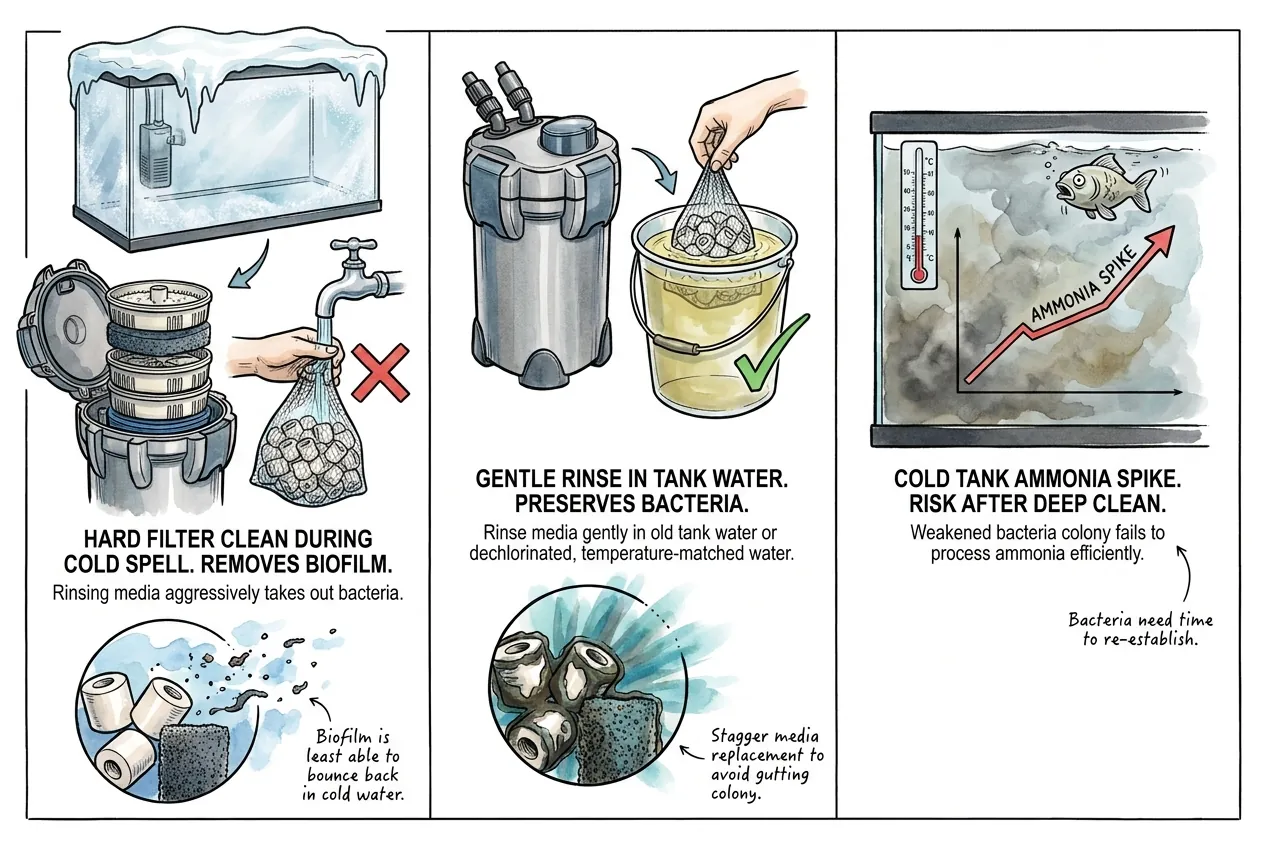
A hard filter cleaning removes a large share of the biofilm right when it is least able to bounce back.
Rinsing media aggressively, replacing a lot of media at once, or scrubbing every surface takes out bacteria you need.
Rinse media gently in old tank water or in dechlorinated, temperature-matched water instead of under the tap.
Stagger any media replacement over several weeks so the colony is never gutted in one go.
Respect Chlorine and Chloramine
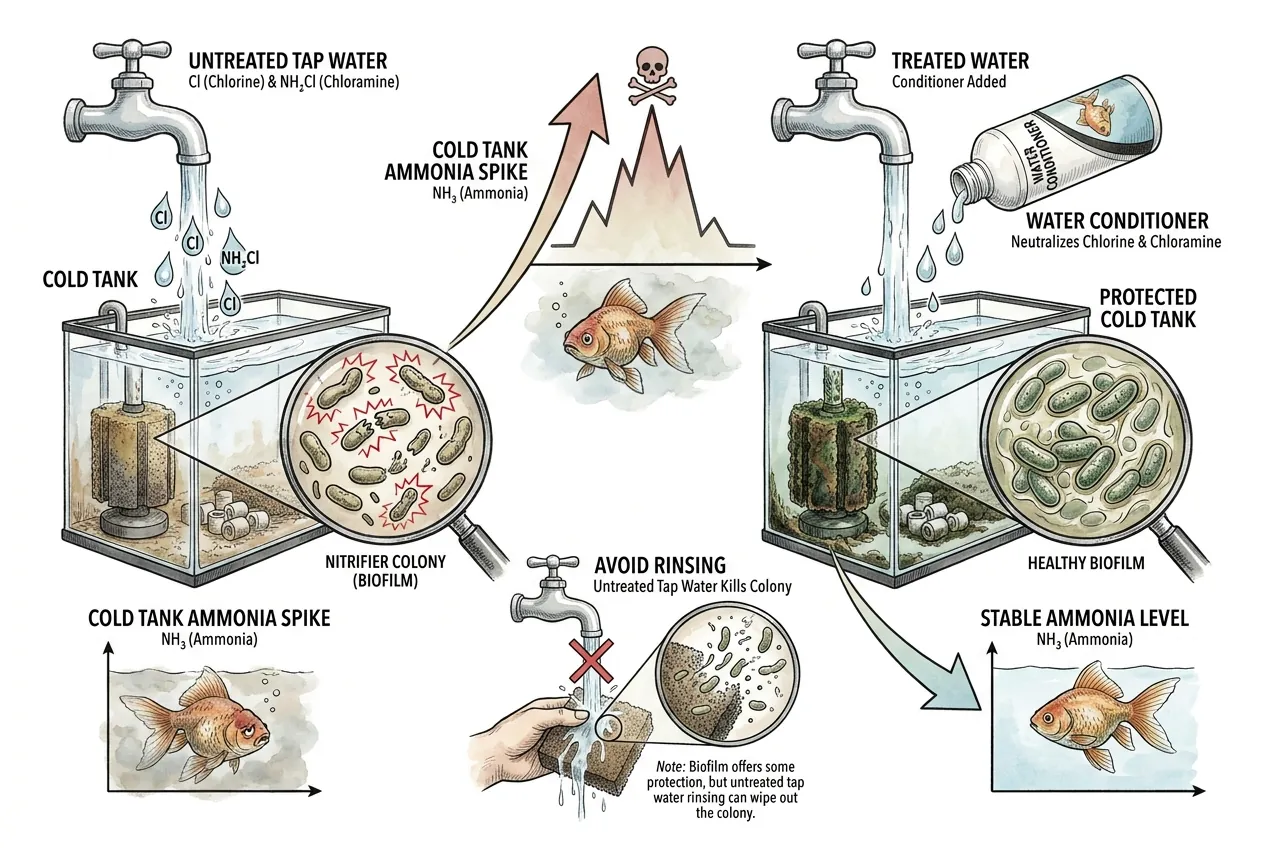
Tap water disinfectants damage nitrifiers, so always treat replacement water. Free chlorine kills these bacteria fairly readily, and chloramine is more persistent, so use a conditioner that neutralizes both.
Bacteria buried in biofilm survive brief low-level exposure better than free cells do, but rinsing filter media directly under untreated tap water can greatly reduce or wipe out the colony.
Be Careful With Medications
Some fish medications, including certain antibiotics, suppress or kill nitrifying bacteria. Dosing during the slow-nitrification window can knock the biofilter down further right when it is already struggling.
If a treatment is unavoidable, plan to test ammonia and nitrite closely and be ready with water changes.
How much biological surface area your filter provides is a separate equipment question. If you are weighing biomedia, our aquarium filter media chooser covers how mechanical, biological, and chemical media stack up and how much colony each can host.
Coldwater Tanks Versus Tropical Tanks
The risk plays out differently depending on whether your tank is heated at all. A heated tropical tank held around 75 to 80 F keeps nitrification in its efficient band all year.
So the real threat is heater failure or a heater too small to overcome a cold room.
The fix there is stable, adequate heating plus monitoring through the transition.
A coldwater or unheated tank, such as some goldfish or pond-style setups, genuinely runs cold in winter and its cycle is slow by design.
You cannot and should not simply crank the heat on a coldwater species to speed the bacteria up.
The levers there are lighter stocking, lighter feeding, and patience, so the reduced waste load stays within the reduced processing capacity.
Match your response to your tank, because a tropical tank needs stable warmth while a coldwater tank needs a lighter load.
Key Takeaways
- Cold water does not dirty your tank. It slows the bacteria that clean it, so waste outruns the filter.
- Nitrification is efficient near 77 to 86 F and drops sharply as water cools toward the low 60s and below.
- Test ammonia and nitrite every few days through the temperature transition, and act the moment either rises off baseline.
- When ammonia shows up, dilute with a water change first, then warm the tank slowly at about 1 to 2 F per day.
- Skip deep filter cleans in the cold, treat all new water for chlorine and chloramine, and feed lightly.