
Cryptocoryne Melt After a Cold Water Change: The Real Cause
Cryptocoryne melt after cold water change is temperature shock, not pH. Autumn tap runs 20 or more degrees colder. Diagnosis, rescue, and prevention.
Samuel Reed · Published 2026-08-31 · 13 min read
Key Takeaways
- Autumn tap water runs far colder than summer tap, so the same water change suddenly cold-shocks crypts.
- A 25 percent change with 53 °F tap water drops a 78 °F tank over 6 degrees in minutes.
- Trim melting leaves at the base but never uproot. A firm crown usually regrows within 2 to 4 weeks.
- Check tap temperature weekly in autumn. Temper each bucket to within 2 °F of the tank before pouring.
- Verify KH matches between tap and tank. If it does, temperature, not pH, was the melt trigger.
You did the exact water change you have done every week since spring. Two days later your Cryptocoryne stand is collapsing into translucent mush, and every forum thread says to test pH.
Test it if you like. But the variable that actually changed between August and October is almost certainly the temperature of your tap water.
The first cool-weather bucket of the season is a cold-shock event. Crypts answer cold shock the way they answer every abrupt insult. They melt.
The good news is that melt is rarely death. The better news is that one thermometer habit prevents the whole thing.
What crypt melt actually is
Crypt melt is the plant deliberately abandoning its own leaves. When conditions change abruptly, a Cryptocoryne reabsorbs the nutrients stored in its foliage. It redirects them into new roots and new leaves built for the current environment.
The leaves turn translucent, then brown, then dissolve. Florida Aquatic Nurseries, one of the largest aquatic plant growers in the US, describes it bluntly.
Environmental change can make the foliage of a completely healthy plant partially or totally disintegrate.
The rhizome below the substrate stays alive and regrows once conditions settle. Melt is a resource-reallocation maneuver, and the buried rhizome decides whether your crypt survives. Treat the leaves as expendable and the crown as precious.
The autumn trigger nobody measures
Your water change routine did not change. Your water did. Between summer and late autumn, the cold tap in much of the US quietly drops by double-digit degrees, and almost nobody measures it.
How cold your tap actually gets when the season turns
In colder northern regions, winter municipal water can average between 35 and 45 degrees F. In summer, the same taps can run 60 to 80 degrees F. The identical bucket routine can deliver water 20 or more degrees colder in November than in July.
The drop also arrives on a delay, which is exactly why it blindsides people. Water mains sit in soil, and soil temperature lags air temperature by weeks. A USGS field study measured shallow groundwater at 8 feet deep swinging from 70.1 degrees F in September down to 45.0 degrees F in February.
So the danger window opens a few weeks after the weather turns, not on the first cold day.
The air already feels like autumn, your routine feels like summer, and the bucket is the coldest thing in the room.
Once a week from the first cool spell, a cup filled from my cold tap goes under the same thermometer I use for the tank.
I let the tap run for about 30 seconds first, then compare the reading against the tank.
The moment the tap reads more than 5 degrees F below the tank, straight-from-the-tap refills stop for the season. Every bucket gets tempered from then on.
No published study defines a safe tap-to-tank gap for Cryptocoryne. I hold that 5-degree line because it sits well inside the shock territory described below and costs nothing but a minute.
How much one bucket actually cools your tank
Mixing water is just a weighted average. Multiply the fraction of water you change by the gap between tank and tap. That is your temperature drop, delivered in minutes.
Take a 78 degree F tank and autumn tap water at 53 degrees F, both realistic numbers from the seasonal range above. Here is what the arithmetic does.
| Change size | Tank right after the change | Drop |
|---|---|---|
| 10 percent | 75.5 °F | 2.5 °F |
| 25 percent | 71.75 °F | 6.25 °F |
| 50 percent | 65.5 °F | 12.5 °F |
Now run the same table with 72 degree F summer tap water. The 25 percent change drops the tank 1.5 degrees, and the 50 percent change drops it 3.
Your routine was genuinely fine all summer, which is why you trusted it.
Husbandry guidance for tropical tanks keeps replacement water within about 1 degree C of the tank.
The same guidance warns that quick shifts of just 2 to 4 degrees C can disturb metabolism and immune function in livestock.
An untempered 25 percent autumn change blows past that envelope more than three times over.
There is also a placement problem. Cold water is denser than warm water, so the incoming cold plume sinks and pools along the substrate, exactly where crypt crowns sit. The same 25 percent water change that moved your tank a degree and a half in July can move it 6 or more degrees in minutes in November.
Why a cold pulse hurts a tropical plant
For a tropical organism, cold starts far above freezing. The reason lives in the cell membrane.
Plant membranes are built of lipids tuned to a working temperature range. Chill them and the lipids stiffen from a fluid state toward a gel state. Research on chilling injury describes the membrane contracting as it gels, opening cracks and channels that let ions leak out of the cell.
The surprising part is how warm the danger zone starts. Postharvest research on bananas, a classic tropical tissue, finds chilling injury becomes prominent below 13 degrees C, which is about 55 degrees F.
That is not a frost number. That is the temperature of autumn tap water in much of the country.
This evidence carries two honest boundaries. The studies are fruit-storage experiments running days of continuous cold, not aquarium tests of a brief partial-volume pulse.
The fair claim is that a cold pulse pushes tropical tissue toward the same membrane-stress pathway, not that it replicates storage injury.
The same literature also notes early membrane changes are reversible before destruction becomes permanent. That fits what aquarists actually see. A shocked crypt sheds leaves and rebuilds rather than dying outright.
Speed is the multiplier. A tropical tank cooling 1 degree over a season is nothing. The same shift compressed into the minutes of a water change is a stress event, and crypts respond to stress events by shedding.
So is pH off the hook
Not entirely, and the honest version of this diagnosis keeps both suspects in the room.
A water change does move chemistry. Tap water arrives out of equilibrium with the air, sometimes carrying extra dissolved CO2 that suppresses its pH.
Within a few hours that excess gas escapes and the water settles back toward a normal 3 to 4 ppm of CO2.
That means the scary pH reading taken right after a change is often a transient. Carbonate hardness is the other half of the story. KH is the water’s pH buffering capacity, and in typically buffered tap water it caps how far a change can push pH.
The pH-shock explanation for autumn melt asks a modest, self-correcting swing to do what a 6-degree cold pulse does effortlessly. Chemistry-driven melt is still real, though. Retailer education pages list large water changes and shifts in pH, KH, or GH among the triggers for established crypts.
Some utilities also change source water seasonally, so spend one test on it. Measure KH in your tap and in your tank. If the two KH readings match while your change-day thermometer gap is in double digits, temperature is your verdict.
Which melt you are actually looking at
Before you rebuild your routine, confirm the diagnosis. Three patterns cover almost every melting crypt. They separate on timing, plant age, and which leaves go first.
| Cue | Transition melt | Cold-shock melt | Chronic decline |
|---|---|---|---|
| Plant’s time in your tank | Under 2 months | Months to years | Any |
| Onset | Days to weeks after planting | Days after one event | Weeks to months, no event |
| Leaves affected | Thick emersed leaves first | Most leaves at once, several stands together | Oldest leaves first, one species |
| Matching clue | New thin leaves at the center | Thermometer gap on change day | No trigger in the log |
Transition melt is the famous one. Commercial farms grow crypts emersed, with leaves in open air, and those leaves get shed once submerged.
It is so predictable that experienced growers cut all the leaves off at planting, and a healthy rhizome regrows within 2 to 3 weeks.
If your crypt is new, this is your answer regardless of what your bucket did.
Cold-shock melt is the established-plant pattern in question. A stand that sat untouched for a year collapses within days of the season’s first cold change. Several crowns go at once while ferns and stems mostly shrug.
Sensitive livestock can co-sign the diagnosis by acting stressed during the change itself. Chronic decline is the impostor. No event, slow yellowing, oldest leaves first, and that is a light or nutrition problem wearing melt’s costume.
The rescue, from hour zero to week six
Your crypts are melting right now. Here is the sequence, and the first rule is the hardest one. Do not pull the plant.
The first 48 hours
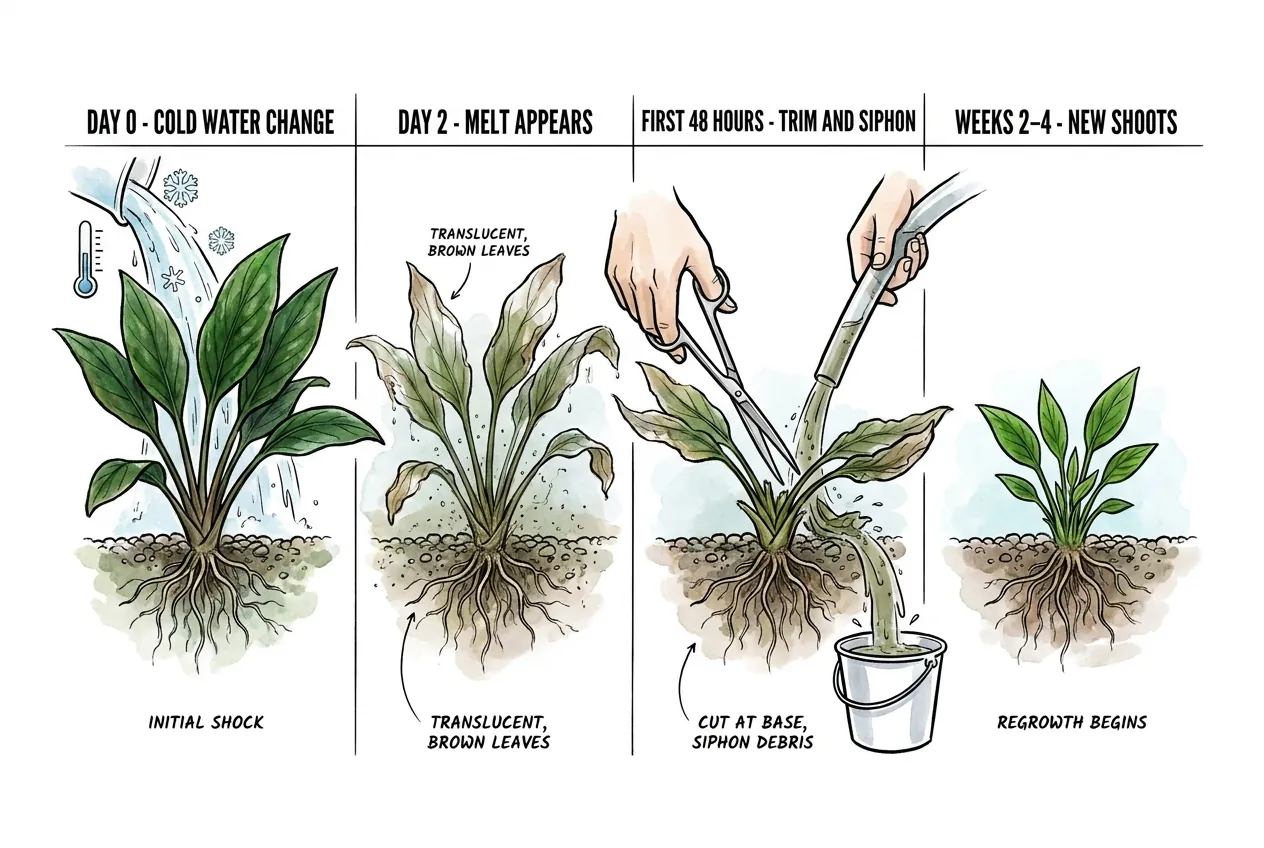
Cut clearly melting leaves off at the base of the stem, right near the substrate. Decaying leaf tissue is an ammonia and algae liability, and the plant has already written those leaves off.
If most of the stand is going, trimming everything back to the substrate is legitimate. It lets the crypt spend energy on new leaves instead of dying ones.
Leave the roots and crown exactly where they are. Growers document regrowth starting from the rooted crown within days to weeks.
Uprooting a crypt is itself a melt trigger that resets the clock.
Siphon out the debris, then stabilize the tank and stop changing things.
Weeks one through six
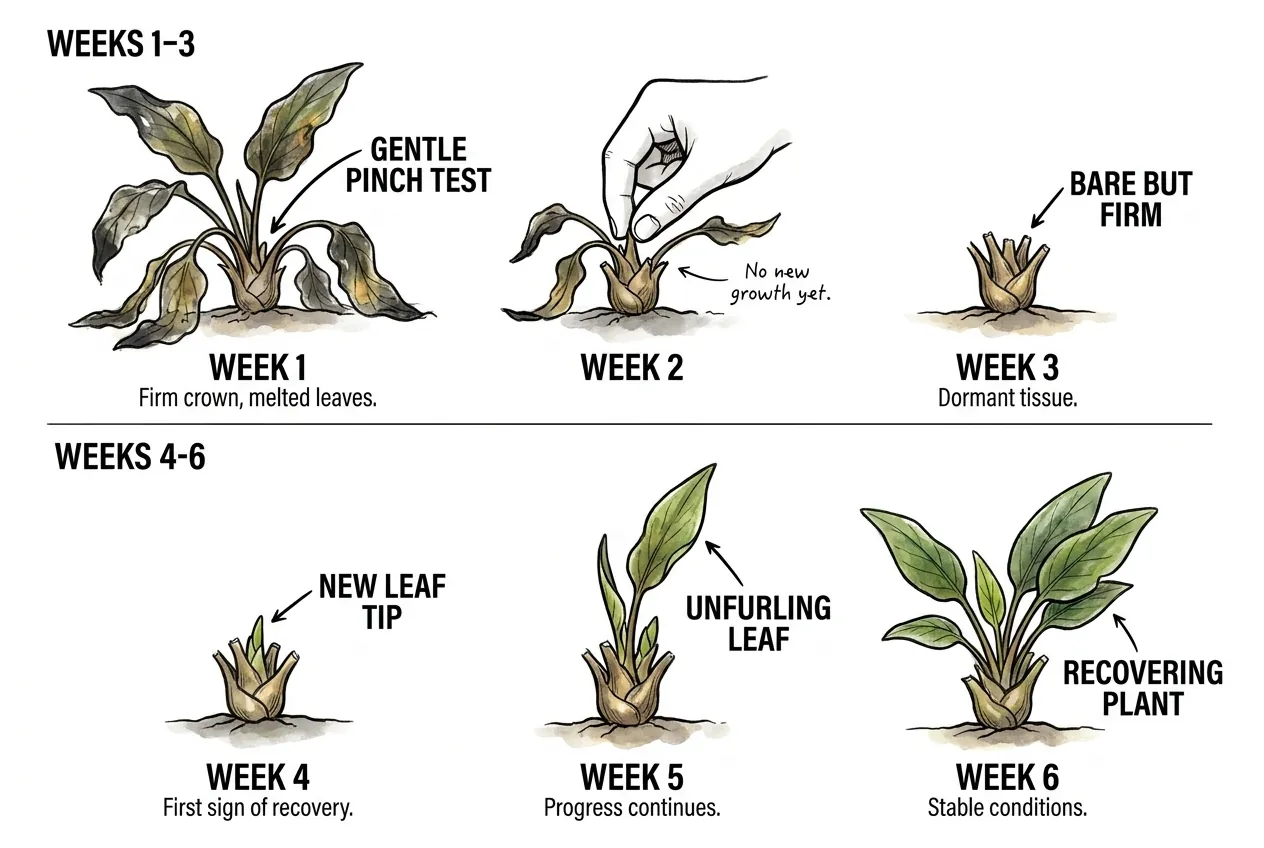
New shoots typically appear within 2 to 4 weeks under stable conditions. The standard advice is to wait at least 3 to 4 weeks before passing judgment on any crown.
My keep-or-toss call happens at the substrate line, not at the leaves. Each week the crown of each melted plant gets a gentle pinch between two fingertips, without lifting or twisting it.
Two things get checked. Firmness compared to last week, and any new leaf tip at the center of the rosette.
A firm crown stays planted no matter how bare it looks. Only a crown that has gone soft and mushy or smells foul comes out, because that tissue is dead rather than dormant.
A firm crown gets 6 weeks of those weekly checks before I give up on it.
The sourced regrowth windows above run out to a month, and my rule is to be more patient than the average timeline, not less. A bare but firm crown is a recovering plant, and pulling it up to inspect the roots reliably turns recovery into loss.
The cold-months routine that prevents the next melt
Prevention is two levers on the bucket and one check on the tank. Every grower source lands on the same principle. Stability, not any particular parameter value, is what keeps crypts dressed.
Temper the bucket
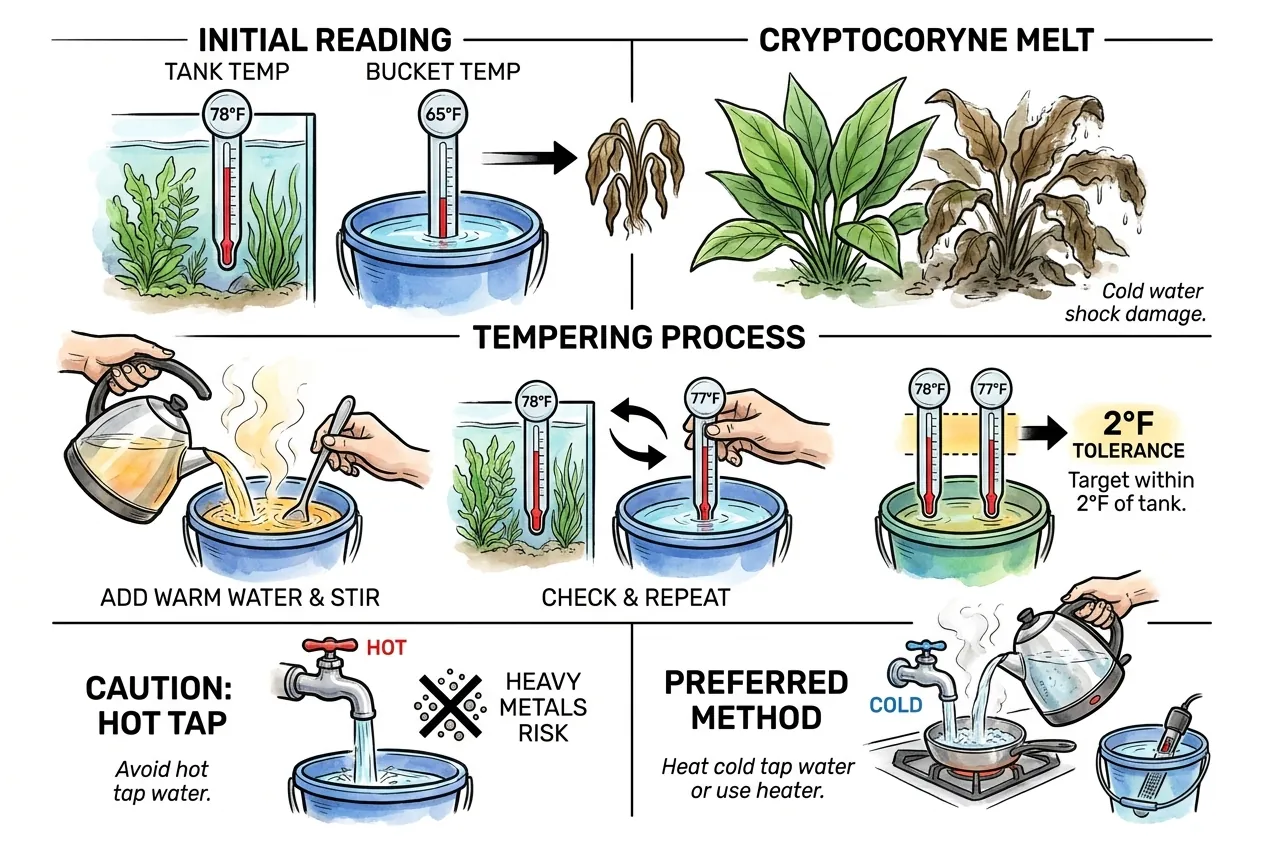
Before any cold-months change, the tank gets read first. Then the same thermometer goes into the bucket. Warm water gets blended in a little at a time, with a stir and a fresh reading after each addition.
Nothing pours until the bucket sits within 2 degrees F of the tank. I bias toward the warm side of that window because cold is the direction that does the damage.
That 2-degree figure is my own working tolerance, not a published standard. I chose it because it matches the 1 degree C husbandry guidance while staying easy to hit with a kettle and patience.
Prefer heating cold tap water, using a splash of boiled water or a spare heater in the bucket, over drawing from the hot tap. If a heater does the warming, keep it fully submerged and unplug it before your hands go into the bucket or anything gets poured.
Avoiding the hot-water lines of older homes is a standard heavy-metal precaution among aquarists, and dechlorination stays exactly the same either way.
Shrink the change instead
If tempering will not fit your routine, use the arithmetic from the mixing table. Halving the change fraction halves the temperature drop at any given tap gap. Two smaller changes on different days move the tank half as far per event as one big one.
In the cold months, that difference is the whole game.
Make sure the baseline holds too
A water change is not the only cold pulse in autumn. A heater sized for a summer room can let the whole tank sag as the house cools.
Heater failure sits on the same documented list of established-crypt melt triggers as the cold bucket.
Cryptocoryne wendtii runs happiest at 75 to 82 degrees F and tolerates a stable 68. A sagging baseline plus a cold bucket stacks two stresses the plant would have shrugged off individually.
Check that your heater actually holds setpoint on the first properly cold week. If it cannot, work through the watts-versus-volume decision in our guide to aquarium heater sizing for the autumn temperature drop.
What the melt was telling you
The collapse looked like a catastrophe, but it was information. Your tap water crossed its seasonal cliff, your bucket delivered a cold pulse to the substrate, and your crypts reacted on script.
None of it means your water is bad or your plants are weak.
Trim the casualties, leave every firm crown planted, and give the stand its quiet weeks to rebuild.
Then make the two small edits that close the loop for good. A weekly glance at tap temperature once the weather cools, and a tempered or smaller bucket once the gap opens.
By the time the new submersed leaves fill back in, your routine will be the stable thing the plant needed all along.
The melt does not have to be an annual event. It just needed a thermometer pointed at the right water.