
Fish Not Eating in Cold Water? It's Metabolism, Not Illness
Fish not eating cold water is usually normal metabolic slowdown, not illness. Learn the mechanism, how to adjust feeding, and the red flags to watch.
Priya Patel · Published 2026-10-14 · 14 min read
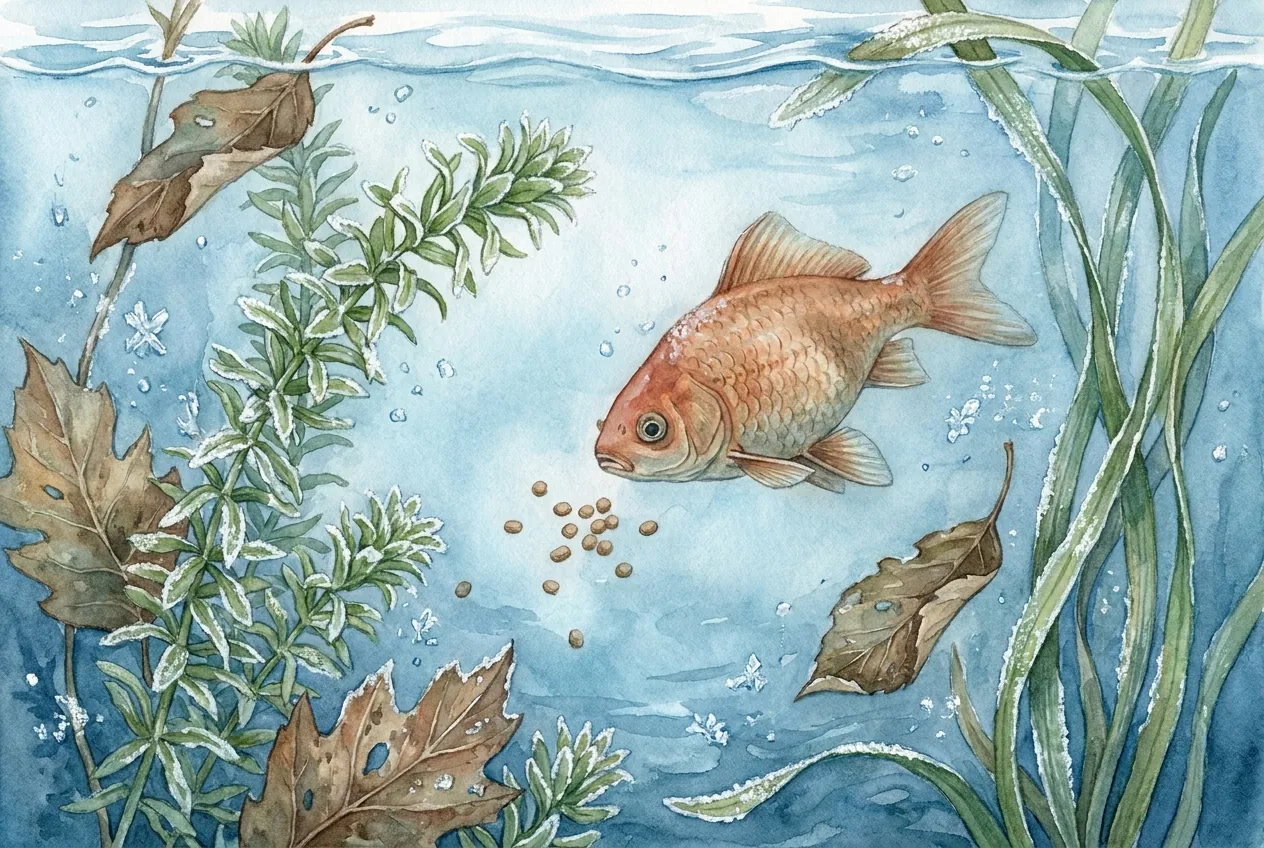
Key Takeaways
- Fish are cold-blooded, so cooler water slows metabolism and appetite. This is physiology, not illness.
- A 3 to 4 degree drop can cut metabolic rate about a quarter and visibly reduce feeding interest.
- Feed to what fish finish in a few minutes, then remove leftovers to protect the slowed biofilter.
- Clamped fins, flashing, white stringy feces, or gasping mean disease, not a cold taper. Test the water.
- Warm a chilled tropical tank gradually. Coldwater fish usually just need less food, not a heater.
Your fish ignored breakfast this week, and the tank feels a few degrees cooler than it did in August. Before you reach for medication, check the thermometer. A quiet fish in a cooling autumn tank is usually showing normal physiology, not sickness.
Fish are ectotherms, so their body temperature is whatever the water is. When the water cools, their whole metabolism slows down, and appetite is one of the first things to drop.
Understanding that mechanism makes it straightforward to adjust feeding safely and to tell a normal taper apart from a real health problem.
Why cooling water shuts down a fish’s appetite
A fish eats less in cold water because its metabolism has slowed, and appetite follows metabolism.
Because a fish cannot warm itself, every process that drives hunger and digestion runs at the pace the water sets.
What the Q10 rule says about fish metabolism
Metabolic rate in fish roughly doubles or triples for every 10 degrees Celsius of warming, and falls the same way with cooling.
Scientists call this the Q10 effect, and for most biological systems the Q10 value sits around 2 to 3.
In plain terms, a fish is a chemistry set running on water temperature. Warm it up and the reactions speed along. Cool it down and they slow, including the ones that make a fish feel hungry.
This is why a modest autumn drop matters more than it looks. A fall of about 4 degrees Celsius at a Q10 near 2 trims metabolic rate by roughly a quarter. A few degrees of cooling is enough to visibly reduce appetite without anything being wrong with the fish.
Why digestion slows along with hunger
Cold water lengthens the time food spends in the gut, so a fish stays full far longer.
Digestive enzymes work more slowly and the gut empties at a reduced rate.
The size of that change is striking. In yellowtail kingfish, gut transit takes 12 to 16 hours in summer but 36 to 48 hours at winter temperatures.
A fish still processing yesterday’s meal has little reason to eat again today.
That slower gut is the practical reason behind every feeding adjustment that follows. A cold fish genuinely needs less food, so feeding it on a summer schedule just leaves food rotting in the tank.
How much a home tank actually cools in autumn
An unheated or just-switched-on tank drifts toward room temperature, and in mid-autumn that can mean a few degrees lost over several days.
How fast the tank cools matters as much as how far it falls.
Slow drift versus a sudden drop
A gradual seasonal change of about 1 to 2 degrees Celsius per day is treated as cold stress, which fish tolerate.
A rapid plunge of several degrees in an hour is cold shock, which is far more dangerous.
The difference is physiological. A slow change lets the fish acclimate, while a fast one triggers a cortisol stress response.
The effect gets worse as the rate and the size of the drop increase, and as the temperature nears a species limit.
This is why a big cold water change can harm fish even when the final temperature would have been fine. Always match replacement water to tank temperature within a couple of degrees, especially in cold weather.
Where the tank sits in your home
Water holds heat well, so a tank lags behind room air and swings less than the air does.
A tank beside a drafty window or an exterior wall will run cooler, with its lowest readings overnight once heating cycles off.
The practical takeaway is to measure your own tank rather than guess from the room. A thermometer reading tells you both how far the tank has fallen and whether it has dropped below your fish’s comfortable range.
Feeding a cooling tank without fouling the water
Feed less as the tank cools, and feed to what the fish actually finish rather than to a fixed pinch.
Temperature is a dominant driver among several factors controlling how much a fish will eat.
The reduce, don’t stop principle
For fish still inside their comfortable range, cut portion size and lengthen the intervals between feedings rather than stopping outright.
Controlled feeding trials show the right ration tracks temperature and peaks near a species optimum.
A study of juvenile Korean rockfish measured this directly. Optimum feeding rates were 3.41 percent of body weight per day at 16 degrees Celsius, 3.75 percent at 20 degrees Celsius, and 3.34 percent at 24 degrees Celsius.
The fish performed best at 20 degrees Celsius, with the right amount falling off on either side of that optimum.
You do not need to calculate percentages at home. The point is that the correct amount changes with temperature, so a summer portion is simply too much for a cooled fish.
A finish-time check that scales feeding to the cold
Rather than guess, I key feeding to how quickly the food disappears, because that tracks the fish’s current metabolism instead of the calendar.
First I read the tank temperature with a thermometer so the observation is anchored to a number.
Then I drop in a small pinch, start a timer, and watch. If any food is still sitting there after about 2 to 3 minutes, I net it out and offer less at the next feeding.
If the fish ignore food entirely, I skip that feeding rather than leave it to foul the water.
That 2 to 3 minute window is my own working rule, not a published standard. I choose a short window on purpose, because erring toward slight underfeeding is far safer than letting uneaten food decay.
In warm weather a normal portion usually vanishes in under about two minutes, so a longer finish time is itself the signal that appetite has dropped.
The overfeeding trap that turns a non-problem into a real one
Overfeeding a cooled tank can cause the very ammonia-driven distress a worried keeper is trying to prevent.
Cold water slows the bacteria that detoxify waste at the same time uneaten food is adding more of it.
Why the biofilter weakens in cold water
The nitrifying bacteria that convert ammonia to nitrite to nitrate slow down as the water cools.
As a rule of thumb, a drop of 10 degrees Celsius roughly halves the nitrification rate, and the loss bites hardest at the cold end.
So the tank can process less waste exactly when a nervous keeper is tempted to add more food.
A biofilter that held ammonia at zero all summer can let a small spike appear once the water cools and feeding stays high.
How uneaten food becomes toxic ammonia
Food that is not eaten decays and releases ammonia directly into the water. That adds to what the fish already excrete, while the cold-slowed bacteria clear it more slowly than usual.
Ammonia then becomes its own problem. The un-ionized form is somewhat toxic above about 0.05 parts per million, and the familiar signs of ammonia stress are surface gasping, lethargy, inflamed gills, and loss of appetite.
That is the cruel twist of the overfeeding trap. Feeding more to tempt a quiet fish can trigger the gill irritation and appetite loss you were trying to fix. Removing uneaten food promptly cuts the ammonia at its source.
Is it the cold or is my fish sick?
Judge it by combining a temperature reading with a check for specific disease signs. A metabolic taper looks like a calm fish that simply eats less, while disease adds visible symptoms a slowdown never produces.
What a normal taper looks like
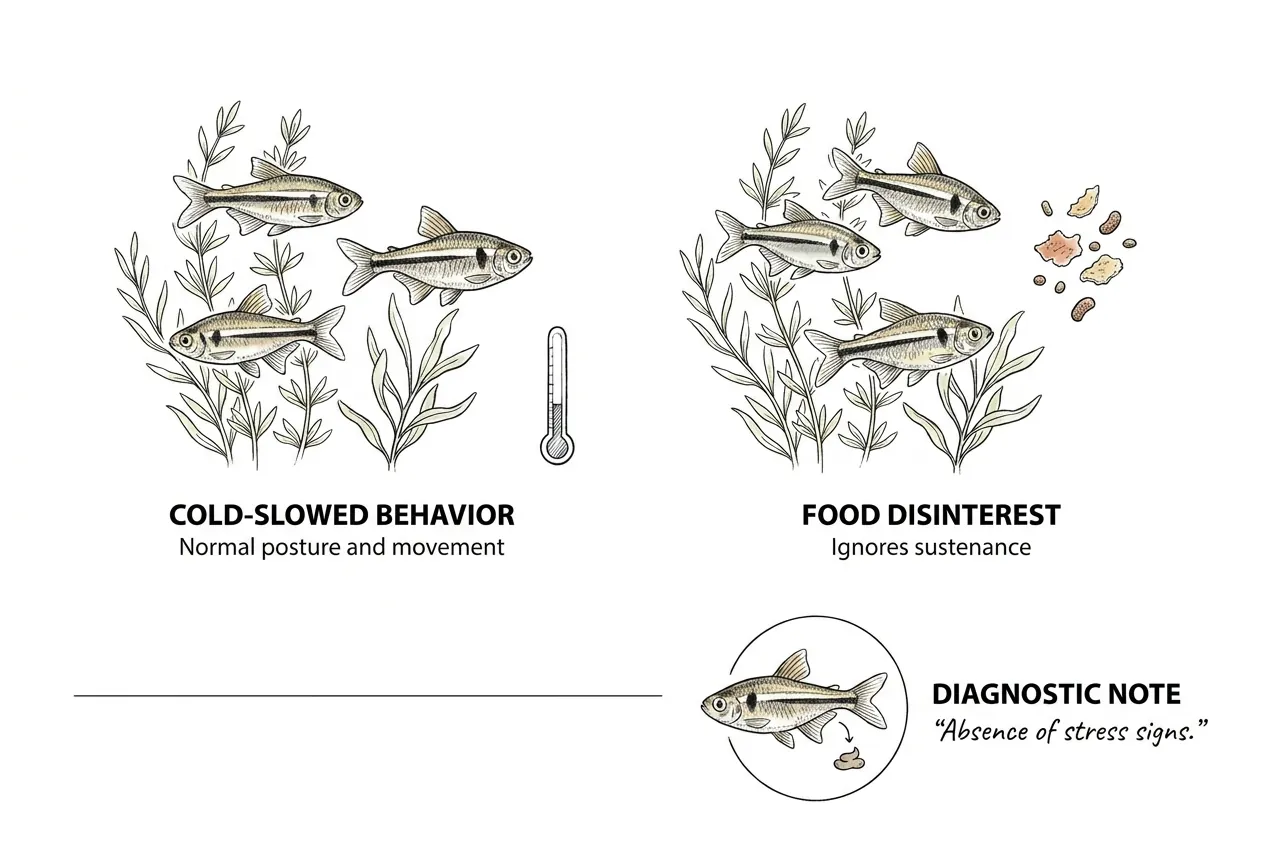
A cold-slowed fish swims and breathes normally, keeps its fins relaxed, and has normal feces. It is just less interested in food. The absence of specific signs, paired with a measured temperature drop, is itself useful diagnostic information.
A tetra school that still cruises midwater and breathes calmly but ignores a pinch of food, right after the tank cooled, is almost certainly tapering. Nothing about that picture points to infection.
Red flags that mean something else is wrong
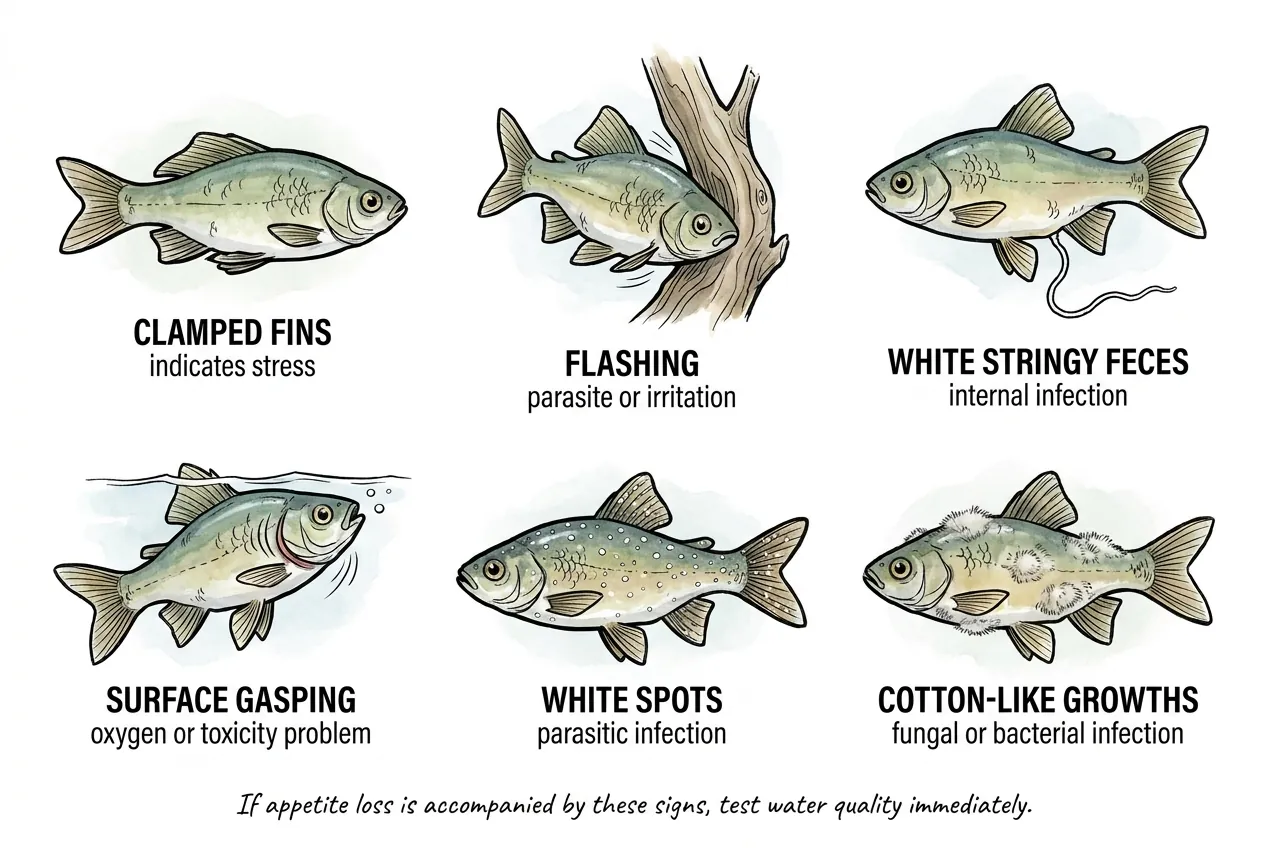
Certain signs move the problem out of the metabolic bucket and into disease or water quality.
Watch for clamped fins, flashing or scratching against decor, white stringy feces, rapid or labored gilling, surface gasping, white spots, cotton-like growths, and sudden isolation.
Each of these points to a cause that warming the tank alone will not fix. If appetite loss comes with any of these signs, stop blaming the cold and test your water before anything else. Flashing suggests irritation or parasites, white stringy feces suggests internal infection, and gasping with inflamed gills suggests a toxicity or oxygen problem.
A decision check before you change anything
Before I adjust feeding or reach for medication, I run a short check that separates a cold cause from a disease cause.
I read the tank temperature at the same time of day for several days in a row and write the number down, while scanning for the red-flag signs above.
If the temperature has fallen below my species’ comfortable range and no red-flag sign is present, I treat it as metabolic and stabilize temperature first.
If any red-flag sign shows up at any temperature, I do not attribute it to cold and I move straight to water testing and diagnosis.
I give a stabilized tank about 3 to 5 days to show a trend, which is my own conservative window.
That span is long enough to see change but short enough that real illness is not left waiting.
Not every fish reacts the same way
The same autumn drop is trivial for one fish and dangerous for another, because comfortable ranges differ widely.
Knowing your species’ range decides whether a cooling tank needs a heater or just a smaller portion.
Tropical community fish want the mid-20s
Most common community fish are comfortable in a fairly narrow warm band. The table below shows typical ranges for popular freshwater species.
| Species | Comfortable range | Autumn response |
|---|---|---|
| Betta | 25 to 28 C | Add heat if below range. Below 24 C cuts appetite and raises disease risk |
| Tetras | 23 to 27 C | Reduce feeding. Add heat if it slips into low 20s |
| Corydoras | 22 to 26 C | Reduce feeding. Tolerant of the lower end |
| Goldfish (coldwater) | 18 to 24 C | Usually reduce feeding only, no tropical heat |
For a tropical tank, a slide into the low 20s Celsius is the cue to add or set a heater.
Below its range, a warm-water fish both eats less and faces a higher disease risk, so cold stops being harmless.
Coldwater fish are supposed to slow down
Goldfish and white cloud mountain minnows are coldwater fish, so a cool autumn tank is often fine or even good for them.
Forcing tropical-level heat on a goldfish overdrives its metabolism and shortens its life.
So a goldfish eating less at 16 degrees Celsius in autumn is behaving exactly as it should.
The right response there is usually a feeding reduction, not a heater. This is also why mixing goldfish with tropical fish is a classic mistake, since one group is always out of its range.
What to actually do about a cooled tank
Measure the temperature, decide whether the species range is breached, adjust feeding, and raise heat gradually if you need it.
The order matters, because a rushed correction can stress fish more than the cold did.
Warm back up slowly if heat is needed
If your tank has fallen below the species range, raise the temperature gradually rather than all at once.
Spreading a correction over a day or more keeps you in the safe cold-stress zone instead of causing shock.
A jump from 22 to 25 degrees Celsius over two days is far safer than forcing it in an hour.
Set a heater to climb toward the target rather than dumping in warm water, and the same gentle-change logic applies in both directions.
Choosing and sizing that heater is its own decision with real tradeoffs. For how to pick one that holds a stable temperature without overshooting, see our aquarium heater buying guide.
If a heater is already misbehaving, read our guide on a heater stuck on in winter.
Keep the waste load low while the tank recovers
While the biofilter is running at reduced cold-weather capacity, keep the waste input down and watch your parameters.
Feed to appetite, remove anything uneaten, and test ammonia and nitrite through the transition.
A quick weekly test during the first cool weeks catches a small spike before it harms fish.
For the full mechanics of how a cold biofilter lets ammonia build, our piece on the cold-tank ammonia spike goes deeper.
Getting appetite back and preventing next year’s scare
Once temperature is stable and inside the species range, appetite climbs back up the same curve that suppressed it. Recovery follows the thermometer, not a fixed number of days.
What normal recovery looks like
Warming the water re-accelerates digestion, so hunger rebuilds as the gut starts clearing faster again. Expect interest to return over a few days of stable, in-range temperature rather than instantly.
There is no fixed healing time, because a simple taper injured nothing. If appetite does not return after several days at a correct, stable temperature, re-run the red-flag check rather than waiting indefinitely. Persistent refusal at the right temperature is a reason to look again for disease.
Preventing the autumn scare altogether
The scare mostly disappears when the tank holds a stable, in-range temperature through the season. A reliable heater set to the species range keeps both metabolism and the biofilter in their working band.
Match water-change temperatures, let seasonal change happen gradually, and size your heating before the cold arrives.
A tank held steady all winter never produces the autumn appetite scare in the first place.
Key Takeaways
- Fish are cold-blooded, so cooler water slows metabolism and appetite. This is physiology, not illness.
- A 3 to 4 degree drop can cut metabolic rate about a quarter and visibly reduce feeding interest.
- Feed to what fish finish in a few minutes, then remove leftovers to protect the slowed biofilter.
- Clamped fins, flashing, white stringy feces, or gasping mean disease, not a cold taper. Test the water.
- Match the response to the species. Warm a chilled tropical tank gradually. Coldwater fish usually just need less food.