
Microgreens Root Hairs vs Mold: The Mist Test and Triggers
Microgreens root hairs vs mold, settled with a one-minute mist test and a 24-hour edge check, plus the water, lid, and seed triggers behind mold.
Jordan Cole · Published 2026-10-31 · 19 min read
Key Takeaways
- White fuzz that sits only on roots and flattens under a light water mist is root hairs, not mold.
- Treat fuzz on seed hulls, unsprouted seeds, stems, or bare medium, or threads bridging seeds, as mold.
- A toothpick at the edge of a mixed patch, rechecked at 12 and 24 hours, shows whether it is spreading.
- Standing water, a cover left on too long, still air, crowded sowing, and contaminated seed all invite mold.
- Discard a moldy tray whole, and remember that a clean-looking tray can still carry invisible bacteria.
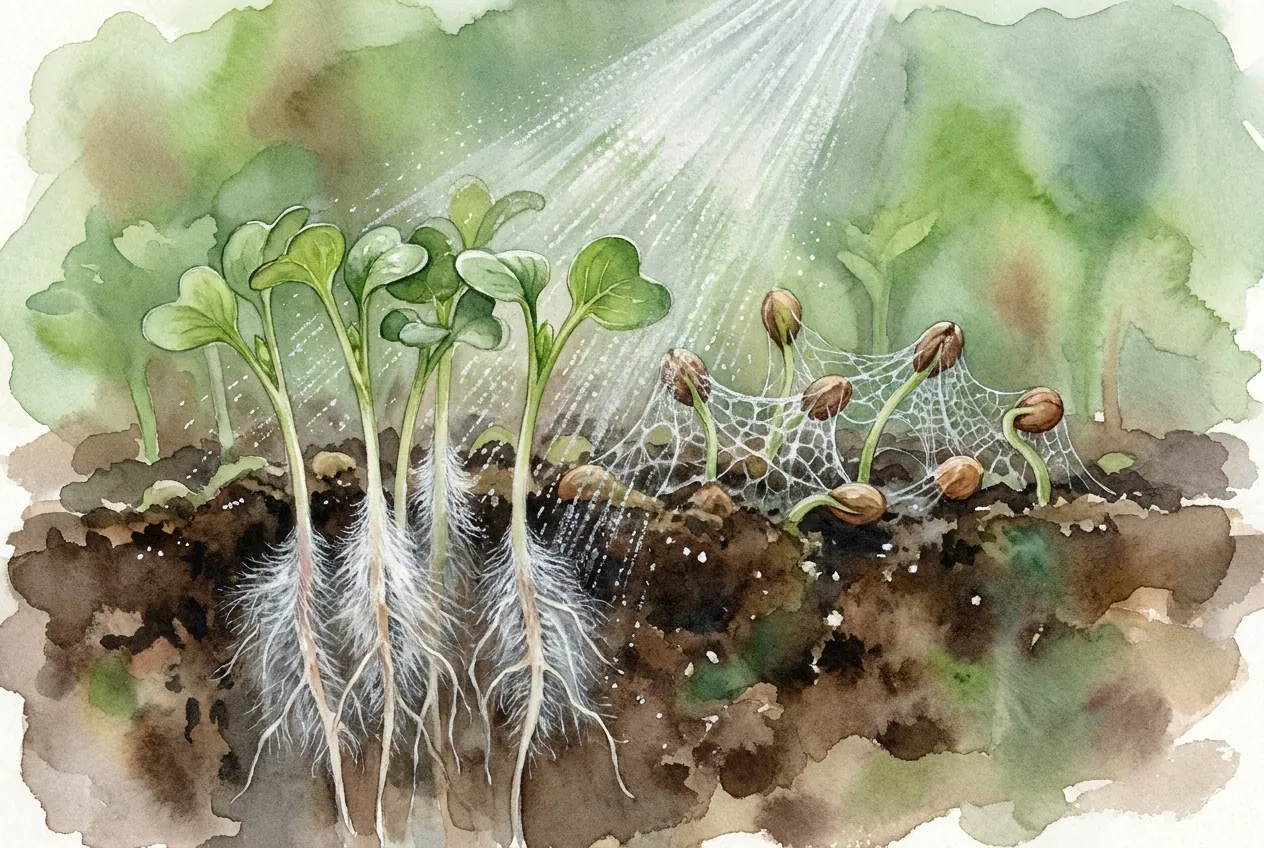
At the end of blackout, you lift the lid off a radish tray and every seedling wears a white fuzzy collar.
It looks exactly like the mold everyone warned you about. Usually, it is not.
The microgreens root hairs vs mold question comes down to where the fuzz grows and what it does when wet.
Root hairs are single root cells that sit only on roots, and a light mist makes them seem to vanish.
Mold usually grows on seed hulls, unsprouted seeds, and bare medium, bridges seed to seed, stays visible after misting, and spreads.
Fuzz confined to roots that collapses under a mist is root hairs, while fuzz on seeds, hulls, stems, or medium should be treated as mold. No visual check says anything about invisible bacteria, so seed choice and clean trays still matter.
Root Hairs, a Common False Alarm
Knowing what root hairs are, and why they show up on schedule, removes most of the panic when a tray turns white.
What Healthy Root Hair Fuzz Looks Like
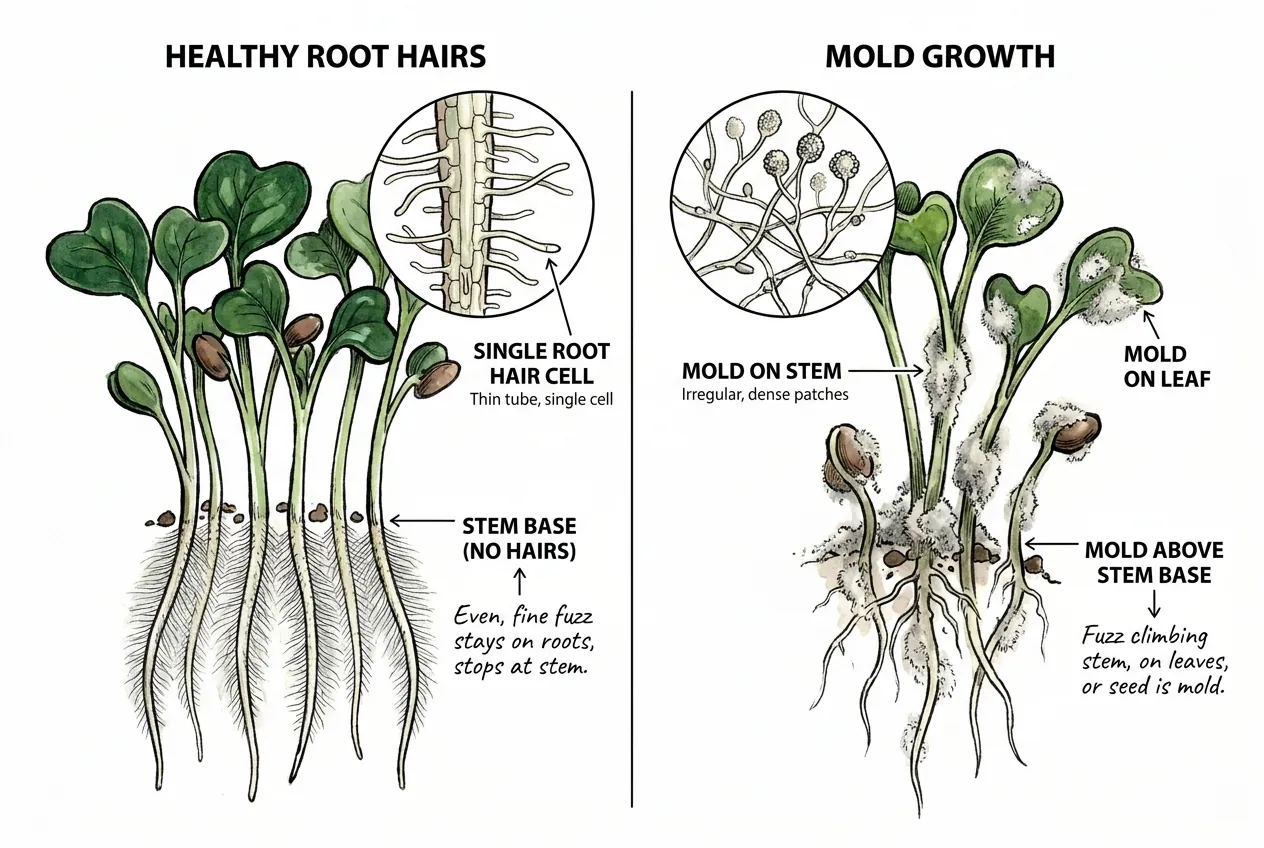
Each strand of fuzz is one cell. A root hair is a thin tube grown by a single cell of the root’s outer skin.
In Arabidopsis, a lab relative of radish and broccoli, root hairs are about 10 micrometers wide and a millimeter or more long.
Together they form an even, bottlebrush halo along each young root, with a bare tip at the end.
Where the root meets the stem, every skin cell grows a hair at once, which makes a dense white ring. The stem above that ring grows no root hairs at all.
That last fact is the most useful one on the tray. Fuzz climbing the stem, sitting on the seed leaves, or tufting from a seed with no root is not root hairs.
Root hairs exist to absorb water, and they grow well in moist air. Even, fine fuzz that stays on the roots and stops at the stem is the normal look of a healthy seedling.
Why the Fuzz Appears When the Lid Comes Off
Roots can tell air from a wet surface. In one study of Arabidopsis, maize, and rice, root hairs formed mainly on the side facing air, not the side touching wet media.
A blackout lid keeps the air above the tray close to saturated. Radicles, the first roots, lying on top of the medium are roots in humid air, the setting where dense root hairs are expected.
Timing lines up too. In lab Arabidopsis seedlings at 20 °C, every skin cell of the root and stem junction sprouted a hair about 40 hours after soaking began.
A radish or broccoli tray probably follows a similar schedule, though no microgreen study has timed it.
Humid, still air is also what mold likes. A sudden flush of white fuzz is usually root hairs, but it is also your cue to check airflow. Lift the lid once the crop’s covered time is up.
What Mold and Its Look-Alikes Look Like
Mold, damping-off, and seed gel each leave a different signature. Location does most of the sorting before any water touches the tray.
Mold Threads That Start on Seeds and Cross the Medium
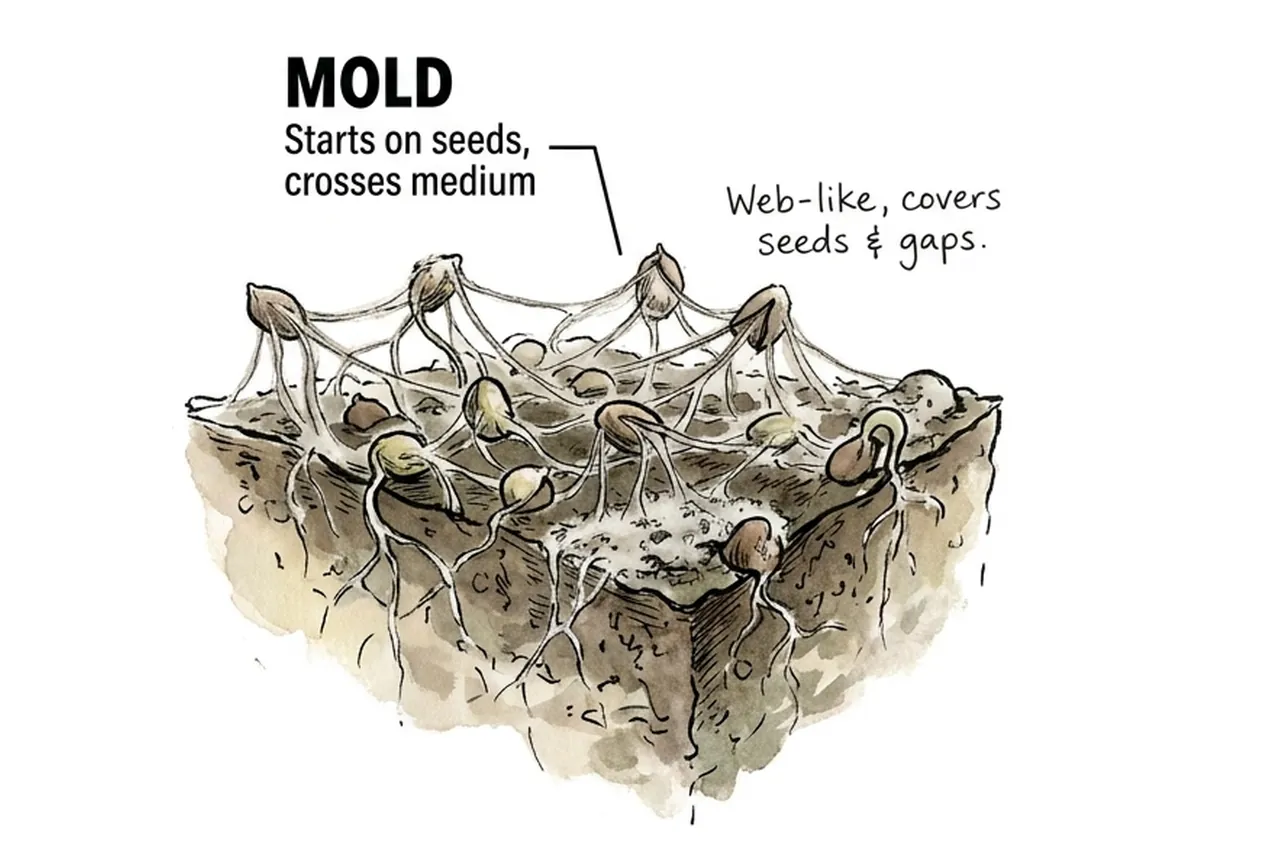
Mold is a web of fine threads, and on a microgreen tray it usually gets going on something that is not growing.
It often starts on a seed hull, an unsprouted seed, or bare medium, then runs across gaps and links seed to seed.
A kit handout hosted by Idaho State University describes mold as spidery growth that sits on the soil or covers the seeds, not the roots.
Seed that never sprouts is a classic starting point. UC IPM notes that seeds attacked before they germinate turn soft, mushy, and dark brown. Infested soil can also be laced with fine, threadlike growth.
Some crops arrive carrying mold more often than others. One study tested seed lots bought from online vendors. Mold and yeast turned up in all 10 sunflower lots and all 7 buckwheat lots, but in only 2 of 7 pea lots.
Sunflower and buckwheat go into the tray in their hulls, which rest right on the surface, so fuzz on those hulls deserves real suspicion. Any fuzz that starts on a seed, a hull, or bare medium instead of a root should be treated as mold.
Damping-Off Shows Up at the Stem Base
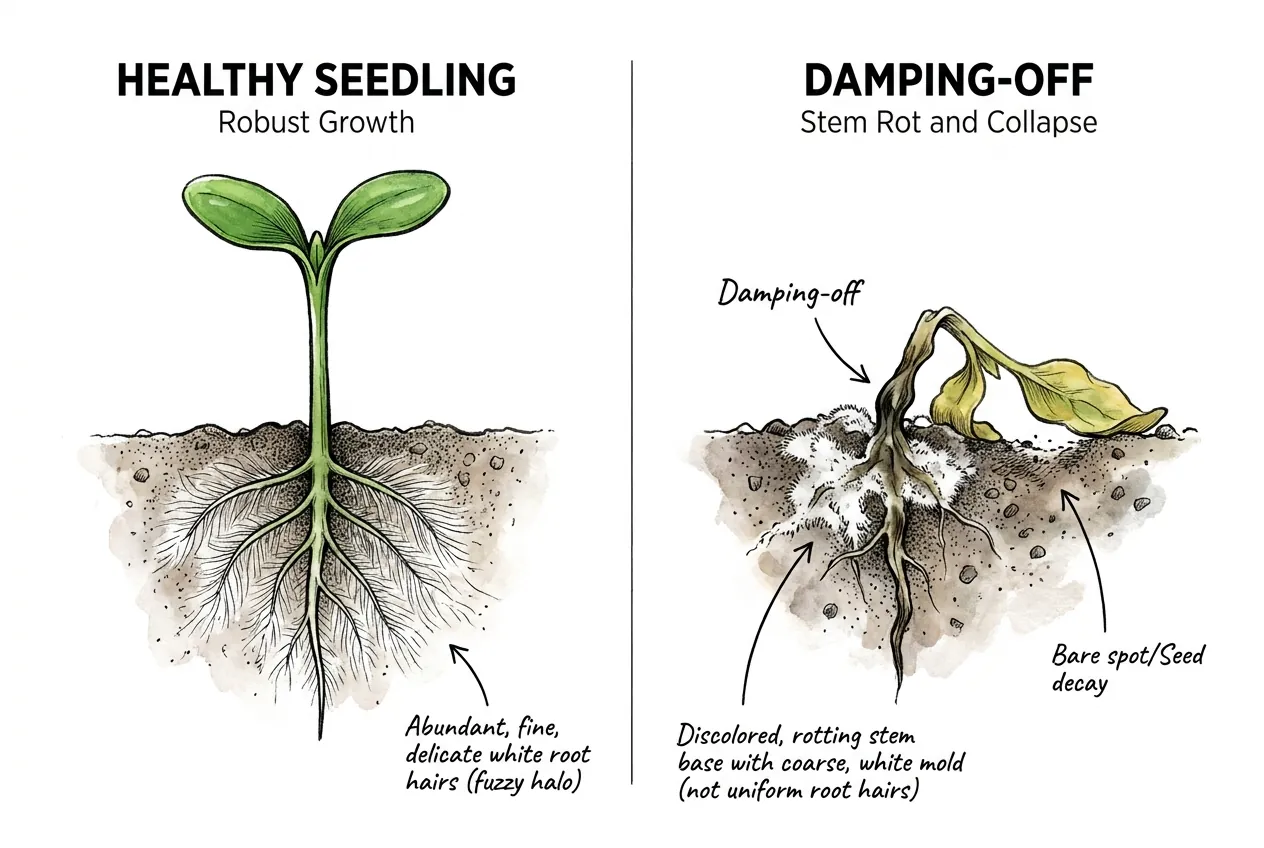
Damping-off is a rot, not just a fuzz. It is caused by water molds such as Pythium and Phytophthora, plus fungi such as Rhizoctonia and Fusarium.
Infected seedlings get a discolored, rotting stem near the soil line, then wilt and collapse. In high humidity, white, fluffy growth of the pathogen can form on the infected tissue, which is where it gets confused with root hairs.
So the test here is the stem, not the fuzz. A seedling that topples with a discolored, rotting base should be treated as damping-off, whatever the fuzz around it looks like. Bare spots that look like poor germination can be the same disease striking early, since Pythium seed decay is common.
Seed Gel Is Not Mold
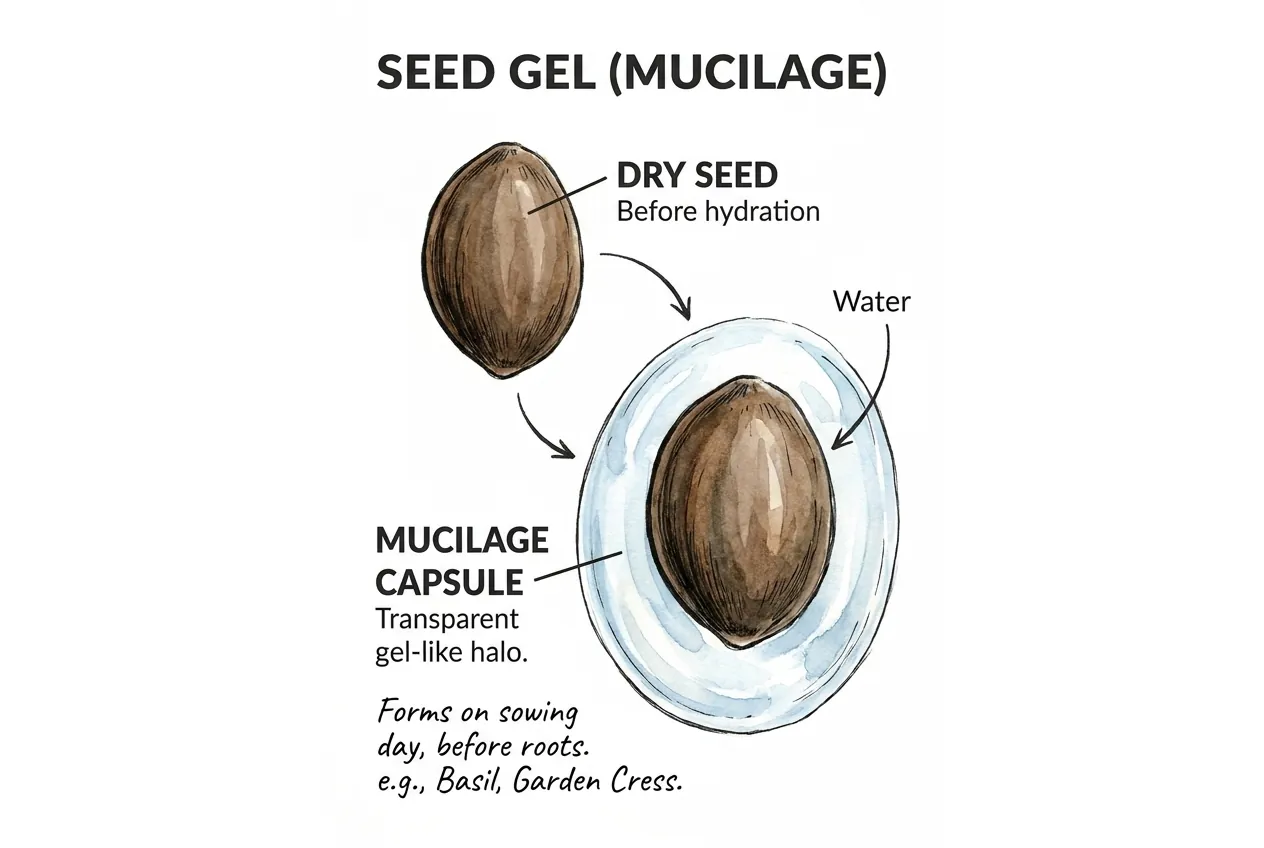
Some seeds wrap themselves in clear gel soon after they get wet. Basil and garden cress form this mucilage as a transparent, gel-like capsule just after hydration.
The gel appears on sowing day, before any root exists, as a glossy, slippery halo around each seed. It has no threads and does not spread. It helps hold water around the germinating seed.
The crop decides whether gel is possible at all. In a screen of 27 species in the mustard family, 19 released mucilage, including garden cress and two mustards, while radish did not.
Another mustard in that screen, Brassica juncea, made none, so check the Latin name on the packet.
A clear halo on basil or cress seed is gel, but white fuzz near a radish seed is root hairs or mold, never gel.
The Mist Test for Root Hairs vs Mold
When the fuzz sits on roots and you still are not sure, a light mist of plain water usually settles it.
Why Water Beads on Mold but Flattens Root Hairs
Mold threads that grow up into the air carry a coat of proteins called hydrophobins. The coat makes aerial mold water repellent, while threads growing inside wet material stay wettable.
The effect is large. Water sat on normal lab-grown mycelium at a contact angle of 115 degrees, similar to Teflon.
It soaked straight into a strain unable to make the main hydrophobin.
Root hairs have no water-repellent coat, so water wets them and the fine strands cling to the root. Upright, aerial mold stays visible when misted, while root hairs collapse. The blind spot is young, flat mold on soggy medium, which can wet like root hairs, so medium fuzz is judged by location alone.
How I Run the Mist Test
The bottle matters more than it seems. Mine is a fine-mist sprayer that has only ever held plain water, because peroxide, vinegar, or soap residue could change how the fuzz wets.
First comes a look from arm’s length at where the fuzz sits. Fuzz on hulls, unsprouted seeds, stems, or bare medium, or threads bridging seeds, skips the test and goes straight to the discard rules. Location overrides the mist.
Next, I pick a reference seedling in the same tray whose fuzz is clearly on its root only.
From about 30 cm (12 inches), the suspect patch gets two or three pumps, and the reference gets the same.
A hard stream or a close spray can flatten mold by force and fake a collapse, which is why the distance stays fixed.
At about one minute, I look again from the same arm’s-length spot under the same light, without leaning in.
The result has three outcomes. Fuzz that flattens and turns glossy like the reference seedling reads as root hairs, and fuzz still visible across the whole patch reads as mold. Mold may bead water, stay fluffy, or mat down, but at about one minute it is still in view.
Root fuzz where some strands vanish and others stand counts as mixed. If the reference seedling stays fuzzy, the test has no baseline, so the patch also counts as mixed.
A mixed result goes to the marked-edge check below instead of a guess.
The 30 cm distance, the pump count, and the one-minute look are my own settings rather than values taken from a published method.
They keep the spray gentle, avoid puddling an already humid tray, and catch the collapse before evaporation lets the fuzz spring back.
One grower guide describes the same split, with root hairs disappearing and mold matting down but staying visible.
Keep your face back and never sniff the tray. EPA notes that inhaling mold or spores may cause allergic reactions and can trigger asthma in sensitive people.
Root Hairs vs Mold at a Glance
Read across a row to compare what you see on the tray.
| Clue | Root hairs | Mold | Damping-off |
|---|---|---|---|
| Where it sits | Along roots and the root and stem ring only | Seed hulls, unsprouted seeds, bare medium | Stem base at the medium line |
| Shape | Even, fine, radiating halo | Spidery threads that bridge seeds | Rotted stem, sometimes white fluff |
| After a light mist | Flattens and turns glossy | Still visible, beaded or matted | Stem stays rotted |
| Over 24 hours | Stays on roots | Spreads past a marked edge | Collapse spreads to neighbors |
| Seedling | Upright and firm | May be overgrown | Topples |
| Next step | Keep growing | Discard the tray | Discard the tray |
The table answers a mold question only. Microgreens can carry human pathogens without any visible sign of spoilage. A root hair verdict never proves a tray is safe to eat.
Settling a Mixed Result With a Marked Edge
Mold grows outward from a starting point, so a marked edge turns a hunch into an observation.
Right after a mixed mist test, a toothpick goes into the medium at the outer edge of the white patch. I also take a phone photo from a fixed spot.
Nothing changes between checks. Watering, fan, and light stay the same, with rechecks at 12 and 24 hours from the same viewing distance.
My working rule calls it mold when any of these shows up at either recheck.
- Fuzz that is not attached to a root spreads more than about 3 mm past the toothpick, across bare medium or between seeds.
- New fuzz appears on nearby hulls or stems.
- Grey, green, or black dots develop.
Fuzz that advances only along a lengthening root, still ending in a bare tip, is new root hair growth and does not count.
A toppled seedling with a rotting base reads as damping-off. If the fuzz is still only on roots at 24 hours, with none of the signs above, the patch reads as root hairs.
The 3 mm margin is mine, set wider than the error of marking a fuzzy edge.
The 12 to 24 hour window rests on lab data. Rhizopus molds isolated from food grew 1.5 to 2.0 mm per hour on very moist media.
A tray is cooler and poorer in sugar than lab media, so real spread is probably slower.
By my estimate, even a tenth of that rate would carry an active colony past a 3 mm margin within a day.
A slower mold may still need more than a day to show spread, so the marked patch gets a daily look until harvest.
Any one of the three mold signs, at a recheck or a later daily look, means the whole tray goes. Never taste or eat greens from a tray during the 24-hour watch.
The Real Mold Triggers
Mold needs spores, food, and moisture, and still air helps it along. On a microgreen tray they come from standing water, a cover left on too long, crowded sowing, and the seed itself.
Water Left Standing in the Tray
Pythium and some other damping-off pathogens have spores that swim in a film of water, so trays standing in water let them travel between seedlings.
Utah State Extension’s microgreen method wets the coir from below, then discards any water still in the bottom tray after 30 minutes.
Its moisture target for coir is the feel of a wrung-out sponge, wet to the hand without dripping.
Every bottom watering is a measured pour, followed by a 30-minute timer. At the bell I lift the growing tray and pour off whatever is left. Then I look across the medium at a low angle under the shelf light.
Leftover water or a glossy, filmed surface means the tray is wetter than the wrung-out sponge target.
Leftover water shrinks my next pour by about a quarter, while a glossy surface alone delays it until the surface turns matte.
A matte surface and an empty bottom tray mean the routine is working.
Applying Utah State’s 30-minute soak drain to routine waterings, and the quarter cut, are my own adaptations rather than published guidance.
The cut stays small so the medium does not swing to dry. Water that sits in the bottom tray keeps the root zone saturated, which is where water molds thrive.
Humid, Still Air Under a Lid Left On Too Long
A humidity dome or blackout cover helps seeds germinate, then starts working against you. Oregon State Extension advises removing a plastic cover right after germination to avoid excess humidity. A blackout cover follows a different clock, and Utah State’s method lists its covered time crop by crop.
Room humidity is not tray humidity. UMass Extension’s greenhouse guidance places the most humid air inside the plant canopy, where moisture from the leaves gets trapped by still air.
UMass also gives a simple airflow test. Air movement is adequate when the leaves move slightly, which keeps leaf surfaces from cooling to the dew point.
Droplets inside the lid mean the air has reached its dew point. Pull a clear humidity cover at germination, end a blackout cover on the crop’s schedule, then run a gentle fan so seedlings barely tremble. Keep the fan and its cord clear of the water tray.
Seed Sown Too Thick
Crowding shortens the bridge a pathogen has to cross. In controlled experiments with garden cress, damping-off multiplied and advanced faster at high seedling density, passing readily between neighboring plants.
Dense sowing also traps humid air in the canopy, which stacks on top of the lid problem.
Sowing rates and the yield tradeoff are covered in the guide to high-density microgreens planting.
If mold keeps starting in the densest middle of the tray, sow the next one lighter.
Seed That Arrives Contaminated
Seed can carry both mold spores and bacteria into the tray. FDA treats microgreens as produce rather than sprouts, but its sprout guidance makes a point that likely applies to microgreen seed too.
Many seed treatments reduce, but do not eliminate, pathogens, and survivors can multiply during sprouting. Even treated seed cannot be counted on to be pathogen-free.
UC ANR’s home sprouting guide starts with buying seed certified as pathogen-free, and notes that organic does not necessarily mean pathogen-free.
It also advises against chlorine seed treatments at home, so keep bleach away from seed.
Choosing seed sold for sprouting or microgreens from a supplier that tests its lots is the first food-safety decision you make. Keep the packet with the tray, so you can match the lot if a recall is announced.
For tray, light, and seed choices, see the microgreens grow kit chooser.
When It Is Mold, Discard the Tray and Reset
Once a patch reads as mold, the question is no longer whether the greens can be eaten. The job becomes safe disposal and a clean restart.
Why the Whole Tray Goes
USDA’s Food Safety and Inspection Service tells consumers to discard soft, high-moisture fruits and vegetables with mold, because they can be contaminated below the surface.
FSIS does not list microgreens by name, but they are tender, wet, and share one medium, so a moldy tray belongs with them.
The visible fuzz is only part of the organism. FSIS explains that mold has thread-like roots that can run deep, and that spores give mold its color. Moldy food may also carry invisible bacteria.
None of the food-safety guidance cited here offers a way to salvage the clean-looking corner of a moldy tray. When in doubt, throw the whole tray out, greens, roots, and medium together. Do not sniff it, since FSIS warns that can cause respiratory trouble.
Bag the contents and put them in a covered trash can. Then wipe the shelf spot and check the neighboring trays.
Resetting the Tray for the Next Sowing
NC State Extension calls new trays with new growing media the best way to limit pathogen carryover from the last crop.
A reused tray should first be scrubbed free of all old medium and debris.
For disinfecting used containers, Maine Extension’s seed-starting bulletin uses one part chlorine bleach to nine parts water.
NC State adds that most disinfectant solutions should be rinsed off after soaking, because residue can damage the next crop.
Bleach irritates skin and eyes, so wear gloves and eye protection. NC State and CDC both advise good ventilation and following the label directions. Never mix bleach with ammonia, vinegar, peroxide, or any other cleaner, because CDC warns that the vapors can be dangerous to breathe.
A new or fully disinfected and rinsed tray with fresh medium gives the next sowing a clean start.
Reading the Fuzz Next Time
The first call takes about a minute, and a mixed patch needs at least one more day. The order never changes.
- Check location first. Fuzz on roots only goes to the mist test, while fuzz on hulls, seeds, stems, or medium should be treated as mold.
- Mist gently from about 30 cm and look again at about one minute. Fuzz that flattens like a clean reference seedling is root hairs.
- Mark the edge of a mixed patch on the roots and recheck at 12 and 24 hours.
- Discard any tray that reads as mold, then fix standing water, the cover, airflow, density, and seed source before the next sowing.
A root hair verdict means the tray keeps growing, with moving air and a daily look until harvest.
It speaks to visible mold only, so keep the seed packet with the tray in case that lot is ever recalled.