
Stop Kratky Basil Bolting: Photoperiod and Pinch Fix
Passive-hydroponic basil bolts in late summer from long days, heat, and maturity. Fix it with photoperiod control, a cool reservoir, and correct pinching.
Samuel Reed · Published 2026-08-20 · 17 min read
Key Takeaways
- Basil bolts from long days, heat, and maturity together, so pull all three levers.
- Cool a passive reservoir to 65 to 72F, since warm water loses oxygen and speeds flowering.
- Read a rising EC as a signal to dilute with plain water, and refresh about every two weeks.
- Hold a fixed 12 to 14 hour photoperiod under a bright LED to weaken the flowering cue.
- Pinch above a leaf pair weekly and remove flower buds on sight to keep harvesting.
Your Kratky basil looked perfect in July. Now, in late August, the tops have gone pointy, the leaves near the crown are shrinking, and tiny flower buds are stacking up where lush leaves used to be.
That is bolting, the plant switching from making leaves to making seed.
It is not a mystery and it is not bad luck. It is three ordinary forces arriving at once, and each one has a lever you can pull this week.
What Actually Triggers Basil to Bolt
Bolting is a combined response to day length, accumulated heat, and plant maturity, not any single cause. Sweet basil behaves as a facultative long-day plant. Long days push it to flower sooner, but it is not obligate, so it will eventually flower under most conditions once it is old enough and warm enough.
That is why you cannot fully stop a mature plant from flowering with one trick, but you can delay it a long way by working all three forces together.
Late summer is the perfect storm. Days are shortening but are still long, the accumulated heat of the season has built up, and your plant is now mature and tall. Each force nudges the same switch.
Day Length Is a Lever, Not an On/Off Switch
Long days speed flowering, but short days delay rather than permanently prevent it. Controlled-environment researchers grew sweet basil ‘Nufar’ under a daily light integral of 13 or 23 moles per square meter per day and either a 9-hour or a 16-hour photoperiod.
They ran it that way specifically to separate the effect of day length from the effect of total light.
The mechanism is that leaves sense long days through the phytochrome system and send a mobile florigen signal to the growing tip. That signal flips the tip from making leaves to making flowers.
Because basil is facultative, a controlled photoperiod delays bolting rather than switching it off, so it must be paired with cooling and pinching.
Heat Speeds the Whole Clock
Warmth pushes basil to flower in fewer days even under identical light. In greenhouse trials, basil grown at about 82°F flowered roughly 11 days sooner than basil at about 72°F under the same light.
Consistent daytime highs above roughly 75°F, especially with warm nights, accelerate floral development.
The reason is thermal time. Basil development tracks accumulated warmth, often measured as growing degree days. Hotter plants bank those degree days faster, so they cross every developmental threshold, including the flip to flowering, in fewer calendar days.
Cooling the canopy and the reservoir slows that clock and buys vegetative harvest time.
Maturity Sets the Stage
A plant bolts only once it is old and large enough to respond. Most cultivars begin flowering after producing roughly 6 to 8 true-leaf pairs and reaching about a foot tall.
Very young plants resist flowering no matter the conditions, because the tip must pass a juvenile phase before it can respond to flowering signals.
This is why one plant bolts while its younger neighbor stays leafy. It is also why succession sowing, starting a fresh batch every few weeks, is quietly one of the strongest bolting defenses.
There is always a young, flowering-resistant plant coming up behind the one that is about to flower.
Why Passive Reservoirs Make It Worse in Summer
A non-circulating reservoir runs hot in late summer, and hot water quietly starves and stresses the roots.
In a Kratky or wick system there is no pump, so the water tracks the room temperature and the roots depend on the widening air gap for oxygen.
Two things then go wrong together, and both add stress that pushes the plant toward flowering.
Warm Water Holds Less Oxygen
Warm water simply cannot hold as much dissolved oxygen as cool water. Oxygen solubility falls as temperature rises, which is Henry’s law in action, and above roughly 72°F dissolved oxygen drops off noticeably even with aeration.
In a pump-free reservoir there is no aeration to fight it, so cooling the water is the single cheapest way to raise available oxygen.
Aim to keep the root zone around 65 to 72°F, and treat 75°F as a warning line.
Above roughly 78°F, root-disease risk climbs as oxygen falls and respiratory demand rises. General guidance puts healthy root-zone dissolved oxygen at or above about 6 parts per million.
The practical read is simple. A reservoir at 68°F and one at 84°F hold very different amounts of oxygen, and the warm one browns roots first.
In a pump-free passive system, cooling the reservoir is the primary way to protect roots, because you cannot force oxygen in mechanically.
Cool the Reservoir Without a Chiller
You can drop a passive reservoir several degrees with cheap passive measures, no chiller required. The most effective approach stacks a few of them.
Insulate and shade the vessel
Wrapping a reservoir in foam insulation board can hold it several degrees cooler, and a thicker foam layer on a larger vessel reduces the daily temperature swing further.
A reflective wrap of foil or mylar and a position out of direct sun both cut the heat the water picks up.
Add thermal mass and airflow
A larger water volume warms and cools more slowly, so a bigger reservoir buffers midday spikes.
A small fan moving air across the water surface adds evaporative cooling, and a swapped-in frozen water bottle knocks down a hot afternoon.
Stacking shade, insulation, and volume is cheaper and steadier than a powered chiller.
Protect the Air Gap When You Top Off
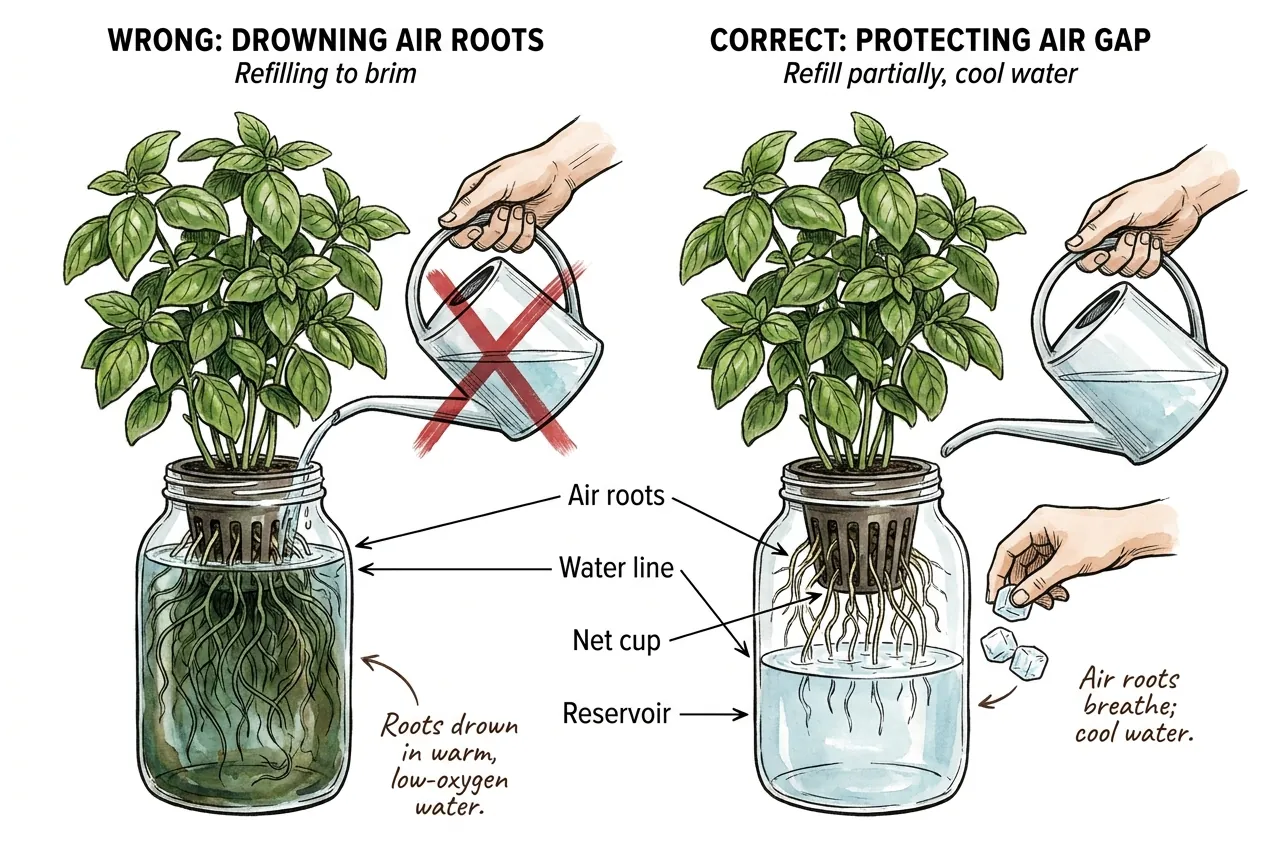
In Kratky, the air gap is the oxygen supply, so refilling to the brim in a heat wave can drown the roots that breathe air.
As the plant drinks, the water level falls away from the net cup and the exposed roots become air roots, taking oxygen straight from the atmosphere.
If you top the vessel back to full, you submerge those air roots in warm, low-oxygen water and can trigger a fast decline.
When roots brown near the old water line, cool the water and let the gap widen again rather than refilling. The air-root fraction will carry the plant.
Keep the Nutrient Solution From Drifting
As a static reservoir draws down, the solution concentrates and the plant gets saltier water, which adds stress that compounds bolting.
Early on, the plant drinks water faster than it takes up nutrients, so the leftover solution becomes more concentrated and the reading on an EC meter creeps up. pH drifts at the same time.
The fix is a short measure-and-correct routine rather than guesswork.
Read a Rising EC as a Signal to Dilute
When EC climbs while the water level drops, the answer is plain water, not more nutrient.
A rising EC on a falling reservoir means the plant is taking up water faster than salts, so the solution is concentrating.
Top up with plain pH-adjusted water to restore the balance, and do a full reservoir change if it stays high.
Basil grows well at roughly EC 1.0 to 1.6 millisiemens per centimeter, starting at the low end for young plants.
Hold pH around 5.5 to 6.5, with 5.5 to 6.0 as the uptake sweet spot. Outside that pH band, some nutrients lock out and new growth goes pale.
Refresh on Schedule and Do Not Over-Feed
A regular reservoir change flushes accumulated salts, and pushing extra fertilizer at a stressed plant backfires.
A full change roughly every two weeks clears the salt buildup that would otherwise concentrate as unusable residue.
Excess nitrogen does not rescue a bolting plant, and it worsens the bitterness of bolted leaves.
Small non-circulating reservoirs also drift in pH faster than large circulated systems, so check pH more often and make small corrections toward the band.
The Photoperiod Fix, Control the Day Length Under Lights
The single most controllable lever is day length under an indoor light on a timer. Because basil is facultative, holding a shorter, fixed photoperiod weakens the flowering signal, while total light quantity keeps driving leaf growth.
Indoors you decide the day length, so the plant never sees the long summer days that a window plant gets.
Photoperiod and DLI Are Separate Levers
Day length signals flowering, while the daily light integral drives growth, and you can lower one without losing the other.
That ‘Nufar’ study tested 9-hour versus 16-hour photoperiods at a DLI of 13 versus 23 moles per square meter per day precisely because these are different controls.
A short but bright day can deliver strong growth while sending a weaker flowering cue.
In practice, set a fixed schedule around 12 to 14 hours on a plug-in timer and raise intensity to keep the daily light dose up.
A 12-hour day at higher light can match the leaf growth of a 16-hour day while pushing the plant toward flowering less hard.
Hold a fixed shorter photoperiod on a timer and raise intensity, so the plant gets its full light dose in fewer hours and receives a weaker flowering signal.
Hit a Solid Light Dose for Dense Leaves
Vegetative basil needs a real light dose, or it stretches and pales. The controlled-environment work used DLI levels of 13 and 23 moles per square meter per day, and leafy-herb guidance targets a moderate daily dose.
Meeting that dose at a shorter photoperiod means running a proportionally brighter light, which a good LED can supply.
If growth stretches and leaves thin out, raise intensity or lower the light rather than lengthening the day.
Enthusiasts verify canopy light with a PAR meter, but you do not need one to start.
A bright LED at a sensible height and a fixed 12 to 14 hour timer covers most home setups.
To choose an actual light by canopy light dose rather than watts, use the grow-light chooser by PPFD and DLI.
The Pinch Fix, Use Apical Dominance to Your Advantage
Pinching works because basil is apically dominant, so removing the tip forces two new shoots and delays flowering.
The growing tip makes the hormone auxin, which travels down the stem and holds back the buds below it. Cut the tip and you release that brake.
Why One Cut Becomes Two Shoots
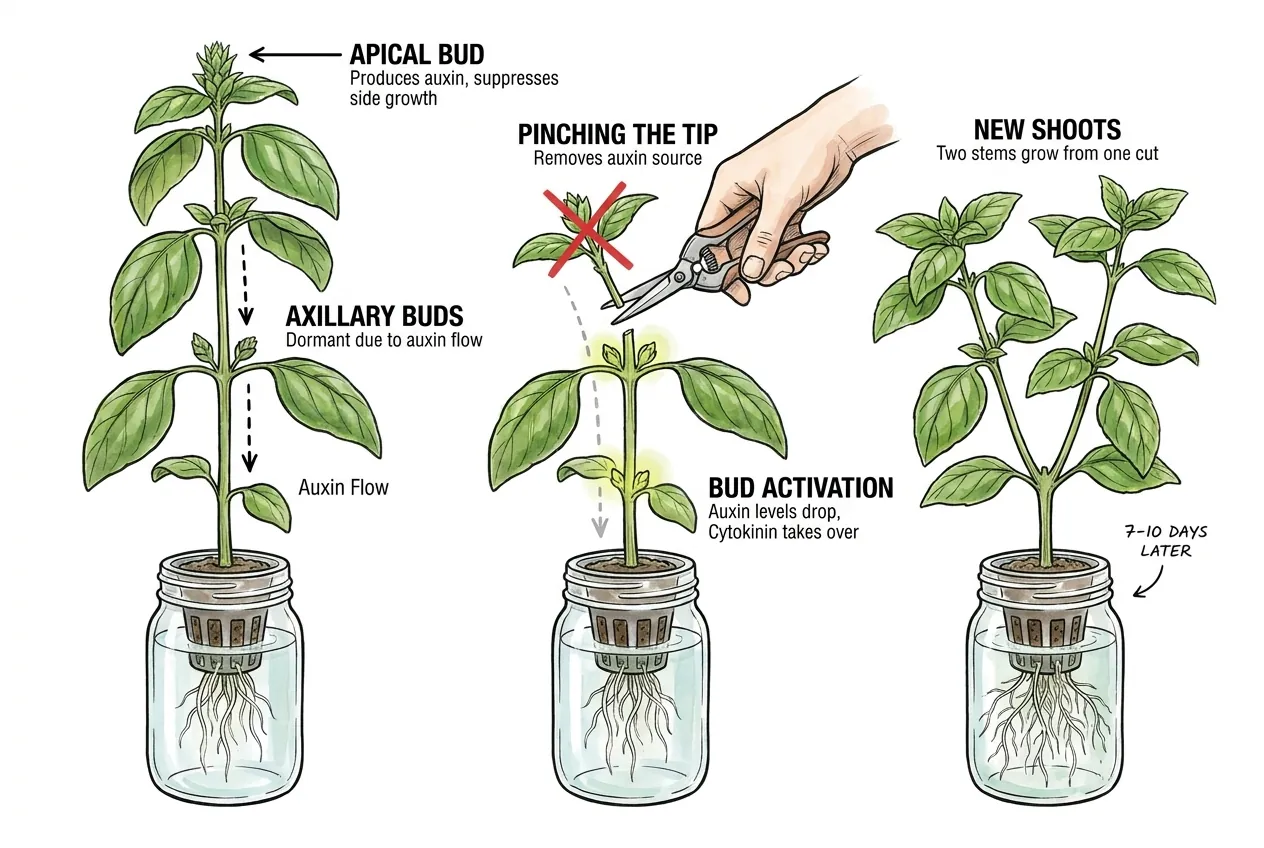
Removing the apex lowers auxin at the buds beneath it and lets them break. When you pinch the tip, the two axillary buds at the node directly below activate and each produces a new shoot.
As a general rule of thumb, that break happens within about 7 to 10 days in warm conditions.
One stem becomes two, the plant gets bushier, and you have removed the tissue that would have flowered.
The hormonal picture is a shift in balance. With the auxin source gone, the buds respond to cytokinin and grow out, which is exactly what turns a single leggy stalk into a dense bush.
Where and When to Cut
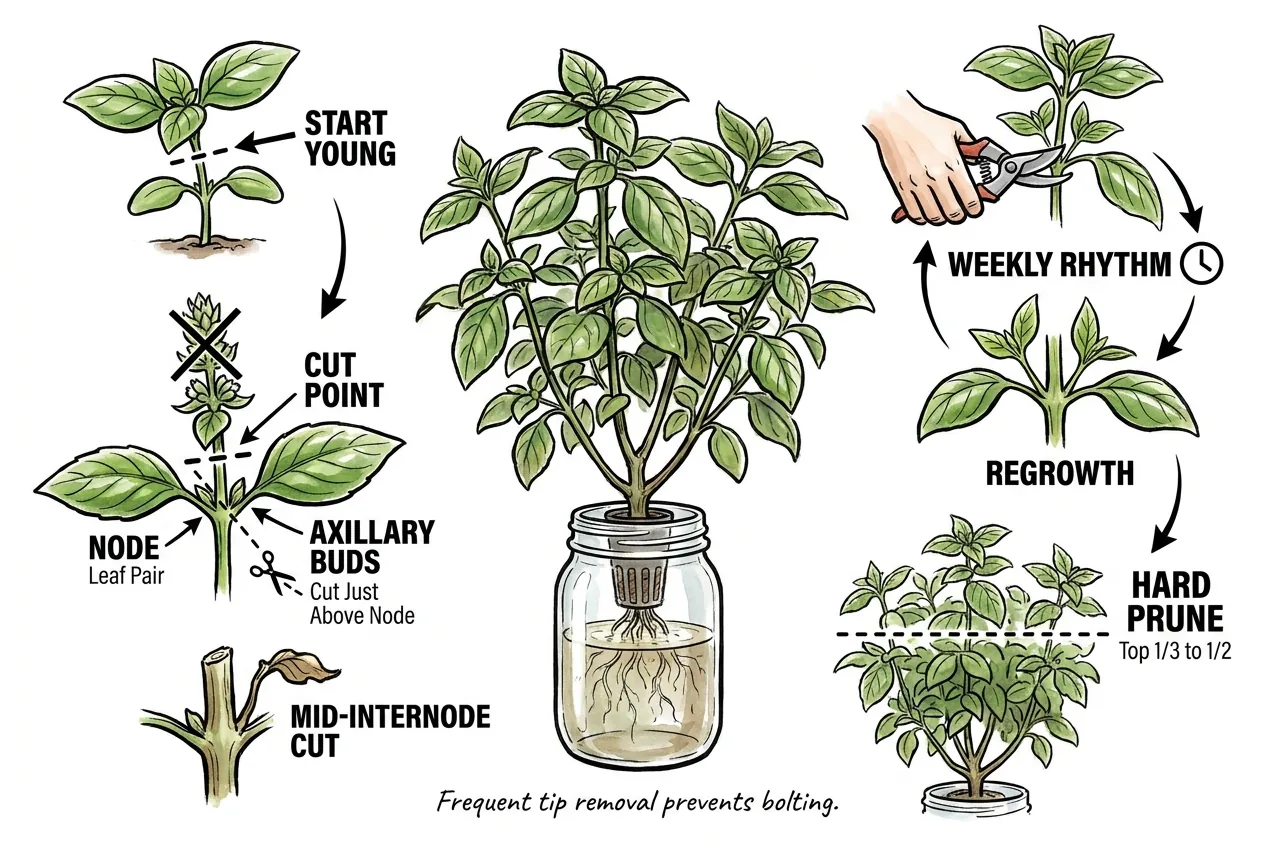
Cut just above a healthy leaf pair, and start young. The axillary buds sit in the leaf axils at each node, so cutting just above a node leaves them intact to break, while cutting mid-internode leaves a dead stub.
Begin pinching once the plant has about three sets of true leaves, and always leave one or two leaf pairs below your cut so the plant can rebuild.
Then keep a rhythm. Harvesting at least weekly in peak season is itself the best bolting prevention, because every cut removes the tip that would otherwise flower.
A hard prune of the top third to half every couple of weeks keeps the plant in dense, productive growth.
Cut just above a healthy leaf pair on a weekly rhythm, and remove any flower bud on sight, because frequent tip removal is the strongest day-to-day bolting defense.
Catch Bolting Before It Wins
The reproductive switch shows up at the growing tips before any open flower, and catching it there keeps your fixes working.
The earliest signs are tighter, smaller leaf pairs at the top, elongating internodes, and a squared-off or budding growing point.
Once the tip commits, it makes compressed nodes and flower buds instead of normal leaf pairs.
Inspect the top inch of each stem every week, which folds neatly into your weekly harvest.
Spot the crowded, budding tip and pinch it, and you keep harvesting for weeks longer.
I hold a small white card behind the growing tip and photograph it from the side before the weekly harvest. The plain background makes a squared flower cluster and shortening internodes much easier to see than they are against a mass of overlapping green leaves.
The first photo from each plant stays beside the newest one. If the silhouette has changed but the plant also wilts at midday, I treat tip shape and heat response as separate clues. I do not assume every small top leaf is bolting.
Tell Bolting Apart From Heat Wilt and Deficiency
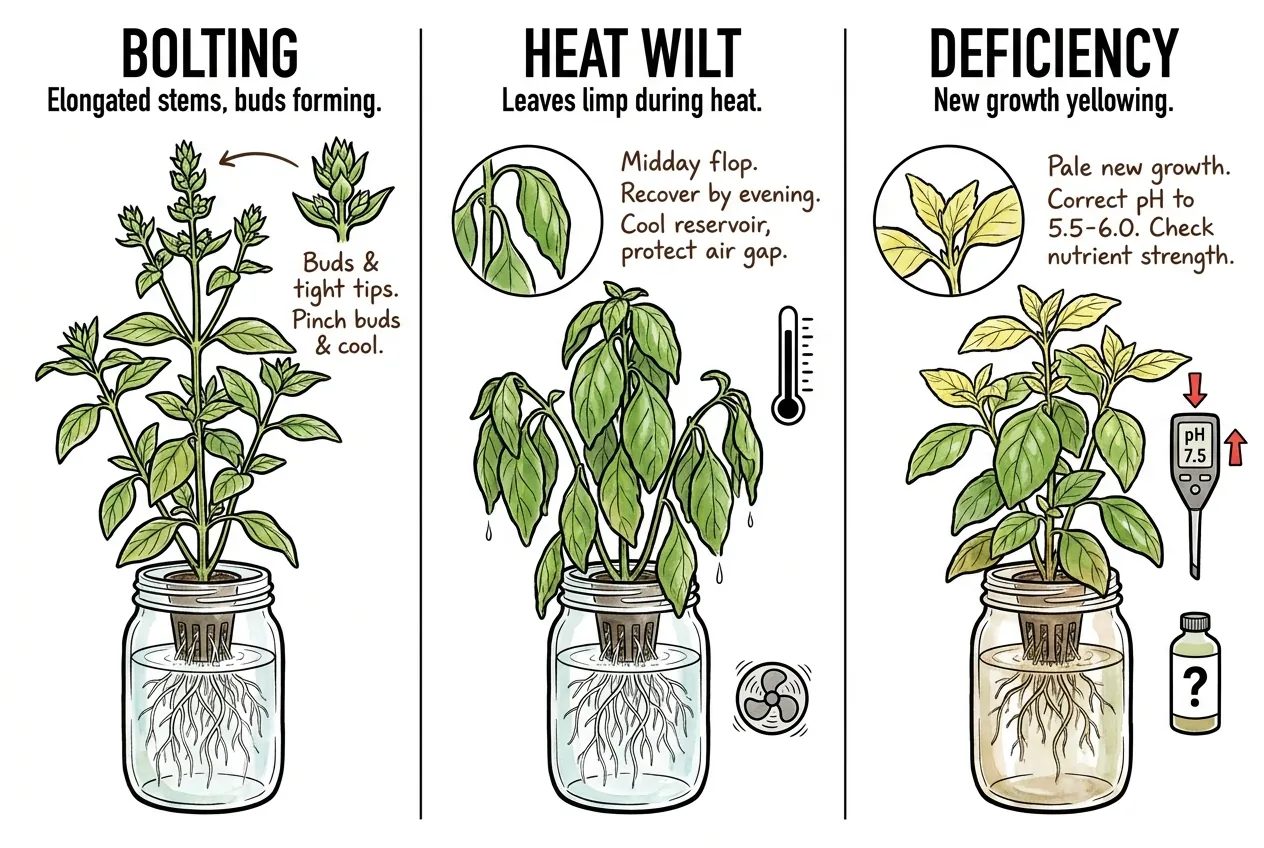
Different symptoms point to different levers, so read the whole plant. Buds and tight tips mean bolting, so pinch and cool.
A midday flop that recovers by evening is heat and low root oxygen, so cool the reservoir and protect the air gap.
Pale new growth points to pH out of band or low EC, so correct pH toward 5.5 to 6.0 and check the nutrient strength.
Matching the sign to the lever stops you from misreading a heat-stressed plant as a bolting one, or over-feeding a plant that actually needs its pH fixed.
What Bolting Does to Flavor, and How to Salvage a Plant
Bolting is not just cosmetic, because flavor chemistry drops as the plant flowers, and a hard cutback can often reset it.
As basil moves into flowering, essential-oil content and yield decline and the aroma shifts. Reported flavor intensity can fall by more than half after flowering, and leaves can turn sharp, medicinal, or bitter.
Flavor Falls Because the Plant Reallocates Resources
Linalool, the sweet floral note, drops as the plant redirects energy toward seed. Reported linalool sits at roughly 55 to 70 percent of the oil depending on cultivar and stage, and it is highest around the flower-bud stage before declining.
During the reproductive transition the plant shifts carbon and nitrogen toward flowers, changing the balance of the aromatic compounds stored in the leaves.
Two practical rules follow. Harvest at the vegetative or early-bud stage for peak flavor, and do not over-feed a bolting plant, because excess nitrogen worsens bitterness.
Reset a Bolting Plant, or Start Over
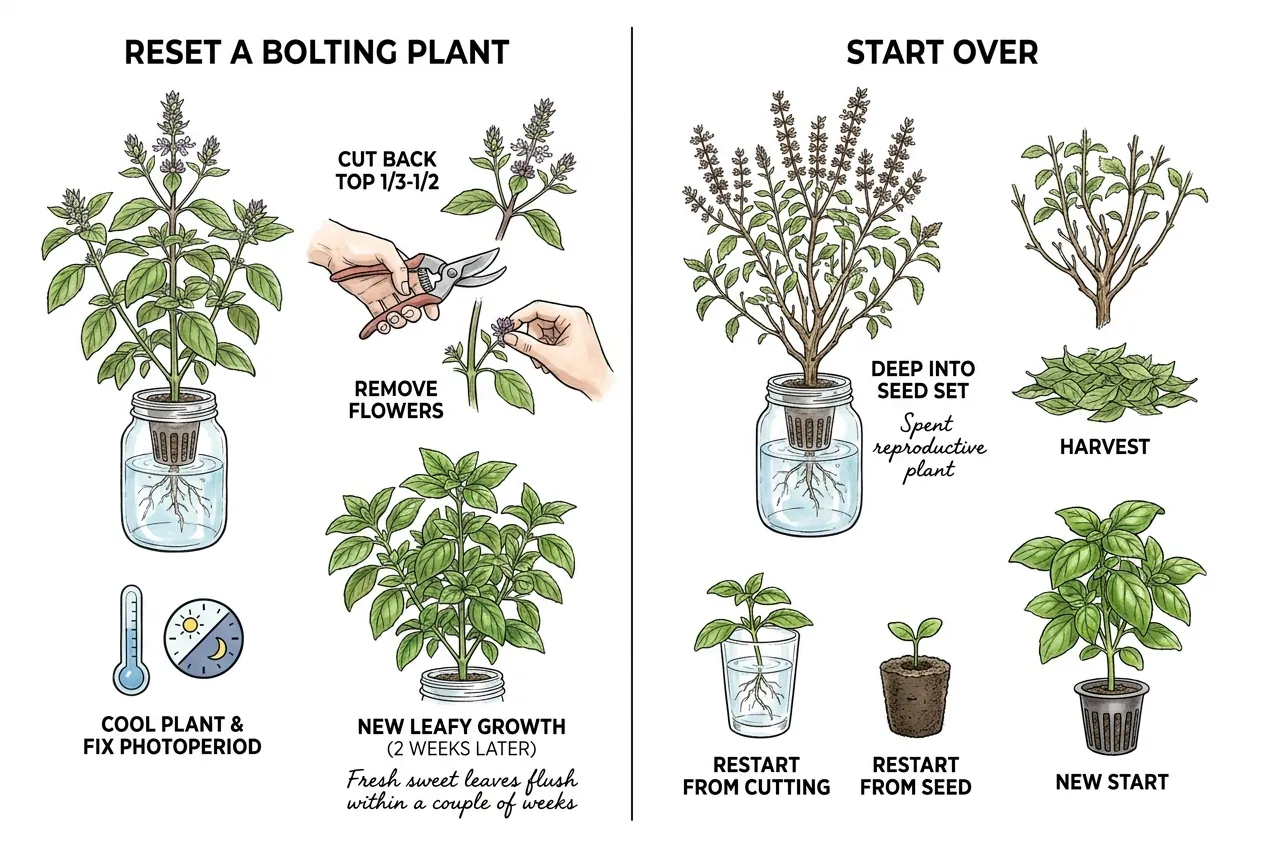
A leafy plant that is only starting to bolt is usually worth saving, while a spent one is not.
If buds are forming but the leaves are still good, cut back the top third to half and remove every flower cluster at the node below it. Then cool the plant and fix the photoperiod.
Removing the reproductive tips shifts the balance back toward vegetative buds on the lower nodes, and fresh sweet leaves flush within a couple of weeks when conditions are corrected.
If the plant is deep into seed set with small bitter leaves and a woody base, do a full harvest and restart from a cutting or a new sowing. A spent reproductive plant will not efficiently regain young-leaf quality.
Salvage with a hard cutback while the plant is still leafy, but restart from cuttings or seed once it is deep into seed set.
Cultivar and Setup Choices That Buy Time
Some of the bolting battle is won before you sow, through cultivar choice and system design.
Slow-bolt selections and a well-sized, cooler passive system reduce the pressure so your weekly management has less to fight.
Choose a Slow-Bolt Cultivar, but Do Not Expect Miracles
Slow-bolt selections delay flowering by weeks, though none are truly heat-proof. Everleaf-type Genovese selections can delay flowering well beyond standard Genovese, flowering as much as roughly two months later than common basils, because they were bred for a longer juvenile phase.
Standard Genovese is comparatively slow but still bolts quickly once daytime temperatures push past the mid-80s Fahrenheit.
The honest limit is that thermal time still accumulates in slow-bolt plants, so even Everleaf benefits from a cool reservoir and a fixed photoperiod.
Pick a slow-bolt cultivar for late-season and warm-window plantings, then stack it with the other levers.
Size the System and Stagger Your Sowings
Reservoir volume, spacing, and succession all lower bolting pressure. A larger water volume buffers temperature swings, sensible spacing avoids crowding stress, and staggered sowings keep a supply of young plants that resist flowering until they mature.
With a new batch coming up every few weeks, no single aging plant carries all the risk.
For a cooler, better-sized passive vessel or a LECA conversion, see the semi-hydro conversion-kit chooser.
For seed, trays, and a starter setup, see the microgreens grow-kit chooser. And because a cool root zone is the same lever that tames bolting in other leafy crops, the cold-reservoir approach for hydroponic spinach is worth a look.
Key Takeaways
- Bolting comes from long days, heat, and maturity together, so pull all three levers, not one.
- Cool a passive reservoir to around 65 to 72°F, since warm water loses oxygen and speeds flowering.
- Read a rising EC as a signal to dilute with plain water, and refresh the reservoir about every two weeks.
- Hold a fixed 12 to 14 hour photoperiod under a bright LED to weaken the flowering cue while keeping growth.
- Pinch above a leaf pair weekly and remove flower buds on sight, then hard-cut to salvage a plant that starts to bolt.