
Stop Hydroponic Spinach Bolting with Cold Roots
Hydroponic spinach bolting is driven by long days and warm conditions together. Keep the nutrient solution cool as one lever alongside air temperature, light hours, and slow-bolting cultivars, and measure reservoir temperature, EC, pH, and dissolved oxygen rather than guessing.
Priya Patel · Published 2026-02-23 · 10 min read
Key Takeaways
- Bolting in spinach is driven mainly by long days and warm conditions acting together. Extension sources and cool-season biology point to both air and light hours, not the root zone alone. Once a plant is visibly bolting, leaf quality rarely recovers.
- Keeping the nutrient solution cool can help in a warm room, but it is one lever alongside air temperature, day length, and cultivar choice. There is no proven single threshold temperature that switches spinach bolting off.
- Watch the new center leaves for a genuine flower stalk and stretching stems. Leaf shape alone is not reliable, because some healthy spinach cultivars naturally have pointed, arrowhead leaves. Compare against your cultivar’s normal look.
- If your measured reservoir EC climbs during a heatwave, correct it toward your formulation’s label range and re-check pH and calcium. Do not assume a fixed dilution target.
- Measure reservoir temperature, EC, pH, and actual dissolved oxygen with a probe. Slow-bolting cultivars such as Space or Seaside and shorter photoperiods can also reduce bolting risk on long-day indoor grows.
Why does hydroponic spinach turn bitter and throw up a flower stalk? Spinach is a cool-season crop with a strong long-day flowering response, so bolting is driven by day length and warm conditions working together, including both air temperature and the nutrient solution, which is worth measuring on its own.
As days lengthen and temperatures rise, spinach shifts from leafy growth to producing a flower stalk.
That transition, called bolting, is what turns the leaves bitter and tough.
What causes hydroponic spinach to bolt?
Start With Day Length and Heat
Bolting is the shift from leafy growth to flowering. University extension sources (for example UMass, Utah State, and Minnesota) attribute it primarily to long days combined with warm or hot weather, often made worse by dry stress.
These factors interact, so there is no single trigger temperature, and no published spinach experiment identifies a specific root-zone temperature that flips an irreversible switch.
Once a flower stalk is clearly forming, the marketable leafy phase is largely over, so the practical goal is to slow the transition and harvest before quality declines.
Heat stress and reactive oxygen species (ROS) are real concepts in plant biology, but the specific chain some guides describe, warm roots producing ROS that shift gibberellin signaling into bolting, has not been measured in spinach that I can find.
Treat that mechanism as unconfirmed rather than established.
Because the nutrient solution can hold or shed heat differently from the air, it is worth measuring water temperature separately, as one input alongside air temperature, light hours, and cultivar, not as a replacement for them.
What are the early signs of bolting?
| Feature | Typical vegetative growth | Possible bolting sign |
|---|---|---|
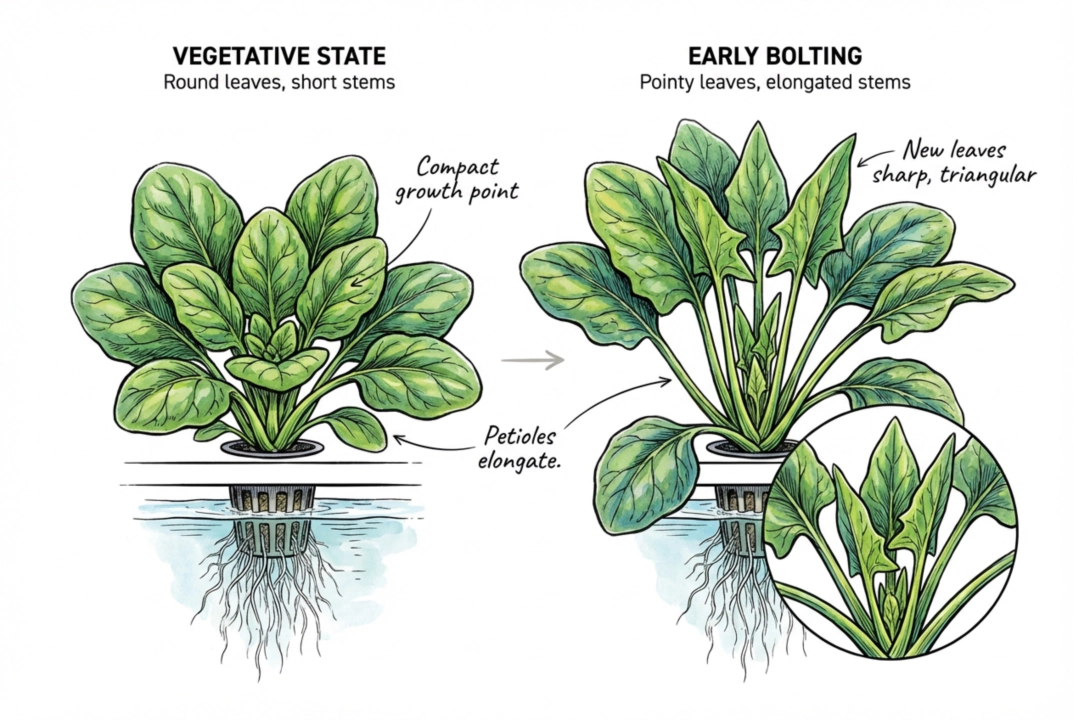
| Center growth | Low, spreading rosette | Central stem elongating upward |
| Stem length | Short petioles | Elongating petioles |
| Flower stalk | None | Emerging flower stalk (the definitive sign) |
The most reliable early cue is elongation at the center of the plant, a stretching stem and lengthening leaf stems (petioles), and, ultimately, a visible flower stalk.
Leaf shape on its own is a weak signal. Some healthy cultivars naturally carry pointed or arrowhead-shaped leaves, including Oriental Giant and Flamingo Improved, so treating rounded leaves as safe and arrowhead leaves as bolting produces false alarms.
Compare new growth against how your specific cultivar normally looks.
Spinach flowers on an upright stalk and is wind-pollinated. Inspect the newest central growth regularly, and confirm bolting from a real stalk plus the plant’s environmental history (day length and temperature), not from a single leaf-shape cue. Otherwise you may harvest a whole tray prematurely.
Bolted leaves do tend to get more bitter and tough, but the specific compounds behind that in spinach are not well established. Claims that sesquiterpene lactones and oxalates spike come mostly from other crops and haven’t been shown for spinach bolting.
What is the ideal temperature for hydroponic spinach?
Use a Cool but Flexible Setpoint
There is no single proven ideal root-zone temperature for spinach that switches bolting on or off.
Spinach generally grows best in cool conditions, and cooler nutrient solution can help in a warm room, but the two hydroponic studies most often cited here did not test bolting at all.
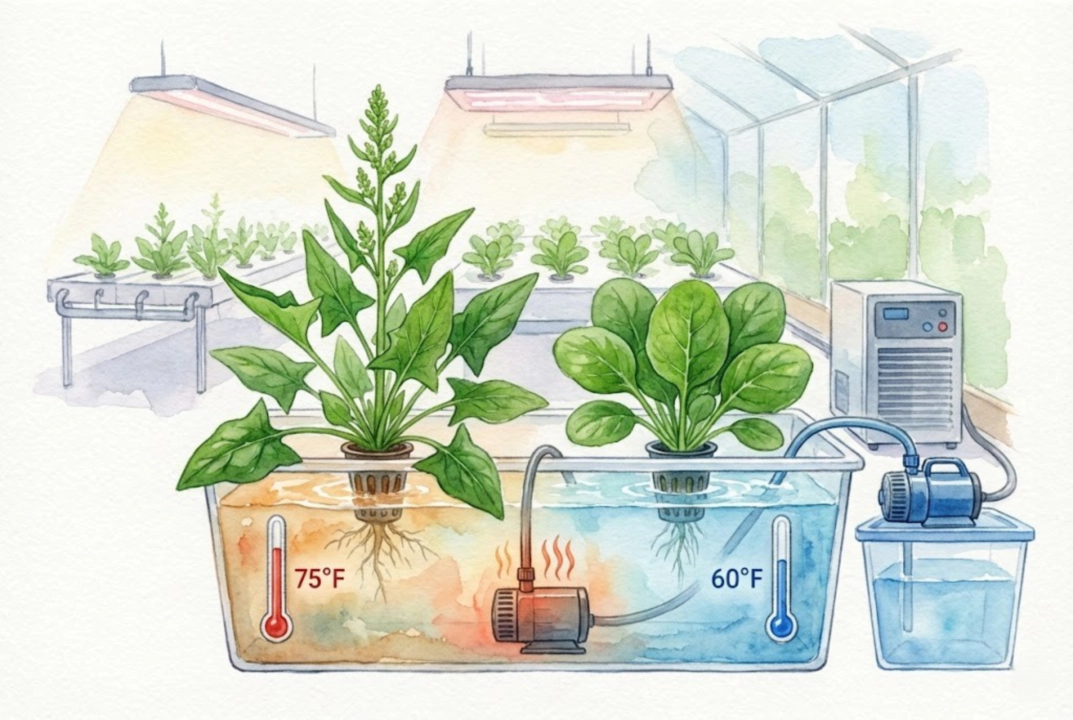
One compared root zones of 15, 20, and 25°C and found mean air temperature more influential than root-zone temperature for biomass. The other compared ambient, 24°C, and 21°C and, weighing growth and energy use together, recommended 24°C (about 75°F).
So rather than locking in a strict setpoint, aim for cool but not extreme solution temperatures, watch actual growth, and adjust.
Very cold roots can also slow water and nutrient uptake, so colder is not automatically better.
Any target you choose should be validated against your own cultivar, air temperature, and measured results, not treated as a fixed rule.
How Do Air and Root-Zone Temperature Work Together?
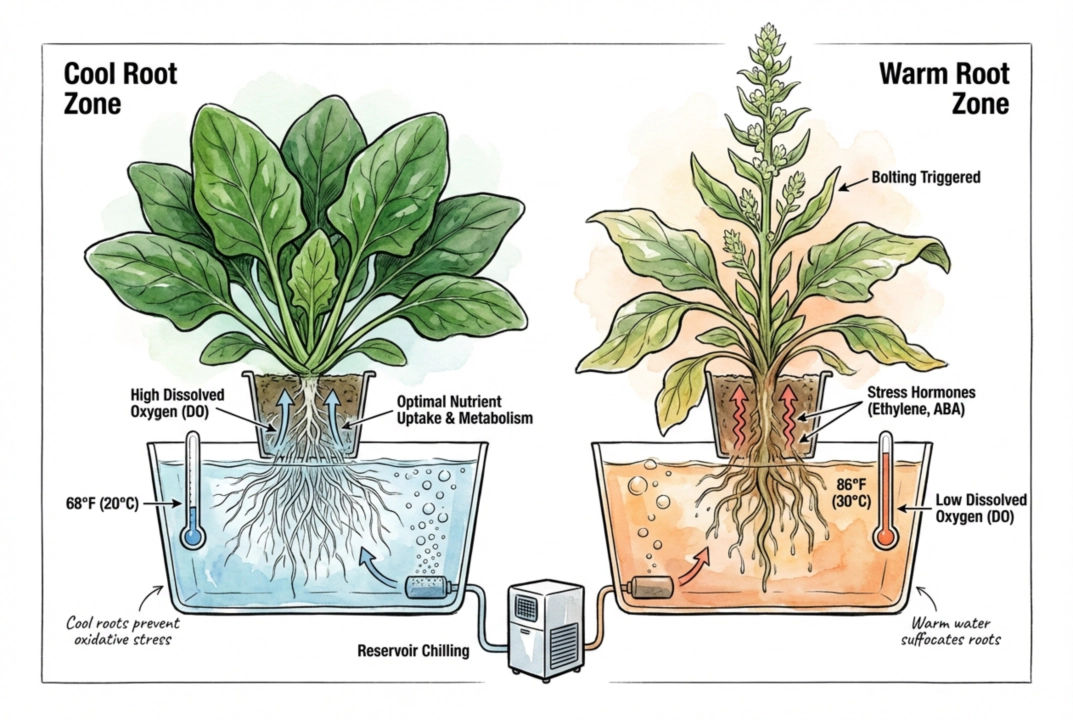
Both air and root-zone temperature matter. Air temperature affects transpiration but also photosynthesis, respiration, and development. Root-zone temperature affects root metabolism and oxygen availability.
One of the studies cited below actually found air temperature more influential than root-zone temperature for spinach biomass, so it is a mistake to reduce air to transpiration alone or to treat the root zone as the master control.
Warm water can hold less dissolved oxygen, but temperature alone cannot tell you whether your roots have enough. Aeration, root and microbial demand, nutrient strength, altitude, and circulation all affect the actual reading.
Measure dissolved oxygen if you need to diagnose an oxygen problem instead of treating a warm reservoir as proof that the roots are starved.
Root-zone Temperature Effects on Spinach Biomass Production Using a Nutrient Film Technique System
Cultivar-Specific Responses of Spinach to Root-Zone Cooling in Hydroponic Systems in a Greenhouse Under Warm Climates
How do you cool a hydroponic reservoir effectively?
Start With Low-Cost Heat Controls
If you decide the solution is running warmer than you want, cooling options range from mechanical (a chiller) to passive (added insulation, shading, and reducing heat inputs).
A chiller gives the most direct control but draws real power. Before buying one, first try the cheaper levers. Shorten the photoperiod, shade or insulate the reservoir, improve room ventilation, and choose slow-bolting cultivars.
To size a chiller you need your reservoir volume, peak ambient temperature, the temperature drop you want, expected heat gain from pumps and lights, insulation, and pump flow and head, not a one-size figure.
A chiller can help in a genuinely warm room, but it is one tool among several, not the single thing standing between a good crop and a failed one.
Aquarium chillers differ in capacity, required flow, ventilation, and clearance. Choose a model from your reservoir’s measured heat load and required temperature drop, then follow that model’s pump-flow and placement instructions.
A chiller is most useful when the room stays genuinely hot after lower-cost controls have failed. Account for the heat it releases into the room, and weigh a fan against a chiller before committing to active cooling.
Burying a reservoir to use the ground as a heat sink is sometimes suggested, but it is not a casual DIY tip.
Soil temperature varies widely with location, climate, moisture, and depth. The roughly constant 50–59°F the Department of Energy describes applies near about 30 feet down, not at 3–6 feet, and the ground is a finite heat sink that warms up as pumps, lights, and room heat keep feeding it.
Excavation also involves utility locating, permits, frost and groundwater, tank flotation and loading, waterproofing, sanitation, and electrical code, and digging five feet or deeper crosses into serious trench-safety territory (OSHA requires protective systems).
If you pursue it, treat it as an engineered project, not a quick fix.
I log canopy air and reservoir temperature together from lights-on through the warmest part of the cycle, with the water probe suspended away from the tank wall and pump. A morning reading can miss the several-hour peak that the spinach actually experiences.
One low-cost change comes first, such as shading the reservoir, insulating a return line, or moving a heat source, followed by the same logging window. I consider a chiller only after the log shows that the peak remains high and identifies the temperature drop the equipment must actually deliver.
How should you adjust nutrients during heat stress?
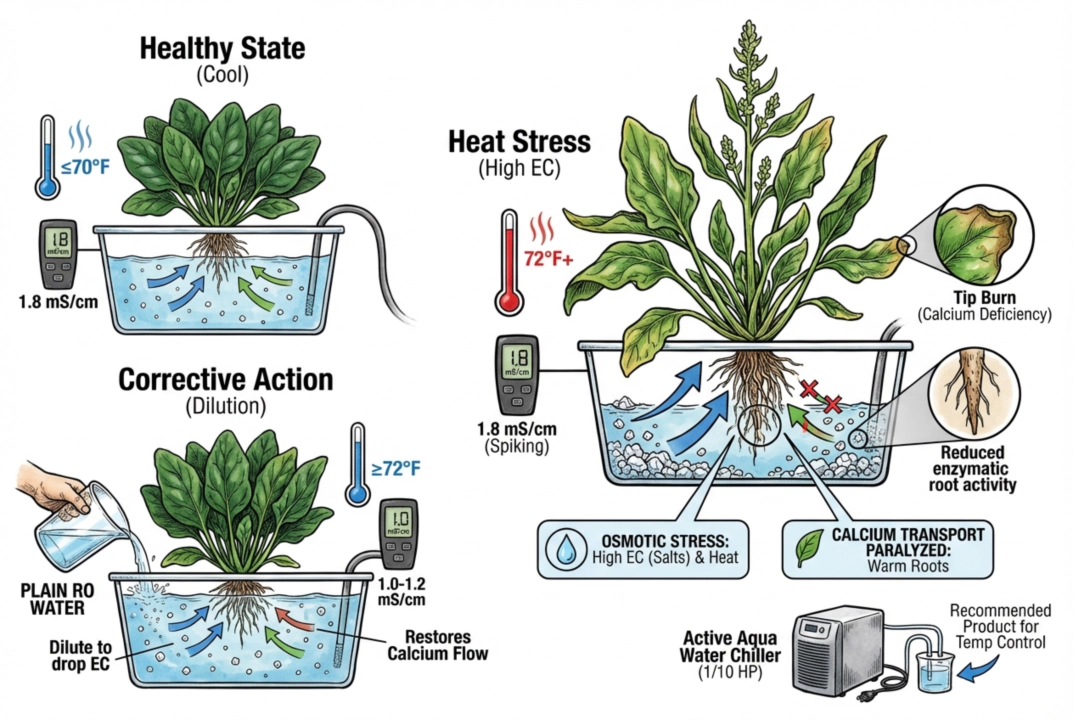
Manage EC from measurement, not a fixed rule. Common hydroponic references put spinach EC around 1.8–2.3 mS/cm, and production examples run 1.6–1.8, so 1.8 is a normal working value, not an automatic danger point.
In hot, high-transpiration conditions the reservoir can lose water faster than the plants take up nutrients, and measured EC may drift upward, but the fix is to correct toward your formulation’s label range, not to blanket-dilute to 1.0–1.2 at a set temperature.
If your measured EC is genuinely high, diluting with RO water lowers everything at once, every nutrient plus pH buffering and alkalinity, so re-check pH and calcium afterward rather than assuming a lower number restores balance.
Tip burn on new leaves is a calcium-distribution problem, but it depends on rapid growth, low transpiration into young leaves, air movement and humidity, nitrogen and ion balance, root health, and cultivar, not just EC or temperature.
Track reservoir volume, make-up water, and EC over time to see the real trend before making a change.
Be clear about what an inexpensive TDS meter reports. A TDS pen infers a ppm value from electrical conductivity by applying a conversion factor, so the number is not a direct inventory of individual nutrients and does not substitute for pH measurement. Check the exact meter’s factor, range, accuracy, calibration method, and displayed units.
If you manage a target in mS/cm, use a calibrated EC meter and record EC directly so an unknown ppm conversion does not obscure the comparison. You still need a separate pH measurement unless the selected instrument includes and calibrates that function.
Does genetics prevent bolting?
Choose for Slow Bolting
Cultivar choice does materially affect bolting risk. Spinach has a strong long-day flowering response, and slow-bolting varieties are bred to hold in vegetative growth longer under long days.
Seed catalogs rate them on a relative scale rather than by an exact trigger hour. In Johnny’s current comparison, for example, Space is a faster grower rated medium for bolting while Seaside grows more slowly and is rated slow to bolt.
Slow-bolting behavior comes from conventional breeding across several traits, not a single mutation, and hybrid (F1) status by itself is no guarantee. Catalogs list fast-, medium-, and slow-bolting F1s.
Published photoperiod data are limited. One older study found a single cultivar, Dimple, had a critical photoperiod longer than 13 but shorter than 15 hours. That does not translate into fixed thresholds for heirlooms, Space, or Seaside.
Day length interacts with temperature, plant age, spectrum, and daily light integral, so treat cultivar ratings as guidance rather than exact numbers.
If you grow indoors under long (roughly 14-hour) days, a slow-bolting cultivar and, where practical, a shorter photoperiod both help reduce bolting risk (alongside cool conditions and good air management).
How do equipment choices affect water temperature?
Measure Heat Gain Before Reconfiguring
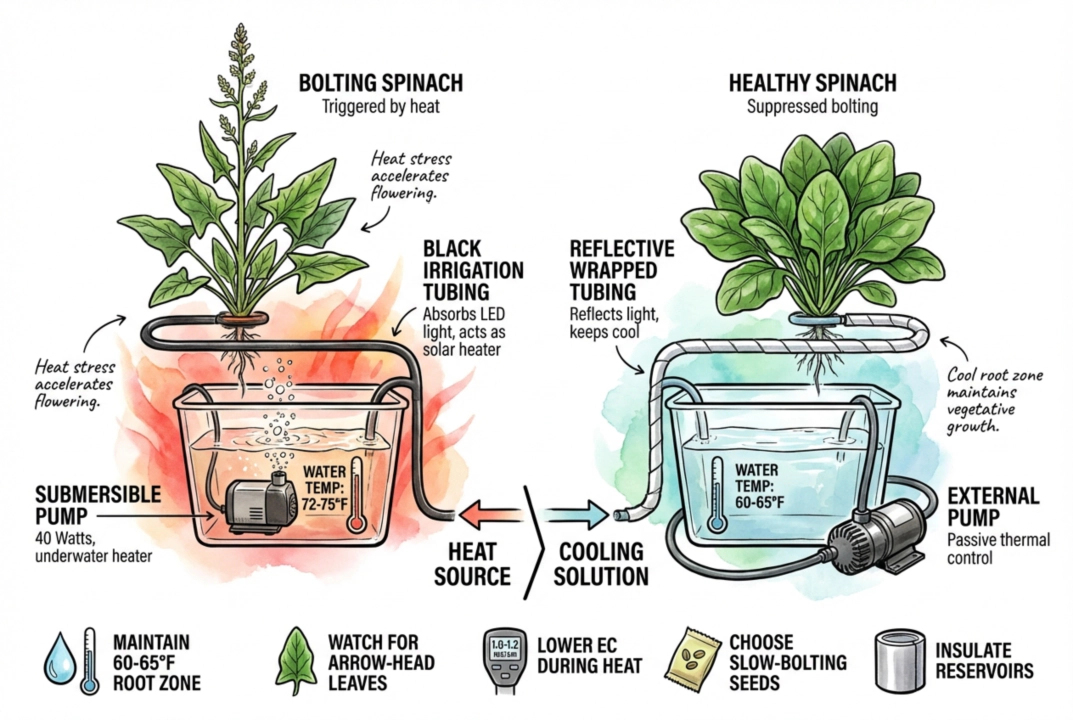
Equipment can add heat to a reservoir, though how much varies with your setup. A submersible pump delivers essentially all of its input energy into the water. Wattage depends on the pump. A small circulation pump moving around 370 GPH may draw only about 24 watts, so check the actual rating rather than assuming a round generic figure.
Whether that raises the temperature by a noticeable amount depends on reservoir mass, runtime, and heat loss, so measure before and after rather than assuming a set rise.
An external inline pump rejects more of its motor heat to the air, but it is not heat-free (it still transfers hydraulic work into the water) and it needs an inline-rated pump plus attention to priming, head, and leak protection.
Watch for a conflict here. Many chillers specifically call for a submersible pump, so a blanket "always go external" rule can clash with your cooling setup.
Opaque black tubing can absorb more light and warm up, but it also suppresses algae, so it is a tradeoff, not simply a culprit. Reflective or insulated runs can cut heat gain, provided the material is food-safe and cleanable.