
Hydroponic Lettuce Tipburn Is a Calcium Transport Problem
Hydroponic lettuce tipburn under LEDs is a calcium delivery problem. Spot it in the heart, then cut the risk with airflow, a lower DLI, and humid nights.
Jordan Cole · Published 2026-10-27 · 19 min read
Key Takeaways
- In one growth-chamber study, outer leaves held about 15 times more calcium than the enclosed heart leaves.
- Brighter LEDs and longer days speed growth without speeding calcium delivery to the heart.
- Air aimed into the heads, at speeds as gentle as 0.4 m/s, was the strongest environmental lever tested.
- Extra calcium in the tank mostly raises EC, and a lower EC cuts tipburn more, at some cost in head size.
- I check the heart every 3 days once heads start forming, because tipburn hides inside and never heals.
Your butterhead looks perfect from above. Fold back the outer leaves, though, and the smallest leaves in the heart have brown, papery edges.
That is hydroponic lettuce tipburn, and the usual reflex is to pour calcium into the reservoir. It rarely helps, because the solution usually holds enough. The shortage sits only in the fast-growing leaves enclosed in the heart, where calcium-carrying water barely reaches.
The fix is better delivery and slower growth, not more calcium in the tank. The levers are air into the heart, a lower daily light integral (DLI), humid nights, sensible solution strength (EC), a tolerant cultivar, and timely harvest.
Why Tipburn Is a Delivery Failure, Not an Empty Tank
Tipburn is a true calcium deficiency, but a local one. The dead margin starves while the outer leaves of the same plant stay well stocked.
Calcium Rides the Water Conveyor
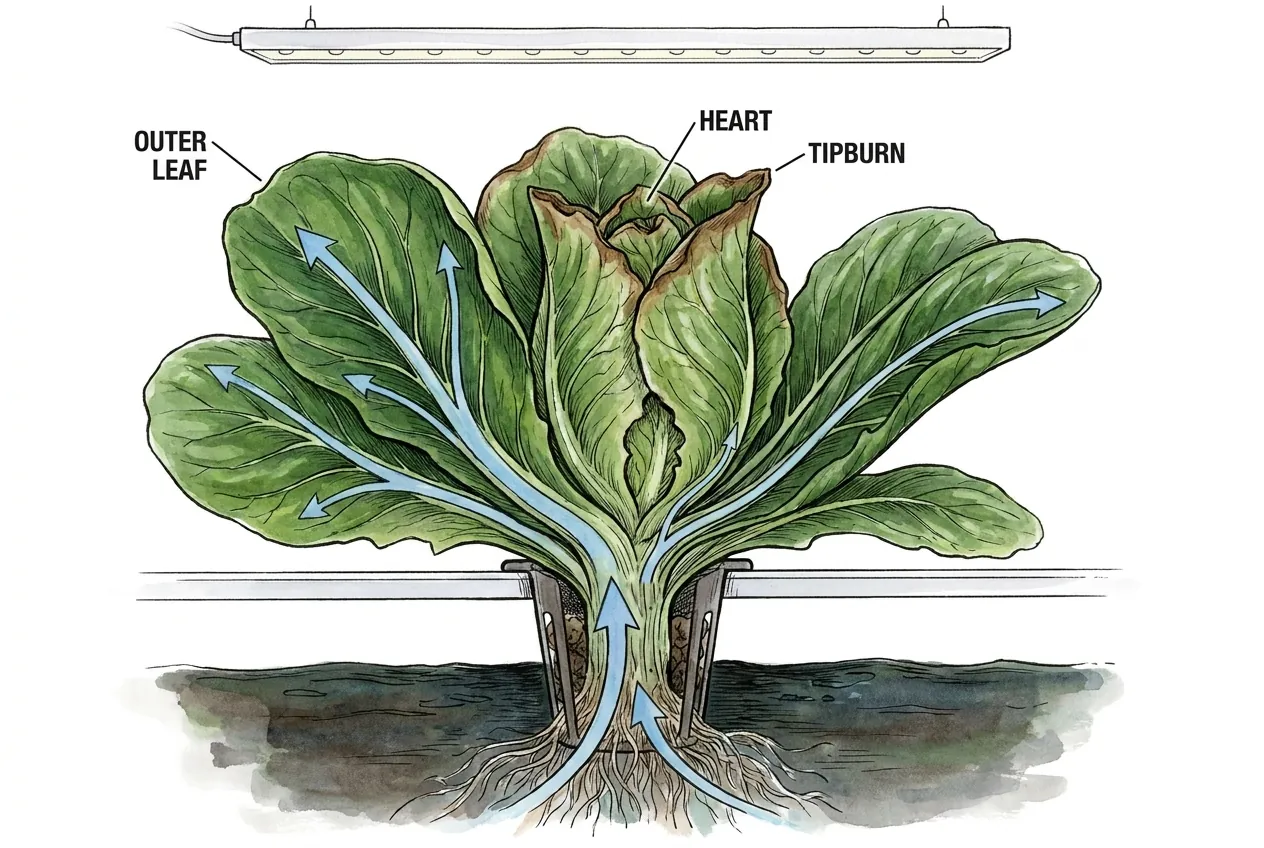
Picture calcium as cargo on a one-way water conveyor. Water enters the roots, climbs the xylem, and streams out to whichever leaves evaporate the most. Calcium goes where water goes, not where cells need it.
Big, open outer leaves lose the most water, so they collect most of the calcium. Young leaves folded inside the heart barely transpire, and only a trickle reaches them while they expand fastest.
Calcium cannot move back out of old leaves through the phloem, so the outer leaves never share.
In a growth-chamber study, enclosing young butterhead leaves caused tipburn within days, and outer leaves held about 15 times more calcium than enclosed ones.
Home shelves were not tested, but a head under a strong LED likely has the same calcium-rich rosette around a starving center.
Same Solution, Different Delivery
A greenhouse deep water culture trial with butterhead shows the gap. Without fans, tipburned leaves rose from 2% at 14 days after transplant to 20% at 21 days and 39% at 28 days.
Daytime downward fans held tipburn at 7% or less of central head leaves and raised inner-leaf calcium, with the same nutrient solution.
A field study of 498 lettuce lines agrees, since bigger plants burned more and leaf calcium explained only part of the gap. The heart runs short when growth demand outruns delivery, so anything that speeds growth raises the risk.
A home tub under a bright LED can be that same high-demand setup, often with no fan aimed into the heads.
The Night Route Through Root Pressure
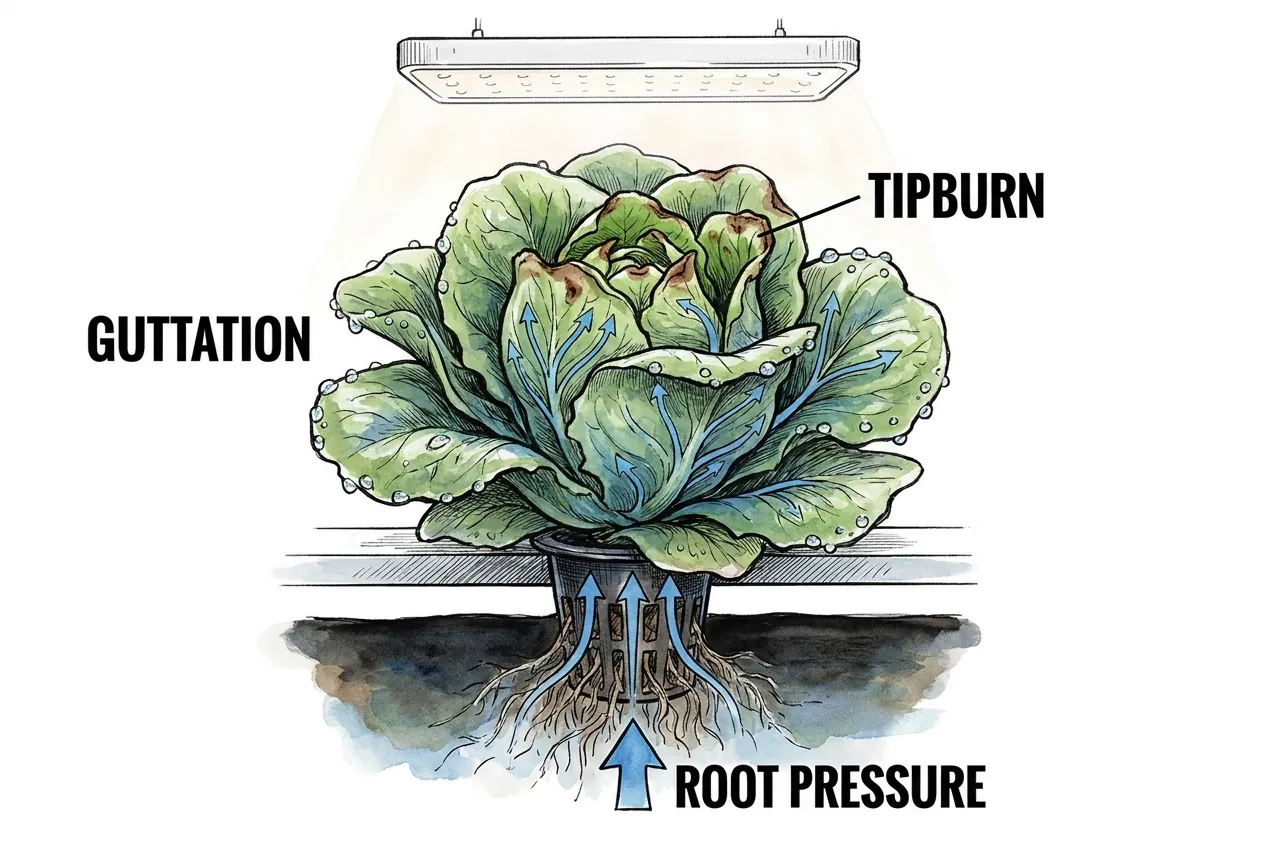
Calcium has a second route into the heart, and it runs at night. When the whole plant stops transpiring, roots keep loading minerals, water follows, and pressure pushes sap into every leaf, enclosed ones included.
Its visible sign is guttation, a row of tiny clear beads along the leaf edges at lights-on.
In a cabbage tracer study, covered leaves on partly covered plants showed no beads and gained little calcium. Fully bagged plants guttated and still received it.
A dry night with heavy air exchange keeps outer leaves pulling water, which may leave this route idle.
Humid nights quiet the outer leaves and give root pressure its chance.
Confirm It Is Tipburn First
Browning in the heart and browning on the outer leaves need nearly opposite fixes. Where the damage sits separates them faster than any meter.
Dead Margins Hidden Inside the Heart
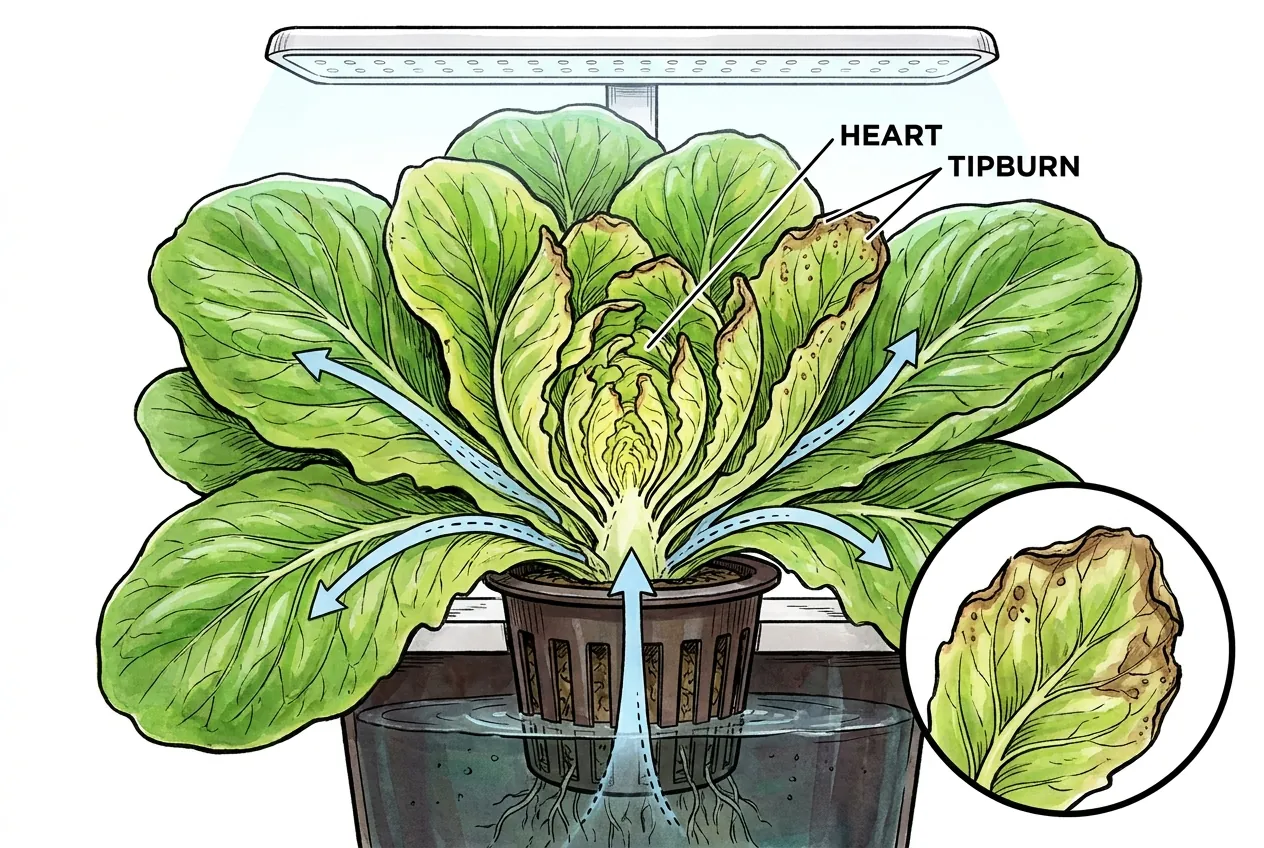
Tipburn starts on the youngest center leaves, often only a few centimeters long. Look for darkened veins near the edge, pinpoint brown specks, or a continuous tan to brown dead rim, while the surrounding outer leaves stay green.
In butterhead, romaine, and other heading types, the damage is usually invisible from outside. Loose-leaf types show it on the newest leaf tips at the rosette center, in plain view.
Dead tissue never recovers, so finding it early protects the leaves not yet formed.
Tipburn or Something Else
Cornell’s e-GRO alert treats inner-leaf tipburn and outer-leaf salt necrosis as separate disorders sharing one name.
| Problem | Starts on | What you see | First check |
|---|---|---|---|
| Tipburn | Youngest heart leaves | Dry tan to brown margins, pinpoint specks | Look into the heart |
| Salt or EC edge burn | Oldest outer leaves | Crisp brown edges, often yellow-rimmed | Check EC, water level, and fan aim |
| Light or heat scorch | Leaves nearest the fixture | Bleached or tan patches, not only edges | Raise or dim the fixture |
| Soft rot or gray mold | Dead tipburn margins | Wet, slimy, or gray fuzzy tissue spreading inward | Bag and discard the whole head |
Outer-leaf burn follows high root-zone salts, dry air, a short water supply, or strong wind, so a fan blasting the outer rows can worsen it.
The scorch row is a practical pattern, not a tested lettuce diagnosis.
A Three-Day Heart Check
Once a plant starts forming a heart, or reaches about 8 to 10 true leaves, I check every head’s center in trays of up to 12.
In a larger tray, I mark 12 spread across the center and edges and recheck those same heads.
Onset can come early, since the greenhouse trial above showed tipburn 14 days after transplant.
With clean hands and a small flashlight, I fold back the two or three outermost leaves and look straight down into the heart.
My target is any leaf shorter than about 5 cm, plus any leaf just unfolding from the heart. The outer leaves of the same plant are my comparison.
That 5 cm cut is my working definition of an inner leaf, since injury begins on leaves a few centimeters long.
Each find gets a note with the date, plant position, and leaf size.
Checks run every 3 days, then daily once any lesion appears. Damage in that trial jumped from 2% to 20% of leaves within a week, so weekly looks can miss several new leaves. The 3-day cadence is my working rule, not a published standard.
Any dry tan to brown margin on an inner leaf, even 1 to 2 mm long, confirms tipburn in the batch. That triggers my light dial-back and an airflow check, while browning only on outer leaves sends me to the EC route. A clean heart means no change.
Loose-leaf types need no folding. Torn leaves may give rot an extra way in, so the fold stays gentle.
Dry Papery Margin or Soft Wet Rot
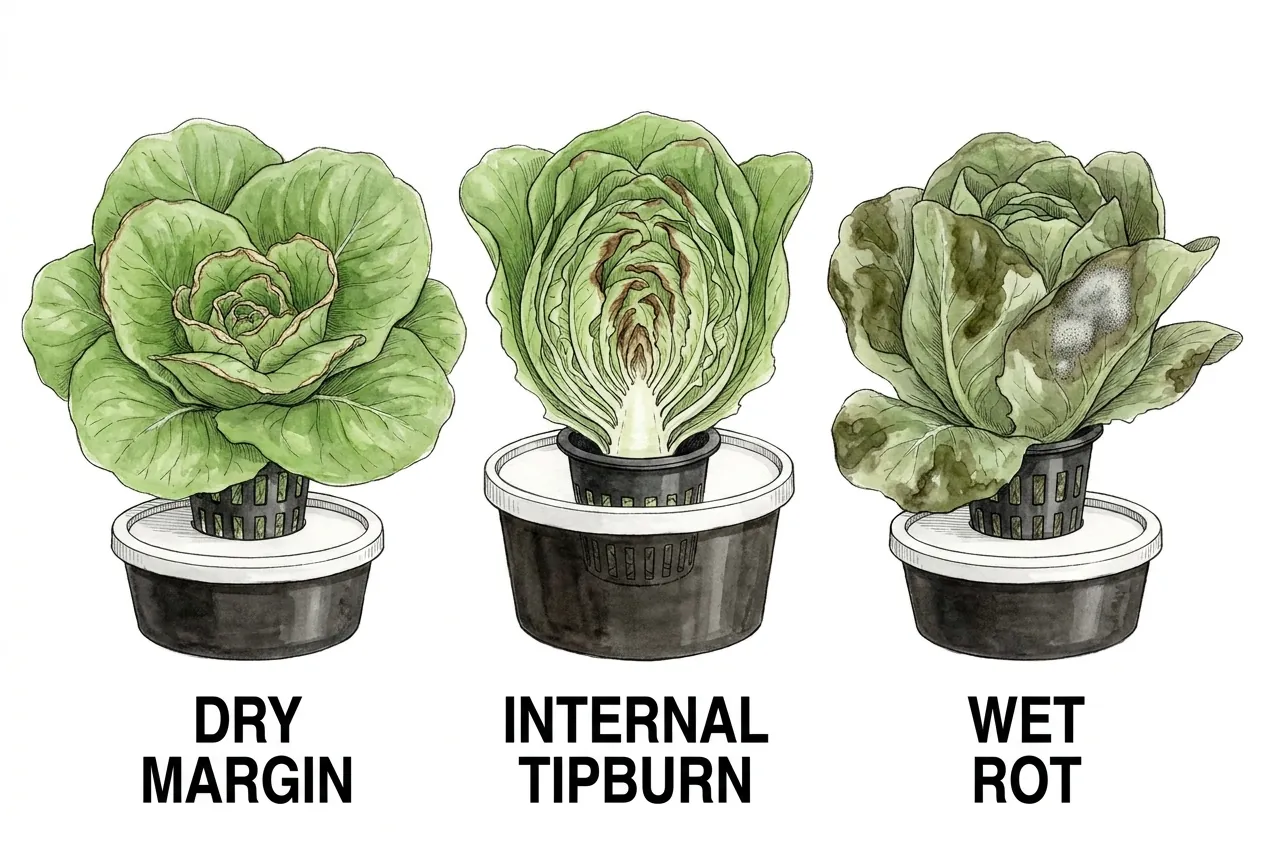
Texture decides whether a tipburned head is kept. A tipburn margin on its own is thin, tan, dry, and papery. A rotting lesion turns dark, soft, and water-soaked, creeps toward the midrib, or grows gray fuzz.
Tipburn is a nutrient disorder, not an infection, but dead margins invite soft-rot bacteria and gray mold.
Growers trim wrapper-leaf tipburn at harvest, while internal tipburn can turn to slime inside the head.
To check texture, I touch the lesion once with a fresh cotton swab, using a new one for each plant. I trim only dry, papery margins. If any lesion in the head is soft, wet, slimy, or fuzzy, the whole head goes.
Trimming is a quality step, not a food-safety guarantee. Before lifting a rotting head, I bag it so spores and drips stay off other plants. There is no sniff test.
Why Strong LEDs and Long Days Raise the Risk
Light intensity and day length both drive how fast a head grows.
More Light Feeds the Outer Leaves First
In a plant-factory study, butterhead grown at 150 to 300 µmol/m²/s grew faster and had more tipburned leaves as light rose.
Whole-plant and outer-leaf calcium climbed with light, but inner-leaf calcium did not.
Day length acts the same way. In a greenhouse trial at equal daily light, longer photoperiods produced more growth and more tipburned plants.
A brighter fixture or a stretched day speeds growth without speeding calcium delivery to the heart.
DLI Ceilings With and Without Downward Air
DLI equals PPFD, the plant-usable light hitting the heads each second, times hours of light times 0.0036, in mol/m²/d.
Virginia Tech Extension lists lettuce at 12 to 17, and the PPFD and DLI guide covers the math.
Cornell’s greenhouse program could run 17 only with enough downward airflow, and even then some cultivars top out near 15.
Without the airflow, the program could not exceed 12 for its butterhead cultivar.
| PPFD at head height (µmol/m²/s) | DLI at 14 h | DLI at 16 h | DLI at 18 h |
|---|---|---|---|
| 200 | 10.1 | 11.5 | 13.0 |
| 250 | 12.6 | 14.4 | 16.2 |
| 300 | 15.1 | 17.3 | 19.4 |
A shelf at 300 µmol/m²/s for 16 hours already reaches 17, the level that needs airflow.
Without a fan aimed into the heads, about 12 is the safer target for heading types.
Dialing Back Light After the First Lesion
When the heart check confirms a first inner-leaf lesion, I calculate the current DLI before touching anything.
PPFD comes from the tops of the heads, averaged from the tray center and one edge. My floor for heading types is about 12 mol/m²/d.
A crop already at or below that floor keeps its light while I move to airflow, cultivar, and earlier harvest.
The floor is my rule, not a Cornell or Virginia Tech recommendation. It matches Cornell’s no-airflow ceiling and the bottom of the extension range, and deeper cuts mostly cost yield.
Before any step, a first lesion within about 7 days of planned harvest means harvesting now instead.
Above the floor, and on a day longer than 14 hours, my first step is cutting the photoperiod by 2 hours.
It is exact and needs no meter, since 16 to 14 hours removes 12.5% of the DLI.
If the day is already 14 hours or shorter, PPFD comes down about 15% with the fixture’s built-in dimmer or by raising it. I then re-measure at the same two spots.
If a full step would break the floor, I cut only as far as 12. At 14 hours, that means keeping at least about 238 µmol/m²/s.
Each lesion event gets one step, then a 7-day wait. At its end, only inner leaves under about 5 cm count as new. Clean ones mean the setting holds through harvest, while fresh lesions earn one more step, never past the floor.
My 2-hour and 15% steps and 7-day wait are working values with a research anchor. In a growth-chamber trial, a 15% DLI cut over the final 12 days dropped tipburn in one butterhead from 14% to 2% of leaves.
Deeper cuts added nothing for that cultivar and cost up to 26% of yield, while a second cultivar improved only after a 45% cut.
Dimming means the fixture’s own control or hanging height, never rewiring a driver. Without a quantum sensor, I read PPFD from the maker’s map at my hanging height, since phone apps read roughly.
The grow light and PPFD meter chooser covers meters and dimmable fixtures.
Move Air Into the Heads, Day and Night
Directed airflow is the strongest environmental lever in the research, as long as the air reaches the heart.
Where to Point a Small Fan
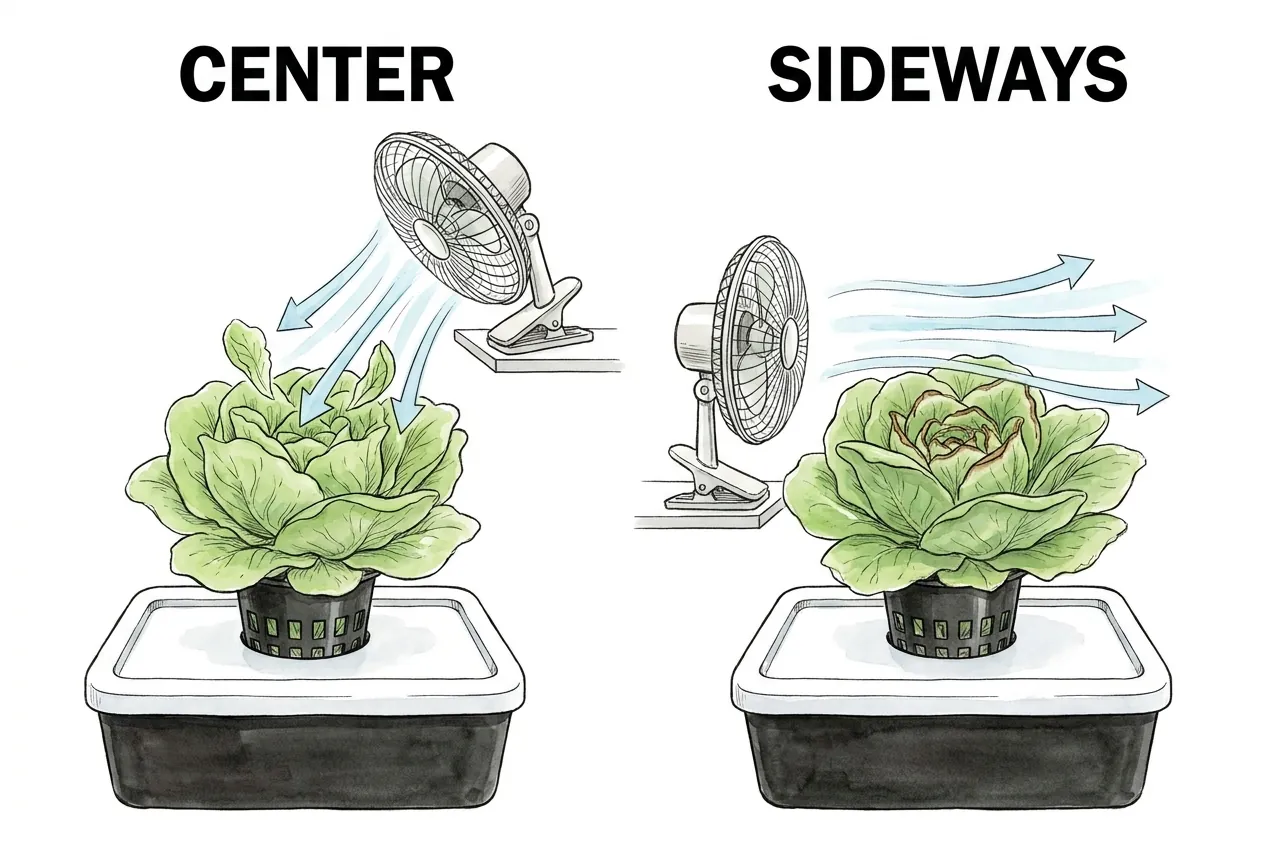
Mount a small fan above the canopy, or angle it steeply down, so air lands in the centers of the heads.
The youngest center leaves should flutter gently, while outer leaves stay upright, untorn, and free of dry edges.
A fan blowing sideways across the tops moves the outer leaves but not the heart. Air pushed into the head thins the still, humid layer around enclosed leaves, so they transpire and pull calcium-carrying water in.
The fan, light, and any pump near a reservoir belong on a GFCI-protected outlet, with cords looped below it and nothing hung over an open tub.
What the Airflow Trials Found
Trial air speeds ran from 0.4 to 1.3 m/s, roughly 1 to 3 mph.
| Trial and setting | Air delivery | At night | Result |
|---|---|---|---|
| Goto and Takakura 1992, controlled room | Piped onto inner leaves | All-day supply worked best | No tipburn up to about 60 g heads, against onset near 15 g |
| Ertle and Kubota 2025, growth chambers | Box fans 0.4 m above, about 0.4 m/s down | Yes | One affected leaf on one plant, against 50 to 75% of plants without fans |
| Persons and colleagues 2025, vertical farm | 0.4 to 1.3 m/s down | Not stated | More air cut tipburn at every light level, no biomass loss |
| Moosavi-Nezhad and Meng 2025, greenhouse | Fans near 1 m/s down | No, daytime only | 7% or less of head leaves, against 39% without fans |
Aim the air into the heads, the way each of these trials delivered it. In the Ertle and Kubota chambers, dim night light raised whole-plant transpiration without reducing tipburn, so keep the dark period dark.
Night Settings for the Fan and Humidity
At lights-off, I drop the fan blowing into the heads to its lowest setting that still visibly moves the center leaves. It never switches off.
All-day airflow did best where timing was compared, though daytime-only fans also worked, so the evidence leans toward night air without requiring it. The slower night speed is my untested compromise.
Humidity rises by cutting exhaust, not circulation. In a closed tent, turning exhaust down at lights-off often lifts humidity by itself, mostly because the air cools. Normal daytime fan speed and exhaust return at lights-on.
A hygrometer sits among the plants at head height, shaded from the LED, off the leaves, and out of the fan stream.
I log the dark-period minimum and maximum nightly for 7 nights after any change, then weekly.
My working band for the dark period is 75 to 90% RH, with the floor set to favor the night root-pressure route.
Vapor pressure deficit (VPD) measures how hard the air pulls water from leaves.
| Night RH | VPD at 20 °C (68 °F) | Role in my rule |
|---|---|---|
| 75% | 0.58 kPa | Band floor |
| 80% | 0.47 kPa | Inside the band |
| 85% | 0.35 kPa | Inside the band, as in the controlled-room trial |
| 90% | 0.23 kPa | Ceiling |
| Above 95% | 0.12 kPa or less | Greenhouse trial level, gray mold zone |
Above 90%, or with water films on leaves, walls, or windows at lights-on, I add air exchange until both stop.
Water on the light fixture means I switch it off at the outlet and let it dry before reuse.
Below a 75% minimum in a tent or closed cabinet, I trim exhaust further or run a humidifier outside the canopy, never misting the plants.
An open shelf in dry winter air may stay below 75%. I never humidify the room to reach it. Downward airflow carries most of the load, since the Ertle and Kubota fans worked with no night humidity setpoint.
Guttation beads on leaf margins are a bonus sign, not a target or a water film.
Ertle and Kubota call the 90 to 95% night humidity that induces guttation practically challenging indoors, since condensation can form on electrical and structural parts.
My 90% ceiling also stays under the gray mold zone of 93% RH or more with 8 to 12 hours of surface wetness.
Humidifiers follow the same GFCI rule as the fan and light, and the plant cabinet humidity control chooser covers fans, hygrometers, and humidifiers.
Leave the Calcium Dose Alone and Watch EC
EC, the strength of the solution, moves tipburn far more than the calcium dose.
More Calcium in the Tank Mostly Raises EC
University of California field guidelines and Cornell’s e-GRO alert say low root-zone calcium rarely causes tipburn. Cornell’s lettuce handbook recipe runs about 84 ppm calcium.
Every extra dose of calcium salt raises EC, and a stronger solution tends to raise tipburn.
In the greenhouse fan trial above, a calcium-mobilizing research additive in the solution also cut tipburn without fans, but it is not plain calcium salt.
Confirm the nutrient is a complete hydroponic formula containing calcium, mixed at label strength.
Leaf sprays fail in tight heads such as iceberg, because calcium stays where it lands and cannot reach the folded heart in time.
Sprays that helped butterhead in a greenhouse trial wetted the young leaves about twice a week, which adds leaf-burn and mold risk.
EC Is the Stronger Root-Zone Lever
In a recirculating hydroponic trial, lowering EC from 3.6 to 0.4 dS/m cut tipburned leaves from 23.1 to 4.4 per plant. Changing the potassium to calcium ratio did far less. A stronger solution makes water harder for roots to take up, so less reaches the heart.
The trade is yield, since fresh weight peaked near 1.6 dS/m and plants ran short of nitrogen and potassium at 0.4.
| Reference point | EC | Setting |
|---|---|---|
| Home small-system target | 1.2 to 1.8 mS/cm | UF/IFAS home hydroponics guide |
| Cornell grow-out | 1.15 to 1.25 mS/cm above source water | Cornell greenhouse handbook |
| Outer-leaf salt burn cases | Above 2.0 mS/cm | Commercial vertical towers, e-GRO |
One dS/m equals one mS/cm. More calcium in the tank rarely helps, while a lower EC can, at some cost in head size. Once tipburn appears, I keep EC in the lower half of that home range, about 1.2 to 1.5 mS/cm.
EC climbs as a tub or Kratky jar drinks down, and plain water lowers it. A Kratky jar gets that water only partway, keeping the level below the upper air roots.
For the meter itself, see the EC and pH meter chooser.
Choose Tolerant Cultivars and Harvest Early
One indoor screen suggests cultivar matters more than lettuce type. In that Ohio State growth chamber, built to induce tipburn, all 10 commercial cultivars showed tipburn about 22 days after transplant. At harvest, 7% to 41% of their leaves were affected.
Type and leaf color did not predict risk there, but varieties recommended for indoor production had less severity.
Open types still help at home, because lesions show in plain view.
Your own light gives the truest ranking, so sow two or three varieties side by side.
In that chamber, damage built up in roughly the 6 days between onset and harvest. Heading types are safest harvested a few days early when tipburn pressure is high. Baby-leaf harvest before a heart forms should carry less risk, though the trials here did not test it.
What to Change First When the Heart Turns Brown
When hydroponic lettuce tipburn shows up, check where the browning sits. Outer-leaf browning means reading EC and turning the fan away from those leaves. Heart browning means working down this list, doing steps 2 and 3 together.
- Harvest now if planned harvest is within about a week, discarding any head with soft rot.
- Otherwise, if DLI is above about 12 mol/m²/d, cut 2 hours from a day over 14 hours, or dim about 15% at 14 hours or less. Never go below 12.
- Point a fan down into the heads and leave it on overnight at the lowest moving setting.
- In a tent or closed cabinet, cut night exhaust and log humidity, holding 75 to 90% without condensation.
- If EC has climbed, add plain water, filling a Kratky jar only partway, and keep calcium at label strength.
For the next batch, set DLI near 12, run the downward fan from transplant, and try a cultivar recommended for indoor production. No lever guarantees clean hearts, but stacking them protects the leaves still to come.