
Planaria in Shrimp Tank: Hydra, Look-Alikes, Dewormer Risks
Planaria in shrimp tank or hydra? Tell them apart with a timed night check, starve the bloom first, and see why dewormers can harm snails and shrimp.
Priya Patel · Published 2026-10-29 · 20 min read
Key Takeaways
- Many white specks on shrimp tank glass are harmless look-alikes that only signal overfeeding.
- Planaria glide with an arrowhead head and two eyespots, while hydra stay attached with a tentacle ring.
- A feeding cut and dark-period traps come first, but never a total fast while shrimplets are present.
- No common dewormer is proven safe for snails or dwarf shrimp, and betel-nut or fenbendazole may harm snails.
- If you treat, move snails out, follow the label dose, and test ammonia against your own baseline.
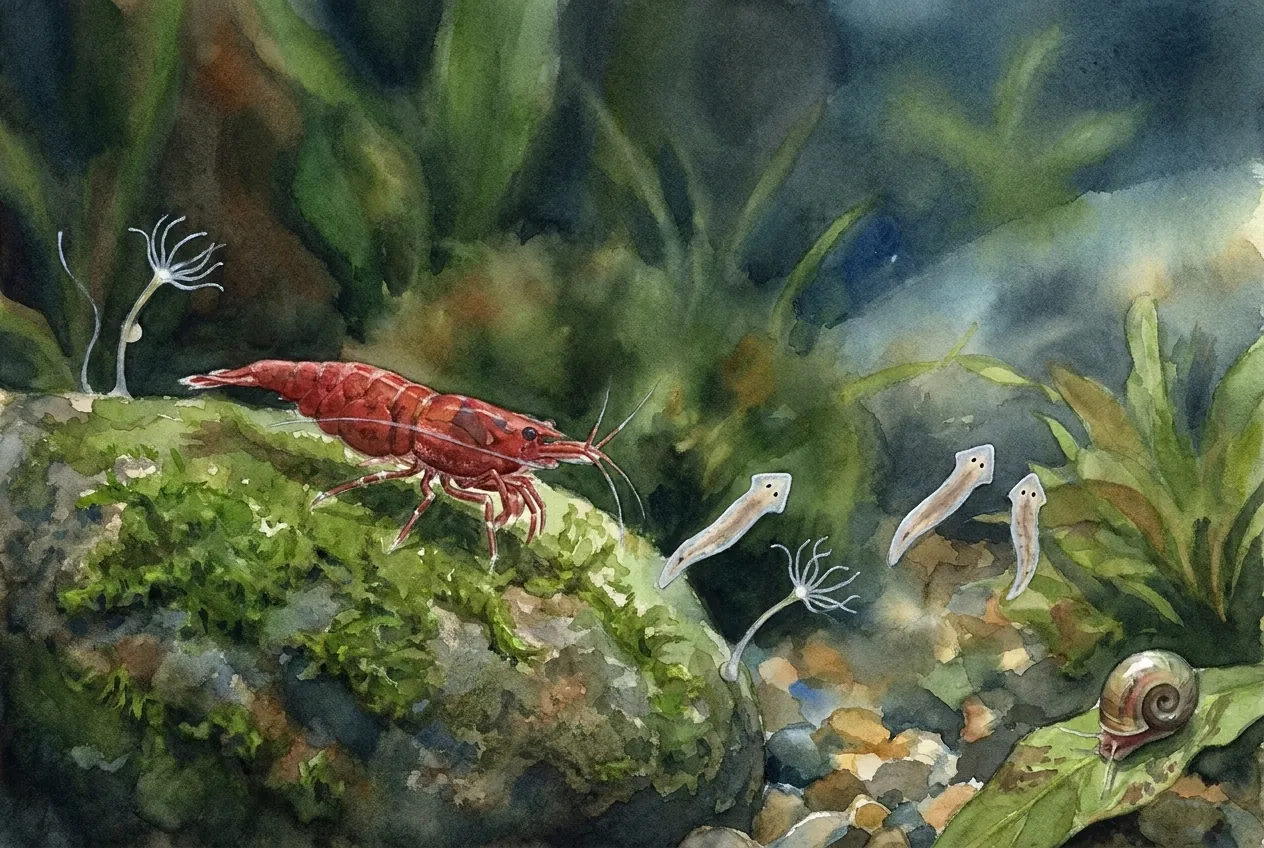
You switch off the tank light and the front glass is crawling with tiny white things.
The right move depends on which white thing it is. Planaria in a shrimp tank, hydra, and a crowd of harmless look-alikes all turn up where food is plentiful, and most need no medicine.
The drugs sold for planaria and hydra also do not stop at their targets. Fenbendazole, praziquantel, betel-nut products, and levamisole each carry a different, mostly unstudied risk to snails and shrimp.
The sensible order is identify, starve, trap, and only then treat, with the snails moved out first.
Identify First With a Timed Night Check
Many white specks on shrimp tank glass are not planaria or hydra. Planarians hide by day and come out after dark, so a daytime glance badly undercounts them.
Researchers kept lab-cultured planarians outdoors under natural day length and watched them with a dark-red flashlight.
Activity peaked just before midnight, and lab tests found red light causes no lasting avoidance.
Before any treatment decision, I mark the four corners of a 10 cm by 10 cm square with dry-erase dots on the outside of the front glass.
I count everything white inside it, plus the substrate line directly below. The starting condition is lights off for at least 1 hour and no food for the previous 12 hours.
Those values are my own working rules. The fast keeps a feeding swarm off the patch, and the hour puts the count inside the nocturnal window.
A red or dimmed flashlight goes against the side of the glass, never straight on, so translucent bodies glow.
After about 60 seconds of stillness, which lets shrunken hydra re-extend, a 10x hand lens or phone macro goes against the outside glass.
For each organism I note whether it moves or stays attached, its shape, its movement over about 30 seconds, and the patch count.
The same check runs the next night at the same clock time.
A flat glider with an arrowhead head and two dark eyespots on both nights is planaria.
An attached stalk with a tentacle ring in the same small area on both nights is hydra. Anything else goes to the look-alike table below.
My house trigger for the feeding-cut test is 3 or more planaria or hydra on the patch on both nights.
No published threshold exists, and one or two animals on a small patch can be chance. Name the organism on two separate nights before you buy or dose anything, because the most common white specks need no medicine.
How to Recognize Planaria by Their Arrowhead Head and Two Eyespots
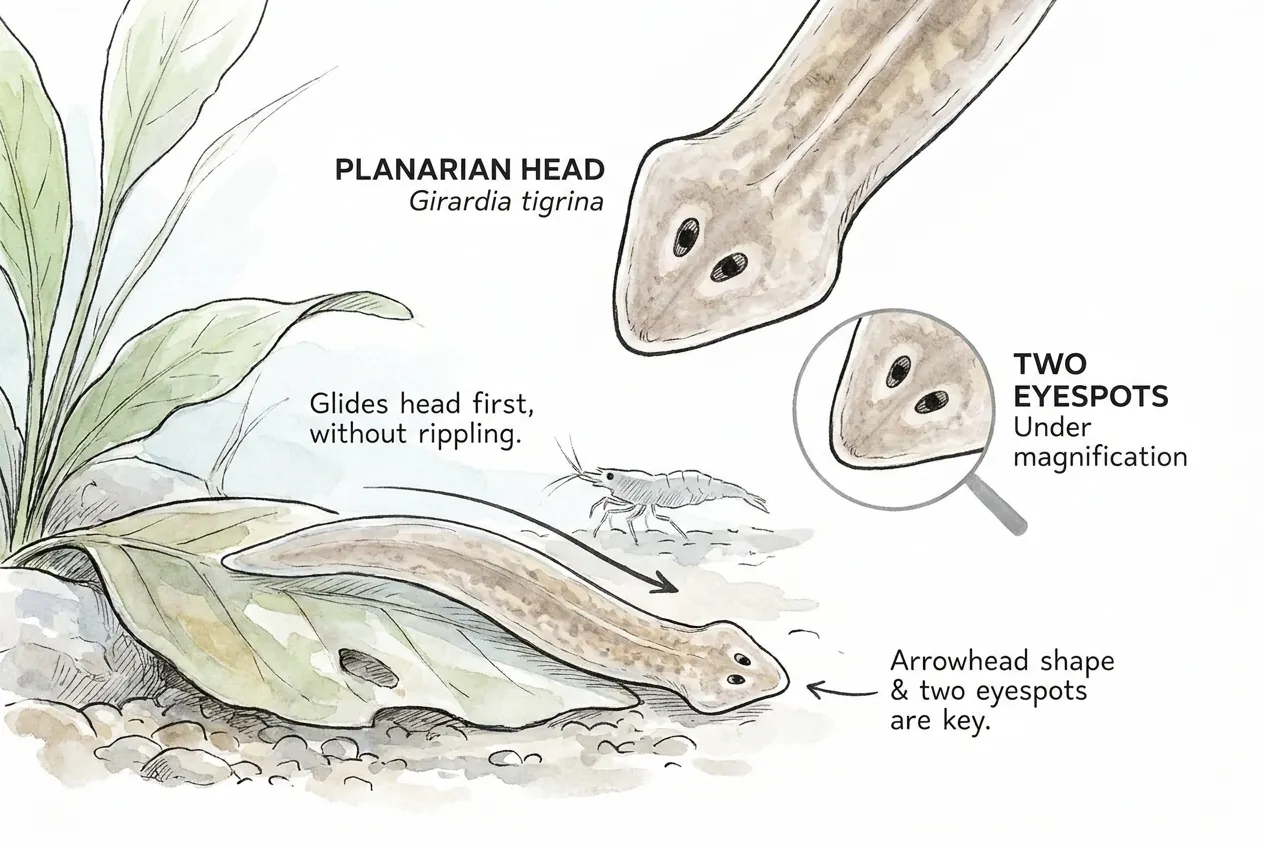
Planaria are flat, soft flatworms with a distinct head end. The common aquarium-trade species, Girardia tigrina, has a triangular head with two large, close-set eyes and ear-like lobes behind them.
Under a 10x lens, those two dark dots on a pointed head are the most decisive feature.
Color tells you almost nothing, but movement is the second giveaway. A planarian slides head first on a mucus film without rippling, its head sweeping side to side as it crosses the patch.
A hand lens cannot separate Girardia from Dugesia or Schmidtea, and the treatment decision does not need it. Two dark eyespots on a gliding arrowhead head mean planaria, whatever the color.
How to Recognize Hydra by Its Stalk, Tentacle Ring, and Habit of Shrinking
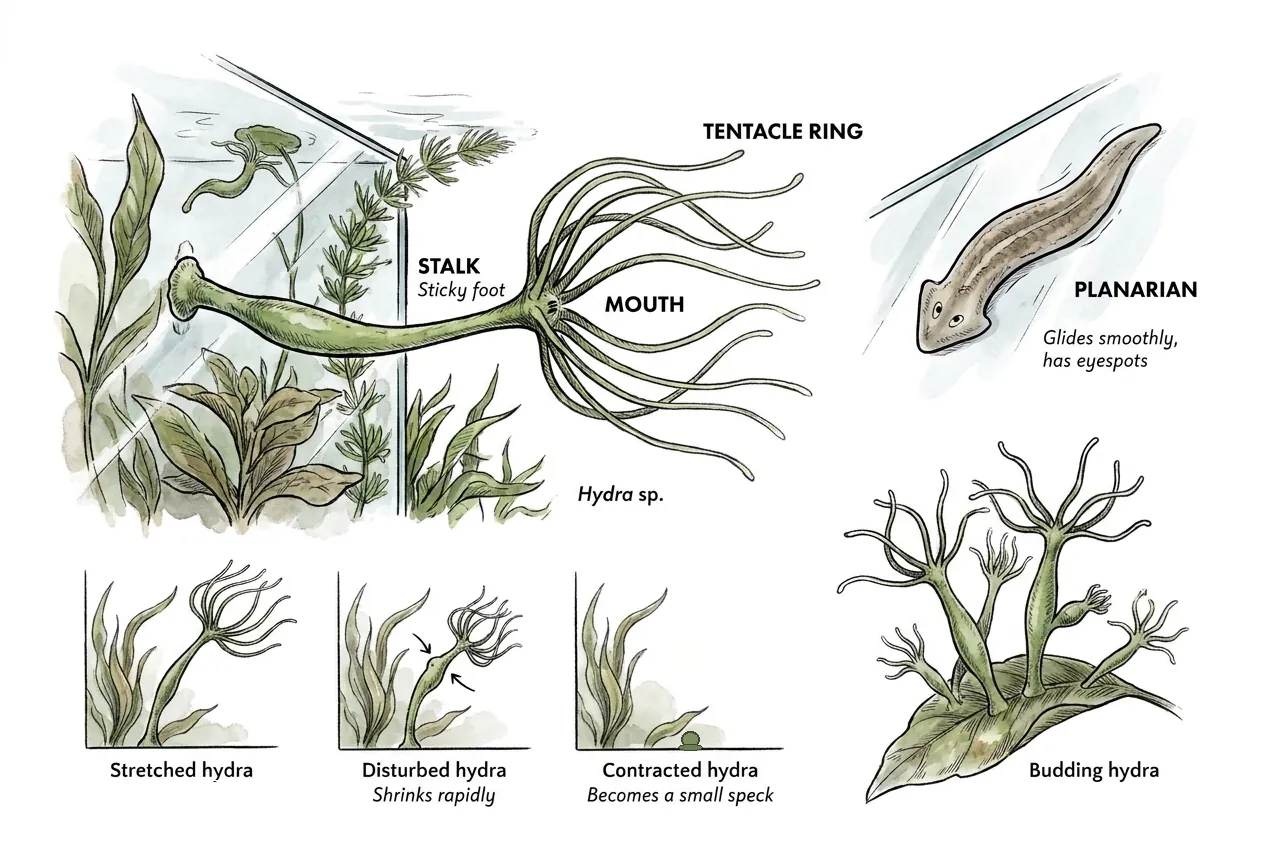
Hydra is not a worm. It is a tiny freshwater relative of jellyfish, a tube glued to the glass by a sticky foot.
Its mouth sits at the free end inside a ring of long, thread-like tentacles, with no head end and no eyespots.
Fully stretched, most hydra measure about 1/2 to 2 inches. Contracted, they shrink to a speck, so a bumped lid can make a colony seem to vanish. That is why the night check includes a still-water wait.
Hydra can be grey, brown, whitish, or green from symbiotic algae. A small side bud is a new hydra growing from the parent. While you watch, a hydra sways its tentacles but rarely moves, and then only slowly.
An attached stalk with a tentacle ring that shrinks when disturbed is hydra, not a worm.
Harmless Look-Alikes That Only Signal Overfeeding
These organisms need no medication, but many eat the leftovers that fuel planaria.
| What you see on the glass | Likely group | What to do |
|---|---|---|
| Hair-thin thread whipping in C or S curves, no head | Free-living nematode | No drug. Reduce food |
| Thin round worm with segments and bristle tufts, often in substrate or moss | Detritus worm | No drug. Reduce food and vacuum detritus |
| Pinhead speck that hops in jerks | Copepod | No action needed |
| Tiny bean-shaped dot that scoots along | Seed shrimp | No action needed |
| Motionless domed cap with two dark dots showing through | Freshwater limpet | No action. It is a small snail |
| White fuzz that snaps flat when the glass is tapped | Stalked ciliate colony | No drug. Reduce organic load |
Eyespots alone never confirm planaria. Some detritus worms have them, and juvenile limpets show two dark dots through the shell. Freshwater limpets reach about 3 mm, arrive on aquarium plants, and are snails, so snail-toxic dewormers hit them too.
If the patch shows only look-alikes, the fix is less food, not medicine.
How Dangerous Planaria and Hydra Are to Shrimp
The answer depends on which life stage is in the tank. No peer-reviewed study has measured planaria or hydra predation on Neocaridina or Caridina. Related evidence points at newborns, molting shrimp, and snail hatchlings rather than healthy adults.
Planaria Target Small, Soft, or Injured Prey
Planarians are predator-scavengers that track food by smell and suck out soft tissue. In a controlled lab study, Schmidtea polychroa (published as Dugesia polychroa) drove every Physa acuta snail population it lived with to extinction within six weeks.
Juveniles fell first, around week 2, and adults followed by week 3.
By inference, the exposed animals in a shrimp tank are shrimplets, freshly molted shrimp, and snail babies.
A planarian on a dead shrimp is not proof that it killed the shrimp, because planarians readily scavenge. Planaria are a real risk to soft, newborn, and molting animals and a minor one to healthy adult shrimp.
Hydra Are a Likely Threat to Newborn Shrimp
Hydra are sit-and-wait predators with stinging cells on their tentacles. In field and lab work, hydra ate newly hatched bluegill larvae, and lab trials showed they ate more of them at night.
The authors estimated they could kill up to 20% of a nesting colony’s larvae within 2 m.
A newborn shrimplet is tiny and lives on the same surfaces where hydra attach. Based on the fish-larva evidence, hydra can reasonably be expected to catch shrimplets, though no shrimp study measures the loss. Adult shrimp are far larger than hydra prey.
Hydra plus shrimplets or a berried female is the combination that justifies acting quickly.
Starve the Bloom First With a Measured Feeding Cut and Traps
Both planaria and hydra bloom on surplus food, and a shrimp tank with protein pellets and no worm-eating fish is a buffet.
A feeding cut works on a different clock for each. In one study, hydra fed every weekday grew from 15 to about 159 polyps at 25 °C, and budding dropped after unfed weekends.
Planarians can survive more than 3 months without food by shrinking, so the realistic goal is a falling count, not zero worms.
Running the 14-Day Count Test
My baseline is the average of the two night-check counts on the marked patch. For 14 days, each feeding is a portion the shrimp clear within 2 hours, and leftovers get siphoned at the 2-hour mark.
Bloodworm and meaty pellets stop, and hidden decay such as dead snails and food lodged in moss comes out.
On days 3, 6, 9, 12, and 14, I recount the patch at the same clock time under the baseline conditions.
That means 12 hours since the last food, lights off for at least 1 hour, and the same 60-second still wait.
The 2-hour, 14-day, and halving values are my working rules, not published standards.
Reading the Day-14 Count
- At or below half of baseline, the cut is working. I keep it until two consecutive counts read zero, then return to normal portions while keeping the 2-hour clear-down.
- Still at or below half after 14 more days without two zero counts, I accept the small, stable population. The 2-hour portions become the permanent routine.
- Lower but still above half, I run one more 14-day window of the same cut and trapping. A count still above half on day 28 sends me to the treatment decision.
- Not below baseline with no leftover food visible, starvation is not winning. I move to the treatment decision.
- Berried females dropping eggs or shrimp that stop grazing get minimal feeding restored immediately, whatever the count says.
Fourteen days gives five counts, enough to see a direction, and halving is the smallest change I trust on a small count.
The cut never becomes a total fast while shrimplets are present. In Neocaridina davidi, half of starved juveniles could no longer recover after about 16 days at the first juvenile stage.
For the third stage that point came at about 9.4 days, well inside a 14-day window.
Judge a feeding cut by a falling patch count, and never let it become a total fast while shrimplets are in the tank.
Setting a Trap Shrimp and Snails Cannot Enter
Planarians find food mainly by smell, and light only wins when it gets bright. In lab tests, planarians moved toward liver bait at 400 lux but fled the light at 800 to 1,600 lux. A baited trap therefore belongs in the tank after lights-off.
The trap is part of the count test. Every 2 to 3 nights, but never on a count night, I bait it with a pea-sized piece of raw shrimp at lights-off.
It comes out before the lights come on, so the bait never rots.
Catches go in a separate column so they never inflate the glass count. Entry holes must be visibly smaller than the smallest shrimp or snail. With shrimplets present, I check the trap at dawn and release any shrimp.
Traps miss cocoons and buried worms, and attached hydra rarely enter them, so a trap is a counting aid, not a cure.
Remove Whole Animals, Never Pieces
Planaria and hydra both regenerate from fragments. A planarian smeared across the glass can rebuild into several worms from body-wide stem cells.
Siphon visible worms and polyps out whole with an airline tube. Rinse infested moss outside the tank rather than shaking it inside. Fish that eat planaria or hydra also eat shrimp, so biological control is off the table.
What the Evidence Says About Each Dewormer
No common dewormer has published proof of safety for aquarium snails or dwarf shrimp. They differ in mechanism and in the kind of evidence behind them.
| Active ingredient | How it works | Evidence against planaria or hydra | Snail and shrimp evidence |
|---|---|---|---|
| Fenbendazole and other benzimidazoles | Binds beta-tubulin and blocks microtubules | Keeper reports only | Snail deaths widely reported. Water fleas highly sensitive. No snail or dwarf shrimp study |
| Praziquantel | Disrupts calcium channels in flatworms | Lab kill shown only at about 12 times label strength. Label strength untested. Hydra claims anecdotal | Low water flea toxicity in one study. Snail and shrimp safety unestablished |
| Betel-nut products (arecoline) | Acts on acetylcholine signaling | Sold for both. No peer-reviewed efficacy study | Arecoline kills apple snails in the lab. Label warns against snails |
| Levamisole | Activates roundworm muscle receptors | No planaria or hydra data | No peer-reviewed snail or shrimp data |
Levamisole targets roundworm receptors and has no published test against planaria or hydra, so it is unlikely to be a reliable treatment for either.
The white threads it would kill are the harmless nematodes from the look-alike table.
Fenbendazole and Other Benzimidazoles
Fenbendazole does not recognize planaria. It binds beta-tubulin, a building block shared by nearly every animal. Its wide safety margin was established for mammals, never for snails, shrimp, or hydra.
The only controlled aquatic data come from tiny crustaceans. Fenbendazole had a 48-hour EC50 of 16.5 µg/L in the water flea Daphnia magna. Chronic exposure harmed its survival, reproduction, and growth at 1.25 to 4.1 µg/L.
Water fleas are not dwarf shrimp, but that sensitivity suggests shrimp could be vulnerable, especially berried females and shrimplets.
Keeper reports of adult shrimp surviving are anecdote, not a safety margin.
Snails have no controlled study at all. One hobby reference warns that fenbendazole harms snail species and that flubendazole kills snails and lingers in substrate for months.
Pet and livestock fenbendazole in a tank is off-label, and the dog label gives no aquarium dose. In the US, extra-label use requires a veterinarian’s order. Any dose must come from an aquarium-labeled product or a veterinarian, never a forum.
Treat fenbendazole as snail-lethal and shrimp-uncertain, because water fleas are highly sensitive to it and dwarf shrimp remain untested.
Praziquantel
Praziquantel treats parasitic flukes, but free-living flatworms are far less sensitive to it. In the key study, intact Dugesia japonica held continuously in 100 µM praziquantel took a median of about 7 days to die.
By molar conversion, 100 µM is about 31 mg/L. The PraziPro label concentration is 2.5 mg/L, so the lab kill needed about 12 times label strength.
Sub-lethal fragments survived and kept feeding, and none of these lab figures is a tank dose.
The PraziPro data sheet says it is not known to be toxic to commonly kept aquarium animals when used as directed. It never names snails or shrimp. A water flea EC50 of 42.7 mg/L makes it far less toxic to that crustacean than fenbendazole.
The label says to remove activated carbon during treatment, because carbon strips the drug. Praziquantel is not proven safe for snails or shrimp, and at label strength it is an uncertain planaria killer.
Betel-Nut Products Such as the No Planaria Brand
Betel-nut products are the shrimp hobby’s default planaria and hydra treatment, and their main alkaloid, arecoline, acts on acetylcholine signaling. Natural does not mean snail-safe.
In a lab study on apple snails, arecoline had a 72-hour LC50 of 1.05 mg/L in 15 mm snails.
Smaller snails were more sensitive, and gill cilia were stripped. Hobby mystery snails share a genus with the snail tested.
A retailer reproduction of one product label says not to use it with snails. The same page also claims 20 snail species showed no issues, while keeping the snail warning in place.
Treat the warning as controlling and the shrimp-safe claim as the manufacturer’s alone.
By inference from the size effect, baby ramshorns, bladder snails, and juvenile nerites face the most risk. Assume a betel-nut product will harm snails, because its own label says so and its alkaloid kills apple snails in lab tests.
If You Treat, Protect Snails, Shrimp, and Water Quality
A dewormer course is also an ammonia event, because dead animals rot fast in a small tank.
The Go or No-Go Check Before the First Dose
Treat only when hydra meet the night-check trigger in a tank with shrimplets or a berried female, or when the count test fails. These gates are practical cutoffs, not published standards. Without an aquarium label or a veterinarian’s direction, do not dose.
When hydra threaten a berried female, move her to a separate hydra-free container to hatch first. Dosing around developing embryos is likely the riskiest timing. No dewormer is shown safe for shrimplets either, so move them with her where possible, or accept that untested risk knowingly if they stay.
Dose, course length, repeat interval, and scheduled water changes follow the product label only. Before the first dose, move every snail you want to keep into an aerated container of tank water, checking moss, hardscape undersides, and sponges for stragglers. If snails cannot be relocated, skip benzimidazoles and betel-nut products.
The holding container may stay in use for more than a week. Feed its animals lightly and make small, regular water changes with prepared water matched to the tank, never water from the dosed tank.
Move every snail you value out before dosing, and let the label, not a forum, set the dose.
Ammonia and Nitrite Watch After Dosing
Shrimp suffer at ammonia levels far below lethal ones. In a thesis study on Neocaridina denticulata, small juveniles had a 96-hour lethal concentration of 37.82 mg/L total ammonia nitrogen. Yet levels above 1.14 mg/L already reduced growth and egg-carrying.
Extension guidance treats any ammonia in an established tank as a problem and suggests a 25 to 50% water change. The toxic share rises with pH and temperature. Hard, alkaline Neocaridina tanks have less margin than soft, acidic Caridina tanks.
On treatment day, before the first dose, I record ammonia, nitrite, pH, and temperature with a liquid kit as the tank’s own baseline.
The aquarium water test kit chooser covers kits that resolve low ammonia steps.
I retest ammonia and nitrite at 12 and 24 hours after the first dose, then daily.
Daily testing continues until two consecutive readings taken 48 hours or more after the label’s end of treatment match baseline.
Nitrite lags ammonia, which is why the schedule runs past the course.
Visible dead worms and snails get siphoned before each test. A rise of one color step above baseline in either reading triggers a 25% water change and a retest 6 hours later.
While the retest stays above baseline, that change and retest repeat, and feeding stays reduced.
Replacement water stays within about 1 °C of the tank and about 10% of its TDS, with matched GH.
The 25% volume and those tolerances are my rules, chosen to limit mineral swings for molting shrimp. The shrimp molting post on RO water explains why.
At the label’s end point I make its specified water change, vacuum mulm, and add fresh activated carbon.
My carbon run lasts at least 4 days, borrowed from a marine aquarium praziquantel study, not a fenbendazole standard.
That study saw praziquantel vanish in 2 to 8 days with biofiltration but persist 15 days in sterile water.
The aquarium filter media chooser covers carbon options. Snails return only after the course, its water change, and the carbon run are complete.
Benzimidazoles are the exception, because carbon works on the water, not the substrate. The hobby reference cited above reports that flubendazole lingers in substrate for months and keeps killing snails, which rules out restocking during that time.
Fenbendazole shares that drug class, so after either drug, keep valued snails out of that substrate rather than returning them after the carbon run.
Test against your own day-zero reading and act on any rise, because shrimp reproduction suffers far below lethal ammonia levels.
Watching for the Rebound After Treatment
A clean glass a few days after treatment proves little. At about 20 °C, Girardia tigrina cocoons with a rigid capsule hatched 12 to 22 days after laying.
Development is slower in cool water, and another population of the same species took 5 to 29 days.
Whether dewormers reach the embryos inside has not been tested. Repeat the night check on the same patch every 3 days from the label’s end of course.
Stop when two consecutive counts read zero after about day 30, just past the longest published hatch time, and count longer in an unheated tank.
Worms returning at any point in that window may be hatchlings from cocoons laid before or during treatment, not proof the dose failed.
Go back to the count test, and repeat treatment only if the label permits. Keep counting past the cocoon window, because a clean week is not a cleared tank.
Keeping Planaria and Hydra Out Next Time
Aquatic plants are a major hitchhiker route. A survey of 55 home aquaria found non-native invertebrates more often in tanks that had plants added.
Hold new plants and moss in a separate lit container without livestock, and run the night check before moving them. Tissue-culture plants are a cleaner alternative.
Quarantined plants and food that disappears within hours work before a bloom starts, while a dewormer can only react after one.
Choosing Your Path to Tolerate, Starve, or Treat
Look-alikes call for smaller portions and nothing more. A few planaria or hydra in an adults-only tank need only the feeding cut and a dark-period trap.
Treatment earns its place only for hydra with newborn shrimp or a count test that fails on day 14 or day 28.
Even then, betel-nut products and fenbendazole should be treated as snail killers, and praziquantel is unproven for both control and invertebrate safety.
If you treat, pull the snails, follow the label, test ammonia against your baseline, and count past the cocoon window. Planaria in a shrimp tank are a symptom of surplus food, and the tank stays clear only when that surplus stays gone.