
Winter Tap Water pH: Why Water Changes Crash Your Aquarium
Winter tap water reads lower pH and quietly loses KH, so water changes crash your aquarium. Run the 24-hour degas test and a monthly KH log to stop it.
Jordan Cole · Published 2026-10-06 · 14 min read
Key Takeaways
- Fresh tap water reads falsely acidic in winter. Aerate a sample 24 hours to see its true pH.
- A gap of 0.4 pH or more between fresh and aerated samples means CO2 is skewing your readings.
- Log tap KH monthly October through March. Below 3 dKH, shrink water changes to 25 percent or less.
- A post-change pH drop that recovers in 24 hours was CO2. One that sticks means the buffer is gone.
- After a crash, test ammonia before raising pH. Fast chemical rescues convert ammonia to its toxic form.
Your tank ran smoothly from April to October. Then one routine winter water change sent the pH sliding, and the test kit said your tap was not the water you remembered.
You did not imagine it. Tap water is a seasonal product, and winter is when it moves the most.
Two Separate Things Change in Winter
The first change is in your reading. Cold tap water arrives loaded with dissolved carbon dioxide, which pushes the pH test down even when the underlying chemistry is unchanged.
The second change is in the water itself. Utilities switch sources, watersheds dilute, and treatment plants retune their targets as temperatures fall.
A winter pH crash after a water change is almost never random. It traces back to either a CO2-skewed reading or a real drop in your tap’s buffering capacity. The fix is knowing which one you have, and both are testable at home.
Your Fresh Tap Sample Reads Falsely Acidic
Before you blame your utility, check your sample. The number on a fresh tap test is partly an artifact of the pipe it just left.
Dissolved CO2 Pushes the Reading Down
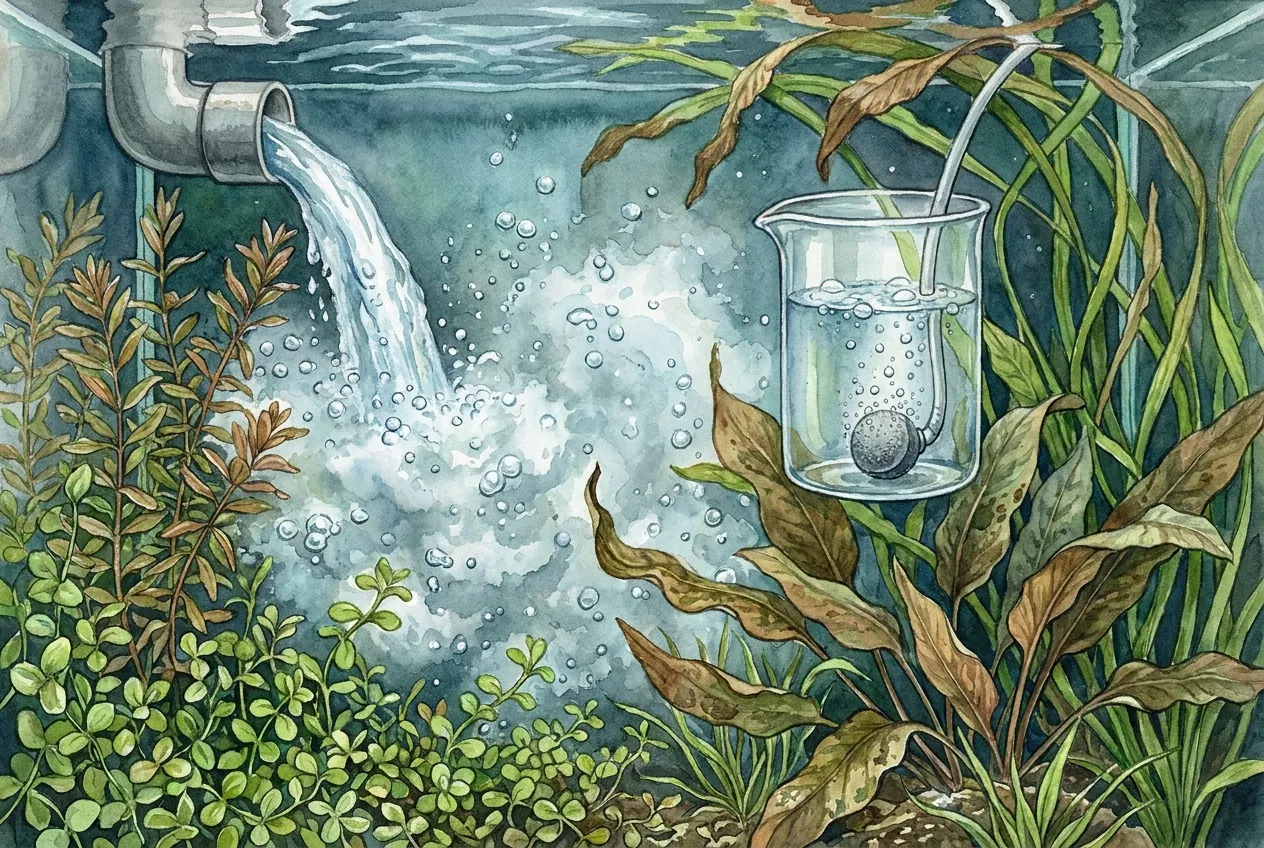
Water in a pressurized main has no air contact, so it holds more dissolved CO2 than it will after sitting in your open-topped tank. Dissolved CO2 forms carbonic acid, and carbonic acid lowers pH.
The size of this effect is not subtle. A US Geological Survey field study found that stripping residual CO2 by mechanical aeration raised pH by as much as 2 full units.
Water-treatment engineers see the same thing in routine practice. Industry degasification guidance describes a pH 5 feed rising to around 6 or 6.5 once the free CO2 is removed.
Cold water holds more dissolved gas than warm water, so the gap between the fresh reading and the true reading widens in winter.
Your tap can read honestly in July and falsely acidic in January.
The pH of a fresh tap sample measures the CO2 state of your plumbing, not the water your tank will actually hold a day later.
The 24-Hour Degas Test I Run Every Winter
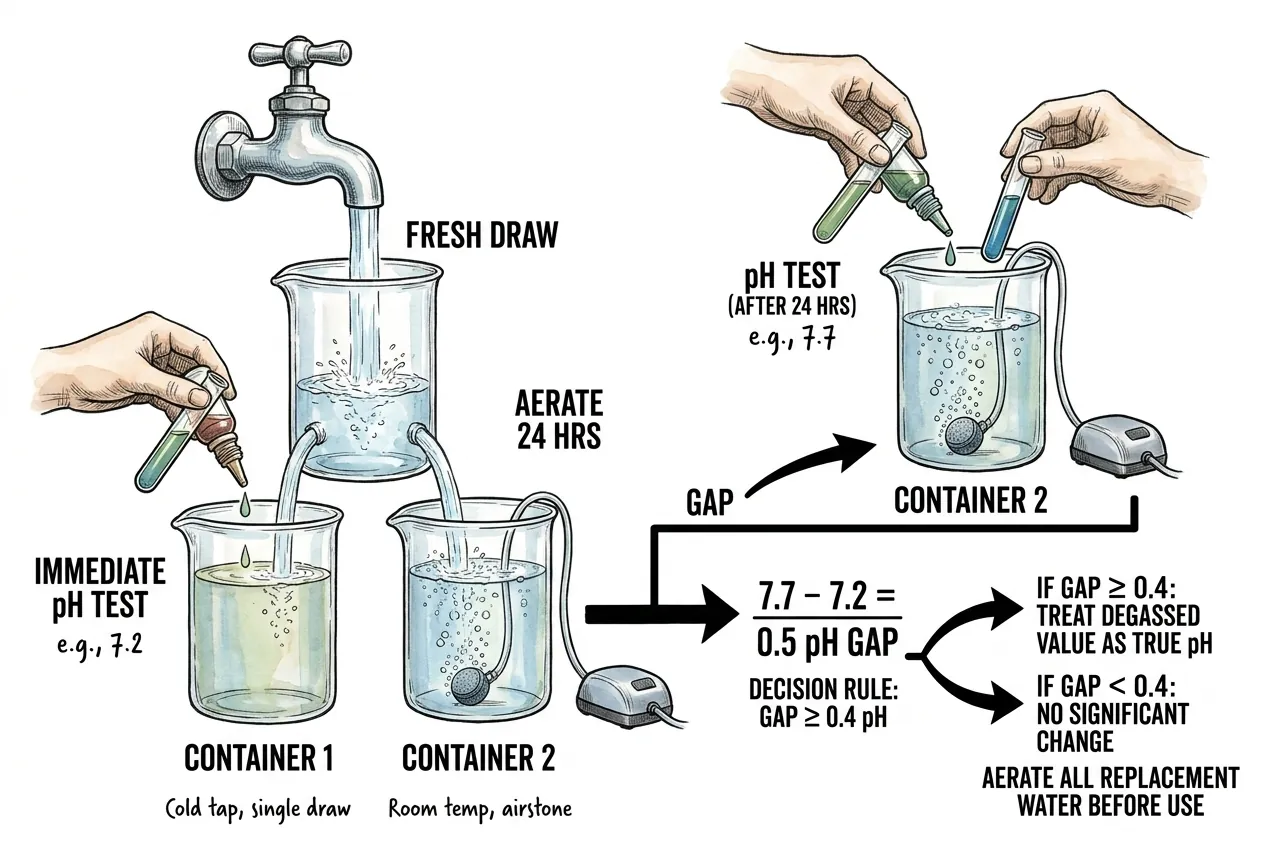
Telling a CO2 artifact from a real change takes two containers and a day. I fill both from the cold tap in a single draw, then test one immediately and write that number down.
The second container gets an airstone and sits at room temperature for 24 hours. Then I test it with the same kit, since switching kits between samples would hide the very gap I am measuring.
My decision rule is a gap of 0.4 pH units. If the aerated sample reads at least 0.4 higher than the fresh one, I treat the degassed value as my tap’s true pH.
From then on I aerate all replacement water for 24 hours before it touches the tank.
No agency publishes a hobby cutoff for this gap, so 0.4 is my own conservative line.
It sits clearly above the resolution of common liquid test kits. Documented degas rises run from about half a unit to 2 units, so a real gap will usually clear it.
Use only the cold tap for both samples. Hot-water lines pick up metals from the water heater, and well water usually shows an even larger gap than municipal water.
The Water Itself Really Changes in Winter
If the degas test shows no meaningful gap but your numbers still moved, the water leaving the plant has genuinely changed. There are three documented ways that happens.
Utilities Switch Sources, and the Sources Differ Enormously
Many cities run more than one water source and move between them with the seasons and the weather.
Portland, Oregon, serves soft Bull Run surface water at 7 to 11 ppm total hardness, but supplements with groundwater at about 80 ppm.
That is roughly an 8-fold hardness difference flowing from the same faucets, depending on operations. Portland activates its well field seasonally and during turbidity events, and winter storms are a classic turbidity trigger.
The pattern is not unique to Portland. In Santa Clara County, California, groundwater hardness averages over 250 mg/L while treated surface water averages under 120 mg/L.
If your utility blends or switches sources, your tap KH and hardness can step-change overnight without any notice a fishkeeper would see.
Snowmelt and Reservoir Turnover Dilute the Buffer
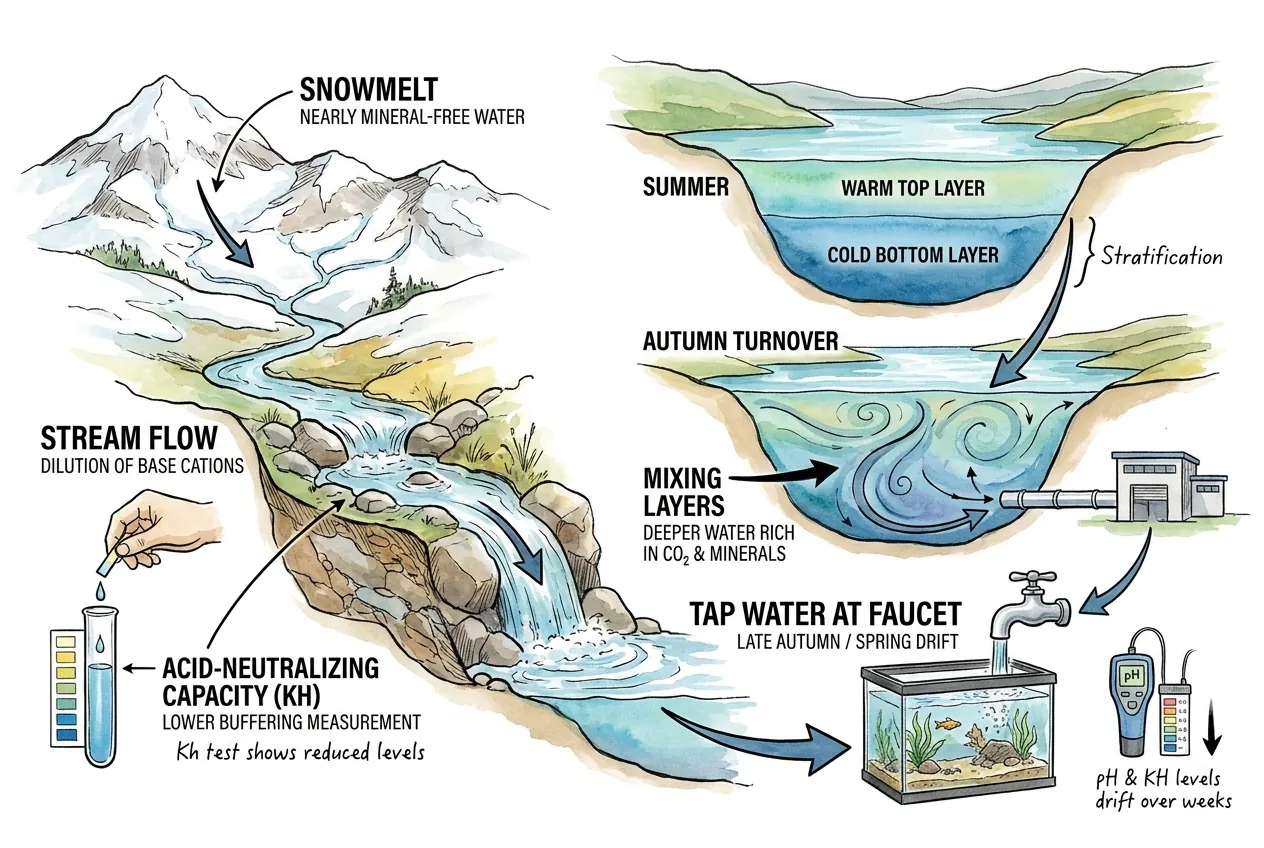
Surface sources also change on their own. Snow is nearly mineral-free water, and USGS studies of snowmelt-dominated streams found that melt episodes diluted base cations and measurably decreased acid-neutralizing capacity.
Acid-neutralizing capacity is the field name for the same buffering your KH test measures. Less of it in the river means less of it at your faucet.
Reservoirs add a second mechanism. They settle into a warm top layer and a cold bottom layer each summer. When the surface cools in autumn, the layers mix and send deeper water rich in CO2 and minerals toward the intake.
So a reservoir-fed or snow-fed tap tends to drift over weeks in late autumn and again toward spring melt.
Groundwater-served homes largely skip this seasonal mineral drift, but they carry more dissolved CO2 instead.
The Plant Retunes Finished Water to Protect Pipes
Your tap’s pH is also an engineering target. Utilities deliberately raise pH to make water less corrosive to lead and copper plumbing, under the federal Lead and Copper Rule.
Washington, DC offers a concrete example. The Washington Aqueduct must hold finished-water pH between 7.4 and 8.0. DC Water then checks distribution pH daily to keep its orthophosphate treatment effective.
EPA’s corrosion-control guidance recognizes that seasonal swings in source water, including temperature, may require seasonal adjustment of those treatment settings.
A tap stepping from one pH to another in November, with KH unchanged, often means the plant retuned rather than the river changed.
That kind of plant-side pH step is the least dangerous version of winter change. The pH the plant sets re-equilibrates with your tank’s own CO2 quickly, while the KH it ships is what determines stability.
How to See Your Own System’s Numbers
Every community water system must give customers an annual water quality report, the Consumer Confidence Report, due by July 1 each year. EPA hosts a lookup tool for finding yours.
The CCR tells you which sources your system uses, whether it blends, and the year’s reported ranges for pH and hardness.
What it averages away is timing, since a wide annual range does not say which months sat where.
For current numbers, contact the utility lab directly. I ask which source currently serves my address and what this week’s finished-water pH and total alkalinity are.
Utilities measure both daily for compliance, and customer service departments field exactly this kind of question.
A private well has no CCR, so well owners should lean on the degas test and a periodic lab test instead.
Why a Water Change Crashes Tank pH
Seasonal tap drift only matters because of what it does inside the glass. The crash mechanism runs through KH, not pH.
This is also a different failure than the in-tank swings that heating season causes on its own.
Those are covered in the guide to aquarium pH swings in heating season, while this problem arrives through the faucet.
KH Is the Crash Protection
Carbonate hardness measures bicarbonate and carbonate, the ions that absorb acid before it can move pH.
Extension guidance for fish culture recommends at least 20 ppm of alkalinity. The same guidance notes that low-alkalinity water can swing between pH 6 and 10 in a single day.
Aquaculture references put the comfortable band far higher, with 75 to 200 mg/L CaCO3 described as desirable.
They also note that alkalinity changes over weeks to months, while CO2 and pH move by the hour.
That timing difference explains the classic winter mystery. A tank consumes KH continuously, because the nitrifying filter produces acid as it processes waste.
Water changes are the KH refill. When winter tap quietly drops from a comfortable KH to a thin one, each change refills less buffer. The tank then burns through its reserve over the following weeks.
The crash lands in January because the tap changed in November, and nothing about the tank itself had to go wrong in between.
A Dip That Recovers vs a Crash That Sticks
Not every post-change pH drop is a crash. CO2-rich replacement water pulls pH down immediately, then the excess CO2 gases off through surface agitation and the reading climbs back within hours.
A KH-driven crash does not climb back, because the buffer itself is missing. Three readings separate the two cases.
I test tank pH right before a water change, then 1 hour after, then 24 hours after, using the same kit each time.
In a planted tank I take all three at the same point in the light cycle, because photosynthesis moves pH through the day.
If the tank still reads 0.5 or more below the pre-change value a full day later, I halve my water-change volume.
I also start aerating replacement water for 24 hours before every following change.
That 0.5 figure is my own conservative rule, not a published standard. Extension sources establish that rapid pH changes stress fish without naming a home-aquarium cutoff, and controlled exposures show measurable stress from even sub-unit drops.
In one such trial, juvenile rockfish spent 96 hours at pH 7.0 to 7.8 against a control of 8.0.
They showed altered behavior and elevated cortisol for about 24 hours. None died, and the fish recovered, which is exactly why I treat sub-unit drops as a warning rather than an emergency.
What a Crash Does to the Filter, and Why the Rescue Kills
A crashed tank has a second problem hiding behind the first. Nitrifying bacteria work best in roughly the pH 7.5 to 9.0 range, and their activity falls as pH drops.
So while pH sits low, ammonia processing slows and waste accumulates. The chemistry grants a temporary mercy, because at low pH ammonia sits mostly in its ionized form, which is far less toxic.
University of Florida extension work puts the un-ionized form at roughly 100 times more toxic. Tissue damage becomes possible above 0.05 mg/L, and 2.0 mg/L is typically lethal to sensitive fish. The un-ionized fraction grows as pH and temperature rise.
That is the trap in a fast rescue. Jam the pH back up with chemicals, and the banked ammonia converts toward its toxic form before the slowed filter catches up.
After any crash, test ammonia before touching pH, and raise pH only in small steps with modest aerated water changes spread over days. Feed lightly and keep testing ammonia daily for a week, since the filter lags behind the fix.
If ammonia keeps climbing afterward, the tank has slid into the cold-tank cycle problem covered in the guide to heating-season ammonia spikes.
The Winter Routine That Prevents the Crash
Prevention is a short list, executed in order. Measure the tap monthly, prepare replacement water deliberately, rebuild buffer slowly when it thins, and know when to stop fighting the faucet.
Log Your Tap KH Monthly From October Through March
KH is the early-warning number, so I log it instead of pH. Once a month from October through March, I run a liquid KH titration on a fresh cold-tap sample.
The kit reports degrees of carbonate hardness, written dKH, and I record the value with the date.
I test the tank’s KH the same day, which gives me a paired record of what the tap delivers and what the tank retains.
Fresh samples are fine here, because off-gassing CO2 shifts pH but not KH.
My floor is 3 dKH, and my drift alarm is a fall of 2 dKH from the October baseline.
When either trips, I cut water changes to 25 percent or less per session. I then run the three-reading pH check on the next change.
That floor is my house rule, built with margin. The extension minimum of 20 ppm alkalinity converts to only about 1 dKH. A closed tank consumes alkalinity between changes, so I refuse to operate near the bare minimum.
| Tap KH reading | What I do |
|---|---|
| 4 dKH or higher | Normal water-change routine, keep logging monthly |
| 3 to 4 dKH | Keep volume moderate, recheck in two weeks instead of monthly |
| Below 3 dKH, or 2+ dKH under my October baseline | Cut changes to 25 percent or less, run the before-and-after pH check |
| Near 0 to 1 dKH | Rebuild buffer before the next scheduled change |
Aerate and Temperature-Match Replacement Water
Replacement water should meet the tank on the tank’s terms. A food-safe container, an airstone, and a small heater turn raw winter tap into predictable water overnight.
The aeration drives off the excess CO2, so the water enters the tank at its true pH instead of its pipe pH.
The heater closes the temperature gap, which winter tap makes wider than people expect.
Aging fixes CO2, dissolved-gas supersaturation, and temperature. It does not add one degree of KH, so an aerated low-KH tap is still a low-KH tap.
If the aging container needs its own heater, sizing and failsafe behavior matter more than brand.
The aquarium heater buying guide covers how to choose one.
Rebuild Thin KH Slowly
When the log shows the tap can no longer supply enough buffer, I add it deliberately.
Plain sodium bicarbonate dissolved in a cup of tank water raises KH directly, and crushed coral in the filter releases buffer passively as pH falls.
Rather than dosing by the spoonful, I let the test kit set the pace. I raise KH by no more than 1 dKH per day, retesting before every addition. The pH rise that follows a KH jump is itself a rapid change, and it pushes ammonia toward its toxic form.
Nobody publishes an aquarium dosing standard for baking soda, so slow steps with a test kit between them are the honest method.
Crushed coral is the lower-effort option for tanks that sit chronically thin, since it dissolves fastest exactly when the water drifts acidic.
When RO Is the Real Answer
Some taps are not worth fighting. If the monthly log shows KH spending whole months below the floor, or you keep KH-sensitive livestock, rebuilding buffer change after change becomes a treadmill.
Reverse osmosis plus a remineralizer makes winter source drift irrelevant, because you rebuild the exact same water every time.
Shrimp keepers moved to RO for precisely this stability, and the tradeoffs are covered in the guide to shrimp molting deaths on RO water.
Key Takeaways
- Test tap pH twice, fresh and after 24 hours of aeration. A gap of 0.4 or more means CO2 is skewing your readings.
- Log tap KH monthly from October through March. Below 3 dKH, or 2 dKH under your autumn baseline, shrink water changes.
- A post-change pH drop that recovers within 24 hours was CO2. One that sticks is missing buffer.
- After a crash, test ammonia first and raise pH slowly. A fast chemical rescue converts banked ammonia toward its toxic form.
- Your utility’s Consumer Confidence Report and one email to its lab tell you which water you are actually getting this month.
The first move costs nothing. Fill two containers from the cold tap tonight and aerate one. By tomorrow evening you will know whether your winter problem is the water or the reading.