
CO2 Drop Checker Wrong in Cold Water? The Autumn Lag Fix
A CO2 drop checker in cold water lags hours behind the tank and biases blue. Cross-check with the degassed-sample pH drop before you adjust injection.
Marcus Hale · Published 2026-10-19 · 14 min read
Key Takeaways
- A drop checker reads hours behind the tank, and autumn cold stretches the lag while biasing it bluer.
- Morning blue appears at the daily CO2 maximum, so never raise injection on a morning reading.
- The degassed-sample pH drop cancels KH error. One full unit of drop means roughly tenfold CO2.
- Hold a mid-window CO2 target in cold water and change one thing per three-day window.
- Gasping fish outrank every instrument. Aerate and water-change first, diagnose second.
It is a cold October morning and your drop checker is blue. Your hand is already on the needle valve, because blue means not enough CO2.
In a cooling tank, that morning blue is the most misleading reading of the whole year. Raising injection on it is how autumn fish get gassed.
The checker is not broken. It is a slow instrument that gets slower in cold water, and its color scale was built on warm-water chemistry.
Cold water also quietly holds more CO2 at the same injection rate, so the instrument drifts optimistic exactly when the water drifts loaded.
The fix does not require new hardware. A degassed sample of your own tank water plus a basic pH test gives you a reliable cross-check.
It cancels the errors that mislead both the checker and the pH/KH chart.
Why a drop checker always reads behind your tank
A drop checker never measures the moment you look at it. Understanding the mechanism makes the lag obvious instead of mysterious, and it tells you which jobs the device can still do well.
The air gap that makes it honest also makes it slow
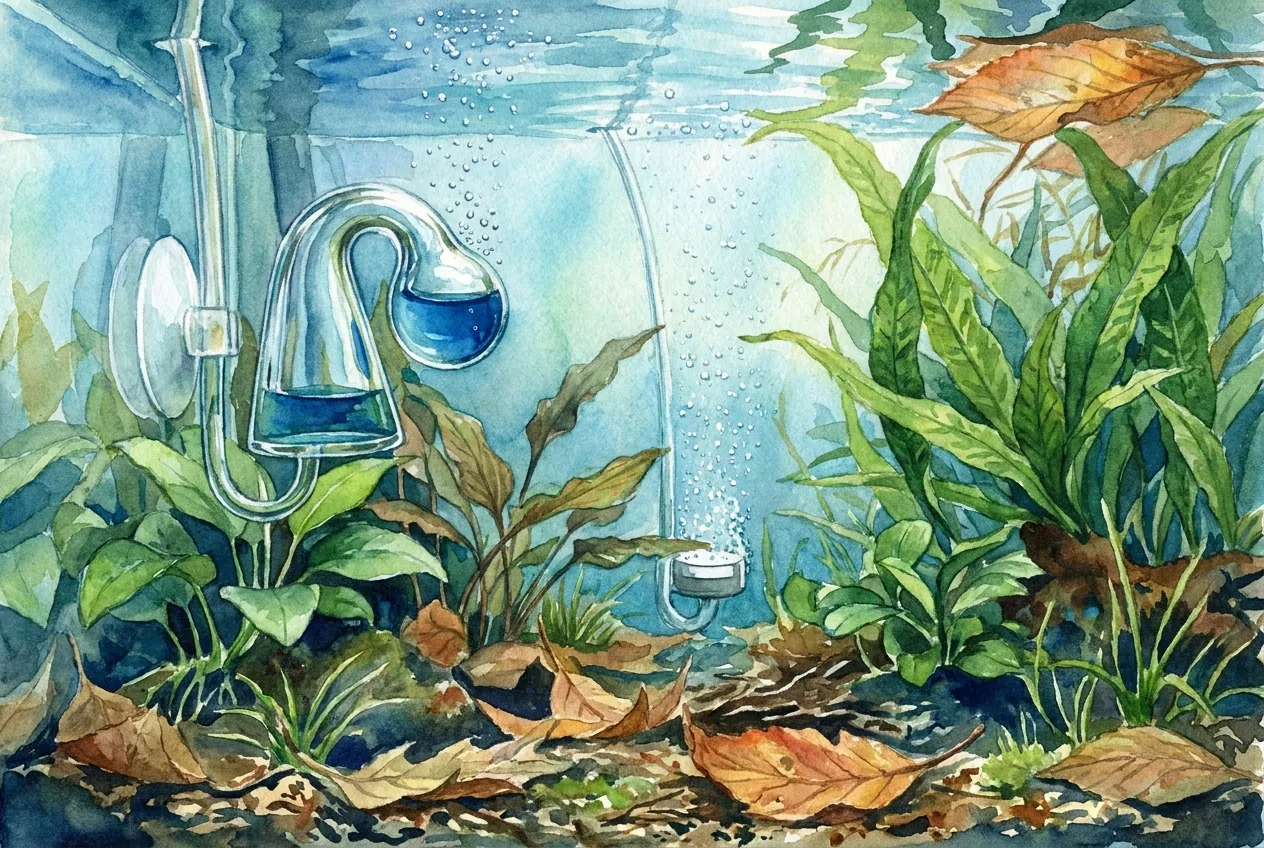
The little glass holds a reference solution behind a trapped pocket of air. Dissolved CO2 must leave your tank water as gas, cross that air pocket, and re-dissolve into the reference before anything changes color.
The reference is distilled or deionized water set to exactly 4 dKH, dosed with bromothymol blue.
Because only CO2 gas can cross the air gap, tank buffers, fertilizers, and tannins never touch the solution. That isolation is the entire point of the device.
At a fixed 4 dKH, the solution’s pH depends on dissolved CO2 alone. Bromothymol blue turns yellow below pH 6.0, sits blue above pH 7.6, and passes through green between them.
A green reference near pH 6.6 corresponds to roughly 30 ppm CO2, which is why green became the target.
Never refill the glass with tank water. Your tank’s KH is not 4, and part of it is usually not carbonate at all, so the color loses its meaning entirely.
How late the color actually runs
The manufacturer’s own figure for full equilibration is 4 to 5 hours. Even a settled reading describes the tank as it was an hour or two earlier.
An independent technical review calls the display an average over roughly three hours. Whatever color you see, you are looking at your tank’s past, not its present.
Cold stretches this further. Cooling from 25 C to 20 C cuts the CO2 diffusion coefficient from about 1.91 to 1.67 hundred-thousandths of a square centimeter per second.
At 15 C it reaches about 1.45. That is roughly 13 to 24 percent slower transport across the exact range a tank drifts through in autumn.
I stopped arguing with my own checker and started timing it instead. For three consecutive days I photograph the glass at three fixed clock points.
The points are CO2-on, mid-photoperiod, and lights-off, shot from the same angle with the thermometer in frame.
The photo strip shows my tank’s real lag, not a forum estimate of it.
My working rule for that log is simple. If green first arrives 3 or more hours after CO2-on, I stop trusting the checker for same-day dosing decisions. It gets demoted to a multi-day trend indicator.
I chose 3 hours because it is stricter than the manufacturer’s own 4-to-5-hour equilibration figure, so the rule fails safe.
What cold water does to the color itself
Lag is only half the lie. The other half is the color scale’s warm-water assumption. Cold water changes how much CO2 your tank holds and how the reference solution reports it.
Cold water holds more CO2 and releases it more slowly
Gas solubility rises as water cools. At the same CO2 partial pressure, the dissolved capacity climbs steeply across the autumn range.
| Water temperature | CO2 solubility at 1 atm | Relative to 25 C |
|---|---|---|
| 15 C (59 F) | 0.1970 g per 100 mL | about 36 percent more |
| 20 C (68 F) | 0.1688 g per 100 mL | about 16 percent more |
| 25 C (77 F) | 0.1449 g per 100 mL | baseline |
The same inverse rule is documented for oxygen, which is why cold water carries more of both gases. For CO2 the practical meaning is uncomfortable.
A tank that cooled from 25 C to 20 C can carry more dissolved CO2 at an unchanged injection rate. It also gives that CO2 up to the air more slowly.
The green you trust was calibrated warm
The familiar relationship behind every chart and every checker scale computes CO2 as 3.00 times KH times 10 to the power of 7 minus pH. That constant was evaluated at a 25 C baseline. The underlying solubility shifts by roughly 6 percent for every 5 C of temperature change.
The checker and the tank sit in the same water, so part of the temperature effect cancels.
The carbonate equilibrium inside the reference solution does not cancel, and published hue scales are stated for a 25 C aquarium.
As water cools, the available equilibrium evidence points the error in one direction. The reference sits at a slightly higher pH for the same CO2, so the glass reads bluer than the water deserves.
Extension water-quality guidance adds a useful boundary here. Temperature shifts the carbon dioxide math less than alkalinity does, so this bias is real but modest. Treat a cold-tank green as at least target CO2, and never read a cold-tank blue as proof of low CO2 on its own.
Why autumn mornings invert the reading
The lag and the cold bias collide at dawn. Overnight, every living thing in the tank respires while photosynthesis sleeps, so dissolved CO2 climbs all night and peaks at first light.
Pond research puts numbers on the cycle. Carbon dioxide accumulates to a maximum of around 10 to 15 mg/L at dawn and falls to a minimum, often near zero, by late afternoon.
Dawn is also the dissolved-oxygen minimum, which is exactly why extension guidance calls it the critical hour for water quality.
Autumn sharpens the peak. Cooler water retains that respiration-built CO2 longer into the morning, and heating-season temperature swings keep perturbing surface exchange.
If your room drops several degrees overnight before the thermostat catches up, your tank’s gas balance moves on a clock the checker cannot follow.
Now place the instrument on top of the biology. The checker is still displaying yesterday evening’s falling CO2 curve when you walk past at breakfast.
It shows blue at the precise hours the water is most loaded. The morning blue that tempts you to raise injection appears at the daily CO2 maximum, not the minimum.
If your tank swings more than a couple of degrees between evening and morning, fix temperature stability before touching any CO2 setting. Heater capacity and placement are their own decision.
The aquarium heater buying guide covers sizing for the coldest overnight room you expect.
What those same swings do to pH is covered in the heating-season pH swing guide.
The pH/KH cross-check that works in the cold
The cross-check does not ask the checker to be faster or the chart to be truer.
It measures your tank against its own water, which cancels the biggest error terms at once.
Why the chart alone misleads
The chart’s math is exact only when carbonate is the sole buffer in the water. The classic aquarium water-chemistry reference states the relationship holds under exactly that condition. Most planted tanks do not meet it.
Your KH test makes it worse in a specific way. Hobby KH kits actually titrate total alkalinity, so phosphate buffers, some substrates, and fertilizer salts inflate the KH number you plug in.
Humic acids from wood and botanicals push pH down without any CO2 involved.
Both errors stack in the same direction. The chart reports more CO2 than the water really carries, and the comfortable number hides carbon-starved plants.
If winter tap water is also shifting your KH between water changes, the baseline moves underneath you.
That failure mode is covered in the winter tap water pH guide.
The degassed-sample pH drop method
The method I rely on through the heating season is a comparison, not a lookup. I draw about a cup of tank water and let it equilibrate with room air until the injected CO2 has left.
An airstone speeds this up, and standing overnight in a wide dish works without one.
I accept the sample as fully degassed only when the pH stops rising between two readings taken an hour apart.
That patience matters because tank water keeps hold of injected CO2 for many hours. An impatient reference makes a well-dosed tank look starved.
Then I measure the tank itself at one fixed daily event, with the same test kit I used on the sample. My event is 60 minutes after the solenoid opens.
The difference between the two readings is the signal. Carbonate math makes each full pH unit of drop a tenfold rise in dissolved CO2, whatever your actual KH is.
My working target is a drop of about 1.0 pH unit below the degassed reference. Degassed water equilibrated with room air carries only a few mg/L of CO2. A tenfold rise from there lands inside the 20 to 30 mg/L range cited for injected planted tanks.
I treat the 1.0 figure as my own operating rule rather than a published standard, chosen because it sits mid-window rather than at the ceiling.
One more of my rules completes the routine. If same-event readings drift more than 0.2 pH units between consecutive days, I treat delivery as unstable and inspect hardware before touching the needle valve.
I use 0.2 units because it is the smallest change a liquid kit can distinguish from reading noise.
Any fish gasping at the surface overrides every number on this page.
Extension aquaculture runs the same chemistry in reverse as a screening test. Aerate a bucket of pond water for about 30 minutes, and a rise of more than one pH unit flags a carbon dioxide problem.
The planted-tank version simply reads the same comparison in the other direction.
Tools that can resolve a one-unit drop
A differential measurement needs repeatability more than laboratory accuracy. A low-range liquid pH kit read in good daylight resolves steps of a few tenths of a unit. That is enough to see a one-unit drop clearly.
A pH pen reads finer, but only if you calibrate it. Extension guidance is blunt on this point. Uncalibrated pens are inaccurate, and many do not compensate for temperature, which matters doubly in a cooling fish room.
Whichever tool you use, use the same one for the reference and the tank reading in every session.
If you are deciding what to actually buy for pH and KH testing this winter, the aquarium water test kit chooser breaks down that decision.
Keep the fish ahead of every number
Dissolved CO2 harms fish from the blood side. High water-side CO2 collapses the gradient fish use to unload their own CO2 across the gills.
Blood CO2 climbs, and hemoglobin loses its grip on oxygen. A fish can suffocate internally in oxygen-rich water.
The numeric ladder is consistent across source tiers. Extension guidance marks 20 mg/L as the line where problems become plausible. Planted-tank references place the working window at 20 to 30 mg/L.
Stress behavior is documented above roughly 35 mg/L, and chronic exposure beyond 40 mg/L is lethal.
The commonly cited safe ceiling for most community fish and invertebrates sits near 30 ppm.
Notice where green lives on that ladder. The standard 4 dKH green target of about 30 ppm is the top of the safe window.
That leaves no headroom for a cold-biased instrument that understates the real load.
The behavioral ladder is your fastest sensor. Sluggish fish and skipped food come first, surface gasping and worse follow.
If fish gasp at the surface, aerate hard and do a large water change immediately, and leave the diagnosis for afterward. Aeration strips dissolved CO2 within minutes, and the water change physically removes the load.
Cold water gives you one free margin, because it carries more oxygen and CO2 toxicity worsens as oxygen falls.
Do not spend that margin on purpose by dosing to the ceiling in a cold tank.
Plants slowed by cool water cannot use ceiling-level CO2 anyway. Growth below about 15 mg/L is the slow, recoverable kind of problem.
An autumn decision order you can run in five minutes
Each signal you own answers a different question on a different clock. Assign each one only the decisions it is fast and honest enough to make.
| Signal | What it measures | Response time | Breaks when | Use it for |
|---|---|---|---|---|
| Fish behavior | Physiological CO2 load | Immediate | Only shows extremes | Emergency override |
| Tank pH at a fixed event | Dissolved CO2 now | Minutes | Instrument inconsistency | Same-day dosing decisions |
| Degassed-sample pH drop | CO2 versus your own baseline | Minutes, after reference prep | Impatient degassing | Weekly ground truth |
| Drop checker | CO2 isolated from tank buffers | Hours | Cold, stale fluid, bad placement | Multi-day trend only |
| Plant pace and algae | Long-term adequacy | Days to weeks | Confounded by temperature and light | Seasonal review |
Run the checks in this order before any valve change.
- Glance at the fish.
- Read the thermometer at your fixed event.
- Compare fixed-event pH against the degassed reference.
- Check the checker fluid’s age. The manufacturer practice is replacing it with the weekly water change.
- Inspect delivery hardware for clogs, leaks, or a dying cylinder.
- Only then consider a small valve change.
Make one small change per three-day window and re-measure at the same fixed event. The reason for patience is arithmetic rather than caution.
CO2 scales with the power of pH, so near the bottom of the pH range a small pH move is a large CO2 move. Stacked same-day adjustments overshoot into the stress zone.
Route each failure signature to its own fix. A shrinking pH drop at a fixed valve setting is a delivery problem. If the hardware inspection points to a failing regulator, check valve, or diffuser, the aquarium CO2 system chooser covers the replacement decision.
A wandering checker against a stable pH drop is an instrument problem, so replace fluid and fix placement.
Multi-degree daily temperature swings are a heater problem, not a CO2 problem.
And if your real symptom is black beard algae creeping in as the room cools, start with the autumn CO2 stability check for BBA. It tests delivery stability before changing any dose.
Key Takeaways
- A drop checker reads hours behind the tank, and autumn cold stretches the lag while biasing the color bluer.
- Morning blue appears at the daily CO2 maximum, so never raise injection on a morning reading.
- The degassed-sample pH drop cancels KH error. One full unit of drop means roughly tenfold CO2.
- Hold a mid-window target in cold water and change one thing per three-day window.
- Gasping fish outrank every instrument. Aerate and water-change first, diagnose second.