
Vivarium Misting System Product Chooser: Pump & Timer
A vivarium misting system product chooser matching pump pressure, nozzle count, seconds-timer, and reservoir to your enclosure without over-wetting.
Marcus Hale · Published 2026-07-30 · 41 min read

Key Takeaways
- Automation is most worthwhile for tall paludariums, epiphyte walls, dart-frog builds, or racks. Many small sealed tanks are fine hand-misted, and the decision also depends on species, ventilation, drainage, and how often you are home.
- Match pump pressure, nozzle count, and orifice to enclosure height and a measured RH target. Delivered flow, nozzle pattern, distance, and water quality matter alongside PSI.
- A seconds-resolution timer lets you run short pulses without a 60-second minimum. The 5–10 second reference comes from plant-propagation practice, so treat it as a starting point and measure your own output.
- Hard, alkaline water can scale and clog fine nozzles. Test hardness, pH, alkalinity, and chloramine rather than assuming a threshold. RO/DI or dechlorinated soft water reduces scaling.
- Prolonged leaf wetness raises foliar-disease risk. Dose to the RH target and let foliage dry between bursts with airflow. Over-misting is one contributing factor, not the sole cause of leaf spot.
Most keepers buy a misting system to chase a bigger humidity number, then discover the real skill is knowing when to stop.
Automate the wrong enclosure and you trade a dry tank for water-soaked leaves, scaled-shut nozzles, and a swamped substrate.
Start with the enclosure rather than a brand. Decide whether automation is needed, then match the pump, nozzles, seconds-resolution timer, reservoir, and water treatment to the enclosure’s height, ventilation, drainage, and species needs.
Use a species-specific husbandry source for an amphibian’s humidity and water needs. Treat the product figures as compatibility information, not proof that any system will create the right conditions in every enclosure. Persistent plant lesions need a diagnosis, and mains wiring near water needs a qualified electrician where local rules require one.
What is the one-line buying verdict for a vivarium misting system?
Automate only when enclosure volume, height, or a multi-box rack defeats hand misting. Otherwise a hand sprayer plus a moist substrate reservoir is the cheaper, safer tool.
Several variables shape the class. Enclosure volume and height, your target relative-humidity (RH) band, how sealed or ventilated the box is, and the animals and plants inside.
Temperature, airflow, drainage, and nozzle flow also matter, so brand is a minor factor.
Droplet size is one useful lens. As a rough guide from spray-vendor literature, very fine fog (roughly tens of microns) tends to stay airborne and evaporate to raise RH with little surface wetting, while larger drops carry more mass, fall, and wet surfaces.
Exact cutoffs depend on nozzle type, pressure, distance, temperature, and ambient RH, so treat these ranges as approximate rather than fixed classes.
This is why a small, well-sealed box that already holds its RH band often gains little from a pump and takes on added over-wetting risk.
Volume, height, and airflow, not droplet size alone, tend to decide whether automation helps.
I place small labeled catch cups at the intended plant zones before the enclosure contains animals. After one timed pulse, I measure the captured water by volume, or I weigh each cup and subtract its tare weight. I also photograph leaf-sized paper targets to reveal overlap, dry shadows, and a nozzle flooding one corner.
One nozzle angle changes at a time before I repeat the same pulse. This turns timer seconds into an enclosure-specific distribution map before runoff, substrate, and animal safety make corrections harder.
The verdict by enclosure archetype
Sealed small glass terrarium (moss, small tropicals)
Hand misting is often enough here, or a single fine-mist nozzle. Many small sealed volumes hold RH from the substrate, so a pump can over-wet. Confirm with a measured RH reading and your species' needs rather than assuming.
Tall or large paludarium
Fine-misting with multiple nozzles usually helps here. Vertical reach depends on delivered pressure at flow, nozzle pattern, line length, and spray angle, so a small low-pressure self-contained unit often struggles to cover a tall enclosure, though a scalable pump is not the only variable.
Open mounted-epiphyte, orchid, or moss wall
Fine mist, or a dedicated fogger, on frequent short bursts guided by a measured RH reading.
With no sealed air, RH decays fast, and you want humidification without pooling water in crowns.
Note that a fogger differs from a fine mister in respiratory risk, sanitation, and condensate, so evaluate it separately rather than as the same class.
These are the plants covered in our guide to the best micro orchids for high-humidity paludariums.
Iowa State Extension gives a general indoor-orchid range of 40-70% RH. Individual species, light, and temperature shift the target, so confirm each species rather than treating one band as universal.
Dart-frog bioactive
Automated fine-to-medium misting over a drainage layer is common, but confirm the target RH for your specific frog species rather than assuming one high band.
A false bottom does not absorb runoff. It stores and isolates it below the substrate, and only works with a drain, a maximum waterline, and controlled dosing.
When is a misting system the wrong purchase?
Skip automation if a small, well-sealed enclosure already holds its RH band from a hand-sprayer and substrate.
Prolonged leaf wetness raises foliar-disease risk. How many hours it takes to start an infection depends on the specific pathogen, host, and temperature (see the leaf-spot section below), so shorter wet periods are a reasonable precaution rather than a hard threshold.
Adding automated bursts to a box that is already in-band mainly adds leaf-wetness time with little humidity benefit.
If your problem is a leaky cabinet rather than a hand-watering chore, a sealed-climate approach may fit better.
Our plant cabinet VPD product chooser covers the fan, humidifier, and sensor route as the alternative to a misting or rain system.
Understanding Dry Fog. Technical report on droplet size and evaporation
Effects of leaf wetness duration and temperature on infection of Prunus by Xanthomonas arboricola pv. Pruni
Growing Orchids Indoors. Iowa State University Extension
What relative humidity does a bioactive vivarium actually need?
There is no single tropical vivarium number. The Merck Veterinary Manual states that most amphibians do well at 75-80% RH, while some tropical species may need 85-90%, and it stresses that requirements are species-specific and best confirmed with a veterinarian. Merck also calls for water free of chlorine, chloramine, and other contaminants, and advises against distilled water in amphibian enclosures or handling.
Set the target and day/night cycle from a credible source for your actual species.
A published epiphyte-physiology experiment held two epiphyte species (Tillandsia brachycaulos and Phlebodium aureum) at 85% RH by day and 90% RH by night while studying their elevated-CO2 and light responses.
Those figures were the chamber environment at cool temperatures, and the plants were watered separately. They are not a validated humidity target for a warm tropical vivarium or for all epiphytes.
Confirm each orchid or fern species against an authoritative care source.
Amphibians exchange water and gases across highly permeable skin, so ambient humidity is a physiological factor, not just comfort.
Species differ in skin resistance and behavior, and substrate moisture, ventilation, and daily cycle all interact, so a single RH gradient does not fully describe safety.
Measure it mid-enclosure, not with a stick-on dial
Place a calibrated digital probe hygrometer in a zone representative of where the animals spend time. Ideally log a daily high and low and check more than one spot, since temperature and RH vary across the enclosure.
A stick-on dial can read whatever surface it sits on, which may not represent the air the animals experience.
If a paludarium reads a comfortable-sounding 78% RH, that may be below the target for some tropical species.
Rather than assuming a fixed number like 88% is a safe zone, confirm the species-specific range and its day/night cycle, then tune to hold that range and watch the animals and surface humidity.
Housing for Amphibians. Merck Veterinary Manual
The Pressure Is On. Epiphyte Water-Relations
Why does the same RH feel drier when it is warmer?
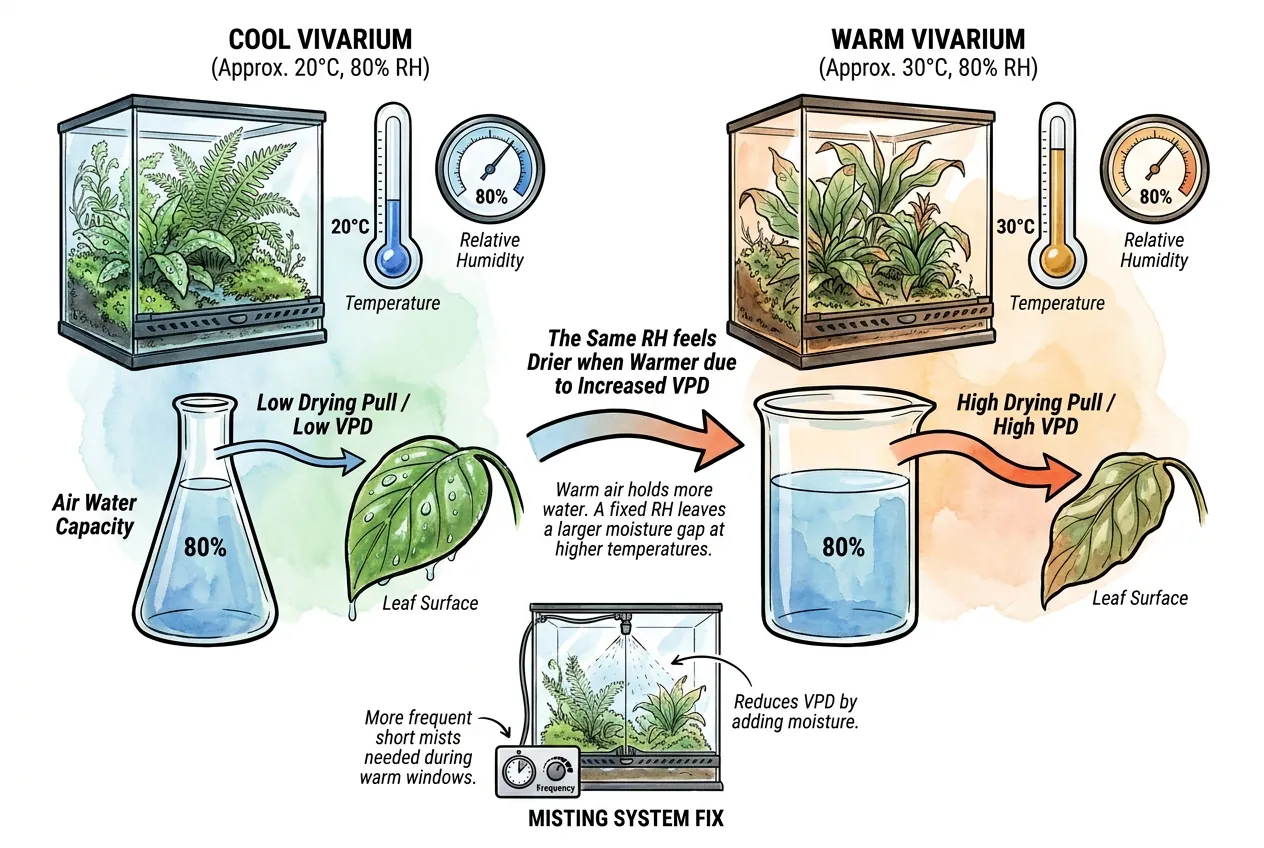
Warmer air can hold more water vapor, so at a fixed RH the vapor pressure deficit (VPD) rises as temperature climbs, meaning stronger evaporative pull.
VPD is a useful single number for plant water demand, though it does not by itself capture animal needs.
VPD is a way to describe how strongly air pulls moisture from a leaf. You do not need a crop-VPD target to set a vivarium, because crop bands are not animal or epiphyte targets.
Check temperature alongside RH instead of chasing one fixed humidity number. At the same RH, warmer air can dry plants more strongly, so a rising daytime temperature may call for shade, lamp adjustment, ventilation, or a species-safe temperature correction before more misting.
If a heat lamp pushes daytime air warmer, the drying pull rises even though the RH number has not moved.
Before simply misting more (which can raise animal exposure and leaf wetness), check whether shade, adjusting the lamp, added ventilation, or a species-safe temperature is the better first move.
Very low VPD with long-lasting condensation and leaf wetness can raise disease risk, but there is no single VPD value that universally triggers leaf wetness or increases pathogen virulence.
Water Vapor-Pressure Deficit. Greenhouse Product News
Vapour-pressure deficit. Definition, Tetens formula, evapotranspiration relationship
How does misting physically raise humidity?
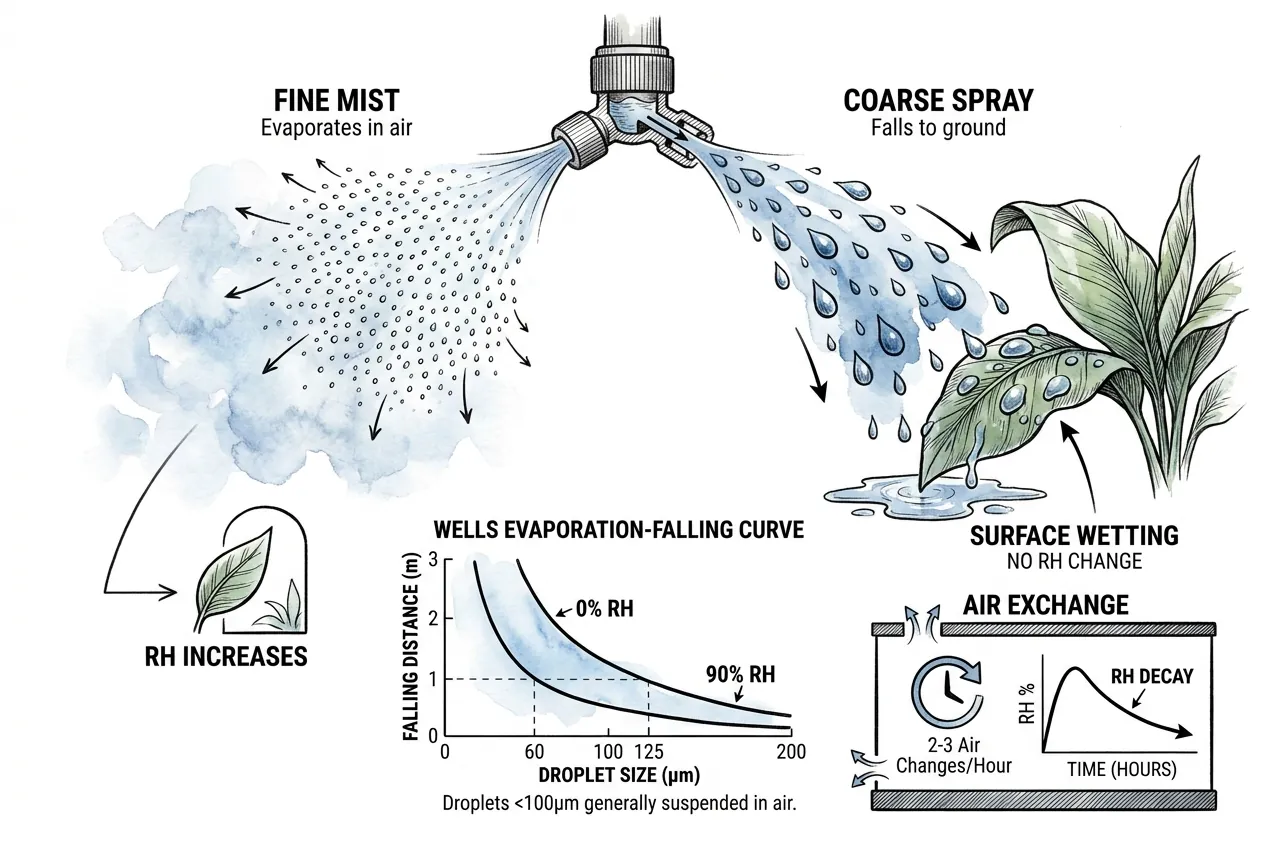
Droplet size is a major factor. Finer droplets tend to evaporate in the air and add water vapor, raising RH. Larger droplets carry more mass, fall, and wet the leaf.
Coarse droplets also evaporate to some degree and can still contribute to RH, so the effect is a matter of degree, not on/off.
No universal droplet-size cutoff tells you whether a vivarium nozzle will wet a leaf. Nozzle type, pressure, distance, enclosure humidity, and airflow all change the result, so aim into open air and check where droplets actually land.
Higher ambient RH slows evaporation, so in an already-humid vivarium even fairly fine droplets can survive longer and land on surfaces.
Where exactly this happens depends on droplet spectrum, spray velocity, distance, and airflow.
Aiming nozzles into open head-space rather than directly at foliage is a sensible precaution.
RH decays after a mist roughly with the enclosure's air-exchange rate. The actual rate depends on how sealed or ventilated your box is and is worth estimating for your own setup rather than assuming a fixed value.
How far droplets can move in indoor environments. Wells evaporation-falling curve
Can over-misting cause leaf-spot disease?
Over-misting can contribute. Foliar infection risk generally rises with how long leaves stay wet, so misting beyond your RH target adds risk rather than a hydration bonus.
Dose to hit the RH band, then let foliage dry between bursts. Disease also requires a pathogen to be present and a susceptible host, so wetness is one factor among several.
Free liquid water on the leaf is a common requirement. Many foliar fungi and bacteria need liquid water on the surface before they can infect, though some pathogens use high humidity alone, wounds, or vectors, so removing water does not eliminate every route.
One controlled study shows the shape well. Inoculating a peach-almond hybrid (Prunus) with Xanthomonas arboricola pv. Pruni, disease severity rose sigmoidally with wetness duration, optimum near 28.9°C, with high severity needing over 10 h near 20°C or about 5 h at 25-35°C. Those numbers are specific to that host, pathogen, and heavy inoculation in bagged darkness, not a universal threshold for all leaf spots.
The general trend is that warmer, continuously wet conditions favor some pathogens, so it is reasonable to keep continuous wet periods short and let foliage return to a matte, dry surface between bursts.
Do not treat any single hour figure as a hard ceiling for every plant and pathogen.
Water-soaked spots with a yellow halo can indicate bacterial leaf spot, but fungal disease, edema, and chemical injury can look similar, so this is not a confirmed diagnosis by eye.
If you see lesions, isolate the plant from the enclosure and, before treating, get a diagnosis from an extension plant clinic or diagnostic lab.
Our deep-dive on Pseudomonas syringae on Philodendron leaf-spot discusses the symptoms. Note that copper products can be toxic to aquatic organisms and amphibians, so never apply them in an occupied vivarium, and confirm the exact label, host, and animal-safety review with a professional first.
Effects of leaf wetness duration and temperature on infection of Prunus
Leaf and Flower Wetness Promotes Disease. UC ANR Nursery & Flower Grower
Which leaf-spot organisms threaten a planted vivarium?
Several kinds of organism can cause leaf spots, including various bacteria (such as Pseudomonas syringae), fungi (such as gray mold, Botrytis cinerea), oomycetes, plus non-living causes like edema and chemical injury.
Two common examples in humid plantings are bacterial leaf spot and gray mold. Both are favored by leaf wetness and high humidity.
Because their symptoms overlap, a lab diagnosis is what tells them apart.
Bacterial leaf spot is favored by high humidity and prolonged leaf wetness and spreads by splashing water, which a coarse mist or rain bar can produce inside a glass box.
Pseudomonas syringae can be a problem even in cool conditions (roughly 55-77°F), so a cool, wet case is not automatically safe.
For gray mold, NC State reports Botrytis cinerea grows best around 60-70°F with RH above 85% and, in greenhouse ornamentals, is managed by limiting long high-humidity periods and improving air circulation.
That greenhouse guidance is about canopy conditions and dead-tissue sanitation. It is not a daily air-RH ceiling to impose on an animal enclosure that needs sustained humidity.
The tension is that a plant's preferred humidity can overlap a pathogen's preferred humidity, so humidity alone is not a reliable control.
Adjust species selection, microclimate, and the night cycle rather than assuming one band fits all.
Let surface drying and gentle airflow between bursts do much of the work. Rather than dropping below the measured, species-safe range your animals need, reduce how long leaves stay wet, reduce splashing, and space bursts.
Finer droplets are not always safer, so match droplet behavior to the plants and airflow.
| Condition | Bacterial leaf spot (P. syringae) | Gray mold (Botrytis) |
|---|---|---|
| Temperature optimum | 55-77°F (12.8-25°C) | 60-70°F (15.6-21.1°C) |
| Humidity driver | High RH + prolonged leaf wetness | RH above 85% |
| Wetness guidance (context-specific, not a universal ceiling) | Shorter continuous wet periods reduce risk. The 5 h figure is from an inoculated Prunus study, not all plants | Limit long high-humidity periods (greenhouse-ornamental guidance) |
| Real control | Surface drying, airflow, less splashing | Airflow, remove dead tissue, dry between bursts |
Bacterial Leaf Spot on Greenhouse Ornamentals. NC State Extension
Botrytis Blight of Greenhouse Ornamentals. NC State Extension
How does hardware choice change the disease risk?
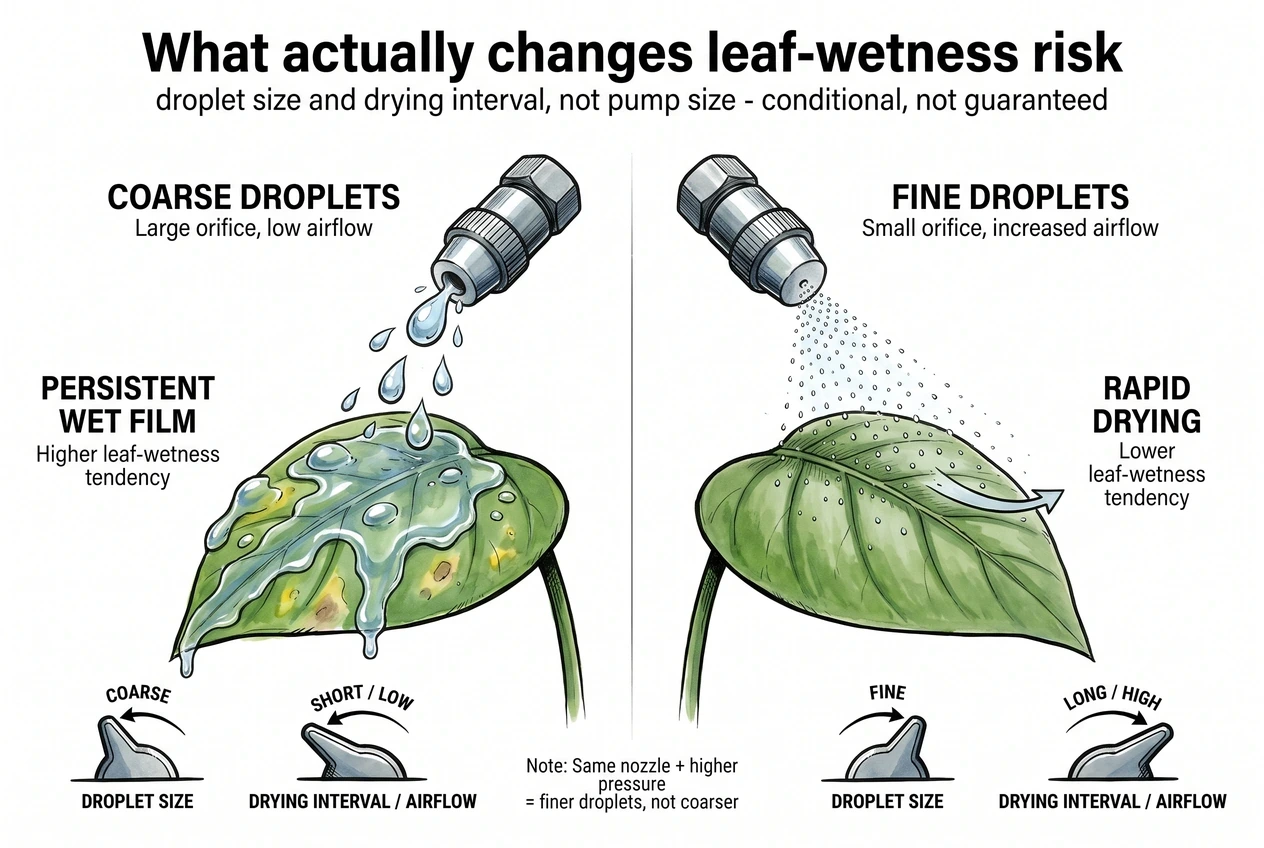
Droplet size and burst frequency affect how long leaves stay wet, so nozzle and dosing choices influence disease risk, though host, pathogen, temperature, and actual coverage also matter.
Coarser droplets tend to pool and cling, keeping leaves wet longer per burst.
Finer atomized droplets raise RH partly by evaporating and can leave a thinner, faster-drying film.
Note that fine spray aimed straight at foliage can still form a wide wet film, so aim and coverage matter as much as droplet size.
Roughly, daily leaf-wetness scales with wet time per burst times the number of bursts, less any drying between them.
If bursts are stacked too tightly, each can re-wet a still-damp leaf and total wet time grows.
This is a qualitative relationship, not a precise equation, since spatial coverage and drying curves vary.
Two practical levers are droplet size and dry-interval length assisted by airflow. Choose a droplet size the plants tolerate while also considering animal inhalation and contact, spray drift, coverage, and nozzle clogging, and space bursts so leaves visibly dry in between.
The Plant Doctor. Watering and Plant Disease (Mississippi State University Extension)
What specs should you compare when buying?
Match four hardware roles to your enclosure. Pump pressure and duty, nozzle orifice and count, timer resolution in seconds, and reservoir volume plus water quality.
The table below is a shopping checklist. A complete plan also needs the animal species, delivered flow, line loss, drainage, sanitation, electrical listing, and a failure-response plan, so treat the figures as starting points to verify against manufacturer data and your own measurements.
| Selection criterion | What to look for | Why it matters |
|---|---|---|
| Pump pressure (PSI) | Higher pressure (roughly 100+ PSI) for tall/fine work. Lower-pressure integrated units (about 36-65 PSI) for small enclosures. Check pump curve at flow, not PSI alone | At the same nozzle, higher pressure tends to atomize finer. Reach also depends on flow, nozzle, and line loss |
| Pump duty class | Continuous-rated diaphragm for frequent bursts | Frequent seconds-long bursts wear a low-duty unit |
| Nozzle orifice | Finer orifice for RH lift. Coarser for rain (compare against the manufacturer's stated droplet spec) | Finer generally means lower leaf wetness but faster clogging |
| Nozzle count | Rule of thumb. About 1 per side, 2 for a 36x18x18 in, 3+ for total coverage. Adjust for spray angle, plant density, and pump budget | Hardscape shadows mist, so coverage often needs more heads |
| Timer resolution | ON step in seconds (1-2 s), never minute-only | A 60-second floor over-doses an 8-second burst |
| Reservoir volume | Sized to per-burst volume x bursts/day x target days | On-board tanks last days. A bucket lasts weeks |
| Water quality | RO/DI or dechlorinated soft water. Test hardness, pH, alkalinity, and chloramine rather than relying on one number | Hard, alkaline water can scale micro-orifices. Test to see how fast |
Choose in this order. Start with pump capacity, then check nozzle layout, timer resolution, the reservoir, and water treatment. That prevents a timer or nozzle choice from masking an enclosure that does not need automation in the first place.
Guide to Spray Properties. Droplet Size (spray-nozzle engineering reference)
Which misting pump fits your enclosure?
Delivered pump pressure strongly affects how fine your mist is and how far it reaches, but it is not the only spec.
Reach and coverage also depend on flow, the pump curve, line length and head loss, nozzle pattern, and spray direction.
As a trend, higher pressure at a given nozzle makes smaller droplets. Lower pressure tends to throw coarser droplets that fall out nearer the nozzle.
Agricultural extension describes the mechanism. At a given nozzle, higher pressure creates a thinner liquid sheet that breaks into smaller droplets.
That trend is real, but it does not substitute for a specific nozzle's measured droplet spectrum and pressure curve.
Smaller droplets also settle more slowly. In the idealized Stokes regime, halving diameter roughly quarters the settling velocity.
Real emitted droplets carry initial velocity, evaporate, and hit surfaces, so this is a tendency toward canopy drift, not a guarantee of even coverage.
The second consideration is duty class. Match a pump's rated duty cycle to your schedule. A continuous-rated diaphragm pump is designed for frequent short bursts, while a small integrated unit rated for occasional spray may wear faster under a heavy schedule.
Confirm the rated duty and warranty for the specific model.
The high-pressure pick for tall enclosures and racks
Choose Pressure for the Actual Height
A higher-pressure (roughly 100+ PSI) continuous-duty pump is generally well suited to fogging a tall paludarium and running a frequent seconds-long schedule.
Confirm the specific pump's curve and rated duty rather than treating a PSI number as a strict requirement.
The MistKing Starter suits a taller enclosure or frequent short bursts for dart frogs or epiphytes. It can grow into a larger system, but verify the current duty rating, pressure at your planned flow, and nozzle limit before designing the line.
Skip it if you have one small, well-sealed terrarium that already holds RH, because it can over-pump and invite over-wetting.
Its fine nozzles do best on low-scale water. Whether you need RO/DI depends on your measured hardness and alkalinity and the manufacturer's guidance, not a fixed rule.
For a multi-enclosure rack, the MistKing Ultimate suits a manifold serving several enclosures. Check the flow budget and line layout before sharing one reservoir. Skip it for one or two enclosures, where its extra capacity is unlikely to help. Do not exceed the current rated nozzle limit, because that lowers pressure at each nozzle and coarsens the mist.
The mid-tier and entry picks for a single enclosure
Choose Simplicity for One Enclosure
For a single small-to-mid enclosure that does not need canopy reach, a lower-pressure integrated unit is enough and avoids flooding a small substrate.
The Monsoon Multi II suits a mid-size enclosure or a couple of tanks where an integrated reservoir is more useful than DIY plumbing. Its refill interval depends on the mist you actually measure and the schedule you set.
Skip it if you need more than its rated 6 nozzles. For a tall 3-4 ft paludarium it may not deliver the finest fog, though this depends on the nozzles, reach, and line loss as much as on the 4.5 BAR rating. Confirm against a droplet and reach test if fog quality is critical.
The Zoo Med ReptiRain Mister suits a simple small setup or a portable backup that does not need plumbing. Its fixed intervals make precise humidity tuning harder, so skip it when the enclosure needs finer control.
Skip it if you need finer interval control than its fixed hourly options, since precise humidity tuning can be harder with a limited interval set.
Its suitability for delicate epiphytes depends on your species, ventilation, and how you supplement it, so it can still work as an entry or backup unit.
Spray Drift of Pesticides. University of Nebraska-Lincoln Extension (G1773)
How many nozzles do you need, and which type?
Nozzle count scales with enclosure size and coverage rather than a fixed number. As a rule of thumb, figure roughly 1 nozzle per side, 2 for a standard 36x18x18 in vivarium, and 3 or more for tall or densely planted builds, all within the pump's rated max and adjusted for spray angle, plant density, and animal avoidance.
Coverage is line-of-sight plus atomization spread. Cork tubes, wood, and dense foliage shadow the mist, so more surfaces often means more nozzles.
That said, repositioning a nozzle, adding oscillation, using separate zones, or hand-watering can sometimes cover a spot without adding heads, and more heads means more total water.
There is a general tradeoff. At a given design and pressure, a smaller orifice tends to make a finer, faster-evaporating mist that can lower standing leaf wetness, but it also clogs faster and needs finer inline filtration.
Actual results also depend on flow, aim, distribution, and filtering.
Because smaller droplets have more surface area per volume, they can flash to vapor before pooling.
Specific orifice-to-micron conversions vary with nozzle type, pressure, liquid, and how droplet size is measured, so compare each nozzle's manufacturer-stated droplet spec rather than assuming a fixed micron figure.
The fine-fog nozzle for disease-sensitive plants
For epiphytes, orchids, and moss walls, you want fine-orifice fog nozzles with a check valve to stop post-burst dribble, plus enough heads that no single leaf takes a concentrated stream.
The MistKing L-nozzles suit the end of a run or added coverage in an established MistKing line. Their check valve helps limit post-burst drips. Fine nozzles clog easily on untreated hard water, so use the water treatment and filtration that your measured water quality requires.
The MistKing double nozzle suits a line that must branch to cover several areas or enclosures. Confirm the current included parts before buying. Skip it for one small terrarium that needs only a single end nozzle.
Nozzles for other ecosystems and for adjustable spray
If you already run an Exo Terra Monsoon, the Monsoon nozzle pack is the matching expansion option. Use it only within the Monsoon system and stay within that system’s current nozzle limit. Skip it for MistKing tubing, which is incompatible.
The REPTI ZOO nozzles suit a DIY line where you need to adjust between a finer mist and coarser substrate wetting. Confirm the material, tubing fit, pressure limit, and check-valve behavior before relying on them around disease-sensitive epiphytes.
Any nozzle without a check valve, especially at a low point in the line, can siphon or dribble after a burst and spray less consistently. Verify the specific product's behavior rather than assuming.
Running opaque 1/4 in PE tubing rather than clear line reduces light-driven algae. MistKing's black tubing is rated to 250 PSI. Blocking light helps limit algae, but reservoir sanitation and biofilm control matter more, and confirm the rating for the current product.
MistKing FAQ. Check-valve anti-drip design and run-dry operation
Why does the timer have to be seconds-resolution?
Short mist pulses of only a few seconds are common, so a minute-only wall timer with a 60-second floor over-doses them several times over.
A controller that resolves to the second lets you dial in short bursts. Note the 5-10 s figure below comes from plant propagation, not animal vivaria, so use it as a starting point, not a fixed correct value.
University of Florida IFAS describes intermittent mist systems for plant propagation using a mist duration of 5 to 10 seconds at 5 to 20 minute intervals.
That is a cutting-propagation system, not an animal-enclosure schedule. A misting pump runs at roughly constant flow during a burst, so delivered water scales with ON seconds.
Force a 60-second minimum onto an 8-second target and you deliver about 7.5 times the intended water per cycle.
Depending on nozzle flow, air exchange, surface area, and drainage, much of that extra water can pool rather than evaporate, so it raises RH inefficiently and risks over-wetting.
The dosing math
Daily mist dose depends on burst duration, the number of bursts, and the flow rate per nozzle.
Tune it against two references. The species-safe RH range you want to hold, and how long leaves stay wet, since prolonged wetness raises disease risk.
Both depend on your species and system, so treat them as bounds to measure, not fixed universal numbers.
A reasonable starting point is a short burst a few times during the photoperiod, then measure RH and observe surfaces and adjust.
If RH undershoots, adding bursts before lengthening them keeps wet periods short. If you see standing water, mold, or leaf spotting, cut frequency first, then duration, and if you see lesions, get a diagnosis before treating.
Set your own starting values from measured mL per burst, the species-safe RH, leaf drying, drainage, and animal behavior rather than a fixed recipe.
Front-loading misting into the warm, lights-on window, when evaporation is usually fastest, and thinning the night schedule can help leaves dry between pulses.
Some animals are nocturnal and some plants behave differently at night, so confirm with surface observation rather than assuming.
The controller picks
Use Seconds-Level Control
For an AC pump on a budget, the BN-LINK timer suits a DIY or non-MistKing setup that needs short repeat cycles. Keep it dry and use a GFCI-protected outlet. Skip it when you need separate day and night schedules rather than one repeating cycle.
For MistKing owners who need different day and night schedules, the MistKing timer suits an enclosure that dries faster under daytime lights than overnight. Set the schedule from your measured humidity, leaf drying, and animal needs rather than copying a sample program. Skip it if you do not own a compatible MistKing pump.
Also skip it if one fixed schedule is enough and a BN-LINK covers you.
Wi-Fi apps and cloud dashboards are optional. A well-tuned open-loop seconds schedule can run a single stable enclosure.
Humidity-sensor feedback is more useful on larger or less stable setups, but sensor placement and failure safeguards matter regardless, so plan for what happens if a sensor or the power fails.
Water. Mist and Fog (University of Florida IFAS propagation guide)
Intermittent Mist System Control Devices for Propagating Plants (Oregon State University Extension)
How big a reservoir do you need, and why does water quality decide nozzle life?
Calculate days of autonomy by dividing usable reservoir volume by daily water use. Daily use equals the measured volume per burst multiplied by the number of bursts per day.
On-board tanks are small, so keepers who need long unattended runs often move to a bucket-fed pump.
Water quality also affects nozzle life, so consider it alongside tank size.
Measure per-burst volume once by misting into a graduated cup for a set number of seconds rather than trusting a spec.
For example, a two-nozzle enclosure using roughly 30 mL per burst at 6 bursts a day draws about 180 mL/day, so a 1.5 L tank lasts about 8 days and a 5-gallon (about 19 L) bucket roughly 100 days on that draw.
Do not leave a reservoir standing that long without cleaning. Water freshness and biofilm limit how long any container should sit, regardless of the arithmetic.
The reservoir picks
Size the Reservoir for the Schedule
For longer autonomy, a bucket-fed platform decouples the reservoir from a fixed on-board tank.
The MistKing Starter draws from a user-supplied container through an included bulkhead adapter, so you size the reservoir to your measured burst math.
The manufacturer states the pump can run dry if the container empties. Use an opaque, lidded, animal-safe container, plan for a low-level cutoff or alert, a leak tray, and an overflow path, and clean the reservoir on a schedule rather than leaving it standing.
Use this with a 5-gallon (19 L) bucket for long unattended stretches on a rack.
Skip it for a single tiny sealed terrarium that already holds humidity, where an on-board unit or hand-misting is enough.
For a single small-to-mid enclosure, the Monsoon Solo II suits a modest setup that can be refilled frequently. Its real run time depends on the output you measure and the schedule you set.
Skip it for multi-enclosure or long-autonomy needs, because 1.5 L caps unattended run time.
Its lower 2.5 BAR pressure may struggle to reach a tall canopy, though reach also depends on the nozzle, elevation, and line loss, not pressure alone.
Why hard water clogs fine nozzles
The USGS classes water above 180 mg/L as CaCO3 as very hard. Whether water actually precipitates scale depends on its saturation state (a function of calcium, alkalinity, pH, temperature, and TDS, summarized by indices like the Langelier index), not hardness alone, and calcium hardness differs from total hardness.
At a mist orifice, evaporation and turbulence at the tip can concentrate minerals near the exit, which is a plausible mechanism for scale forming where the passage is smallest.
How fast this happens depends on your specific water chemistry, flow, and nozzle material, so it is not a fixed universal outcome.
RO/DI water removes most dissolved minerals, so there is little to precipitate and fine nozzles tend to stay cleaner.
The tradeoffs are real. Many point-of-use RO systems waste several gallons of reject water per gallon treated (WaterSense-labeled units are more efficient, so check the specific unit), and very low-TDS water can be corrosive to some materials, so treat that as a conditional caution rather than a blanket claim.
Because RO output carries few minerals, the water chemistry needs review for the animals. Amphibians absorb water and dissolved substances across their skin, so mist they are exposed to is contact water, not just water they drink. Do not assume only water they drink or bathe in matters.
Follow an exotics veterinarian's water protocol for your species, and note Merck advises against distilled water for amphibians.
Our RO water remineralization product chooser covers prepping low-hardness water for this reservoir role.
Keepers on soft or moderately-hard tap below 120 mg/L may not need RO, but hardness alone does not decide it.
Test for chloramine, metals, pesticides, pH, and alkalinity too, then dechlorinate as needed. Running RO where it is not required mainly wastes water.
Water safety for amphibians
Chlorine and especially chloramine should be removed if amphibians live in or under the mist, because amphibian skin readily absorbs waterborne chemicals.
Chloramine does not reliably dissipate by standing or boiling, so aging water does not make it safe.
Check your municipal report for the actual disinfectant used, and confirm the residual with a test.
Seachem Prime may treat chlorinated or chloraminated municipal water, but confirm its suitability with an exotics veterinarian before using it in amphibian mist. Measure the label dose precisely in a small reservoir. Skip it when your water is already verified free of chlorine and chloramine.
USGS Water Science School. Hardness of Water
Corrosive or Scaling Water. University of Georgia Extension (C858-9)
Point-of-Use Reverse Osmosis Systems. EPA WaterSense
Frogs and chlorinated water. NC Cooperative Extension (Ask Extension)
How do you install and maintain the system safely?
Plan the electrical and drainage layout from the start, not last. A workable install order is
Mount the reservoir and pump per the pump's manual, slope the tubing, flush the empty line, add nozzles last, and put every mains-powered component on a GFCI outlet with a drip loop.
Doing so helps prevent both clogging and shock hazards.
The install sequence
Follow the specific pump's manual for mounting and priming. Some external diaphragm pumps prime more easily with the reservoir above the pump (gravity feed), but this is not universal, so do not assume a pump will not prime if mounted higher. Check the manual, and watch for back-siphon and leak risk in whatever configuration you use.
With animals and plants out of the spray path and a clean container to catch discharge, flush the open-ended line before any nozzle goes on. A single chip of tubing burr, or a shred of PTFE tape, lodged in a fractions-of-a-millimeter orifice can permanently distort the spray, so apply PTFE tape only where the manufacturer directs and keep debris out.
Add all but one nozzle, flush again, then attach the final nozzle and do a leak and flow check.
Route tubing so residual water does not sit at a high nozzle and dribble. Rely on the nozzles' check valves and the manufacturer's recommended layout, and be aware that any low point can itself collect water and siphon or drip.
Aim nozzles to hit hardscape or open air, not point-blank at foliage.
The mains-near-water safety gate
Treat water near electricity as a real hazard. Note that some misting pumps run on low-voltage DC through a mains adapter (MistKing pumps are 24 V DC), while the adapter, an AC timer, a controller, or a separate heater or fogger may be mains-powered, so identify which components carry mains voltage in your setup.
Plug the pump's power supply, controller, and any inline heater or fogger into a GFCI outlet or GFCI-protected strip.
A GFCI shuts power within about 1/40 of a second when leakage reaches roughly 5 mA, well before a standard breaker would notice.
GFCI is a supplementary safeguard. Also use listed equipment, keep connections dry and elevated, use drip loops, keep an accessible disconnect, test the GFCI periodically, and replace damaged cords.
Route every cord in a drip loop, a downward loop below the outlet, so runoff drips off the loop instead of tracking into the socket. Do not site the reservoir directly above an outlet.
Newer code editions (the 2023 NEC 210.8(B)(13)) added a 6-foot GFCI requirement around non-dwelling aquariums, bait wells, and similar. Requirements differ for dwellings and by local adoption, so have a licensed electrician confirm what applies to your installation.
Handling mist runoff (the false-bottom myth)
A gravel or LECA layer alone does not dry the substrate. At a fine-over-coarse boundary, water tends not to move into the coarse layer until the fine layer above is saturated (a perched water table), so a simple drainage layer can keep the soil wetter.
Whether this happens depends on particle sizes, container geometry, and capillary continuity, and it differs from a raised-void false bottom.
A raised-void false bottom stores overflow below a barrier so it is less likely to re-wick into the substrate, but it does not guarantee water never re-enters without a drain, a defined maximum waterline, mesh and root management, an overflow path, and regular cleaning.
Keep standing water below the barrier and dose conservatively so you do not saturate the substrate faster than it drains.
The KASTLITE grid is one material keepers repurpose for a raised platform. Note it is a polystyrene ceiling/HVAC light diffuser, not a product validated for vivarium use. Its load capacity, support spacing, cut-edge safety, long-term wet contact, and animal-safety (ingestion, escape) are not established, so do not treat it as a certified platform.
If you use it, cut and support it carefully and confirm it suits your build. A purpose-built platform designed for the load and animals may be a better choice.
Whatever platform you use, keep the perched wet zone away from roots. Prolonged saturation promotes root rot. Some Phytophthora species can develop in as little as 4-8 hours of soil saturation in trees and shrubs, which is a reason to drain well and dose conservatively rather than a fixed vivarium threshold.
For very shallow builds under about 2 inches of headroom, a thin filter-mat barrier may fit better.
A false bottom manages overflow. It does not license aggressive dosing, and a full design also needs drain/siphon access, a maximum water mark, a leak or overflow alarm, cleaning intervals, and animal escape/drowning prevention.
Maintenance cadence
Maintenance covers two things. Mineral scale from hard water, and living biofilm or algae in the lines and reservoir.
Both can clog micro-orifices, but biofilm also matters for animal health, so sanitation is not just about clogging.
Merck recommends disinfecting amphibian humidifiers and spray bottles regularly (roughly weekly), so treat reservoir and line cleaning as a hygiene task, not only a scale check.
Descaling frequency scales with water hardness. On soft or RO water, scale builds slowly, but still inspect and clean regularly for biofilm.
On harder water, a periodic white-vinegar soak of the nozzles can dissolve carbonate scale. Follow the nozzle manufacturer's guidance on concentration, contact time, seal compatibility, and rinsing rather than a fixed schedule, and rinse thoroughly before reuse.
On persistently hard or alkaline water, switching to RO/DI can reduce scaling.
Flush the lines regularly, keep the reservoir opaque or covered to limit algae, clean and disinfect the reservoir on a schedule with a compatible, thoroughly rinsed disinfectant, and clean or replace inline filters per the manufacturer's instructions.
Keep a simple service log.
Ground-Fault Circuit Interrupters (GFCI). OSHA eTool
Phytophthora Root and Crown Rot. UC Statewide IPM Program
Who should NOT buy each product class?
A hand pump sprayer plus a hygrometer is often the better tool in several cases. One small well-sealed enclosure, lower-humidity species, a tight budget, or being home enough to mist by hand.
This assumes you can mist consistently enough for the animals' hydration needs. Automation tends to earn its cost on racks, tall paludariums, mounted-epiphyte walls, and long unattended stretches.
| Product role | Who should skip or downgrade |
|---|---|
| Misting pump | Single small sealed terrarium that already holds RH. Anyone expecting a low-pressure rain unit to fog a 4-ft paludarium. One-enclosure budget keepers who can hand-mist |
| Nozzles + tubing | Hard-water users without RO/DI picking ultra-fine nozzles. Setups that actually want coarse rain, not fog |
| Timer / controller | Single stable enclosure paying for humidity-feedback it will not use. Anyone considering a minute-only wall timer, whose 60-second floor over-doses a few-second burst |
| Reservoir + water | Keepers already on soft tap below 120 mg/L who do not need RO hardware. Tiny enclosures that do not need multi-liter reservoirs |
| Drainage / false bottom | Shallow builds under about 2 in headroom. Anyone treating a plain gravel layer as a drainage cure, since it can perch water rather than drain the substrate |
Frequently asked questions
Will a bigger, more powerful pump keep my plants healthier?
Usually not. Once you hit your RH target, extra misting mainly adds leaf-wetness time and disease risk with little humidity benefit.
A high-pressure pump in a small sealed tank can wet the glass and substrate faster than the box vents, depending on nozzle flow and duration.
Size pump pressure and nozzle count to enclosure height and volume first. Over-pumping a small enclosure invites over-wetting and can raise disease risk.
The goal is to hit the range and then let leaves dry.
Can I just use a cheap wall-outlet timer on my pump?
Usually not. Many mechanical and digital outlet timers have a 1-minute minimum ON, several times longer than the short (roughly 5-10 second) bursts these systems typically use, so they over-dose short pulses.
A seconds-resolution controller avoids that.
Buy a controller whose spec sheet lists per-second control or a cycle range starting at 1 second.
Also check that it retains its program after a power outage, its minimum OFF time, its inductive-load rating, and its indoor listing, and verify the smallest ON increment before you buy.
Do I really need RO water, or is my tap fine?
Test your water first, but hardness is not the only factor. Below 120 mg/L as CaCO3 (soft to moderately hard), dechlorinated tap is often fine, but also check chloramine, metals, pesticides, pH, and alkalinity, and confirm it suits your species.
On hard or alkaline water, calcium-carbonate scale can narrow fine nozzles. How quickly depends on your water chemistry and flow, so test rather than assume a fixed timeline.
RO/DI or dechlorinated soft water reduces scaling. Because amphibians absorb water through their skin, follow a veterinarian's water protocol for any water they contact, not just water they drink.
Why are my leaves getting spots after I upgraded to automated misting?
Leaves staying wet too long between bursts is a common cause, but it is not the only one. Prolonged leaf wetness raises foliar-disease risk (in one inoculated Prunus study, high severity took about 5 h at 25-35°C, which is host- and pathogen-specific), and stacked bursts extend total wet time.
Edema and chemical injury can also cause spotting, so if lesions persist, isolate the plant and get a diagnosis.
As non-chemical first steps, cut burst frequency, then duration, aim nozzles off the foliage, and add gentle airflow so leaves dry between mists.
Finer atomization does not always reduce wet time, so verify by observation. Rather than dropping below the species-safe range your animals need, shorten the wet time and, if disease is suspected, confirm it before treating.
How often will I have to clean the nozzles?
Water hardness influences scale buildup, but biofilm and reservoir hygiene also drive cleaning frequency.
On RO or soft water, scale builds slowly, though you should still inspect and clean the reservoir and lines regularly.
On harder water, plan periodic vinegar soaks based on inspection and observed flow rather than a fixed calendar, and consider RO/DI if scaling is persistent.
To clear a clogged nozzle, soak it in white vinegar per the nozzle manufacturer's guidance to dissolve carbonate scale, rinse thoroughly, then flush the line and reinstall.
Keeping the reservoir opaque helps limit algae, but disinfecting the reservoir matters more for animal health.
What should you buy first?
- Weigh enclosure volume and height, your species' RH range (confirm per species. Iowa State gives a general 40-70% for indoor orchids, and Merck gives 75-80% for most amphibians and 85-90% for some tropical species), and how sealed the box is, plus ventilation, drainage, and how often you are home. Automate when volume, height, or a rack makes hand misting impractical.
- More misting is not always better. Prolonged leaf wetness raises foliar-disease risk (exact onset times are pathogen- and host-specific), so dose to your RH range, then let foliage dry with spaced bursts and airflow. If you see lesions, get a diagnosis before treating.
- Match four roles. Pump pressure and duty, nozzle orifice and count, a seconds-resolution timer, and reservoir volume plus low-scale water. A minute-only timer over-doses short bursts.
- Hard, alkaline water can scale fine nozzles. Test hardness, pH, alkalinity, and chloramine rather than assuming a threshold. RO/DI or dechlorinated soft water reduces scaling, and for amphibians follow a veterinarian's water protocol for any water they contact.
- Install safely. Follow the pump manual for mounting and priming, slope and flush the line, add nozzles last, and put every mains component on a GFCI outlet with a drip loop (have a licensed electrician confirm local code). A plain gravel layer can perch water and keep substrate wetter, so use a proper drained barrier and dose conservatively.
Affiliate Disclosure
This article contains Amazon affiliate links. As an Amazon Associate I earn from qualifying purchases. If you use these links, the site may earn a commission at no extra cost to you. Product availability, price, and specifications can change. Check the current listing before buying.