
Summary
- Marcgravia is the essential shingling vine for sealing bioactive backgrounds and providing micro-habitats.
- Beginners should start with M. rectiflora, while collectors can explore rare cultivars like ‘El Coca’.
- Success requires high humidity and the use of a sealed Prop Box for establishing cuttings.
Key Points
- Bioactive Function: Seals hardscape and aids moss retention, stabilizing humidity.
- Best Starter: Marcgravia rectiflora is the most forgiving species for beginners.
- Color Variations: M. sintenisii offers deep burgundy foliage but is slower growing.
- Giant Shingles: M. umbellata requires large tanks (24+ tall) due to its size.
- Propagation Rule: Must use sealed box method; direct planting leads to melt.
- Rare Cultivars: ‘El Coca’ and ‘Azrael’ offer unique iridescent colors but need stable conditions.
- Troubleshooting: Leaves turning transparent (melting) is a sign of humidity shock.
Why is Marcgravia the undisputed king of bioactive backgrounds?
Because it is the only neotropical genus that creates a living, sealing seal over hardscape while providing essential micro-habitats for vivarium inhabitants.
Why is Marcgravia considered essential for bioactive vivariums?
It functions as both a decorative background cover and a biological stabilizer.
Unlike other climbing plants that merely drape over surfaces, Marcgravia roots aggressively at every node, creating a sealed layer of vegetation.
This shingling habit traps humidity against the background material (cork, tree fern, or wood), creating a stable microclimate that benefits moss growth and provides critical shelter for microfauna like springtails and isopods.
How does it benefit dart frogs specifically?

It creates vertical micro-territories and egg-deposition sites.
In the wild, the overlapping leaves of juvenile Marcgravia shingles form water-tight pockets.
In a vivarium, these leaves serve as visual barriers that reduce aggression between territorial frogs and offer safe roosting spots that remain humid even when ambient tank humidity fluctuates.
Which Marcgravia species is best for beginners?
Marcgravia rectiflora is the most resilient and adaptable species for new hobbyists.
It tolerates a wider range of lighting (low to bright indirect) and hydration levels than any other species in the trade.
If you are establishing your first bioactive tank, rectiflora provides the classic shingling look with a significantly lower risk of melting during acclimation.
What are the key differences between M. rectiflora and M. sintenisii?

M. sintenisii offers superior coloration but requires stricter humidity control.
While rectiflora remains a vibrant green, sintenisii (often sold as Red Marcgravia) produces juvenile leaves that emerge deep burgundy red before fading to bronze and then dark green.
However, sintenisii is slower to root and will drop leaves immediately if humidity dips below 80% during the establishment phase.
Species Comparison Data
| Feature | Marcgravia rectiflora | Marcgravia sintenisii | Marcgravia umbellata |
|---|---|---|---|
| Growth Rate | Fast / Vigorous | Moderate | Slow / Steady |
| Juvenile Color | Bright Green | Deep Burgundy | Green with White Veins |
| Leaf Size | Small (0.5 inch) | Medium (0.75 inch) | Large (1.5 – 2 inch) |
| Difficulty | Low | Medium | Medium-High |
Can you grow Marcgravia umbellata in a standard terrarium?
Yes, but only if you have adequate vertical space for its larger foliage.
M. umbellata is a giant among shingles, with leaves often exceeding 2 inches in diameter.
It is best suited for tanks taller than 24 inches where it can visually anchor the hardscape without overwhelming the sense of scale.
In smaller tanks (under 18 inches), it will quickly crowd out other plants and require frequent pruning.
Designing with Marcgravia: Layouts that Pop
A well-planted background isn’t just about coverage; it’s about composition.
Using Marcgravia strategically can create a sense of depth and scale that transforms a glass box into a slice of the rainforest.
How do you create depth and perspective?

Use the ‘Force Perspective’ technique by placing larger-leafed species (like M. umbellata) in the foreground or lower sections, and smaller-leafed species (like M. rectiflora) near the top.
This mimics the natural visual recession, making the tank appear taller and deeper than it actually is.
Avoid planting a single species across the entire background, which can look flat and monotonous. Instead, create vines or trails that guide the viewer’s eye diagonally across the hardscape.
What are the best companion plants?

Marcgravia pairs perfectly with plants that share its high-humidity requirements but offer contrasting textures.
Design Tip
Pair the flat, geometric leaves of Marcgravia with the soft, feathery texture of growing mosses (like Java Moss or Christmas Moss) or the intricate, lace-like foliage of Microgramma ferns.
Avoid aggressive spreaders like Ficus pumila (Creeping Fig), which will outcompete and overgrow your slower-moving Marcgravia jewels.
Beyond the Basics: Other Notable Species to Hunt For
Once you have mastered the common varieties, the world of rare Marcgravia offers stunning patterns and forms.
Marcgravia sp. ‘Mendez’

Named after the locality or collector, ‘Mendez’ implies a specific patterned variety often characterized by silver or white veining against a dark green leaf.
It is significantly slower growing than rectiflora but offers a turtle shell pattern that is highly prized for macro photography. It requires lower light to maintain the stark contrast of its venation.
Marcgravia sp. ‘Suriname’

This undescribed species from Suriname typically features rounder, coin-like leaves with a unique texture.
It is a true collector’s gem, often requiring strictly consistent humidity (above 90%) and stable temperatures. It is not recommended for tanks that experience dry cycles or temperature drops at night.
How do you propagate Marcgravia without failure?
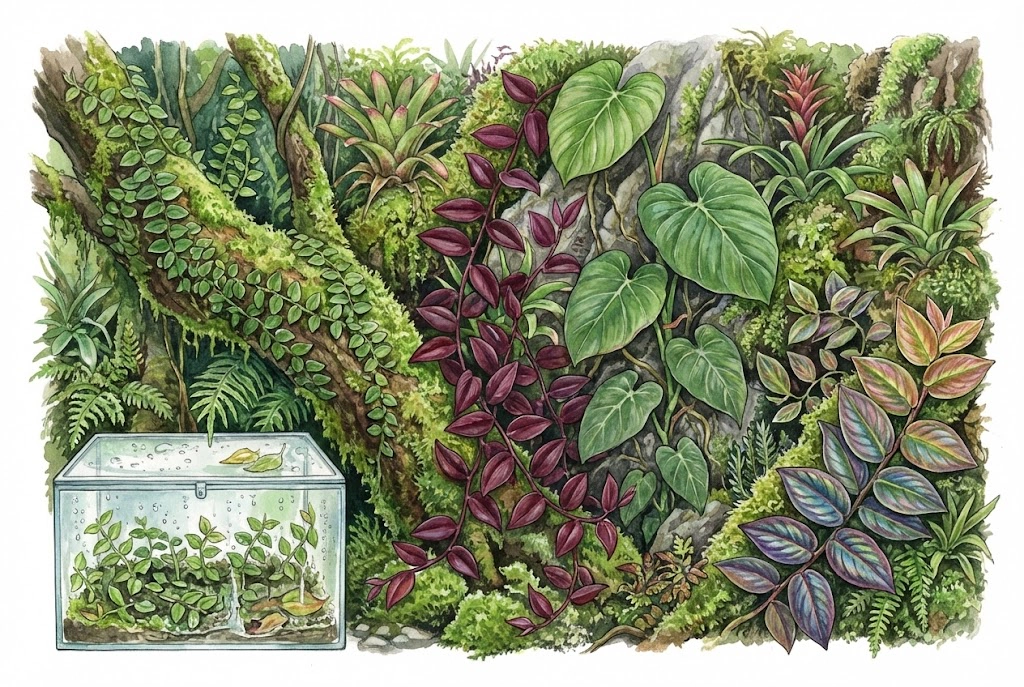
The sealed Prop Box method is the only reliable way to multiply these vines.
Placing unrooted cuttings directly into a display tank often leads to failure because ambient humidity fluctuates too much for the initial root grasp.
A prop box ensures 100% constant humidity, which is critical for the adventitious roots to adhere to the substrate.
Step-by-Step Propagation Guide

Prepare the Box
Use a clear plastic bin with a tight-fitting lid. Layer the bottom with 1 inch of moist Sphagnum moss.
Take the Cutting
Select a healthy stem with at least 4-6 leaves. Key: Ensure you have a growth tip if possible, though mid-stem cuttings can work.
Positioning
Lay the cutting flat humidity-side down on the moss. Do not bury the stem; press it firmly so the nodes contact the damp moss.
Incubation
Seal the box and place it under a grow light (12 hours on). Do not open for 3-4 weeks.
Transplant
Once roots have grip, cut the moss around the roots and transplant the entire moss plug onto your vivarium background.
What are the rarest Marcgravia cultivars available?
Varieties like Marcgravia sp. El Coca and Azrael represent the pinnacle of collector shinglers.
El Coca is renowned for its iridescent, almost metallic surface texture that reflects light differently depending on the viewing angle.
Azrael is a stunning, dark-leaved variety that maintains a chocolate-bronze hue even as it matures.
These plants are significantly more expensive and less tolerant of environmental swings than the common species.
Do rare cultivars require different care?

They demand higher stability and lower light intensity to maintain their unique patterns.
Excessive light can wash out the subtle iridescence of El Coca or the deep tones of Azrael.
We recommend placing these species in the lower or mid-sections of the tank where they receive dappled, filtered light, replicating their natural understory position.
Troubleshooting: Why is my Marcgravia turning transparent and melting?
This is the classic sign of acclimation shock caused by a humidity drop or wet leaves with poor airflow.
When a Marcgravia cutting is moved from a high-humidity environment (like a prop box or seller’s greenhouse) to a drier tank, the leaves lose turgor pressure and the cell walls collapse, turning the leaf translucent.
How do you save a melting plant?

Increase local humidity immediately and stop spraying water directly on the leaves.
Cover the specific vine with a clear plastic cup or bag to create a mini-greenhouse within the tank.
Ensure the roots are moist but not waterlogged.
If the stem itself turns brown/black, cut the healthy portion above the rot and restart it in a propagation box.

Leave a Reply