
Vampire Crab Breeding Guide: Seasonal Cue Experiment
Breed vampire crabs conservatively: identify Geosesarma, keep moist burrows unflooded, log seasonal cues, and protect brooding females and juveniles.
Samuel Reed · Published 2026-02-15 · 16 min read
Key Takeaways
- Identify the species before changing its enclosure. The common name vampire crab covers more than 60 Geosesarma species with different habitats and reproductive modes, and no single breeding protocol is proven across the genus.
- Seasonal cues are worth observing only as an unvalidated hypothesis. Humidity, food, and mild temperature changes may track field seasonality, but any phase schedule remains an optional experiment rather than a guarantee.
- Skip daily tidal cycles. These are freshwater, non-intertidal crabs, so repeated burrow flooding serves no known purpose and may stress them. Keep brooding females undisturbed.
- Build a flood-safe layout with a permanently unflooded, moist burrowing zone and a low-organic shelf if you raise water anywhere. Prolonged inundation can make organic soil anoxic and foul.
- Protect juveniles from adult predation without assuming a missing female is brooding. She may be hiding, molting, injured, escaped, or dead, so check non-invasively and prepare dense refuge or adult separation.
Captive breeding of Geosesarma is inconsistent, and one commonly cited reason is a static, unchanging environment, though there is no published data comparing successful and failed keeper setups, so treat this as a working assumption rather than a measured cause.
Field studies of some populations associate reproduction and juvenile recruitment with seasonal shifts in rainfall, humidity, temperature, and food. Timing varies by population. A 2025 field study of one undescribed Java Geosesarma inferred reproduction in the dry season (February–April) and recruitment during the dry-to-rainy transition (May–July), so the onset of a wet season does not automatically flip breeding.
Seasonal changes in a paludarium are an optional observation trial, not a proven breeding trigger. Make small, reversible changes, keep welfare conditions stable, and log what happens rather than expecting a guaranteed result.
Before you begin, identify what you actually keep. The common trade species G. dennerle and G. hagen are land-dwelling central-Java crabs (the L.A. Zoo notes G. dennerle spends 80–95% of its time on land), and their reproductive mode and needs differ from other Geosesarma, so do not apply one water-level protocol to unidentified stock or mix species.
The 2015 species descriptions also warn that wild collection of these crabs is not sustainable, so prefer documented captive-bred animals where you can.
Build and cycle the enclosure before experimenting with breeding cues. The bioactive terrarium and paludarium guide covers drainage, substrate, cleanup crews, and maintenance limits.
Seasonal Water Changes Remain Unverified
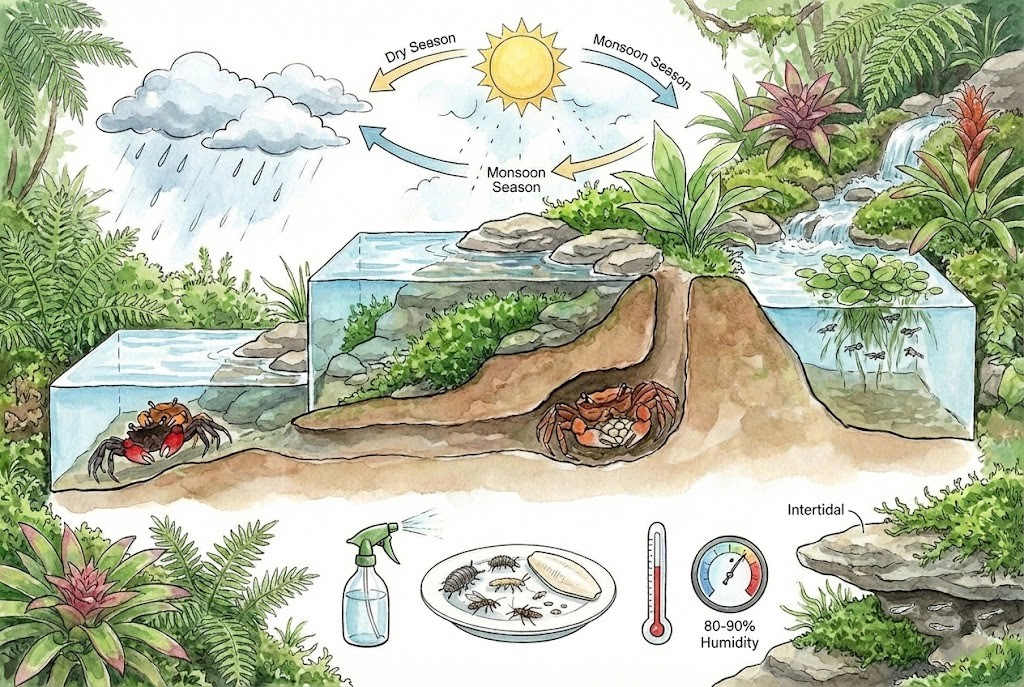
The idea is that raising the water level helps simulate the seasonal wet-dry cycle. Seasonality is one plausible influence on reproduction in some Geosesarma populations, but no experiment has isolated water level from humidity, temperature, photoperiod, food, and maturity. Calling water level the primary biological cue therefore overstates what is known.
Before altering water level, misting, temperature, or feeding, I record a 14-day baseline in two 20-minute windows each day. One begins 30 minutes after lights-out, and the other begins 10 minutes after the fixed feeding time. Two weeks captures repeated routine activity without mistaking one unusually active evening for a breeding response.
For the first trial, I mark a safe high-water line below every land and burrow zone. I divide the vertical distance from baseline into four equal steps and raise only the water section by one step every two days. Four size-relative steps span roughly one week without imposing the same centimeter change on different enclosures.
If another cue must change for safety, I record the result as a husbandry adjustment rather than proof of a breeding trigger.
Why Seasonal Conditions Might Matter
Geosesarma is a semi-terrestrial to terrestrial genus with more than 60 described species spread across Southeast Asia, the Andamans, and the western Pacific (including Taiwan and Luzon), not just Java and Sulawesi.
Several Java species live near rainforest hill streams and wetlands that swell during the rainy season.
Where a seasonal association exists, two factors are often suggested for juvenile survival.
Complex Moist Edges
Wet, humid land and shallow margins create refuge where small crabs can shelter. Note that in the 2025 Java field study, young crabs were found more often on wet, humid land near water, not congregating in open water.
Resource Availability
Rain can coincide with more insect life and detritus, which may support the energy and nutrients needed for egg production.
Whether replicating these conditions in captivity actually shifts reproduction is unverified. No study has measured Geosesarma hormones or reproductive pathways in response to a keeper’s water schedule, so any endocrine explanation is speculative.
Treat the seasonal association as a hypothesis to test and record, not a mechanism to rely on.
Breeding and recruitment in some freshwater crabs is reported to coincide with seasonal rains, though species-specific timing and reproductive mode differ widely.
Monsoon-dependent breeding in the field crab Paratelphusa hydrodromous
Skip Daily Tidal Cycles
| Feature | Daily Tidal Cycle | Stable freshwater husbandry (with optional seasonal cues) |
|---|---|---|
| Frequency | Every 6–12 hours | Steady conditions. Any seasonal change made gradually over weeks |
| Biological basis | Marine/intertidal (does not fit these crabs) | Tropical freshwater/terrestrial habitat |
| Burrow disturbance | High (repeated flooding) | Low |
| Breeding evidence | No basis for these species | Seasonal association reported in the field. Captive effect not yet tested |
A daily tidal cycle is unnecessary for the common trade species and may do more harm than good. The table contrasts it with steady husbandry, not a fixed schedule proven to raise breeding rates.
Why Daily Flooding Is a Poor Fit
Unlike mudskippers or fiddler crabs, which live in true intertidal zones, common vampire crabs are freshwater and non-intertidal, so ocean tides are not part of their environment. Tides reflect the combined gravity of the Moon and Sun together with local coastline geography, and intertidal species do not all follow the same rhythm. The relevant variation for these crabs is seasonal rainfall, not a daily tide.
Keep Brooding Females Undisturbed
Flooding terrestrial burrows every few hours serves no natural purpose and could add stress. Sources that give a figure put incubation at roughly 45–60 days, but species, temperature, and source are usually unstated, so treat that range as approximate. Most described Geosesarma carry their eggs directly under the female’s abdomen rather than in an exposed burrow clutch. Repeated disturbance can stress a brooding female, but there is no data showing daily water changes reliably cause her to drop her eggs. Keep conditions stable and undisturbed as a precaution, not because abortion is certain.
Run Seasonal Cues as a Measured Experiment
The idea is a gradual, multi-week change in humidity and water level that loosely mimics a dry-to-wet-to-dry seasonal transition.
The specific durations, water depths, and humidity percentages are estimates, not values from a Geosesarma breeding trial. No such trial has validated this schedule.
Because it is unproven and involves manipulating water and moisture, treat it as an optional experiment on a stable, well-established enclosure. Change one thing at a time, log behavior and molts daily, define in advance a point at which you stop if animals show stress, and never flood the burrowing land or let its substrate dry out.
If you are not prepared to monitor closely, keep conditions steady instead.
Phase 1. The Onset (roughly a week)
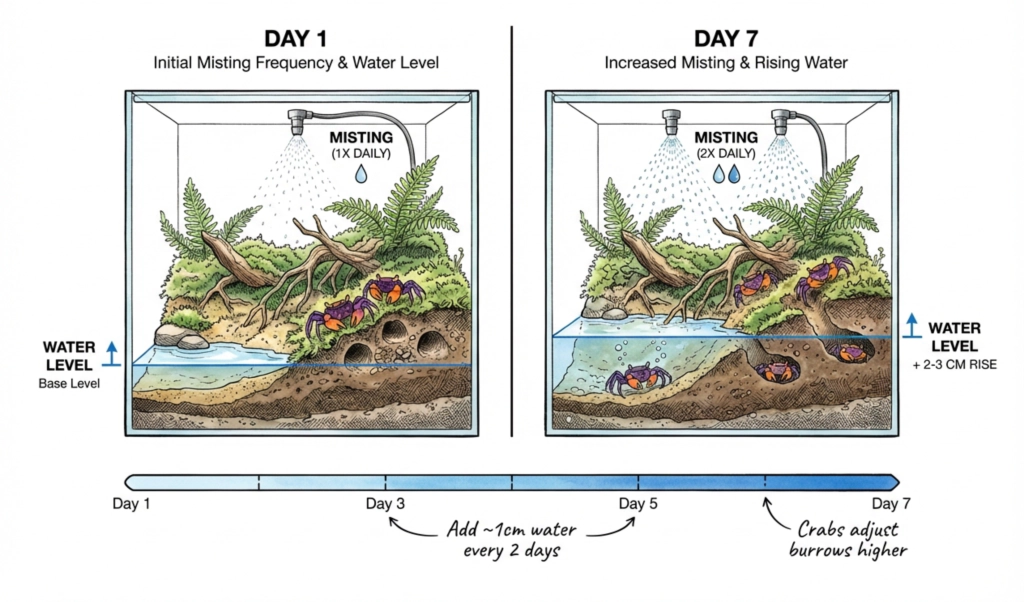
Raise Water Gradually
Slightly increase misting and raise the water level in small increments over several days rather than all at once, so the crabs can adjust. Use dechlorinated, temperature-matched water and keep the water section cycled and filtered. A fixed rate of 1 cm every two days is not universal because the same depth means a different volume and flooded area in a small tank versus a large one. Keep the rise well below the burrows and permanent land, and do not let water reach the soil zone. One centimetre is about 0.4 inch.
Check Water Quality
Confirm ammonia, nitrite, nitrate, pH, KH, and GH with an appropriate option from the aquarium water-test kit guide before and during any water-level change.
Phase 2. The high-water period (several weeks)
Keep the Land Zone Above Water
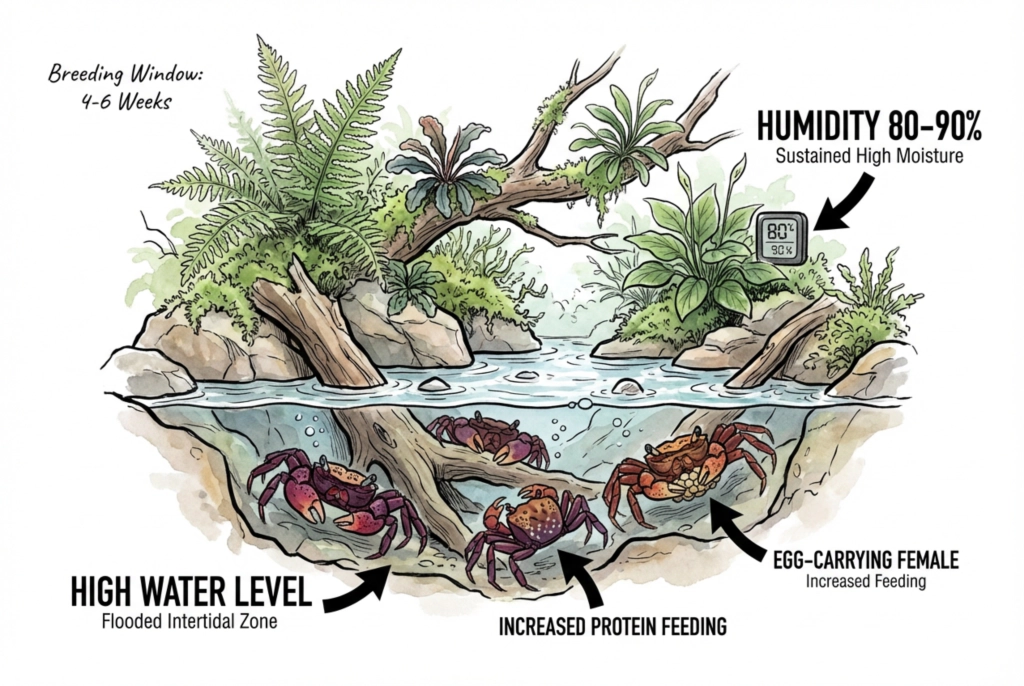
Hold the water at your chosen high level, flooding only the low-organic hardscape shelf (rocks, driftwood, lower moss). Never submerge the burrows or the land zone.
Aim for high ambient humidity, but a single 80–90% setpoint is not a species-verified target. Measure at more than one location, watch for condensation and mold, and keep airflow so surfaces are humid, not waterlogged.
Use the paludarium climate-control guide to coordinate humidity, airflow, misting, and drainage without turning the land substrate anaerobic.
If a seasonal cue works at all, this high-water period is when breeding would be most likely, so it is a good time to observe closely.
Feeding a bit more, with adequate protein, is reasonable while animals are active, but there is no trial showing that heavier feeding here raises breeding success, so don’t overfeed, and remove uneaten food to protect water quality.
Phase 3. The recession (roughly a week)
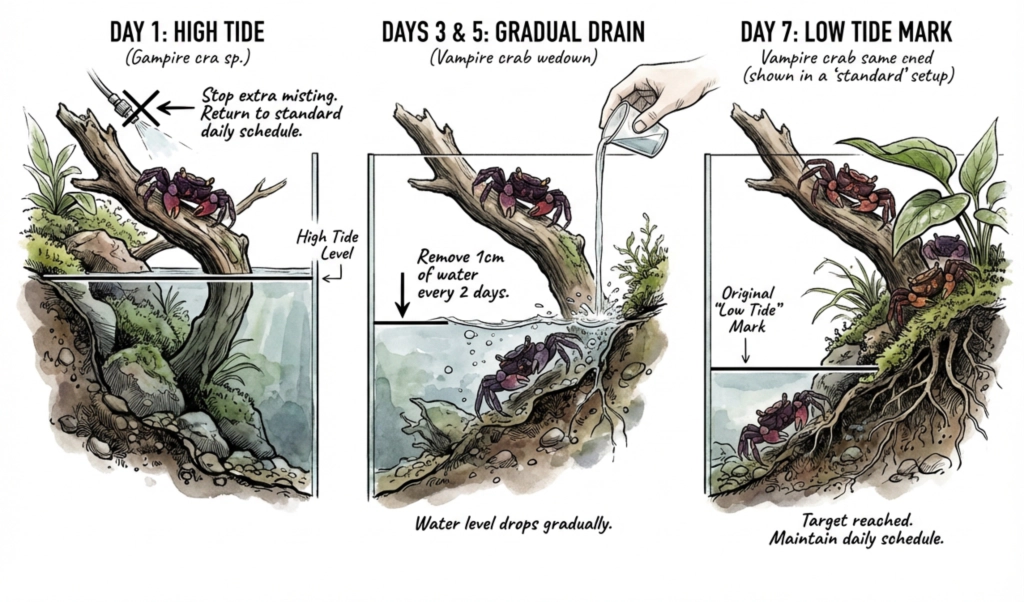
Return misting to your normal routine and lower the water gradually over several days back to the original low mark, rather than draining it abruptly.
When you remove and replace water, keep it dechlorinated and temperature-matched and watch your water parameters.
Phase 4. The lower-water rest
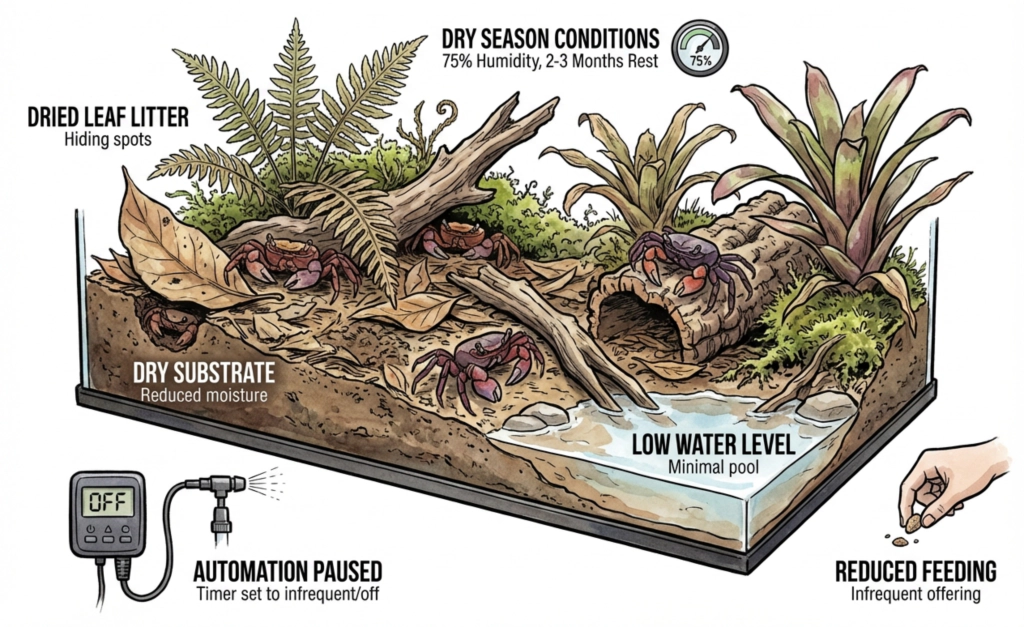
Return to Baseline
Return to your normal baseline with a lower water level and steady humidity for an extended period. There is no data showing that a specific 2–3 month dry rest is necessary or beneficial, and you should not let the substrate dry out or stop misting entirely. These wet-soil, stream-edge animals and their frequently molting juveniles are prone to desiccation, so keep the land moist rather than waterlogged and adjust based on observation instead of a fixed calendar.
Keep Burrows Above the High-Water Line
Protect the Burrowing Zone
If you are going to change water levels at all, design the enclosure so any flooding happens on a low-organic hardscape shelf, keeping the burrowing land permanently above the waterline.
These are non-intertidal crabs, so the zone names are construction labels, not real tidal zones.
The paludarium hardscape guide provides the structural supports, stone and wood checks, and stability sequence needed before animals enter the enclosure.
A common mistake is flooding the primary land area (coco fiber or soil). Organic substrate that stays submerged for weeks with poor flow can go anoxic and produce a rotten-egg (hydrogen sulfide) smell, which harms microfauna. How quickly this happens depends on flow, oxygen, and duration, so it is a real risk to avoid rather than a certainty.
If you ever smell sulfide, treat it as a water-quality emergency. Test the water, improve oxygenation and flow, and be ready to move animals, not just proceed to the next phase.
Build Three Functional Zones
A workable layout uses three zones. Size them to your species and enclosure, and include gentle slopes and easy exits so a small crab can always climb out of the water.
Zone A. Water
The submerged section uses sand or gravel. Keep it cycled, filtered, and oxygenated, with an easy way out onto land.
Zone B. Flood-Safe Shelf
This area gets flooded if you run the high-water period. Build it from non-organic materials like lava rock, slate, or coarse gravel, avoiding sharp or unstable edges. Epiphytes such as Java moss or Anubias can be attached here. Keep the Anubias rhizome unburied, and remember that not every plant tolerates repeated emersion equally.
Zone C. Permanent Land
This zone stays above water at all times and holds the moist soil mix where the crabs burrow. Give it enough depth and area to burrow, keep it moist rather than dry or flooded, and prevent burrow collapse.
Nutrition Supports Health, Not Guaranteed Breeding
Feed for Health and Molting
Provide a varied, balanced omnivorous diet with adequate protein and available calcium. This supports general health and molting. It is a sensible baseline, not a proven breeding formula.
Whatever cues breeding, animals still need adequate nutrition to reproduce. Producing eggs is energetically costly, requiring energy, protein, lipids, and minerals. Calcium matters, but it is not uniquely the limiting nutrient for eggs. It is also central to the exoskeleton and molting, and comes from both diet and water.
Severe malnutrition can prevent reproduction, but nutrition is only one factor. Maturity, molt cycle, mating, temperature, and disease all play a role, so good feeding alone does not guarantee ovulation.
Use Live Foods Carefully
When animals are active, you can offer varied animal foods such as springtails, isopods, and appropriately sized crickets alongside plant and detrital matter.
Match prey to crab size, gut-load feeders, feed in dispersed spots, and remove leftovers so they don’t foul the water.
Use only pesticide-free feeders, and quarantine new live cultures.
Springtails and dwarf white isopods seeded into the moist land section can act as a cleanup crew and supplemental prey.
They are not a complete diet or a guaranteed constant protein source. Cultures take time to establish, need the right airflow and humidity, and can crash or be eaten faster than they reproduce, so keep feeding directly.
Springtail starter culture
A starter culture usually supplies temperate springtails (typically Folsomia candida) in a moist culture medium. It can seed prey and cleanup activity in a suitable crab enclosure, but it cannot replace a varied feeding and maintenance routine.
Use a culture when the enclosure fits
Use a culture when the land section stays within the springtail species’ humidity and temperature range and you can seed it early enough to verify establishment. Starter containers do not disclose a reliable live count, and enclosure coverage and buildup time depend on culture condition, food, moisture, temperature, and habitat area. Follow the supplier’s directions and confirm activity in several locations before relying on the colony.
Skip a culture when conditions do not fit
A live culture is a poor choice for an arid build, an enclosure with pesticide residue, or an immediate protein need. Before ordering, identify the species and review the seller’s shipping range, weather hold policy, and live-arrival remedy.
If the cleanup crew disappears, work through the dwarf white isopod crash diagnosis before restocking, especially after pesticide exposure or a moisture change.
Provide Calcium Carefully
Keep a calcium source available, such as cuttlebone or calcium powder dusted on food. Consider it alongside water hardness and the overall diet rather than dosing without limit, and check the product composition.
Adequate protein and calcium support normal physiology and molting. A balanced diet is important, but no single formula is proven to guarantee breeding success.
Confirm Breeding With Eggs or Juveniles
The most direct sign of success is seeing eggs held under a female’s abdomen. A female simply going missing is not a reliable sign on its own.
Unlike fish that spawn openly, Geosesarma are secretive brooders, and a female may retreat into a burrow to carry her eggs (reported at roughly 45–60 days, depending on source).
But a disappearing female could also just be hiding, molting, avoiding aggression, escaped, injured, or dead, so treat disappearance as something to check, not confirmation of brooding.
If a female goes missing, avoid unnecessary digging (disturbance can stress a brooding female) but do not ignore her entirely.
Use non-invasive checks (a quiet night observation, looking for her at the burrow entrance) and rule out escape, injury, or a collapsed burrow so you don’t overlook a trapped or dead animal.
Brooding Signs to Record
- Visible orange or reddish eggs held under the abdomen (the most direct evidence). Color alone doesn’t confirm viability or stage, so record what you see over time.
- A wide abdominal flap (apron) indicates a mature female, but on its own it is a sex/maturity feature, not proof of brooding.
- Burrow-defensive or aggressive behavior, which can also stem from territory, crowding, molting, or competition for food.
Geosesarma mirum, a New Semi-Terrestrial Sesarmid Crab from Central Taiwan
Protect Juveniles With Refuge or Separation
Because these species have direct development, breeding produces fully formed juvenile crabs (crablets), not free-swimming fish-style fry.
To protect them, provide dense refuge or separate adults, since adults may prey on juveniles.
Adult–juvenile cannibalism is a plausible and often-cited cause of breeding failure, though there is no Geosesarma cohort data establishing it as the leading cause or pinning mixed-tank survival at a specific figure like under 10%.
More water does not necessarily dilute density. These are largely terrestrial, direct-developing crabs, and adding water can actually reduce the usable land refuge the young need.
Build a nursery refuge
Provide dense, complex cover. In the 2025 Java field study, young crabs were found more often on wet, humid land near water than in open water, so prioritize moist land leaf litter, fine crevices, and moss, with only safe, shallow water and easy exits.
Floating plants like Riccia fluitans or Java moss can add shelter, but there is no evidence that all Geosesarma juveniles gather in aquatic clumps.
If juveniles do shelter in a moss clump, you can gently move the clump to a rearing tank, but check for individuals first, since scooping blind risks crushing, stranding, or leaving crablets behind, and match the rearing tank’s temperature and water.
Separate the adults after juveniles appear
In a dedicated breeding tank, one option is to move the adults out once you see the first juveniles, so the young can grow with less predation.
Prepare the second enclosure in advance, fully cycled, escape-proof, and matched for temperature and humidity, and handle the crabs gently, counting individuals and monitoring after the move.
Separation can improve juvenile survival, but it is one option, not the only way. Dense land refuge, low density, size separation, dispersed food, and a monitored nursery are also worth comparing.
Vampire Crab Breeding Troubleshooting
No juveniles appear
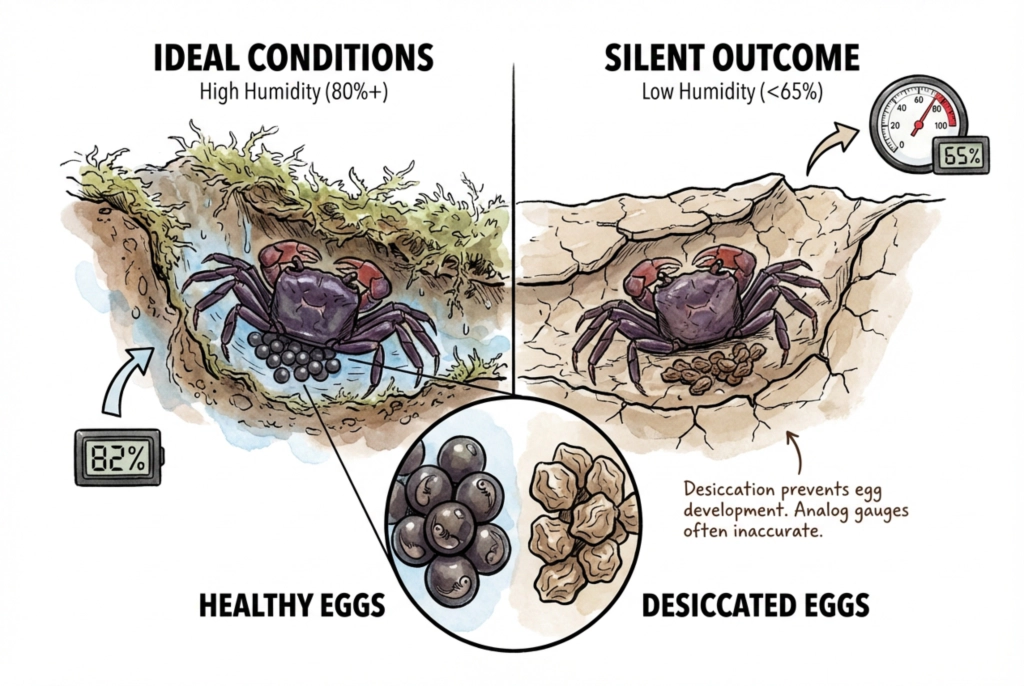
What to look for
You ran the full seasonal cycle but see no juveniles.
What to check
Work through the likely factors in order (species and sexes present, maturity, actual egg evidence, temperature and humidity history, water and substrate quality, diet and body condition, then aggression and health). A missing cue is only one of many possibilities. Analog dials are often inaccurate, so compare them with a digital sensor. If a digital sensor reads 65% when you assumed 80%, that gap is worth correcting, but a single ambient reading does not by itself explain a failed cycle. It measures one spot of air, not the burrow microclimate or egg status. Low humidity and desiccation can hinder development, but they are one factor among maturity, sex ratio, temperature, nutrition, and water quality, not a proven single cause.
Digital hygrometer
An inexpensive digital hygrometer provides temperature and relative-humidity readings at one repeatable enclosure location. Check the exact model’s accuracy, refresh rate, logging, alerts, probe type, and water-resistance rating. A dry-room display is not automatically suitable for a misted crab enclosure.
Use a different sensor when one spot is not enough
A basic single-point unit is not enough if you need remote alerts, a protected probe, direct substrate or water measurement, or evidence of conditions inside a burrow. Use more than one placement for a tall enclosure and periodically compare sensors, because one screen cannot describe every microclimate.
Repeated aggression or injury
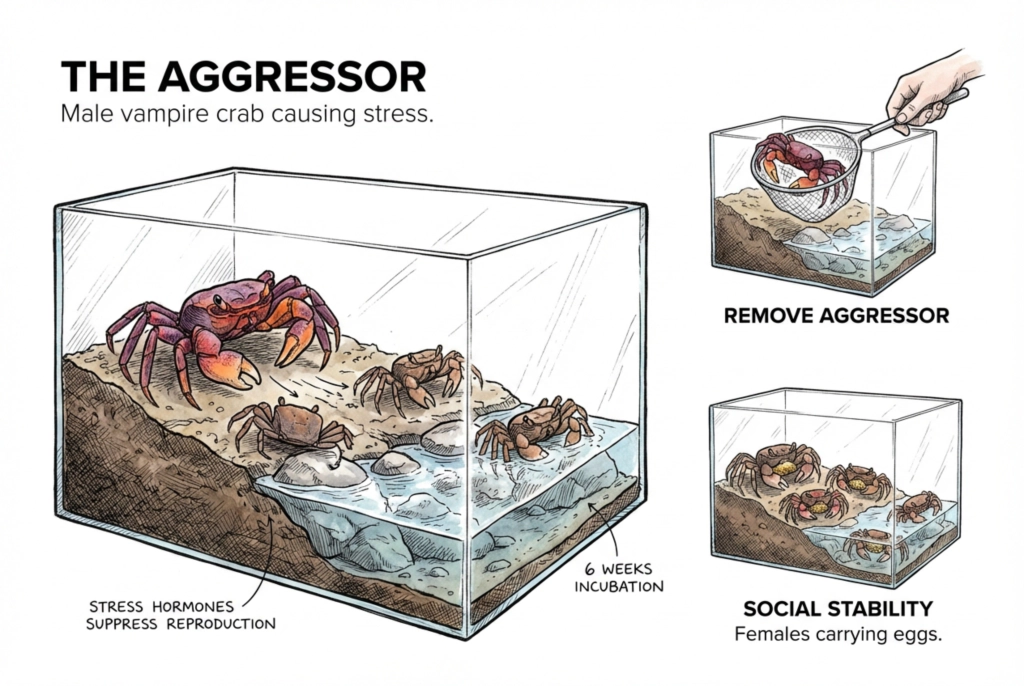
What to look for
One individual repeatedly chasing others, with injuries such as lost legs.
What to do
Repeated injury is a welfare problem (separate the aggressor and any injured animals, and give injured crabs a quiet place to recover and molt). Then reassess the underlying causes. Add hides and visual barriers, reduce density, check the sex ratio, spread food out, and make sure the enclosure is large enough.
Why it may help
Chronic disturbance and stress can interfere with reproduction in general, though this is broad physiology rather than a measured diagnosis of your tank. A calmer, less crowded group is a reasonable goal regardless of whether it changes breeding outcomes.