
Chitosan vs Hydrogen Peroxide for Damping Off
Chitosan vs hydrogen peroxide for damping off: what each one actually does, why there is no head-to-head trial naming a winner, and how cultural controls and labeled products fit in. Read the caveats before you mix anything.
Samuel Reed · Published 2026-02-17 · 11 min read

Key Takeaways
- Chitosan and hydrogen peroxide do different jobs, and no head-to-head trial names a winner for damping off. Chitosan may prime plant defenses, while peroxide is a contact oxidizer used mainly on hard surfaces.
- Neither product has a settled good-versus-bad effect on all soil microbes. Chitosan and peroxide outcomes vary with grade, dose, concentration, contact time, and the organisms present.
- Keep soil treatment separate from hard-surface cleaning. Household peroxide on soil is not a labeled, tested drench simply because it can clean pots and tools.
- Mixing depends on the chitosan formulation. Plain high-molecular-weight powder usually needs dilute acid, while water-soluble grades do not, so the manufacturer’s label controls the method.
- Culture comes first because drainage, sanitation, moderate moisture, spacing, and airflow reduce risk more reliably than any spray. No single technique guarantees a healthy seedling.
Pathogens like Pythium and Rhizoctonia can collapse a tray of seedlings quickly, so it helps to understand your options rather than expect any single spray to guarantee a rescue.
Fix drainage, sanitation, moisture, spacing, and airflow first. Choose a product only for a defined job and within its label.
If overwatering is your underlying problem, see our guide to saving drowned plants.
What causes damping off in seedlings?
Damping off is caused by soil-borne fungi and fungus-like organisms. Common culprits include the fungi Rhizoctonia and Fusarium and the oomycete (water mold) Pythium. Depending on the crop and site, Phytophthora, Botrytis, and others can be involved too.
These pathogens attack the roots, hypocotyl, and soft tissue of young seedlings near the soil line, which can cause them to collapse.
Wet, poorly drained media is an important risk factor, especially for Pythium. But it is not the only trigger. Extension guidance notes that Rhizoctonia and some Pythium can cause disease in drier, warmer conditions too, so a too-wet explanation will not diagnose every failed tray.
Overwatering, poor airflow, and contaminated media or reused containers all raise the risk.
Using clean or pasteurized soilless mix and sanitized containers lowers it.
A collapsed seedling usually cannot be saved, so prevention matters. That means correcting the environment, discarding badly infected flats, and, where appropriate, using products according to their labels rather than relying on any one cure.
Which fungi are responsible?
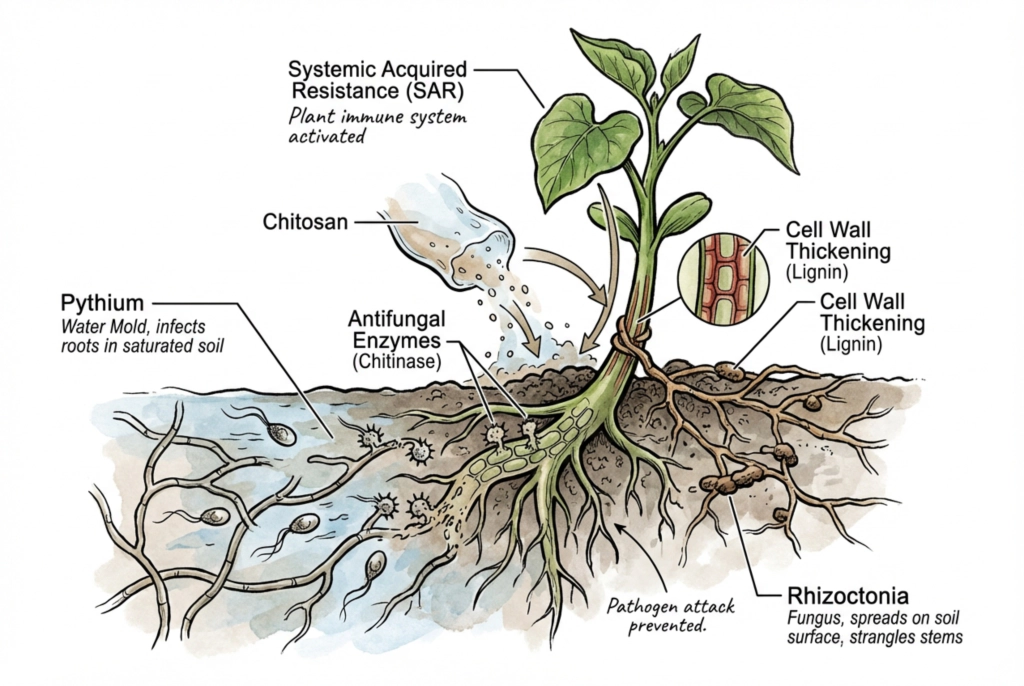
Pythium and Rhizoctonia are two of the more common culprits, but which pathogens matter depends on the crop and site.
Pythium is a water mold (oomycete). Its motile zoospores move through water films in saturated soil and can infect seeds and roots.
Rhizoctonia is a true fungus that spreads by mycelium and can attack roots and stems. Both can cause the collapse gardeners recognize as damping off, so identifying the actual pathogen matters before choosing a response.
Damping-off in Flower and Vegetable Seedlings | NC State Extension
How does Chitosan prevent damping off?
Chitosan may prime some plant defenses in some crop-and-pathogen systems. That can be useful as one part of prevention, but it is not a vaccine and does not make a waterlogged or contaminated tray safe.
Results vary with the formulation, seedling, dose, timing, and disease organism. Treat a labeled chitosan product as a limited preventive tool, not a proven rescue for an already collapsing tray.
What the Evidence Does Not Establish
A result from one crop, pathogen, and formulation does not set a protection period or a working rate for every seedling. Use the directions for the exact product and do not turn a study result into a universal schedule.
Does Chitosan kill fungi directly?
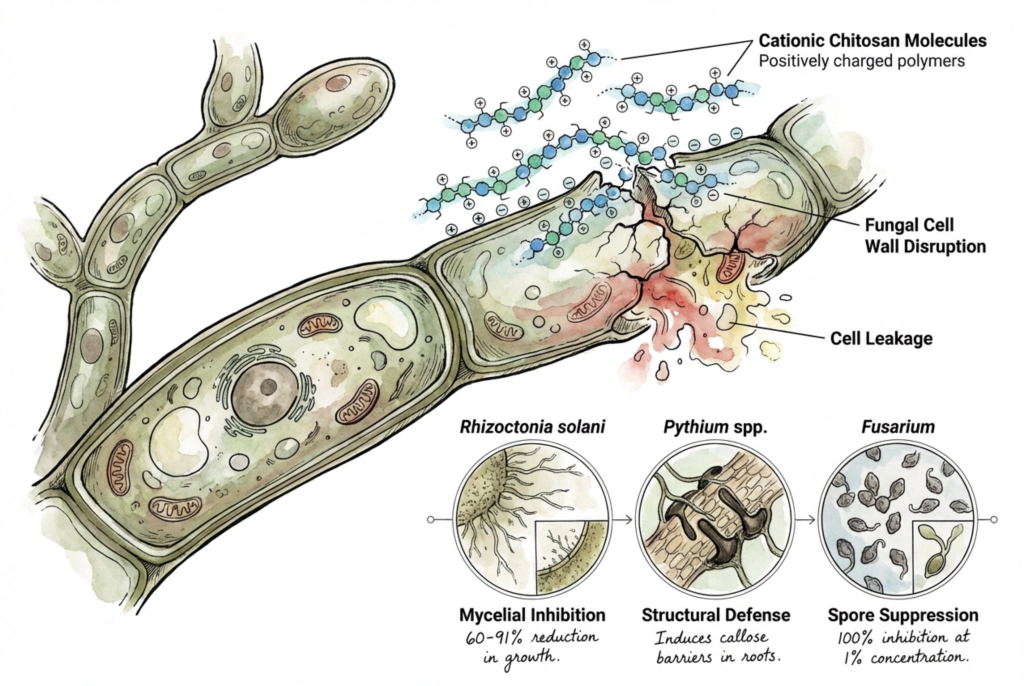
Chitosan has shown direct antimicrobial activity in laboratory studies, but those results use different crops, organisms, formulations, and test conditions. They do not establish that a home soil drench will stop damping off.
In particular, results against true fungi do not automatically apply to Pythium, which is an oomycete. Keep the decision practical. Use only a product and application the label supports, then judge the tray by disease spread and growing conditions.
Chitosan Effects on Plant Systems
Chitosan in Plant Protection
How does Hydrogen Peroxide work?
Hydrogen peroxide is a contact oxidizer. Its effect depends on concentration, formulation, organic debris, and contact time, so it does not instantly sanitize every surface or growing medium.
It does not move through a plant as a systemic treatment and leaves no residual protection. Use it for a labeled cleaning or treatment purpose, not as a general cure for a collapsing tray.
Keep Peroxide on Labeled Uses
Terms like sanitizer, disinfectant, and sterilizer are regulated performance claims. A diluted home solution has not been shown to sterilize soil.
Household 3% peroxide can be useful for cleaning some hard, non-porous surfaces, but on soil and organic matter its effect is limited by that organic load and contact time.
Peroxide decomposes into water and oxygen. Fizzing shows it is reacting, often with catalase or organic matter, but it does not prove pathogens were fully killed. There is no fixed reinfection timer because reinfection depends on whether inoculum is reintroduced.
Is Hydrogen Peroxide safe for seedlings?
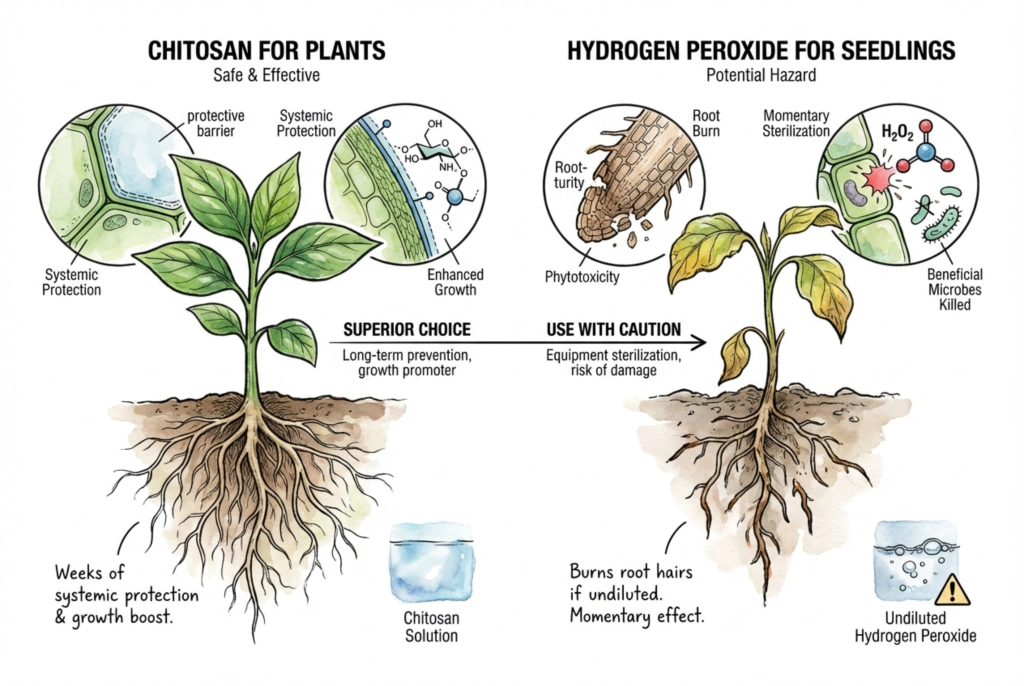
Concentrated peroxide can injure delicate root hairs, and a solution safe for one seedling and mix may not be safe for another.
A safe dilution depends on the plant, the medium, the product, and exposure.
Do not make a home peroxide soil drench from a pharmacy bottle. A safe use rate depends on the formulated product, crop, target, soil condition, contact time, and any required rinse.
Use a soil-applied peroxide product only when its label specifically covers that use.
For any home use, stick to ordinary 3% household grade. Concentrated or 35% food-grade peroxide is corrosive and can burn skin and eyes, so it is not worth the risk for seedling care.
Follow the product label first. Wear gloves and eye protection, control splashes, work in a ventilated spot, keep it off your skin, and keep it out of reach of pets and children.
Which is better (Chitosan or Hydrogen Peroxide?)
No head-to-head evidence establishes a universal winner. Chitosan and household hydrogen peroxide have not been compared on the same seedlings, pathogen, dose, and timing while measuring disease, plant injury, and soil-microbe effects.
Choose by the job, not by a claim that one always works better.
They are different tools with different roles.
| Feature | Chitosan | Hydrogen Peroxide |
|---|---|---|
| Type of action | Can act as a defense elicitor and has some direct antimicrobial activity, both dependent on formulation and conditions | Non-selective contact oxidizer |
| Duration | Varies by product, crop, and pathogen, not a fixed duration measured in weeks | Short-lived. Decomposes to water and oxygen, no residual protection |
| Soil microbes | Reported as compatible with some beneficials and inhibitory to others, depending on grade and dose | Non-selective. Extent of kill depends on concentration and exposure |
| Typical use | Applied to plants as a foliar spray or drench per label | Used to clean surfaces and tools. Soil use needs a product labeled for it |
| Cost | Low to moderate | Low |
Should I use both?
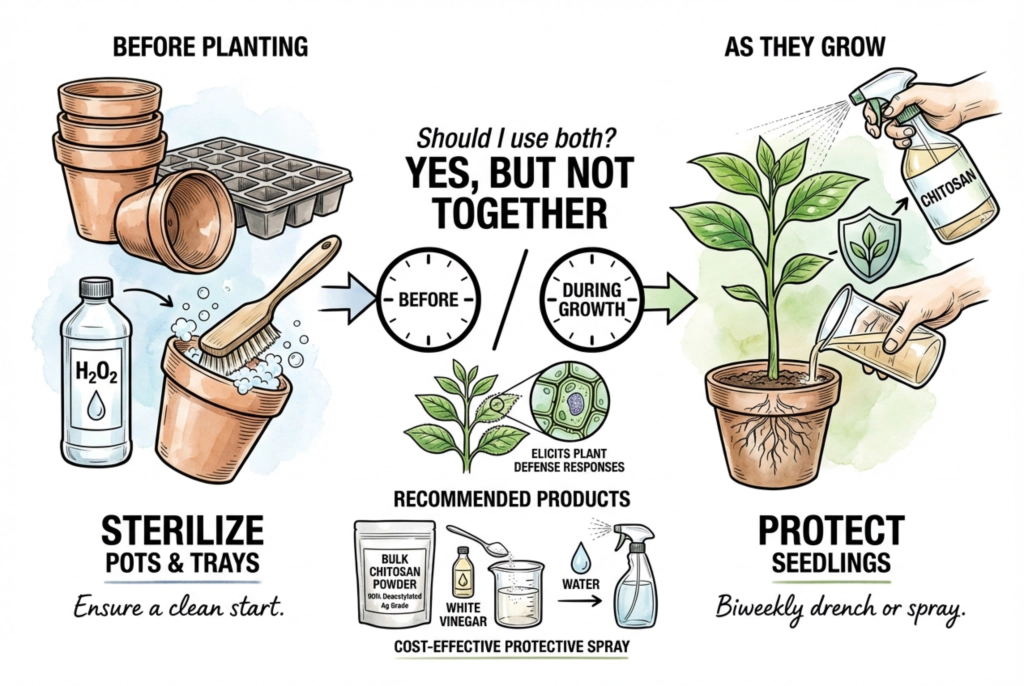
They fill different roles, so it makes sense to keep them separate rather than mix them.
Before planting, you can clean empty pots and trays. Extension services describe concrete container sanitation. Remove soil debris, wash, then soak in a labeled disinfectant (for example, a 10% household bleach solution for about 30 minutes is a commonly cited method), and rinse.
Whatever cleaner you use, follow its directions for dilution, contact time, and rinsing.
On the growing seedlings, chitosan can be applied as a foliar spray or drench, but the frequency and rate should come from the specific product’s label.
A generic every-two-week schedule is not supported for every formulation, crop, or application route, and a foliar spray and a root drench are not interchangeable.
I never change sanitation, airflow, watering, and a seedling product on the same day. Each labeled product group and the untreated baseline receive 12 seedlings from the same sowing, with three selected from each tray quadrant and otherwise matched care. With 12 seedlings, one loss changes survival by 8.3 percentage points, so it is visible without deciding the result by itself.
The same section of each group goes into every photograph, beginning before treatment. That comparison has often stopped me from crediting a product for improvement that appeared just as clearly in the baseline seedlings after airflow or watering was corrected.
How do I make a soluble Chitosan spray?
Whether you need vinegar depends on the product. Plain, non-water-soluble chitosan may require an acid-based preparation, while water-soluble grades do not. Do not turn a homemade formula into a seedling drench unless the product directions support that use. The final acidity can damage tender plants.
MarkNature chitosan
MarkNature chitosan is a water-soluble grade, so it fits a use where the product directions call for dissolving it in water rather than vinegar. It is sold as a raw material, not a ready-to-spray seedling product, so do not use it if you cannot follow the supplied directions and measure the preparation accurately.
MarkNature product boundary
The maker describes it as a professional raw material, so treat it as an ingredient rather than a finished consumer product.
Chitosaner concentrate
Chitosaner chitosan concentrate can be simpler when you want a prepared concentrate rather than raw powder, but it still needs label-directed dilution before use on seedlings. It is not a ready-to-use spray and should never be applied undiluted.
Why do I need vinegar?
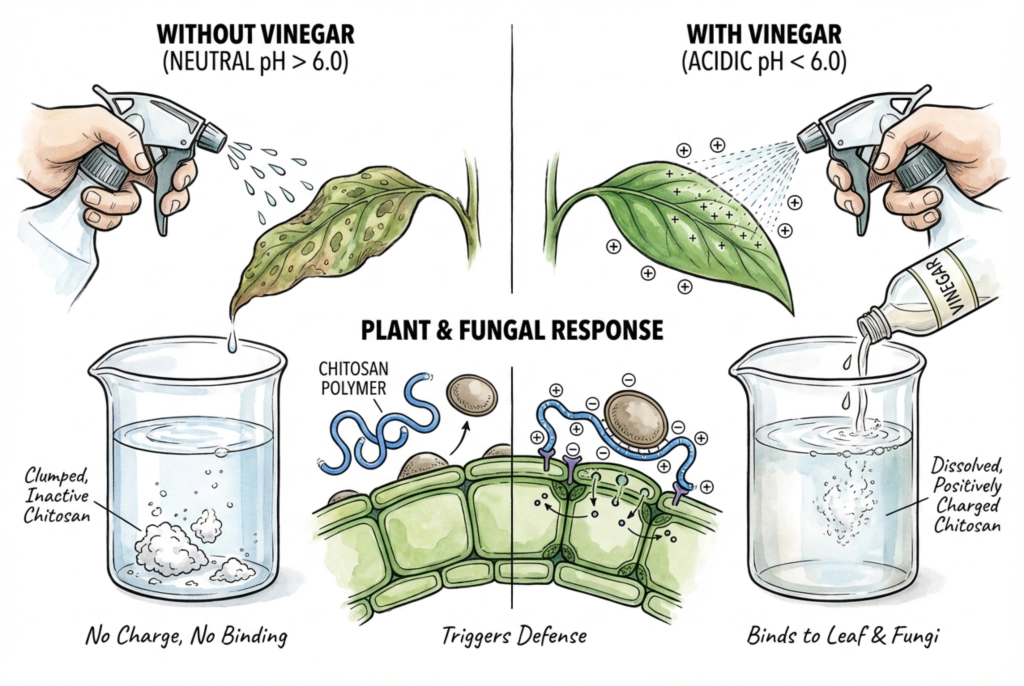
Plain chitosan dissolves more readily in a dilute acid, which is why some raw powders call for vinegar. Water-soluble grades dissolve in water, so adding vinegar to them is unnecessary and can conflict with the manufacturer’s directions.
What is the correct dosage?
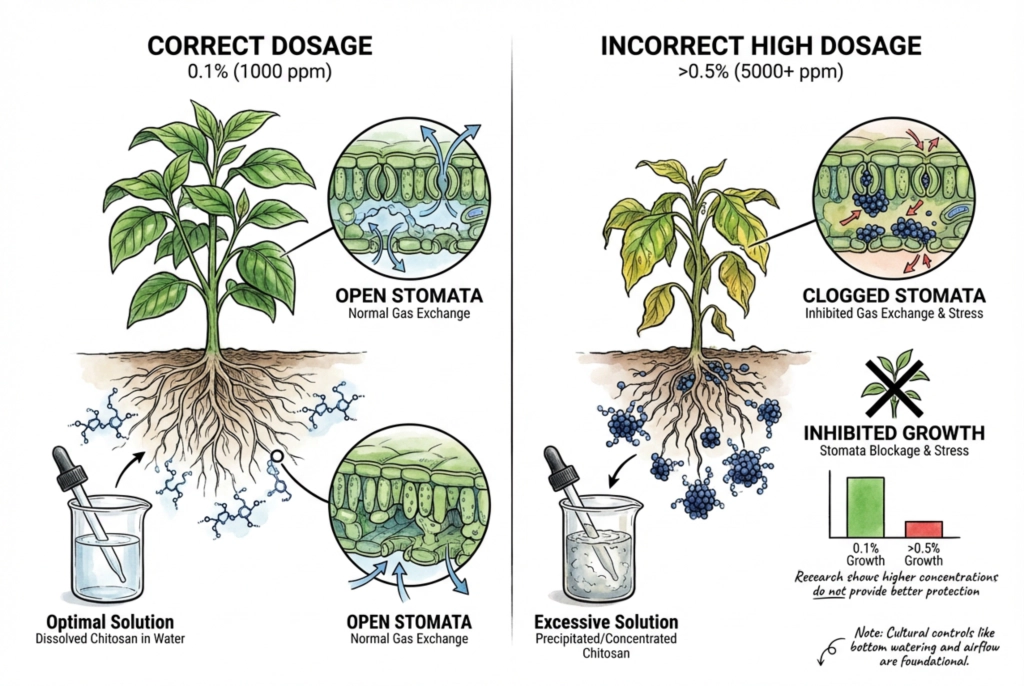
There is no universal chitosan dose for damping off. Rates vary by formulation, crop, pathogen, and application route, so use the exact product directions rather than a study concentration or an online recipe.
Higher is not automatically better. Too much can stress seedlings, which is another reason to avoid improvising a stronger mix.
Can I prevent damping off without chemicals?
Yes. Cultural controls are the foundation of damping-off prevention. Good drainage, sanitation, moderate moisture, appropriate temperature and light, adequate spacing, and air circulation all matter.
Bottom watering is one optional technique within that, not a required control on its own.
If the growing medium stays waterlogged and stagnant, no product is a reliable substitute for fixing that. Correcting the environment comes first.
Why is bottom watering important?
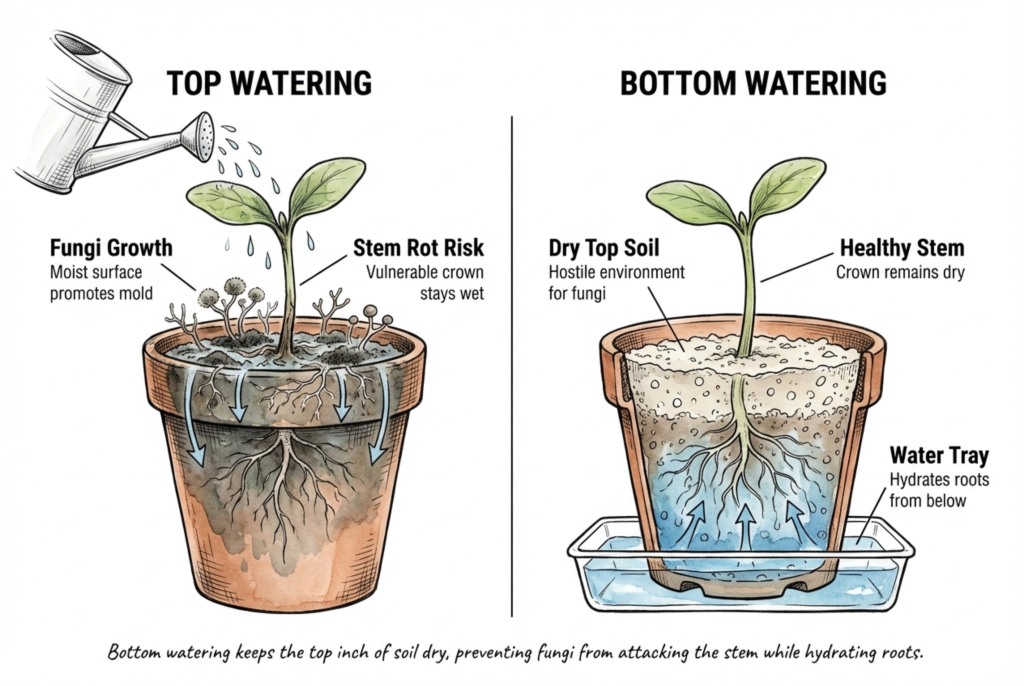
Bottom watering can help keep the surface of the mix drier and reduces splashing onto foliage and the crown, which can lower some disease pressure.
It does not guarantee a dry top inch, though. Capillary rise can still wet the surface depending on the medium, pot height, and how long it soaks. Aim to keep the medium moist but not soggy rather than bone dry.
Standing pots in a shallow tray of water lets them wick moisture from below. The right soak time depends on pot size, mix, and drainage rather than a fixed number, and you should let pots drain afterward.
Bottom-watering hygiene
Sharing the same tray water between pots can move Pythium from pot to pot, so use clean water and avoid reusing tray water across sick and healthy plants.
Does airflow really help?
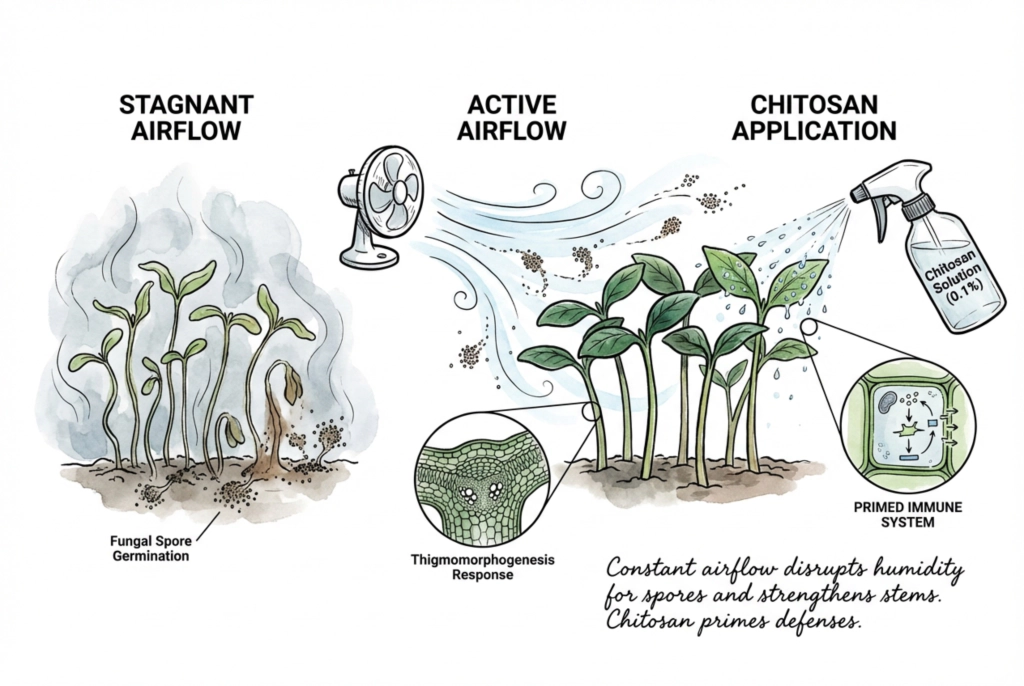
Gentle air circulation can help by reducing condensation and lowering humidity in the seedling canopy, which makes conditions less favorable for some pathogens.
It does not fix a waterlogged medium, and a strong, constant jet aimed directly at seedlings can over-dry them and the mix, and may even spread some spores.
Aim for gentle movement, keep the fan at a distance, and watch humidity and moisture rather than running it at full blast.
Physical movement can make seedlings grow shorter and stockier. It does not demonstrate protection from damping off, which mainly attacks young roots and stems.
AC Infinity Multifan S5
AC Infinity Multifan S5 can suit a small tray that needs gentle airflow from a fixed position. It is less suitable when the tray needs broad, even coverage or humid-enclosure use, because it does not oscillate or control humidity. Keep it far enough away that seedlings move slightly rather than bend in a constant jet.
Affiliate Disclosure
This article contains Amazon affiliate links. As an Amazon Associate I earn from qualifying purchases. If you use these links, the site may earn a commission at no extra cost to you. Product availability, price, and specifications can change. Check the current listing before buying.