
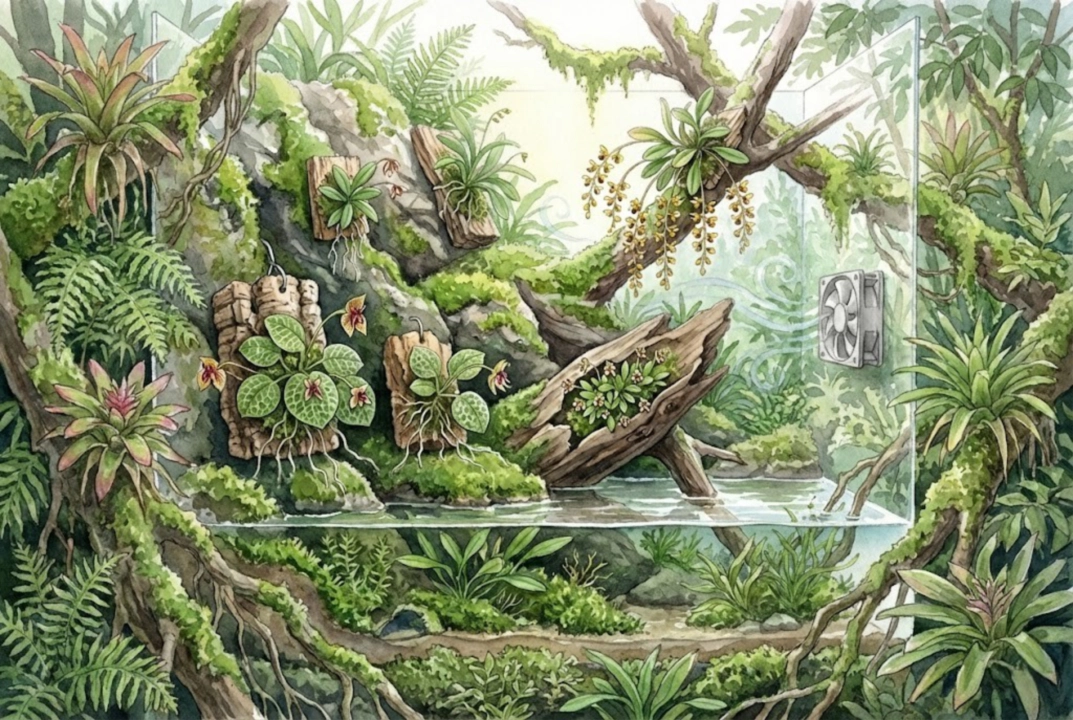
Summary
- High-humidity paludariums require specific non-pseudobulbous micro orchids like Lepanthes and Platystele rather than standard houseplants.
- Airflow is the critical invisible factor that prevents rot and powers calcium transport in these wet environments.
- Mounting orchids on cork or hardscape is superior to planting them in substrate to prevent root suffocation.
Key Points
- Airflow is Mandatory: Prevents fungal pathogens and nutrient deficiencies (black tips).
- Best Species: Lepanthes telipogoniflora (shade, wet), Platystele (crevices), Haraella retrocalla (scented, brighter).
- Mounting Rule: Always mount epiphytes; never bury their roots in wet substrate.
- Lighting: Low to medium PAR (40-150 µmol) is ideal; avoid high-intensity aquarium lights.
- Troubleshooting: Use springtails for mold control and fans for condensation.
Micro orchids are the crown jewels of high-humidity paludariums, thriving where standard houseplants rot, but only if you master the invisible balance of airflow and moisture.
What is a Paludarium Microclimate?
A paludarium is a specific type of terrarium that incorporates both aquatic and terrestrial elements, maintaining 80-95% humidity through the interaction of a water feature and an enclosed space.
This environment perfectly mimics the riparian zones of tropical rainforests, supporting non-pseudobulbous orchids like Lepanthes that would desiccate in minutes in a standard room.
However, this stability also creates a high risk of bacterial proliferation if not managed correctly.
Why is airflow critical in this environment?

Airflow is the absolute non-negotiable factor because it powers transpiration and prevents fungal pathogens from anchoring on wet leaves.
Without active air movement, the boundary layer of air around the leaf remains saturated, halting transpiration completely.
When transpiration stops, the plant cannot move calcium to new growth, leading to ‘black tip’ die-back often mistaken for rot.
A simple computer fan running at 20% speed disrupts this boundary layer and dehydrates fungal spores before they germinate.
Which Micro Orchids Thrive in High Humidity?
The best micro orchids for these conditions are generally epiphytic Pleurothallids that lack water storage organs and require constant moisture.
What are the best Lepanthes species for beginners?

Lepanthes telipogoniflora is the premier choice because it thrives in the exact stable, high-humidity (80%+) conditions a glass-enclosed paludarium provides.
Known as the ‘Miniature Flower of Life,’ its paper-thin leaves uptake moisture directly from the air, making it perfectly adapted to the splash zones of a paludarium.
It requires low light (shade) and intermediate temperatures (60-80°F).
Are there any orchids that fit in tiny crevices?

Platystele species, particularly Platystele jungermannioides, produce the smallest orchid flowers in the world and can colonize minute cracks in hardscape or driftwood.
These true miniatures require medium light and persist in damp nooks where larger plants cannot fit.
How do I care for Haraella retrocalla?

Haraella retrocalla is a monopodial species that produces a strong lemongrass scent and blooms almost continuously if kept warm and moist.
Unlike the shade-loving Lepanthes, Haraella prefers higher light and should be mounted higher up in the tank, closer to the LEDs, but positioned at a 45-degree angle so water drains rapidly from its crown to prevent rot.
Comparison of Top Species:
| Species | Humidity Needs | Light Level | Best Placement |
|---|---|---|---|
| Lepanthes telipogoniflora | Very High (90%+) | Low/Shade | Lower/Mid Background |
| Platystele spp. | High (80%+) | Medium | Crevices/Driftwood |
| Haraella retrocalla | High (70-80%) | Medium/Bright | Upper Branches |
How Should I Mount Orchids in a Paludarium?
You should almost always mount micro orchids on cork bark, tree fern fiber, or branches rather than planting them in substrate.
Why is mounting better than potting?

Mounting mimics the natural epiphytic habit of these plants, exposing their roots to the air so they can breathe even in 95% humidity.
Planting them in soggy substrate within a paludarium creates an anaerobic environment that suffocates the velamen (the root’s sponge-like covering), leading to rapid root rot.
Cork bark is naturally rot-resistant and provides a textured surface for roots to grip, while hygrolon fabric can wick water from the reservoir to keeping moisture-loving species hydrated.
How much light do they need?

Most paludarium-suitable orchids are understory dwellers that require low to medium light, typically between 40 and 150 µmol/m²/s PAR.
High-intensity LEDs designed for high-tech planted aquariums are often too strong and will bleach Lepanthes leaves.
You should run lights for a 12-hour photoperiod and use a dimmer to achieve ‘bright shade’ levels. If leaves turn purple or red, it is a sign of anthocyanin production, indicating the light is too intense.
Troubleshooting Common Issues
What causes black tips on leaves?

What to look for: New growth turning black at the very tip or margins.
How to fix: Increase internal air circulation immediately using a small fan.
Why it works: This is a calcium deficiency caused by a lack of transpiration. By moving air, you force the plant to transpire, which pulls calcium-rich water from the roots to the tips of new leaves.
How do I stop mold on my mounts?

What to look for: White fuzzy growth on sphagnum moss or driftwood.
How to fix: Add Springtails (Collembola) to the tank and direct a fan towards the wet area.
Why it works: Springtails are detritivores that eat mold and decaying matter, keeping the micro-environment clean for orchid roots.

Leave a Reply