Monstera Indoor Plant Watering: The Expert Guide to Hemiepiphytic Hydrology
Master monstera indoor plant watering with this scientific guide. Learn why soil physics matters more than a schedule, how to prevent root rot, and the truth about misting.
Summary
Soil Physics First: Monstera roots are hemiepiphytic and require high oxygen levels, so you must replace dense potting soil with a chunky ‘Aroid Mix’ (bark/perlite) to prevent the ‘swamp effect’ of a perched water table.
Verify, Don’t Guess: Stop watering on a calendar schedule; instead, insert a wooden skewer to the bottom of the pot and only water when it comes out completely dry, ensuring the roots aren’t sitting in stagnant moisture.
Flush & Monitor: Water deeply to flush out stale air and salts, use clear pots to visually inspect root health, and avoid misting, which promotes fungal growth without effectively increasing humidity.
Key Takeaways
The Hemiepiphytic Reality: In nature, Monsteras climb trees with roots exposed to air. In a pot, standard soil compacts and creates a hypoxic (low oxygen) zone at the bottom, leading to root rot.
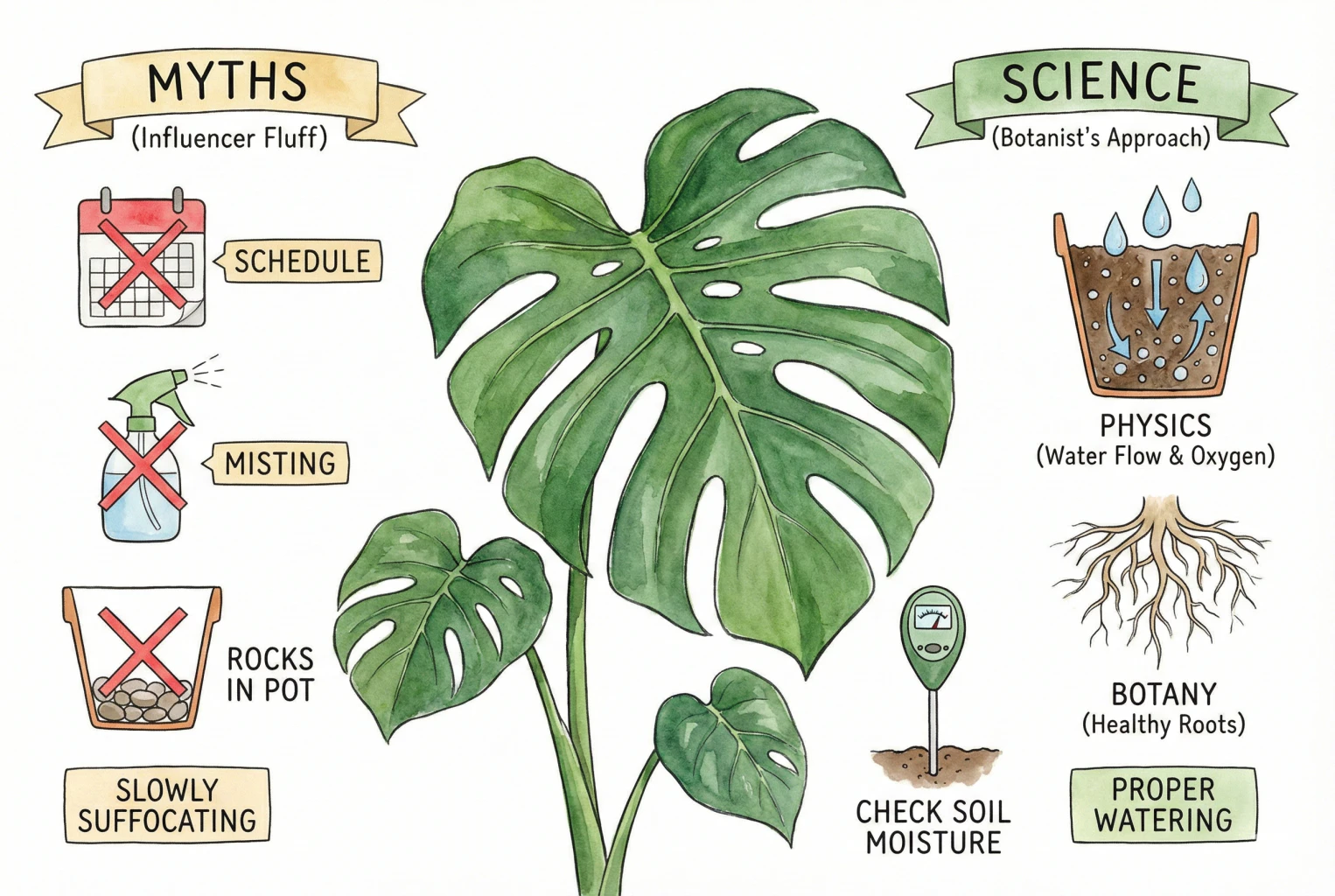
The ‘Drainage Layer’ Myth: Putting rocks at the bottom of a pot does not help drainage; it actually raises the saturation zone (Perched Water Table) closer to the roots, increasing the risk of drowning the plant.
The Skewer Diagnostic: Analog moisture meters are often inaccurate in chunky soil. A simple wooden BBQ skewer inserted to the bottom is the most reliable tool—if it’s damp, do not water.
See the Roots: Switching to clear nursery pots allows you to instantly diagnose root health (white/green = healthy; brown/mushy = rot) and see moisture condensation.
Stop Misting: Research shows misting increases humidity for only a few minutes. It is far better to use a humidifier, as wet leaves combined with stagnant indoor air invite pathogens like Pseudomonas.
1. Introduction
Your Monstera is turning yellow, and you’re terrified to touch the watering can. I get it. The problem is that most social media advice—like ‘water every Sunday’ or ‘mist for humidity’—is actually slowly killing your plant.
I’ve spent a decade growing rare aroids, and I’m telling you to forget the trends. We are going to ignore the influencer fluff and look at the actual soil physics and root biology required to keep a Monstera alive.
2. The Science Behind Monstera Indoor Plant Watering
To understand monstera indoor plant watering, you have to understand what the plant is. It isn’t a begonia, and it certainly isn’t a fern. It is a hemiepiphyte.
2.1 The Hemiepiphytic Paradox
In the wild—specifically the tropical forests of Mexico and Central America—a Monstera deliciosa doesn’t start life as a big bush in a pot. It starts as a seed on the forest floor, germinating into a ‘shingle plant’ that skitters across the ground seeking darkness (skototropism) until it finds a tree trunk. Once it hits that vertical surface, it shoots up, transforming its entire vascular system.
Here is the kicker: as it climbs, the bottom part of the stem often dies off or becomes hydraulically insignificant. The plant loses its connection to the ground soil and relies heavily on aerial roots that dangle down from the canopy to re-connect with the earth.
What does this mean for your living room? It means this plant evolved to have its roots in loose, airy, chunky organic debris—rotting bark, leaf litter, and moss. It evolved to have roots that are exposed to massive amounts of oxygen. When you shove those roots into a dense, peat-heavy ‘potting mix’ and saturate it with water, you aren’t mimicking nature; you’re creating a swamp. And Monstera roots in a swamp don’t drink; they drown.
2.2 Hydraulic Architecture: The Internal Plumbing
Research on Monstera acuminata (a close cousin) shows that these plants have a weird internal plumbing system. Unlike trees, which have a consistent vascular taper, Monsteras have a ‘hydraulic constriction’ at the base of the stem. The plant is literally bottlenecked at the soil line.
This makes water uptake highly efficient if the pressure is right, but it also means the plant relies on root pressure to push water up, especially at night. This is why you see water droplets on the tips of the leaves in the morning (a process called guttation). It’s the plant’s way of dealing with internal pressure when transpiration (water evaporation from leaves) is low. If you see this constantly, your soil is staying too wet, and the plant is frantically trying to offload excess water before its cells burst.
2.3 The Physics of ‘Wet’ (Perched Water Table)
This is the most important concept for monstera indoor plant watering. In any container, there is a layer of soil at the bottom that is always 100% saturated with water after you irrigate. Gravity pulls water down, but the soil holds onto it like a sponge (capillarity). The zone where gravity and capillarity cancel each other out is called the Perched Water Table (PWT).
In the ground: Water drains away infinitely downward.
In a pot: Water stops at the bottom, creating a hypoxic (low oxygen) ‘death zone.’
If you use a fine, dusty soil (like standard potting mix), that PWT might be 4 inches high. In a 6-inch pot, that means two-thirds of your roots are underwater. Monstera roots need oxygen to breathe (respire). If they can’t breathe, they can’t drink water. They rot. The rot is caused by anaerobic pathogens like Pythium that thrive where oxygen is absent.
So, the goal of watering isn’t just ‘adding water.’ It is managing oxygen.
3. The Setup: Monstera Indoor Plant Watering Process
Forget ‘Once a week.’ We water based on diagnostics and physics. Here is the protocol.
Step 1: Substrate Engineering (The Foundation)
You cannot water correctly if your soil is garbage. Most store-bought ‘Houseplant Soil’ is just peat moss. Peat moss acts like a sponge: it holds too much water and has zero structural integrity. You need to build an ‘Aroid Mix.’
The Mix:
40% Orchid Bark (Fir Bark): These large chunks create massive air pockets (macropores) that prevent the PWT from suffocating the roots.
30% Coco Coir or Peat: This holds the moisture the plant actually drinks.
20% Perlite or Pumice: Inorganic rocks that never decay, ensuring the soil stays loose.
10% Worm Castings/Charcoal: For nutrients and chemical filtration.
Recommended Gear: Better-Gro Special Orchid Mix
Why: This is the industry standard for a chunky, bark-based substrate. It contains western fir bark, charcoal, and perlite pre-mixed. It mimics the arboreal environment of a hemiepiphyte perfectly, ensuring rapid drainage and high oxygenation. Do not use ‘Potting Soil’—use this as your base.
Stop planting directly into decorative ceramic pots without holes. That is a coffin. Use a clear plastic nursery pot with massive drainage slots.
Recommended Gear: homenote Clear Nursery Pots for Plants 6.7 Inch
Why: Transparency is your best diagnostic tool. You can see the condensation on the sides (moisture) and the color of the roots (White/Green = Healthy, Brown/Mushy = Rot, Gray/Shriveled = Dry). The slotted design eliminates the PWT by allowing air entry from the sides, not just the bottom.
Throw away your $10 analog moisture meter. They measure electrical conductivity, not water. If your soil is chunky (which it should be), the air gaps break the circuit, and the meter reads ‘Dry’ even when the bark is soaking wet.
The Tool: A raw, wooden BBQ skewer or a disposable chopstick.
The Method:
Insert the skewer all the way to the bottom of the pot (where the PWT lives).
Leave it there. (Some people leave it permanently; others insert for 30 mins).
Pull it out.
Dark, damp, soil sticking to it: DO NOT WATER.
Cool to touch, slightly darker wood: Wait a few days.
Dry, light color, no soil sticking: It is time to water.
Step 4: The Execution (The Flush)
When the skewer says ‘Dry,’ you don’t give it a ‘sip.’ You create a monsoon.
Take the plant to the sink or shower.
Run lukewarm water through the pot until it pours out the bottom for 30 seconds.
The Physics: This ‘flush’ pushes out the old, stale air (CO2) from the pore spaces and pulls in fresh oxygen from the top as the water drains down. It also washes away accumulated fertilizer salts that can burn the roots.
Let it drain completely. Tilt the pot at a 45-degree angle to break the PWT tension and drain the last bit of excess water.
4. Deep Dive / Tips
You’ve got the basics. Now let’s talk about the advanced stuff that separates the casual plant owner from the botanist.
4.1 The Myth of Misting & Foliar Uptake
You will see people spraying their Monsteras with water bottles, claiming it ‘increases humidity.’ Let’s look at the data.
The Physics: Misting increases humidity for about 5 to 15 minutes before the water evaporates and diffuses into the room. To actually raise the humidity around the plant, you would need to mist every 20 minutes, 24 hours a day.
The Biology:Monstera leaves have a thick waxy cuticle designed to prevent water loss, not absorb water. While some ‘Foliar Water Uptake’ (FWU) is possible, it is minimal compared to root uptake.
The Risk: Wet leaves + stagnant indoor air = Fungal infections (Anthracnose, Pseudomonas). You are creating a breeding ground for pathogens while doing nothing for humidity.
The Solution: If you want humidity, buy a humidifier. If you want to clean the leaves, wipe them with a damp cloth. Stop misting.
Video Tutorial: ‘Don’t Mist Your Houseplants! (Do This Instead)’ by Worcester Terrariums
Why: This video breaks down the specific humidity requirements of aroids and why misting is ineffective physics. It offers practical alternatives like pebble trays (debunked) vs. humidifiers (validated).
4.2 Fluoride & Water Chemistry
Tap water contains chlorine and fluoride. Monstera are tough, but they are technically sensitive to fluoride (though less so than Dracaena or Calathea).
Fluoride Toxicity: Fluoride is a cumulative toxin. The plant cannot excrete it. It travels to the tips of the leaves and stays there. Over time, this builds up and kills the leaf tissue, causing those crispy brown tips you hate.
The Fix: If you have hard water or fluoridated water, and you see brown tips, switch to Rainwater or Reverse Osmosis (RO) water. Charcoal in your soil mix can also help buffer these toxins.
4.3 Aerial Roots: The Secret Weapon
Remember the ‘Hydraulic Constriction’ at the base of the stem? As your Monstera gets big, the stem gets too wide for the original roots to support. It needs those aerial roots.
Don’t cut them.
Do direct them. Guide the aerial roots back into the soil. Once they hit the soil, they transform into ‘feeder roots,’ developing root hairs and sucking up water. This creates a secondary hydraulic highway, bypassing the bottleneck at the base and supercharging leaf growth.
Video Tutorial: ‘Guide Aerial Roots into Soil for HUGE Leaves’ by Sheffield Made Plants
Why: This visual guide demonstrates the technique of directing aerial roots and explains the morphological changes that occur when an air root becomes a soil root.
A study published in Plant Physiology analyzed the hydraulic architecture of Monstera. They found that unlike woody dicots (trees) where vessel size is uniform, Monstera vessels get wider as you go up the stem. This means the plant is hydraulically optimized for moving massive amounts of water to the canopy if the root pressure is maintained.
The Takeaway: Your watering must be deep and consistent. Shallow watering fails to generate the root pressure required to push water up the widening vessels to the top leaves.
5. Troubleshooting (Q&A)
Here is where we debunk the ‘Common Knowledge’ that is killing your plant.
Myth 1: ‘Put rocks in the bottom for drainage.’
The Reality: This is called the ‘Drainage Layer Myth,’ and soil physicists have been screaming about it for decades.
The Science: Water moves from fine-textured material (soil) to coarse-textured material (rocks) only when the soil is 100% saturated. By adding rocks, you just move the Perched Water Table (that saturation zone) higher up the pot. You are actually reducing the amount of usable soil and bringing the swamp closer to the roots.
Correction: Use the same soil mix throughout the entire pot. If you want better drainage, mix more perlite/bark into the entire mix.
Myth 2: ‘Water every 7 days.’
The Reality: A calendar does not know the weather.
The Science: Water consumption relies on Vapor Pressure Deficit (VPD)—a combination of temperature and humidity. A hot, dry week might dry your plant in 3 days. A cool, rainy week might keep it wet for 14 days.
Correction: Use the Skewer Method (Step 3). The plant tells you when it’s thirsty; the calendar is irrelevant.
Myth 3: ‘Yellow leaves mean it needs water.’
The Reality: Yellow leaves usually mean you watered it too much.
The Science: This is Chlorosis induced by root rot. When roots rot from hypoxia, they can’t uptake nutrients (specifically Nitrogen and Magnesium). The plant, sensing a shortage, cannibalizes its oldest (lower) leaves, sucking the chlorophyll out of them to sustain the new growth.
Correction: Check the roots. If they are mushy/brown, you have overwatered. If they are crispy/dry, then you have underwatered. 90% of the time, it’s the former.
6. Conclusion
Keeping a Monstera alive isn’t about luck, and it isn’t about ‘green thumbs.’ A green thumb is just a dirty thumb that understands basic hydrology.
Here is your cheat sheet:
Air is as important as water. Use a chunky, bark-heavy Aroid Mix.
Drainage is non-negotiable. Clear pots with slots, no rocks at the bottom.
The Skewer never lies. Don’t guess. Check the core moisture.
Flush, don’t sip. Water deeply to reset the oxygen in the pot.
Respect the plant’s evolution. It wants to climb a tree in Mexico, not sit in a mud puddle in your living room. Give it the physics it expects, and it will take over your house.
Table 1: The ‘Aroid Mix’ Ratios
Component
Percentage
Scientific Function
Orchid Bark
40%
Creates macropores for rapid gravitational drainage; prevents compaction.
Coco Coir
30%
High Cation Exchange Capacity (CEC) for nutrient buffering; hydrophilic re-wetting.
Perlite/Pumice
20%
Inorganic aeration; increases total porosity; prevents anaerobic zones.
Worm Castings
10%
Slow-release nutrients; introduces beneficial microbial life.
Table 2: Water Quality Impact on Monstera
Water Type
Fluoride (ppm)
Chlorine
Risk Level
Notes
Tap Water
~0.7 – 1.2
Yes
Moderate
Can cause marginal necrosis (brown tips) over time.
Rain Water
~0
No
Low
Ideal. Mimics natural evolutionary conditions.
Distilled/RO
0
No
Low
Safe, but requires added fertilizer (Cal-Mag) as it lacks micronutrients.
Softened Water
Varies
Yes
High
Avoid. High Sodium content replaces Calcium/Magnesium, toxic to plants.
Table 3: Troubleshooting Matrix
Symptom
Diagnosis
Scientific Cause
Action
Lower Leaves Yellowing
Overwatering
Hypoxia (Root Rot) → Nutrient Cannibalization
Repot into coarser mix; trim rot.
Droopy Leaves + Heavy Pot
Overwatering
Physiological Drought (dead roots can’t drink)
Inspect roots immediately.
Droopy Leaves + Light Pot
Underwatering
Loss of Turgor Pressure
Soak pot in water for 30 mins.
Brown Crispy Edges
Humidity/Salts
High VPD or Fluoride Accumulation
Flush soil; switch to distilled water.
Guttation (Dripping Tips)
High Root Pressure
High Soil Moisture + Low Transpiration
Normal behavior; reduce watering frequency slightly.



Leave a Reply