
Hydroponic Herb Garden Product Chooser for Winter Basil
A hydroponic herb garden product chooser for winter basil. Compare Kratky jars, DWC buckets, and smart gardens on light, root oxygen, and EC.
Elena Vargas · Published 2026-11-05 · 22 min read
Key Takeaways
- Winter windowsills fall far short of basil’s 13 to 17 mol/m²/day, so buy a measurable light first.
- Light-proof Kratky jars breathe through an air gap, so never top up more than 2 cm above the current line.
- DWC grows the biggest single basil plant but needs an air pump running all day and a GFCI outlet.
- A countertop smart garden trades light per plant for convenience, so plant fewer pods than it holds.
- Use a complete hydroponic nutrient and a temperature-compensated EC pen, and let EC drift decide what to add.
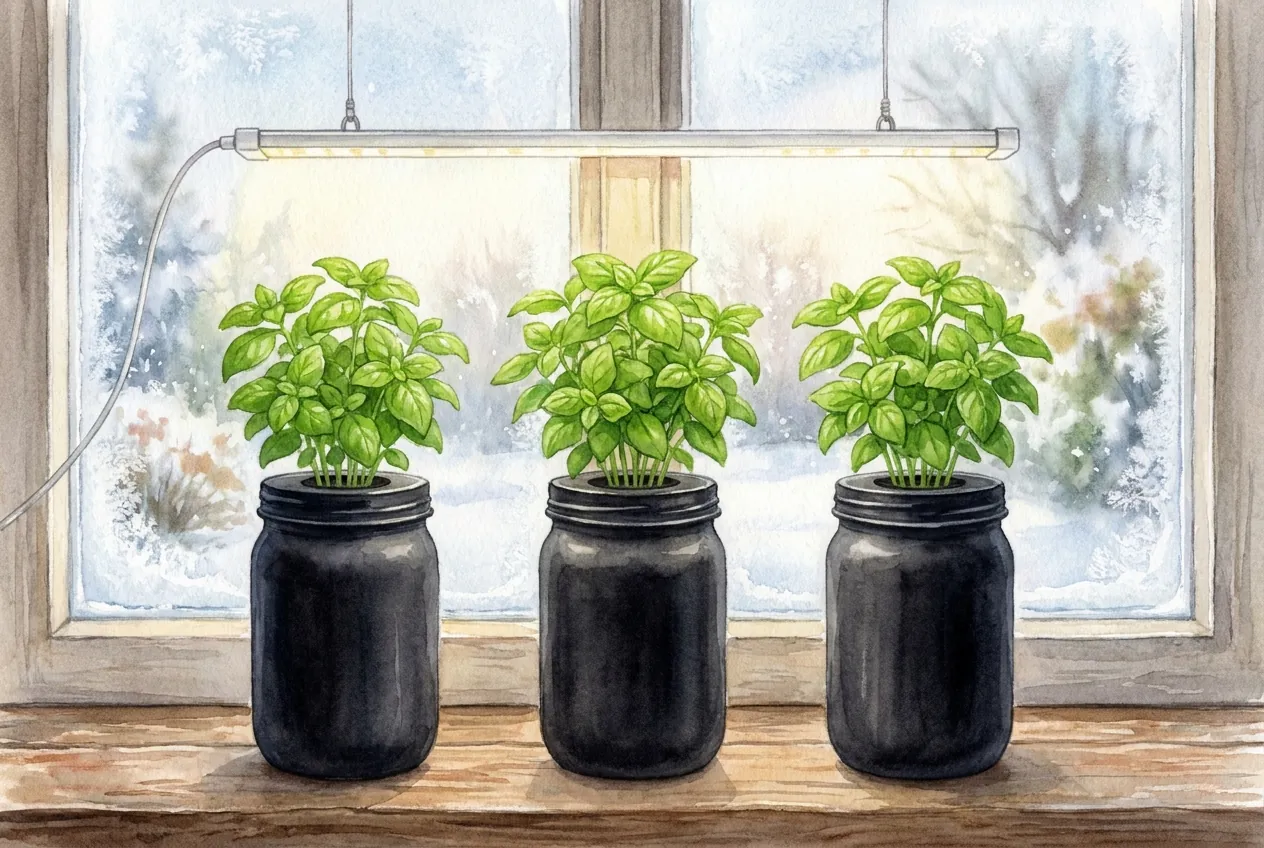
Winter basil on a kitchen windowsill rarely dies outright. It stalls, thins out, and gives up a few small leaves a week.
Three measurable limits sit behind that stall. They are daily light, root-zone oxygen, and the salt strength of the water. Checking them makes a better hydroponic herb garden product chooser than any brand list.
For the least effort, buy a countertop smart garden with a strong lamp and plant fewer basil pods than it holds.
For more light per plant, build passive Kratky jars or a deep water culture (DWC) bucket under a grow light that publishes its intensity.
That build also needs a complete hydroponic nutrient and an EC pen before any upgrade.
The buying order by role
Decide in this order, by role, before comparing brands.
- Light first. Look for a published intensity at a stated hanging height, or, in an all-in-one unit, the most LED watts per planted pod.
- System class second. Kratky jars need no pump, though for basil the sizing rule below calls for 1.5 gallons or more per plant. An aerated DWC bucket grows the biggest single plant, and a countertop garden trades yield for convenience.
- A complete hydroponic nutrient with calcium, magnesium, and micronutrients.
- An EC pen with automatic temperature compensation, plus a pH test.
- Starter cubes and net cups last, since they are cheap and interchangeable.
Spend on light first, because no nutrient or meter can rescue basil in a dim winter kitchen.
Why light, root oxygen, and salt strength decide winter basil
Each system has its own weak point, and most failures trace back to one of those three limits.
How far a winter window falls short
Outdoor light in December averages only 5 to 10 mol/m²/day across the northern United States.
That figure is the daily light integral, or DLI, the day’s total photosynthetic light per square meter.
Purdue Extension notes that glazing and structures can cut greenhouse light by another 40 to 70 percent, to as little as 1 to 5 mol/m²/day.
A windowsill usually fares worse, since walls and ceiling hide most of the sky. In a controlled indoor trial, basil at a DLI of 12.9 produced 54 percent more fresh weight than basil at 9.3.
The authors recommended 12.9, and yield barely rose above about 16.5, so a practical target band is 13 to 17 mol/m²/day.
Low light did not make those plants taller. It made thinner leaves and fewer leaf pairs, the sparse look most people call leggy.
In a second study, raising DLI from about 7 to 15 lifted basil fresh weight by 144 percent.
Nutrient strength from 0.5 to 4.0 mS/cm did not affect growth.
To convert a light’s spec into DLI, multiply its PPFD at leaf height by the hours it runs and by 0.0036.
PPFD is light intensity in µmol/m²/s, and the constant converts that rate and the hours into a daily total.
| Daily light target | 14-hour timer | 16-hour timer |
|---|---|---|
| 13 mol/m²/day | 258 µmol/m²/s | 226 µmol/m²/s |
| 17 mol/m²/day | 337 µmol/m²/s | 295 µmol/m²/s |
Basil trials ran a 16-hour photoperiod, which makes 16 hours a sensible timer ceiling. The autumn DLI cliff for aroids shows the same seasonal slide, and the PPFD and DLI primer for houseplants covers the math in more depth.
Below about 226 µmol/m²/s at the leaves, even a 16-hour timer cannot reach the bottom of the basil band.
Root-zone oxygen, air gap versus air stone
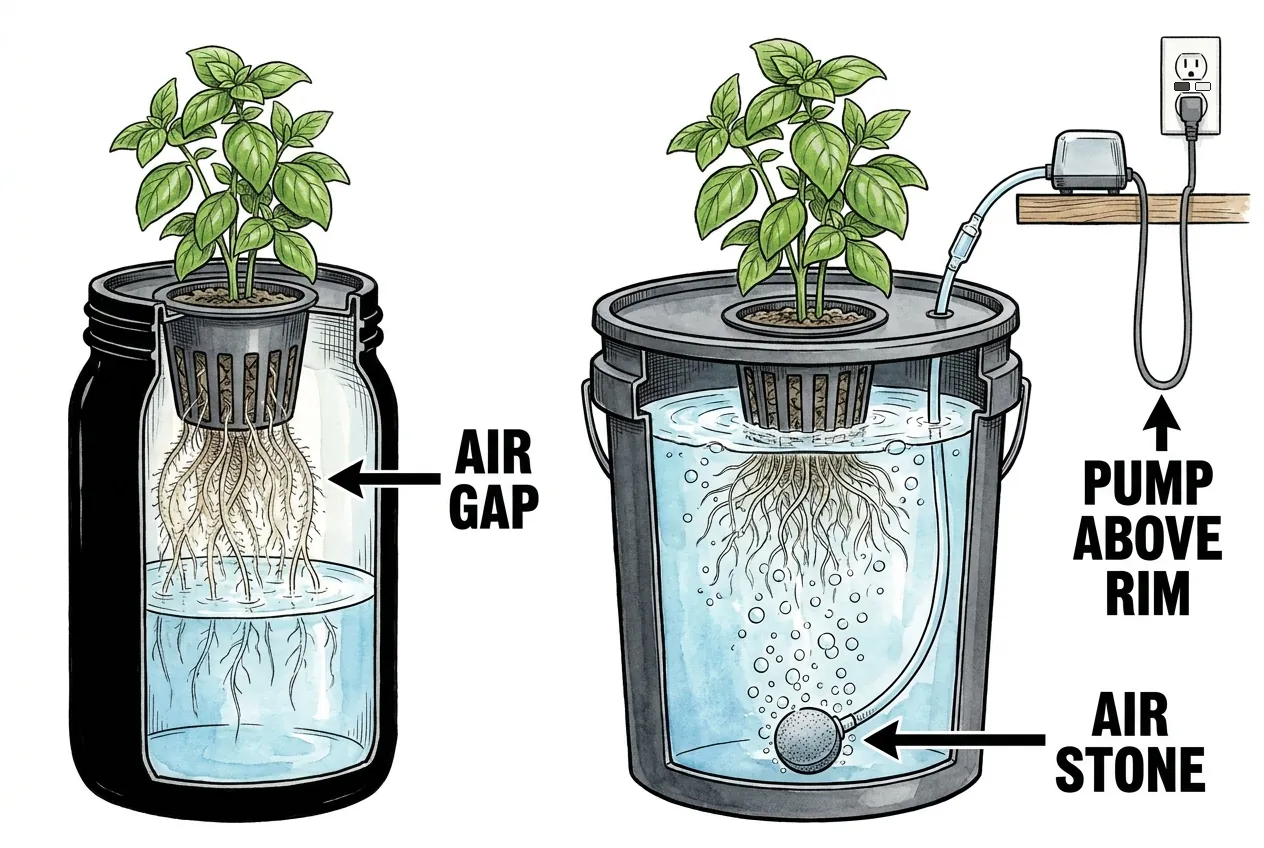
In Kratky’s passive method, the lower 2 cm or more of the net pot starts in solution.
As the plant drinks, the level drops and the upper roots hang in moist air, where they take up oxygen.
Kratky warned that raising the level more than 2 cm after that point may injure the plant.
A DWC bucket keeps every root submerged, so it depends on an air pump and stone running continuously.
Warm water holds less oxygen, about 10.07 mg/L at 15 °C, 9.08 at 20 °C, and 8.24 at 25 °C. Warm roots and the microbes around them also use oxygen faster.
That combination favors Pythium root rot. In other hydroponic crops, colonized roots can look almost normal at 16 to 18 °C, then develop severe symptoms within hours at 24 to 28 °C.
Keep reservoirs away from heat vents, radiators, and lamp drivers, as the cold reservoir guide for hydroponic spinach also stresses.
A Kratky jar breathes through its air gap and a DWC bucket breathes through its pump, so never flood the first or unplug the second.
Salt strength and pH
EC, or electrical conductivity, tracks total dissolved salts, which tells you how strong the mix is.
Oklahoma State Extension lists basil at an EC of 1.0 to 1.6 mS/cm and a pH of 5.5 to 6.0.
Tennessee Extension puts leafy crops at 1.5 to 2.0, so starting near 1.5 sits where the two ranges meet.
The Tennessee guide also explains why houseplant food falls short in water. Hydroponic fertilizers can carry more calcium and magnesium than soil fertilizers, and most include every micronutrient.
In a jar that never recirculates, EC drifts. It falls when plants take up nutrients faster than water, and it rises when warmth makes them drink more water than salt.
pH tends to creep up, and it climbs faster with tap water above 75 ppm alkalinity. Lower it with hydroponic pH Down, not kitchen acids. In one trial, vinegar cut lettuce, basil, and chard yields compared with pH Down, and lime juice cut basil yield.
Basil grew equally well across a wide range of strengths, so the reason to own an EC pen is to catch drift.
Selection criteria you can read off a spec sheet
Every row below can be checked on a box or product page before buying.
| Spec to check | Kratky jar | DWC bucket | Countertop smart garden |
|---|---|---|---|
| Light source | Separate LED with a PPFD map | Separate LED with a PPFD map | Built-in LED, usually rated in watts only |
| Light per basil plant | Set by how many jars share the lit area | One large plant under the lamp | LED watts divided by pods planted |
| Root oxygen | Air gap that opens as the level drops | Air pump and stone running all day | Pump circulation or a wick, by model |
| Consumables | Bulk nutrient, cubes, net cups | Same, plus air stones | Brand seed pods and plant food |
In a four-system basil comparison, DWC yielded 21 percent more than the next-best system. Kratky and DWC also used 41 percent less nutrient solution than nutrient film technique (NFT) and sub-irrigation systems.
That trial did not test consumer countertop gardens, so judge them on light per plant. Read light per plant first, root oxygen second, and consumables third.
Product roles matched to the problem they fix
Each role below answers one of the three limits, so buy only the roles your chosen system needs.
Countertop smart garden, the single splurge
An all-in-one garden bundles light, timer, and pump, so the deciding spec is LED power per planted pod.
Grow height matters next, because basil climbs until it hits the lamp.
AeroGarden Bounty carries a 40 W LED, dimmable to 30 percent, over 9 pods.
That works out to about 4.4 W per pod, and planting fewer pods than the deck holds gives each plant a larger share.
It offers up to 24 inches of grow height and a touchscreen for setting light on and off times.
It is the one item here priced around $100 or more, and the money buys convenience more than extra light.
Scotts publishes no PPFD and no bowl volume, so you cannot calculate DLI or predict refills.
Scotts states that AeroGarden is not out of business, with pods and support continuing. That matters because the unit is built around AeroGarden’s own seed pods.
Without a PPFD figure, run the lamp at full brightness and keep the hood a few inches above the canopy. Pinch basil before it reaches the ceiling. Pass on it if you want measured light, plants taller than 24 inches, or freedom from one brand’s pods.
A grow light that publishes its PPFD
For jars or a bucket, the light is a separate purchase, and the deciding spec is PPFD at a stated hanging height.
Spider Farmer SF300 draws 32.77 W and lists 691 µmol/m²/s at 6 inches, 282 at 12 inches, and 196 at 16 inches.
At 12 inches on a 14-hour timer, that works out to about 14.2 mol/m²/day, inside the basil band. At 16 inches, even 16 hours gives only about 11.3.
The 2-foot bar suits two or three jars in a single row, or one bucket. Each height has one published figure and no edge reading, so keep plants directly under the bar.
It has no dimmer or timer, so add a plug-in timer, and skip it if you want dimming or a square cluster of jars.
Each week I tape-measure from the lit LED face to the tallest basil tip and compare that gap with the lamp’s reference map height, 12 inches for an SF300.
If the gap shrinks or grows more than 1 inch from that height, I move the lamp back to it.
On the bar above, the published values more than double between 12 and 6 inches, so a few inches of growth or a harvest cut quietly changes the dose.
The 1-inch trigger is my own rule, and a tape reads it easily. It keeps the canopy close to the 12-inch reference height that the daily total is computed from.
Next comes the daily total, recomputed from the map figure and the timer hours. If it falls under 13 mol/m²/day, I add timer hours one at a time up to 16 before considering a stronger light, though longer days can hasten flowering.
University of Tennessee safety guidance calls for GFCI protection on outlets within four feet of a water source.
Use a GFCI outlet or plug-in adapter, and keep plugs above the reservoir rim with a drip loop.
Kratky jars and a DWC bucket kit
Both DIY systems need a light-proof reservoir. Nebraska Extension notes that algae can be suppressed by excluding light, using black food-grade containers or foil over the lid and base.
VIVOSUN DWC 1-bucket kit covers the whole DWC role. It includes a black 5-gallon bucket, an 8-inch basket, clay pebbles, an air stone, and an air pump rated at 7 L/min. One basket means one large basil plant, not a row of herbs.
No check valve is listed, so add an inline one or set the pump above the rim to stop back-siphoning during a power cut.
For Kratky, I give each basil plant its own opaque container of 1.5 gallons (about 6 liters) or more.
Kratky limits his 4-liter bottle to short crops like lettuce and describes a larger alternative with three or four plants in a 20-liter bucket.
Basil keeps drinking for months, so I match that bucket’s share per plant.
VIVOSUN 1.6-inch rockwool cubes come 28 to a sheet with a pre-formed seed hole, and at 1.6 inches across they sit inside a 3-inch net cup.
Pre-soak them in the same pH-adjusted water you will grow in, and handle them wet with gloves, since stone wool sheds fine fibers.
Skip rockwool if fibers bother you, and sprout seeds in a peat or coco plug set in rinsed clay pebbles, since bare pebbles hold little water.
A complete nutrient instead of houseplant food
The nutrient must be sold for hydroponics and supply calcium, magnesium, and micronutrients.
Masterblend 4-18-38 combo kit splits that job into three bags. The 4-18-38 base carries the micronutrients, Epsom salt adds magnesium, and calcium nitrate adds calcium. Masterblend’s sheet calls for 2.4 g base, 1.5 g Epsom salt, and 2.4 g calcium nitrate per gallon, dissolved in that order.
Use half rates for seedlings and weigh on a scale that reads 0.1 g. Then check the mix with your EC pen, and dilute with plain water if it reads above the basil range.
Never premix the dry parts, because calcium can drop out of solution when it meets concentrated sulfate or phosphate.
If you will not weigh grams, pick a liquid hydroponic formula dosed by syringe instead.
An EC pen with temperature compensation, plus a pH test
A Kratky jar needs a numeric EC reading every week. Without automatic temperature compensation, a pen reads a cold winter reservoir as weaker than it is.
Apera EC20 conductivity pen reads 0 to 20.00 mS/cm with 0.01 mS/cm resolution and ±1% full-scale accuracy, an error far smaller than the weekly drift you are watching for.
It compensates for temperature from 0 to 50 °C, which covers any kitchen reservoir, and its IP67 rating means it should survive a dunk in the bucket.
The probe is not replaceable, and the pen does not read pH.
For pH, General Hydroponics pH test kit uses 3 drops in a 5 mL sample and a color chart from pH 4.0 to 8.5. It needs no calibration, which suits a weekly check. Color steps are coarser than decimals and harder to read with color-vision deficiency, so a pH pen is the upgrade if decimals matter.
Neither is needed if you will run only a countertop garden on its reminder schedule.
Who should not buy each class
A countertop garden is the wrong buy for a large basil harvest, because every planted pod shares one lamp.
A DWC bucket is a poor fit for a bedroom or studio, because its pump runs around the clock.
It also needs a GFCI outlet in reach and a stable, level spot where a spill from a full 5-gallon bucket will do no damage.
Kratky jars punish anyone who tops up to the brim, because that drowns the air roots. They also demand a weekly EC and pH reading.
Every class is risky where toddlers or pets can tip water near a cord. Choose the class whose weekly task you will actually do, because each system depends on that one routine.
Questions buyers ask before ordering
Water source and running cost are the last two checks before ordering.
Can I use tap water?
Usually, yes. Read its EC before mixing, expect hard water to push pH up between checks, and avoid softened water, which Tennessee Extension advises against for hydroponics.
Is a countertop garden cheaper to run than a DIY setup?
Electricity is similar. A 40 W lamp on a 16-hour day uses about 0.64 kWh, and a 33 W bar on a 14-hour day uses about 0.46 kWh.
Consumables decide the gap, so price a season of the garden’s pods against a sheet of cubes and a powder kit.
Setup protocol, from empty jar to first harvest
Safety and light-proofing come first, because both are hard to fix once plants are growing.
- Pick a spot near a GFCI-protected outlet, and set plugs, timer, and pump above the reservoir rim with drip loops.
- Cut a small access hole beside each Kratky cup. In a dark room, set a lit phone flashlight inside each empty container, close the lid, and wrap or tape any spot that glows.
- Read your tap water’s EC before adding anything, so you know how much of later readings comes from the water.
- Mix nutrient at half rate, adjust pH to about 5.8, and record the EC as your reference.
- Pre-soak the rockwool cubes, then sow a few basil seeds in each.
- For Kratky, fill until the bottom 2 cm of the net cup sits in solution, mark the line on tape, and never refill to that mark. For DWC, fill to the kit’s line and start the pump before planting.
- Hang the light at the 12-inch map height on a 14-hour timer. Switch the nutrient to full strength at the first solution change after seedlings have two sets of true leaves, and record that EC as the new reference.
Run the flashlight check before the first fill, because algae are far easier to prevent than to scrub out.
Maintenance, failure modes, and replacement intervals
Hydroponic basil usually fails slowly, through drift, warm water, or a clogged air stone, so a weekly routine catches problems early.
The weekly reading for jars and buckets
Once a week at the same hour, I stir the reservoir gently and read EC and pH.
My reference is the EC recorded right after the latest fresh mix, because the direction of drift shows what the plant has been taking.
For the level, I stand a clean chopstick on the jar floor through the access hole.
Its wet line, held against the outside tape, shows how far the solution has dropped since last week.
I then mark that line on the tape, and re-mark after any top-up, so next week’s drop is read from the latest line.
In a Kratky jar, I add liquid only when the remaining solution would not last another week at the latest drop.
A DWC bucket gets its oxygen from the air stone, so I simply top it up to the fill line. The EC reading then decides what goes in.
| Weekly EC against the reference EC | What I add | Why |
|---|---|---|
| More than 20% higher | Plain water, pH-adjusted if the tap water is alkaline | The plant drank water faster than salts |
| Within 20% either way | Half-strength solution | Holds the strength steady |
| More than 20% lower | Solution at the reference strength | The plant took salts faster than water |
I set the band at 20% as my own rule, because it ignores pen noise yet keeps each correction small. In a jar, each top-up stops 2 cm (about 3/4 inch) above the current line, because Kratky linked rises above 2 cm to injury.
When one 2 cm top-up cannot cover a week’s drop, I check and top up twice a week.
If the jar still runs low, the plant has outgrown it, so I move it to a larger opaque container or a DWC bucket instead of raising the line.
My action band for pH is 5.5 to 6.5, slightly wider than the basil target so normal weekly wobble triggers nothing.
A reading above it gets one correction back to about 5.8 with hydroponic pH Down, and a reading below it gets pH Up to the same target. Use either one per its label with gloves and eye protection.
I drain and replace a jar when pH is back outside that band the week after a correction, or when EC sits outside the 20% band two weeks running.
I also replace it once the mix is three weeks old, and the fresh solution goes only to the current marked level, never back to the original line.
That three-week ceiling is my compromise between the two-week replacement Oklahoma State Extension recommends and Kratky’s single fill for short lettuce crops. A DWC bucket keeps to that two-week interval.
Reading the roots
Lift the DWC basket at each refill and look at the roots. Healthy roots are white and firm. Tan or brown roots that feel soft and slough at the tips point to rot.
When you see them, check the pump and stone, move the reservoir off any heat source, and discard badly affected plants.
Kratky warns that lifting the lid after roots emerge may damage them, so a jar’s cup stays seated between solution changes unless the plant wilts or yellows.
I stir, read, and top up through the taped access hole instead.
Replacement intervals
| Item | Replace or service when | Basis |
|---|---|---|
| Kratky solution | Three weeks, or sooner on a failed check | The weekly rule above |
| DWC solution | Every two weeks | Oklahoma State Extension |
| Air stone | Bubbles weaken or spread unevenly | Wear part |
| Air pump | Output drops or noise rises | The diaphragm wears out |
| Rockwool cube | Discard with the roots after each crop | Roots grow through it |
| EC pen | Recalibrate when the pen misreads a fresh calibration standard | Pen calibration |
Between crops, wash emptied containers in hot soapy water and rinse well. Nothing but water, hydroponic nutrient, and hydroponic pH adjusters belongs in a planted reservoir.
Harvesting so basil keeps branching
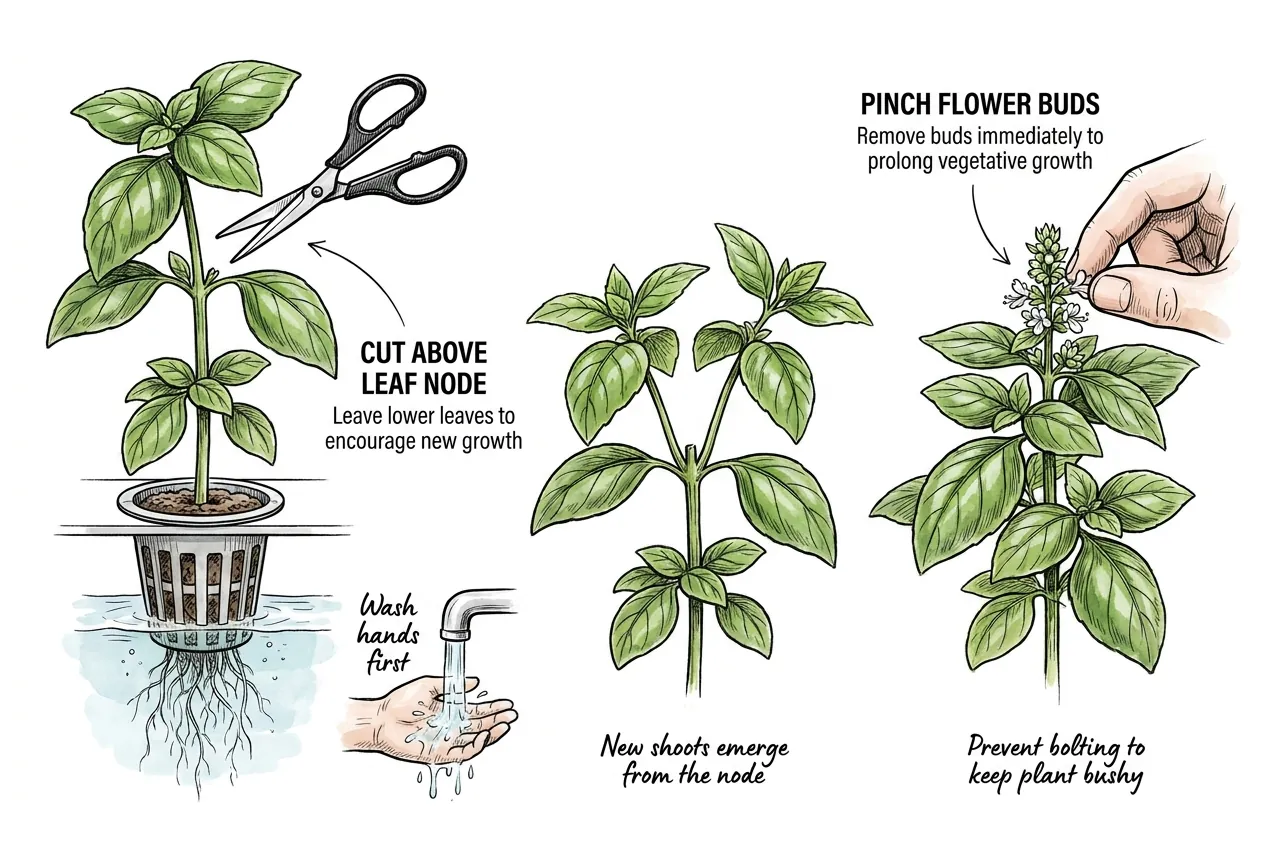
Cut each stem just above a pair of leaves, leaving a few leaves below the cut, so new shoots can grow from that node.
Wash your hands first, and keep cut leaves off the growing medium.
In a 2025 study, most basils tested flowered sooner at a daily light total near 23 mol/m²/day than near 13.
A 16-hour photoperiod also hastened first flowers in several of them, but day length alone did not control flowering.
Pinch buds as soon as they appear, as the Kratky basil bolting fix explains.
Choosing your setup this week
A countertop garden wins on simplicity, at the cost of unmeasured light, a 24-inch ceiling, and one brand’s pods.
A DIY build wins on light per plant, at the cost of a weekly meter reading and either an all-day pump or the jar-size rule.
Either way, light is the main winter limit, so the lamp or the garden is this week’s order.
With a DIY build, the nutrient kit and meters can follow before the first fill.
For a faster first harvest under the same lamp, the microgreens grow kit chooser covers trays and seed.
Affiliate Disclosure
This article contains Amazon affiliate links. As an Amazon Associate I earn from qualifying purchases. If you use these links, the site may earn a commission at no extra cost to you. Product availability, price, and specifications can change. Check the current listing before buying.