
Why Crypts and Stems Melt After a Cold Water Change
Crypts and stem plants melt after the first cold water change of heating season. Learn the thermal and gas triggers and a safe winter change routine.
Priya Patel · Published 2026-10-10 · 14 min read
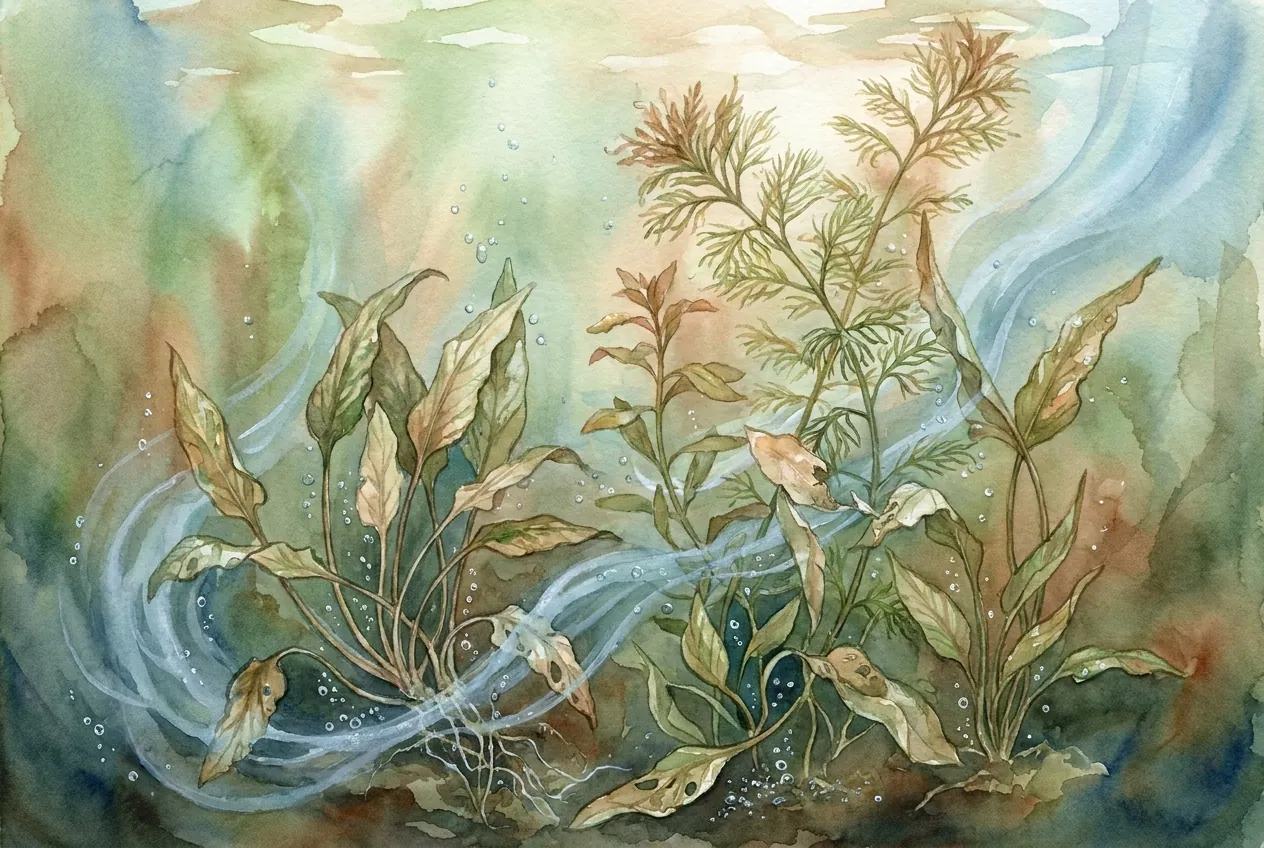
Key Takeaways
- The first cold change of heating season opens a 30-plus degree tank-to-tap gap that shocks plants.
- Cold tap also carries extra dissolved gas that off-gasses in the warm tank, a second hit.
- Match refill water within about 2 F of the tank, pre-warm and aerate it, and go smaller in winter.
- Crypts melt and regrow from an intact rhizome, but soft stems without reserves can rot for good.
- Check rhizome firmness before pulling a plant, and never let shed leaves spike ammonia in a cold tank.
The first cold morning of the season has a way of showing up in your aquarium a day later.
You run your normal water change, and within a week the crypts go translucent and slump into mush while the Rotala tips brown and the lower stems turn to slime.
Nothing about your routine changed. What changed is the water coming out of the tap.
Once your heater starts holding a warm setpoint against a cold room, the gap between your tank and your tap water opens up fast.
The same bucket of water that was nearly harmless in July is now a cold, gas-loaded, slightly different-tasting slug of water hitting plants that were comfortable an hour ago.
That first cold change triggers melt through temperature and dissolved gas, and a smaller pre-warmed change prevents it.
The state of the rhizome then tells you whether a melting plant will recover.
Why the first cold change of the season is a distinct event
A mid-summer water change is nearly isothermal. Your tap might be 72 F and your tank 77 F, so the plants barely notice.
Winter rewrites that math. Cold tap water in the US commonly drops into the mid-30s to mid-40s F, and surface-water utilities swing hardest.
A river-fed system like St. Louis reports source water near 90 F in late summer and about 33 F in deep winter.
Now put a heater in the picture. It holds the tank at a typical 24 to 26 C (75 to 79 F) while the room has gone cold.
A refill at 40 F then creates a tank-to-tap gap north of 30 F.
In August that same change was a five-degree nudge. The volume and speed of your routine did not change, but the thermal size of the event tripled.
That is why the FIRST change after the heater kicks in does the damage. Your plants spent months acclimated to stable warm water, and acclimation is a slow adjustment. An abrupt step of that size lands as a shock, not a drift.
The water itself is also a slightly different product in winter. Disinfection-byproduct studies show real seasonal variation, with chlorine demand and byproduct levels shifting by season and region.
So the winter refill can differ in chemistry as well as temperature from the water your plants were used to.
What a cold shock actually does to a submersed plant
Melt is not rot and it is not a disease. It is a stress response, and the trigger that matters is the rate of change, not just the final temperature.
Why the speed of the change matters more than the number
Thermal biology draws a clean line between gradual change and acute change. A slow seasonal drift lets tissue acclimate, which is a cellular adjustment that takes time.
An abrupt change instead sets off a cellular stress response with damaging effects. The adjustment is not instant either.
A plant can handle almost any seasonal temperature if it arrives slowly, and almost none of it if it arrives in one bucket. That single idea drives every prevention step that follows.
The cellular damage behind a melting leaf
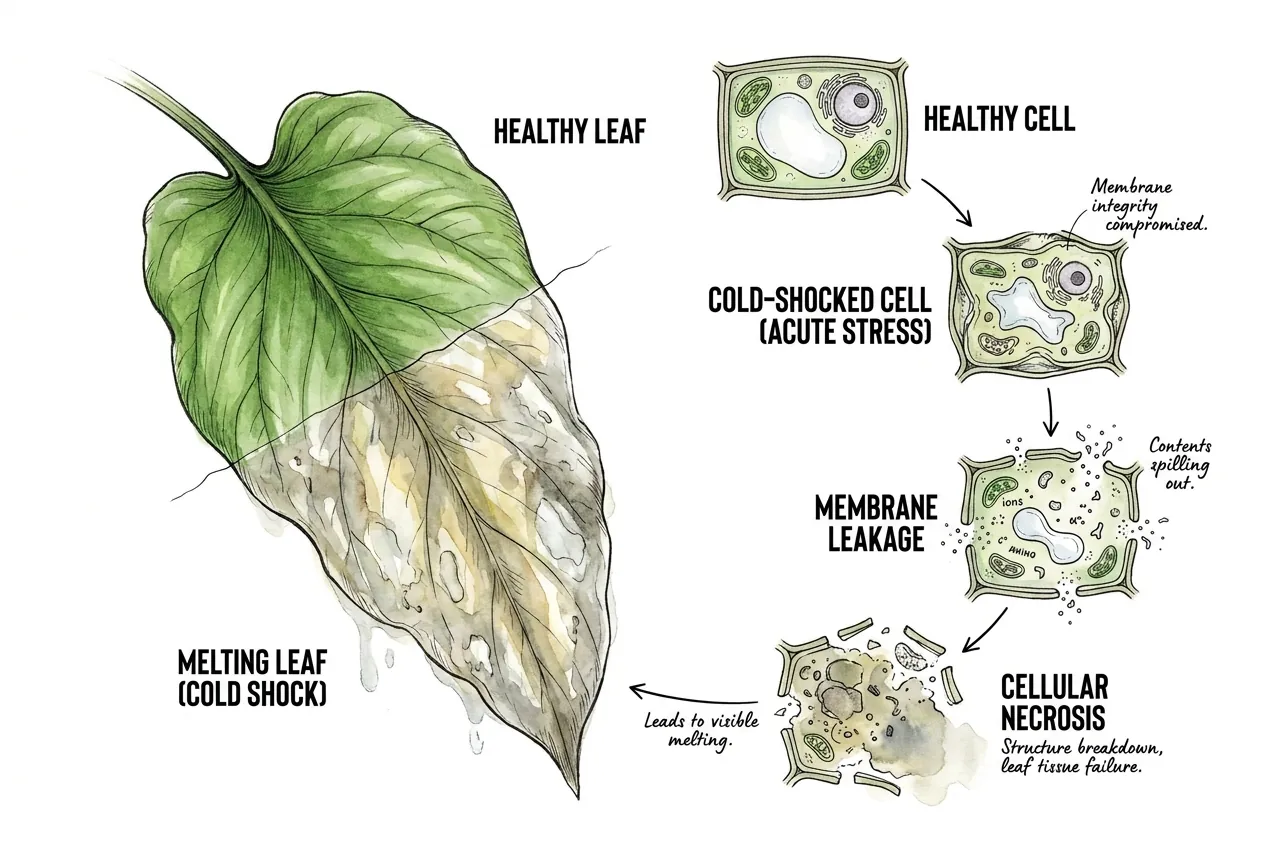
Cold hits plant cells at the membrane first. Low-temperature stress makes membranes a primary injury site, driving lipid peroxidation and membrane leakage. Once membranes leak, ions and amino acids spill out of the cell and structures break down, which can end in necrosis.
That is the picture behind a leaf that goes limp and see-through a few days after a cold change. The leaf is not drowning. Its cell membranes took a cold hit and failed, and the plant is now deciding what to do with the damage.
For a plant with an energy-storing rhizome, the decision is to cut its losses. It sheds the shocked leaves and lives off the reserve, which reads to us as melt rather than death.
The hidden second hit from dissolved gas and chemistry
Temperature is only the first blow. Cold tap water carries two more problems that land at the same moment, which is why a winter change punches above its weight.
Cold water is loaded with gas, and your warm tank forces it out
Colder water holds more dissolved gas. Winter tap near 38 F can hold a huge amount of it. When that water enters a warm tank, its gas-holding capacity drops and the excess comes out of solution, the same way a warming soda fizzes.
Using very cold tap water for changes is identified as the primary cause of chronic supersaturation in aquaria.
City supply pumps can force even more gas into solution before it reaches you.
This is not only a plant issue. Supersaturation is a genuine animal hazard.
When dissolved-gas pressure exceeds atmospheric pressure, fish can develop gas bubble disease, where gas leaves the bloodstream and forms bubbles under the skin. The condition can be fatal.
The useful part for a planted-tank keeper is that the fix for the gas problem is the same move that fixes the temperature problem.
Letting change water warm and breathe before it goes in solves both at once.
Chemistry swings pile on
A large cold change also moves pH, hardness, and disinfectant level in one step. Utilities adjust disinfectant dose with temperature, pH, and organic load through the year, and the EPA caps chloramine residual at 4.0 mg/L as combined total chlorine.
So the plants can take a temperature step, a dissolved-gas surge, and a parameter swing all in the same ten minutes.
That stack is harder to absorb than any single change on its own.
Why crypts bounce back and soft stems often do not
Not every plant responds to the same cold change the same way, and the difference comes down to whether the plant has a savings account.
Crypts melt because they can afford to
Cryptocoryne are famously touchy about change. When water chemistry, temperature, hardness, light, or location shifts, the plant pulls nutrients back out of its existing leaves.
It pushes them into new roots and new leaves suited to the current conditions.
The rhizome stays alive underground the whole time and grows fresh leaves once things settle.
So a crypt melt is a reset, not a funeral. As long as the rhizome and roots are intact, the plant is spending its reserve to re-equip itself.
There is a timing trap here. Most crypts are farm-grown emersed in humid trays, and their emersed leaves die back within days to a couple of weeks after they go underwater. Smaller submersed leaves replace them.
A tank that recently got new crypts and then takes its first cold change is carrying two melt pressures at once.
Soft stems have no reserve to spend
Fast stems like Rotala, Ludwigia, Bacopa, and Hygrophila have no protective rhizome. The same cold membrane injury hits their soft lower stems directly, and they cannot shed-and-regrow from storage the way a crypt can.
That is why a severe cold change more often leaves stems with irreversible basal rot instead of a recoverable melt.
Age matters too. A newly planted crypt still converting from emersed growth melts far more readily than an established clump with adapted leaves and an anchored root mass.
How to run a winter water change that does not trigger melt
The whole prevention strategy is one sentence long. Shrink every shock. You do that by matching temperature, driving off the gas, and moving in smaller steps.
Match the temperature, and check it with one thermometer
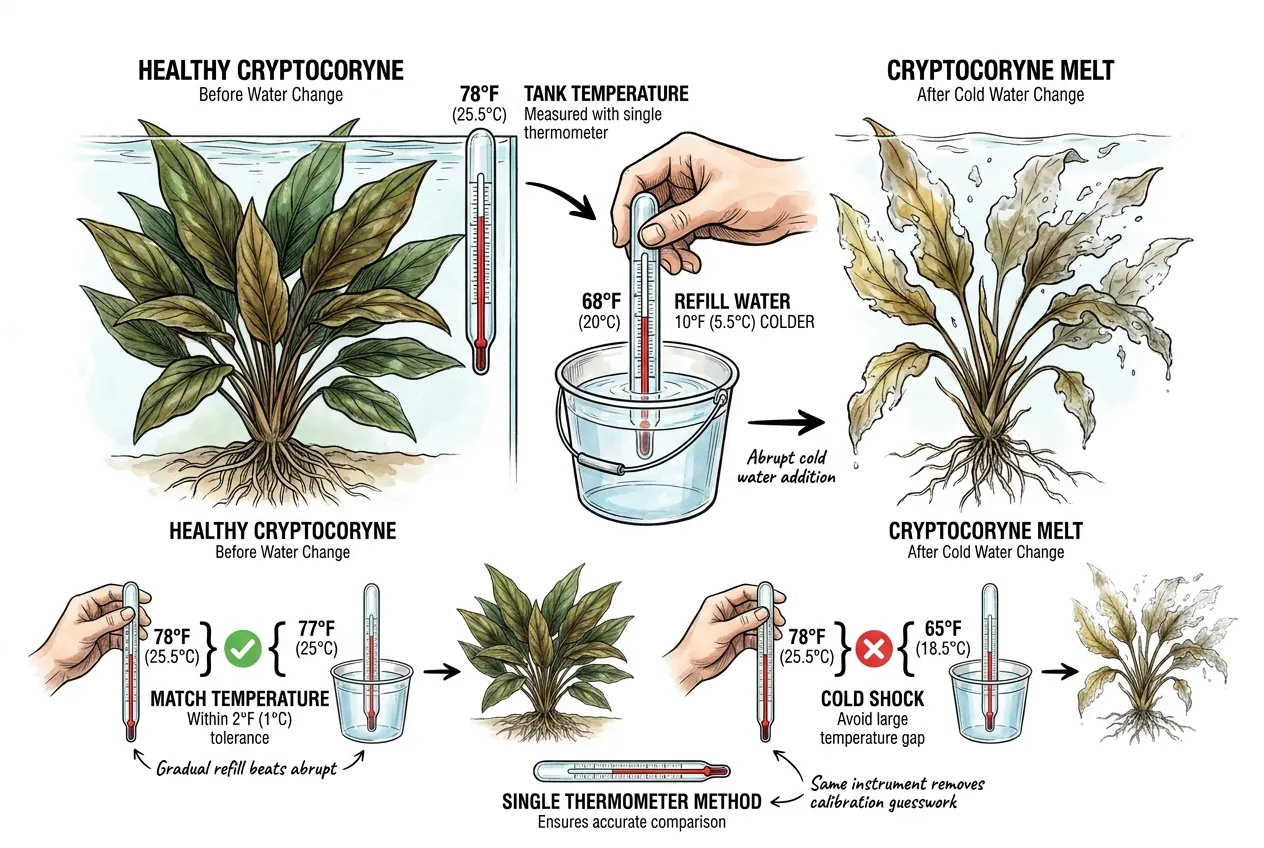
Everyone says match the temperature. Almost no one says how close is close enough or how to verify it, so here is the method I actually run.
Before I add any new water, I read the tank with a thermometer, then I stir the refill vessel and read it at mid-depth with the SAME instrument.
I do not start the refill until the two readings agree within my working tolerance, and I pour slowly even when the gap is already inside it.
Using one thermometer for both readings removes the calibration guesswork between two devices.
For sensitive crypts I hold the refill water within about 2 F (roughly 1 C) of the tank.
The sources are clear that gradual beats abrupt, but they do not publish one universal hobby cutoff.
So I treat 2 F as a conservative working rule that turns the vague advice to match temperature into something I can actually measure.
If you only own one aquarium thermometer, this is the step to spend it on. A reliable thermometer and test kit decision is covered in the aquarium water test kit chooser.
Pre-warm and aerate so the gas leaves before the plants meet it
The published fix for the dissolved-gas problem is to pre-warm and aerate the change water before use.
One cited approach warms tap water to about 85 F (30 C) and aerates it heavily for 48 hours, because gas escapes fast when water is agitated.
Pre-staging a bucket with a small pump or airstone the day before does double duty. It closes the temperature gap and lets the excess gas off before the water ever touches a leaf.
Go smaller in winter
A large change is a known melt trigger because it moves parameters abruptly, and the standard fix is to favor small, frequent changes over large, infrequent ones.
In the heating season, cutting the per-change volume directly shrinks the temperature and gas delta the tank sees at once.
A safe winter-change recipe
| Step | What to do | Why it matters |
|---|---|---|
| 1. Pre-stage | Fill the change vessel the day before. Warm toward tank temperature and run an airstone. | Matches temperature and off-gasses dissolved gas before use. |
| 2. Verify delta | Read tank and vessel with the same thermometer. Hold within about 2 F for crypts. | Turns match temperature into a measured check. |
| 3. Dechlorinate | Dose a chloramine-rated conditioner for the full change volume, per its label. | Winter tap can carry chloramine up to the 4.0 mg/L residual limit. |
| 4. Smaller volume | Reduce the per-change percentage versus summer. | Shrinks every shock the tank absorbs at once. |
| 5. Slow refill | Pour or pump in slowly, not a single dump. | Keeps the change gradual rather than acute. |
Is it melt or rot? How to tell, and what to do next
Once leaves are already collapsing, the only question that matters is whether the plant will recover. Melt comes back. Rot does not.
The tell is the storage organ, not the leaves.
The firmness check
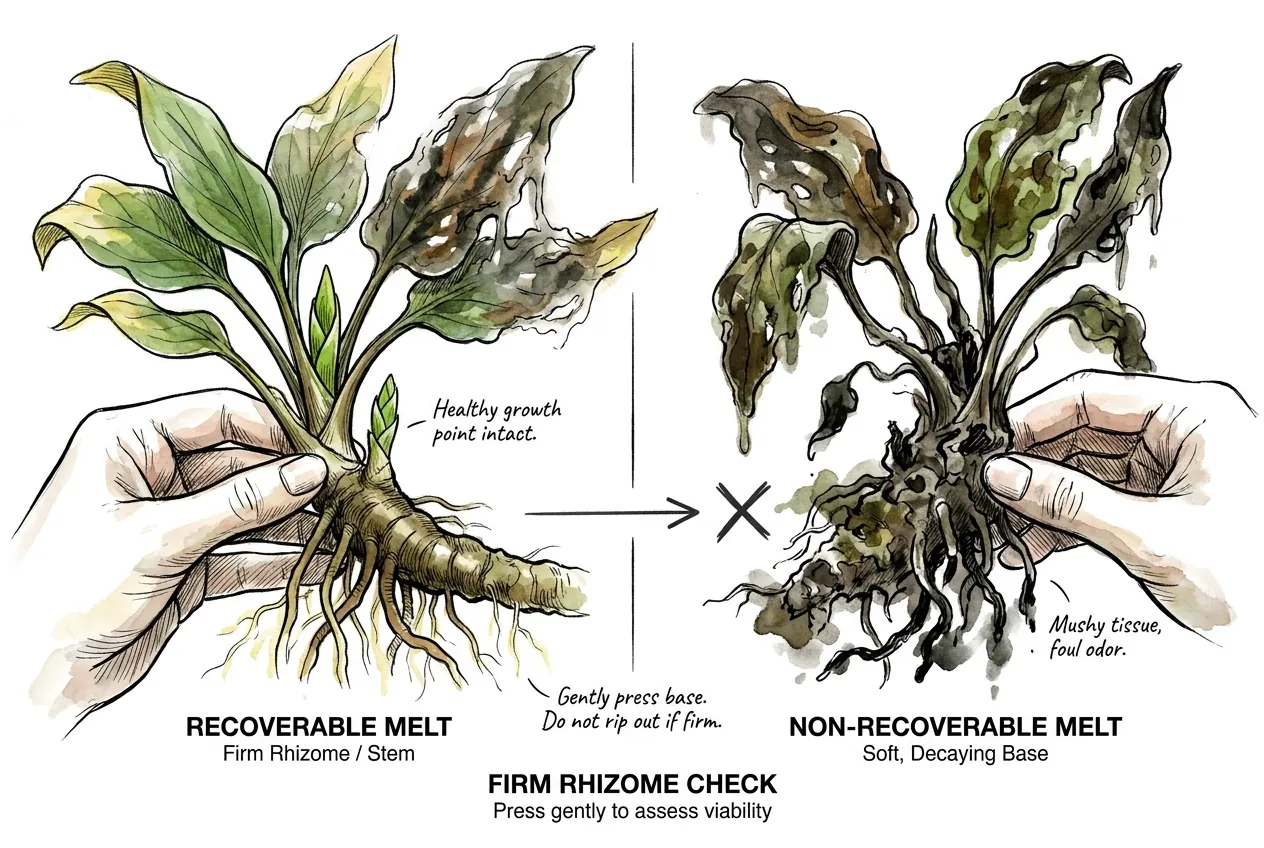
A few days after the melt starts, I work with clean hands and no open cuts.
I lift the leaf litter off the substrate and gently press the crypt rhizome with a fingertip. For stems, I pinch the lower stem just above the substrate.
If the rhizome or stem is still firm and the growth point looks intact, I leave the plant exactly where it is and pull off only the fully mushy leaves.
If the base is soft and smells of decay, I remove it so it cannot foul the water.
This is a look-and-touch check only. Do not inhale the gas off decaying tissue and do not taste anything.
A firm rhizome with mushy leaves is a plant that will regrow, and ripping it out is the one mistake that turns a recoverable melt into a real loss.
The recovery protocol is mostly patience
The consistent recovery advice is stability, not intervention. Keep a stable environment, do small regular changes, and fertilize gently and regularly.
Leave the roots and rhizome undisturbed, and trim mushy tissue close to the base so decay does not foul the water or feed bacteria and fungus.
With healthy roots, new submersed leaves usually appear within a few weeks.
What not to do matters just as much. Do not relocate or replant the crypt, because moving it is itself a melt trigger.
Do not crank the light or add CO2, and do not overcorrect with heavy fertilizer. A recovering plant needs time and calm, not a fresh stimulus.
Don’t let the melt become an ammonia problem
A big melt is also a bioload event, and a cold tank is the worst place to have one.
Decaying plant matter is a recognized ammonia source, so a large sheet of shed leaves adds to the load your tank has to process.
The trouble is that a cold tank processes it slowly. Nitrifying bacteria run fastest in warm water, with nitrification optimized roughly between 15 and 35 C, dropping sharply below 15 C and cut by about half near 12 C. So the very conditions that caused the melt also slow the cleanup, which is how a melt can tip into an ammonia spike.
The management is simple. Trim and remove mushy leaves promptly so they stop releasing ammonia. Keep the tank warm and stable so the bacteria stay active, and watch ammonia and nitrite through the recovery window.
If a reading climbs toward a level that threatens livestock, the controlled response is a small temperature-matched change plus physical removal of the decayed matter. A big cold change would only re-trigger the original shock.
Set a winter routine so it doesn’t happen again
The one-time fix turns into a season-long habit without much effort. Assume the tank-to-tap gap is at its widest all winter, because it is, and build the routine around that.
Keep change water temperature-matched, keep each change smaller, and keep the cadence frequent rather than occasional.
Pre-staging a bucket to warm and aerate the day before makes temperature matching the default instead of a scramble at the sink.
A short logbook of tank temperature, refill temperature, and change volume keeps your 2 F rule honest across the months.
A few equipment questions naturally come up as you set this up. Where they do, these guides cover the decision without me steering you to a single product.
| Decision | Where it comes up | Guide |
|---|---|---|
| Thermometer and test kit | Running the delta check and watching ammonia during recovery | Aquarium water test kit chooser |
| Heater sizing and winter setpoint | Holding a stable temperature against a cold room | Aquarium heater buying guide |
| Substrate for crypts | Giving rhizomes a root zone that supports recovery | Planted tank substrate chooser |
| Lighting during recovery | Holding light steady instead of spiking it | Planted tank LED light chooser |
Melt after the first cold change is not bad luck, it is a predictable thermal and gas shock, and a pre-warmed, temperature-matched, smaller winter change prevents nearly all of it. Match the temperature, let the water breathe, go smaller, and when a melt does happen, check the rhizome before you reach for the tweezers.