
Spider Mites and Thrips: The Heating-Season Pest Window
Heating dries the air and crashes humidity into the spider mite's comfort zone. Here is the mechanism, the weekly scouting routine, and the fix that works.
Jordan Cole · Published 2026-10-01 · 14 min read
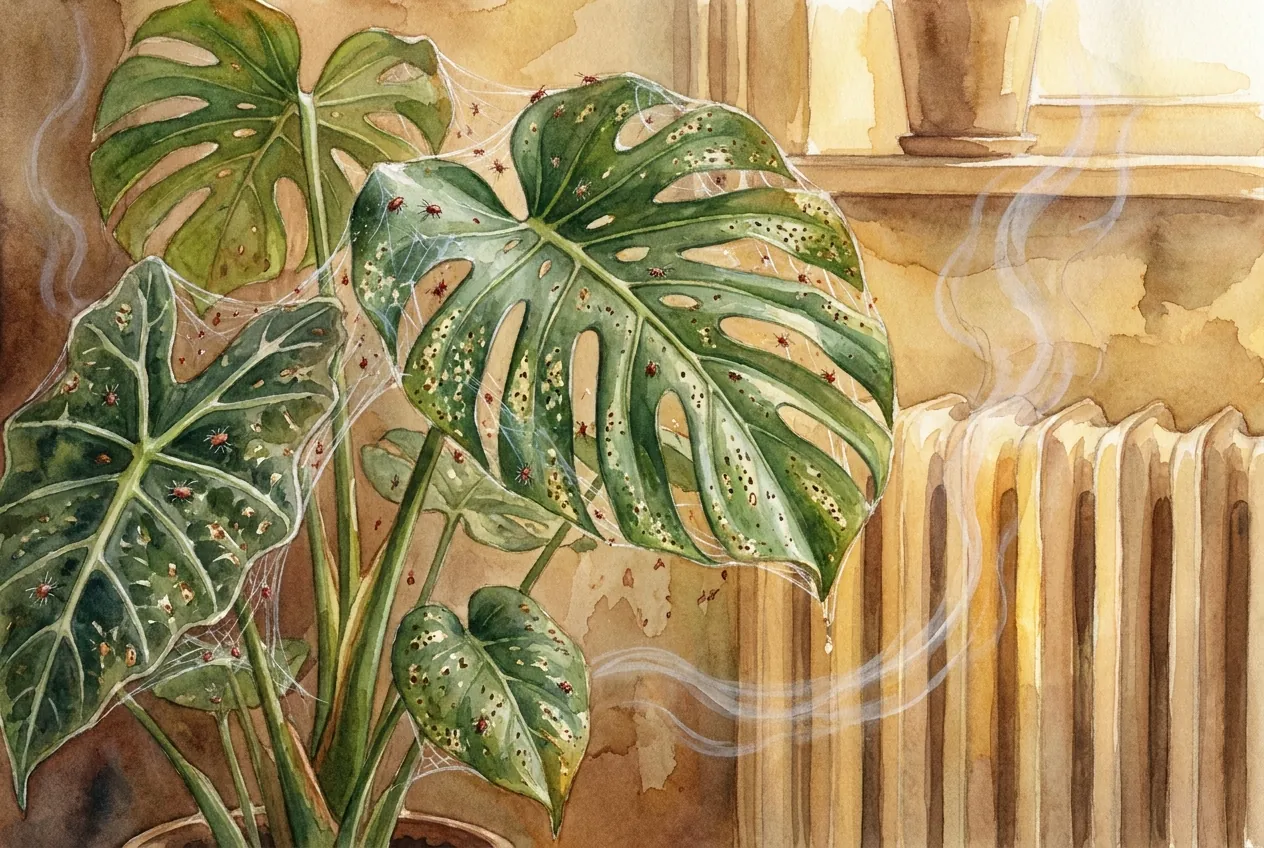
Key Takeaways
- Heating crashes indoor humidity to 15 to 25 percent, near the spider mite’s ideal warm dry climate.
- Warm dry air shortens a mite generation to about a week and disables its natural fungal enemies.
- Thrips surge from warm steady temperature, not dryness, so humidity suppresses mites but not thrips.
- Scout leaf undersides weekly with a loupe and paper tap test from the day heating starts.
- Raising humidity near 50 percent slows mites but cannot cure an outbreak on its own.
The week your heating first kicks in, you are not just drying out your own skin.
You are handing two-spotted spider mites close to their ideal climate while quietly weakening your plants.
That overlap is the RH-crash pest window, and it is the reason a clean collection in October can be webbed over by December.
This is a mechanism story with a short action list. Once you understand why warm dry air speeds mites up and stresses leaves, the monitoring routine and the fixes almost choose themselves.
Why Heating Crashes Indoor Humidity
Heating cold outdoor air is what crashes your relative humidity, and the drop is physics, not bad luck. Cold air holds very little water vapor.
When your furnace warms that air to room temperature, it adds no moisture. The air’s capacity to hold water rises while the actual content stays flat, so relative humidity falls.
The numbers are stark. Comfortable indoor humidity sits around 30 to 50 percent. A typical northern home with no humidifier often drops to 15 to 25 percent once the heating runs, and colder weather forces it even lower to avoid condensation.
That 15 to 25 percent band is almost exactly the warm, dry climate two-spotted spider mites are built to exploit. The same air that chaps your lips is a comfort zone for the pest.
Why Spider Mites Explode in Warm Dry Air
Spider mites explode because warm dry air speeds up their life cycle, raises egg output, and disables their natural enemies all at once. No single factor would matter much. Stacked together, they turn a few mites into a population curve that goes vertical.
The Life Cycle Compresses to About a Week
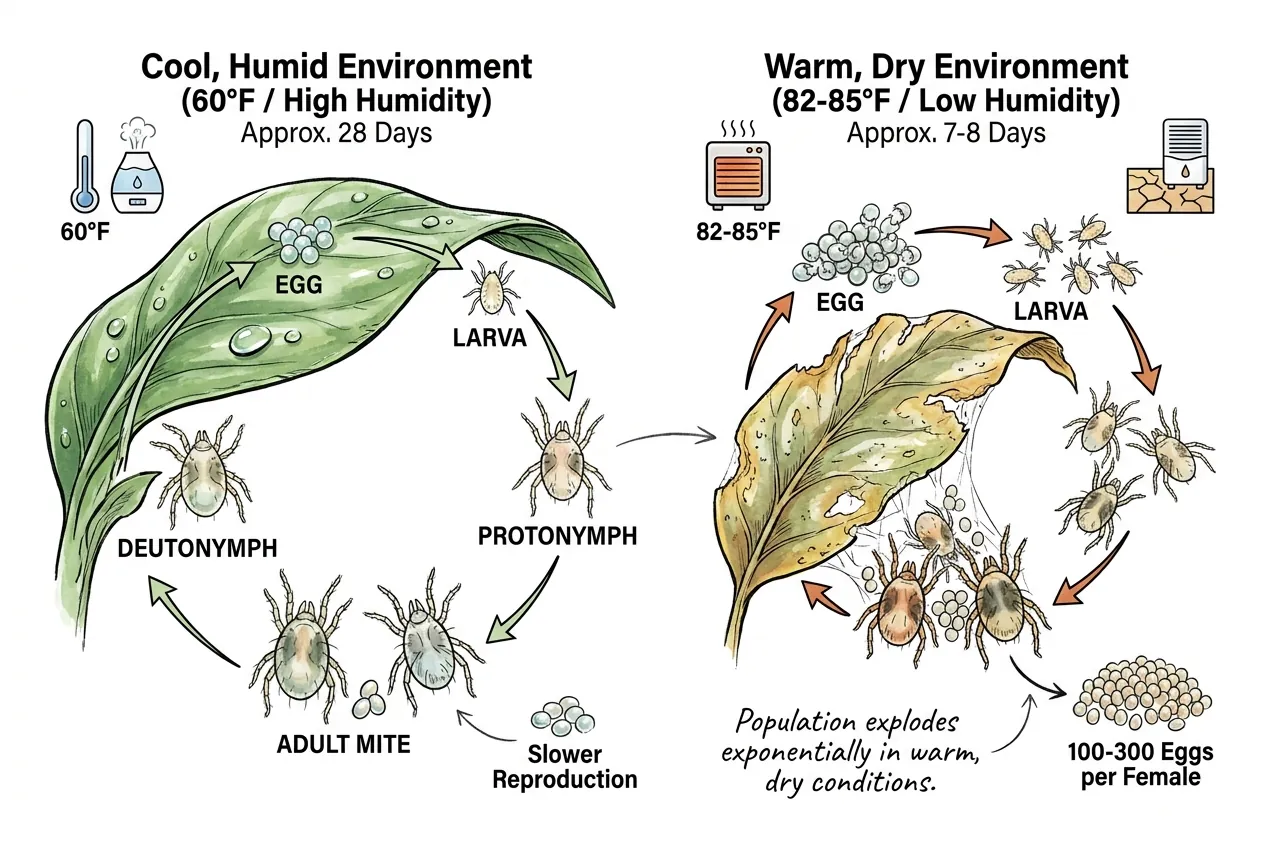
Development from egg to adult collapses as temperature rises and humidity falls. At cool room temperatures near 60 degrees Fahrenheit, a mite needs roughly 28 days to mature.
At the warm 82 to 85 degrees of a cozy heated room with low humidity, that drops to about 7 to 8 days.
A single female lives two to four weeks and lays somewhere around 100 to 300 eggs over that span.
Shorten each generation to a week while each female keeps laying hundreds of eggs, and the math turns exponential fast.
A spider mite generation that took a month in a cool room can finish in about a week once the air warms and dries.
Dry Air Also Disarms the Mite’s Natural Enemies
Low humidity does more than speed mites up. It takes away the fungal diseases that normally keep them in check. The fungi that infect and kill mites need moisture to work, so as the air dries their killing power fades.
Controlled trials make the pattern clear. A fungal biocontrol killed about 91 percent of mite eggs at 95 percent humidity, but only about 72 percent at 55 percent humidity.
In a 20 percent living room, those fungal allies are barely functional.
This is the hidden half of the outbreak. The dry room is not only better for the mite, it is worse for the mite’s predators and pathogens.
Why Thrips Surge Too, For a Different Reason
Thrips surge in heated rooms mainly because the warmth speeds their generations, not because the air is dry.
This distinction matters, because it changes which tools actually work on them. Treating thrips like mites will waste your effort.
Warmth Drives Thrips, Dryness Does Not
Western flower thrips breed faster as rooms warm. A generation takes 13 days or more at 59 degrees Fahrenheit.
At 86 degrees it can finish in about 4 to 5 days, with the population multiplying several fold each cycle.
A steady warm winter also removes the cold pause that slows them outdoors.
Here the biology splits from the mite story. Low humidity is actually hard on thrips. Humidity below about 40 percent increases their water loss and harms survival, and their soil-pupation stage needs high moisture to succeed.
The heating-season thrips surge comes from warm, stable temperature and nonstop indoor breeding, not from the dry air that favors mites.
Telling Mite Damage From Thrips Damage
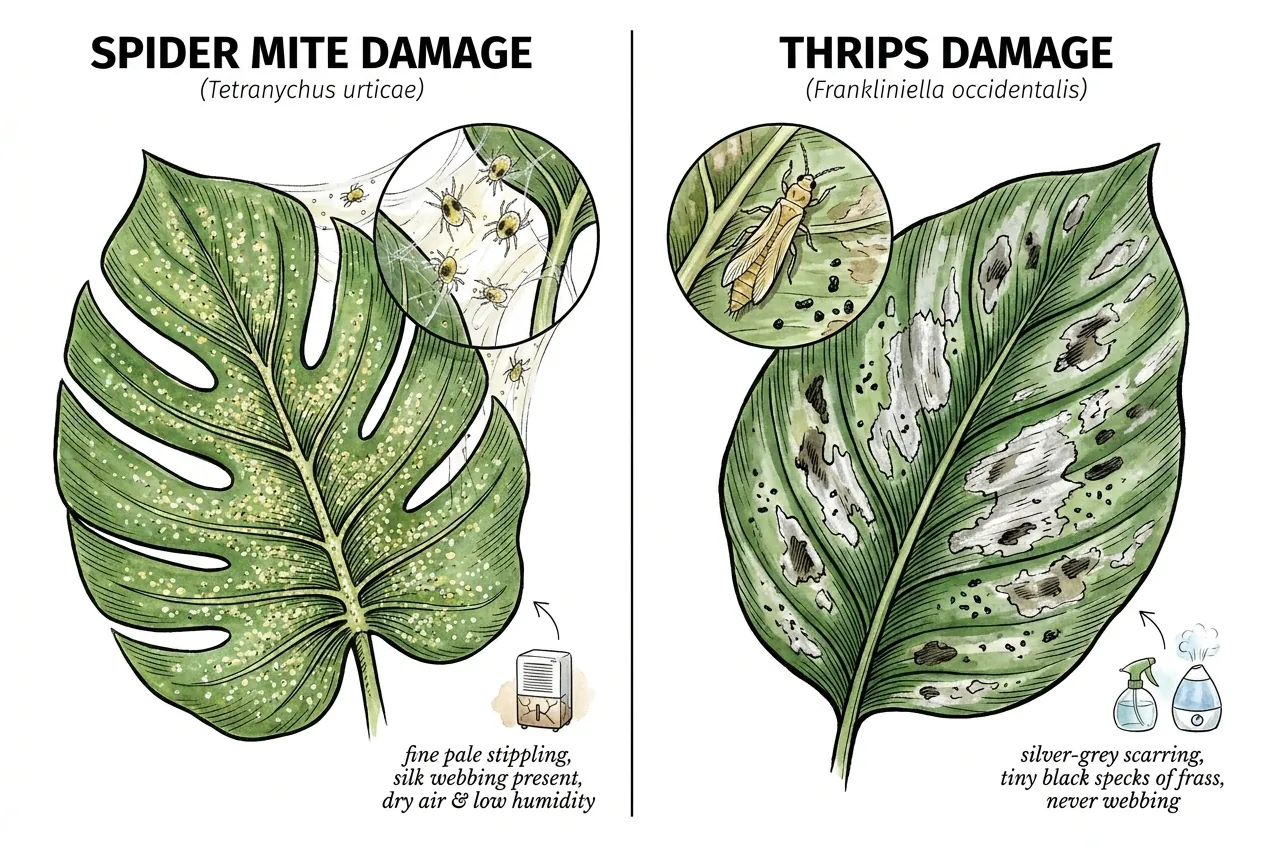
You can separate the two pests by their marks before you ever see the insect. Spider mites leave fine pale stippling and, at high numbers, silk webbing on leaf undersides and stem tips.
Thrips leave silver-grey scarring plus tiny black specks of frass, and they never spin webbing.
That difference points you to the right response. Webbing means mites and the humidity lever is in play. Silvering with black frass means thrips, so you lean on traps, physical removal, and breaking their soil stage instead.
Catching the Outbreak Before the Webbing
Catch mites at the stippling stage, because by the time you see webbing the population is already large. Webbing is a late sign. The early tell is a faint speckling on leaves that most people miss until the plant looks dull or bronzed.
Where and How to Look
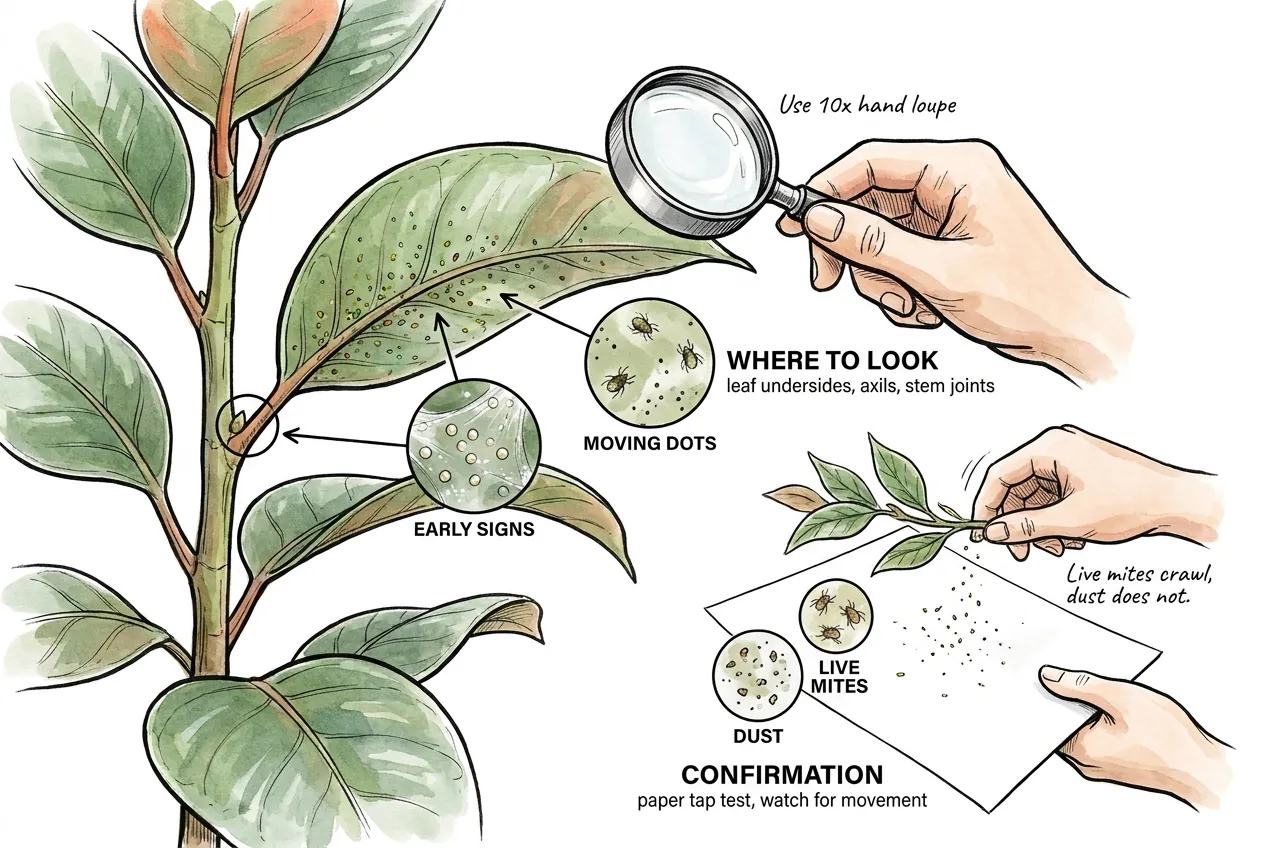
The action is on the undersides of leaves, in leaf axils, and at stem joints, so that is where your eyes go.
A 10x hand loupe or a phone macro lens turns invisible specks into recognizable mites, their pearl-colored eggs, and early webbing.
Look for tiny moving dots that may be green, yellow, red, or brown.
The fastest confirmation is the paper tap test. Hold a sheet of white paper under a branch and tap it, then watch for specks that crawl around once disturbed. Live mites move, dust does not.
A Weekly Scouting Routine Tied to the Heating Date
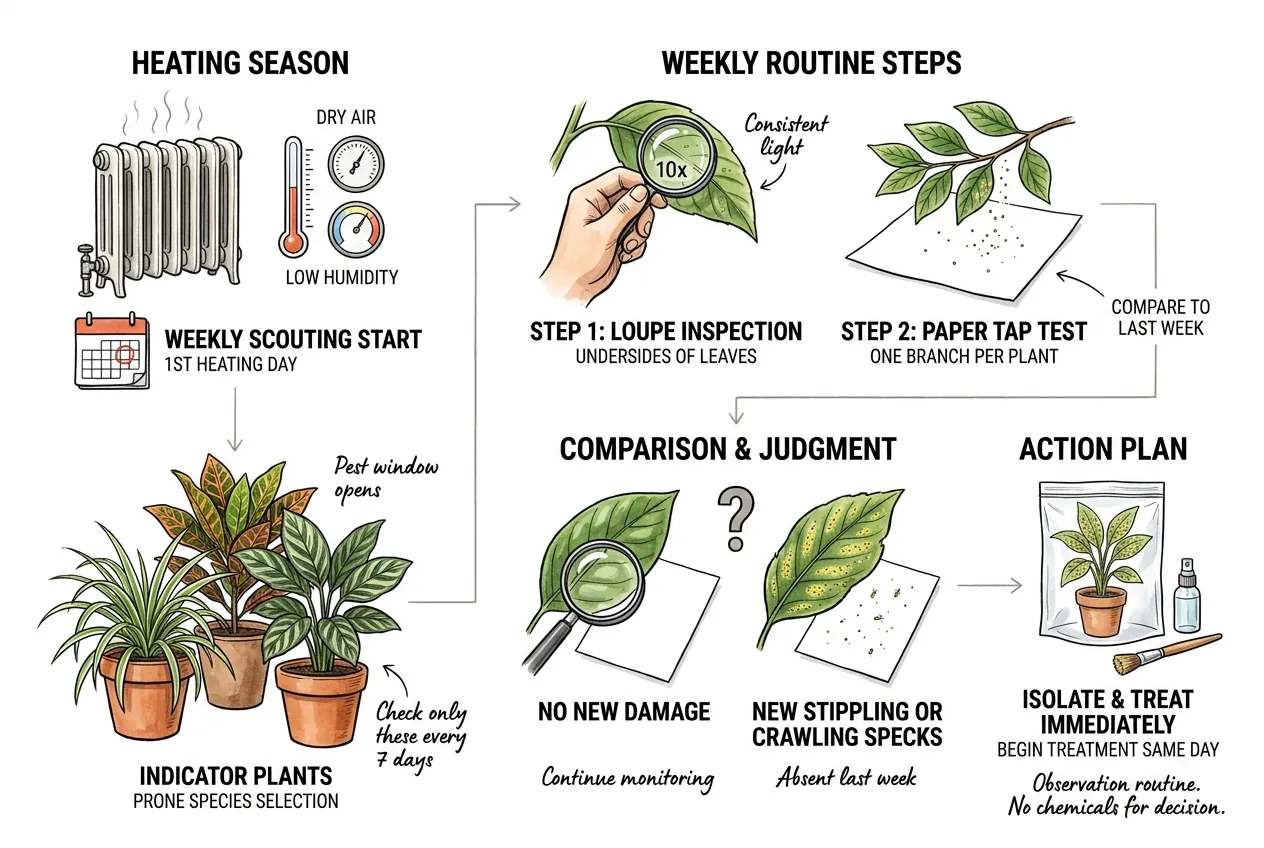
I start a fixed scouting routine the same week the central heating first runs, because that is the day the pest window opens.
I pick three to five indicator plants, the species in my collection most prone to mites, and check only those every seven days.
The seven-day interval is deliberate. A mite generation can compress to about a week in warm dry air, so no new cohort matures unseen between checks.
Each check is the same two steps in consistent light. I scan the undersides of leaves with a 10x loupe, then run the paper tap test under one branch per plant. Then I compare what I see to the week before.
If any indicator plant shows new stippling, or the paper shows crawling specks that were absent last week, I act that same day.
I isolate that plant and begin treatment rather than waiting for webbing.
This stays an observation routine, so I use the loupe and paper, never a chemical, to decide.
The only judgment call is new damage versus last week, and that comparison is what turns a vague worry into a dated decision.
How Much Humidity Actually Helps, and Where It Stops
Raising humidity genuinely suppresses mites, but it is a brake, not a kill switch, and it does almost nothing for thrips.
Understanding that boundary keeps you from leaning on a humidifier while a population quietly doubles.
The Humidity Lever and Its Honest Limits
Higher humidity hurts mites in two ways. It shifts the air away from their dry optimum, and it restores the killing power of the fungal diseases that infect them.
The strongest documented effect is that indirect one, where damp air lets the mite’s fungal enemies work again.
The catch is reach. Those dramatic egg-mortality numbers come from very high humidity near 95 percent, which no normal heated home can hold without condensation and plant disease.
The realistic indoor ceiling in cold weather is closer to 50 percent. That is enough to slow mites and help their enemies, not enough to wipe out an established infestation.
Treat added humidity as a suppression aid that buys time, never as a standalone cure for an active mite outbreak.
Checking Whether Your Humidifier Is Really Working
I verify the humidity lever by measuring, because a running humidifier is not the same as a humid canopy.
I place a hygrometer at canopy height next to the most affected plant, not in the middle of the room.
Air near a radiator or sunny window reads differently, so I record one baseline reading before the humidifier runs, in late afternoon with the heating fully on.
Then I log the same late-afternoon reading for six more days and judge it against a working floor of 50 percent.
I chose 50 percent as my own conservative target, not a published kill threshold. It sits near the practical ceiling a heated room can hold while staying well above the 15 to 25 percent zone mites love.
If canopy humidity holds at or above 50 percent on at least five of those six afternoons, the lever is doing its job.
If it falls short, the humidifier is undersized or the room exchanges air too fast, so I stop trusting humidity and escalate to physical control.
Throughout, I keep foliage dry overnight, because wet leaves in a cool room invite fungal disease and, at very high humidity, even help thrips pupate.
When this is where you land and you need to pick humidity gear or a hygrometer, match the device to your room size and target before you buy.
The site’s plant cabinet humidity control chooser and the VPD monitoring chooser walk through that decision without guesswork.
Why Stressed Plants Make the Outbreak Worse
A heated, dry room does not just help the pest, it weakens the plant and makes its leaves better food. This is the quiet amplifier behind the pest window. The same air change attacks both sides of the fight.
Dry Air Raises Leaf Water Demand Through VPD
Vapor-pressure deficit, or VPD, is the gap between how much water the air could hold and how much it actually holds.
Warmer air can hold far more moisture, so heating cold air widens that gap even when the room feels fine. As VPD rises, leaves transpire faster and lose water more quickly.
Push VPD high enough and plants close their stomata to conserve water, which slows their growth and their defenses.
The dry winter room drives thin-leaved tropicals toward exactly that water-losing, stressed state.
Drought-Stressed Leaves Are Better Mite Food
Water-stressed plants change their internal chemistry in ways that favor mites. Studies on tomato show that two-spotted and related mites actually benefit from the improved nutritional value of drought-stressed leaves.
Water stress shifts defense proteins and nutrient balance, and a chronically stressed plant mounts a slower, weaker defense.
The practical lesson is to avoid drought swings during heating season. Steady watering that never lets a prone plant wilt keeps its defenses responsive and its leaves less attractive.
Combine consistent root moisture with raised canopy humidity and gentle airflow, and you blunt both drivers at once.
The Intervention Ladder
Work an outbreak in order, from physical removal to cultural change to targeted treatment, because one aggressive spray rarely wins.
The integrated path knocks the population down first, then removes the conditions that let it rebuild. Each rung buys the next one a better chance.
Step One, Isolate and Physically Remove
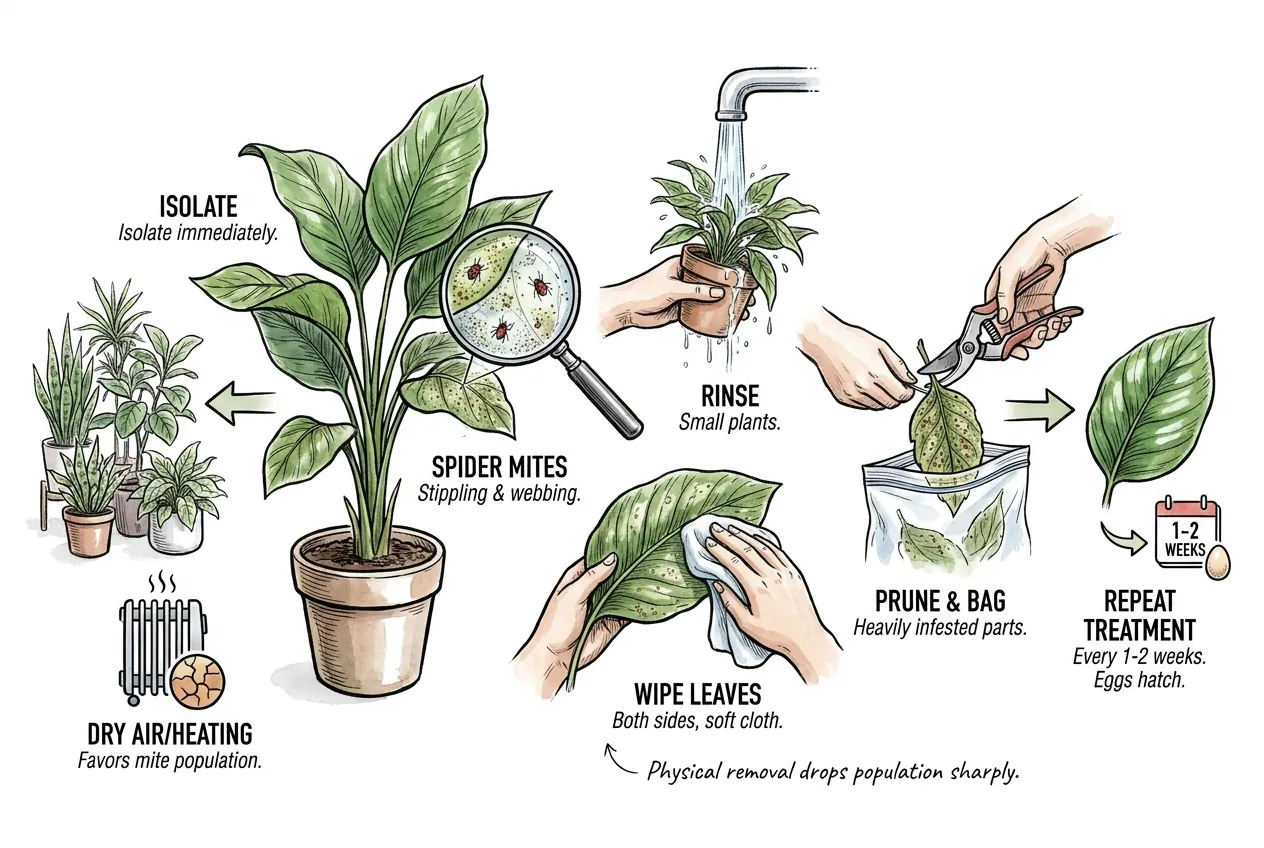
Move the affected plant away from the collection the moment you confirm mites. Spread is the fastest way a single plant becomes ten.
Rinse small plants in the sink or shower, and wipe both sides of larger leaves with a soft damp cloth. Prune and bag the most heavily stippled or webbed leaves.
Physical removal alone drops the population sharply, and it costs nothing. Repeat it every one to two weeks, because eggs survive a single pass and hatch between treatments.
Step Two, Change the Environment
Raise canopy humidity toward that 50 percent working floor and improve airflow, which shifts conditions against mites and revives their fungal enemies.
Relieve drought stress with steady watering so leaves stop being premium mite food. Keep foliage dry overnight so you do not trade a mite problem for a fungal one.
Step Three, Targeted Controls, By the Label Only
For houseplants, the effective low-risk treatments are insecticidal soap and horticultural oil, which smother mites on contact.
These can burn drought-stressed plants or leaves above about 90 degrees, so water the plant first and treat in the cool of the evening. Follow the product label for dilution and timing every time, and never improvise a dose.
Predatory mites are the biological option. Commercial species such as Phytoseiulus persimilis and Neoseiulus californicus eat pest mites, and they work best before a population explodes. They do not bite people and they stay on the plants.
For thrips, add blue or yellow sticky cards to monitor adults and let the soil surface dry to break their moisture-dependent pupation stage.
When you reach the point of buying soaps, oils, sticky traps, or predators, pick tools that match your plants and the pest you confirmed.
The site’s fungus gnat and indoor pest control chooser covers that adjacent tooling decision so you are not guessing in a store aisle.
Preventing Next Year’s Pest Window
Prevention is cheaper than treatment, and it hinges on two habits, quarantine and a calendar anchored to the heating date.
Most outbreaks are either imported on a new plant or missed in the first vulnerable weeks. Close both gaps and the window barely opens.
Quarantine Every New Plant
Isolate every new or returning plant in a separate room, or at least a distant corner, for two to four weeks before it joins the collection.
Most pest eggs hatch within one to two weeks, so it is the second generation that reveals a hidden infestation.
Inspect leaf undersides, axils, and the soil surface every few days under good light, and treat before you move the plant in if anything appears.
A single unquarantined plant is the most common way a clean collection gets seeded right before heating season.
The quarantine habit is the highest-value, lowest-cost move on this entire list.
Run the Calendar From the Day the Heating Comes On
Treat the first sustained heating day as the start of the pest window and begin your routine then.
Take a baseline canopy-humidity reading, name your three to five indicator plants, and set the weekly scouting check.
Hold a steady watering routine so no prone plant swings into drought stress.
The window runs through the heating season and eases once outdoor warmth lets you turn the heat off and indoor humidity recovers.
A few minutes a week during those months is what keeps December from turning into a rescue operation.
Key Takeaways
- Heating crashes indoor humidity to 15 to 25 percent, close to the two-spotted spider mite’s ideal warm dry climate.
- Warm dry air shortens a mite generation to about a week and disables the fungal diseases that normally control them.
- Thrips surge from warm steady temperature, not dryness, so humidity suppresses mites but not thrips.
- Scout leaf undersides weekly with a loupe and paper tap test from the day heating starts, before webbing shows.
- Raising humidity to about 50 percent slows mites but will not cure an outbreak, so work the physical-to-targeted ladder.