
Fungus Gnat Control Product Chooser (by Life Stage)
A fungus gnat control product chooser that matches Bti, a coarse surface cap, sticky traps, and S. feltiae nematodes to each life stage, with honest limits on each.
Marcus Hale · Published 2026-07-21 · 33 min read
Key Takeaways
- Match the product to the life stage. Larvae in the top inch do the damage, adults are just the symptom.
- Bti kills fly larvae, not adults. Buy subspecies israelensis, and follow the product’s own EPA label for dose and timing (kurstaki and aizawai are caterpillar products).
- A coarse dry surface cap can reduce egg-laying. A 1.3 to 2.5 cm layer of coarse grit or pumice is a reasonable option, though pumice itself has not been gnat-tested.
- Yellow sticky traps mainly monitor the adult trend and are not a cure on their own. Pair them with a larval-stage tool in established cases.
- S. feltiae nematodes can help with stubborn root-zone larvae, but only if you refrigerate the pack and apply it within the supplier’s temperature range.
Fungus gnats are not a single-product problem. The flies you swat are mostly the visible symptom.
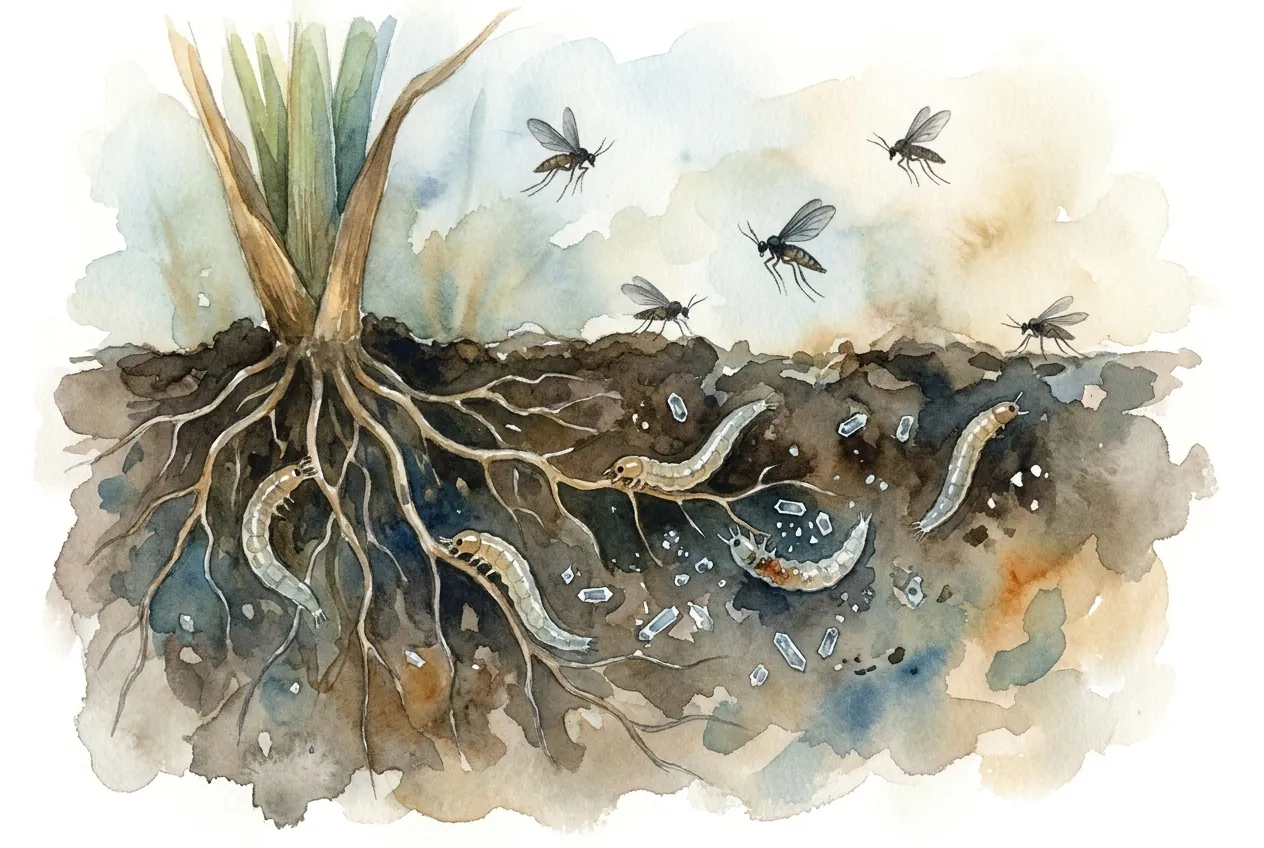
The root injury happens underground. Whitish, black-headed larvae chew fine roots in the top few centimeters of moist potting mix.
Buying only for the flying adults tends to disappoint. Matching a tool to the right life stage is what breaks the cycle.
This is a role-based chooser. Each product is matched to the stage of the Bradysia life cycle it targets, and each one has clear limits noted alongside it.
What should I actually buy to get rid of fungus gnats?
A practical kit is a Bti larvicide, a dry inorganic barrier cap, and yellow sticky traps for monitoring.
Add Steinernema feltiae nematodes when larvae are entrenched in the root zone. Many mild single-pot cases resolve with free moisture correction alone, so start there before buying.
No single tool touches all four life stages. A tool that targets the air cannot reach the three buried stages, and one that targets the substrate cannot catch adults already flying.
Trapping adults does modestly reduce egg-laying, so it is not without value, but it will not clear an established larval population.
Here is the fast verdict by role.
I number yellow cards by pot and pair each with a six-millimeter-thick raw-potato slice placed flat on the same moist surface for four days. The thickness follows the quarter-inch Extension method, while four days gives larvae time to gather beneath the slice.
I replace and count both indicators every four days, leaving each card at its original pot. Matching the replacement interval to the potato check keeps adult and larval trends aligned. A falling adult count with larvae still present tells me the lifecycle is not yet broken.
Kill the larvae
Use Bti (Bacillus thuringiensis subsp. Israelensis) as a soil drench or top-dress, following the product label.
This is usually the first product to buy when a larvicide is needed, since larvae are the stage that injures roots. Summit Mosquito Bits, 8 oz, is a common example.
Block the egg-laying surface
Use a coarse inorganic cap roughly 1.3 to 2.5 cm deep. Bonsai Jack Horticultural Pumice is a widely available coarse material of this class, though the gnat-barrier trials used recycled-glass grit, not pumice.
Monitor the adults
Lay yellow sticky traps flat at the soil surface to quantify the population and confirm the program is working.
Gideal Yellow Sticky Traps are the dual-sided 6 by 8 inch sheet format.
Clear entrenched root-zone larvae
Use Steinernema feltiae nematodes as a soil drench, mainly for stubborn or chronic infestations.
NaturesGoodGuys nematodes SF, 10 Million, is a hobbyist-sized pack.
A single mildly infested pot can often be handled with the free cultural fix plus a barrier and a trap.
A chronic, multi-pot collection is where nematodes are more likely to be worth their cost and shelf-life demands.
Fungus Gnats. UC Statewide IPM Program, Pest Note 7448
Ecology of Fungus Gnats in Greenhouse Production Systems. Cloyd 2015, Insects
Why do the larvae, not the flies, cause the damage?
The larvae are the stage that causes root injury because they live in the top 5 to 8 cm (2 to 3 in) of moist media and chew fine roots, root hairs, and seedling stems.
Adults do not feed on roots. They live about 7 to 10 days, and a female lays roughly 100 to 200 eggs.
On mature, established houseplants the damage is often minor. Seedlings, plugs, and fresh cuttings are the vulnerable cases.
The pest is Bradysia spp., family Sciaridae. Adults are small, about 1/8 inch, dark, mosquito-like, and weak fliers that walk low over the soil.
That is how you tell them apart from red-eyed fruit flies over the fruit bowl, and from robust, spotted-wing shore flies over algae.
The four stages live at four addresses
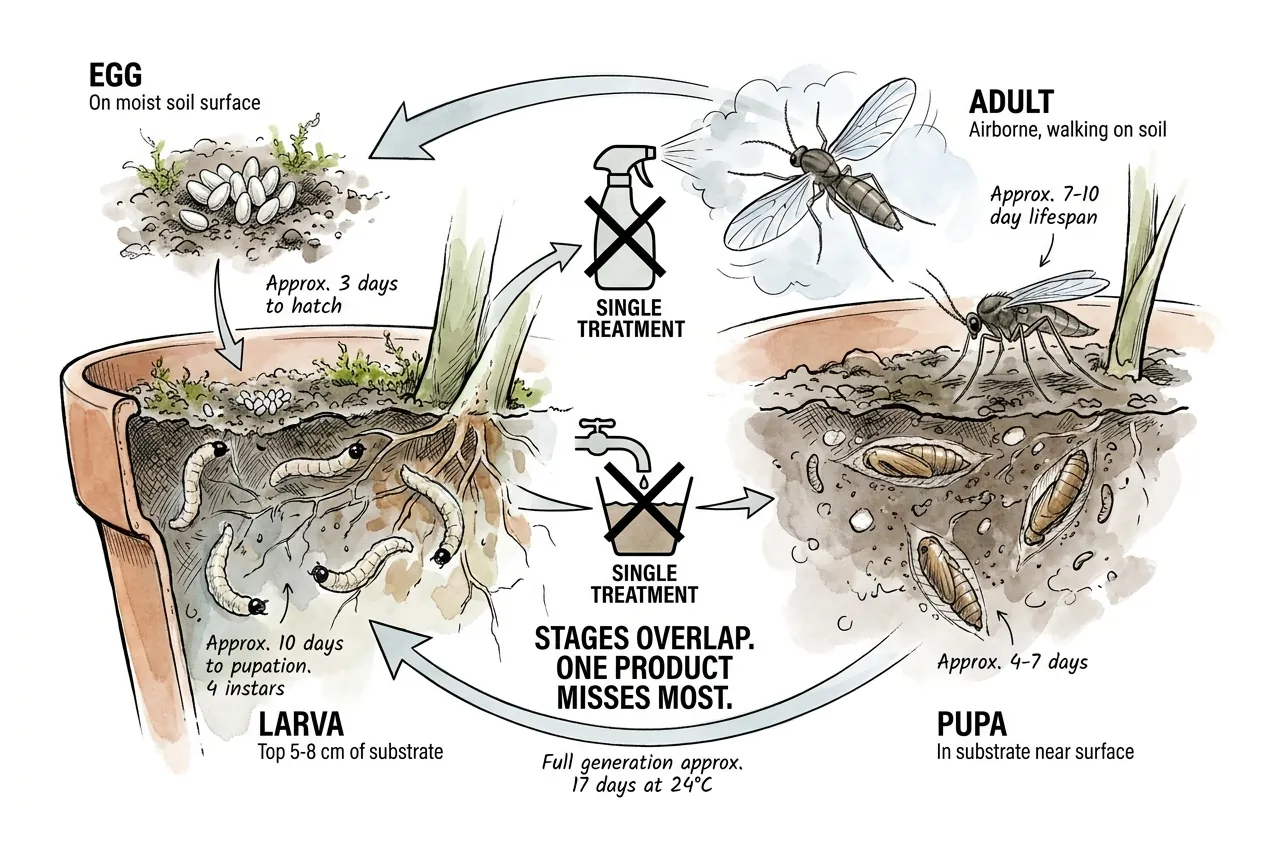
The life cycle runs egg to larva to pupa to adult. The egg, larva, and pupa share the upper media while the adult is airborne, and no single product reaches every stage, which is why control combines tools.
| Stage | Where it lives | Approximate duration at 24°C (75°F) |
|---|---|---|
| Egg | On or just under the moist soil surface | About 3 days to hatch |
| Larva (4 instars) | Top 5 to 8 cm (1 to 2 in) of the substrate | About 10 days to pupation |
| Pupa | In the substrate near the surface | About 4 to 7 days |
| Adult | Airborne, walking on the soil surface | About 7 to 10 day lifespan |
A full generation runs in about 17 days at 24°C (75°F). Because the stages overlap, a pot holds all four at once, so a single treatment only catches whatever is in the targeted stage that day.
Larvae open the door to root rot
Larval feeding prunes fine roots directly and wounds the root surface, which can let soil pathogens in. In a petri-dish assay using an oospore-rich Pythium aphanidermatum strain, Bradysia impatiens larvae transmitted the pathogen to healthy geranium seedlings at up to 65%. In commercial peat plug-cell trays the same strain transmitted at under 6%, and non-oospore strains at 0%.
Gut passage raised germination for that one strain but reduced it for others, so the effect is strain-dependent, not general.
The takeaway is narrower than a blanket alarm. On seedlings, plugs, or fresh cuttings, a larval population is a reasonable root-disease concern worth acting on, especially where pathogens are already present.
On established houseplants it is usually a nuisance rather than a disease driver.
The at-home diagnostic
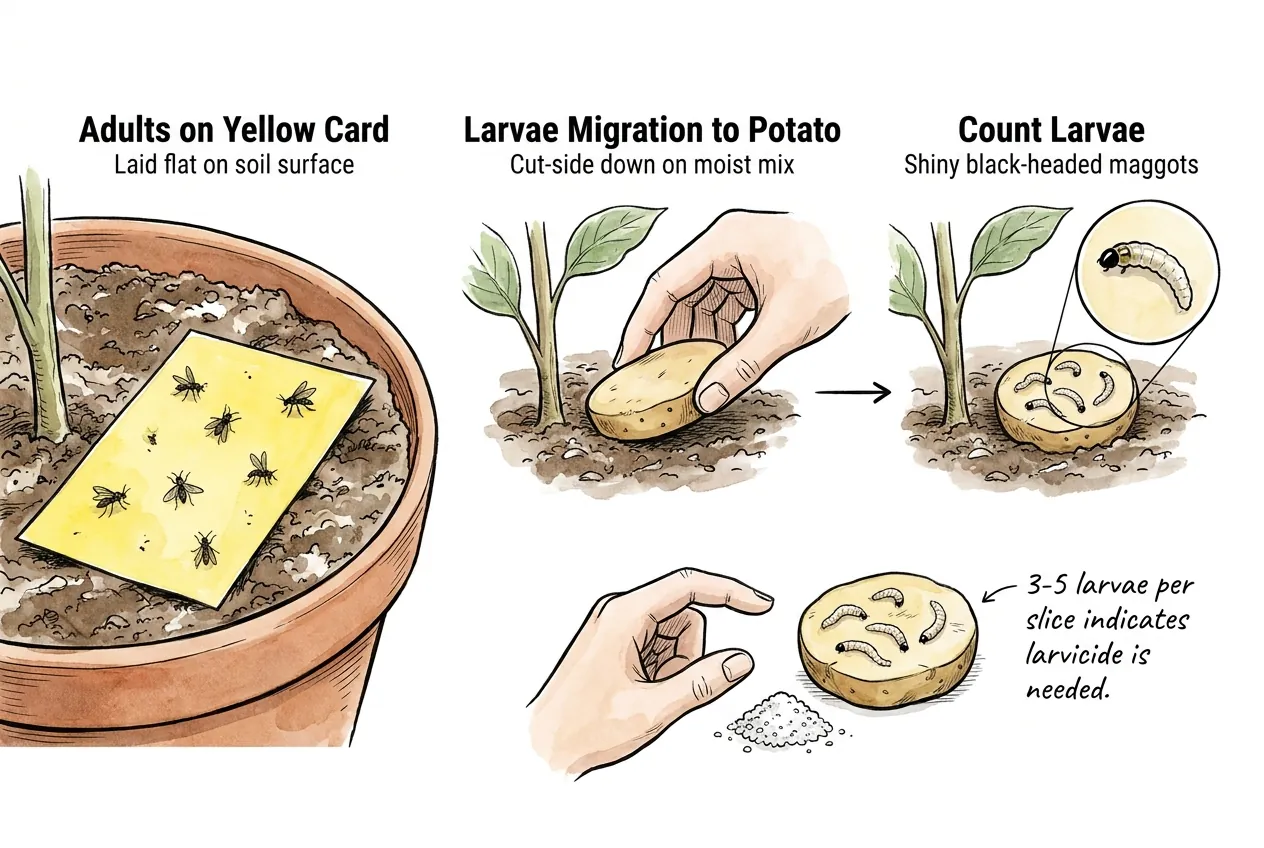
Flies you can see are the adult stage. Catch them on a yellow card laid flat at the soil surface to confirm they are fungus gnats.
To confirm larvae, press a 1/4 inch slice of raw potato cut-side-down onto the moist mix. Larvae migrate into it within 24 to 48 hours.
Lift the slice and count the shiny black-headed maggots. The published action thresholds are for nursery use. Roughly 3 to 5 per slice in propagation pots and 15 to 20 in larger production pots.
For a home houseplant, weigh the count alongside plant age, visible damage, and repeated readings rather than treating on a single number.
Fungus Gnats. UC Statewide IPM Program, Pest Note 7448
Larval Bradysia impatiens Potential for Vectoring Pythium Root Rot Pathogens. Braun, Sanderson and Wraight 2012, Phytopathology
Fungus Gnats. Colorado State University, Agricultural Biology and IPM
What is the real root cause, and how dry should the soil be?
The main driver is a persistently moist, organic-rich substrate surface. The free first-line fix is to let the top 2.5 cm (1 in) dry between waterings.
That upper layer is where most eggs are laid, where young larvae concentrate, and where soft larvae are most exposed to drying.
Larvae feed on fungi, algae, and decaying organic matter, which thrive on a wet surface, along with soft root hairs.
Drying the surface reduces much of that food and the humid microclimate the larvae favor, though some organic matter and roots remain deeper.
The knuckle test
Insert a finger to the first knuckle, roughly 2.5 cm. If the medium is still damp at that depth, do not water.
A wooden skewer gives a similar rough read. A cheap moisture meter is a looser guide, since many read conductivity rather than moisture directly and can be thrown off by fertilizer salts.
Colorado State notes larvae are very susceptible to drying out.
Bottom-watering keeps the egg-laying surface dry
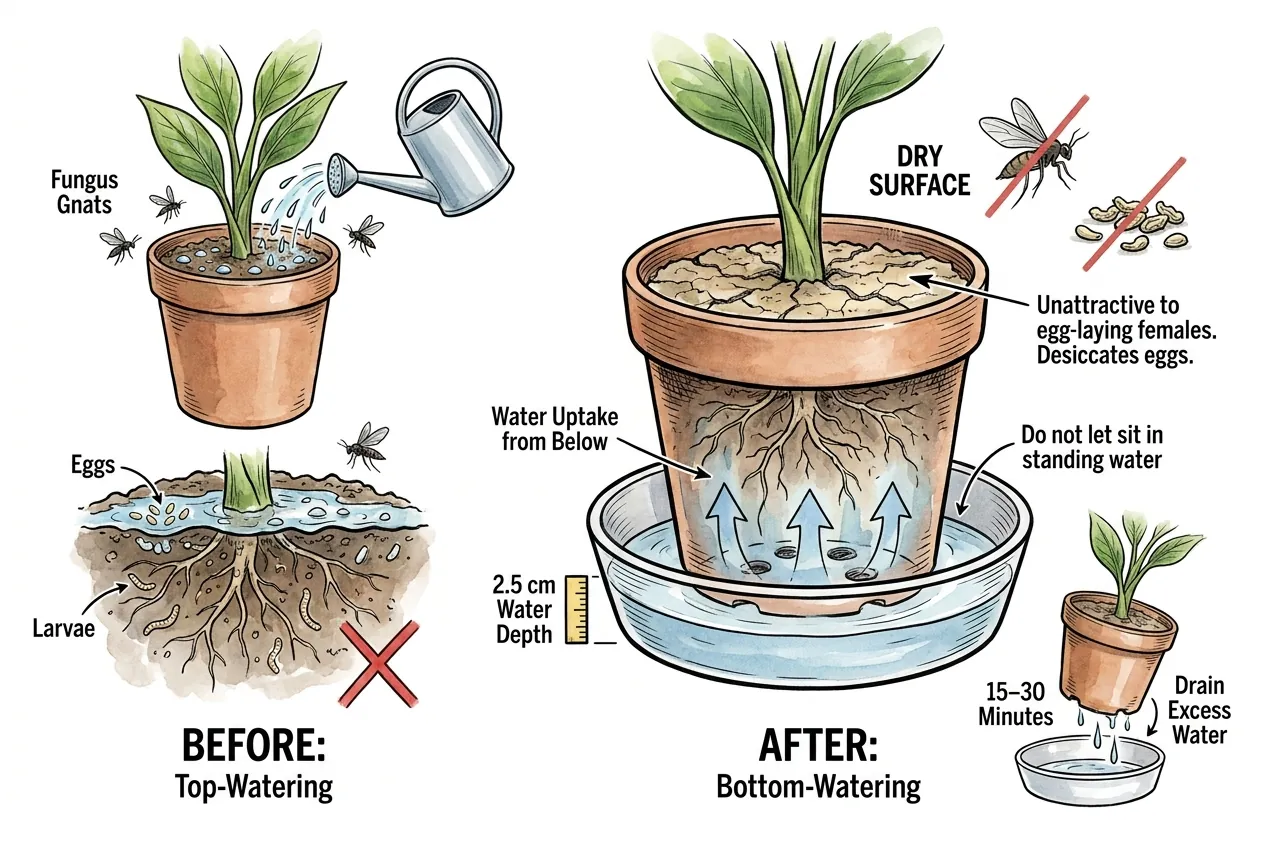
Set the pot in about 2.5 cm of water for 15 to 30 minutes. This hydrates the root ball from below, and it tends to keep the surface drier, though in short or heavily wicking pots water can still reach the top.
Check that the surface is actually dry afterward rather than assuming it.
A dry surface is less attractive to egg-laying females and can desiccate eggs. Do not let pots sit in standing water afterward, which itself favors gnats.
Where dry-down alone fails
Dry-down has a hard ceiling wherever the medium must stay moist. In one soilless-mix experiment, adult recovery was highest at moderate-to-high moisture rather than at dry or waterlogged extremes. That study measured one mix and did not test eggs or first instars, so read it as directional, not a precise setpoint.
Seedlings, cuttings, and dense peat or aroid mixes are cases where the medium often must stay evenly moist for the plant’s sake, which limits how far you can lean on dry-down.
In those cases dry-down cannot carry the whole job, and the other roles become more useful.
If your mix genuinely cannot dry, consider the barrier cap, Bti, and, for chronic problems, nematodes, matched to how severe the infestation actually is.
Fungus Gnats on Houseplants. University of Wisconsin-Madison Horticulture Extension
Fungus Gnats. PlantTalk Colorado 1445, Colorado State University
Integrated Pest Management Strategies for Fungus Gnats in Ornamental Plant Propagation. Clemson Land-Grant Press
Match Each Tool to Its Job
Buy for the life stage you need to interrupt. The table shows what each tool can do, what to check before buying, and when it is a poor fit.
| Product role | Target life stage | Mechanism | Measurable spec | Reapply / maintenance | Who should NOT buy |
|---|---|---|---|---|---|
| Larvicide, Bti (B. thuringiensis subsp. Israelensis) | Larvae in substrate | Cry and Cyt toxins rupture the alkaline larval midgut after ingestion. Lethal only to fly larvae | Label must read subspecies israelensis. Summit Mosquito Bits lists SUM-6218 at 2.86% | Follow the EPA label. The Mosquito Bits label directs weekly application for three weeks. It does not persist indoors | Anyone expecting it to kill adults or pupae, or who bought kurstaki or aizawai |
| Adult monitor, yellow sticky traps | Adults, flying | Adults orient to a green-band visual signal. Card catches egg-laying females and quantifies the trend | Saturated yellow, dual-sided, horizontal at the soil surface. Count per card per week | Replace when saturated. Read the weekly trend | Anyone who thinks traps alone will end the infestation |
| Physical barrier, coarse inorganic cap | Eggs and emerging adults | A dry coarse porous cap denies the moist organic egg-laying surface and impedes emergence | Continuous 1.3 to 2.5 cm (0.5 to 1 in) depth of coarse porous grit or pumice | Passive. Re-cap after repotting or heavy top-watering | Anyone who cannot hold the depth. It does not kill larvae below the cap |
| Biocontrol, Steinernema feltiae nematodes | Larvae, root zone | Infective juveniles enter larvae and release Xenorhabdus bacteria, killing the host in 24 to 48 hours | Species must be S. feltiae. IJ count in millions. Follow the supplier temperature range (NaturesGoodGuys lists 44 to 86°F) | Perishable, refrigerate, use before expiry. Keep media moist and re-drench per supplier directions (about every 2 weeks) | Anyone who cannot refrigerate or apply promptly, or whose soil is out of band |
Two common mistakes are buying the wrong Bti subspecies and expecting a sticky trap to cure rather than monitor. The table above is meant to help you avoid both.
Fungus Gnats. UC Statewide IPM Program, Pest Note 7448
Entomopathogenic Nematodes. UF/IFAS EDIS EENY-530
Which Bti larvicide should I buy, and how do I use it?
Buy a Bt product whose active-ingredient line reads subspecies israelensis. This is usually the first product to buy when a larvicide is warranted, since it targets the larvae. For a mild case, moisture correction alone may be enough first.
Check the label site and rate before buying. A labeled Bti granule product is a common example.
Bti must be eaten by young fly larvae in the growing medium. It does not reach adults, eggs, or pupae, which is why repeat applications matter.
That selectivity is why the active ingredient is targeted to fly larvae. A mammal gut is acidic and lacks the receptors, so the toxin does not activate, and plants have no gut to activate it in. That is a statement about the active ingredient, not the finished product.
The current residential Mosquito Bits label carries a CAUTION signal word, warns that the dust can be harmful if inhaled or absorbed through skin and is a moderate eye irritant, and directs you to avoid dust contact and to wash after handling.
Follow the label precautions rather than treating the product as hazard-free.
The subspecies is the whole decision
Among the common Bt subspecies, israelensis is the one that controls fungus gnat larvae. It also targets other fly larvae such as mosquitoes and black flies.
The subspecies kurstaki and aizawai are caterpillar products and do not control fly larvae.
Before buying, read the active-ingredient panel and confirm the fungus-gnat use on the label. It must say israelensis, sometimes shown as Bti or H-14.
The product and how to apply it
Summit Mosquito Bits
Summit Mosquito Bits fits a container plant with active larvae when its label lists fungus gnats and you can complete the repeat treatment. The label gives both a water-drench method and a surface application method. Choose the method and amount printed on your package, rather than borrowing a dose from another Bti product.
Wear the protection on the label and avoid dust contact. This is a larvicide, not a general-purpose plant tonic or a way to control flying adults.
The limits of Bti
Bti targets fly larvae. It does not touch eggs, pupae, or adults, and it does not persist in the media, so repeat applications are needed to intercept each new hatch.
The Mosquito Bits label sets that schedule at weekly for three weeks. Follow the label rather than an arbitrary interval.
There is a further limit. In one laboratory study, the Bti treatments tested had no measurable effect on the 2nd and 3rd instar larvae of a Bradysia colony.
That result was for a specific formulation, rate, and colony, so do not read it as proof that every Bti product kills only the youngest larvae. It does, however, support applying early and repeating so each new hatch is caught while young.
Treat Bti as an early-and-repeat larvicide rather than a single-shot rescue for an old, heavy infestation.
For that case, combine it with dry-down and, if warranted, nematodes.
A bulk 4-pack exists for large collections, but it is usually unnecessary for one or two pots, and opened product does not keep indefinitely.
Bacillus thuringiensis Toxins. An Overview of Their Biocidal Activity. Palma et al. 2014, Toxins
Effect of Bti and Neonicotinoid Insecticides on the Fungus Gnat Bradysia sp. Nr. Coprophila. Cloyd and Dickinson 2006, Pest Management Science
Bacillus thuringiensis General Fact Sheet. NPIC / Oregon State University
Which barrier cap actually blocks egg-laying?
Buy a coarse, porous inorganic cap and apply it at a continuous 1.3 to 2.5 cm (0.5 to 1 in) depth. Depth is the spec that matters most.
A dry mineral surface makes the surface less suitable for the moist organic layer females use to lay eggs and can impede adult emergence.
Material choice matters. In peer-reviewed work, fine sand and diatomaceous earth did not reduce adult emergence or egg-laying, while a coarse recycled-glass grit reduced emergence over time, with the effect scaling with layer thickness.
The reported difference tracks particle size and layer depth in those specific tests.
About the material the study used
The recycled-glass grit used in that work was sold as GrowStone Gnat Nix, which is difficult to source now.
What the test points to is a material class. A coarse, angular, porous, inorganic aggregate applied thick enough to stay dry at the surface.
Coarse horticultural pumice is a widely available material of that class and is a reasonable substitute on mechanistic grounds.
It has not itself been tested against fungus gnats, so treat it as a plausible option rather than a proven one.
The product and how to apply it
Bonsai Jack Horticultural Pumice
Bonsai Jack Horticultural Pumice is one coarse, porous cap option for a pot whose surface can stay covered and mostly dry. Apply a continuous 1.3 to 2.5 cm layer with no exposed damp mix, then re-level it after top-watering or repotting.
Skip a cap if it would make watering difficult or if you cannot maintain its depth. Pumice is a plausible substitute for the tested coarse aggregate, not a directly tested fungus-gnat treatment.
The limits of the barrier
A cap is preventive, not curative. It does not kill larvae already feeding below it. At best it reduces how much of the next generation gets seeded, so expect a lag of weeks, not days.
Pumice has not been directly tested against Bradysia in the cited peer-reviewed work, so its use here is a mechanistic inference from the coarse-porous finding.
If you specifically need gnat-tested numbers, look for a tested coarse aggregate or lean on cultural control instead.
Pair it with a Bti or nematode drench to clear the standing larval population, which the cap alone cannot reach.
Ecology of Fungus Gnats in Greenhouse Production Systems. Cloyd 2015, Insects
Fungus Gnats on Houseplants. University of Wisconsin-Madison Horticulture Extension
Integrated Pest Management Strategies for Fungus Gnats in Ornamental Plant Propagation. Clemson Land-Grant Press
Why do sticky traps only monitor, and how do I read them?
Yellow sticky traps are mainly a monitor and, on their own, not a cure for an established infestation.
They catch flying adults but leave the larvae and eggs in the substrate untouched. Their main value is to quantify the adult population so you can gauge whether the rest of your program is working.
Removing adults does modestly reduce egg-laying, so they are a mild adjunct as well.
Yellow is the conventional choice for fungus-gnat monitoring. The direct value is a consistent weekly count from the same location, not a claim that the color will solve the infestation.
Placement is horizontal at the surface
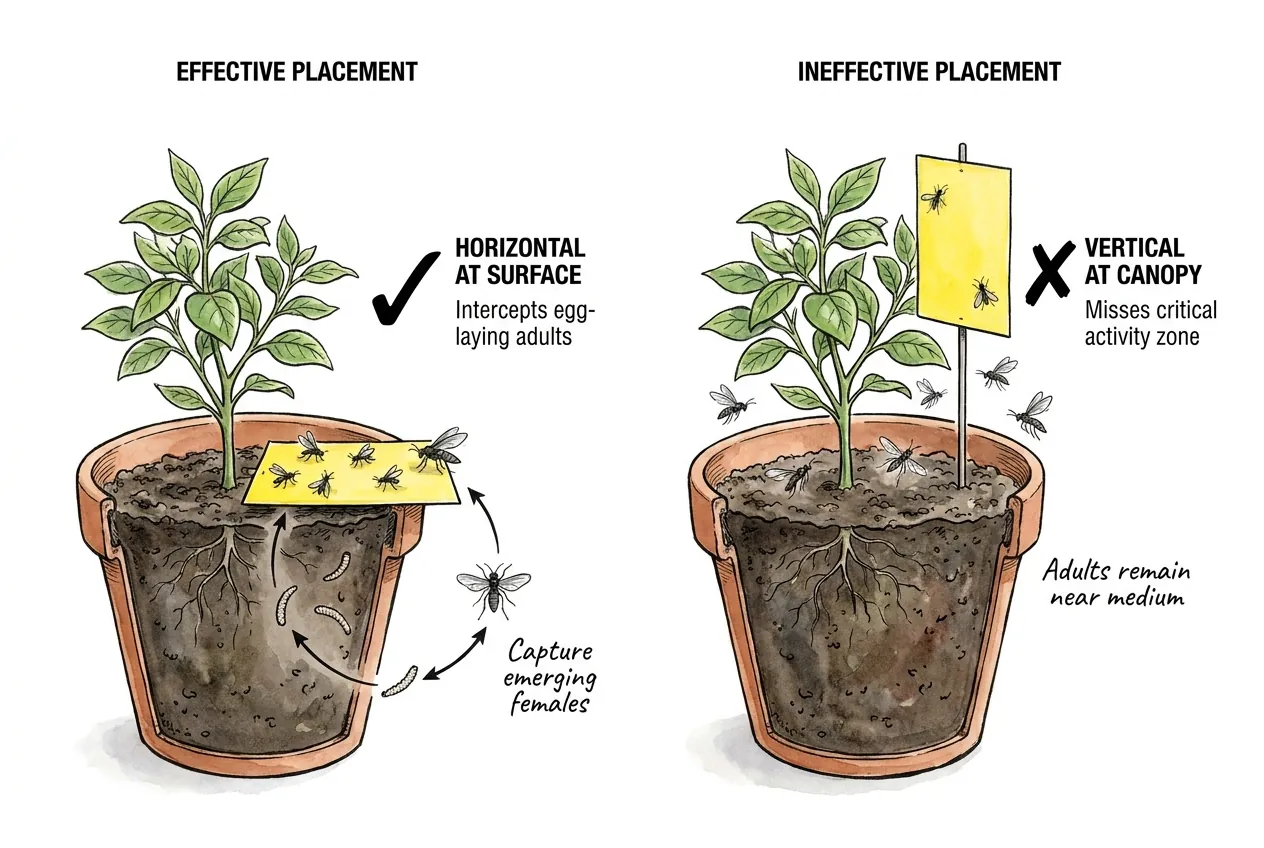
Adults emerge from, rest on, and lay eggs at the media surface, so a card lying flat over the pot is well placed to intercept them.
UC IPM recommends horizontal placement for fungus gnats in some situations. It is a useful orientation for this pest, not the only valid one.
Lay the card flat, or stake it just above the medium at roughly 1 to 2 inches. Vertical cards at canopy height are standard for many greenhouse pests and still catch gnats, but they are less focused on the surface where egg-laying females concentrate.
Reading the trend
Fix one card per hotspot, keep it in the same spot, record the count once or twice weekly, and watch the direction over 2 to 4 weeks.
A falling count after Bti drenches is consistent with fewer larvae surviving to emerge, though airflow, temperature, card age, and new arrivals also move the numbers.
A flat or rising count is a cue to reassess moisture and escalate the larval-stage tools. A card that catches, say, 40 gnats in week 1 and 8 by week 3 is an encouraging sign the program is working, not by itself proof of cause, since it is an uncontrolled reading.
The products
Gideal Yellow Sticky Traps
Gideal Yellow Sticky Traps suit a tray or larger pot where a sheet can sit close to the soil surface. Use them to compare adult counts over time, not as the only treatment.
MAXGUARD Yellow Stake Traps
MAXGUARD Yellow Stake Traps are easier to position at the rim of an individual houseplant. Keep the placement consistent so the count is comparable from week to week.
The limits of traps
Trapping alone will not cure an established infestation. A card removes some egg-laying females but cannot reach eggs, larvae, or pupae already seeded in the pot, and new adults keep emerging as buried stages mature.
That emergence tracks temperature, so the interval varies with conditions rather than being fixed.
Traps are also messy on display plants. In established cases, pair them with a larval-stage tool. For a mild, moisture-corrected pot a trap plus dry-down may be enough.
Spectral Composition of an Effective Light Trap for the Mushroom Pest Lycoriella ingenua. Kecskeméti et al. 2021, Scientific Reports
Monitoring with Sticky Traps. UC IPM Floriculture and Ornamental Nurseries
Biological Control of Fungus Gnats. University of Connecticut IPM
Are Steinernema feltiae nematodes worth the cost and shelf life?
They are worth considering for a stubborn, chronic root-zone problem, but only if you can refrigerate the pack and apply it promptly within the supplier’s temperature range.
Nematodes are the most perishable role and typically the most expensive per treatment, so they are usually more than a single mild pot needs.
The species to use is Steinernema feltiae. It uses an intermediate ambush-plus-cruise foraging strategy, which is why it is the more established choice for reaching the relatively immobile larvae in the root zone.
S. carpocapsae is a surface ambusher and is generally a poorer fit for buried fungus-gnat larvae, so prefer S. feltiae. The sources describe this as a difference in suitability rather than an absolute rule.
Why Nematodes Are a Later Step
These beneficial nematodes move through moist medium to find larvae. Their results vary with the potting mix, temperature, application rate, and product freshness, so they are useful support for a persistent problem rather than a guaranteed rescue.
The product and how to apply it
NaturesGoodGuys Beneficial Nematodes SF is appropriate for a chronic, multi-pot larval problem only when you can refrigerate it on arrival and apply it promptly. Mix and apply it to pre-moistened medium exactly as the supplier directs, then keep the medium moist enough for the nematodes to move.
Skip this option for a mild case, a pot you can safely dry down, or any situation outside the product’s temperature and storage limits.
The limits of nematodes
Perishability gates the purchase. Store the pack cold and dark per the label. NaturesGoodGuys lists roughly 36 to 45°F (2 to 7°C) for up to about 30 days, and never frozen.
Check the expiry date, and once activated in water use the solution promptly, within about 6 hours per the supplier, rather than storing it.
Skip nematodes if you cannot refrigerate on arrival, cannot apply promptly, or your media temperature is outside the supplier’s range.
For a chronically moist mix that never dries, the moisture that defeats dry-down does at least keep the medium in the moist state nematodes need to move, which is one reason they can be a better fit there than in a pot you could simply let dry.
Very wet media can still bring other tradeoffs, such as root oxygen and temperature, so it is not an unconditional advantage.
Entomopathogenic Nematodes. UF/IFAS EDIS EENY-530
Application Rate, Potting Medium, and Host Plant Effects on Efficacy of Steinernema feltiae Against Bradysia coprophila. Jagdale et al. 2004, Biological Control
Integrated Management of Chive Gnats Using Entomopathogenic Nematodes and Low-Toxicity Insecticides. Insects 2019
Beneficial Nematodes. University of Connecticut IPM
What is the correct order of operations?
Deploy the tools in the order the life cycle dictates. Fix moisture and cap the surface first, monitor and knock down adults, kill larvae with repeated Bti, then reach for nematodes only for stubborn root-zone larvae.
Systemic chemistry is a gated last resort.
Attacking recruitment first shrinks how much larvicide and biocontrol you ever need.
Step 1. Cultural plus barrier
Let the top 2.5 cm dry between waterings where you can, and cap the surface with 1.3 to 2.5 cm of coarse pumice.
For a mild single pot, this plus one card often resolves the problem with no larvicide spend.
Step 2. Monitor
Place one yellow card per hotspot at the soil surface and record the weekly count. This gives you a running read on whether the following steps are working.
Step 3. Bti larvicide
Drench with steeped Mosquito Bits on the schedule the label sets, weekly for three weeks. This targets the current larval load repeatedly, catching each new hatch before it pupates.
Step 4. Nematode drench
For chronic, multi-pot infestations and mixes that never dry, drench with S. feltiae across the affected pots and re-drench roughly every two weeks per the label until counts fall.
Nematodes can reproduce inside successfully infected larvae, and repeated applications may extend control where conditions stay suitable, but do not count on a single drench to hold on its own.
The cost is easier to justify across many pots than for a single one.
Match the buy to the severity
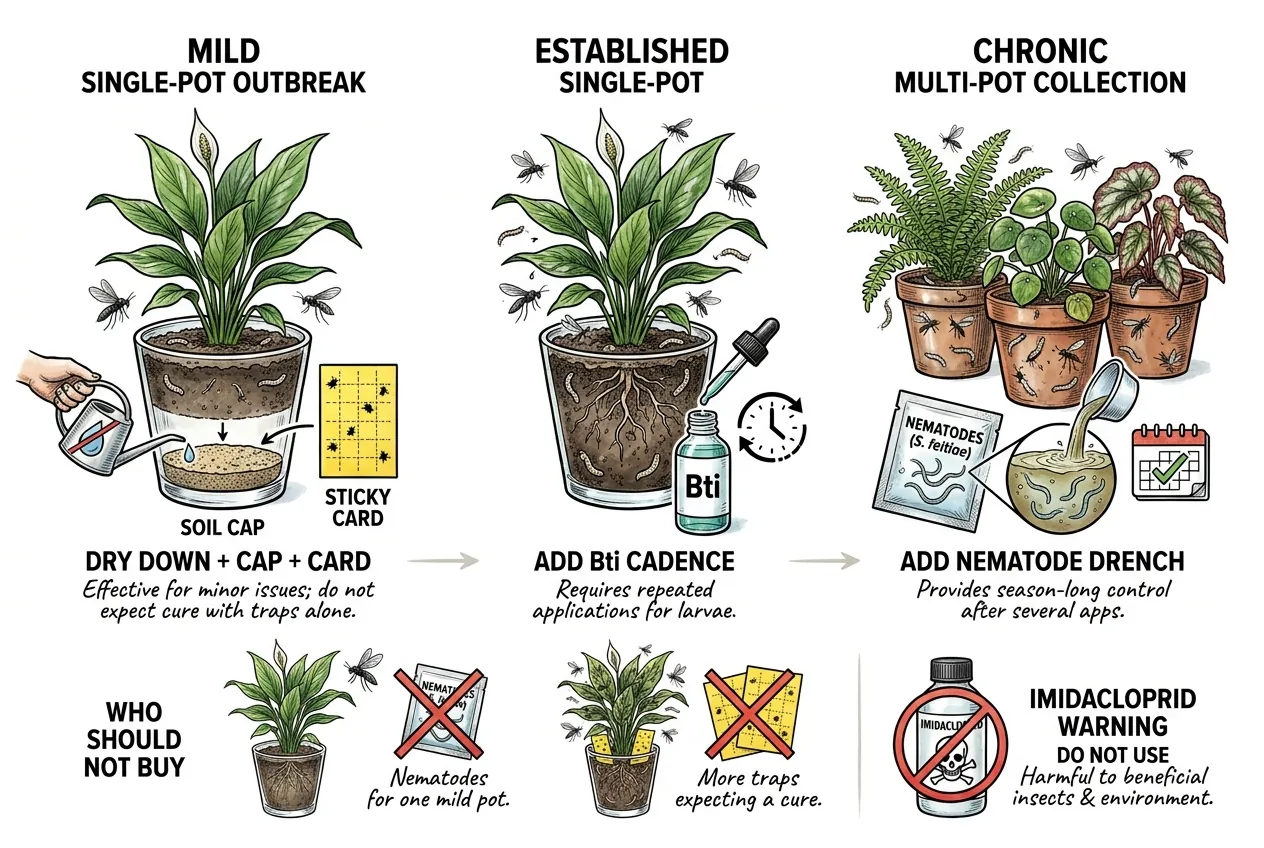
A mild single-pot outbreak often needs only dry-down, optionally a cap and a card. An established single pot adds repeated Bti on the label schedule.
A chronic multi-pot collection is where a nematode drench, repeated per the label, is more likely worth it.
Do not buy nematodes for one mild pot, and do not buy more traps expecting a cure.
Fungus Gnats. UC Statewide IPM Program, Home and Landscape
Fungus Gnats as Houseplant and Indoor Pests. Colorado State University Extension
Who should NOT buy each class, and what about imidacloprid?
Every role has a disqualifying condition where the purchase is wasted money. The systemic last-resort chemistry also carries real safety costs that keep it behind a gate.
Who should skip each role
Skip nematodes if you cannot refrigerate or use them promptly, or if your media temperature sits outside the supplier’s range (NaturesGoodGuys lists about 44 to 86°F).
They are typically the most expensive role per treatment, so they are a poor fit for a single mild outbreak.
Do not buy sticky traps expecting a cure. They track the trend but never touch the eggs and larvae in the substrate.
Skip the barrier if you cannot maintain the depth. A cap thinner than about 1.3 cm, or one repeatedly disturbed by heavy top-watering or frequent repotting, fails to deny egg-laying.
Reconsider any purchase for a plant that may be best discarded. A seriously infested, low-value plant can take more effort than it is worth, and sometimes an inexpensive replacement is the simpler fix.
If you do discard one, bag the plant and its media, isolate it from nearby pots, and follow local plant-waste rules rather than composting it indoors.
The imidacloprid gate
Systemic imidacloprid can reduce fungus gnat larvae in media in laboratory work, but it is a gated last resort with real safety costs, not a lead recommendation.
Products differ, so evaluate a specific product and confirm its label covers indoor ornamental or soil-pest use before considering it at all.
Do not use a product on any edible crop unless that crop and site are on its label. Imidacloprid is systemic and moves into leaves, fruit, roots, and flowers, so it can leave residues in edible tissue. Some imidacloprid products are labeled for certain food crops, but a houseplant granule generally is not, and the label crop, rate, and pre-harvest interval govern.
Its pollinator risk is rated very high, because systemic distribution loads pollen and nectar, so a treated plant that later flowers or moves outdoors can expose bees. UC IPM attaches a do-not-apply-to-flowering-plants precaution.
UC also lists acute mammalian toxicity as low and rates chronic toxicity as no known risk, but that rating is a limited, carcinogenicity- and Prop-65-centered category, not a statement that all chronic, developmental, or exposure risks are absent.
Weigh application exposure, children, and pets alongside the pollinator and residue concerns.
If it is used at all, use it only after the full IPM program has failed and strictly according to the chosen product’s own label, which dictates the allowed sites, application method, and any reentry or protective-equipment requirements.
For most home buyers it is not needed. Extension guidance is clear that insecticides are rarely warranted for these flies indoors, so cultural and biological controls should come first.
Imidacloprid General Fact Sheet. NPIC / Oregon State University
Pesticide Active Ingredient Database. Imidacloprid. UC Statewide IPM Program
Houseplant Problems. UC Statewide IPM Program, Home and Landscape
How do I maintain the program and spot failure modes?
Each role has a maintenance interval, set by its label or supplier, and a specific failure mode. Knowing them prevents the false sense that the problem is fixed.
Bti (reapply on the label schedule)
The failure mode is the one-and-done application. Bti affects only the larvae present when applied, and eggs hatching afterward are untouched, so a single dose lets the population rebound.
Calendar the repeat applications the label specifies, which for Mosquito Bits is weekly for three weeks.
Traps (replace when saturated)
The failure mode is a gnat-coated card that stops sticking and stops reading the trend, giving a false all-clear.
Keep one card reading per hotspot and swap it when the surface fills.
Barrier (re-cap after disturbance)
The failure mode is repotting or heavy top-watering brushing the cap thin, which re-exposes moist organic media. Re-level to full depth after any disturbance.
Nematodes (re-drench and respect the cold chain)
The failure mode is applying dead product. Infective juveniles are living organisms with a short refrigerated shelf life, and heat, age, and direct UV can kill them before they reach the larvae.
Suppliers commonly advise avoiding strongly chlorinated water, so use cool, clean water and apply out of direct sun.
Buy only when you can refrigerate on arrival and apply before the expiry date, checking viability if you can, and drench into pre-moistened media out of direct sun.
Fungus Gnats. UC Statewide IPM Program, Home and Landscape
Fungus Gnats on Houseplants. University of Wisconsin-Madison Horticulture Extension
Frequently asked buyer questions
Which Bt do I buy for fungus gnats?
Buy the one whose active-ingredient line reads subspecies israelensis. The subspecies kurstaki and aizawai, which dominate garden shelves for caterpillars, do not control fly larvae.
Flip the package and read the active-ingredient panel, and check that fungus gnats are on the label.
It must state Bacillus thuringiensis subspecies israelensis, sometimes shown as Bti or H-14. Also note the EPA registration and current concentration.
Fungus Gnats. UC Statewide IPM Program, Home and Landscape
Do sticky traps alone work?
Not on their own for an established infestation. They monitor and lightly mass-trap adults, but the root injury is done by larvae in the substrate, so removing flying adults leaves the egg and larva population intact.
Use a card to read the weekly trend, and pair it with the larvae-killing roles.
Fungus Gnats as Houseplant and Indoor Pests. Colorado State University Extension
Are nematodes worth the cost and shelf life?
They are worth it for a chronic, multi-pot root-zone problem if you can honor the cold chain and the supplier’s temperature range.
They are perishable, must be refrigerated and used before the expiry date on the pack, and are effective within the supplier’s stated range, which for NaturesGoodGuys is about 44 to 86°F (7 to 30°C).
If you cannot meet those conditions or you face a single mild pot, skip them and lean on dry-down plus Bti, adding a barrier if it suits your setup.
Beneficial Nematodes. University of Connecticut IPM
Does hydrogen peroxide kill fungus gnats?
A 3% hydrogen peroxide soil drench can kill larvae it directly contacts, but it does not reach buried eggs and leaves no residual, so at best it is a short-lived stopgap.
Extension sources caution that home peroxide remedies lack proven instructions and can harm plants, people, and beneficial soil organisms, and note that eggs below the surface are not affected.
One extension county page describes a 1-part-3%-peroxide-to-4-parts-water dilution, without controlled efficacy or root-safety data behind it.
If you try it, treat it as an unproven emergency measure rather than a recommended protocol, and lean on dry-down and labeled larvicides instead.
Hydrogen Peroxide for Insect Control on Soil. Ask Extension
A Spooky Houseplant Pest. Fungus Gnats. Cornell Cooperative Extension, Allegany County
Does cinnamon work on fungus gnats?
There is no good evidence for it. Cinnamon is an antifungal, not a demonstrated gnat larvicide, and it is not a control method extension guidance recommends for fungus gnats.
Cinnamon bark extract can inhibit some fungi in laboratory tests, and the idea is that reducing surface fungi removes larval food.
That link is indirect and untested against gnats, and the cited work studied a crop fungus rather than houseplant surface fungi or larvae feeding an inch or two down.
For a more reliable approach, rely on dry-down to reduce larval habitat, and use a labeled larvicide or a barrier where more is needed.
Antifungal Effect of Cinnamon Bark Extract on Fusarium sporotrichioides. PMC
Will letting the soil dry out fix it alone?
Often yes for a mild case, because drying is the most effective free control extension sources point to, but it is insufficient for chronically moist mixes and dense collections.
Let the top 1 to 2 inches dry between waterings and the larvae and eggs in that zone tend to desiccate.
For aroid and peaty mixes that must stay evenly moist, seedling trays that cannot dry, or large collections you cannot let crisp, dry-down handles part of the job.
From there, layer on Bti, a barrier, or S. feltiae as the situation warrants.
Fungus Gnats. PlantTalk Colorado 1445, Colorado State University
The Bottom Line
- Buy for the life stage, not the fly. The larvae in the top few centimeters of substrate cause the root injury. The adults are mainly the visible symptom, though trapping them modestly cuts egg-laying.
- A practical kit is Bti (subspecies israelensis), a coarse dry surface cap at 1.3 to 2.5 cm, and yellow sticky traps for monitoring, adding S. feltiae nematodes for entrenched root-zone larvae. Coarse pumice is a plausible but gnat-untested cap material.
- Free first. Let the top 2.5 cm dry between waterings. That alone resolves many mild cases and prevents over-buying.
- Reapply Bti on the product label schedule, which for Mosquito Bits is weekly for three weeks, because it does not persist and works best on young larvae.
- Nematodes are worth it mainly for chronic, multi-pot problems where you can refrigerate the pack, use it promptly, and stay within the supplier’s temperature range.
- Sticky traps monitor and mildly reduce adults. They do not cure. Read the weekly trend as a sign, not proof, that the larvicide is working.
- Systemic imidacloprid is a gated last resort. High pollinator risk, rarely warranted indoors, and only used where the specific product’s label allows it.
Affiliate Disclosure
This article contains Amazon affiliate links. As an Amazon Associate I earn from qualifying purchases. If you use these links, the site may earn a commission at no extra cost to you. Product availability, price, and specifications can change. Check the current listing before buying.