
Plant Cabinet Humidity Cliff: Hold VPD in Heating Season
When the furnace fights your humidifier, plant cabinet humidity drops in heating season. Track VPD, not raw RH, to keep foliage from crisping.
Jordan Cole · Published 2026-09-14 · 13 min read
Key Takeaways
- Heating air lowers relative humidity without removing water, and the furnace adds dry outside air on top.
- Track VPD, not raw humidity, because steady humidity at a higher temperature is actually drier.
- Aim for roughly 0.6 to 1.1 kPa VPD at leaf height for general foliage, as a band not a point.
- Control the humidifier with a humidistat and add gentle airflow to stop condensation and rot.
- Fix placement, drafts, and plant grouping before spending on higher-capacity gear.
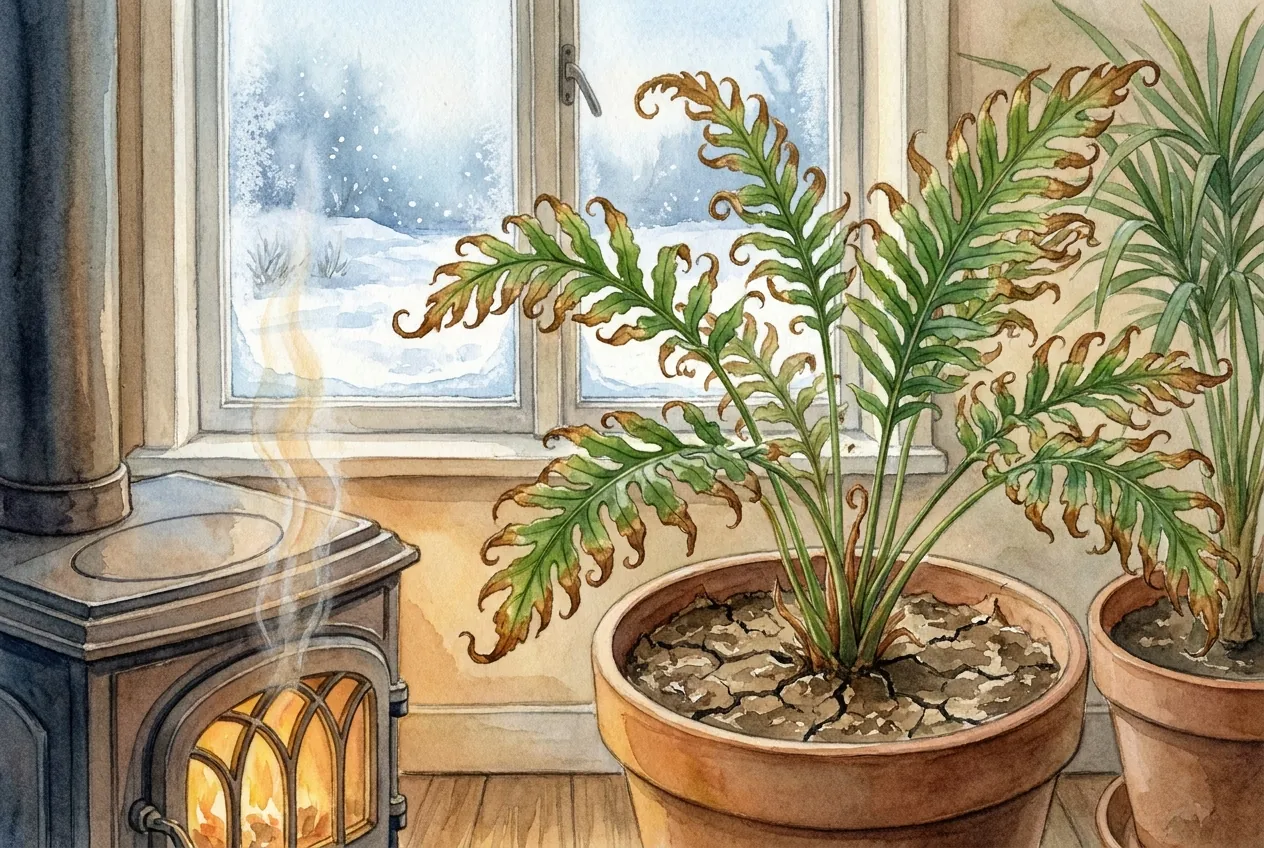
Your cabinet read a comfortable 65% humidity all September. Then the first cold night arrived, the furnace kicked on, and within a few days the same plants had crispy new leaf edges even though the substrate was still moist.
Nothing in the cabinet changed except the air, and the number you were watching was the wrong number.
The reader who wins the heating season stops chasing relative humidity and starts holding a target vapor pressure deficit.
The drop is a cliff, not a slow slide, because it is tied to the furnace switching on.
VPD is what the plant actually feels, and it can be held steady even when a furnace and a humidifier pull in opposite directions.
Why Humidity Crashes the Moment the Heat Turns On
Relative humidity falls when you heat air because warming raises how much moisture the air can hold, without adding any water. Relative humidity is a ratio. It compares the water vapor present to the maximum the air could hold at that temperature.
Warm the air and you raise the denominator, so the ratio drops even though not a single molecule of water left the room.
The maximum the air can hold is called saturation vapor pressure, and it depends only on temperature. It rises steeply as the air warms. Near room temperature a few degrees of warming moves it a surprising amount, which is why heating season hits so hard.
The scale of the drop is larger than most people expect. Because heating adds no water, the absolute moisture stays fixed while capacity rises. Run the psychrometric math on cold outdoor air at 20 F and 80% relative humidity, and heating that same air to 70 F drops it to roughly 15% relative humidity.
Heating without adding moisture is the single largest driver of the dryness your plants meet in autumn.
The Furnace Adds a Second Hit
A forced-air furnace lowers humidity twice over. First it warms the indoor air, which drops the ratio as described above. Second, running the system pulls more cold outdoor air into the house, and that outdoor air carries very little water to begin with.
Cold air is stingy with moisture. Summer air at 80 F and 60% humidity holds about 12 grams of water vapor per cubic meter.
Winter air at 20 F holds only about 3.5 grams per cubic meter even when it is fully saturated.
Heat that dry infiltration air up to room temperature and the humidity reading collapses.
Why VPD Is the Number That Matters, Not Relative Humidity
Vapor pressure deficit measures how hard the air pulls water out of a leaf, and that is what a plant responds to.
VPD is the gap between how much moisture the air holds and how much it could hold at saturation. In plain terms it is the drying power of the air.
The reason humidity alone misleads you is temperature. The same 60% humidity is gentle at 65 F and harsh at 78 F. The warmer air has far more room for water, so it pulls harder on the leaf.
VPD folds temperature and humidity into one figure, and it tracks transpiration in a nearly straight line where relative humidity does not.
Watching relative humidity through a temperature change is like judging a car by its gas gauge while the tank size keeps changing. This is the exact trap autumn sets.
The furnace raises temperature, so even if you somehow held humidity steady, VPD would climb and the air would feel drier to the plant.
What a Good VPD Band Looks Like
A general foliage collection does well in a VPD band rather than at one exact point.
Greenhouse guidance puts the broadly acceptable range near 0.45 to 1.25 kPa. General plant-growth guidance narrows the everyday target to roughly 0.8 to 1.2 kPa.
For a mixed home cabinet of aroids and other foliage, aiming for roughly 0.6 to 1.1 kPa keeps you comfortably inside that range.
Both extremes cause trouble. When VPD runs high the air is too dry, transpiration races, and if the roots cannot keep pace the leaf edges crisp and growth stalls.
When VPD runs very low the air is near saturation, transpiration nearly stops, nutrient movement slows, and standing moisture invites fungal and bacterial disease.
You do not need lab gear to use this. Any online VPD chart converts an air temperature and humidity reading into a VPD number in seconds, so a plain thermometer-hygrometer is enough to work in the band.
Why the Drop Feels Like a Cliff Inside a Cabinet
The change is a cliff because it is tied to a switch flipping, not a season easing in.
Through early autumn your indoor temperature drifted along with mild outdoor air and the cabinet sat at a comfortable VPD.
The first sustained cold nights trigger the furnace to run in earnest, and both of its drying effects arrive together within days.
A plant cabinet makes the jump sharper for two reasons. It is a small volume, so its humidity swings fast when the balance of moisture in and moisture out shifts.
Grow lights also add heat during the photoperiod, pushing the internal temperature above room temperature and raising VPD further for the very same moisture content.
The cycles make it worse still. The furnace and the lights switch on their own schedules, so the internal temperature rides up and down through the day and VPD rides with it. A single midday glance at the hygrometer hides a daily swing that can carry the plant from too wet at night to too dry at noon.
Measuring VPD Where the Leaf Actually Lives
Measure temperature and humidity at leaf height, because that is where the number the plant experiences is set. Air inside a small cabinet stratifies. The shelf under the lights runs warmer and drier than the floor, so a sensor on the base tells you about the base and not about your plants.
Leaf temperature adds a twist worth knowing. A transpiring leaf runs cooler than the surrounding air, commonly about 3 to 5 F cooler, because evaporation cools the surface.
The leaf therefore sees a slightly different VPD than the open air, and indoor growers treat that leaf value as the more accurate one.
A simple way to estimate it is to subtract about 2 C from your air temperature before reading a VPD chart.
A Two-Sensor Baseline That Catches the Drift Early
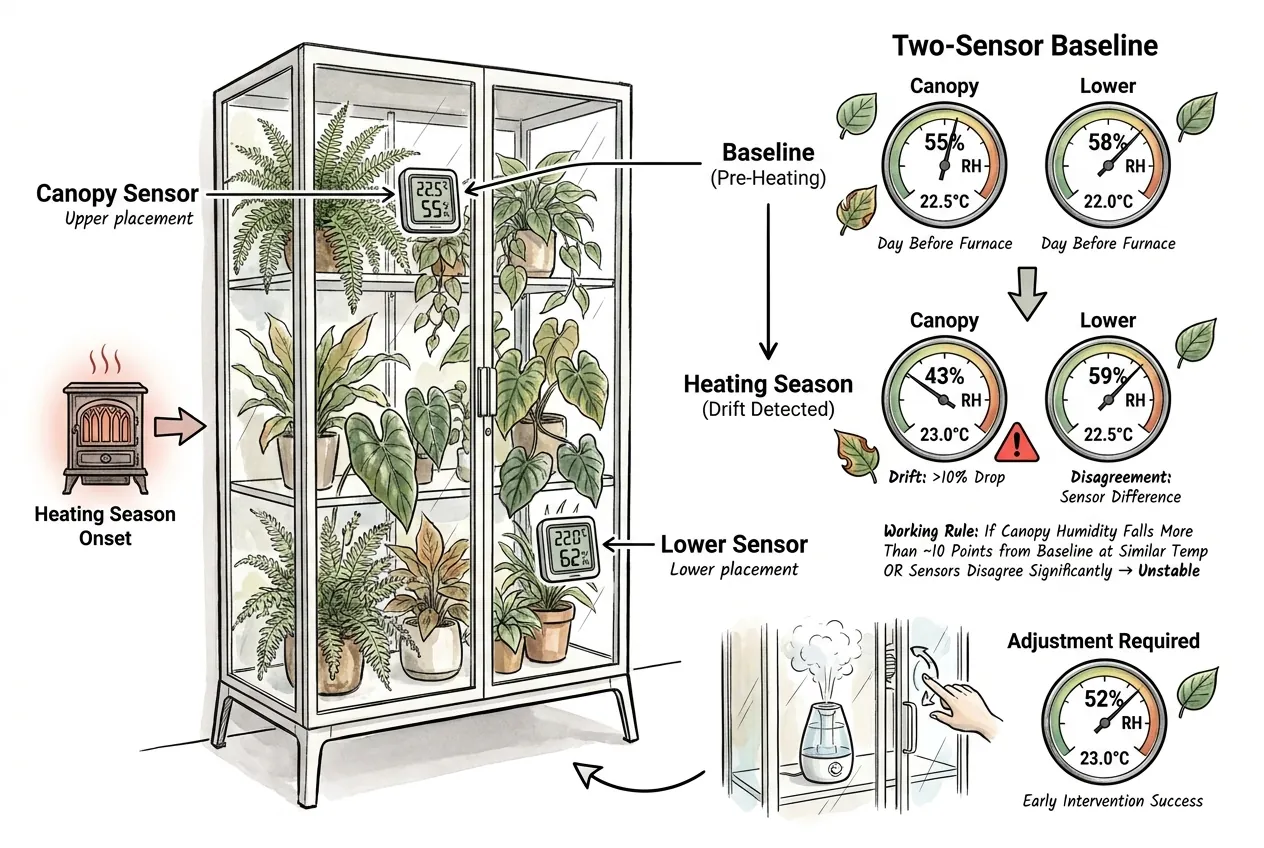
I clip one hygrometer at canopy height and set a second one lower in the cabinet.
I read both at the same clock time each morning and evening through the first heating-on week.
I write down temperature and humidity for each, and I keep the reading from the day before the furnace started as my baseline.
The comparison I care about is at matched temperature, because a steady humidity reading at a higher temperature is actually a higher VPD. My working rule is simple. I compare canopy humidity to the pre-heating baseline at the same temperature.
If it has fallen more than about 10 percentage points, or if the two sensors disagree by more than a few points, I treat the cabinet as unstable. Then I adjust before any leaf shows stress. I chose that 10 point figure as a conservative trigger that catches drift well before symptoms, not as a published threshold.
This two-point read is the part most setups skip. A single sensor averaged over a warm afternoon can look fine while the canopy is quietly drying, and the stratification check tells me whether air is even mixing.
Choosing a Humidifier That Suits a Cabinet
The two common humidifier types differ mainly in what they put into the air besides water.
An ultrasonic unit vibrates water into a cool fine mist and carries whatever is dissolved in that water along with it.
An evaporative unit blows air through a wet wick, so only water vapor leaves and the dissolved minerals stay behind in the wick.
That difference decides whether you get white dust. The pale film that settles on leaves and nearby surfaces from an ultrasonic unit is the calcium and magnesium hardness in tap water, aerosolized and deposited.
An evaporative unit does not aerosolize those minerals, so it does not leave the dust.
If you run an ultrasonic humidifier, fill it only with distilled or reverse osmosis water to remove the dust at its source. An evaporative unit sidesteps the problem and tends to self limit, since its output slows as the air moistens, though it is a little noisier and the wick needs replacing.
Running the Humidifier Without Drowning the Cabinet
Control the humidifier with a humidistat rather than a plain timer, because the demand changes hour to hour once heating starts.
A humidistat switches the unit on and off to hold a target, and it deliberately holds a band rather than an exact number.
It uses a small deadband of a few percentage points of relative humidity, so it is not toggled on and off by every tiny fluctuation.
That deadband protects the equipment and your nerves. Rapid on-off cycling wears out a humidifier and wastes power, and the gap keeps sensor noise from triggering it.
The practical takeaway is to set the band so that even its low edge still keeps your VPD acceptable.
A fixed timer cannot do this, which is the heart of the furnace-versus-humidifier fight.
Placement and Airflow
Put the controlling sensor at plant height, away from the humidifier outlet and away from a cold wall.
Next to the outlet it reads falsely wet and shuts off too soon. Against a cold exterior wall it reads falsely dry and runs too long.
Aim the mist to mix into the cabinet air rather than blast directly onto leaves or the glass door. Add a small clip fan for gentle continuous air movement.
Moving air keeps the thin humid layer at the leaf surface from stalling transpiration. It also prevents cold-spot condensation and evens the VPD across the shelf without drying plants the way furnace air does.
The Cold-Pane Condensation Check
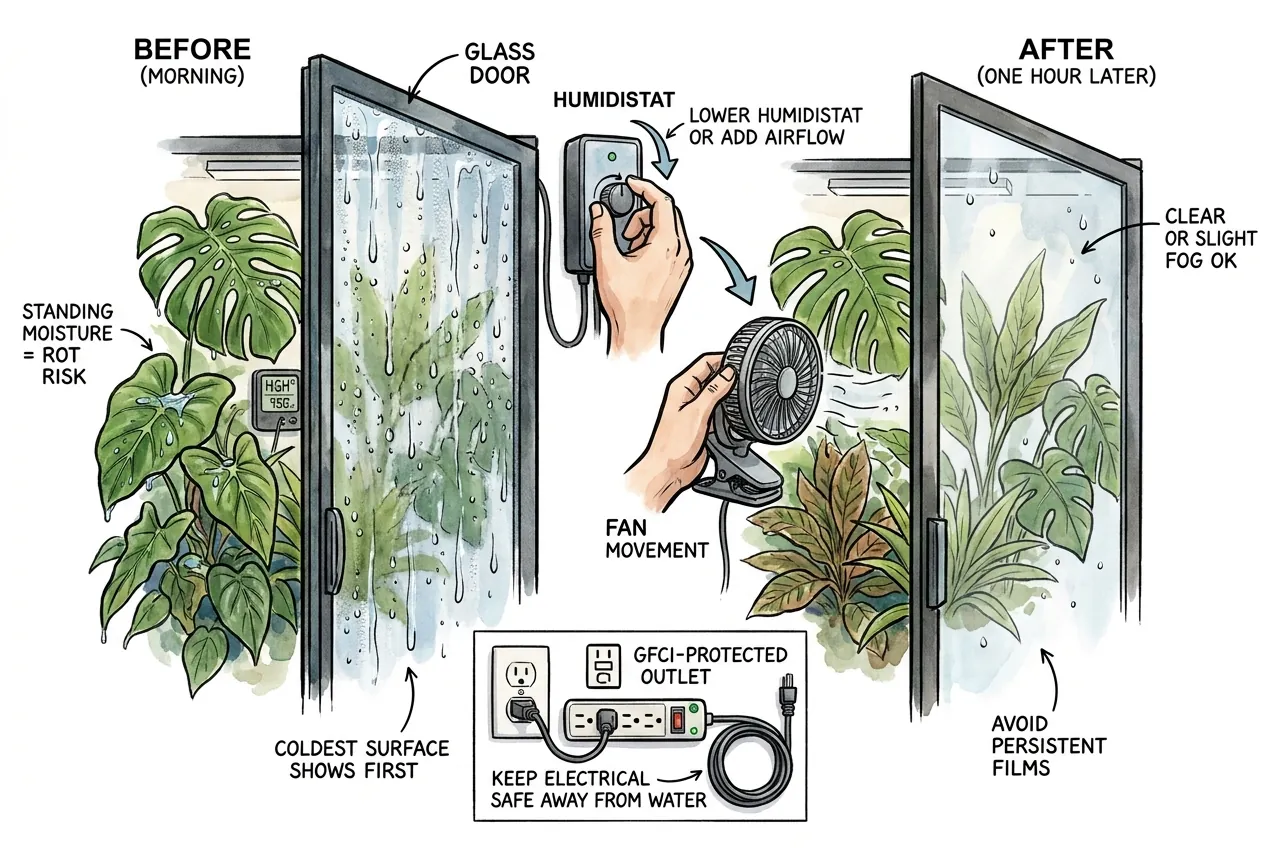
The coldest interior surface is where trouble shows first, usually the glass door or the side against an exterior wall.
Water vapor condenses there before anywhere else, and persistent films or droplets there, along with standing water on leaves, are what drive fungal and bacterial rot.
Each morning during the first humidifier-on week I look at the coldest pane before I open the cabinet, then check again after the first hour of light and airflow.
If condensation is still sitting there after that hour, I lower the humidistat setpoint or add air movement rather than pushing humidity higher.
Standing moisture is a bigger threat than a slightly high VPD, so I let the deficit rise a little rather than let water pool.
Keep the electrical side safe while you do this. Keep humidifiers, fans, and controllers away from standing water, and use a GFCI-protected outlet wherever a cord sits near moisture.
Reading the Warning Signs
Most cabinet failures in heating season fall into two buckets, too dry and too wet, and they look different. Learning the tells lets you correct before a plant declines.
Signs VPD Has Climbed Too High
Crispy brown leaf edges and tips, wilting despite moist substrate, and stalled new growth point to air that is too dry.
This is the classic autumn set, and it appears precisely because temperature rose while you watched an unchanged humidity number.
The fix is to raise humidity toward your band and, if the room itself is very dry, to reduce the cabinet air exchange feeding the problem.
Signs VPD Has Dropped Too Low
Soft or translucent new growth, rot at the base of stems, and condensation that lingers all morning point to air that is too wet.
Transpiration has nearly stopped, so the plant sits in a stagnant, disease-friendly bubble. The fix is more air movement and a lower humidistat edge, not more misting.
Mineral Film Versus Pests
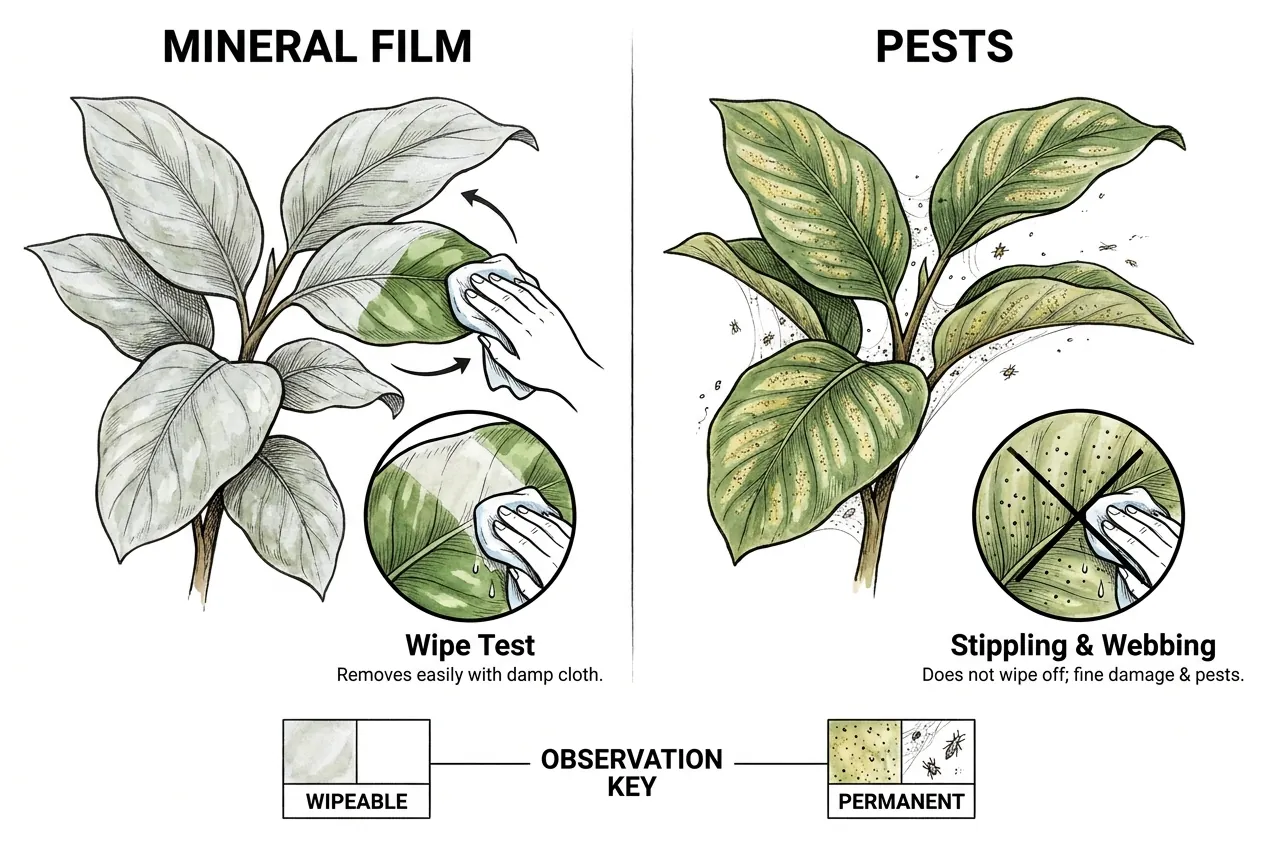
A uniform pale film on the upper leaf surfaces is almost always ultrasonic mineral dust, and it wipes off with a damp cloth.
Pest stippling from spider mites or thrips is finer, often on the undersides, does not wipe away, and may come with webbing or tiny moving specks.
Because the film makes real pest damage harder to spot, keeping it off the leaves is part of good scouting, not just cosmetics.
The Heating-Season Routine, Start to Finish
Hold a VPD band, not a humidity number, and re-baseline the day the heat comes on.
Track temperature and humidity at leaf height, convert to VPD, and aim for roughly 0.6 to 1.1 kPa for general foliage.
Add moisture through a humidistat set so its low edge still keeps that band, and add a small fan for gentle continuous airflow.
Fix the room before you buy more machinery. Move the cabinet off cold exterior walls and away from direct furnace vents. Close obvious gaps so the humidifier is not fighting a draft, and group plants so their own transpiration lifts the local humidity.
These no-cost moves often close most of the gap on their own.
Add capacity only when the space demands it. A large cabinet, a very dry climate, or a sensitive collection can justify a higher-output evaporative unit.
An ultrasonic unit on distilled water works too, paired with an external controller that holds a proper deadband.
Most hobbyists get through the season on measurement at leaf height, a humidistat, and a clip fan, in that order of importance.
When you reach the point of choosing specific hardware, do not guess at a model. Work from the sizing and control criteria in the plant cabinet humidity control kit product chooser.
That guide matches humidifier output, water type, and controller behavior to cabinet volume and climate.
Key Takeaways
- Heating air lowers relative humidity without removing water, and a furnace adds dry infiltration air on top.
- Track VPD, not raw humidity, because a steady humidity reading at a higher temperature is a drier, higher VPD.
- Aim for roughly 0.6 to 1.1 kPa at leaf height for general foliage, treating it as a band.
- Control the humidifier with a humidistat and add gentle airflow to stop cold-pane condensation and rot.
- Fix placement, drafts, and plant grouping before spending on higher-capacity gear.