
Why Monstera Albo Reverts to Green (Cell-Layer Reason)
Monstera Albo reverts to green when the white cell layer is lost at the growing tip. Learn the biology and why cutting to a variegated node works.
Priya Patel · Published 2026-08-13 · 8 min read
Key Takeaways
- Albo variegation is two genetic cell lines, not a pigment you can boost with light or fertilizer.
- Reversion happens at the growing tip when the white cell layer is lost, and it is permanent for that shoot.
- White tissue cannot photosynthesize, so green grows faster and takes over unless you step in.
- Cutting back to a still-variegated node releases a lower bud that may still carry the white lineage.
- Recovery is odds, not a guarantee, so cut to the strongest variegated node and step down if it reverts.
Your Monstera Albo pushed out a solid green leaf, and no amount of extra light is bringing the white back.
That is not a care mistake you can fix with a fertilizer schedule. Albo variegation lives in specific layers of cells at the growing tip, and once the white layer drops out of that tip, every leaf it makes afterward is green.
When repeated new growth is all green, cut back to the strongest visibly variegated node you can keep on the parent plant. That lower bud may still carry the variegation, but the visible pattern is a clue rather than a guarantee.
What Monstera Albo Variegation Really Is
Albo variegation is a chimera. Green and white cell lines grow side by side in the same plant.
Green cells make chlorophyll. White or cream cells do not, so they cannot be created with fertilizer, a supplement, or more light.
I photograph every side of the stem at candidate nodes with the bud eye visible. A white stripe seen from the front may pass beside the bud rather than through the tissue that forms the next shoot.
The nodes are numbered and their images preserved after cutting. If a new shoot is green, I can review the actual choice instead of rewriting it from memory.
When plant health and space allow, I judge a new shoot across several leaves and its stem pattern rather than reacting to the first blade. One leaf can be unusually green or white without defining the entire shoot.
Chimera type decides how easily it reverts
The balance of green and white cells can change as the plant grows. That makes Albo prone to reversion and means two cuttings from the same parent can develop very different patterns.
How this differs from Thai Constellation
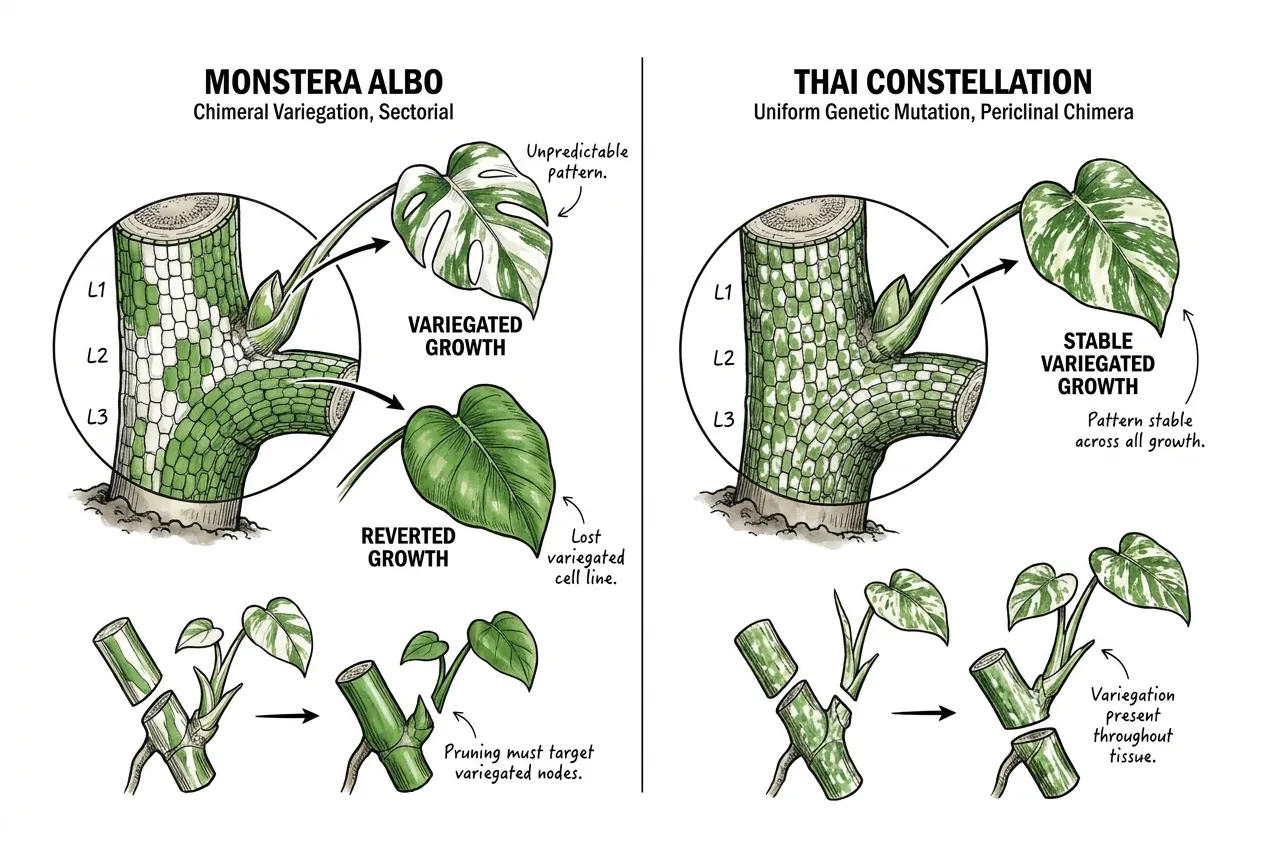
Thai Constellation carries its variegation differently and rarely reverts in the same way. The cut-back method below is for Albo and other chimeral Monsteras.
Choose a Node by Visible Variegation
You do not need to map the cell layers in a Monstera stem to make the cut. The important point is that the growing tip contains separate green and white lineages, and a lower bud can differ from the reverted tip above it.
Visible white in the stem and around an axillary bud gives the best available clue that a node may still make variegated growth. It cannot reveal the bud’s internal cells with certainty.
Why a Variegated Node Can Still Fail
The cell arrangement that creates the pattern can remain stable across several leaves, then change at one growing point. That is why a variegated-looking node improves the odds but cannot promise the next shoot will stay variegated.
Use the Pattern Only as a Clue
Broad white sectors or a visibly variegated bud are generally stronger signs than a single small fleck. Use the strongest healthy node available and be ready to step down to another variegated node if it reverts again.
| Leaf appearance | What it suggests | What it means for regrowth |
|---|---|---|
| Thin white edges only | A weaker visual clue | May not produce strong variegation in new leaves |
| Broad interior white sectors | A stronger visible clue | Better odds of variegated new growth |
| Half-moon, one side fully white | A strong visible clue | A good node to keep when pruning |
| Single small fleck | A weak visible clue | Lower odds of variegated regrowth |
Why the Green Takes Over
Reversion starts at the growing tip, not in a leaf you can already see. By the time an all-green leaf appears, the tip has already lost the white cells.
That tip cannot make white leaves again on its own. The practical response is to cut back to a lower, visibly variegated node.
Green grows faster, so it wins
Green tissue supplies more photosynthesis than white tissue, so an all-green shoot can grow vigorously and use resources the plant might otherwise send to variegated growth. If it keeps producing all-green leaves, it can become the dominant shoot.
Once a shoot has repeatedly reverted, pruning it is more useful than trying to make it white again with light or fertilizer.
The Energy Economy That Drives It All
White tissue has little or no chlorophyll, so it depends on green tissue elsewhere on the plant for sugars. The more white a plant carries, the less leaf area is available to support growth.
An all-white cutting with no green tissue is unlikely to sustain itself long term. A cutting also needs a node to grow at all, so inspect both the pattern and the node before buying or propagating it.
More white means slower growth
Highly variegated plants often grow more slowly than greener plants in the same conditions because they have less photosynthetic tissue. Slow growth alone does not diagnose a problem, but a sudden stall, leaf damage, or rot still deserves normal care checks.
White tissue also scorches more readily under direct afternoon sun. Keep the plant in bright, filtered light and move it back if white areas start to brown.
What Light Can and Cannot Do
Light cannot create variegation. If a growing tip has lost its white lineage, more intensity will not restore it, and a reverted leaf will not become variegated later.
Light still influences plant health. Give the remaining variegated growth bright, indirect light so the green tissue can support the plant, but do not expect more light to restore a reverted tip or create new white tissue.
The practical light target
Aim for bright but diffuse light. Enough brightness to keep the reduced green area well-fed, gentle enough that direct sun does not scorch the delicate white sectors.
Make small changes and judge them by new growth and whether the white tissue is scorching. There is no single light, humidity, or leaf-temperature setting that guarantees stable variegation.
The single practical rule is to stop chasing variegation with a grow light on a reverted vine. Good light supports the variegation a plant still has. It cannot rebuild what a tip has already lost, which is why the real fix happens at a node.
Why Cutting Back to a Variegated Node Works
New Monstera growth comes from axillary buds at nodes on the stem, never from a leaf or a bare stretch of stem. A node is where a leaf attaches and usually holds a dormant bud.
A lower bud may still hold variegation even after the tip above it has reverted. Cutting off the green top lets that lower bud take over.
Where to cut and why it matters
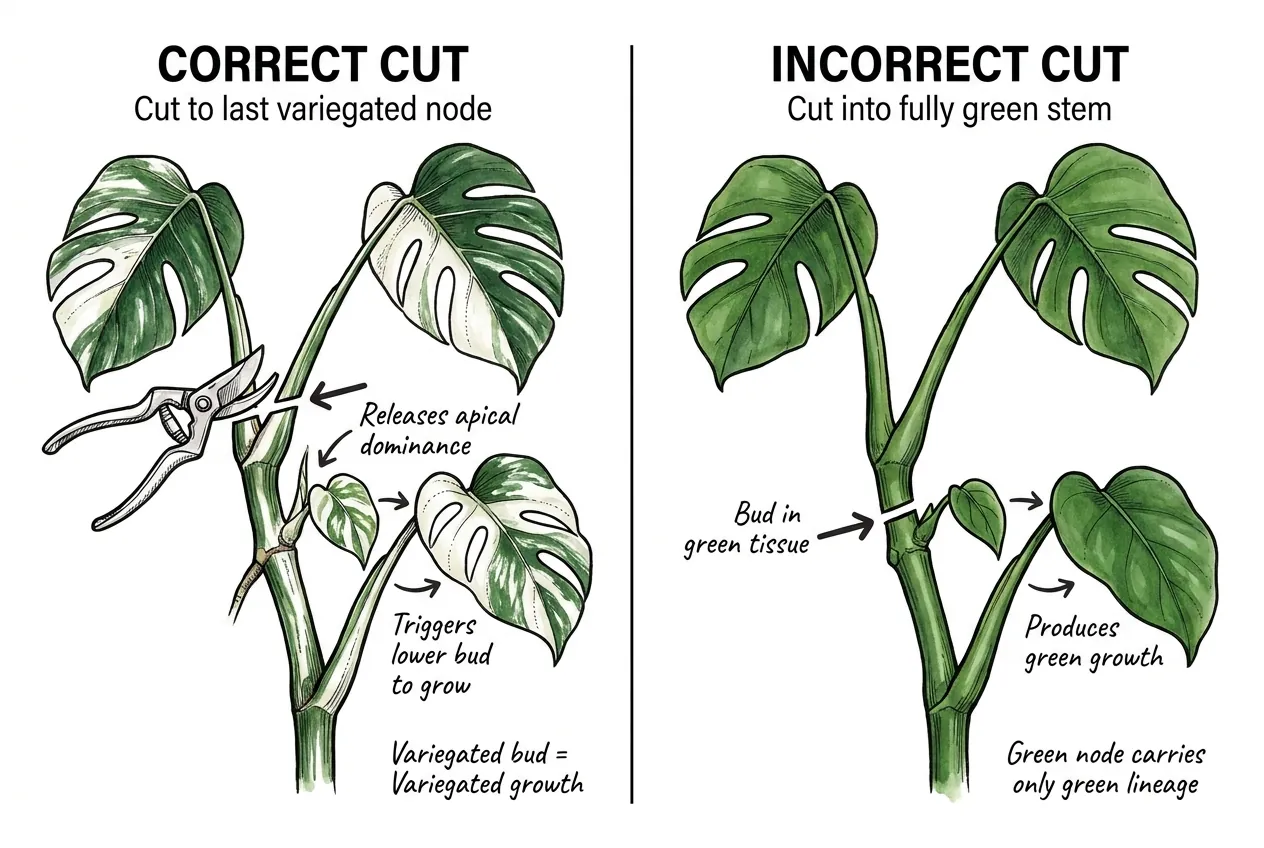
Cut back to the last node that is still clearly associated with variegation, leaving that node on the plant. Removing the green tip allows a lower bud to grow. If it still holds white cells, its new shoot can be variegated.
Cutting into fully green stem usually fails for the mirror-image reason. A node buried in reverted, all-green tissue no longer carries the white lineage, so its bud produces green growth.
This is why growers move up the stem to the highest strongly variegated node rather than cutting deep into green.
It is odds, not a guarantee
Even a variegated-looking node can produce a green shoot. If that happens, cut down to the next lower variegated node and try again. A visibly variegated bud is the best clue, not a guarantee.
Making the Cut: Technique and Realistic Expectations
The mechanics are simple, but a few details decide whether a node breaks cleanly or rots.
Work during the active growing season of spring or summer, when bud break and wound healing are fastest. A cut made during dormancy tends to stall.
Locate your target node first, confirm it has a live bud or eye, then cut cleanly relative to it.
Leave the last variegated node on the parent so its bud is freed to grow. If you are also rooting the removed top, make sure that piece includes a node and ideally an aerial root, because a nodeless cutting cannot grow and will simply rot.
Why a clean, sterile cut matters
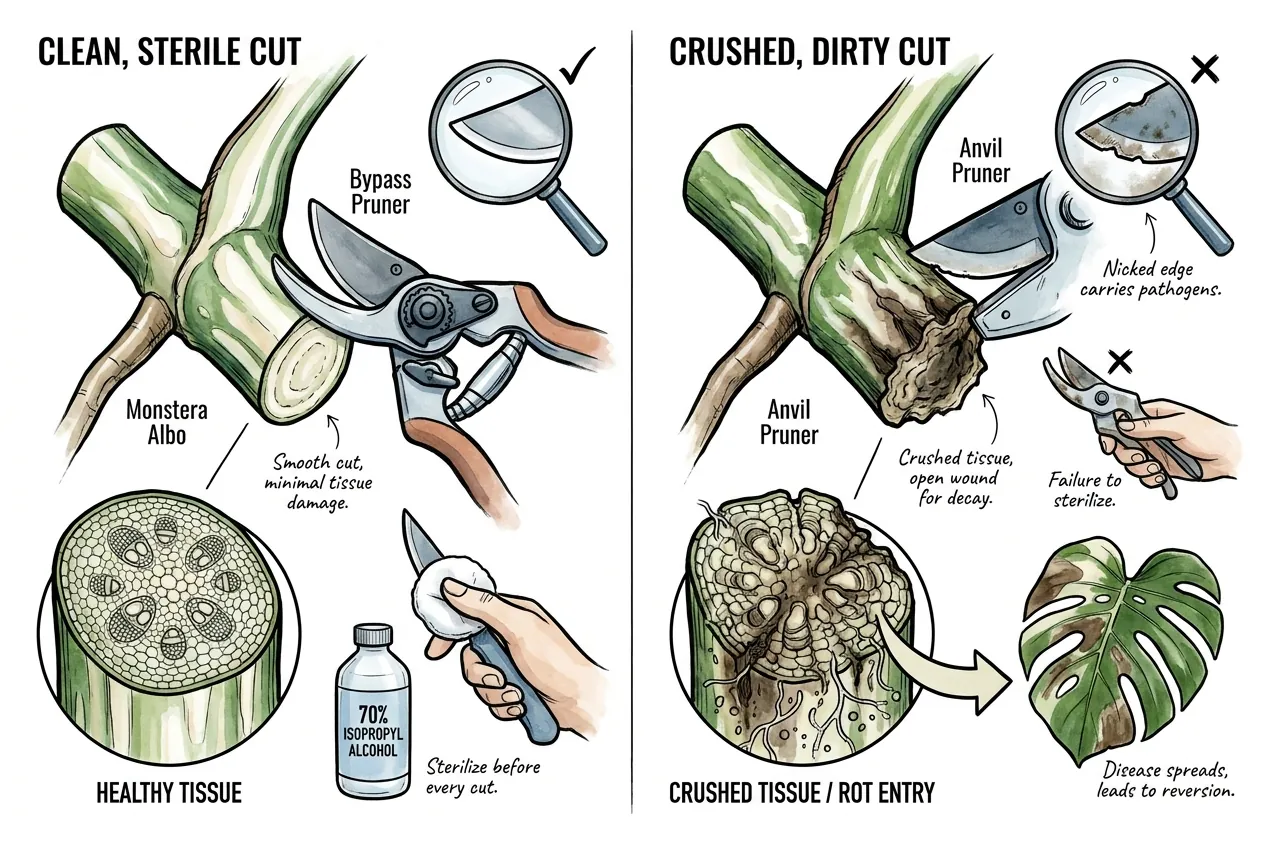
A clean cut leaves less crushed tissue and less open surface for rot and disease to enter while the wound calluses over.
Sterilizing the blade between cuts stops you from carrying pathogens from one wound to the next.
Wipe the blade with isopropyl alcohol and cut decisively rather than crushing the stem.
Use a sharp bypass pruner or a clean craft blade that can cut the stem in one pass without crushing the node. A bypass blade slices past another blade, while an anvil pruner presses against a flat plate and is more likely to bruise soft stems.
If you prune often, a one-hand bypass pruner with replaceable blades is worth it. When the edge nicks, you swap a cheap part instead of buying a new tool.
For a plant or two a year, a sharp, sterilized craft blade does the same clean job. Whatever you use, match the blade to the stem diameter so it slices in one pass rather than crushing, and wipe it down between plants.
Honest limits and troubleshooting
Set expectations before you cut. Recovery is a matter of odds, timing, and sometimes several attempts, not a switch you flip.
Regrowth reverts again
If a new shoot from your chosen node comes back solid green, the bud there lacked the lineage.
Cut back to the next lower variegated node and try again, starting from the strongest-pattern node available.
The cut rots instead of breaking a bud
A mushy, blackened stub means rot set in before a bud could break. Remove the rotted tissue, cut back to healthy stem above a node, improve airflow, and avoid keeping the stub soggy.
No variegated node remains anywhere
If the plant has reverted so completely that no variegated tissue is left, no cut can recover it, because the lineage is gone from the entire plant.
At that point you either keep it as a healthy green Monstera or source a fresh variegated cutting with a node.