
Anthurium Clarinervium Droopy Petioles: The Humidity Fix
Anthurium clarinervium droopy petioles from low humidity? Heating spikes VPD and drains leaf turgor. Measure, rule out rot, then raise humidity to fix it.
Elena Vargas · Published 2026-09-01 · 15 min read
Key Takeaways
- Heating warms the air without adding moisture, so humidity drops and dry air pulls water from the leaf.
- Measure at leaf height during a heating cycle. Aim for 60 percent or more, as 20 to 30 percent invites droop.
- If a petiole firms up overnight under raised humidity, the cause is air, not roots.
- Dark, mushy, sloughing roots mean rot, which needs less water and airier mix, not humidity.
- Use a humidifier, grouping, or a vented enclosure for lasting humidity. Misting fades in minutes.
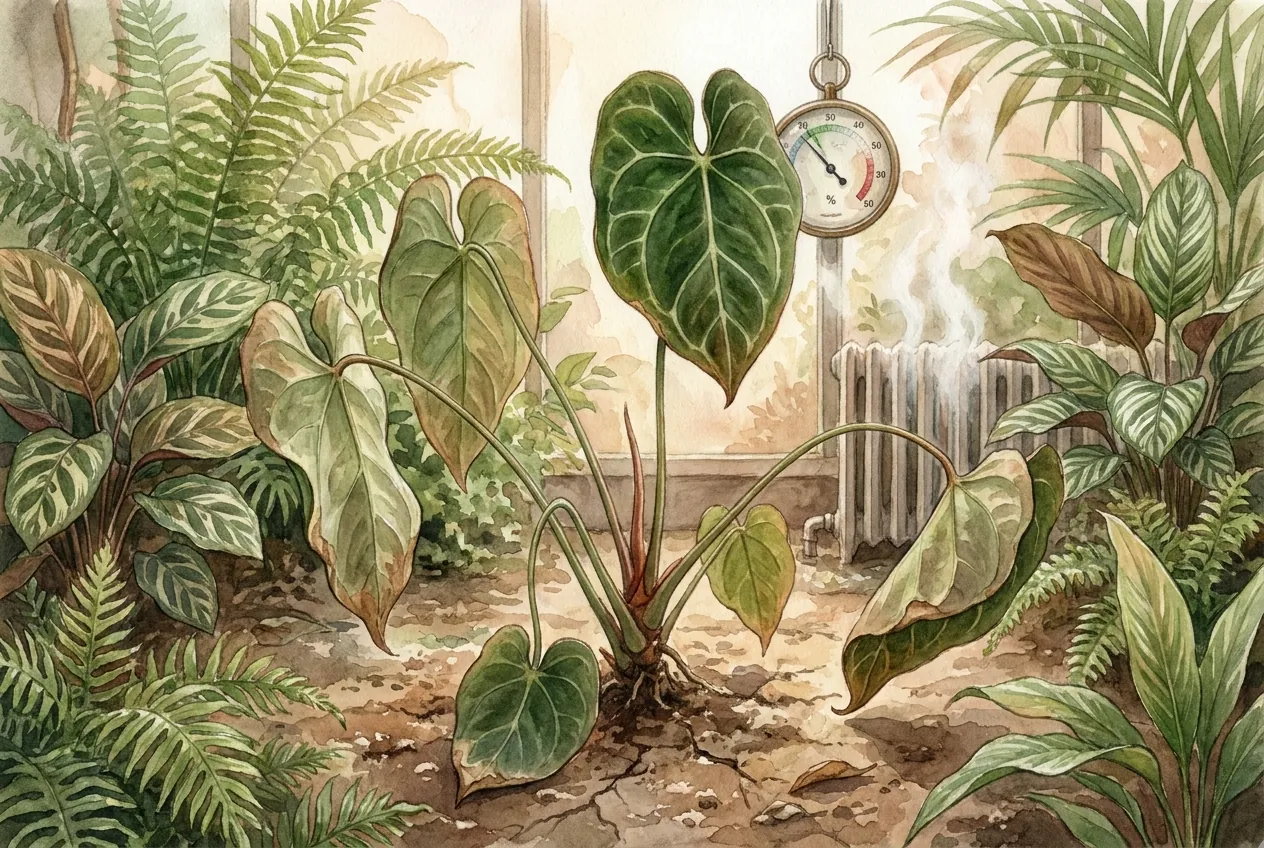
Your velvet Anthurium looked perfect all summer. Then the furnace kicked on for the first cold snap, and within days the petioles started to bend and the leaves sagged.
The soil is still moist, so it cannot be thirst. It is the air.
Central heating warms the room without adding any water to it, so relative humidity collapses. The dry air then pulls moisture out of the leaf faster than the roots can resupply it. The petiole loses its internal water pressure and folds.
In most cases this is reversible, and it is not a watering problem.
This is a mechanism you can measure and fix. The plan below moves in order. Confirm the humidity crash, rule out the look-alike causes that need the opposite treatment, then raise humidity in a way that actually lasts.
Why heating dries the air and drops the humidity
Heating lowers relative humidity because warm air can hold far more water vapor than cold air, and your furnace adds heat without adding moisture.
The same amount of water in the air becomes a much smaller fraction of what the warmed air could hold, so the percentage falls.
The numbers are stark. Air at 41 degrees Fahrenheit and 80 percent relative humidity, warmed to 68 degrees Fahrenheit with no water added, drops to about 29 percent relative humidity.
As a rough rule, the air’s moisture-holding capacity roughly doubles for every 20-degree Fahrenheit rise in temperature.
This is why a room that read a comfortable 55 percent in September can read below 30 percent in December with nothing changed but the thermostat.
The same warmed-air effect drives that seasonal drop into the low band where heating-season indoor air commonly lands.
That is well under the 60 percent or higher that a velvet Anthurium prefers.
The room simply got much drier, so the plant did not suddenly need more water.
It swings with every heating cycle, not just once
Relative humidity dips each time the heat runs, then partly recovers between cycles. Because relative humidity falls as temperature rises at a fixed amount of moisture, the driest moment for the plant is the middle of an active heating cycle.
That timing matters for how you measure. A single reading taken while the heat is off will overstate how comfortable the plant actually is.
To catch the real low point, you have to read during the cycle, which is exactly what the next section sets up.
The mechanism, from dry air to a folded petiole
The chain from dry air to a drooping leaf runs through a single driving force called vapor pressure deficit, or VPD.
VPD is the gap between the water vapor the air holds and the maximum it could hold.
It is the primary pull that moves water out of a leaf and into the room.
When heating raises VPD, the leaf loses water faster. If that loss outruns the rate at which roots and stem can resupply water, the living cells in the petiole lose pressure and the stalk bends.
What VPD is, and why a warm dry room pulls harder
VPD is set by temperature and humidity together, so the same humidity reading means different drying power at different temperatures.
A warm dry room has a high VPD and pulls hard, even at a humidity number that sounds only moderate.
Greenhouse guidance treats roughly 0.5 to 0.8 kPa as a comfortable band for many plants. Push VPD well above that with hot, dry, heated air and transpiration climbs. In response, the leaf’s pores begin to close to conserve water, which protects the plant but also slows its growth.
Turgor is what holds a non-woody petiole up
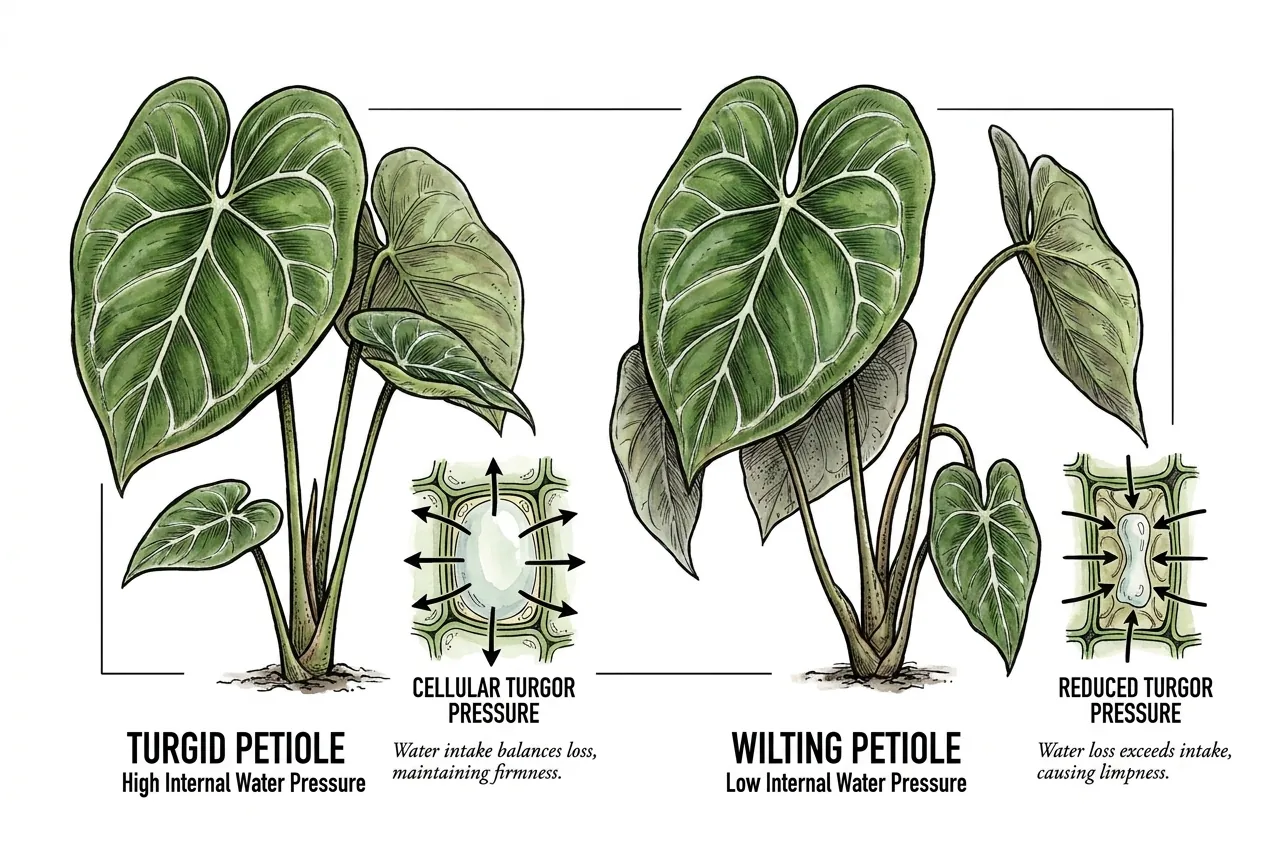
A petiole stays rigid because of turgor, the internal water pressure that pushes each cell’s contents against its wall.
Sum that pressure across thousands of cells and you get a firm, upright stalk that has no wood in it at all.
In a well-watered plant, that pressure sits around 0.6 to 0.8 MPa. Let water leave the cells faster than it arrives and the pressure falls toward zero, and the non-woody tissue goes limp.
That is wilting, and in intact tissue it reverses once the water balance is restored.
This is why the velvet Anthurium tells on the season early. Its large heart-shaped leaf rides on a relatively slender petiole. A drop in turgor shows up as a visible bend before you see any change in leaf color.
A soft, bending petiole is a direct readout that turgor has fallen, not that the pot is empty.
Why moist soil and a wilting leaf go together
Moist soil plus a wilting leaf means demand beat supply, not that the plant is dry.
When VPD is high, water can leave the leaf faster than roots pull it from even damp soil, so the leaf sags while the pot stays wet.
Uptake has a ceiling set by root surface, the plant’s internal plumbing, and how well roots contact the mix.
Once the pull set by dry air exceeds that ceiling, leaf water content falls no matter how wet the soil is.
The practical takeaway is to resist the watering can. Reduce the demand first by raising humidity and easing local heat, and only then reconsider the roots.
Measure before you fix, so you treat the real cause
Measure the air the plant actually sits in before you change anything. A cheap hygrometer placed at leaf height, read during a heating cycle, tells you whether you are in the comfortable band or a droop-prone one. Guessing sends most people straight to overwatering.
For a velvet Anthurium, treat 60 percent relative humidity or higher as the working comfort target.
Heated rooms often sit at 20 to 30 percent, which is squarely in the droop-prone zone.
Where to put the sensor and when to read it
Put the sensor within a hand-span of the plant, at leaf height, away from cold window glass and out of any direct furnace airflow.
Cold glass and hot vents each report their own microclimate, not the leaf’s, and can read fifteen points off.
Read it twice. Take one reading in the cool morning before the heat runs, and one in the middle of an active heating cycle the same day.
Act on the lower number, because that is the air the plant actually endures.
Tie the droop to the heating cycle with a short log
To pin the cause on heating rather than on your watering, I run a two-reading log for about three days.
I set a hygrometer at leaf height beside the plant. I read relative humidity and temperature once before the heat kicks on and once mid-cycle, keeping the sensor in the same spot and off cold glass each time.
The decision rule I use is simple. I look for a drop of roughly 15 or more percentage points between the two readings, landing in the low band around 20 to 35 percent while the plant droops.
When I see that, I treat the heating-driven VPD spike as the working cause.
I then prioritize raising humidity over touching the watering schedule.
That 15-point figure is my own conservative reading rule, not a published cutoff. I set it well above the normal jitter of a cheap sensor, so that a real seasonal shift stands out from ordinary hour-to-hour noise. The underlying fact that heating lowers relative humidity is basic psychrometrics.
Rule out the look-alikes before you commit to a fix
The same drooping leaf can come from opposite causes, and the fixes contradict each other. Reversible humidity droop wants more moisture in the air.
Root rot from overwatering wants less water and more air at the roots. Get the diagnosis wrong and you make it worse.
The fastest way to separate them is a non-destructive reversibility test, before you ever disturb the roots.
The same-evening reversibility test
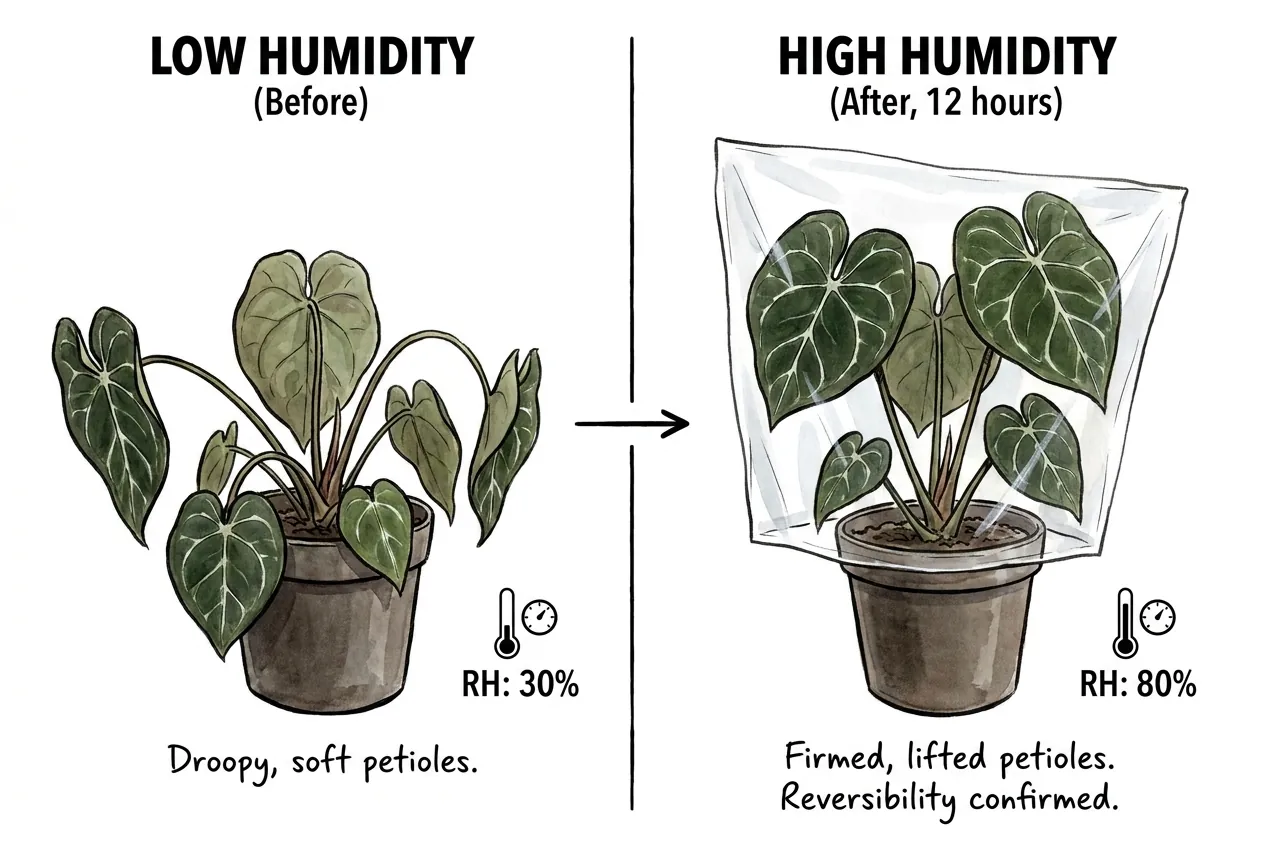
Before I unpot anything, I run an overnight reversibility check. I note the room’s humidity and temperature at leaf height.
Then I loosely tent the plant with a clear bag or bin propped off the leaves, or move it to a spot I have measured as much more humid. I keep watering and light the same.
The rule I follow is about the 12-hour mark. If the drooped petiole regains noticeable firmness or lift within roughly 12 hours at raised humidity, I treat the cause as humidity-driven turgor loss.
If it stays soft, or the base feels mushy or looks dark, I stop calling it humidity and inspect the roots.
I chose 12 hours as a conservative interval, not a published standard. It gives intact tissue time to rehydrate as demand drops. It also stays short enough that I am not sealing damp foliage in a bag long enough to invite mold.
I keep the tent off the leaves and out of direct sun so the enclosure never overheats the plant.
A petiole that firms up overnight under raised humidity confirms an air problem and rules out structural collapse.
If it fails the test, check the roots
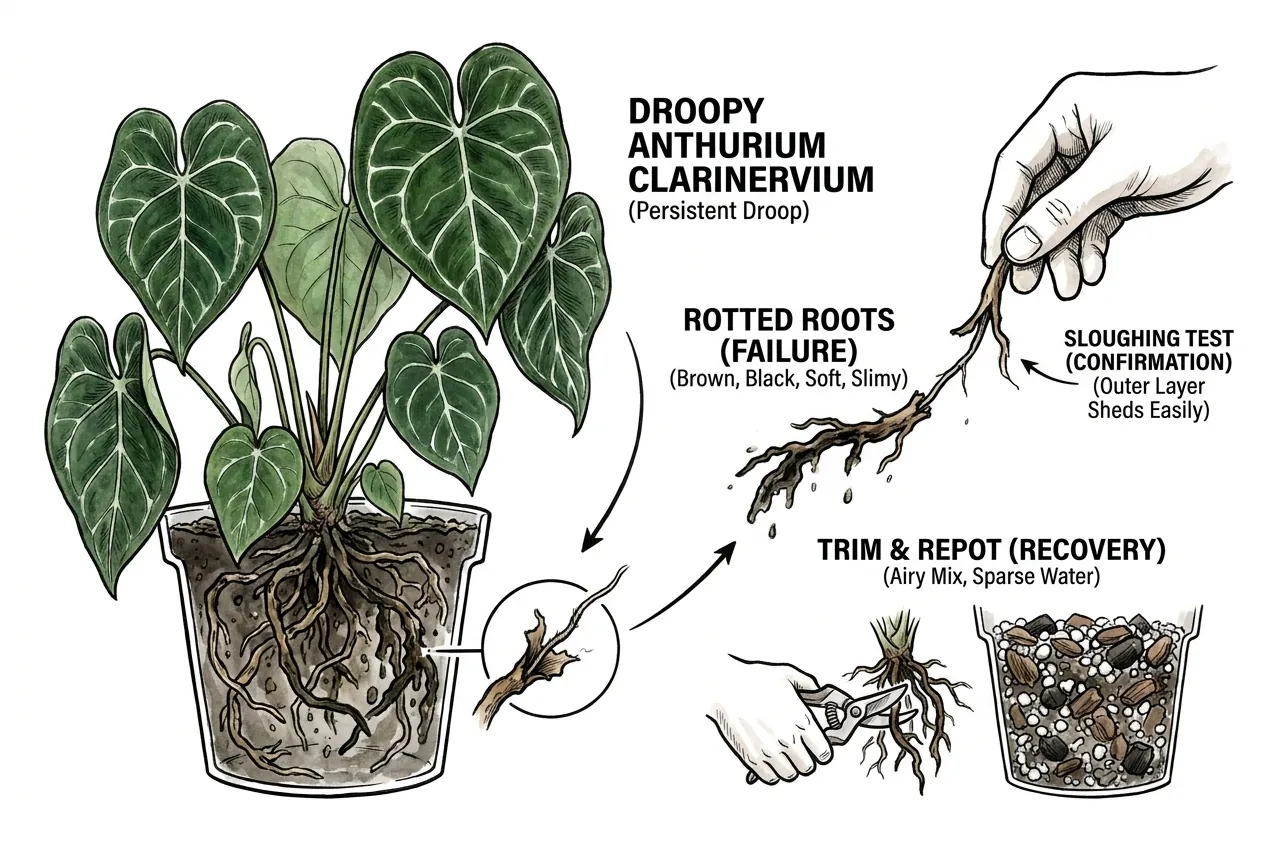
Persistent droop after raised humidity points to the supply side, so the next step is to look at the roots.
Overwatering starves roots of oxygen and invites rot organisms, and rotted roots cannot move water even from soaking soil.
Healthy roots are white or light tan and firm. Rotted roots are brown or black, soft, and slimy, often with a musty smell. A telling field check is that the outer root layer sloughs off when gently pulled, leaving a bare thread, a sign aligned with published anthurium disease guidance.
If you find rot, the fix is the opposite of humidity. Trim the dead roots, repot into an airy, chunky aroid mix, and water sparingly while the plant recovers.
Do not tent damp, rotting foliage, because that only feeds the fungus.
Cold roots, drought, and slow decline look different
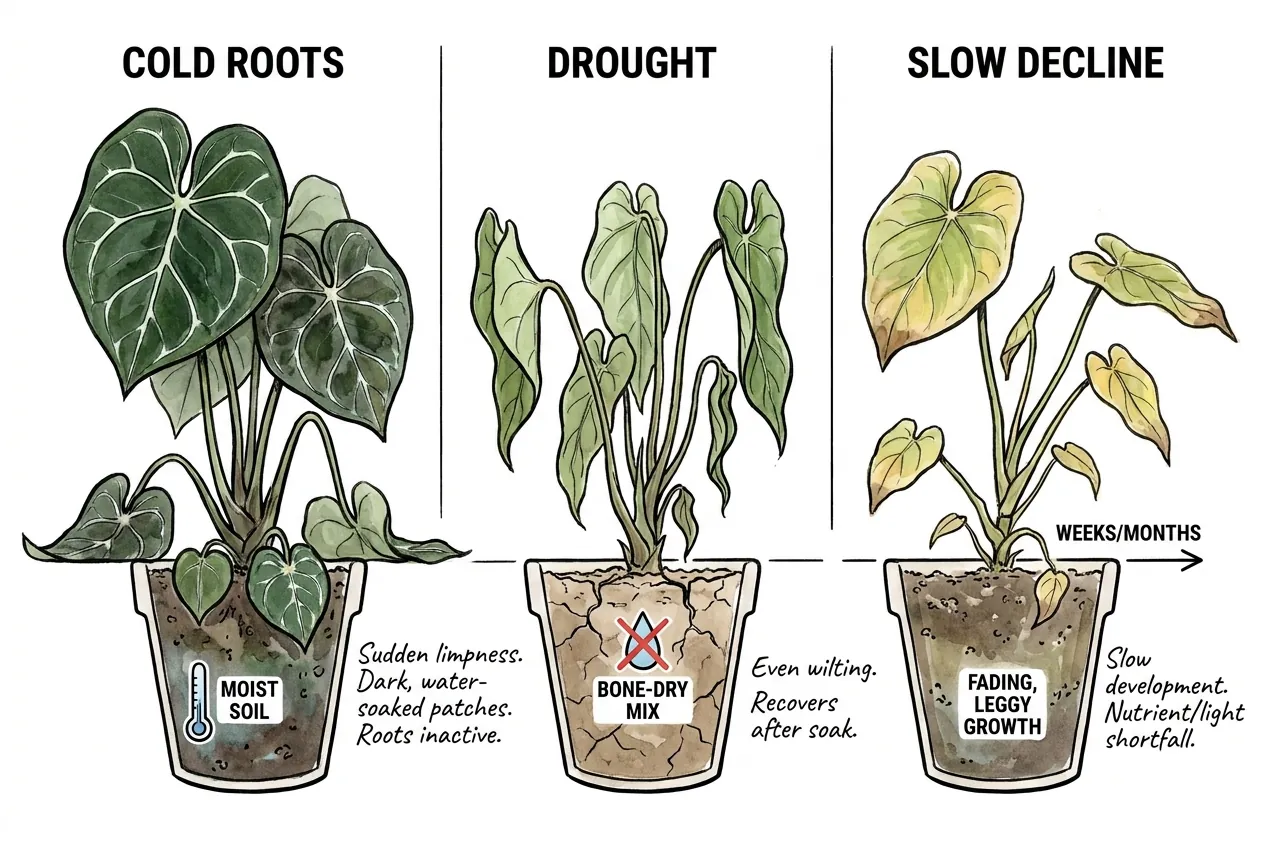
Cold exposure by a window causes sudden limpness or darkened, water-soaked patches, because cold roots cannot move water even when the soil is moist.
The fix is to move the plant off the cold glass, not to water it.
Genuine underwatering shows a bone-dry mix with even wilting that recovers after a thorough soak. Light and nutrient shortfalls develop slowly over weeks as fading, yellowing, or leggy growth, not as an acute overnight droop.
Matching the timeline and the soil-moisture state to the symptom keeps you from applying the wrong fix.
Raise humidity in a way that actually lasts
Once you have confirmed the cause is dry air, fix it with methods that raise humidity for hours, not for minutes.
In rough order of effect, the reliable options are a humidifier with a sensor, grouping plants, an enclosure for very dry rooms, and pebble trays. Misting is the weak link.
The ranked toolkit
A portable humidifier run near the plant adds real water vapor continuously, so it sustains the humidity instead of spiking it.
Paired with a sensor, it lets you hold the target band rather than guess.
Grouping plants pools their combined moisture into a shared humid pocket. An enclosure such as a cabinet or a propped bin holds humidity highest of all, though it needs a small vent gap to avoid stale, wet air.
Pebble or water trays add a small, steady contribution and work best as a supplement.
Misting is the one to drop. A misting raises humidity only until the droplets evaporate, which can be minutes, so even daily misting does little for sustained turgor.
It also leaves velvet leaves wet in a way that can invite fungal spotting.
| Method | Effect on humidity | Notes |
|---|---|---|
| Humidifier plus sensor | Large, sustained | Best single fix, hold near 60 percent |
| Grouping plants | Moderate, sustained | Shared humid microclimate |
| Enclosure or cabinet | Highest | Needs a vent gap, keep foliage dry |
| Pebble tray | Small | Supplement, not a primary fix |
| Misting | Brief only | Evaporates in minutes, wets velvet leaves |
Match the effort to how dry the room is
For a very dry room near 25 percent, combine a humidifier with grouping, or move the plant into a vented enclosure. Re-measure to confirm you have reached the target. Only sustained moisture addition closes a large deficit.
For a borderline room near 45 percent, grouping plants and adding a tray is often enough to nudge you toward the comfort band.
In both cases the point is to reach and hold the target, not to chase a brief spike.
Confirm the fix worked, do not assume it
After running a fix for a while, I close the loop with a measurement rather than assuming it worked.
I re-read relative humidity at leaf height during a heating cycle and re-check the previously drooped petiole with the same light finger support I used before.
My rule here is to keep the setup only if it holds. If leaf-height humidity now sits at or above about 60 percent during heating and the petiole has firmed, I leave it alone.
If the reading is still below about 50 percent, I add another method, such as an enclosure on top of the humidifier, and measure again.
That 60 percent target is the working comfort band for this species, which I treat as a conservative operating goal rather than a fixed law.
Ready to choose a humidifier or a controlled cabinet? Our plant cabinet humidity control kit chooser compares them on the specs that matter for a case like this.
Keep the petioles firm for the rest of the season
Prevention is mostly about holding a stable microclimate before the crash arrives, rather than reacting after the plant folds.
Set up your humidity support when you first turn on the heat. Keep the plant away from both radiators and cold glass, and match watering to the plant’s lower winter demand.
Placement and a steady humidity band
Site the plant in stable, moderately warm air, away from radiators, vents, and cold window glass.
Heat sources create a hot, dry, high-VPD pocket, and cold glass creates a cold-root pocket, and both stress the plant in opposite ways.
Start humidity support at the beginning of the heating season, not after symptoms appear. A humidifier with a sensor, plants grouped together, or a vented enclosure holds the band steady.
That way VPD never spikes far enough to fold a petiole in the first place.
Water to winter demand, not to the calendar
Winter light and transpiration both fall, so the plant uses less water and the same summer schedule can waterlog the roots.
Water by checking the mix rather than the calendar, and let a chunky, fast-draining aroid mix dry out between waterings.
This keeps roots oxygenated while the plant is transpiring slowly under weaker light. It also removes the second half of the droop trap. A plant that is both dry in the air and soggy at the roots is being pushed toward collapse from both ends.
Set up steady humidity before the heat starts, keep the plant off radiators and cold glass, and water to the drier winter plant.
Key Takeaways
- Heating warms the air without adding moisture, so humidity drops and dry air pulls water from the leaf.
- Measure at leaf height during a heating cycle. Target 60 percent or higher. A reading of 20 to 30 percent is droop-prone.
- If a petiole firms up overnight under raised humidity, the cause is air, not roots.
- Dark, mushy, sloughing roots mean rot, which needs less water and an airier mix, not humidity.
- Use a humidifier, grouping, or a vented enclosure for lasting humidity. Misting fades in minutes.