
Why Aroids Stop Drinking When the Heat Turns On
Aroid roots cold soil heating season problems start when warm air fools you into overwatering. Learn to measure the split and warm the roots, not the room.
Priya Patel · Published 2026-09-25 · 15 min read
Key Takeaways
- Air and root-zone temperature differ in heating season, and water uptake follows the roots, not the air.
- Root water uptake collapses below a break-point near the low teens Celsius for tropical aroids.
- Cold quiets aquaporin water channels, so a cold-rooted plant drinks slowly but recovers when roots rewarm.
- Warm air plus cold roots causes physiological drought, so summer watering schedules waterlog the pot.
- Measure the substrate-versus-air gap, water by pot weight, and warm the roots instead of the room.
Your monstera looked fine all summer. Then the furnace kicked on for the season, and now the soil stays wet for a week.
The leaves sulk, and watering on your usual schedule seems to make it worse.
The plant has not forgotten how to drink. Its roots have just gotten cold, and cold roots drink slowly no matter how warm the room feels.
The reason is a split most growers never measure. The thermostat on the wall reads the air. Your plant’s water uptake is set by a different number entirely, the temperature down in the rootball, and in heating season those two numbers pull apart.
What is really happening when warm air meets cold roots
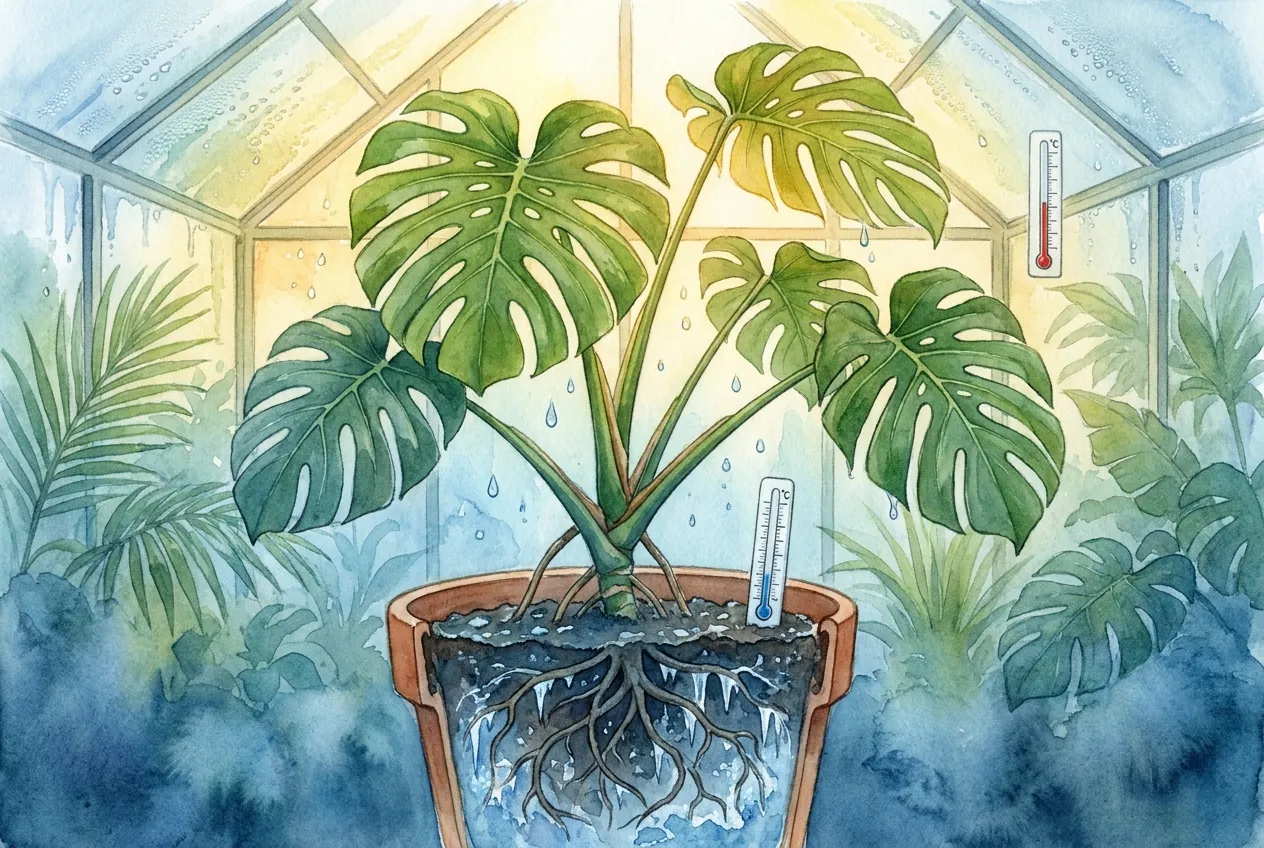
The plant is caught in a temperature mismatch. The air around the leaves is warm and dry from the heating, so the canopy still wants to lose water.
The roots, sitting in a pot on a cold floor or near a cold window, stay several degrees colder and cannot resupply that water fast enough.
Water enters a plant only through its roots, so a warm room cannot make up for a cold root zone.
Researchers study this exact situation on purpose. In one set of experiments, plants were held with their shoots at a comfortable 20 to 25°C while their roots were cooled to 15°C, 7°C, or 2°C.
That is your living room in winter in miniature, a warm top and a cold bottom.
Under those cold roots, water uptake fell, and the plants showed lower leaf water potential and lower stomatal conductance even though the air above was warm.
So the plant is not broken and it is not thirsty in the usual sense. It is throttled from below.
Where the split gets worst in a real room
Warm air rises, and pots sit at the bottom. Central heating warms the air first, and that warm air stratifies toward the ceiling, leaving the floor as the coldest layer in the room.
A pot on a tile floor, on a windowsill, or pressed against an exterior wall loses heat to those cold surfaces faster than the air can warm it back.
The gap is widest in the morning after a cold night, before the day has warmed anything up.
That timing matters, because it is the best moment to catch the problem with a thermometer.
The substrate also fights you with sheer mass. A dense rootball holds a lot of heat energy and changes temperature slowly, so it lags behind the room by hours.
How much does cold actually slow water uptake
Root water uptake does not decline gently as roots cool. It falls off a cliff below a break-point temperature, and the break-point depends on how cold-hardy the plant is.
In rice roots, the break-point sits at 15°C. Above that temperature, hydraulic conductivity changes only modestly, tracking the ordinary thickening of cold water. Below 15°C it drops steeply, and the energy barrier to moving water jumps roughly sevenfold, from about 28 to 204 kilojoules per mole.
In plain terms, once roots pass the break-point, each further degree of cold costs the plant far more uptake than the degree before it.
The break-point moves with the plant’s cold tolerance. Chilling-sensitive species lose uptake sharply already above 10°C. Chilling-tolerant herbs and temperate trees hold on to around 10°C, and truly cold-hardy boreal trees keep working down below 5°C.
Tropical aroids sit at the sensitive end of that scale.
For a warm-climate aroid, a rootball sitting in the low-to-mid teens Celsius is already in the throttled range, even though that same temperature would barely bother a garden shrub.
| Root zone temperature | What happens to uptake |
|---|---|
| Above the break-point | Modest change, mostly water viscosity |
| Below the break-point | Steep collapse, membrane and channel limited |
| Rice break-point | 15°C |
| Chilling-sensitive species | Uptake drops sharply above 10°C |
| Chilling-tolerant and temperate | Break-point around 10°C |
| Boreal trees | Break-point below 5°C |
Why cold roots choke off the molecular tap
The cliff has a cause, and it is a set of tiny water channels called aquaporins.
These are proteins in the root cell membranes that act as dedicated doorways for water. They carry the majority of the water that crosses living root tissue, so when they close, the whole root slows down.
How central are they? When researchers blocked aquaporins in rice roots at a warm 25°C, water flow through the roots dropped by 97%.
Almost all of the root’s water transport was going through those channels.
Cold does not destroy these channels. It quiets them. In the rice work, the number of aquaporins did not change in the cold, but their activity fell, because a colder membrane is stiffer and the channel gating shifts.
Cold roots behave like a tap turned most of the way off, not a tap that is broken, which is why the effect reverses when the roots warm back up.
Why this fools you into overwatering
Here is the trap. Warm air keeps a little evaporative pull on the leaves and on the soil surface, so the topsoil dries and looks like it needs water.
But the cold rootball is barely drinking, and the deeper substrate stays soaked.
You water again, and now cold, wet, low-oxygen soil sits around stressed roots.
This is called cold-induced physiological drought. The water is right there in the pot, but the plant cannot move it, so the plant closes its stomata and idles as if it were in a drought.
Feel the soil and it is wet. Watch the plant and it acts thirsty. Both are true at once.
The consequence is not academic. In lower light and cooler temperatures, roots take up less water and soil dries far more slowly.
Overwatering becomes the leading cause of houseplant death across the October to March window.
The split does not just slow your plant. It sets a trap that your watering habit walks straight into.
One honest boundary here. Not every plant closes its stomata just because the soil is cold. Cold-adapted alpine grasses kept their gas exchange steady as their soil cooled from 15°C to 5°C, and only actual soil freezing cut it hard.
The physiological-drought pattern hits hardest in chilling-sensitive tropicals like aroids, which is exactly the group this article is about.
Telling cold-limited from thirsty from rotting
A drooping plant can mean three very different things in winter, and they call for opposite actions. Guessing wrong is how a cold-but-fine plant ends up rotting.
Three quick signals separate the three cases before any watering in winter, namely pot weight, rootball temperature, and smell at the drainage holes.
Heavy plus cold plus no smell means the plant is cold-limited, so warm the roots and leave the water alone.
Light and dry means it is genuinely thirsty and gets a full watering.
Wet plus a sour smell plus dark mushy roots means rot, which needs unpotting and trimming, not another drink.
When the signals are mixed, default to not adding water to a cold wet pot, because that is the mistake that turns slow uptake into root rot.
| Signal | Cold-limited | Underwatered | Root rot |
|---|---|---|---|
| Pot weight | Heavy | Light | Heavy |
| Rootball temperature | Cold | Normal | Cold or normal |
| Smell at drainage holes | None | None | Sour |
| Soil moisture | Wet | Dry | Waterlogged |
| Action | Warm roots, wait | Water fully | Unpot and treat |
How to confirm the split with two cheap tools
You do not have to guess whether your plant is root-limited. You can measure it, and the measurement is the whole diagnosis.
Measuring the root zone against the room
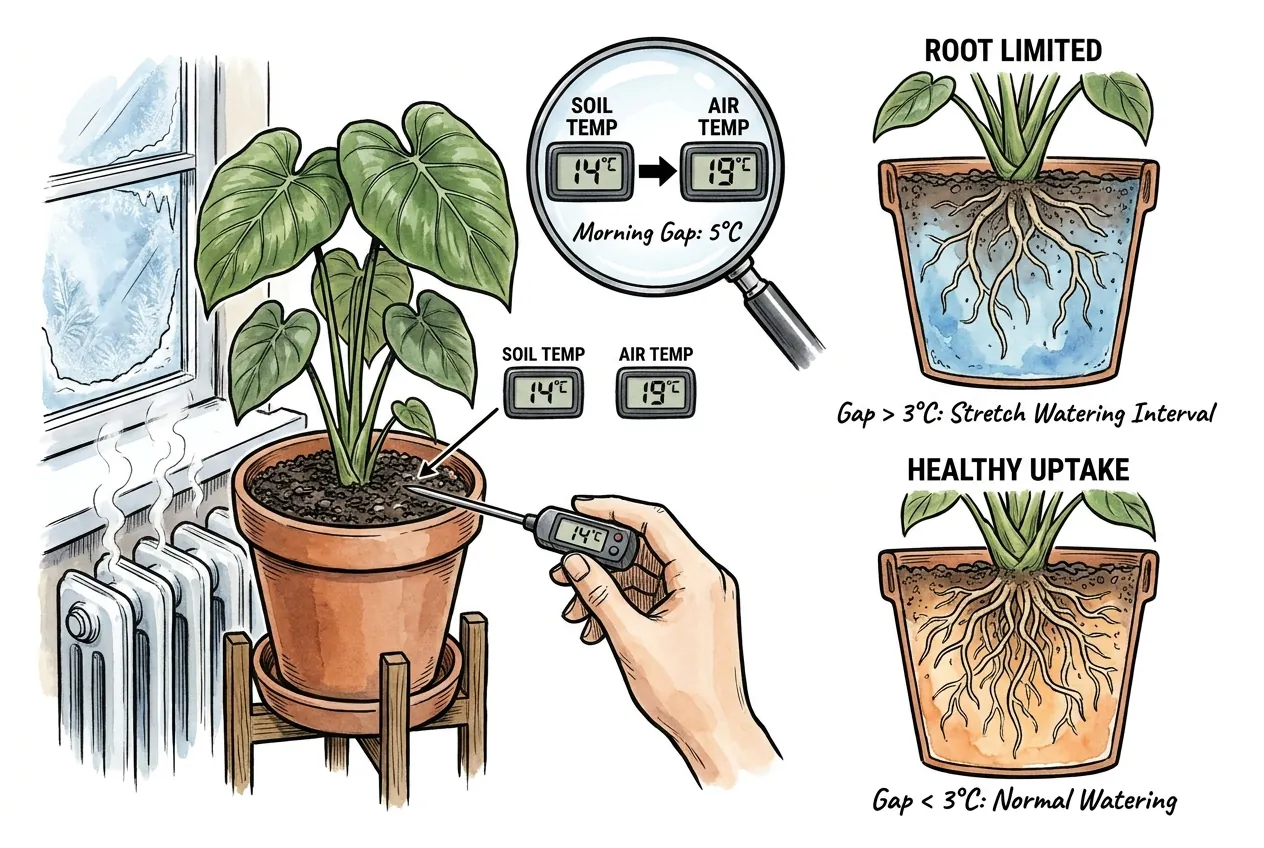
Rather than trust the wall thermostat, I check the split directly with two thermometers. My probe goes into the substrate to about half the pot depth, and I wait for the reading to settle.
Then I read a second thermometer sitting in the air right beside the pot at the same height.
Timing is part of the method. I take both readings in the morning after a cold night, when the gap is at its widest.
To rule out a fluke, I repeat it on a couple of cold mornings.
The number I act on is the gap. If the substrate reads more than about 3°C, roughly 5°F, below the room air, I treat that plant as root-limited.
From there I stretch its watering interval instead of watering on a schedule.
That 3°C figure is my own working threshold, not a published standard. I use it because chilling-sensitive tropicals are already losing uptake once the rootball drops into the low teens.
A persistent multi-degree gap is a simple, conservative flag that the roots are the bottleneck.
One safety note. Use a digital probe thermometer, never a glass mercury thermometer, in substrate. This is a kitchen-table check, not a laboratory measurement, and it is all you need.
Watering by weight instead of by the calendar
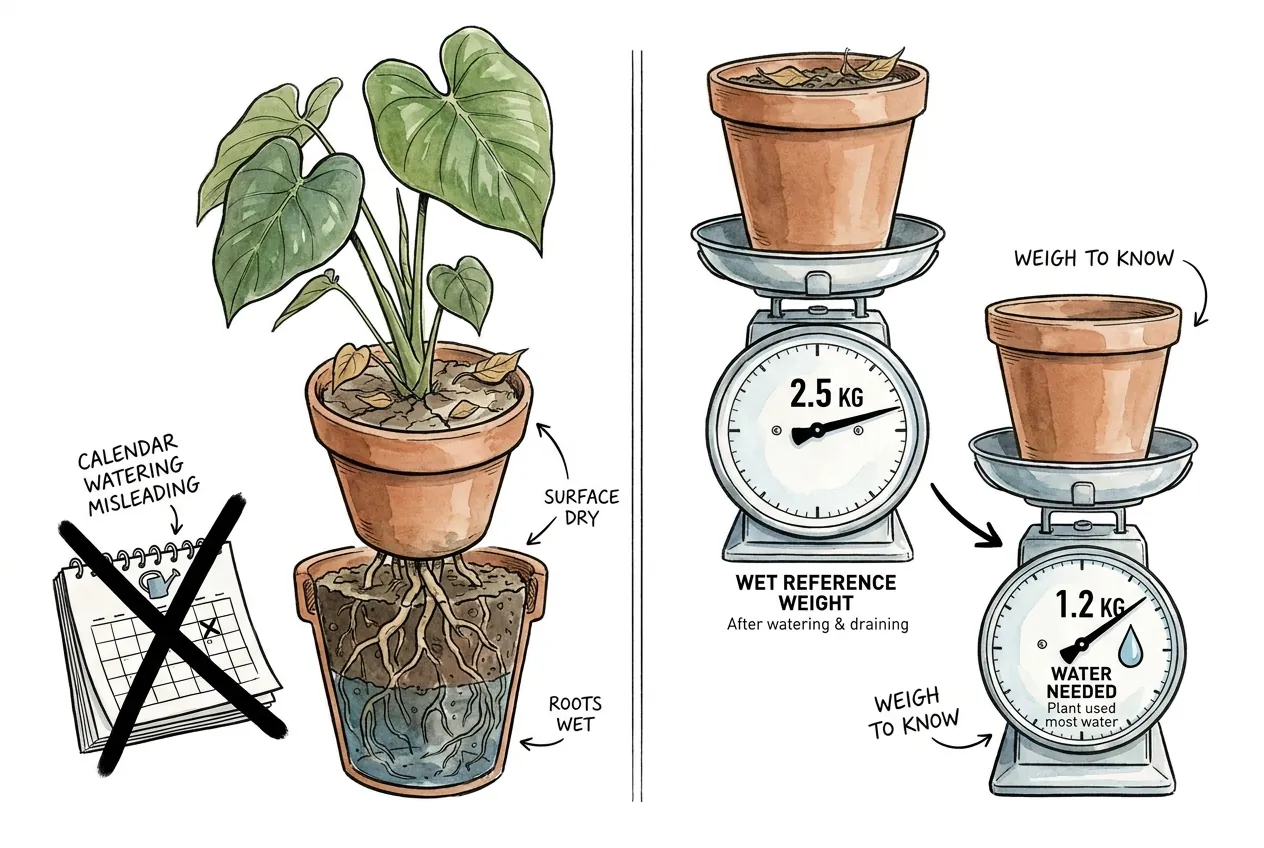
Surface moisture lies to you in winter, because the top dries while the rootball stays soaked.
Pot weight does not lie, because it adds up the water in the whole pot.
Right after a watering has finished draining, I set the pot on a kitchen scale and write that number down as the wet reference. Then I reweigh every two or three days. When the pot has lost most of the water weight it gained, the plant has actually used that water and earned its next drink.
If it is still nearly as heavy as the wet reference, I hold off, because a heavy pot means the roots have barely taken anything up.
This ties watering to real use rather than to a day on the calendar, and in cold-root periods that interval can stretch a long way.
How to close the split safely
Fixing the problem means warming the roots, not the room. Start with the changes that cost nothing, and only add equipment if you still need it.
Free fixes that shrink the gap first
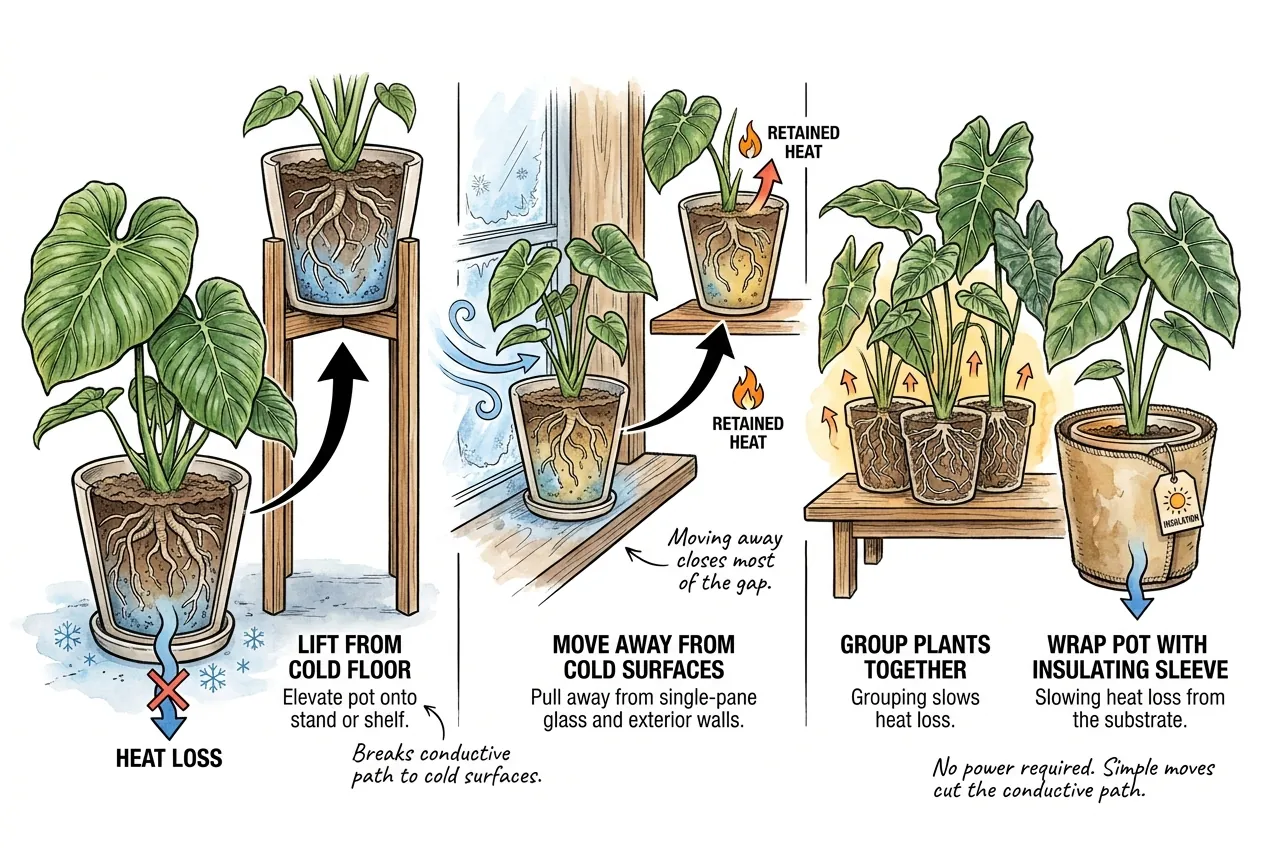
Get the pot out of the coldest layer. Lift it off a cold floor onto a stand or a shelf, pull it back from single-pane glass, and move it away from exterior walls.
Grouping plants together and wrapping the pot with an insulating sleeve both slow heat loss from the substrate.
For many plants on a cold windowsill, simply moving the pot a foot inward and up off the floor closes most of the gap.
These moves work because they cut the conductive path that drains heat out of the substrate into cold surfaces. No power required.
When you need active root-zone warmth
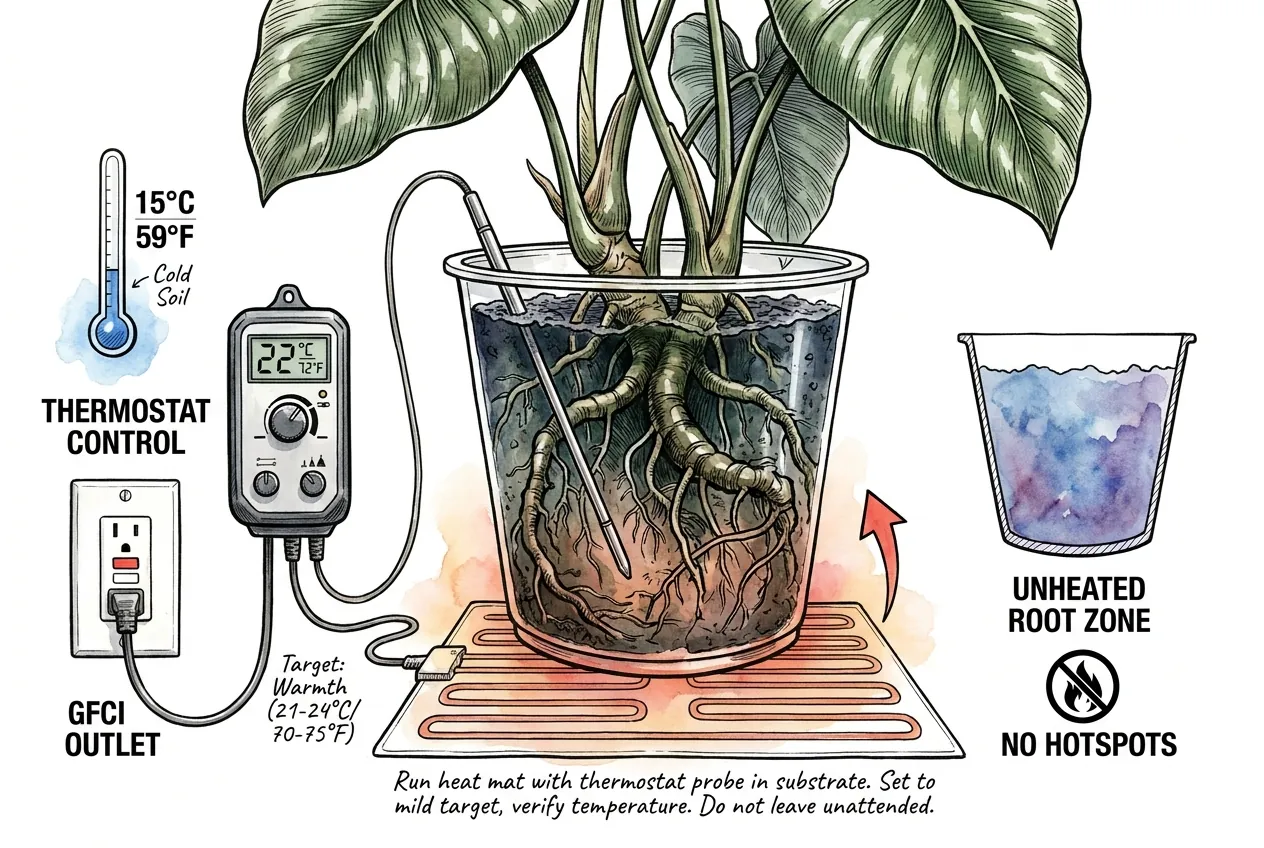
If placement is not enough and the rootball still reads cold, the tool for the job is a heat mat under thermostat control. The target is warmth, not heat. Root-zone heating aims for roughly 21 to 24°C, about 70 to 75°F, which is comfortably above the throttled range without cooking the roots.
Two rules are non-negotiable here. A heat mat must be run through a thermostat with its probe in the substrate, so it holds a mild target instead of climbing to germination heat and creating hotspots.
And it must be plugged into a GFCI outlet, never run unattended and uncontrolled next to wet substrate.
Set the thermostat to a mild target and verify it with the same probe thermometer in the rootball, lowering the setting if the reading drifts toward hot germination temperatures.
Choosing the actual mat, controller, and thermometer is its own decision with real sizing and safety tradeoffs.
Our heat mat and thermostat product chooser walks through matching the gear to your shelf and holding a steady root-zone target.
Why some setups suffer more than others
Two plants in the same room can feel the split very differently, because the pot and the medium change how cold the roots actually get.
Aroids are the sensitive group to begin with. Iowa State Extension puts the ideal range for aroids at 65 to 85°F and warns that temperatures below 60°F, about 15.5°C, can damage the leaves of some species.
That means a mid-teens Celsius rootball is already at the low edge for these plants, and sustained cold below about 10°C moves from throttling into real chilling injury.
The medium matters too. A terracotta pot cools itself by evaporation through its porous walls, so it runs colder than plastic.
A semi-hydro setup with a LECA reservoir is a column of water sitting on the floor.
Water conducts cold readily and equilibrates toward the coldest nearby surface, so those reservoirs can run surprisingly cold at the roots.
Big, dense pots hold their temperature longest, which widens the morning gap.
If your terracotta or semi-hydro aroid sulks in winter while a plastic-potted neighbor shrugs it off, the setup is amplifying the split, so lift and insulate those pots first.
What about feeding during a cold-root spell
Ease off. The same cold that throttles water also slows nutrient uptake, and low winter light slows the whole plant, so a cold-rooted plant simply cannot use a full feed.
Fertilizer that the plant does not take up does not vanish. It stays behind as soluble salts in the cold, slow-drying substrate. University of Maryland Extension describes how excessive or frequent fertilizer raises soluble salt levels, causing root dieback and dead root tips along with browning leaf tips and margins.
Feeding a stalled plant does not help it, it burns the very roots you are trying to protect.
The sensible move is to reduce or pause feeding while the roots are cold. Resume light feeding only once the plant is drinking again and, ideally, sitting under decent light. Tie feeding to active growth, not to the calendar.
Recovery and the mistakes that make it worse
The good news is baked into the mechanism. Because cold quiets aquaporins rather than destroying them, uptake comes back when the root zone warms.
As the rootball climbs back above the throttled range, the channels reopen and the pot starts losing weight again on your scale. Normal growth resumes, often within days of steady warmth.
The mistakes to avoid are the ones that feel like helping. Do not chase the wet surface soil with more water, because that is the overwatering trap.
Do not fertilize a plant that is not drinking, because that builds up salts.
And do not park a cold-shocked plant directly on a hot radiator or vent to warm it fast, because sudden spot heat stresses it. Gentle, steady, thermostat-controlled warmth beats a heat blast every time.
Watch for the line between throttled and damaged. Slow uptake with healthy roots recovers on its own once you warm the zone. A sour smell, dark mushy roots, and collapse mean the problem crossed into rot and needs unpotting, trimming, and drying out.
Knowing which one you have is the difference between waiting a week and losing the plant.
Key Takeaways
- Air temperature and root-zone temperature are two different numbers in heating season.
- Root water uptake collapses below a break-point near the low teens Celsius for tropical aroids.
- Cold quiets aquaporin water channels, so a cold-root plant drinks slowly but recovers on rewarming.
- Warm air plus cold roots causes physiological drought, so watering on the summer schedule waterlogs the pot.
- Measure the substrate-versus-air gap and water by pot weight, then warm the roots rather than the room.