
Heat Mat and Thermostat Product Chooser: Root-Zone Warmth
Heat mat thermostat product chooser that sizes the mat, controller, thermometer, and dome by measurable specs so trays hold 72 to 75 F without overshoot.
Priya Patel · Published 2026-09-16 · 18 min read

Key Takeaways
- Buy the heat mat and external probe thermostat as one decision. Neither is safe alone under a dome.
- Size by required lift. Media target minus your shelf’s overnight low, logged over 3 nights.
- Aim for 72 to 75 F media for general propagation. Air can run cooler than the root zone.
- Verify with an independent probe at root depth. The controller cannot see its own placement errors.
- Dry-run every new setup for a day, plant-free, before trusting it with living material.
The cheapest part of a propagation heating setup is the heat itself. The expensive part is finding out in January that an uncontrolled mat cooked a tray of cuttings while the room felt perfectly cool.
Heating-season buyers usually shop for a mat and stop there, but the mat is only one of four roles.
The buying order that actually works
Buy by role, in this order. First, a heat mat sized to the container footprint together with an external probe thermostat, treated as one inseparable purchase.
Second, an independent verification thermometer that reads the media, not the air.
Third, a vented humidity dome or an insulation layer. Add it only if your measurements show the heat is leaking away before it reaches the root zone.
The mat and controller pair comes first because a mat without closed-loop control is just an open-ended heater.
The verification thermometer comes second because the controller cannot detect its own probe-placement errors. The dome comes last because it is a capacity fix, and you only know you have a capacity problem after you have measured one.
Treat the mat and the external probe thermostat as a single purchase, then verify with an independent thermometer before anything living sits on the heat.
The role specs below decide which exact items fill each slot. Two of the four roles may turn out to be purchases you should skip entirely.
Why root-zone warmth is the lever
Roots respond to the temperature of the media they sit in, not to the air above the tray.
Texas A&M AgriLife Extension puts ideal root-zone temperatures for most plants at approximately 70 to 75 °F, with cutting media doing best near 75 °F.
The same reference notes that winter soil can run 10 to 20 degrees below air temperature. That is exactly the gap a heat mat exists to close.
The effect size is not subtle. A 2024 controlled study in Frontiers in Plant Science raised root-zone temperature just 3 °C above a 22 °C air temperature.
The heated treatment measured 31 percent greater shoot dry mass and 24 percent greater root dry mass, driven by increased nutrient uptake through warmer roots.
Work on unrooted cuttings points the same direction and adds the warning label. A Scientia Horticulturae study of cold-tolerant species found elevated root-zone temperatures cut production time by 10 to 15 percent.
A cool 16 °C air over a 24 °C root zone produced high-quality liners.
Pushing the root zone to 27 °C, however, could be deleterious to root development. More heat is not better. There is a ceiling, and overshoot past it is the classic dead-cuttings failure.
Heat reaches the roots by conduction, from mat to tray bottom to moist media. It leaves by evaporation from the media surface and by air movement across the shelf. An enclosure changes both loss paths at once, which is why the same mat behaves so differently under a dome.
How much lift you actually need
Mat listings advertise footprint and watts, but the number that sizes the purchase is your shelf’s overnight minimum.
Before sizing any mat, I log the air temperature at container height on the actual shelf.
Three consecutive heating-season nights, keeping the lowest reading, is enough. Required lift is the crop’s media target minus that lowest overnight minimum.
My working rule is conservative. If the required lift exceeds about two-thirds of the mat class’s rated lift, I step up in mat class or plan an insulation layer.
Rated lift assumes open still air, and I want the thermostat modulating rather than running the mat flat out.
If the required lift is under 5 °F, I skip the mat entirely, because the room is already doing the job.
Selection criteria that separate products
Every product decision in this stack reduces to a short list of measurable specs. The table below is the whole comparison. Anything a listing advertises beyond these rows is packaging.
| Criterion | What to require | Why it matters |
|---|---|---|
| Safety listing | UL or MET mark, electric heating appliance class (UL 499) | Third-party testing for a powered mat living under a wet tray |
| Footprint match | Mat within about an inch of the container footprint | Oversize wastes watts into the shelf and undersize leaves cold edge cells |
| Watt density | Roughly 0.1 W per square inch (17 W for a 1020 mat, 107 W for a 48 by 20 mat) | Density sets surface temperature and total watts only set heated area |
| Control class | External probe thermostat, not an inline dial | A dial scales power while a probe holds an actual media temperature |
| Probe accuracy | ±1 °C (±2 °F) class or tighter | Bounds how close the held temperature can be to the setpoint |
| Relay headroom | 10 A and 1100 W class rating | Any mat in this stack loads such a relay under 10 percent |
| Differential setting | Adjustable heating differential | Sets cycling depth so the media swing stays shallow |
| Alarms | High and low temperature plus sensor-fault alarm | A cut or failed probe should fail loudly, not silently |
| Waterproof build | Sealed mat surface and jacketed cord | Mats live in water, fertilizer salts, and spills |
If a mat carries no UL or MET listing, the comparison ends there, whatever the price.
The watt-density figure is worth internalizing because it is counterintuitive. A 107 W bench mat is not hotter than a 17 W tray mat. Both sit near 0.1 W per square inch, so both produce the same class of surface lift, and the big mat simply lifts more area.
Filling each role
Each role below follows the same logic. The job and its spec come first, then a product that meets the spec, then the honest reason to skip it.
Heat mat, sized to the container footprint
The mat’s only job is delivering roughly 0.1 W per square inch of listed, waterproof heating across the whole container bottom.
For a standard 1020 propagation tray, a moss box of similar footprint, or a tissue-culture acclimation bin, that means the 17 to 18 W class.
Hydrofarm Jump Start MT10006 heat mat meets the spec at 17 W across an 8.875 by 19.5 inch surface, with UL certification and waterproof construction.
Its first-party rating is 10 to 20 °F of lift over ambient in open conditions. That lift rating is the number your overnight-low log gets compared against.
The honest tradeoff is width. The mat is slightly narrower than a 10 inch tray, so outer edge cells run a few degrees cooler. Sensitive material belongs in the center cells.
Skip this size if you heat a whole shelf of trays. One control point per mat is the rule that decides between several small mats and one large one.
Jump Start MT10009 48 by 20 mat scales the same watt-density class to a four-tray bench at 107 W with the same UL listing. Suggested retail is $91.75.
The tradeoff is control granularity. One thermostat probe reads one tray, so four trays share one control point. Putting a dome on only one of them creates variance the controller cannot see.
Nothing in this stack crosses $100. Even the large-format bench class lists under it, so there is no high-ticket hero here. A budget stretched past $100 buys more value as a second complete mat-plus-controller zone than as any single premium item.
Bundled mat-plus-thermostat combo sets exist as a class and are a reasonable one-box path when their controller range covers your setpoint.
Combo listings move in and out of stock quickly, so the pairing here is built from separates that stay purchasable.
Thermostat controller, the closed loop
An inline dial on a mat scales power, not temperature. The dial position that produces 75 °F media on a 65 °F night overshoots on a 72 °F afternoon. Nothing in that loop is measuring the media.
An external probe thermostat closes the loop, switching the mat off at setpoint and back on below it.
Inkbird ITC-308 thermostat meets the role spec with ±1 °C stated accuracy and a 10 A relay rated to 1100 W at 110 V. It adds a 2 m probe cable, an adjustable heating differential, and both high-low temperature and sensor-fault alarms.
A 17 W mat loads that relay at under 2 percent of rating, so relay wear is a non-issue at these loads.
Use it for any mat driving a domed tray, moss box, or acclimation bin. Set the differential shallow so media swing stays within a degree or two.
Skip it only if a bundled combo controller already closes the loop on your single tray.
The standalone unit earns its slot through range and reuse. The same controller runs a fermentation chamber or another heating project in the off season.
Verification thermometer, the audit instrument
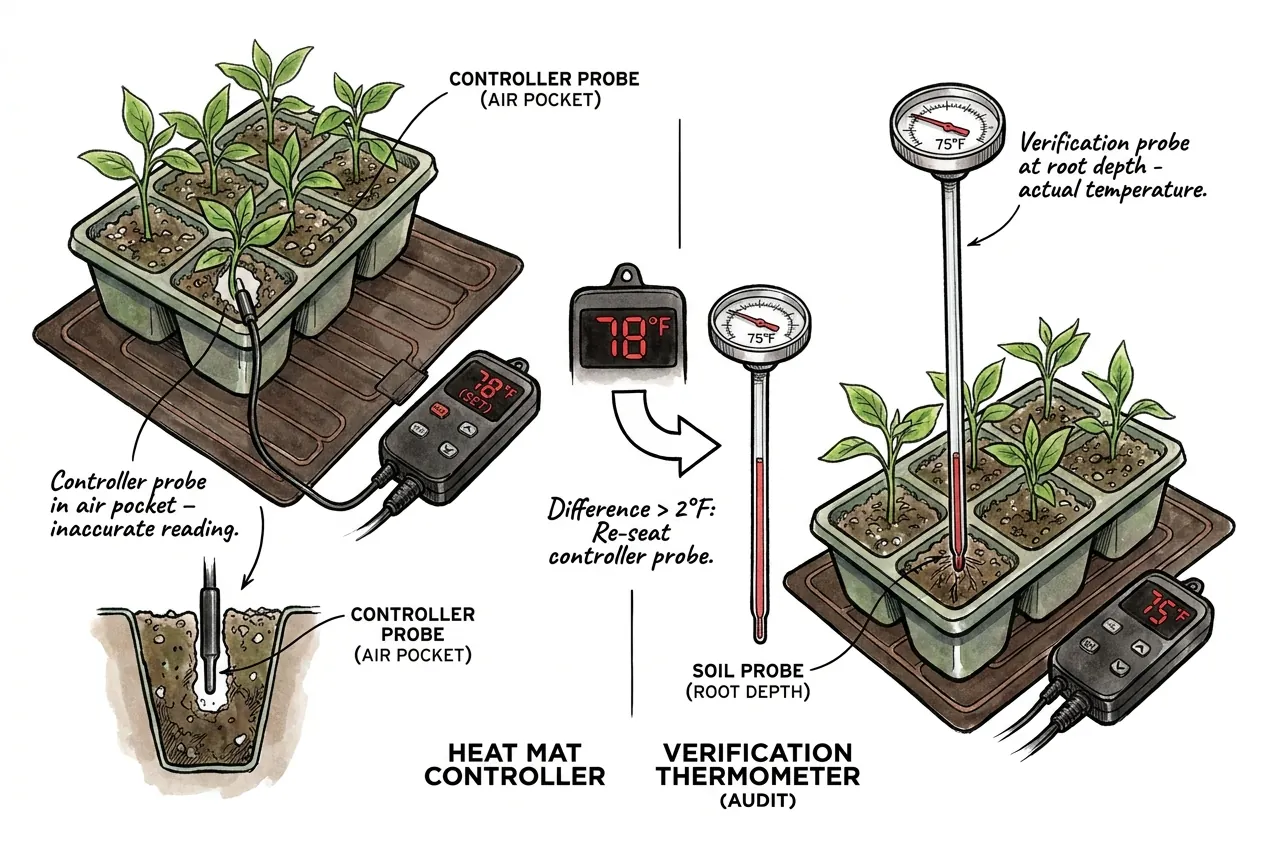
The controller only knows its own probe. If that probe sits in an air pocket, the media runs hotter than the display claims while the controller reports success.
If the probe presses against the mat film, the media never reaches target while the display reads setpoint.
Neither error is visible from the controller itself, which is why this role exists.
University of Maryland Extension demonstrates the underlying practice. It measures soil with a dedicated probe thermometer at the depth roots actually occupy, not the air.
For a plug tray that depth is about an inch into a center cell.
This is where I run the cross-check that decides whether a new setup is trustworthy. After the system has held setpoint for at least an hour, I compare two numbers.
One is an independent probe reading at root depth in a center cell. The other is the controller’s displayed temperature.
A persistent gap larger than 2 °F in either direction sends me back to re-seat the controller probe deeper and more central, with firm media contact.
That gap exceeds the combined stated accuracy of the two instruments, so the placement is lying.
If the media instead sags more than 5 °F below setpoint at the overnight low, I treat it as a capacity problem.
Insulation or a dome fixes capacity, and raising the setpoint does not.
Both cutoffs are my own working rules, chosen so instrument error cannot masquerade as a real fault.
Inkbird IBS-TH2 Plus logger fits the role with a ±0.5 °C external probe, tighter than the ±1 °C the job requires.
Its logged history captures the overnight minimum without a dawn reading. That logged minimum is the same number the mat-sizing rule needs, so one instrument serves both the purchase decision and the commissioning check.
The tradeoff is the app. History lives behind Bluetooth and a phone. A buyer who wants a glance-only instrument should use any ±1 °C class probe thermometer instead and accept doing the dawn reading in person.
An infrared gun is the wrong tool here. It reads the surface it is pointed at, meaning the top of the media or the dome plastic, never the root zone an inch down.
IR earns its keep scanning a bare mat for hot spots, not verifying media temperature.
Vented dome or insulation, the capacity recovery
A dome is usually sold as a humidity accessory, but thermally it is a capacity upgrade.
Covering the tray cuts evaporative and convective loss at the same time, so the same mat holds media measurably warmer under a dome.
The corollary is the single most important safety fact in the whole stack. An enclosure removes the loss paths that were protecting an uncontrolled mat from itself. The dome and the thermostat are a package deal.
How tightly you manage that trapped humidity against heating-season air is its own decision, covered in the piece on the plant cabinet humidity cliff.
MIXC 7 inch vented humidity domes fill the retrofit case, sized for standard 1020 trays.
Four adjustable vents act as the fine trim between warmer-and-wetter and cooler-and-drier.
The tradeoff is the format. It ships as a 10 pack, which overshoots a single-tray setup, and the tall dome encloses more air volume, which warms more slowly.
Jump Start CK64060 Hot House kit covers the starting-from-zero case in one box. It bundles a UL listed mat of the small-tray class, a watertight 1020 tray, a cell insert, and a 7 inch dome.
The honest gap is that the kit still contains no thermostat, so the controller role must be filled separately before the dome goes on.
Insulation has a firm boundary. Rigid foam belongs under the shelf surface and around container sides, never over the mat face. The mat’s safety listing assumes the mat sheds heat the way it was built to.
The setup sequence that prevents the classic failure
Order matters because each step protects the next one. A solid surface prevents the air-gap loss a wire rack creates under the mat. Loading moist media before placing the probe matters because dry mix conducts poorly and makes the probe under-read.
- Set a solid, level, heat-tolerant surface. No open wire racks under the mat.
- Lay the mat flat. Never fold or crease it.
- Seat the tray in full contact with the mat.
- Fill with pre-moistened media.
- Bury the controller probe about an inch deep in a center cell, with firm media contact.
- Fit the vented dome with vents open.
- Set the controller to the media target, 72 to 75 °F for general propagation.
- Run the empty system for a day before adding plants.
That final step is a rule I do not skip, and it is the cheapest insurance in the stack.
I run the fully assembled setup for 12 to 24 hours including one overnight cycle, with the independent logger recording.
Mat, tray, moist media, and dome are all in place, but nothing living is.
If peak media temperature exceeds the setpoint by more than 3 °F at any point, I open vents or re-seat the probe. Then the run repeats before anything living goes in.
Normal thermostat cycling stays shallower than that, so a bigger excursion means a placement or enclosure error, not normal operation.
The 3 °F line is my own threshold, set tight because the overshoot evidence above shows the damage ceiling sits close over the target band.
The same dry run matters most for the highest-value containers. A sealed tissue-culture acclimation bin concentrates both the value and the overshoot risk. The rest of that bin’s equipment stack is covered in the tissue culture acclimation product chooser.
Who should not buy each of these
The overnight-low log from the sizing section doubles as a disqualification test.
Skip the mat when 3 nights of logging show the shelf’s overnight minimum already within 5 °F of the media target. Warm apartments and already-heated cabinets are commonly in this position.
Skip it too for material that prefers to sit cool. Many temperate mosses hold well cool, and a moss box usually earns a mat only when it doubles as a rooting box.
The moss propagation box walkthrough treats that distinction in depth.
Never skip the controller for any enclosed container. It becomes redundant only when a bundled combo already closes the loop on your only tray, at a setpoint inside that combo’s range.
The verification thermometer is the one role a low-stakes setup can defer. An open, undomed tray in a warm room fails gently, so the audit instrument can wait.
A sealed bin of expensive material is the opposite case, and there the verifier is the last thing to cut.
Skip the dome for anything that needs airflow and moderate humidity, including many succulents and any tray in the hardening-off stage.
Skip it also when the room already sits at target, because enclosure without need converts a balanced setup into an overshooting one.
The honest outcome of measuring first is that two of the four roles are frequently purchases you should not make.
Maintenance, failure modes, and replacement
This stack has no service schedule in the parts sense. It has one seasonal inspection and a weekly glance at logged minimums and maximums.
| Symptom | Likely cause | How it shows | Action |
|---|---|---|---|
| Media hot, display normal | Controller probe in air pocket | Verifier reads above display | Re-seat probe deeper and central |
| Media cold, display normal | Probe against mat film | Verifier reads below display | Move probe into media core |
| Continuous heating | Relay stuck closed | Logged max climbs past setpoint | Unplug and replace controller |
| Erratic display or sensor alarm | Probe cable damage or moisture | Alarm or nonsense readings | Replace probe, never splice wet |
| Uneven tray growth | Mat hot spots from element aging | IR scan of bare mat shows patchiness | Retire the mat |
Before each season, inspect the mat jacket, cord entry, and plug. Repeat the commissioning cross-check so this year’s probe delta can be compared against last year’s. A growing delta means probe drift.
After the season, clean the unplugged, cool mat with a damp cloth, dry it fully, and store it flat or loosely rolled.
Folding creases the heating element, and a mat with cracked jacketing or any exposed conductor is done. Nothing in this stack is field-repairable.
Keep plugs, controller bodies, and cord connections out of drip paths. Power the stack from a ground-fault protected receptacle, the standard practice for wet locations.
Buyer questions worth answering
Five objections come up again and again in buying threads.
Can the mat’s built-in dial replace the thermostat?
No for any enclosed container, and only cautiously for open trays in stable rooms. The dial limits power, so the resulting temperature still floats with ambient. The enclosure that makes a dome useful is the same condition that turns that float into overshoot.
Can two trays share one 1020 mat?
Not well. Half the contact area per tray means cooler, uneven media in both trays. The single probe can only tell the truth about the tray it sits in.
The multi-tray answer is the 48 by 20 bench class with trays matched in load. Same media, same fill, same dome state.
Can a reptile mat or an aquarium heater do this job?
Each is built for a different heat path. Reptile mats are sized and listed for terrarium wall or under-glass service, often at higher watt density over a small area. Under a wet tray that concentration is a hot-spot risk.
An aquarium heater controls water volume, the right tool when the thing being held at temperature is water.
Its sizing and failsafe logic is covered in the aquarium heater sizing and failsafe rundown.
A media tray wants a mat listed for exactly this flat, wet-adjacent service.
Will bottom heat dry out the media?
Faster than an unheated tray, yes, because warmer media evaporates more. The dome recovers most of that loss, and bottom-watering replaces it without disturbing cuttings.
Each step of vent closing trades a little dryness for a little warmth. Recheck media temperature after changing vent positions, since the trim works in both directions.
What is the right order to stage purchases on a budget?
Mat and controller together, always, since neither is safe or useful alone in an enclosure. The verifier joins at commissioning time, before the first live tray. The dome waits until the logged overnight minimum proves the capacity gap it exists to close.
Key Takeaways
- Buy the mat and external probe thermostat as one decision. Neither is safe alone under a dome.
- Size by required lift. Target media temperature minus your shelf’s overnight low, logged over 3 nights.
- Aim for 72 to 75 °F media for general propagation. Air can run cooler than the root zone.
- Verify with an independent probe at root depth. The controller cannot see its own placement errors.
- Dry-run every new setup for a day, plant-free, before trusting it with living material.
Affiliate Disclosure
This article contains Amazon affiliate links. As an Amazon Associate I earn from qualifying purchases. If you use these links, the site may earn a commission at no extra cost to you. Product availability, price, and specifications can change. Check the current listing before buying.