
LECA Conversion Product Chooser for Aroids in Semi-Hydro
A LECA conversion product chooser for aroids that matches meter, media, feed, and reservoir to the root zone, with one hero meter and low-cost picks.
Samuel Reed · Published 2026-09-27 · 18 min read
Key Takeaways
- Buy the root zone first, an opaque reservoir with a low water line and rinsed inert clay, then feed and read.
- In LECA the plant eats from the reservoir, so hold pH near 5.5 to 6.5 or iron and micros lock out.
- Use a complete nutrient with calcium and magnesium, since inert clay supplies nothing on its own.
- Spend on one higher-tier pH and EC meter only once many reservoirs make small errors expensive.
- A still, flooded root zone rots roots, so leave an air gradient above the water line.
Moving a soil-grown aroid into LECA fails for one reason more than any other. The roots suffocate or starve before they ever adapt.
In an inert clay medium the plant no longer eats from the substrate. It eats from whatever solution sits in the reservoir, and it breathes from whatever air the wet-to-dry gradient leaves around the root tips.
That single shift decides your whole shopping list. You are not buying generic plant supplies.
You are buying the ability to hold a reservoir near the right pH and strength. You also need to keep the root zone oxygenated and read what is happening down there before roots turn brown.
What to buy first, by role
Buy in the order that protects roots fastest. The reservoir vessel and the media come first because they set the physical root zone. The nutrient comes next because inert clay is nutritionally empty.
The meter is the one higher-tier purchase, and it matters most once you run several reservoirs where small errors repeat.
An optional pH adjuster only enters the picture if your tap water sits above the useful band.
Think of the roles in this order.
The opaque reservoir vessel and net insert set the physical root zone
This is where standing-water rot is won or lost. An opaque outer wall blocks light so algae cannot bloom in the reservoir. An inner insert plus a defined water line builds the wet-to-dry gradient that keeps oxygen at the root tips.
Inert expanded-clay media carries air and water without storing salts
The medium holds air pockets and wicks moisture upward, so roots stay oxygenated while the reservoir, not the clay, controls nutrition.
A complete soilless nutrient feeds a plant that has nothing else to eat
Inert clay supplies no nutrients, so a complete solution with calcium and magnesium dosed to a target strength is not optional.
A pH and EC meter tells you whether the reservoir is actually in range
You cannot see pH drift or salt buildup. A meter is the only honest readout, and it is the single item worth spending real money on once accuracy across many reservoirs starts to matter.
Buy the vessel and media first, add a complete nutrient because inert clay feeds nothing, and treat the meter as the one higher-tier tool.
Why an inert medium moves all control to the reservoir
In LECA the plant lives off the reservoir solution, so pH and strength in that water decide whether nutrients are available or locked away.
This is the mechanism that makes every later product choice make sense.
How expanded clay holds air and wicks water at the same time
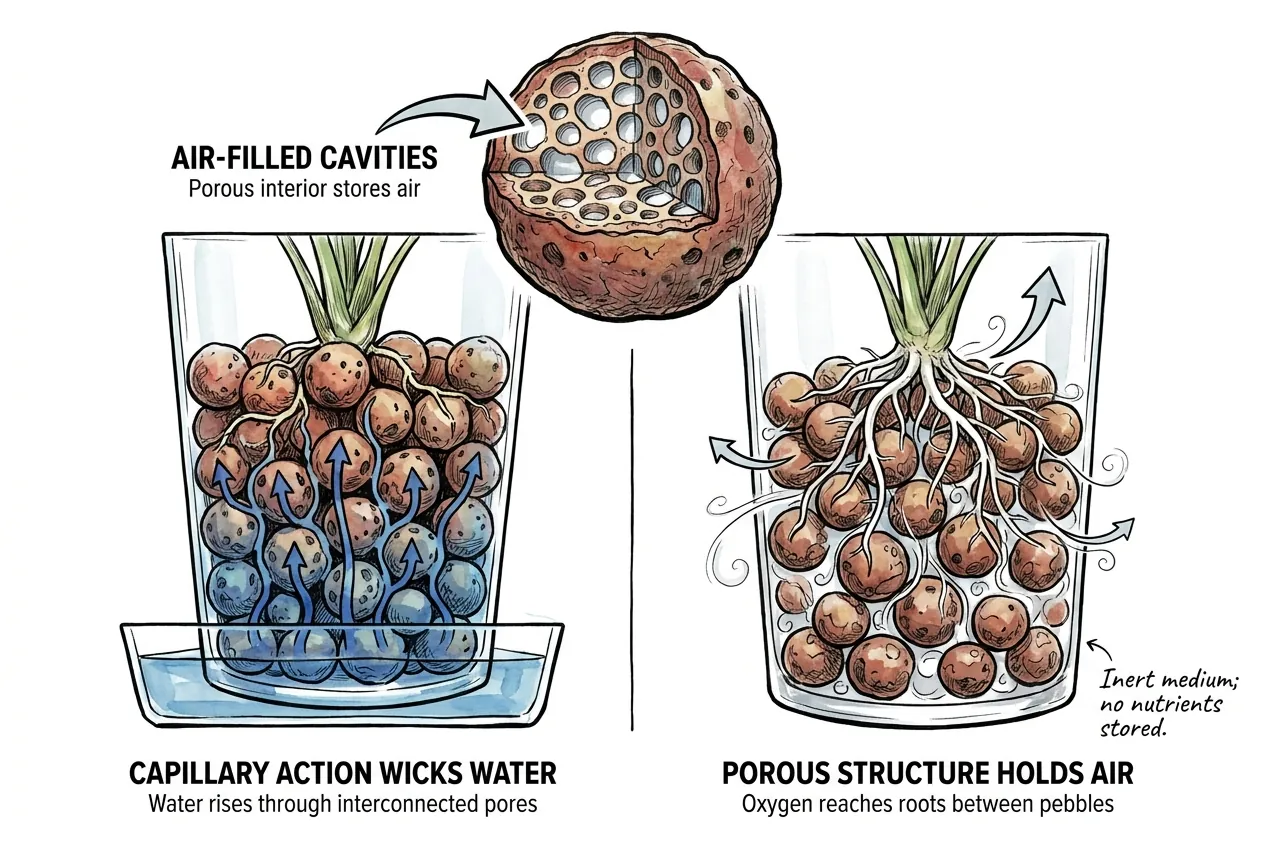
Expanded clay is a fired ceramic full of air-filled cavities. The clay is heated in rotary kilns to roughly 1100 to 1200 degrees Celsius, which expands it into a porous, lightweight aggregate with abundant internal pores.
Those pores give it two properties that matter for roots. It wicks water upward by capillary action, and it stays full of air between the pebbles.
Because the fired clay is inert, it does not hold or release nutrients the way soil does. That is the whole point. The medium becomes a scaffold that carries air and water, while the dissolved nutrients ride in the reservoir solution instead of in the substrate.
Why root-zone oxygen decides whether roots survive the switch
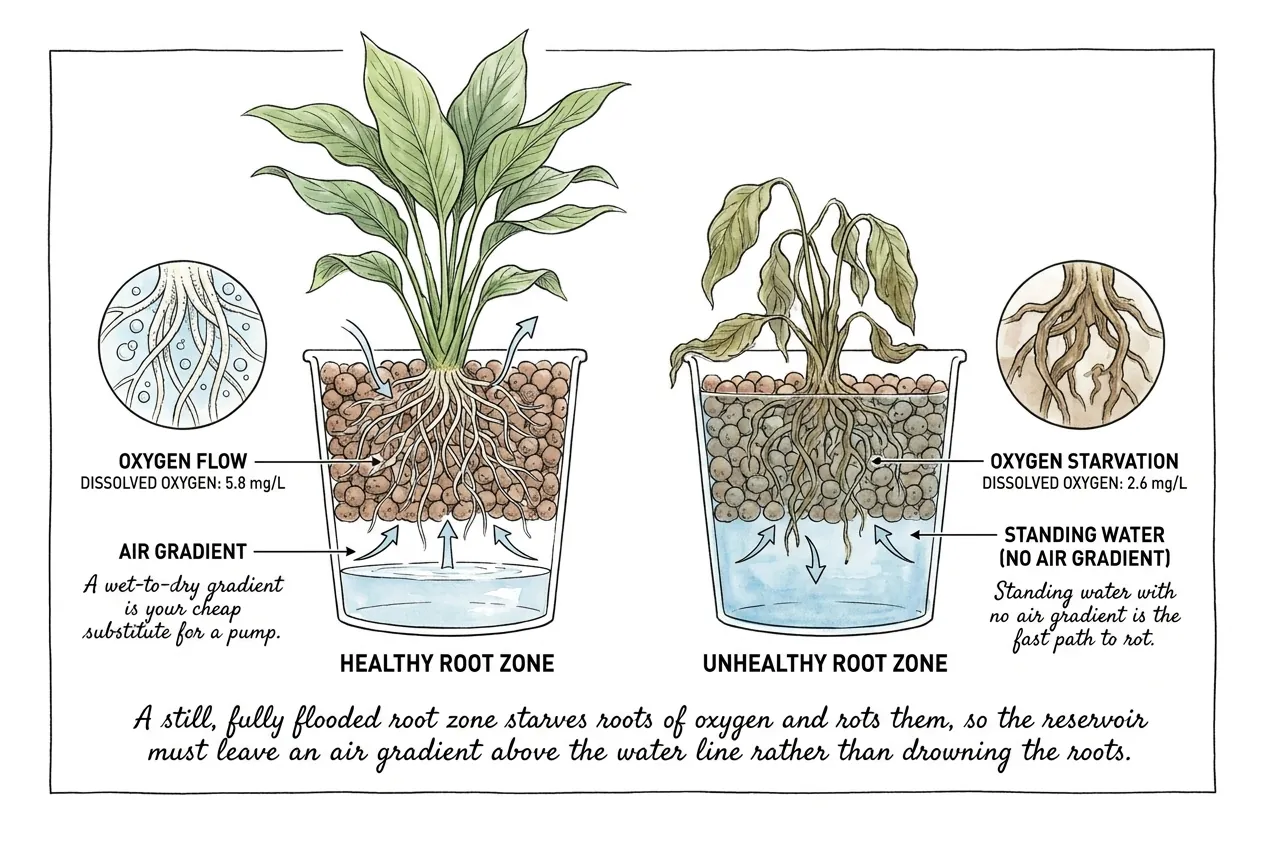
Roots need oxygen at the root surface, and a flooded, still root zone runs out of it fast.
In a study of aquaponic root zones, wilted plants sitting in poorly drained beds measured about 2.6 mg per liter of dissolved oxygen at the roots. Healthy plants measured about 5.8 mg per liter.
The low-oxygen plants developed visibly brown, decayed roots, and the poorly drained systems produced about 21 percent less yield.
Aeration research points the same way. When a floating hydroponic system was aerated for at least 15 minutes out of every 30, fresh weight rose by about 15 percent on average across the species tested.
The lesson for a home conversion is simple. Standing water with no air gradient is the fast path to rot, and a wet-to-dry gradient is your cheap substitute for a pump.
A still, fully flooded root zone starves roots of oxygen and rots them, so the reservoir must leave an air gradient above the water line rather than drowning the roots.
The pH and EC thresholds every purchase has to serve
The target that drives your gear is a reservoir held near pH 5.5 to 6.5 at a moderate strength.
Multiple university extension programs converge on this same band for soilless growing, and it is the reason a meter and sometimes a pH adjuster belong in the list.
Why pH near 5.5 to 6.5 keeps iron and micronutrients available
Most nutrients stay highly available in the pH 5.5 to 6.5 band, and drift above it quietly locks out iron and other micronutrients.
Penn State Extension notes that the availability of manganese, copper, zinc, and especially iron drops as pH rises.
High pH is the most common cause of iron deficiency even when iron is present in solution.
The chelates that keep iron soluble also fail at high pH. Iron-EDTA loses stability above roughly pH 6.5, and iron-DTPA above roughly pH 7.0.
That is nutrient lockout in one sentence. The iron is in the water, but the chemistry above the band makes the plant unable to use it, so new leaves come in pale between the veins.
What EC tells you and why temperature compensation matters
EC measures how much dissolved salt sits in the reservoir, which stands in for how strong the nutrient solution is.
Greenhouse soilless programs run their solutions around 2.0 to 2.4 dS per meter, and aroids as low-to-moderate feeders sit at the gentler end of that thinking.
Two readings then become the whole game. If pH drifts, availability changes. If EC drifts, the plant is either under-fed or heading toward salt burn.
EC readings shift with temperature, which is why a meter with automatic temperature compensation gives a comparable number across a cold morning and a warm afternoon. Without it you are chasing a moving target.
I mix a fresh reservoir to a chosen strength, record that fill-day EC, and then use the direction of drift to decide my next move.
If the level has dropped and the EC has climbed above the fill number, evaporation concentrated the salts, so I top off with plain pH-adjusted water.
If the EC has fallen below the fill number, the plant drew nutrients down, so I refresh with fresh solution at the fill strength.
I only act once the reading is more than about 0.2 mS per centimeter off the fill target.
That tolerance is a working buffer I set to avoid overreacting to normal daily swing, not a published standard.
Selection criteria at a glance
Match each role to the measurable spec that actually protects the plant, then buy the cheapest item that meets it.
Only the meter justifies a higher tier, and only when accuracy across many reservoirs is on the line.
| Role | Spec that matters | Why it matters | Price tier |
|---|---|---|---|
| pH and EC meter | pH accuracy near 0.01, EC accuracy near 1 percent, two-point or better calibration, temperature compensation | Reservoir pH and strength are invisible, and drift causes lockout or burn | The one higher-tier item, about 100 dollars or more |
| Expanded-clay media | Inert, pH-stable, roughly 8 to 16 mm, rinsable and reusable | Carries air and wicks water without storing salts | Under about 40 dollars |
| Complete soilless nutrient | Includes calcium and magnesium plus micros, soluble hydroponic grade | Inert clay feeds nothing, and soil fertilizers often omit calcium and magnesium | Under about 40 dollars |
| Reservoir and insert | Opaque outer wall, inner net or wick, defined water line | Blocks algae and builds the oxygenated wet-to-dry gradient | Under about 40 dollars |
| pH Down (optional) | Food-grade acid adjuster | Brings hard tap water into the 5.5 to 6.5 band | Under about 40 dollars |
The reservoir vessel and insert that build the root zone
Start here because the vessel decides whether roots breathe. You need an opaque outer wall so light cannot drive algae in the standing water. You also need an inner insert plus a clear water line so you can set a gradient that leaves air above the wet zone.
The Wavyleaf self-watering pots meet this spec with a cream, light-blocking outer pot, a clear inner pot, a nylon wick, and a bottom reservoir with a water indicator.
The opaque wall matters because algae need light, and a see-through reservoir turns into a green film that competes for oxygen.
The clear inner pot lets you watch root and water-line position without disturbing the plant, and the wick carries moisture up so the top clay can breathe.
Use this when you want a defined, low water line rather than a drilled jar you have to eyeball.
Skip it if you already run opaque cache pots with net inserts that hold a stable line, since a working setup does not need replacing.
When I first fill a converted pot, I set the water line so standing water covers only about the bottom third of the inner pot.
That keeps the crown and most of the clay column above the line. Then I watch one full dry-down.
If the top clay never dries before the next fill, I lower the line. If new water roots fail to reach moisture within one fill cycle, I raise it slightly.
That bottom-third start is my own conservative starting point, chosen so the gradient leans toward air rather than drowning, and I adjust it per plant from what the dry-down shows.
The expanded-clay media that carries air and water
The media spec is short. You want inert, pH-stable expanded clay in a roughly 8 to 16 mm range that you can rinse and reuse.
Size matters because pebbles that are too fine pack down and choke off air, while the mid-size range keeps large air channels between pieces.
The Legigo LECA clay pebbles meet this with a 10-pound bag of 4 to 16 mm reusable expanded clay.
The reusable, inert nature is the selling point, because it means the pebbles hold structure and air over many cycles and never become the thing feeding or acidifying your plant.
Rinse any expanded clay hard before first use. Fresh clay sheds fine dust that clouds a reservoir and can settle into a low-oxygen sludge, which is exactly the anaerobic condition the oxygen research warns against.
Skip a premium clay brand if a rinsed generic bag in the right size range is all your collection needs.
In an inert role the pebbles are interchangeable once clean and correctly sized.
The complete nutrient that replaces what soil used to provide
Inert clay gives the plant nothing, so the nutrient has to be complete. Complete specifically means it includes calcium and magnesium along with the usual nitrogen, phosphorus, and potassium plus micronutrients.
Many general soil fertilizers leave calcium and magnesium out, assuming the soil supplies them. In LECA there is no soil to supply them, so those omissions turn into deficiency.
The General Hydroponics MaxiGro meets this spec. Its guaranteed analysis is 10-5-14 with 6 percent calcium, 2 percent magnesium, 3 percent sulfur, and chelated iron and manganese. It is a complete, water-soluble powder built for soilless use.
The calcium and magnesium content is the reason it belongs here rather than a bloom-only or nitrogen-only bottle.
You dose it to a target strength and confirm with the meter rather than guessing by color.
Use this when you want one complete powder that covers the full nutrient set for foliage growth.
Skip it if you already run a complete two-part or three-part hydroponic line with calcium and magnesium covered, because stacking a second complete base only risks pushing EC too high.
The meter that turns invisible chemistry into a number
This is the one place to spend real money, and only once accuracy across many reservoirs matters.
A meter is the only way to see pH drift and EC change before roots show damage.
The spec that separates a reliable unit from a toy is calibration plus temperature compensation.
The Apera PC60 tester meets the demanding version of that spec. It reads pH, EC, TDS, salinity, and temperature, and calibrates to as many as three points with buffer recognition.
It compensates for temperature from 0 to 50 degrees Celsius, and lists pH accuracy near 0.01 and EC accuracy near 1 percent of full scale.
Multi-point calibration is what keeps the reading honest across the whole working range instead of at a single point.
Temperature compensation is what makes a morning reading comparable to an afternoon one.
At roughly 147 dollars it is the single higher-tier item in this list, so be honest about when it pays off.
A calibrated single-parameter pen is genuinely enough for a few plants, where one careful pH check and a separate cheap EC pen cover the job.
The combo meter earns its price when you run many reservoirs and small accuracy errors would otherwise repeat across every plant and cost real ones.
Skip it if you keep two or three plants and do not mind two separate calibrated pens.
The optional pH adjuster for hard tap water
Add this only if your tap water sits above the 5.5 to 6.5 band, which many hard-water regions do.
When it does, a small amount of a food-grade acid brings the reservoir into range so iron and micronutrients stay available.
The General Hydroponics pH Down is a food-grade phosphoric acid adjuster for exactly this.
Add it a little at a time and re-check with the meter, because it is concentrated and easy to overshoot.
Keep it away from skin and eyes and follow the label, since it is an acid and not a casual additive.
Use this when your measured tap or mixed-solution pH reads above the band. Skip it if your water already sits in range after the nutrient goes in, because adjusting a solution that is already correct just adds an unneeded variable.
The conversion sequence that avoids rot and shock
Convert in an order that protects the new water roots, because the transition is where most first attempts fail.
The goal is clean roots, clean rinsed media, a correct water line, and a solution already in range before the plant ever goes in.
Rinse the media first
Rinse the expanded clay until the runoff is clear so dust cannot settle into an oxygen-poor sludge at the bottom of the reservoir.
Clean the roots gently
Remove soil from the roots under lukewarm water and trim any soft, brown, already-rotted root tissue so it cannot spread in the wet reservoir.
Mix and check the solution before planting
Mix the complete nutrient to your target strength, then check pH and EC with the meter.
Adjust pH with a small dose of pH Down only if the reading sits above the band.
Set the water line low
Pot into the rinsed clay and set the reservoir line so water covers only about the bottom third of the inner pot, leaving air around the upper roots and crown.
Watch the first dry-down
Let the reservoir draw down through one full cycle before topping off, and use the EC direction to decide between plain water and fresh solution.
Convert with clean roots, rinsed media, and a solution already in range, then set a low water line so the first roots grow in an oxygenated gradient.
A reservoir keeps changing over the following weeks as strength climbs and you decide when to stop feeding.
The companion guide on semi-hydro EC drift carries the ongoing management further.
Who should not buy each class of product
Buy for the situation you actually have, because the biggest waste in a conversion is over-buying a role you do not need at your scale. Each role has a clear over-buy and under-buy edge.
When the combo meter is the wrong purchase
For two or three plants the combo meter is more precision than the job needs. A single calibrated pH pen and a cheap EC pen cover the same decisions at a fraction of the cost.
The combo unit is the right call once you run many reservoirs and the same small error would repeat across all of them. Scale, not enthusiasm, should trigger the upgrade.
When you are over-buying media or nutrient
A premium clay brand adds nothing over a rinsed, correctly sized generic bag, because an inert medium only has to hold air and water.
On the nutrient side, do not stack a second complete base on top of one that already includes calcium and magnesium.
Two complete bases only push EC higher and raise the burn risk.
When the reservoir vessel is overkill
If you already run opaque cache pots with net inserts that hold a stable water line, a new self-watering system is a lateral move, not an upgrade.
The spec that matters is an opaque wall and a defined line, and any vessel that delivers those is enough.
Failure modes, maintenance, and replacement intervals
Most LECA failures trace back to a handful of measurable causes, and each has an early sign you can catch with the same tools you already bought.
Watch for these and you will fix problems while they are still cheap.
Standing-water rot
Brown, mushy roots and a sour reservoir smell point to a root zone that ran out of oxygen.
The fix is a lower water line and a real dry-down between fills. The aeration and hypoxia evidence both show that oxygen at the root surface is what keeps roots intact.
This is the same anaerobic failure the aquaponic root-zone study measured as a drop to about 2.6 mg per liter of dissolved oxygen in wilted plants.
Salt buildup and lockout
Crusty white deposits on the clay and an EC that keeps climbing above your fill target mean salts are concentrating.
Flush the media with plain pH-adjusted water and refresh the reservoir, then confirm the reading has come back down.
Pale new growth between the veins usually means pH has drifted above the band and locked out iron, which a pH check and a small pH Down correction resolve.
Algae in the reservoir
Green film in the water means light is reaching it. An opaque outer wall solves this at the source, which is exactly why the vessel spec calls for a light-blocking reservoir rather than a clear jar.
Maintenance intervals
Recalibrate the meter with fresh buffer solution on the schedule the manufacturer lists and whenever readings look off, because an uncalibrated meter gives confident wrong numbers.
Replace stored buffer and pH-adjuster stock by their labeled shelf life. Rinse and reuse the clay between plants rather than discarding it, since the inert aggregate keeps its structure across many cycles.
Every common LECA failure has an early measurable sign, so a calibrated meter and a low, oxygenated water line prevent far more losses than any premium product upgrade.
Common buyer questions
A few objections come up for almost everyone converting their first aroids. These are decided by role logic, not by adding more products.
Do I really need the expensive meter to start
No. A calibrated pH pen plus a cheap EC pen will move a few plants safely.
The combo meter is a scale purchase, worth it when many reservoirs make repeated small errors expensive.
My tap water is hard, is that a dealbreaker
No, but it makes the pH adjuster useful. Measure your tap pH first, and only add pH Down if the reading sits above the 5.5 to 6.5 band.
Cold, hard tap water also stresses roots during the heating season, which the guide on cold root zones in winter covers in detail.
Can I convert several plants at once
You can, and that is exactly the situation where the combo meter starts to pay off.
One accurate readout across shared reservoirs beats juggling several pens. If those plants live in a cabinet, the humidity swings that follow are worth planning for, which the plant cabinet humidity guide addresses.
Why did my roots rot even though I followed a guide
Almost always a water line that was too high with no dry-down. Lower the line to about the bottom third of the inner pot and let the reservoir draw down fully between fills so oxygen can reach the roots.
The short version of the decision
Buy the root zone first and the readout last. An opaque reservoir with a defined low water line and rinsed, correctly sized expanded clay build an oxygenated root zone.
A complete nutrient with calcium and magnesium feeds a plant that has nothing else to eat, and a pH adjuster only enters if your water runs high.
The single higher-tier meter is the one purchase to delay until you have enough reservoirs that accuracy across all of them protects real plants.
Match each role to its measurable spec, buy the cheapest item that meets it, and let the reservoir readings, not a shopping impulse, drive every upgrade from there.
Affiliate Disclosure
This article contains Amazon affiliate links. As an Amazon Associate I earn from qualifying purchases. If you use these links, the site may earn a commission at no extra cost to you. Product availability, price, and specifications can change. Check the current listing before buying.