
When to Stop Fertilizing Aroids in Semi-Hydro
Pause semi-hydro fertilizer by restoring reservoir volume, comparing EC beyond meter error, and confirming visible aroid growth instead of using the calendar.
Priya Patel · Published 2026-08-27 · 12 min read

Key Takeaways
- Feeding need follows light, root-zone warmth, and visible growth rather than the date alone.
- Restore the marked reservoir volume before comparing EC so water loss does not imitate nutrient change.
- Confirm falling or flat trends over two intervals, but repeat and act on a high normalized EC reading the same day.
- Track EC in mS/cm, not ppm, since ppm depends on a 500 or 700 meter scale.
- Require a change greater than 0.10 mS/cm or twice the stated meter accuracy, whichever is larger.
- Confirm a flush against source-water EC plus the 0.20 mS/cm-or-meter-error allowance.
The advice to stop feeding your aroids in fall assumes the plant knows what month it is. It does not. Your monstera in LECA responds to the light and warmth it actually receives.
This autumn that could mean it is still growing in November, or already slowing in early October. The normalized reservoir reading and visible growth together tell you which.
Why the stop-feeding-in-fall rule misfires in semi-hydro
Feeding need follows growth rate, and growth rate follows light and temperature, not the date. Tropical aroids grown indoors rarely go fully dormant. They downshift, reducing growth sharply from roughly October through February as daylight fades.
A blanket calendar rule works only for a plant on a bare windowsill following natural daylength.
The moment you add a grow light or the plant sits in a cold, dim room, the date and the plant’s real needs part ways.
So the calendar cannot be your trigger. It can only be your reminder to start measuring.
How autumn actually slows an aroid
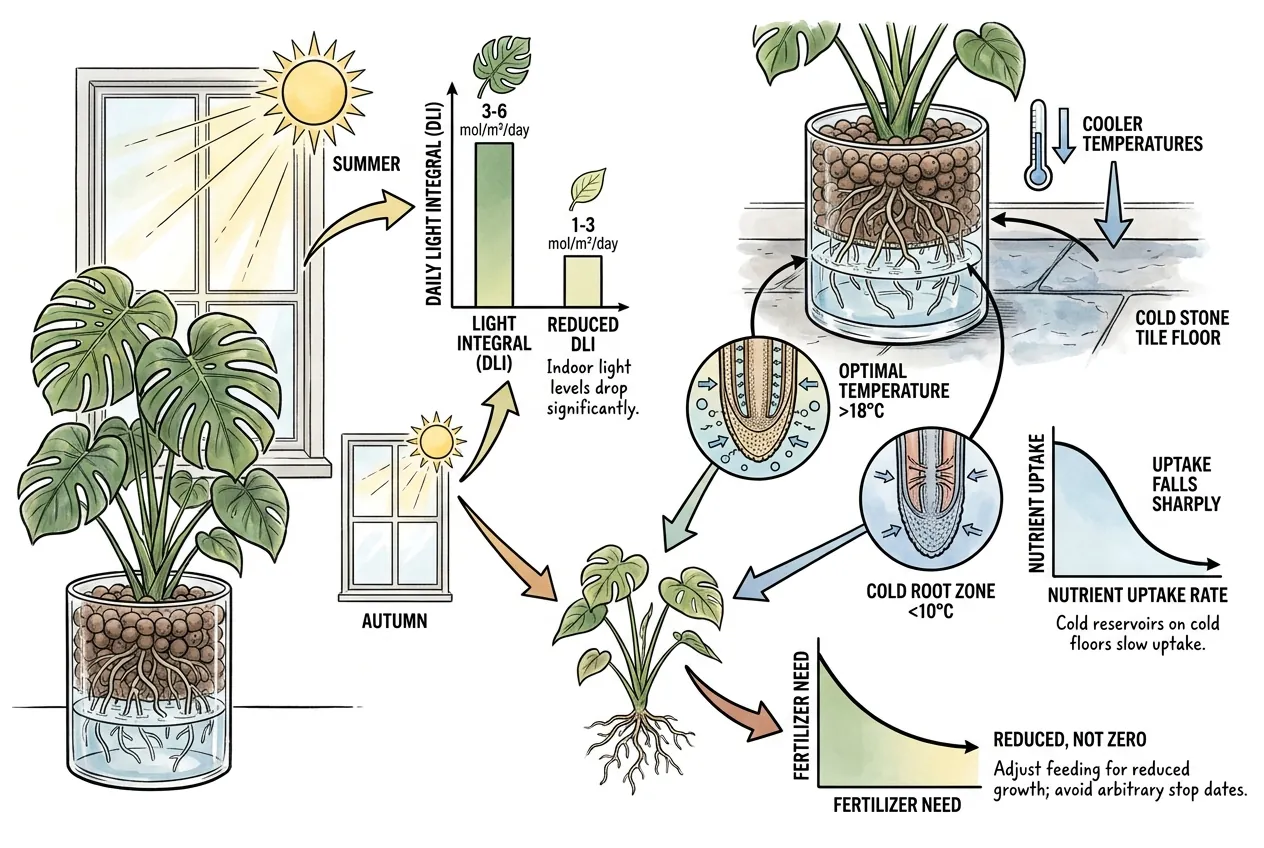
Light is usually the limiting factor, and light collapses indoors in autumn. Growth is set by the total photons a plant collects each day, its daily light integral.
Foliage houseplants sit in a low band of about 3 to 6 mol/m2/day, and autumn indoor light often drops below it.
Cooler root zones can make the slowdown worse, but I do not use 10 C as an aroid cutoff. In hydroponic cucumber seedlings, a 10 C root zone reduced shoot nitrogen, phosphorus, and potassium uptake compared with 20 C.
I use that result only as a warning to measure the reservoir itself, because a vessel on cold tile can run cooler than the room and the study did not establish a universal aroid threshold.
Reduced growth means reduced feeding need, not zero, which is exactly why a hard on-off date is the wrong tool.
What EC really tells you about a reservoir
Electrical conductivity measures the total dissolved salts in your solution, reported in mS/cm. It cannot name which nutrient is present or show whether the remaining ions are still in a balanced ratio.
That makes EC a strong salt-load alarm, but not a stand-alone measure of how hungry the plant is.
More salts in the water conduct more current, so EC rises and falls with fertilizer concentration and water volume.
When you mix fresh nutrient solution, that reading is your personal reference. There is no universal correct number to chase across every fertilizer, water source, and aroid.
EC versus the ppm on your meter
Track EC, because ppm is not a fixed quantity. Meters convert EC to ppm using either a 500 scale or a 700 scale. The same solution at EC 2.4 reads 1200 ppm on one and 1680 ppm on the other.
That difference is a units convention, not a real change in your reservoir. If you switch meters and the ppm appears to jump, you may have only switched scales.
EC is the shared unit, but two calibrated meters can still differ within their stated accuracy and temperature response. That is why I follow EC only when a change clears the instrument threshold below.
For the starting mix, I use the lowest end of the exact product’s general hydroponic range or its labeled foliage or leafy-crop range.
If the label lists only fruiting crops or provides no hydroponic range, I do not transfer that rate or convert an arbitrary fraction of its houseplant dose. I choose a fertilizer that publishes a relevant range, because equal label fractions can deliver very different salt loads across formulations.
Why the reservoir EC drifts up, down, or flat
Two forces pull on your EC in opposite directions. Roots remove ions, which lowers EC. Transpiration and evaporation remove water, which concentrates the salts left behind and raises EC.
A before-top-up reading mixes those two effects because the reservoir is no longer at its starting volume.
Restore the exact fill line with measured plain water before you compare EC, then pair the normalized reading with visible root or leaf growth.
What falling EC can tell you
After the reservoir is restored to the same volume, a real EC decrease means the solution lost more ions than it gained.
It supports active uptake, but it still cannot prove that every required nutrient was removed in a balanced ratio.
Falling normalized EC is supporting evidence for continued feeding, not permission to add concentrate blindly.
What rising EC can tell you
If EC remains above the fresh-mix reference after the reservoir returns to the marked fill line, salts have accumulated rather than merely concentrating in a smaller volume.
That is a direct reason to stop adding nutrient and consider dilution or replacement.
Why flat EC is inconclusive
Flat EC can mean little uptake, or it can mean ion removal and concentration happened to balance.
I do not call the plant dormant from that number alone. I check whether a visible root tip advanced or a new leaf progressed during the same interval.
The reservoir EC-drift test, step by step
This method combines the fresh-mix EC, the amount of water needed to restore the fill line, and visible growth over the same interval. EC guards against excess salt. The other two records stop you from mistaking concentration for nutrient demand.
Before the numbers matter, read the accuracy statement for your meter. Temperature-compensated meters still have a stated tolerance, and uncompensated readings should be taken at the same solution temperature. A real change has to exceed that instrument uncertainty.
Setting the baseline and the interval
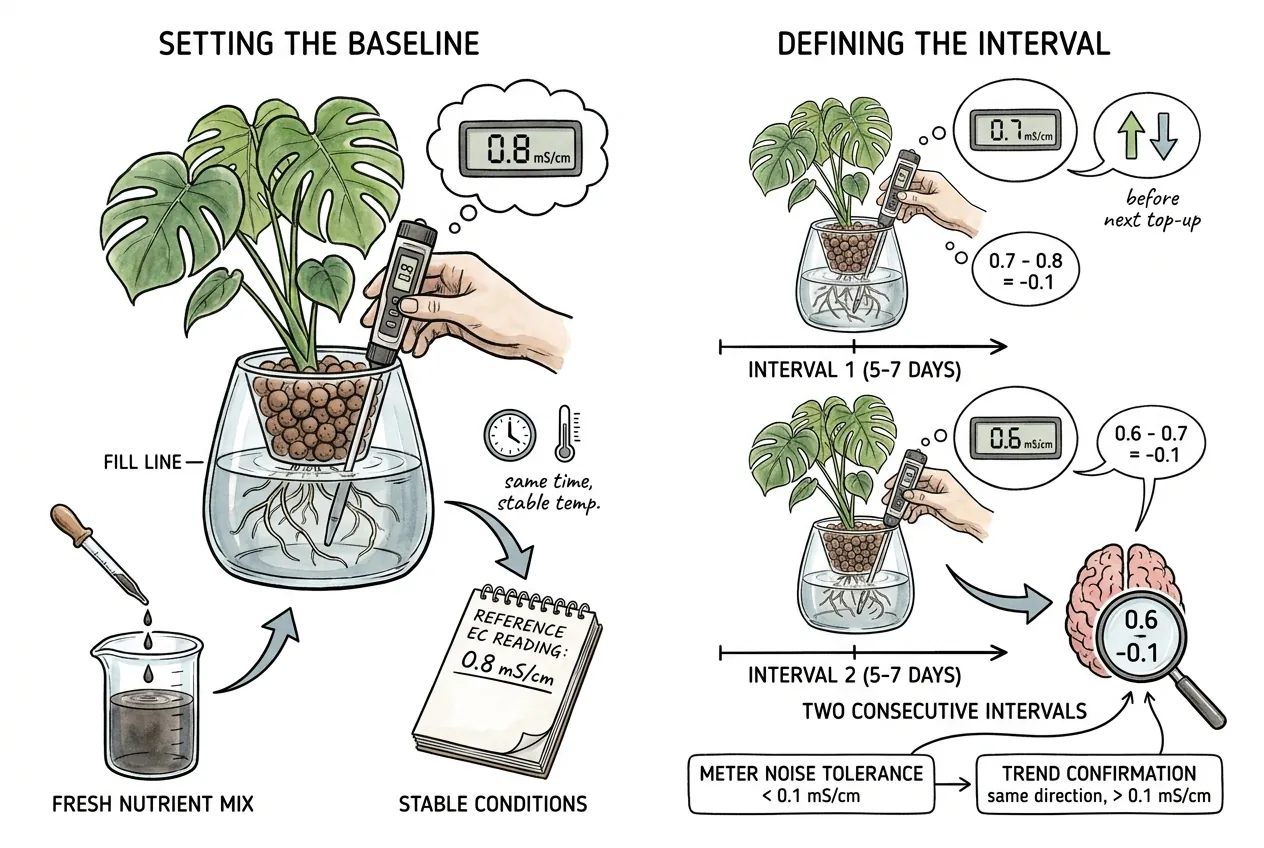
I calibrate with the meter’s specified conductivity standard, commonly 1.41 mS/cm, then mix the nutrient solution to my usual label fraction.
I record the source-water EC and the fresh-mix EC at the marked reservoir fill line.
Every 5 to 7 days, before adding nutrient, I measure how much plain water is needed to return the reservoir to that exact line. I add it, mix for two minutes, let the display settle, and read at the same time of day and solution temperature.
I rinse and store the probe according to its manufacturer rather than dipping it in the next sample to clean it.
I set the signal threshold to whichever is larger, either 0.10 mS/cm or twice the meter’s stated absolute accuracy at that reading.
For a meter rated at plus or minus 5 percent, a 1.50 mS/cm reading needs a change greater than 0.15 mS/cm. I confirm a falling or flat pattern across two consecutive intervals before changing the seasonal routine.
A high reading has a shorter rule because waiting another 5 to 7 days can extend salt exposure. I mix for another two minutes and repeat the reading once.
If the repeat still exceeds the fresh-mix reference by the signal threshold, or exceeds the fertilizer manufacturer’s stated hydroponic maximum, I stop nutrient additions and dilute or replace the solution that day. Visible salt crust, damaged root tips, or rapid leaf-edge burn also overrides the two-interval wait.
During those intervals, I call growth active when at least one visible root tip lengthens by 5 millimeters or a new leaf spear lengthens by 10 millimeters. Those are my working thresholds. They clear ordinary ruler-placement error without making me wait for a whole leaf to finish.
Reading the result and acting on it
Use the normalized EC and the growth note together.
| Confirmed result | What it means | What to do |
|---|---|---|
| Normalized EC falls beyond the threshold and visible growth advances in two intervals | Net ions are leaving the solution while the plant is growing | Continue the current diluted mix. Do not add extra concentrate between complete changes |
| Normalized EC stays within the threshold for two intervals | EC alone cannot separate low uptake from balanced losses | Do not add concentrate. Use the same diluted mix at the next complete change only if visible growth advances. Otherwise use plain water for the next interval |
| Normalized EC rises beyond the threshold and the same-day repeat confirms it | Salts are accumulating even after water-volume correction | Stop nutrient additions. Dilute or replace, and flush if the medium remains high |
Use normalized EC as the salt alarm, then use measured water loss and visible growth to decide whether feeding still earns its place.
A complete solution change still matters because EC cannot show whether individual nutrient ratios have drifted.
For a small recirculating-style reservoir, I use 14 days as the maximum interval, following extension guidance, and shorten it if normalized EC rises sooner.
When salts pile up, and how to flush them out
Keep feeding past the point of uptake and salts accumulate in the reservoir and on the medium.
That raises the osmotic pressure around the roots, so they struggle to draw water even when the reservoir is full.
The visible result is often crispy leaf edges on a plant that looks well watered.
The often-quoted 2 to 3 mS/cm ceiling does not give me a reservoir limit. Rutgers states it as a rule of thumb for most woody ornamentals measured with a saturated-media extract, not for an aroid sitting in a LECA or Pon reservoir.
I therefore use the fresh-mix EC and the fertilizer manufacturer’s crop or hydroponic range as my ceiling. The Rutgers method remains useful here for its salt-injury warning and flushing procedure, not for transplanting its absolute number.
Flushing so it actually resets
An effective flush is a measured reset, not a quick rinse. Extension guidance is to leach with about one container volume of low-EC water, which removes most soluble salts.
When levels are high, repeat the cycle 24 hours later, because more salts re-dissolve overnight.
I pass one total container volume of plain, low-EC water through the medium at a consistent temperature, discard the runoff, and refill with plain water.
After 24 hours, I compare the reservoir EC with the source water I used.
My clearance limit is the source-water EC plus whichever is larger, either 0.20 mS/cm or twice the meter’s stated accuracy.
If the reservoir remains above that limit, I repeat one more container-volume flush and check again after another 24 hours.
The 0.20 mS/cm floor is my working allowance for salts that re-dissolve after the first pass.
Using the meter allowance as the second half of the rule keeps a low-accuracy probe from creating a false failure.
A flush is finished only when the reservoir EC settles close to your plain source-water EC, not after a fixed number of minutes.
Light and warmth decide how long the feeding window stays open
If you want to keep feeding through autumn, you control the two levers that keep an aroid growing.
Give it enough light and keep its roots warm, then use normalized EC and the growth note to check whether that support is working.
Keeping the window open on purpose
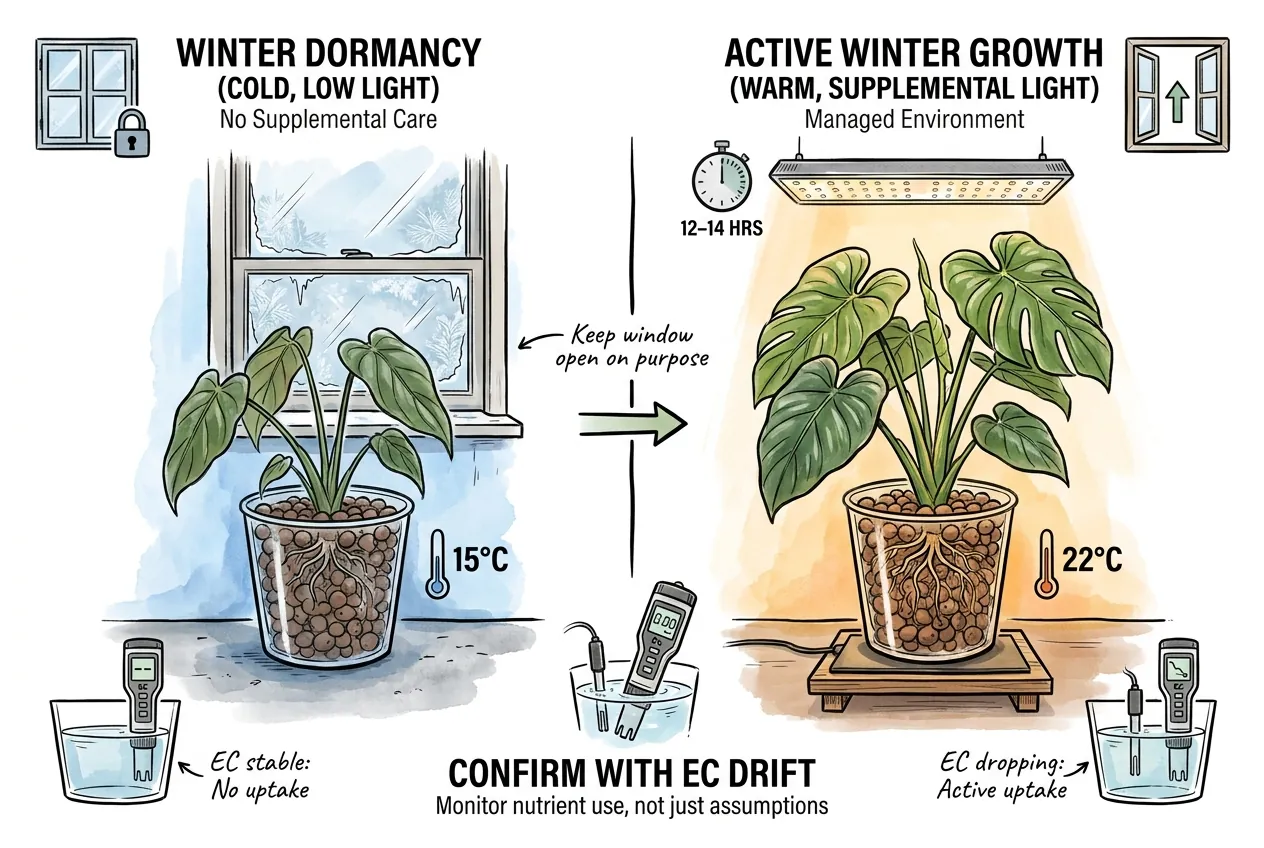
Adequate light means hitting that low-light band with a sensible photoperiod. Extension guidance suggests 12 to 14 hours of supplemental light a day for indoor growth, and foliage plants need only about 3 to 6 mol/m2/day.
A grow light on a timer can keep a philodendron pushing leaves in December when its unlit neighbor has stopped.
Warmth matters just as much at the roots. Raising root-zone temperature improves uptake, and a small warming of a few degrees measurably helped nutrient uptake in controlled trials.
Keeping reservoirs off cold floors and away from drafty single-pane glass protects that uptake.
Whatever you decide about lights and warmth, confirm the outcome with normalized EC plus visible root or leaf progress rather than either signal alone.
Your autumn feeding workflow in one loop
The whole decision reduces to a short loop you can run weekly. Set the fill-line baseline, restore the same volume, measure, check growth, and act.
The loop adapts to different aroids in LECA or Pon because it uses each reservoir’s fresh mix and each plant’s new growth. It does not assume that one EC direction proves nutrient demand.
Start the 5 to 7 day loop before changing the autumn dose. The first normalized baseline is more useful than choosing a seasonal cutoff.
If you still need a meter or a kit
The test needs only a basic EC or TDS meter and consistent habits, not a lab.
Maybe you are still deciding which meter, medium, or full semi-hydro setup to buy. Our semi-hydro conversion kit chooser compares LECA versus Pon, pot choice, nutrients, and meters without the guesswork.
Run the normalize-measure-check-act loop each week, and let salt load plus visible growth decide when the diluted feed pauses.
Key Takeaways
- Feeding need follows light, root-zone warmth, and visible growth rather than the date alone.
- Restore the marked water volume before comparing EC. Direction without volume correction is ambiguous.
- Confirm falling or flat trends over two intervals, but repeat and act on a high normalized EC reading the same day.
- Track EC in mS/cm, not ppm, since ppm depends on a 500 or 700 meter scale.
- Require a change greater than 0.10 mS/cm or twice your meter’s stated accuracy, whichever is larger.
- Confirm a flush when reservoir EC falls below source EC plus the 0.20 mS/cm-or-meter-error allowance.