
Philodendron Leaf Rot When Heating Starts: Wet vs Dry
Philodendron leaf rot when heating starts? Learn to fork wet bacterial soft rot from dry Fusarium collapse in autumn and take the correct first action.
Jordan Cole · Published 2026-09-13 · 15 min read
Key Takeaways
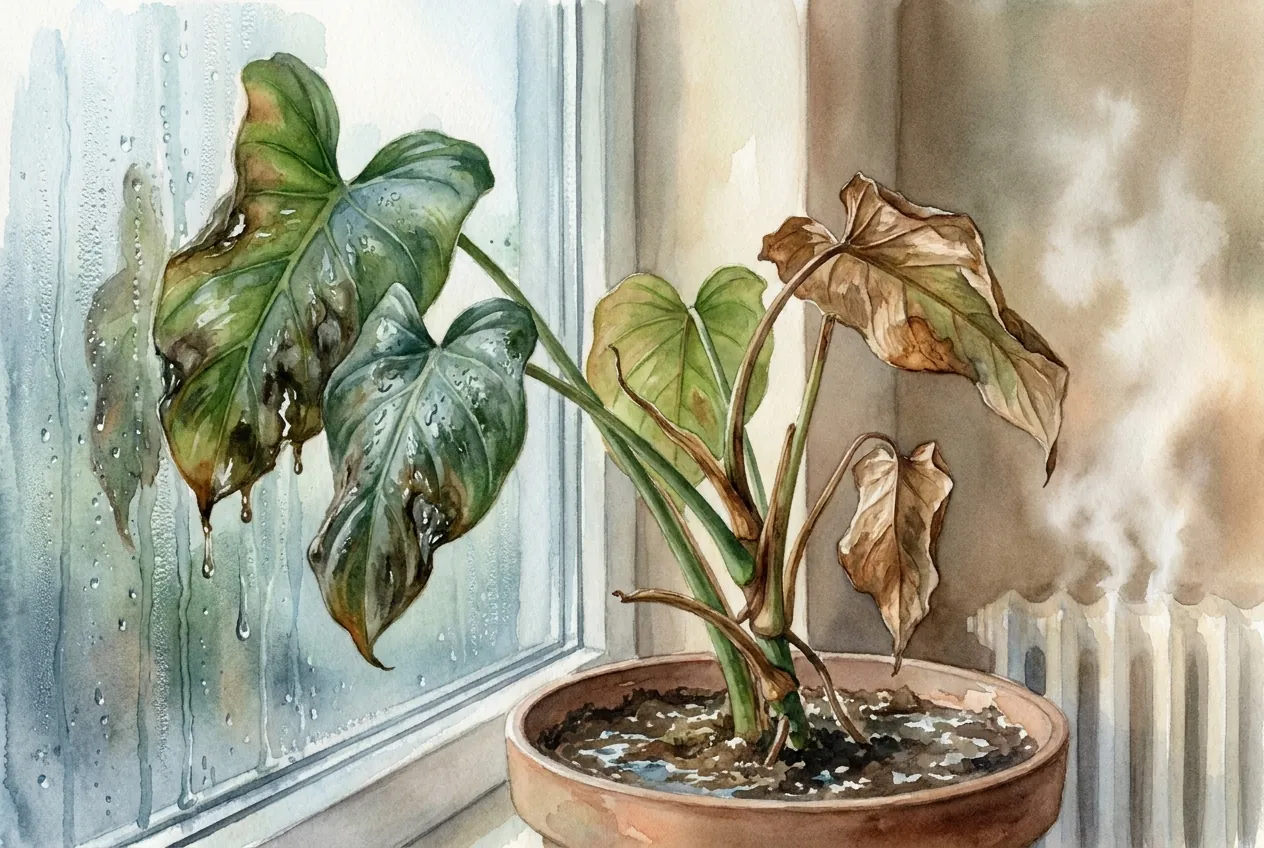
- Heating season spikes both rots at once by drying the room while wetting cold-window leaves and soaking roots.
- Wet, mushy, foul collapse is bacterial soft rot. Firm, dry-browned collapse with wilt is usually Fusarium.
- Fork it at the bench by texture, a smell check from arm’s length, where it starts, and how fast it spreads.
- Fungicides do not cure soft rot and sprays do not rescue vascular Fusarium. Isolation and drying do the work.
- Never reuse substrate from a Fusarium plant, since the fungus survives in soil as long-lived spores for years.
A petiole goes soft near its base, a leaf flops, and within a day the whole thing smells like a forgotten bag of salad. Or the opposite happens. A leaf browns and firms up, the plant wilts on one side, and nothing smells at all.
Those are two different diseases with two different fixes, and early autumn is when both show up at once. The reason is the heat coming on. Sorting the wet, foul collapse from the dry, firm one lets you treat the right problem while the plant can still be saved.
Why does aroid leaf rot spike when the heat comes on?
Heating changes three things at the same time, and each one favors a different rot. That overlap is why early autumn is the worst window for a philodendron collection.
When cold outside air is heated indoors, its relative humidity drops fast, often into the 20 to 30 percent range in a well-heated home.
Tropical aroids that prefer 50 to 70 percent read that as a desert, and you see crispy tips and curling margins. That part is just dry stress, not rot.
The rot risk comes from what happens alongside the dry bulk air. Cold windows and exterior walls stay cold, warm room air condenses on them, and a film of water settles on nearby leaves.
Cool air near the glass evaporates that film slowly, so the leaf stays wet for a long time.
Prolonged leaf wetness is the single condition that most favors bacterial soft rot.
Watering makes it worse if you do not adjust. Autumn brings lower light and cooler soil, so the plant drinks less. But if you keep the summer schedule, the mix stays soggy for days and the roots sit in water.
That wet, airless root zone is what fungal and generic root rots exploit.
Heating dries the room while quietly creating long leaf wetness and a slow-draining root zone.
Both the wet rot and the dry rot get their opening at the same time.
How do I know if my leaves are staying wet long enough to matter?
Measure it, because a dry-feeling room fools people into thinking foliage cannot stay wet. It can, right next to cold glass.
After you water or mist, I mark one leaf sitting near a cold window and one interior leaf on the same plant.
Then I check both every 30 minutes until each is dry. Doing this across a few autumn evenings shows a clear pattern rather than a one-night fluke.
If the cold-surface leaf is still wet when the interior leaf has already dried, that is your signal.
Move the plant off the cold surface, or stop wetting the foliage. The interior leaf is the reference, so you are measuring the surface effect and not blaming the whole room.
Which two rots are you actually dealing with?
You are choosing between a bacterial soft rot and a fungal rot, and they behave nothing alike once you know what to feel for.
Naming the exact organism needs a lab, but forking wet from dry is something you can do at the bench.
What is Erwinia soft rot today?
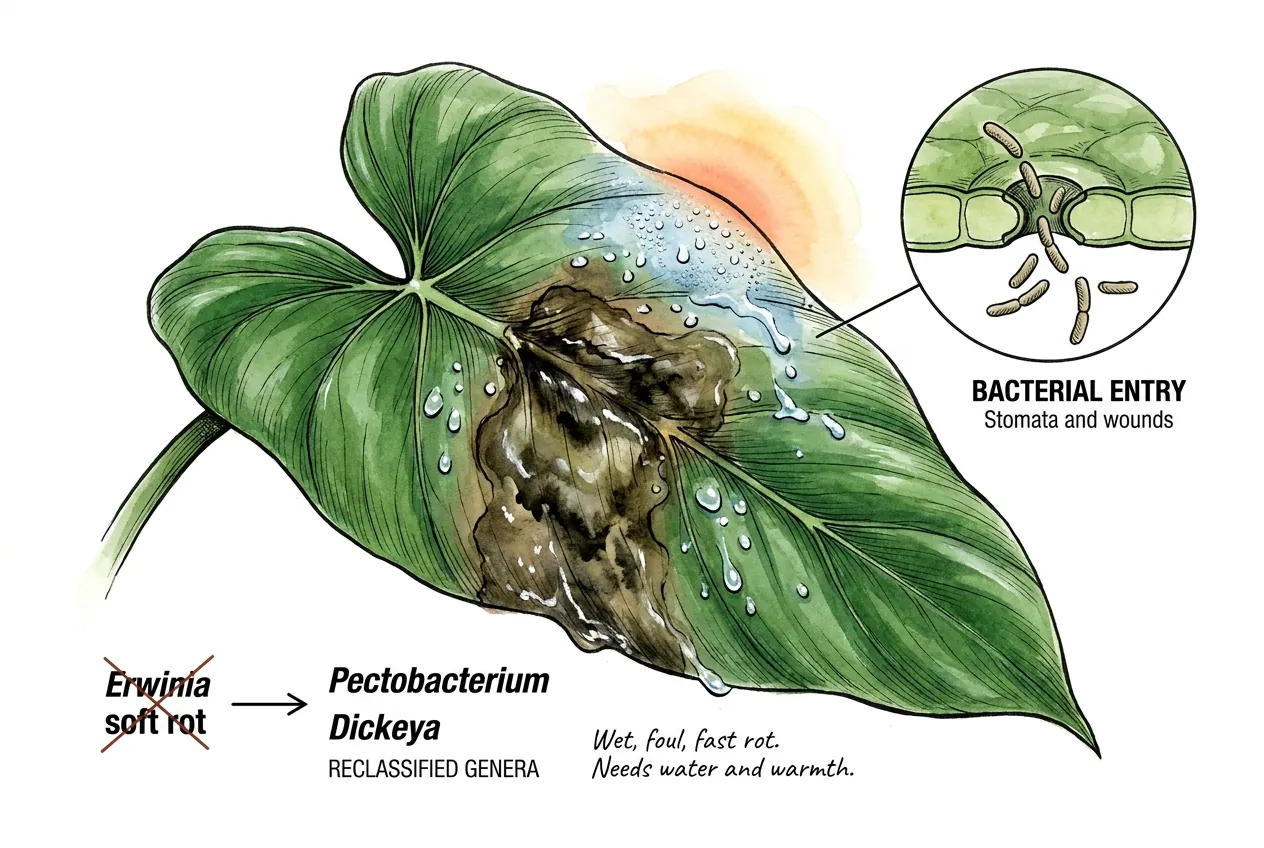
It is the wet, foul, fast one, and the name on your old care sheet is out of date.
The bacteria hobbyists still call Erwinia soft rot were reclassified into the genera Pectobacterium and Dickeya, in the family Pectobacteriaceae.
The practical point is that the old label and the new names describe the same disease you are looking at.
Pectobacterium carotovorum is the broad-host workhorse of the group, and Dickeya even includes a species first named from an aroid host, so aroids are squarely in range.
These are gram-negative bacteria that enter through wounds and natural openings like stomata. They need free water and warmth, which is exactly what condensation on a cold-window leaf provides.
What is Fusarium rot on an aroid?
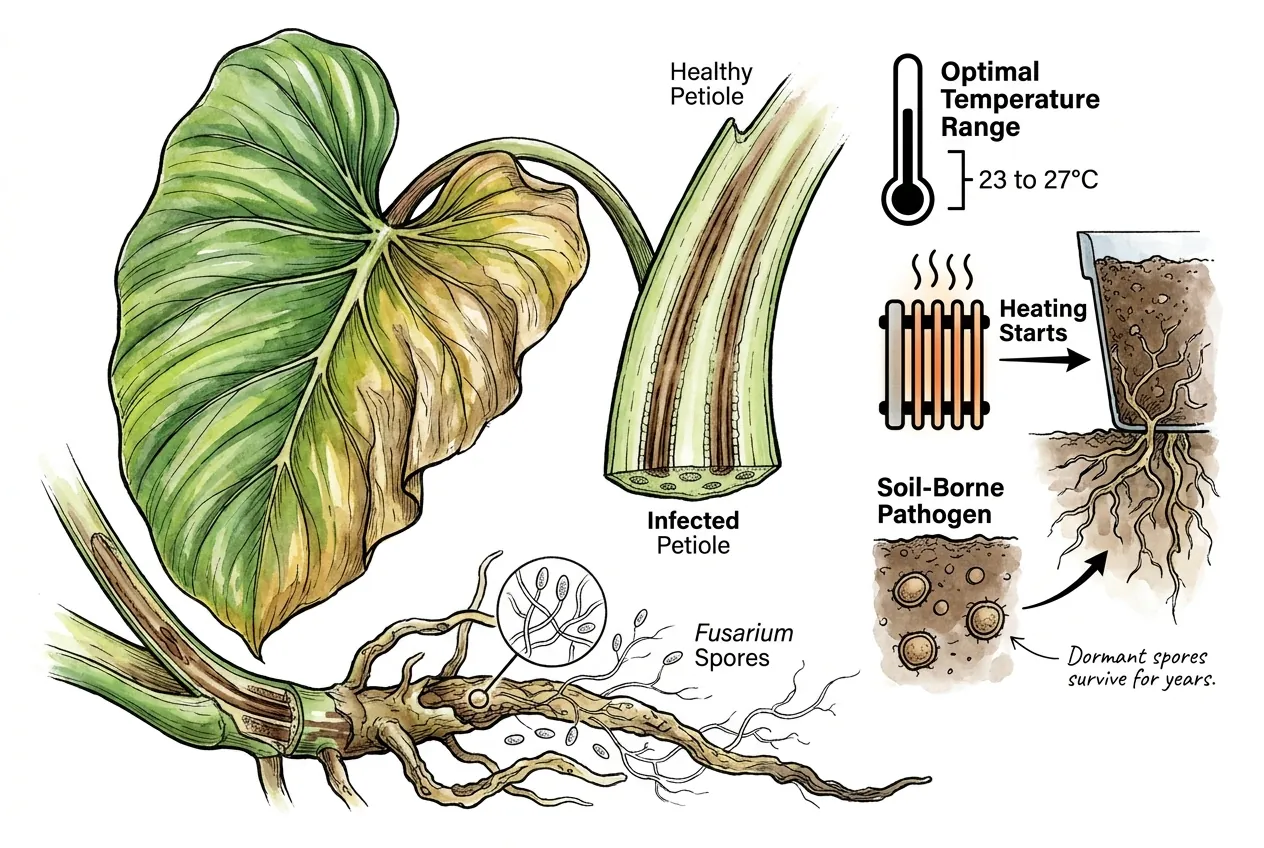
It is the drier, slower, root-and-vascular one. Fusarium oxysporum and the Fusarium solani complex are soil-borne fungi that infect roots, and in the case of F. oxysporum, colonize the xylem and block water movement.
That is why a Fusarium plant can wilt or collapse on one side while the affected tissue stays relatively firm and dry rather than turning to slime.
A cut petiole may show brown vascular streaking instead of a wet, structureless mush.
Two facts about this fungus shape how you respond. It grows across a wide temperature band, with an optimum reported around 23 to 27 degrees Celsius.
A cooling autumn root zone is often still well inside its active range.
It also survives in soil as dormant chlamydospores for years, which is why the substrate itself becomes a hazard.
Why do people confuse them?
Because both end in browning, collapsing, dying tissue, and both often start at a wound or the base of a petiole. The overlap is real, not just careless.
It gets harder because soft rot bacteria frequently move into a Fusarium lesion as a secondary colonizer, especially when surfaces are wet or humidity is high.
So a single plant can genuinely read as both, which is why the fork below is triage rather than a final identification.
Use the wet-versus-dry check to decide your first action, and confirm anything ambiguous, spreading, or on a valuable plant with a plant-disease clinic.
How do I tell wet collapse from dry collapse at home?
Compare the collapse front against a healthy petiole or leaf on the same plant, then work through texture, a safe smell check, the spread pattern, and the advance rate.
The reference matters, because you are judging a change from that plant’s own normal.
The five-step bench fork
Do this with clean dry hands and a blade you disinfect between every cut and every plant.
Step 1. Press the front
Press the edge of the collapse with a clean finger. Water-saturated and slimy points to the wet bacterial fork. Firm and dry-browned points to the dry fungal fork.
Step 2. Cut one thin section
Cut a single thin cross-section right at the boundary between healthy and damaged tissue. Wet, structureless mush reads bacterial. Firmer dry necrosis, or a ring of brown vascular streaking, reads fungal.
Step 3. Smell from arm’s length
Sniff from arm’s length only, never up close. A strong rotting-vegetable smell points hard toward bacterial soft rot.
Absence of smell leans fungal. Do not inhale closely and do not taste tissue.
Step 4. Read where it started and how it spreads
A wet, foul front creeping up a petiole from a soggy base points bacterial. Wilt or collapse tied to the roots or crown, with drier necrosis, points fungal.
Step 5. Time the advance
Mark the boundary and re-check it every 24 hours. When the front is wet and foul and moves more than a few millimeters in a day, that fast advance reinforces the bacterial read. Slow movement reinforces fungal.
That few-millimeters-in-a-day figure is my own working threshold to separate quick bacterial maceration from slower fungal progress, not a published standard. Treat it as a tie-breaker rather than a diagnosis.
Wet versus dry at a glance
This table sums up the fork. Every row is a tendency, not a rule, because the two can overlap on one plant.
| Signal | Wet fork (bacterial soft rot) | Dry fork (Fusarium and related fungi) |
|---|---|---|
| Texture | Mushy, water-soaked, slimy | Firm, dry-browned, sometimes sunken |
| Smell at arm's length | Strong, foul, rotting-vegetable | Little or none |
| Cross-section | Structureless wet mush | Drier necrosis or brown vascular streaking |
| Usual start point | Wet petiole base, wound, or crown | Roots, crown, or a wound, with wilt |
| Advance speed | Fast once established | Generally slower |
| First move | Isolate, remove wet tissue, dry the plant | Isolate, check roots, cut root moisture |
What are the limits of a home check?
The fork sorts your first action, not the species. Bacteria colonizing a fungal lesion, or an early case showing only one or two signals, can blur the read.
Most US states have a plant-disease diagnostic lab through the National Plant Diagnostic Network. Send a fresh sample when the case is ambiguous, spreading, or the plant is hard to replace.
Ask the lab before applying any pesticide, because a prior treatment can interfere with recovering the organism.
What does bacterial soft rot actually do to the tissue?
It dissolves the glue between cells, which is why the tissue turns to wet mush instead of drying out. Understanding the mechanism explains both the smell and the speed.
Soft rot Pectobacteriaceae secrete large amounts of plant cell-wall-degrading enzymes, including pectate lyases, polygalacturonases, and cellulases.
Pectin holds the primary cell wall and the middle lamella together, and these pectinases break it down, so cells lose cohesion and the tissue macerates.
The virulence of these bacteria tracks how much of that enzyme they pump out. More enzyme means faster maceration, which is why a soft rot can go from a small water-soaked spot to a collapsed petiole in a short time.
The smell comes from volatiles released as the tissue breaks down, joined by the mixed microbes that thrive in the wet rot.
It is a reliable warning sign precisely because it is a byproduct of the maceration itself.
Because soft rot is enzymatic maceration rather than slow fungal growth, your early window is short and it closes fast.
Why does the wrong treatment make it worse?
Because the two rots respond to nothing in common, and every day spent on the wrong product is a day the real problem keeps advancing. This is the most expensive mistake in the whole sequence.
Why fungicides do not fix soft rot
They act on fungal structures a bacterium simply does not have. There is no home spray that reliably cures active bacterial soft rot, because the disease penetrates deep and moves fast, so chemical treatment is generally ineffective.
Copper products are the usual suggestion, but copper is a preventive surface protectant. It may reduce new infections on healthy tissue and cannot stop an infection already inside the plant.
Reaching for neem or a fungicide on a wet, foul collapse burns the short window when isolation and drying still help.
Why sprays do not rescue a Fusarium plant either
Fusarium wilt is systemic and soil-borne, living in the xylem and in the substrate as long-lived spores.
Once vascular colonization is established, a foliar fungicide does not reach and cure it, so management leans on removing tissue, replacing substrate, and fixing the root zone.
The overwatering confound
Not every autumn collapse is a named pathogen. Summer watering habits carried into low-light, cooler autumn leave roots sitting wet, and that alone causes ordinary root rot and wilt that mimics both forks.
Before you assume Fusarium, unpot and look. If the mix has been chronically soggy and roots are brown and soft, fix the watering first, because that also removes the conditions the real pathogens exploit.
What is the correct first response for a wet, mushy collapse?
Move fast and lead with sanitation, because no spray will do the work for you. The order matters.
The wet-fork sequence
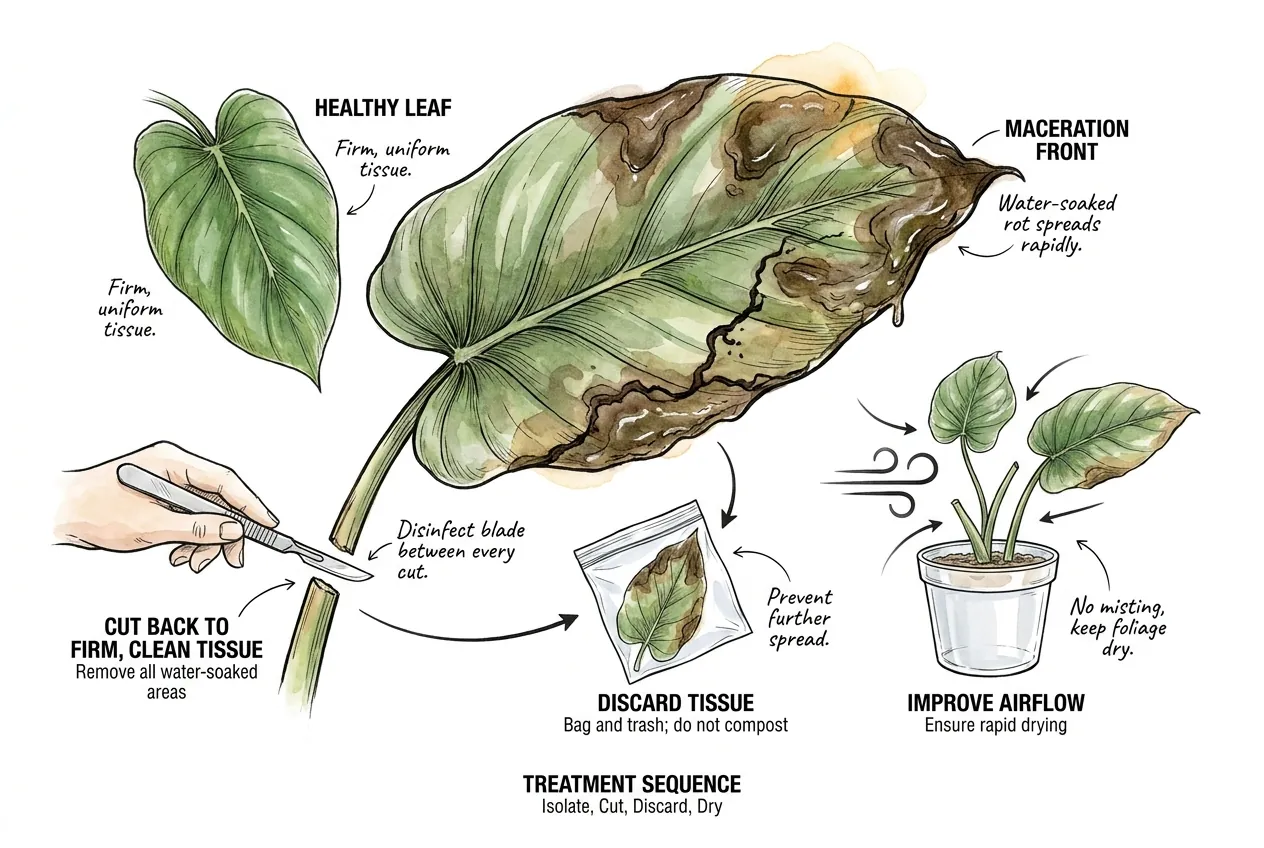
Isolate immediately
Get the plant away from the others. Splash and contact spread these bacteria at every watering, so an infected plant on a shared shelf is a source for its neighbors.
Stop wetting the foliage
No misting and no overhead watering. Keep the leaves and crown dry so any surviving surface bacteria lose the free water they need.
Cut back to firm, clean tissue
Remove the macerated tissue with a disinfected blade, cutting into tissue that is firm, uniform, and shows no water-soaking.
Disinfect the blade between every cut, because the maceration front often runs ahead of what you can see.
Improve airflow and discard the tissue
Move air across the plant so residual moisture dries quickly. Bag the removed tissue and put it in the trash rather than the compost, and follow any local disposal rules.
How far back do I cut, and when is the plant lost?
Cut until the exposed tissue is clean and firm, with no universal margin, because the rot travels inside the petiole faster than the surface shows.
If each cut still reveals wet or discolored tissue, keep going toward the base.
When the soft rot has reached the crown or the main stem base, the plant is often gone, because the maceration has reached the growing point.
Your only salvage may be a clean cutting taken from unaffected upper growth with sterile tools, kept dry while it recovers.
For soft rot, speed of isolation and removal decides the outcome far more than any product you could spray.
What is the correct first response for a firm, dry collapse?
Go to the roots first, because the dry fork is usually a root, crown, or vascular problem rather than a surface one. Then treat the substrate itself as contaminated.
The dry-fork sequence
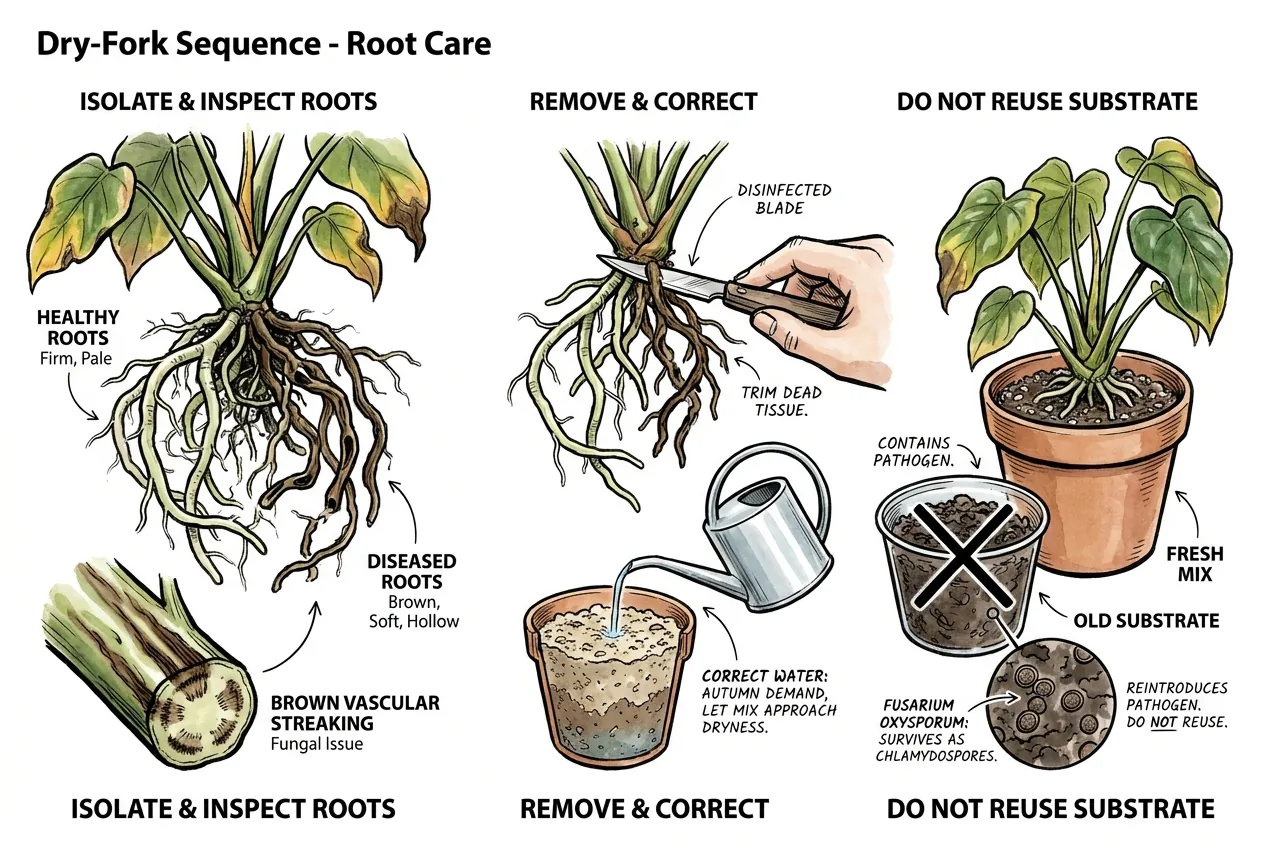
Isolate and inspect the roots
Move the plant aside, then unpot it. Healthy roots are firm and pale. Brown, soft, or hollow roots, along with any brown vascular streaking in a cut stem, point to a root or vascular fungal problem.
Remove dead tissue and correct the water
Trim clearly dead roots and affected tissue with a disinfected blade. Then water to actual autumn demand rather than the summer schedule, letting the mix approach dryness deeper in the pot before you rewater.
Do not reuse the substrate
Repot into fresh mix, and use a new or disinfected pot. Fusarium oxysporum survives in old substrate as chlamydospores for years, so reusing that mix just reintroduces the pathogen to the next plant.
Why does the root zone need to change, not just the plant?
Because the wet, airless root zone is what let the fungus and any generic root rot take hold in the first place.
A faster-draining, more aerated aroid mix keeps oxygen at the roots and shortens the soggy window both problems exploit.
If you are now weighing what substrate actually drains faster for aroids, that is a buying decision worth handing off.
Our aroid potting mix chooser walks it through rather than guessing at the garden center.
When the fungus has already colonized the vascular system broadly, or the crown has rotted, recovery is unlikely.
At that point the job is protecting the rest of the collection and, if any exists, saving a clean cutting.
How do I keep both rots out for the rest of the heating season?
Recalibrate watering, keep foliage dry near cold surfaces, raise humidity without wetting leaves, and stay strict on hygiene. These habits cut the risk for both forks at once.
Recalibrate watering to autumn demand
Lower light and cooler soil mean the plant drinks less, so the summer frequency now leaves the mix soggy for days.
Extend the interval, and let the mix approach dryness deeper in the pot before rewatering.
Keep foliage dry, especially near cold glass
Prolonged leaf wetness is the main lever you control for bacterial soft rot. Move plants off cold windows and exterior walls where condensation films linger, and water at the soil rather than overhead.
Cut back on misting, which gives only brief humidity relief while keeping foliage wet.
Raise humidity without soaking leaves
If the dry heated room is stressing plants, add ambient humidity in ways that leave no standing water on foliage.
Group plants, run a room humidifier, or use an enclosure with airflow. Balance the added moisture with air movement so surfaces still dry between waterings.
If holding humidity and airflow together through the heating season has become your real project, our plant cabinet humidity control chooser walks through the equipment decision without the guesswork.
Stay strict on hygiene and quarantine
Disinfect pruning tools between plants, and clean pots and benches. Quarantine every new plant before it joins the collection, because both soft rot and Fusarium arrive on new stock.
A warm, crowded, humid shelf is where one infected plant becomes many.
The whole heating-season defense is one idea repeated, keep water off the leaves and out of a stagnant root zone, and both rots lose their opening.
Key Takeaways
- Heating season spikes both rots at once by drying the room while creating long leaf wetness on cold-window leaves and a soggy root zone.
- Wet, mushy, foul collapse is bacterial soft rot. Firm, dry-browned collapse with wilt is usually Fusarium.
- Fork it at the bench by texture, a smell check from arm’s length, where it starts, and how fast it advances.
- Fungicides do not cure soft rot and sprays do not rescue vascular Fusarium. Isolation, tissue removal, and moisture control do the work.
- Never reuse substrate from a Fusarium plant, because the fungus persists in soil as long-lived spores.