
Paludarium Plants: Place Them by the Water Line
Most paludarium plants die from placement, not light. Learn to choose and position plants by where their roots belong, above or below the water line.
Jordan Cole · Published 2026-08-19 · 13 min read
Key Takeaways
- A paludarium is a vertical stack of habitats, so place plants by height, not by looks.
- Root oxygen, not water quantity, decides survival below and at the water line.
- Never bury an Anubias or Bucephalandra rhizome. Attach it to hardscape at the line.
- Leaf melt with firm roots is conversion and recovers. Soft basal rot is misplacement.
- The land wicks water upward, so use coarse free-draining media in the emersed band.
Most paludarium plants do not die from bad light or bad water. They die because they were placed a few centimeters too high or too low.
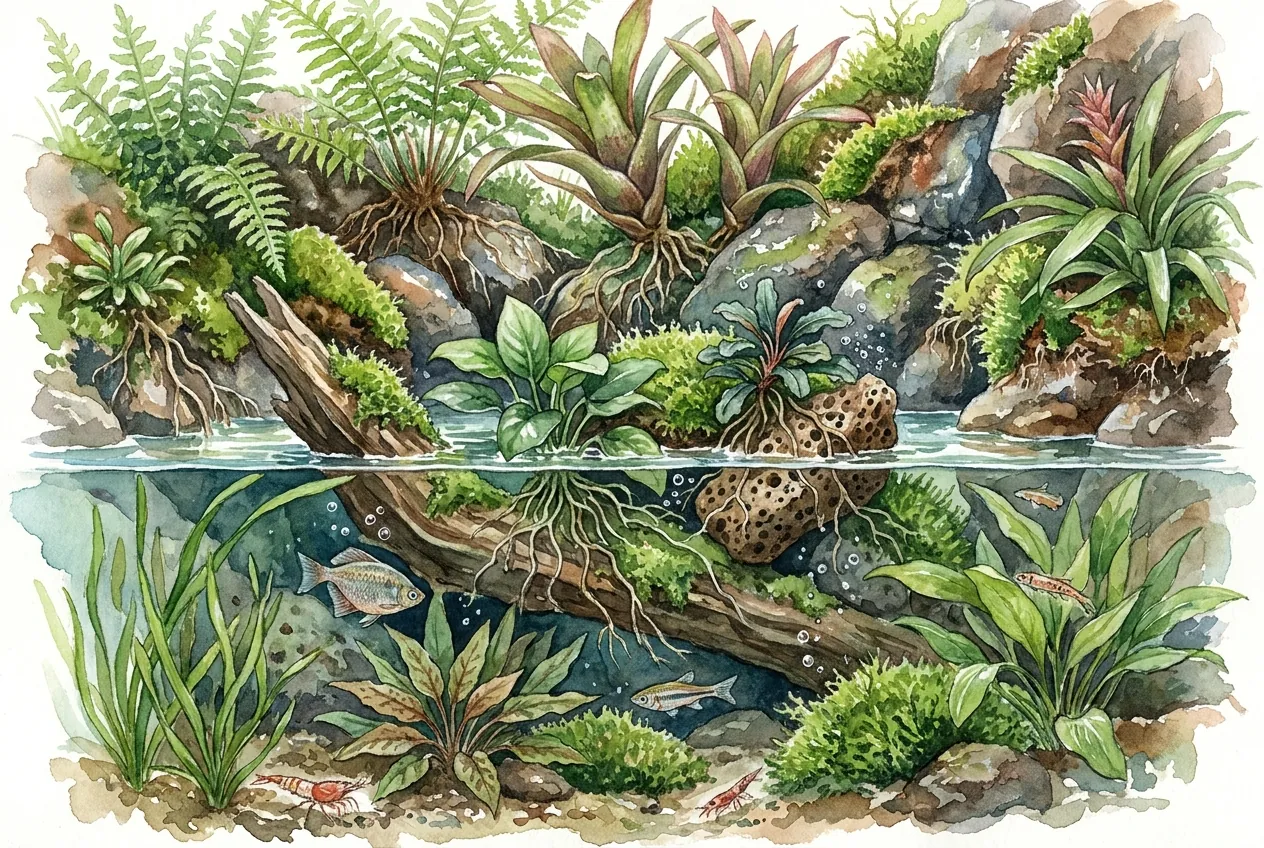
A paludarium is not one environment. It is a vertical stack of microhabitats, and the water line is the boundary between all of them.
Get the height right and forgiving plants almost run themselves. Get it wrong and even tough species rot or crisp. A plant’s native habit tells you its band, the specific height above or below the water line where its roots belong.
Why a Paludarium Is Many Habitats Stacked in a Few Centimeters
A paludarium sorts into distinct bands set by depth relative to the water surface, exactly the way a real shoreline does. Wetland ecologists call this littoral zonation. Submerged plants sit deepest, emergent plants stand rooted in the bottom with leaves in the air, and amphibious plants ring the wet-soil edge.
The bands are narrow. In a tank, a few centimeters of height separates a drowned root from a healthy one.
That is why a plant list with no height plan is the most common way to lose plants.
On a side photograph, I mark the permanent water, splash, capillary, and drier zones and assign every plant a root-zone position. A few centimeters of vertical movement can change oxygen and wetness more than moving across the whole enclosure.
When a plant declines, I add the first failed tissue and date to the zone map before relocating it. Repeated failures along one height suggest a placement problem worth checking against the needs of each species.
What Actually Changes as You Cross the Line
Two things change as you move up through the water line, and neither is simply how wet the medium is.
The first is dissolved oxygen at the root. Submerged substrate goes low-oxygen fast, and only plants with internal air-transport tissue can live there. The second is air humidity, which is very high right at the surface and falls as you climb into the emersed zone.
Root-zone oxygen, not water quantity, is the variable that decides whether a plant survives below or at the line. Wetland species build spongy internal air channels called aerenchyma, and many add a barrier that forces that oxygen down to the root tip.
A plant without this tissue suffocates in saturated substrate no matter how carefully you water it.
Read the Plant, Not the Price Tag: Four Water Groups
You can place almost any paludarium plant correctly if you know which of four groups it belongs to.
Each group evolved a different water strategy, and each maps to a band.
The four groups are aquatic, semi-aquatic or amphibious, terrestrial, and epiphytic. Knowing the group predicts placement far better than knowing the common name.
Sort every plant into aquatic, amphibious, terrestrial, or epiphytic before you place a single one.
The Two Special Cases Worth Learning by Name
Two groups anchor most paludariums and deserve their own labels because they behave unlike ordinary potted plants.
Rheophytes evolved on rock in fast streams. Anubias, many Java ferns, and Bucephalandra attach to hardscape and resist current rather than rooting in soft substrate.
Hemiepiphytes such as Pothos, Philodendron, Monstera, and Epipremnum begin life on the forest floor and climb tree trunks with aerial roots, so they root low and grow up.
| Group | Where its roots sit | Example genera | Paludarium band |
|---|---|---|---|
| Aquatic | Submerged or floating | Echinodorus, stem plants | Submerged bed |
| Amphibious / marginal | Roots wet, foliage in air | Cryptocoryne | Water line |
| Rheophyte | Attached to hardscape in current | Anubias, Bucephalandra | Splash band |
| Hemiepiphyte | Low root, climbing into air | Monstera, Philodendron, Epipremnum | Emersed background |
| Terrestrial / epiphyte | Above saturation or on hardscape | Ferns, mosses, micro-orchids | Emersed zone |
Below the Line: What Really Tolerates Submersion
The submerged band holds plants whose roots, and often leaves, live underwater. What survives here is set by internal air transport, and in a tank without injected carbon dioxide, by carbon demand.
A plant that can move oxygen internally from air-exposed tissue down to a submerged root will live below the line. A plant that cannot will suffocate. That single trait, aerenchyma, is the dividing line.
Picking Submerged Plants for a Low-Tech Tank
For a paludarium without injected carbon dioxide, lead with slow, low-demand species rather than hungry carpeting stems.
Anubias, Java fern, and Cryptocoryne draw carbon efficiently and tolerate lower light, so they settle in where demanding stems melt.
Many plants sold as submerged are actually amphibious and only tolerate submersion after a conversion period, which is normal and covered below.
In a no-carbon-dioxide paludarium, choose slow rhizome and rosette aquatics and skip high-light carpeting stems.
The Splash Zone: Feet Wet, Head in Humid Air
The most valuable band in a paludarium is also the one beginners fail most. It is the splash zone, where roots sit in saturated substrate or moving water while the crown and leaves live in humid air. Most of the best hobby plants live exactly here.
Rheophytes and amphibious marginals dominate this band. The good news is that they are hard to kill once you follow one rule about the rhizome.
Never Bury the Rhizome
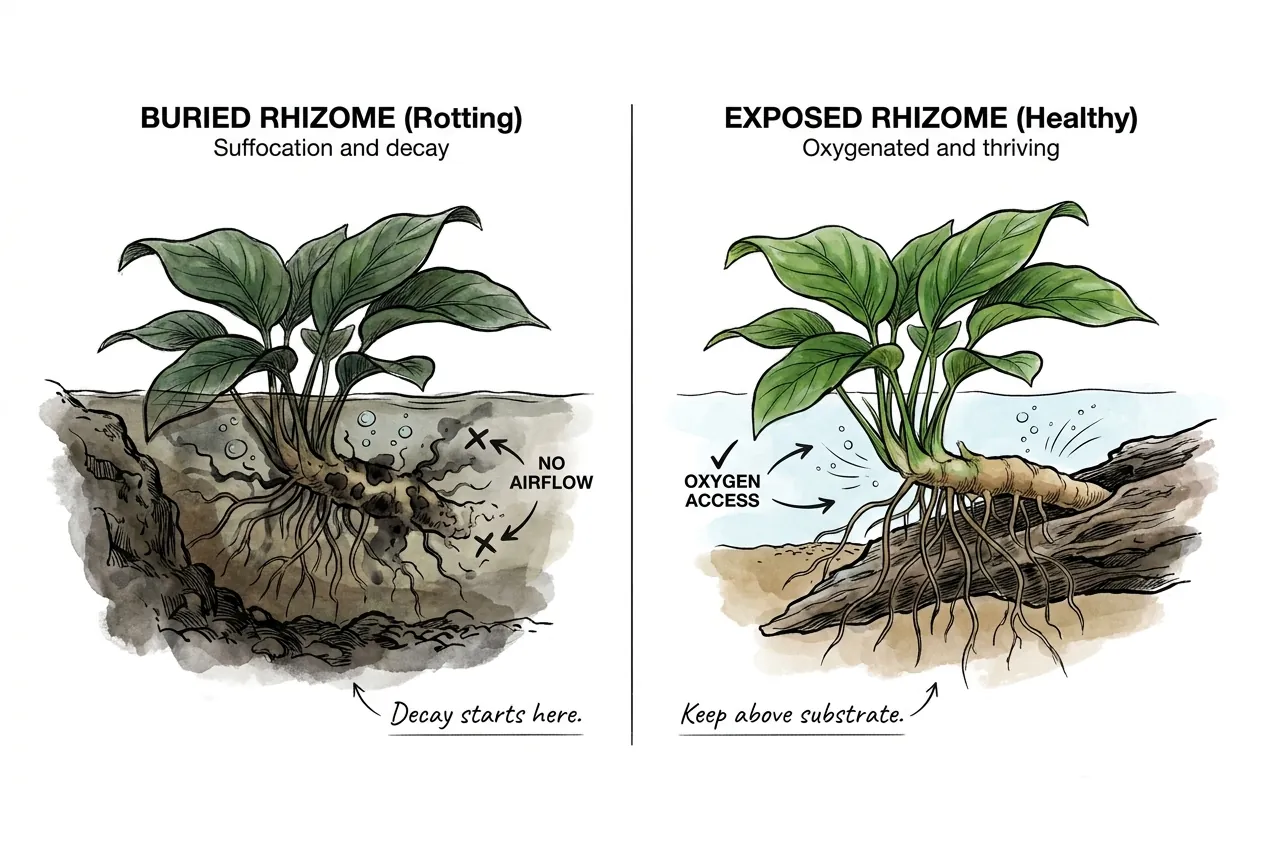
A rhizome is a stem, not a root, and it has to stay in oxygenated water or air.
Bury it and it suffocates and rots, taking the whole plant with it.
A buried rhizome is the single most common way to kill an Anubias or a Bucephalandra. When you plant these, bury only the roots and leave the thick horizontal rhizome sitting on top of the substrate.
Better still, glue or tie the rhizome to rock or wood right at the water line.
Where Amphibious Marginals Belong
Cryptocoryne and similar marginals want their feet in saturated substrate and their leaves in the humid air just above the line.
Plant them at the wet margin and they push emersed leaves upward while rooting into the saturated substrate below. This is the same position they hold on a natural shoreline.
Above the Line: Hemiepiphytes and the Emersed Canopy
The emersed band above the water line is where climbing aroids belong. Pothos, Philodendron, Monstera, and Epipremnum root low in the water or substrate and climb into the air, which makes them ideal background and vertical plants.
These plants keep one foot in moisture and lift their foliage into brighter, drier air. That split is their natural arrangement, not a compromise.
What Aerial Roots Are Doing
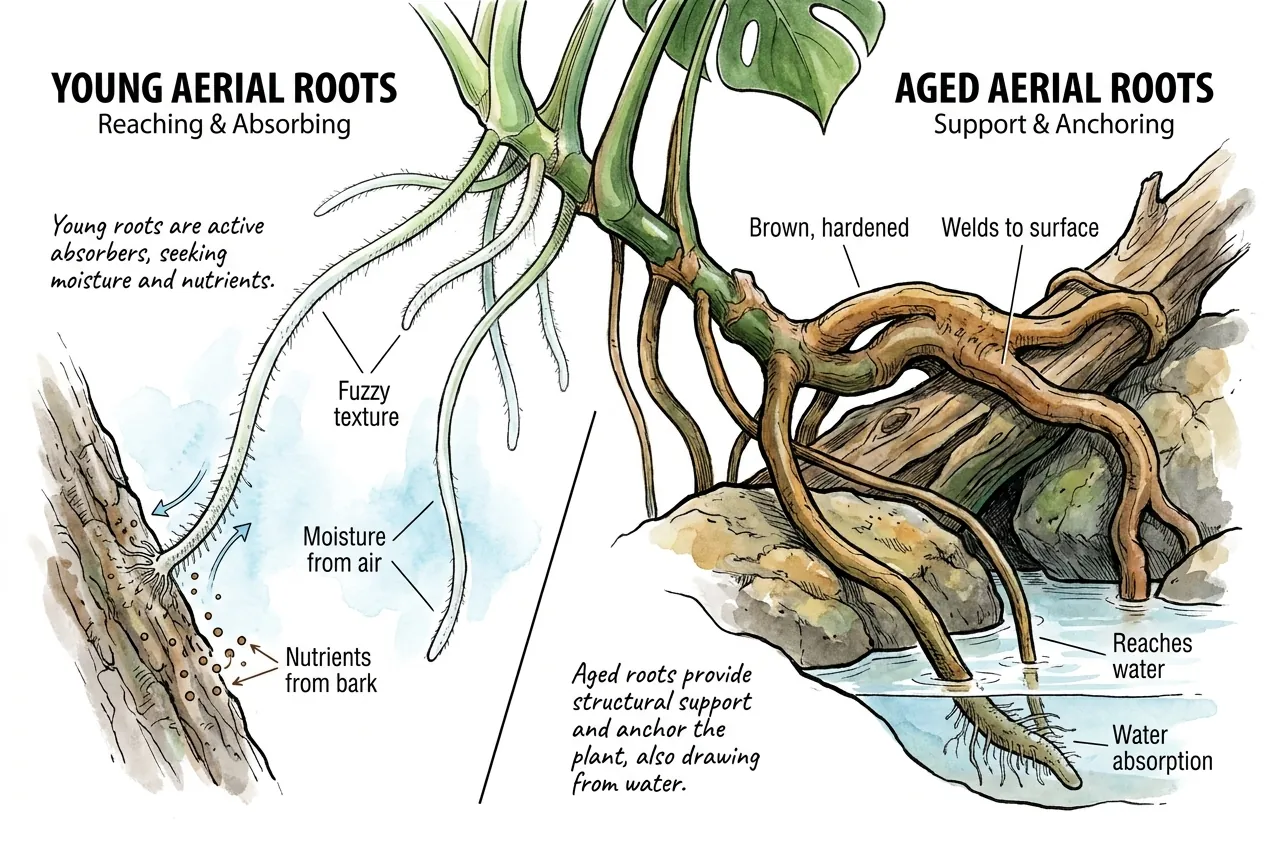
Aerial roots do two jobs at once, and understanding that tells you how to manage them.
Young aerial roots are white and fuzzy and reach for a surface to grip, absorbing a little moisture and nutrient from air and bark along the way.
As they age they turn brown, harden, and weld to whatever they are climbing. Let some aerial roots reach the water while others grip a support.
Why the Emersed Leaf Is the Real One
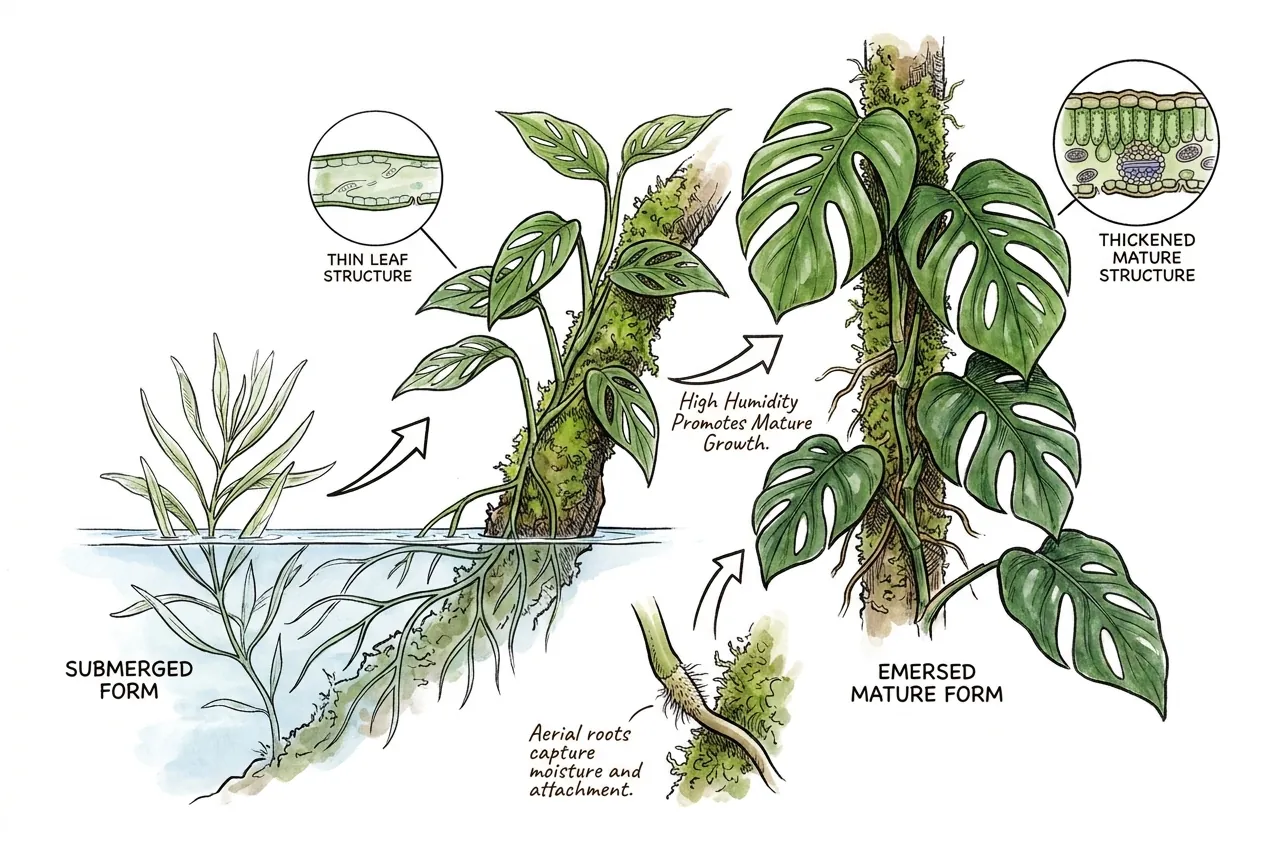
Grown emersed in high humidity, a hemiepiphyte makes its characteristic mature foliage rather than the thin form an underwater plant would produce.
A Monstera in a humid paludarium fenestrates and firms up its leaves, which is the growth most keepers actually want.
The reader who wants a climbing support or a lighting fixture for this canopy should not pick a single product blind.
Use the site’s moss-pole chooser and aroid grow-light chooser instead.
Why Plants Melt When They Cross the Line
Melt frightens new keepers because it looks like death, but it is usually the opposite. Many aquatic and amphibious plants rebuild their leaves when they cross the water line, a plasticity called heterophylly.
Submerged leaves are thin and narrow and lack a cuticle and stomata, so they can absorb carbon dioxide and ions directly from water.
Aerial leaves are thicker, cutinized, and carry stomata to breathe air while holding water in. When a plant moves between zones, it sheds the wrong-form leaves and grows the right ones.
Melt Is the Rebuild, Not the End
Crypt melt is the classic example. A crypt grown emersed at the farm drops its leaves after you plant it underwater, then regrows submerged leaves over several weeks.
Leaf loss on a plant with firm, healthy roots is conversion and will recover, so leave it undisturbed rather than pulling it. The plant is spending old-leaf energy to build medium-appropriate leaves and new roots. This switch is even hormone-driven, mediated by abscisic acid.
Which Plants Convert and Which Do Not
Cryptocoryne, Bucephalandra, and many stem plants convert readily because they are amphibious by nature.
A purely terrestrial fern has no submerged leaf form to switch to, so it does not convert and simply rots underwater. Match the plant’s group to the direction you are moving it.
Diagnosing a Plant in the Wrong Zone
A struggling plant tells you which way to move it if you read where the damage starts. Failures point up or down depending on the symptom.
Damage that begins at the base and roots means the plant is too wet or too deep.
Damage that begins at the leaf tips means it is too high or too dry.
The Three Failure Signatures
Each mismatch has a distinct look, and the fix follows directly from the look.
| Symptom | Likely cause | Corrective move |
|---|---|---|
| Soft, dark, mushy base | Too wet or too deep, roots suffocating | Move up out of the saturated band |
| Rot localized to the rhizome | Rhizome buried | Lift and expose the rhizome |
| Crisp, papery leaf edges | Too high or too dry | Lower toward the humid band or raise humidity |
| Leaf loss, roots still firm | Conversion melt, not misplacement | Leave undisturbed and wait |
Check whether the damage starts at the roots or the leaf tips, then move the plant away from the failing direction.
The Land Is Wetter Than It Looks: Wicking and Root Oxygen
The land section of a paludarium is rarely as dry as it appears. Capillary action pulls water up from the saturated base into the substrate above the water line, forming a saturated fringe that behaves like an extension of the water.
Where that fringe sits decides which roots get both moisture and oxygen. Substrate structure controls the height of the fringe.
Fine Media Wick High, Coarse Media Stay Airy
Pore size sets how high water climbs. Fine media with small pores pull water high and stay wet, while coarse media keep the saturated band low and stay full of air above it.
Use coarse, free-draining media in the emersed band so roots stay moist while still getting air. A chunky mix above the line keeps a Philodendron’s roots damp without drowning them, whereas a dense peat mix at the same height wicks to saturation and rots them.
For the specific emersed and terrestrial mix, the reader should use the site’s potting-mix and jewel-orchid soil choosers rather than a single named product.
The Vertical Planting Map, Bottom to Top
Putting it together, a paludarium is planted in six bands from the substrate bed up to the emersed canopy. Each band takes a specific group, and the ordering mirrors the natural shoreline.
The main grow-in risk is the tallest plants shading the shortest ones, so plan for mature height from the start.
Six Bands, Bottom to Top
Fill the tank in this order and each plant lands in the oxygen, humidity, and light it needs.
| Band | Height | What goes here |
|---|---|---|
| Substrate bed | Deepest | Submerged aquatics, rooted rosettes |
| Underwater midground | Below line | Low-tech aquatics grouped by light |
| Water line | At the surface | Amphibious marginals like Cryptocoryne |
| Splash band | Just above line | Rheophytes attached to hardscape |
| Emersed midground | Above line | Terrestrials, ferns, mosses |
| Emersed background | Tallest | Hemiepiphyte climbers, hardscape epiphytes |
Keep the Canopy From Starving the Floor
Emersed background plants grow tallest and can shade the submerged and transition bands as they fill in.
Light falls off fast through both water and a dense canopy.
Keep tall hemiepiphytes at the back and prune the canopy so light still reaches the water.
The fixture and intensity decision is its own problem, and the reader should use the site’s aroid grow-light chooser for it rather than guessing at wattage.
A Forgiving Shortlist for Your First Build
A first build is far easier if each zone gets a few forgiving species chosen for one clear reason. Save the demanding plants for after the tank settles.
The picks below survive the settling-in period while you learn how your specific tank behaves.
Easy Picks by Zone
Each of these is forgiving for a specific reason, noted so you understand why it works.
| Zone | Beginner picks | Why it is forgiving |
|---|---|---|
| Submerged | Anubias, Java fern, a Cryptocoryne | Low light and no carbon dioxide needed |
| Splash / transition | Bucephalandra or Anubias on hardscape | Nearly foolproof if the rhizome stays exposed |
| Emersed | Pothos or Epipremnum, a fern, moss | Thrive in the high humidity above the line |
For high-humidity background specialties, micro-orchids suit the emersed zone once the tank is stable, and the site’s micro-orchid guide covers those choices.
Skip high-light carpeting plants and delicate variegated aroids until you have a season of experience.
Key Takeaways
- A paludarium is a vertical stack of habitats, so place plants by height relative to the water line, not by looks.
- Root oxygen, not water quantity, decides survival below and at the line.
- Never bury the rhizome of Anubias or Bucephalandra. Attach it to hardscape at the splash line.
- Leaf melt with firm, healthy roots is conversion and recovers, while soft basal rot is a placement error.
- The land wicks water upward, so use coarse free-draining media in the emersed band.