
Aquarium-Safe Adhesive Comparison: Glue, Silicone, Foam
An aquarium safe adhesive comparison for vivarium and paludarium builds: which glue, silicone, foam, and epoxy to buy, and how long each must cure.
Marcus Hale · Published 2026-06-21 · 37 min read
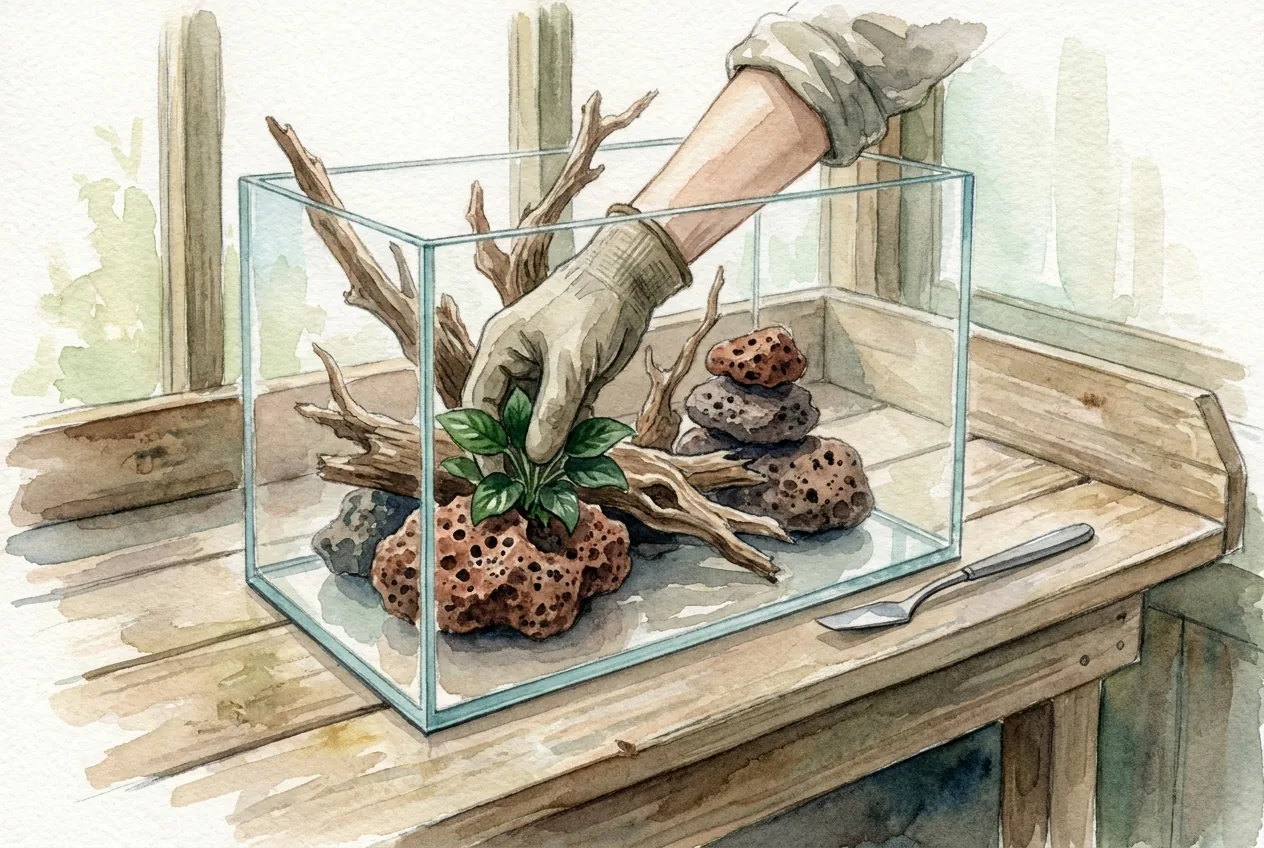
Key Takeaways
- Full cure lowers the risk from most build adhesives, but it is a necessary step rather than proof of aquarium safety. Favor products with a stated aquarium or aquatic-life use.
- Match the chemistry to the job. Use CA gel to tack plants, 100% aquarium silicone to seal glass, pond foam for bulk backgrounds, and epoxy putty for gap-fill. Buy only what your build needs.
- A mildew-resistant or mold-free claim is a prompt to check the label, SDS, and stated aquarium use. It is not a guaranteed sign of a biocide.
- Cure time depends on the product, bead depth, and conditions. Follow each maker's instructions and use the stated time as a minimum rather than relying on smell.
- Cured epoxy is low-risk but not perfectly inert. Use a potable or aquarium-rated putty and soak first.
- Adhesive is not structure. Build heavy rock as a stable mechanical stack first, then use epoxy as a supporting gap-filler rather than the primary load path.
The phrase aquarium safe is stamped on tubes that were never tested for a closed aquatic tank. Safety is not a property of the marketing word.
Full cure lowers the risk, but the product's formulation, its stated aquatic use, how much surface it exposes, and how it is loaded all still matter.
Match Chemistry to the Job
Four different jobs each tend to suit a different adhesive. The comparisons use manufacturer documentation and flag where a product's aquarium fit is unverified.
Which aquarium-safe adhesive should I buy for each job?
Pick the adhesive that fits the job in front of you. Cyanoacrylate gel tacks plants, 100% aquarium silicone seals glass, pond foam builds bulk 3D backgrounds, and two-part epoxy putty fills gaps and sets underwater.
A plant-only tank may need only CA. A leaking seam may need only aquarium silicone. Buy the ones your build actually calls for rather than all four by default.
Each chemistry tends to suit one of these jobs, because its cure behavior shapes what it can and cannot do.
Asking one adhesive to do another's job is a common way to a weak joint. The right choice also depends on the substrate, the joint design, the load, and the specific product, not the chemistry class alone.
Two questions narrow it fast. Does the joint need to bridge a gap, and does it need to cure fully submerged? Epoxy putty handles both.
CA gel bridges only a thin bond line, though some CA products (including aquarium-labeled ones) can be applied underwater. Check the specific product.
Silicone and foam sit in between, split by sealing versus bulk fill. Note too that a fully submerged aquarium, a humid but terrestrial vivarium, and a mixed paludarium expose an adhesive very differently, and fish-safe, potable-water, reptile-safe, and amphibian-safe are not interchangeable ratings.
I make a small test bond from spare pieces of the actual glass, rock, foam, or wood and apply the bead thickness planned for the build. The sample cures for the full manufacturer period under comparable temperature and humidity before I stress or soak it separately.
The coupon can expose obvious adhesion problems, uncured material, or surface contamination without risking the finished enclosure. It cannot certify the finished bond. I still follow the label and never use an adhesive with unknown additives.
Quick decision table
| Build job | Buy this | Why |
|---|---|---|
| Tack moss, Anubias, Bucephalandra, mini orchids to wood/rock | Cyanoacrylate (CA) gel | Sets in seconds on a damp rhizome, thin reversible bond |
| Seal glass seams. Bond rock to glass with support | 100% aquarium silicone | Flexible, aquarium-rated, bonds glass. Cures in air, not underwater |
| Build 3D backgrounds, ledges, fill large voids | Pond/habitat foam (black) | Only chemistry that expands to fill bulk, not a structural support |
| Gap-fill, underwater repair, supporting bonds on a stable stack | Two-part epoxy putty | Cures fully submerged. Anchors, but does not replace a mechanically stable stack |
Cyanoacrylate Adhesives gap-fill and cure trigger
J-B Weld WaterWeld Epoxy Putty technical page
What does aquarium safe actually mean?
Aquarium safe on a tube is a claim, not a guarantee. Two things at minimum have to hold. The adhesive should be fully cured, and it should carry no additive engineered to leach.
Full cure sharply lowers the hazard from most build adhesives, but it is not sufficient on its own.
Formulation, residual monomer, fillers and pigments, how much surface the piece exposes to water, and slow degradation all still matter, which is why a stated aquarium or aquatic-life use from the maker is worth more than the cure alone.
Several things raise the risk. Antimicrobial additives, where present, can leach regardless of cure. Incomplete cure leaves reactive monomer free to off-gas or dissolve, and even a cured joint can fail by carrying a load it was never rated for, by sitting on an incompatible substrate, or by slowly releasing trace compounds over time.
The biocide additive is the real killer
A well-known concern is the biocide that some kitchen-and-bath silicones carry to resist mildew, rather than the silicone itself.
Where an added biocide is present, it is often formulated to migrate slowly and stay active for years, and that kind of leaching is what you want to avoid in a closed aquatic box.
The catch is that a mildew-resistant or mold-free claim on the label does not by itself confirm which biocide, if any, is present, or how much would migrate into aquarium water.
Treat the wording as a reason to check the specific product, not as proof.
Why Biocide Toxicity Matters
Triclosan, a classic mildewcide, has a reported 96-hour LC50 of 260 µg/L for fathead minnow and 370 µg/L for bluegill, with algae far more sensitive at a 96-hour biomass EC50 near 1.4 µg/L. Those figures describe triclosan's own toxicity. They do not establish that any particular sealant contains it.
The EPA registers triclosan as a pesticide and lists it as toxic to fish and aquatic animals.
Practical Screen for Silicone
Prefer a sealant sold as 100% silicone with a stated aquarium or aquatic-life use, and where a mold-resistance claim appears, check the label and SDS and the maker's intended use before trusting it.
Note that some aquarium-rated silicones also describe themselves as mold- and mildew-resistant, so the claim alone is not a disqualifier either way.
Each chemistry off-gasses a different reactive species
Most of the acute hazard falls in the curing window, and each adhesive releases something different there.
Acetoxy silicone releases acetic acid, the vinegar smell, until it has fully off-gassed. Polyurethane foam releases isocyanate vapor, a potent respiratory sensitizer.
Cyanoacrylate releases an irritant monomer vapor that drops off once the glue sets. Epoxy off-gasses amine hardener while it is liquid, then reacts to a largely non-hazardous solid.
The application-to-cure window carries most of the acute exposure, but it is not the whole story. Cutting or grinding cured foam creates dust, and cured joints can still fail under load or slowly release trace compounds, so fully cured is not the same as risk-free forever.
Government limits put numbers on the curing-stage hazard. The NIOSH REL for methyl-2-cyanoacrylate vapor is 2 ppm over an 8-hour shift.
The OSHA PEL for MDI isocyanate is a ceiling of 0.02 ppm, and acetic acid carries an OSHA PEL of 10 ppm.
Why a sealed vivarium amplifies everything
A vivarium is a near-airtight box, so off-gassing that would disperse in a room can concentrate around the plants and animals.
As a general point, some airborne VOCs are known to injure vegetation at ambient levels. Ethylene, for example, causes leaf epinasty and altered flower and seed development, and the dose response is not linear, so low chronic levels can still matter.
That research is about air pollutants such as ethylene rather than these specific adhesive vapors, so treat it as a reason to ventilate, not as measured evidence of harm from a given tube.
The practical takeaway is to ventilate an enclosed build well before sealing it, because trapped acetic acid, isocyanate, or solvent vapor has nowhere to go.
For more on managing enclosed-system airflow, see our guide on paludarium airflow and misting.
Aquatic toxicity of triclosan (Orvos et al., Environ Toxicol Chem)
EPA Triclosan Facts
NIOSH Pocket Guide, methyl-2-cyanoacrylate
NIOSH Pocket Guide, methylene bisphenyl isocyanate (MDI)
OSHA Annotated PEL Table Z-1, acetic acid
Effects of airborne volatile organic compounds on plants (Cape, Environ Pollut)
How do the four adhesives compare on measurable specs?
Compare candidates on several practical axes rather than the words on the tube. Cure chemistry, what it bonds, gap-fill, underwater cure, the cure and safe-wait window, reversibility, and rough price tier.
These are general tendencies of each chemistry class. The exact numbers still come from the specific product, substrate, and conditions, and PPE and a stated aquarium use are separate axes covered below.
Compare Gap-Fill and Underwater Cure
CA bridges only a thin line while epoxy fills bulk. Epoxy sets fully submerged, while CA is usually applied above water unless the specific aquarium-labeled product is rated for underwater use.
Selection criteria comparison table
| Chemistry | What it bonds | Gap-fill | Underwater cure | Cure / safe-wait window | Reversibility | Price tier |
|---|---|---|---|---|---|---|
| CA gel (cyanoacrylate, moisture-cured) | Plants/epiphytes to wood and rock | No (~0.05 to 0.5 mm only) | Varies by product (some aquarium CA rated for underwater use) | Sets ~20 to 45 s. Full cure ~8 to 24 h (per product) | Partial (brittle, cracks off, acetone debonder) | Low |
| 100% RTV silicone (acetoxy, moisture-cured) | Glass seams, rock, foam coats | Limited (seals seams a few mm) | No (cures in air only) | ~3 mm per 24 h. Acetic acid up to ~1 week | Mechanical (cut/peel/scrape) | Low to Mid |
| Expanding PU pond foam (one-component) | Bulk 3D backgrounds, void fill, rock | Yes (bulk, closed-cell) | No (cures in air) | Tack-free minutes. Cures ~8 h. ~24 h re-entry | No (carve out) | Mid |
| Two-part epoxy putty (amine-epoxide) | Gap-fill, supporting bonds on a stable stack | Yes (bulk) | Yes (sets submerged) | Varies by product (set ~25 min to hours) | No (cut/grind off) | Mid to Higher |
CA gel suits thin, close-fitting tacks because it cannot cure reliably through a thick gap. Epoxy can cure through a thicker mass and underwater, so it suits small structural support. Cure time and immersion tolerance still vary by product and joint shape, so read the specific data sheet.
Reversibility is a real tradeoff, not a defect. CA pops off when you rescape, which helps for plant placement and hurts for anything load-bearing.
Foam and epoxy are hard to remove once set, so commit the layout before you spray or knead.
RTV Silicone Sealant Cure Time Guide (INCURE)
Biomedical Silicones additive review
Which exact products meet each role's spec?
Each option below explains its suitable job, its limit, and the safety check to make before use. Use an unverified consumer product only where its own label and safety data support the intended enclosure.
What CA gel attaches moss and epiphytes to hardscape?

Use a cyanoacrylate in the gel grade, because the gel viscosity stays on the contact point instead of wicking onto leaves. Thin CA runs and frosts foliage.
The gel tacks a moist Anubias, Bucephalandra, Java fern, or mini orchid rhizome to wood in roughly 20 to 30 seconds, since surface moisture triggers a fast cure.
Wear eye protection while dosing. CA bonds skin and eyes in seconds and reacts fast with cellulose materials such as cotton, tissue, and dry moss or coir, which can generate enough heat to burn, so keep it off dry organic fibers.
Seachem Flourish Glue
The aquarium-dedicated choice is the one with a documented aquarium use. Seachem Flourish Glue is a cyanoacrylate gel sold for attaching moss and plants to rocks, driftwood, and gravel, bonds within seconds, and can be used underwater.
The maker notes it is not for bonding glass, and warns that it bonds skin and eyes within seconds.
Apply a rice-grain dab on a patted-dry rhizome and press about 20 seconds. The limitation is price. You pay a premium for small 2×4 g tubes.
It is a proprietary cyanoacrylate blend, and while the cured backbone is broadly similar to other CA gels, that does not make its additives, handling, or intended use identical to a hardware-store tube.
Gorilla Super Glue Gel
A common budget stand-in is a hardware-grade gel, but note it is not aquarium-rated. Gorilla Super Glue Gel uses a no-run gel formula, sets in 10 to 45 seconds, cures in about 24 hours, and needs absorbed surface moisture to cure.
The 20 g size lasts for frequent hardscape work. The real limitation is that Gorilla markets this as an indoor small-repair adhesive. It is not stated food-safe and carries no aquarium or continuous-immersion rating.
If you use it, confine it to dry, above-water hardscape assembled before setup, cure and ventilate fully, and understand you are relying on the general CA cure behavior rather than a manufacturer aquarium claim.
Loctite Ultra Gel
For precise single-drop placement on small tufts, a control-tip gel helps. Loctite Ultra Gel is a rubber-toughened cyanoacrylate gel in a side-squeeze bottle for fine dosing, with a 12 to 24 hour full cure.
It suits spot-tacking tiny epiphytes where a large tube over-applies. The limitation is labeling. Like Gorilla it has no aquarium rating, and Loctite does not recommend this formula for glass, silicone, or foam rubber, so keep it to small dry plant-attachment points, not seams or backgrounds.
Apply CA sparingly inside a sealed vivarium and ventilate during cure. Excess monomer vapor re-deposits as white bloom on glass and leaves and adds irritant vapor in the closed box.
Bloom is cosmetic, not a bond failure, but ventilation during cure keeps both bloom and vapor down.
Tissue adhesives review, cyanoacrylate cure and chain length
Gorilla Super Glue Gel manufacturer page
Cyanoacrylate blooming and frosting (third-party explainer)
Which 100% silicone is safe for sealing and bonding?
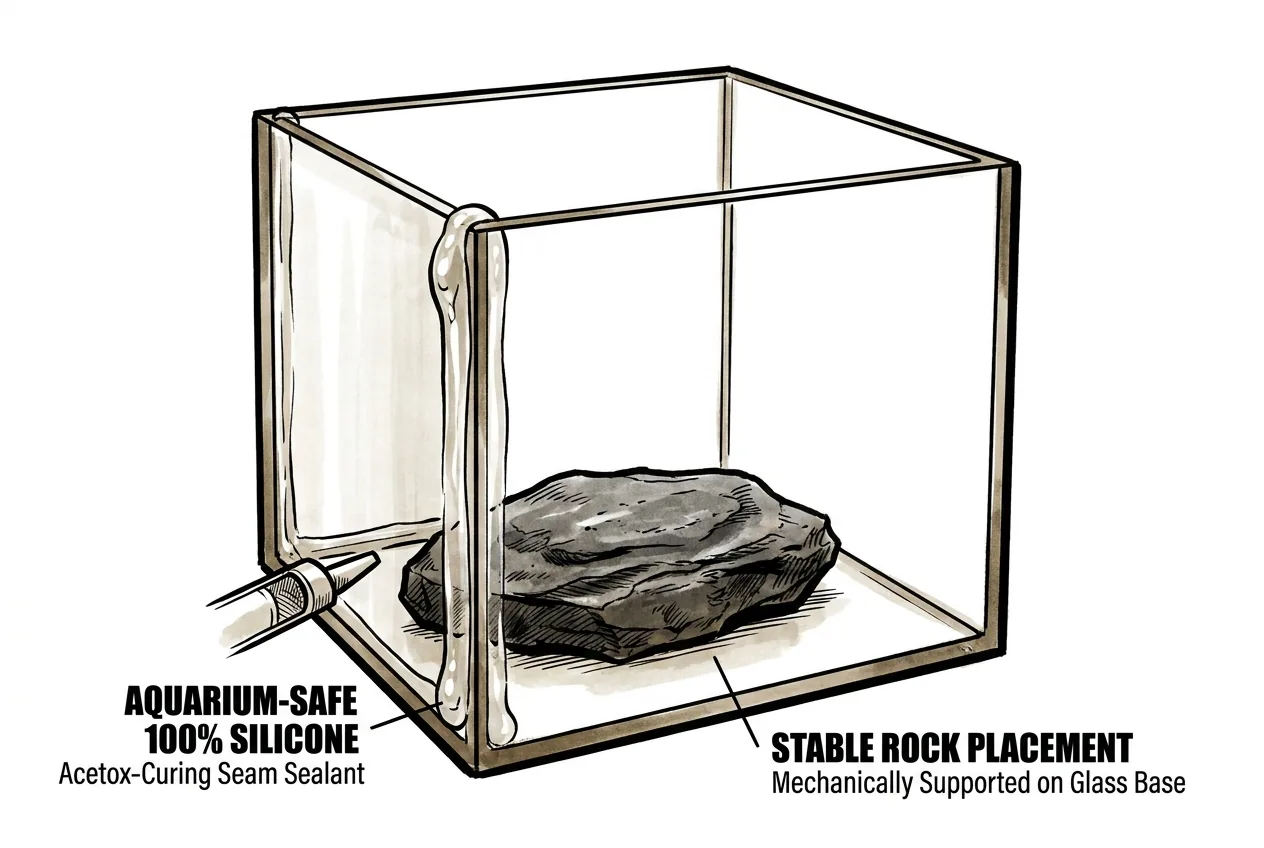
Start from a tube sold as 100% silicone with a stated aquarium or aquatic-life use, and read its own label, SDS, and cure instructions rather than assuming a class-wide screen.
A mold-resistant claim is a prompt to check, not an automatic disqualifier, since some aquarium-rated silicones also describe themselves that way.
Aquarium-branded acetoxy silicones bond glass well and stay flexible, which CA cannot do. Full cure time depends on bead depth, temperature, humidity, and the specific product, so follow the maker's figure. For aquarium silicone that is often several days.
ASI Aquarium Silicone Clear
A well-documented pick is the ASI Aquarium Silicone Clear (ASI 509), an aquarium-rated, one-part 100% silicone acetoxy RTV whose maker states it is safe for aquatic life once cured. It is sold for aquarium manufacturing and repair, meets FDA food-contact rubber standard 21 CFR 177.2600, and skins in about 10 minutes.
Its data sheet gives a typical cure of about 24 hours for a 1/8-inch bead, full strength at around 7 days, and advises about 7 days of cure before adding water and fish.
It fits full-tank glass seams. If you use it to bond rock to glass, treat the silicone as one part of a joint that also needs surface prep, substrate testing, adequate bearing, and a leak test, not as the sole thing holding a heavy rock.
Note that the maker's own page also lists it as mold- and mildew-resistant, which is one reason a mold claim alone cannot classify a product.
ASI Aquarium Silicone Black
For seams where you want to hide algae and shadow lines, use the ASI Aquarium Silicone Black. It is the same aquarium-line acetic-cure silicone in black.
It works for dark seams and as a coat over cured foam backgrounds. The limitation is opacity. Black is the wrong choice where an invisible clear seam is needed, and it shares the same multi-day acetoxy cure and joint requirements as the clear.
Aqueon Silicone Sealant
For small glass repairs and short seams, a small aquarium tube avoids waste. Aqueon Silicone Sealant is a 100% silicone aquarium sealant, labeled non-toxic for fresh or saltwater, that forms a permanently flexible water-tight seal.
Reach for it to seal or patch a glass seam per the maker's directions. The limitations are volume and scope. The 3 oz tube is uneconomical for a full tank or large background coat, and it is a glass leak sealant, not a rated structural adhesive for load-bearing hardscape.
Why a general-purpose tube needs the SDS check
A general-purpose 100% silicone is a much weaker choice. Do not use the common general-purpose tube for a livestock tank. GE All-Purpose Silicone 1 Window & Door is 100% silicone and waterproof, but the current product page advertises 7-year mold-free protection and does not state any aquarium use.
Its data sheet also notes limits on porous natural stone and confined joints. Because it lacks a stated aquarium use, and because a mold-free claim is exactly the kind of wording that requires verification, the aquarium-rated tubes above are the better default.
Food-contact standards such as FDA 21 CFR 177.2600 or NSF/ANSI 51 are not the same as an aquarium or aquatic-life approval.
If you have no aquarium-rated tube on hand and are considering a general-purpose one anyway, at minimum verify the specific label and SDS, prefer a version without a mold-resistance claim, and confirm the intended use with the maker.
The aquarium-rated tubes above avoid that uncertainty entirely.
ASI 509 Aquarium Sealant manufacturer page
Aqueon Silicone Sealant manufacturer page
Aquarium Silicone Sealant (CLEAR) – American Sealants
Selecting Preservatives and Testing Microbial Resistance
Which pond foam builds a 3D background?
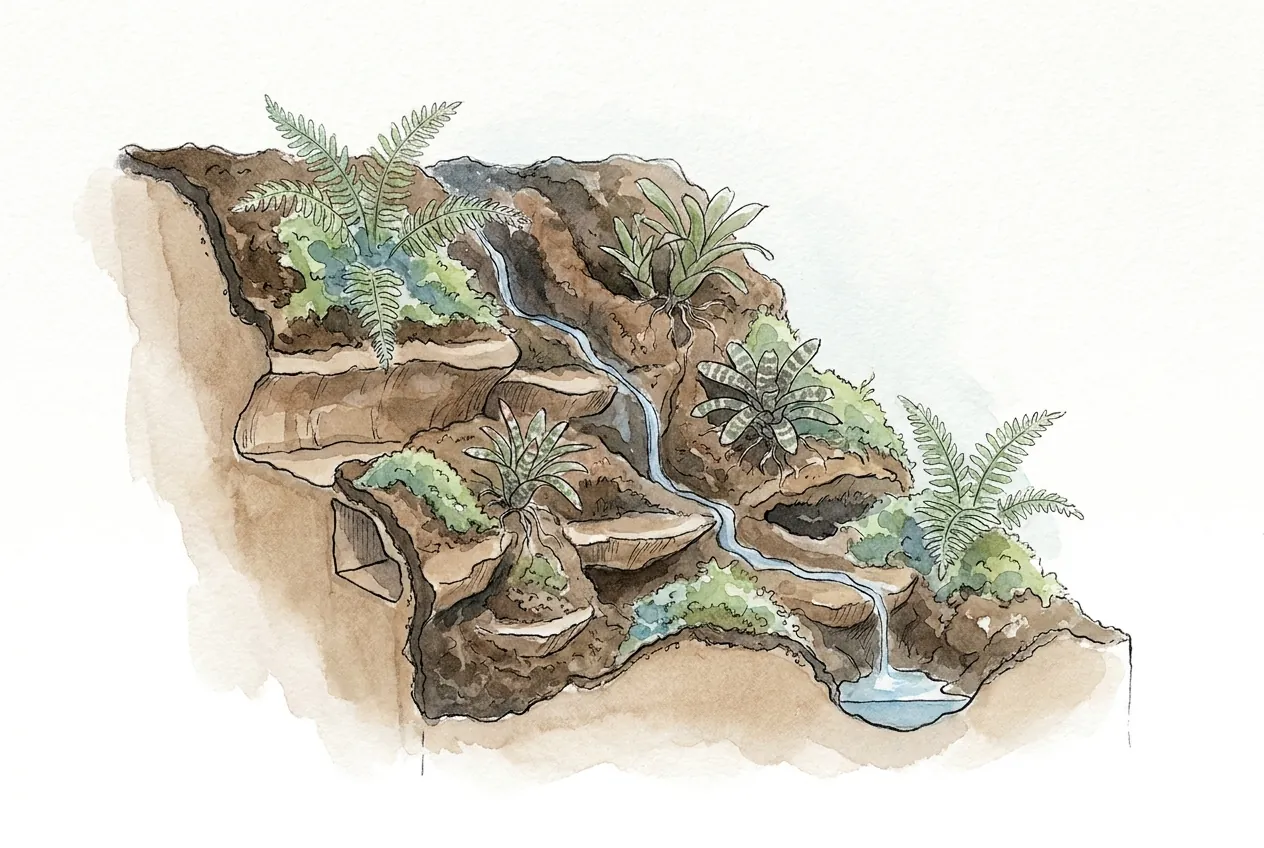
Use a black, pond-rated, one-component polyurethane foam rather than standard tan insulating foam.
The pond SKU is color-loaded to read as shadowed rock and cures water-resistant. It expands and rigidifies as ambient moisture reacts with the isocyanate groups, which lets you sculpt lightweight bulk backgrounds and fill dead space behind hardscape.
Standard tan gap foam is not rated for this use. The absence of a fish-safe claim is a reason to avoid it here, not proof that it is toxic.
Great Stuff Pond Foam
The most available choice is a purpose-made pond foam. Great Stuff pond foam is closed-cell black polyurethane that DuPont states is safe for ornamental fish and plants once cured, bonds to rock without mortar, and cures in about 8 hours at DuPont's stated conditions (roughly 70°F and 50% relative humidity, 1-inch bead). Thicker beads and cool or dry air take longer.
Spray it onto glass and rock, let it expand, cure fully, then carve and coat. Two limitations matter. It is a bulk fill, not a structural support.
And bare aromatic-MDI foam yellows and degrades under light, so an exposed background needs a protective coat (silicone plus coco coir is the common choice). How much UV your build actually sees depends on your lighting.
Aquascape Waterfall Foam
For larger or professional builds, a gun-style can gives more control. Aquascape waterfall foam is a black fast-drying expanding polyurethane sold to fill gaps between rocks and boulders and direct water flow in water features.
It suits large waterfall structures. Two limitations. It works best with a dedicated foam gun and is overkill for a small vivarium, and its current product page describes a water-feature use rather than a confirmed ornamental-fish or inhabited-aquarium approval, so check its SDS and Proposition 65 notice and confirm the intended use with the maker before using it in a planted, stocked enclosure.
Most of the acute foam hazard is in the wet curing stage, but it is not the only hazard. Uncured foam off-gasses isocyanate, which OSHA lists as a leading cause of work-related asthma, with a PEL ceiling of 0.02 ppm for MDI.
Once the isocyanate-polyol reaction completes, the EPA considers cured foam relatively inert, but the EPA also notes that cutting, trimming, sanding, or heating cured foam can create additional dust and vapor exposure.
Follow the can's SDS. It calls for ventilation, safety glasses, chemical-resistant gloves matched to the product, and control of ignition sources, and it treats odor as an unreliable measure of exposure.
Keep animals and plants out of the work area during spraying and cutting.
Coat any exposed cured foam. Bare aromatic-MDI foam yellows and eventually crumbles under light because short-wavelength UV breaks the urethane bonds, and the silicone-plus-substrate coat acts as a UV barrier.
For shaping a natural-looking back wall, plan the layout like a paludarium hardscape layout before you commit the hard-to-remove foam. Then follow the paludarium expanding foam build guide for bead planning, carving, coating, and cure gates.
Great Stuff Pond & Stone manufacturer page
OSHA Green Jobs, spray polyurethane foam and isocyanate hazards
EPA Safer Choice, potential chemical exposures from spray polyurethane foam
UV Stability of Polyurethane Foam (Technical Foam Services)
Which epoxy putty handles structural and underwater bonding?
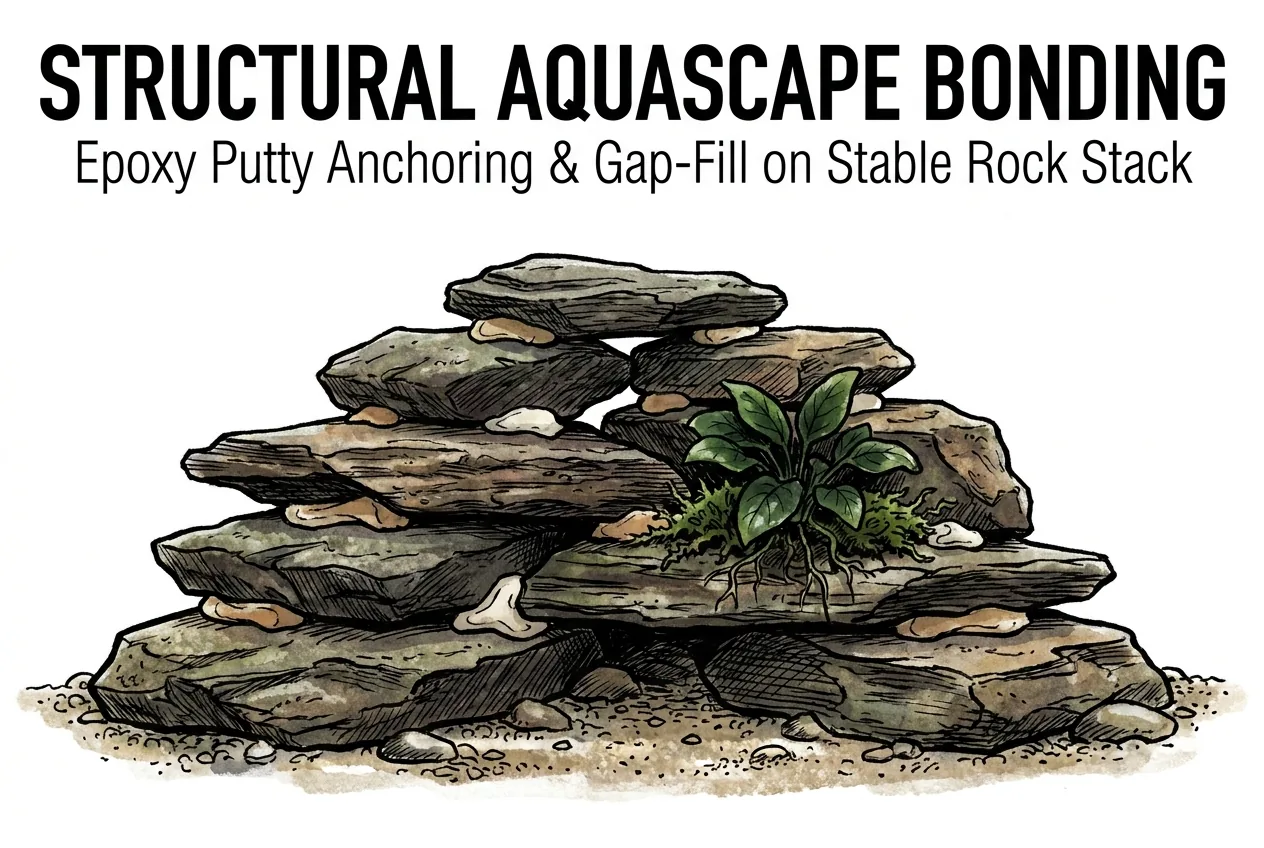
Use a two-part epoxy putty for a join that must fill a gap or set underwater. It cures by an exothermic amine-epoxide reaction that is independent of air, so it can set in the middle of a thick mass and while fully submerged, which lets you re-seat a rock in a running tank without draining it.
Use Epoxy as a Support, Not the Structure
Epoxy is not a substitute for a stable stack. Build heavy rockwork so each stone bears mechanically on the one below, with a broad footing and anti-tip support, and dry-fit and test the structure first.
Use the putty to anchor and gap-fill an already-stable arrangement, not as the load path that keeps a top-heavy arch from falling.
Fluval Sea Epoxy Stick
An aquarium-marketed stick with a documented aquarium use is Fluval Sea Epoxy Stick. It cures underwater, reaching full cure in roughly a day submerged and about two days in open air, and is sold as safe for plants, fish, and reptiles.
It suits anchoring submerged rock or a frag onto a stable base. Its own FAQ is explicit that it makes a secure base but will not support an object that gravity would otherwise topple, so keep it to supporting bonds, not primary structure.
The two-tone stick also leaves a visible off-white join and has a limited working window.
HoldFast Epoxy
For reef and rock work, another fish-safe stick is HoldFast epoxy, sold non-toxic for fish and invertebrates and rated to bond rock, coral, and slate and to build steps, caves, and walls.
It cures underwater.
It helps join stones into caves and ledges once the stack is mechanically stable.
Follow the working and set times on the current package rather than any figure quoted secondhand, and remember the cured mass is visible.
As with any epoxy, the bond supports a stable arrangement. It does not make an unstable one safe.
J-B Weld WaterWeld Epoxy Putty
A budget structural-repair option is plumbing-grade and potable-rated. J-B Weld WaterWeld Epoxy Putty sets in about 25 minutes, cures in about 1 hour, and lists a strength around 4,370 PSI (the maker states it as a general strength figure, not a defined lap-shear rating, and its own materials quote it inconsistently) and a 500 PSI water-pressure rating.
It is marketed for pipe and leak repair, not aquaria, and it carries no fish-safe label. Its NSF/ANSI 61 listing is for potable-water pipe and fitting joining and sealing at a limited exposed surface area, which is not an aquatic-life certification and does not cover a large exposed mass of putty in a stocked tank.
If you use it, keep it to small dry repairs, cure fully, and soak and rinse before adding sensitive livestock. Do not lean on the pressure or strength numbers to justify a load-bearing rock structure.
Milliput Epoxy Putty
For a longer working window and a machinable finish, a slow-set option is Milliput Epoxy Putty, which mixes 1/1, gives a long open time, goes rock-hard in about 3 to 4 hours, sets underwater, and is non-shrinking.
It fits detailed gap-filling and sculpting where you need working time on dry, above-water repairs.
Its aquarium fit is unverified, so do not use it for an occupied aquatic habitat. Milliput provides no livestock-safety certification, its current SDS classes the uncured component as a skin sensitizer and an aquatic chronic hazard, and its own toxicological assessment states that some grades, including Superfine White, contain BHT, which is very toxic to aquatic life.
Because of that, do not switch to the white grade for appearance as a safer option. If you use Milliput at all, keep it to dry, out-of-tank work and confirm the specific grade's suitability with the maker.
Why fully cured epoxy is not perfectly inert
Cured epoxy is lower-risk than uncured epoxy, but it is not a guarantee of zero migration over time. Evidence from specific drinking-water pipe coatings does not prove that every aquarium putty behaves the same way. Use a product intended for the job, allow the full cure, and avoid treating a soak as proof of complete inertness.
The practical response is to prefer a putty with a stated aquarium use, or an NSF/ANSI 61 potable-rated one within its listed scope, cure it fully well beyond set time, and soak and rinse the piece before adding sensitive livestock such as shrimp or dart frogs.
Treat the soak as a reasonable precaution, not as a test that certifies long-term safety.
US Patent 4,260,700, underwater-curing epoxy compositions
BPA migration from cured epoxy resins
J-B Weld WaterWeld Epoxy Putty manufacturer page
J-B Weld WaterWeld NSF potable-water approval
Milliput – Versatile Epoxy Putty
What tools does the build actually require?
Safety gear comes first, and it is more than gloves. The product SDS sheets call for eye protection, chemical-resistant gloves matched to the specific adhesive, and adequate ventilation or local exhaust, with respiratory protection where ventilation is poor. Foam adds flammable-aerosol and sensitization warnings, and both foam and epoxy list skin sensitization.
Plan on safety glasses, ventilation, gloves chosen against the exact SDS, and long sleeves, and keep ignition sources away from foam.
Prepare the Finishing Tools
Two consumables make the finishing work easier. Use gloves and a smoothing tool to press and feather the silicone-plus-substrate coat.
Nitrile Work Gloves
For skin protection, 6 mil nitrile work gloves are a disposable starting point. This option is powder-free and latex-free at 100 count.
The limitation is that they are one part of the PPE, not the whole of it. At about 0.15 mm they are thinner than the roughly 0.2 mm nitrile Milliput's SDS cites as an example, they come with no published chemical breakthrough data, and they do not replace eye protection or ventilation.
For prolonged contact with a specific adhesive, choose a glove rated for that chemical per its SDS.
Silicone Sealant Finishing Tools
For feathering the substrate coat into seams, an 8-profile silicone smoothing kit provides smoothing and edging profiles plus a remover.
Use it for pressing coir into wet silicone and tooling clean seams. It is a convenience tool, not safety gear, and its generic straight profiles suit flat seams better than free-form 3D backgrounds.
NIOSH Pocket Guide, methyl-2-cyanoacrylate (PPE)
What is the safe build and cure sequence?
Build in cure-gated order, on top of a mechanically stable design. Foam the background and cure it, then coat with silicone plus coco coir and cure again.
Attach plants with CA and anchor rock with epoxy on a stable stack, final-cure, then soak, rinse, and ventilate before livestock goes in last.
Each layer's adhesion depends on the layer beneath being fully reacted, so let each one cure per its own instructions before the next.
Cure is the gate, not appearance, because tack-free foam still contains unreacted chemicals.
Full cure is a prerequisite, though, not an automatic guarantee of aquatic safety. The product's stated use still matters.
Step 1. Foam the background, then cure
Spray the black pond foam in overlapping passes and let it reach full cure before touching it.
Great Stuff Pond & Stone is rated to cure in about 8 hours at 70°F and a 1-inch bead.
The EPA cites an 8 to 24 hour window for one-component foam. Thick beads in a closed enclosure cure slower, so allow about 24 hours before carving.
Step 2. Coat with silicone and press substrate, then cure
Carve off the smooth foam skin so silicone can grip, wearing eye protection and a dust mask for the cutting.
Spread a thick layer of 100% aquarium silicone, then press coco coir or peat into the wet silicone before it skins.
As a rough guide, acetoxy silicone cures through on the order of a few millimeters per day, but the real figure depends on the product, bead depth, temperature, and humidity, so follow the maker's cure time rather than a single formula. Aquarium silicone often wants several days.
Cutting uncured foam exposes unreacted isocyanate, so coat only rigid, tack-free foam, and cut it with ventilation and gloves.
Step 3. Attach plants with CA or epoxy, then final-cure
Tack moss and epiphytes with CA gel, which fixtures in seconds and fully cures in roughly 8 to 24 hours depending on the product.
Anchor rock on your stable stack with epoxy putty. Set and cure times vary by product (WaterWeld sets in about 25 minutes, while Fluval reaches full cure in about a day submerged and two days in air), so follow the specific stick and give a wet-applied join extra time before you stress it.
Step 4. Soak, rinse, ventilate, then add livestock last
Use odor as a one-way warning, not a green light. A lingering vinegar or chemical smell means the build is still curing, so no animals, but the absence of a smell does not by itself prove full cure or aquatic safety.
Go by each product's stated cure time as the minimum. Aquarium-silicone makers commonly advise about 7 days (some resellers say up to 10) before water and fish, so the curing agent can dissipate.
The foam should be cured, coated, and aired before water contact. Ventilate through every step.
For controlling the humid microclimate this build creates, our notes on vivarium mold control cover airflow and springtails.
EPA Safer Choice, spray polyurethane foam exposures and cure
Momentive RTV108 technical data sheet
Aron Alpha, curing speed of cyanoacrylate
Aquarium Silicone Sealant (CLEAR) – American Sealants
Who should NOT buy each type of adhesive?
Each class has a use it is poorly suited to, and steering away from the wrong job is half the decision.
The counter-indications follow from how each chemistry cures and loads. The wrong chemistry risks a failed joint or, with an unverified product, harm to livestock, so it is worth getting right.
Skip kitchen-and-bath or mildew-resistant silicone entirely
Be cautious with any general-purpose silicone sold on a mildew-resistant claim for a livestock tank, and prefer an aquarium-rated tube instead.
The concern is that some such tubes use isothiazolinone biocides, which are toxic to aquatic life. A reported CMIT/MIT 48-hour LC50 is 63.20 µg/L in Daphnia magna, and modeled surface-water risk quotients for one isothiazolinone run high.
Those figures describe the biocides' hazard. They do not confirm that a specific sealant contains them or how much would reach aquarium water, so the point is to choose a product with a stated aquarium use rather than to assume every mold-resistant tube is lethal.
Also be careful using acetoxy silicone to bond alkaline or porous rock, because the released acetic acid can react with the substrate and weaken the bond. Test on an offcut first.
Skip CA gel for structural loads or permanently submerged joins
Do not ask CA to hold a rock stack or anything that takes a knock. It is brittle, with very low elongation, and its bonds tend to weaken with prolonged water exposure.
Lab measurements of the size of that loss come from unrelated test setups, such as dental bonding, so treat the direction as reliable but not the exact percentage.
For structure and submerged load, rely on a stable mechanical stack anchored with epoxy putty instead.
Skip pond foam for thin or flat backgrounds and for sensitized people
Foam needs depth to expand and grip, so a thin veneer background is the wrong application. Use a non-foam method for a flat back wall instead.
Anyone with respiratory sensitivity should avoid handling it, because the EPA states there is no recognized safe level of isocyanate exposure for sensitized individuals, and should choose a foam-free design and avoid the exposure entirely.
Skip epoxy putty where an invisible join is needed
Epoxy is bulky and visibly off-white, so it is a poor choice where a seamless look matters.
Many epoxies also bond better on a dry substrate than a wet one, so dry-fit and bond dry where you can.
For a thin, hidden, above-water plant tack, CA gel is the better choice.
CMIT/MIT aquatic toxicity in Daphnia magna
Isothiazolinone biocide leaching and surface-water risk
CA underwater bond-strength loss
EPA, health concerns about spray polyurethane foam
How do these adhesives fail, and how often do I replace them?
Each class tends to fail in a characteristic way, though the details vary by product, load, and environment.
None of the intervals below come from a manufacturer vivarium spec, so treat them as rough estimates.
Silicone seams can peel and leak over years. Bare foam degrades under UV. CA bonds weaken with prolonged water exposure, and epoxy is mainly limited by being visible and by weaker adhesion on wet substrates.
Silicone seams (peel, leak, and surface mold)
Silicone usually fails mechanically, when joint movement exceeds its elastic limit and the bead pulls off the substrate.
Black streaks on a seam are often surface biofilm feeding on organic detritus rather than the silicone itself failing, but discoloration alone does not confirm the seam is sound, so inspect the bond, not just the color.
Note also that commercial sealants contain fillers and other additives and are not pure PDMS.
Outdoor weatherseal silicone is often quoted at roughly 15 to 25 years, but that figure comes from building applications, not submerged, loaded aquarium seams, so do not read it as an aquarium seam lifespan.
In practice, inspect seams periodically and reseal when edge-peel or weeping appears. A properly applied indoor seam can last many years, but a leak test matters more than any fixed interval.
Foam backgrounds (UV crumble of any exposed surface)
Bare aromatic-MDI foam yellows then crumbles under light, which is why the silicone-and-substrate coat acts as a UV barrier, not just decoration.
As long as the coat stays intact, the foam beneath is shielded and long-lasting, though the coat itself can age or separate, so inspect and recoat any exposed foam as needed rather than treating it as permanent.
CA-tacked plants (routine re-gluing)
Treat re-gluing detached plants as ongoing maintenance, not a defect. Prolonged water exposure weakens and embrittles CA bonds, so periodic re-tacking of submerged, high-flow, or fast-growing specimens is normal.
Remove the old brittle residue, dry the contact point, and re-tack with fresh gel out of water.
An epoxy-anchored rock on a stable stack generally holds longer than a CA-tacked plant, but that is a maintenance tendency, not a certified durability comparison.
Interfacial water and underwater adhesion
Great Stuff Pond & Stone, UV discoloration and crumble
Frequently asked questions
Is Great Stuff safe for a vivarium?
Only the pond-rated SKU, and only after full cure. Great Stuff Pond & Stone is black, closed-cell, water-resistant, and stated by DuPont as safe for ornamental fish and plants once cured, with a typical cure around 8 hours at its stated conditions.
Standard tan Great Stuff is not water-rated for this use, which is reason enough to skip it here. That is different from it being proven fish-toxic.
Even the pond version needs full cure, then a protective coat on any exposed surface, because the wet foam off-gasses isocyanate and bare foam degrades under UV.
How long does aquarium silicone take to cure?
It depends on the product and the bead. As a rough guide acetoxy silicone cures through a few millimeters per day, so a thick seam takes longer than a thin one, and dry-to-touch is not full cure.
Go by the specific maker's figure rather than one universal number.
For the products here, ASI's data sheet gives a typical 24-hour cure for a thin bead, full strength around 7 days, and advises about 7 days before water and fish. Some resellers say up to 10. Use a lingering vinegar smell as a stop signal, but do not treat the absence of smell as proof of full cure.
Super glue versus epoxy, which should I use?
Use CA gel to tack plants and epoxy putty for gap-fill and underwater joins. CA sets in seconds on a damp rhizome but only bridges about 0.5 mm and is brittle, so it cannot carry load or fill gaps.
Epoxy putty cures underwater and fills voids, but it is bulky and visible, and it anchors a stable stack rather than replacing one.
WaterWeld lists a strength around 4,370 PSI, but that is a general figure for one product, not a load rating for a rock arch. The two solve different problems, so many builds use both.
Can I add fish the next day after gluing?
For an aquarium-rated CA gel used above water, often yes. Cured CA is largely inert within hours, so with an aquarium product such as Seachem Flourish Glue, after a short set and rinse livestock can usually return the same day.
With a hardware-grade CA that carries no aquarium rating, be more conservative, since same-day safety is not something the maker states. For silicone and foam, no.
Silicone needs days to off-gas acetic acid per the maker's cure time, and foam needs a full cure plus ventilation and, for exposed backgrounds, a coat.
Cured epoxy is low-risk once fully hard and rinsed. Soak an NSF- or aquarium-rated putty before adding sensitive shrimp or amphibians, treating the soak as a precaution rather than a guarantee.
Cyanoacrylate adhesive SDS, cured material non-hazardous
PRO-SET Epoxies safety, cured epoxy is a non-hazardous solid
Key Takeaways
- Full cure lowers the risk from build adhesives but is not proof of aquarium safety. Favor products with a stated aquarium or aquatic-life use, and mind formulation, exposed surface, and load.
- Match the chemistry to the job and buy only what your build needs. CA gel to tack plants, aquarium silicone to seal glass, pond foam for bulk backgrounds, epoxy putty for gap-fill.
- Treat a mildew-resistant or mold-free claim as a reason to check the label, SDS, and stated aquarium use, not as automatic proof of a livestock-toxic biocide.
- Follow each product's own cure time as a minimum (aquarium silicone often 7+ days). Coat exposed foam, and use odor as a stop signal, not a green light.
- Cured epoxy is low-risk but not perfectly inert. Use a potable- or aquarium-rated putty and soak first.
- Adhesive is not structure. Build heavy rock as a stable mechanical stack and use epoxy as a supporting bond, not the load path.
Affiliate Disclosure
This article contains Amazon affiliate links. As an Amazon Associate I earn from qualifying purchases. If you use these links, the site may earn a commission at no extra cost to you. Product availability, price, and specifications can change. Check the current listing before buying.