
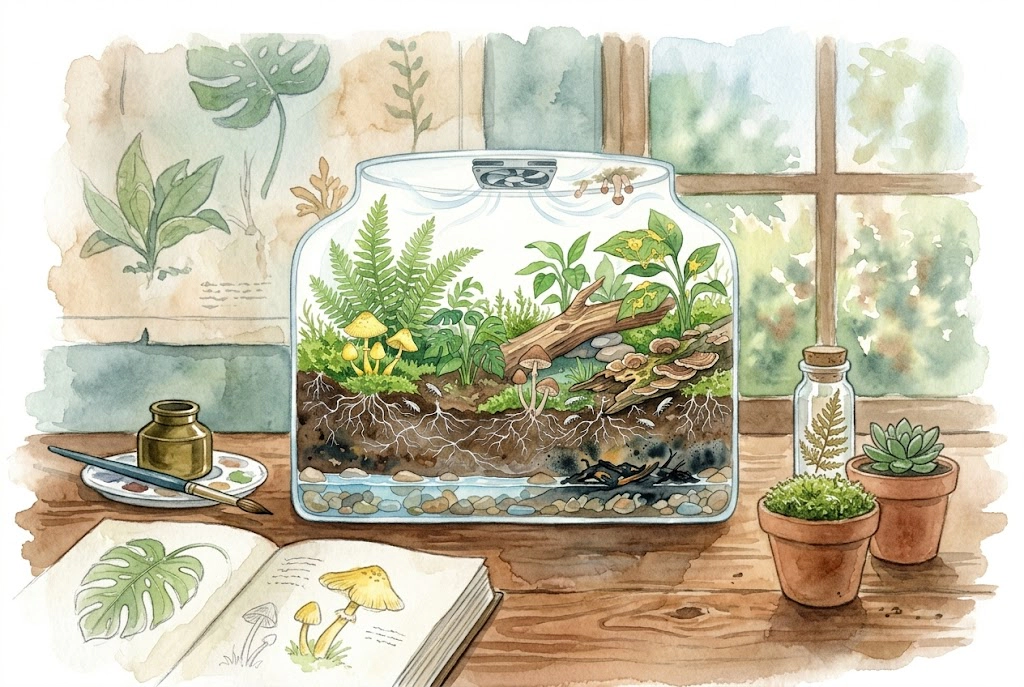
Summary
- Terrarium mushrooms are rarely pathogens; they function as a biological diagnostic dashboard indicating soil health, moisture levels, and underlying nutrient cycling.
- Distinct fungal morphologies—from harmless yellow Leucocoprinus birnbaumii saprotrophs to destructive structural wood rot and anaerobic water molds—signal exact environmental thresholds.
- Implementing Integrated Pest Management (IPM) through active ventilation to disrupt humidity boundary layers and adding springtails entirely negates the need for system-crashing chemical fungicides.
Key Points
- Fungi Are Essential Decomposers: Soil-borne mycelium handles the bulk of lignin breakdown, increasing nutrient cycling efficiency by nearly 50% without harming living plant roots.
- The Yellow Mushroom is Harmless: Leucocoprinus birnbaumii is a common, non-parasitic soil saprotroph indicating highly organic, moist substrate.
- Wood Rot Requires High Moisture: True structural decay only occurs when wood moisture content (WMC) exceeds the fiber saturation point (roughly 30%); elevating wood prevents capillary wicking.
- Slime Molds Indicate Bacterial Blooms: Amoebozoa form giant, moving plasmodium cells that engulf bacteria, providing a harmless, self-regulating biological cleanup.
- Odors Are the True Warning Sign: A rotten egg (hydrogen sulfide) smell indicates a failed drainage layer and the onset of anoxic, pathogenic water molds (like Pythium).
- Ventilation Aborts Fruiting Bodies: Stagnant air creates 100% relative humidity boundary layers; small PC fans promote evaporative cooling, stressing and aborting mushroom pins naturally.
- Collembola Are Fungal Predators: Springtails track fungal metabolic gases olfactorily and can consume their own body weight in hyphae, acting as the primary biological control.

Before jumping to conclusions, you have to understand the difference between the mushroom and the mycelium.
The visible mushroom is just the reproductive organ—a temporary structure built to drop spores.
The actual organism is the underlying mycelial network, the brilliant white, hair-like threads stretching through your substrate.
Fungi are the unseen workhorses of a healthy vivarium.
According to soil ecology research from the USDA, fungi handle the vast majority of complex lignin breakdown, turning tough leaf litter and sphagnum moss into bioavailable plant food.
When you learn how to diagnose situations by mushroom type occurring in terrariums, paludariums, and vivariums, you’ll realize that the appearance of a mushroom usually just means your underlying composting engine is running at 100% capacity!
Did You Know? Fungal mycelium secretes massive amounts of extracellular enzymes, increasing nutrient cycling efficiency by nearly 50% in bioactive enclosures.
The Classic Yellow Houseplant Mushroom
Leucocoprinus birnbaumii: Friend or Foe?

One of the most common sights in indoor horticulture is the sudden appearance of bright, lemon-yellow pins emerging from the soil.
This is Leucocoprinus birnbaumii, the yellow houseplant mushroom.
Because commercial potting soils naturally harbor its spores, this mushroom is practically omnipresent.
But what does it indicate? It means your substrate is rich in organic matter and consistently moist.
The University of Wisconsin-Madison Extension notes that this fungus is strictly saprotrophic—meaning it only eats dead matter. It will never attack the living roots of your expensive tropical plants.
To Pluck or Not to Pluck?

While completely harmless to your plants, L. birnbaumii does possess moderate gastrointestinal toxicity if ingested by mammals.
While your isopods and springtails will happily graze on it, you should pluck the caps if you have free-roaming dogs, cats, or curious toddlers in the house.
Structural Rot vs. Surface Fuzz
Decoding Driftwood Decay

A massive bloom of white, fluffy fuzz on a newly introduced piece of spider wood is almost a rite of passage for new terrarium owners.
But knowing how to diagnose situations by mushroom type occurring in terrariums, paludariums, and vivariums means knowing the difference between harmless surface saprotrophs and aggressive structural rot.
Usually, that initial white fuzz is just a temporary water mold consuming residual sugars on the wood’s surface.
However, true wood-decay fungi (like white rot and brown rot) are different. The USDA Forest Products Laboratory states that serious decay fungi require the wood moisture content (WMC) to be above the fiber saturation point—roughly 30%.
If your hardscape turns white and spongy, or crumbles into brown cubical chunks, you have structural rot.
Preventing Hardscape Collapse

To prevent severe decay, ensure the base of your driftwood isn’t sitting directly in the drainage layer, wicking up endless water.
Elevating your hardscape slightly on rock or PVC cuts off the capillary action, keeping the wood below that critical 30% moisture threshold.
The “Not-Quite-Mushrooms”: Slime Molds
Bacterial Grazers on the Move

Sometimes a bright yellow or white vein appears on the glass, pulsing and changing shape daily.
This isn’t a fungus at all; it’s a slime mold! Belonging to the kingdom Amoebozoa, slime molds are essentially giant, single-celled amoebas moving around your tank.
Unlike true fungi, which secrete enzymes to digest complex carbon, slime molds physically engulf and consume bacteria.
If you spot a slime mold, it simply indicates that your terrarium has a thriving bacterial population.
They are completely harmless to plants and animals, and trying to kill them with fungicides won’t work anyway because they lack chitin cell walls.
Enjoy the fascinating sci-fi show while it lasts!
Red Alerts: Overwatering and Anaerobic Crashes
Diagnosing the Swamp Smell

While most fungi are friends, some fungal blooms are desperate red flags.
If your soil suddenly smells like rotten eggs and your plants are wilting despite the wet soil, your tank has crashed.
Waterlogged substrates displace all the oxygen from the soil macropores.
When this happens, beneficial aerobic fungi drown, and anaerobic bacteria take over (producing that awful hydrogen sulfide smell).
Combating Water Molds

In anoxic conditions, aggressive pathogens like Pythium (water molds) thrive, sending swimming zoospores to rot your plant roots.
If you smell the swamp, immediately use a turkey baster or siphon to drain your false bottom completely dry. The reintroduction of oxygen will naturally halt the progression of the water mold.
The Stagnant Air Factor
Why Do Mushrooms Keep Fruiting?

You might have perfect soil and drainage, yet mushrooms keep popping up endlessly. Why? Because of stagnant air.
Stagnant air allows invisible, hyper-humid microclimates to form directly above the substrate.
Even if your external hygrometer reads 70%, the lack of airflow means the boundary layer against the soil is effectively 100% relative humidity. This tricks fungal spores into germinating.
The Power of Evaporative Cooling

Air circulation is the ultimate non-chemical mushroom deterrent.
Passing air rapidly wicks moisture from the delicate surface of young mushroom sporocarps (pins), causing them to abort before they can open.
Installing a small, low-RPM PC fan inside the enclosure can reduce unwanted fungal fruiting bodies by up to 80% with zero chemicals.
Your Frontline Defense: The Cleanup Crew
Springtails to the Rescue

How do you manage fungi without chemicals? You employ biological warfare.
According to entomological extensions from Texas A&M, springtails (Collembola) and isopods are naturally drawn to the olfactory cues of fungal metabolic gases. They literally hunt mold using smell.
A healthy springtail population can consume its own body weight in fungal hyphae rapidly.
If a terrarium suffers from chronic, severe surface mold overgrowth, it is almost a guarantee that your springtail population has crashed due to either total desiccation or drowning.
Re-inoculating with a fresh culture guarantees that microscopic mold spores are grazed aggressively before they can fruit.
Do Fungi Threaten Vivarium Inhabitants?

Most common soil mushrooms (like L. birnbaumii) are saprotrophic, not parasitic. They do not attack living animal tissue.
Furthermore, amphibians generally do not eat mushrooms, and contact toxicity is non-existent. The true threat comes from spores.
A mature mushroom can release 100,000 spores per hour. In a closed tank, this dense spore load can irritate sensitive amphibian lungs. The solution? Just pluck the mushroom before the cap opens.

Leave a Reply