
Summary
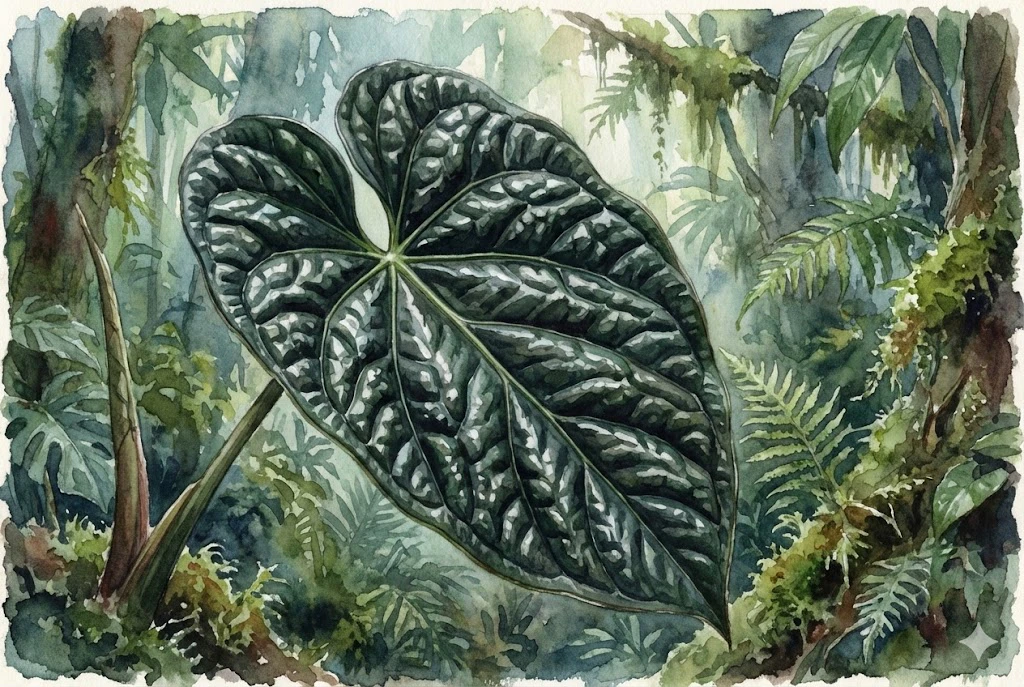
- Evolutionary Design: Anthurium luxurians evolved its signature bullate (blistered) leaf texture to maximize light capture in dark rainforest understories while efficiently shedding excess water to prevent fungal issues.
- Hybrid Vigor: Breeders cross this slow-growing species with others (like A. radicans or A. crystallinum) to create robust hybrids that retain the prehistoric, textured aesthetic but offer faster growth and better adaptability to indoor conditions.
- Cultivation Success: Thriving plants require mimicking the forest floor environment—specifically using a loose, oxygen-rich aroid mix (bark and perlite), maintaining high humidity (60%+), and providing bright, indirect light to support dark pigmentation.
Key Takeaways
1. The Science of the Look The dramatic, bumpy texture of Anthurium luxurians is functional, not just ornamental. The ridges act as light traps to scatter photons towards chloroplasts in low-light environments, while the valleys channel water away rapidly to keep the leaf surface dry and free of rot.
2. Pigmentation is Protection The dark, chocolate, or red coloration in emerging leaves is caused by anthocyanins. These pigments act as a chemical sunscreen to protect young, vulnerable tissue from high-energy light and potential herbivory until the leaf hardens.
3. Hybrid Growth Habits Dictate Care Not all Luxurians hybrids grow the same way:
- Crawlers: Hybrids with A. radicans are creeping (plagiotropic) and require wide, shallow pots to let the rhizome spread across the soil.
- Sitters: Hybrids with A. magnificum or A. crystallinum are self-heading (upright) and are better suited for standard pots or display shelves.
4. The Chunky Soil Rule Since A. luxurians is primarily terrestrial/hemiepiphytic with thick roots, it suffocates in dense potting soil. The ideal substrate is an Aroid Mix composed of roughly 40% orchid bark, 30% perlite, and 20% coco coir to ensure maximum airflow around the roots.
5. Light Intensity Balance While they are shade plants, they need bright shade (200–400 foot-candles) to maintain their dark color. Too little light results in leggy growth and fading color; too much direct sun quickly overheats and scorches the dark leaves due to heat absorption.
Introduction
The contemporary landscape of ornamental horticulture has witnessed a profound shift in preference, moving away from the ephemeral beauty of floral blooms toward the enduring, architectural permanence of foliage.
Within this foliage renaissance, the genus Anthurium has emerged as a titan, and Anthurium luxurians stands as one of its most enigmatic and sought-after standard-bearers.
Once a botanical obscurity hidden within the dense rainforests of Colombia, this species has rapidly ascended to the pantheon of elite aroids, captivating a global audience ranging from casual windowsill gardeners to dedicated botanical conservators.
The Progenitor: Anthurium luxurians
To understand the hybrid, one must first understand the parent.
Anthurium luxurians is not merely a component in a genetic equation; it is a biological masterpiece of adaptation, shaped by millions of years of evolutionary pressure in one of the wettest environments on Earth.
Taxonomy and Discovery

The scientific recognition of Anthurium luxurians is a relatively recent event in the timeline of botany.
It was formally described by Dr. Thomas B. Croat and Raul N. Cirino in 2005 in the journal Aroideana.
Before this formal description, the plant existed in the shadows of horticulture, often circulating in limited numbers among elite collectors under various misnomers or confused with similar bullate species like Anthurium splendidum.
SUMMARY
The confusion with A. splendidum is particularly noteworthy. Both species possess the characteristic bullate or blistered texture that defines this group.
However, A. splendidum is a creature of the high-elevation cloud forests, requiring cool, mist-laden air that is notoriously difficult to replicate in cultivation. In contrast, A. luxurians hails from lower elevations, imbuing it with a thermal tolerance that has proven critical for its survival in the global plant trade.
The specific epithet luxurians was chosen with deliberate care, reflecting the plant’s luxuriant growth habit and the rich, opulent quality of its dark, textured foliage.
Geographic Distribution and Ecological Niche

Anthurium luxurians is endemic to the rainforests of Colombia, specifically the Chocó and Andean regions.
This geographic context is the single most important factor in understanding its cultivation.
The Chocó region is characterized by extreme rainfall, high humidity, and relatively stable warm temperatures.
Unlike many of its cousins that have taken to the trees as epiphytes, A. luxurians is primarily terrestrial or hemiepiphytic.
It grows in the leaf litter of the forest floor or clings to the lower trunks of trees.
This terrestrial habit has significant implications for its root system; unlike the purely aerial roots of a canopy-dwelling Anthurium veitchii, the roots of A. luxurians are adapted to interacting with a substrate—albeit a loose, aerated, and organic one.
It is a plant of the deep shade, inhabiting the dim understory where sunlight is a precious and fleeting commodity.
Morphological Distinctiveness

The visual impact of A. luxurians is driven by three primary morphological traits, all of which it passes on to its hybrids with varying degrees of dominance:
The Bullate Texture
The leaf surface is defined by deep peaks and valleys, a trait known as bullation.
The tissue between the veins rises up, creating a quilted or pebbled appearance.
This is the species’ signature brand, instantly recognizable and highly heritable.
The Quadrangular Petiole
The petiole (leaf stalk) of A. luxurians is not round.
It is distinctly four-sided or ribbed, often with sharp, winged edges.
This structural reinforcement helps support the heavy, thick leaf blades and serves as a key diagnostic marker in identifying true hybrids.
Pigmentation
New leaves emerge in shades of deep chocolate, rust, or garnet, slowly hardening off to a dark, metallic green that can appear nearly black in low light.
This pigmentation is due to high concentrations of anthocyanins, which we will explore in the physiological section.
Ecophysiology: The Why Behind the Design
Why does Anthurium luxurians look like a piece of hammered copper?
To the casual observer, it is an aesthetic curiosity.
To the physiologist, it is a set of specific solutions to the problems of living in a dark, wet rainforest.
Understanding these mechanisms allows the horticulturist to optimize the growing environment, moving beyond rote care instructions to a deeper intuition of the plant’s needs.
The Physics of the Bullate Leaf

The most striking feature of A. luxurians—its bumps—serves two hypothesized functions, balancing the need to capture light with the need to shed water.
The Solar Panel Hypothesis (Light Capture)
In the understory of a dense rainforest, light levels can be as low as 1-2% of full sunlight.
A flat leaf acts as a simple reflector; if a photon of light hits it and bounces off, that energy is lost to the canopy above.
A bullate surface, however, acts as a light trap.
Mechanism
When a photon strikes the sloped side of a bulla (bump), the angle of reflection often directs it not upwards, but sideways—onto the adjacent slope of the next bump.
This second chance absorption increases the probability that the photon will be captured by a chloroplast and used for photosynthesis.
Surface Area
Furthermore, the texturing effectively increases the surface area of the photosynthetic tissue within the same spatial footprint.
It allows the plant to pack more chlorophyll-bearing cells into a leaf that occupies the same amount of horizontal space, a critical adaptation where space and light are premium resources.
The Raincoat Hypothesis (Water Shedding)
While light is scarce, water is abundant—often dangerously so.
The Chocó rainforest receives meters of rain annually.
Water that sits on a leaf surface for extended periods blocks gas exchange (stomata) and creates a breeding ground for epiphyllous mosses, algae, and pathogenic fungi.
Mechanism
The deep valleys created by the veins act as a high-efficiency drainage system.
The hydrophobic nature of the cuticle, combined with the steep slopes of the bullae, channels water rapidly off the leaf surface and toward the drip tip.
This rapid shedding ensures that the leaf dries quickly after a deluge, maintaining the efficiency of transpiration and reducing fungal risk.
TIP
This explains why A. luxurians and its hybrids are surprisingly prone to leaf rot in stagnant home environments.
In the wild, they are structured to shed water rapidly. In a home with no airflow, water trapped in the deep quilted pockets does not evaporate, leading to bacterial and fungal infections.
The bumpy texture requires air movement to function correctly.
An ecological perspective on water shedding from leaves
Anthocyanins: The Science of Dark Leaves

The dark plant trend is a major driver of the Anthurium market.
A. luxurians is a key genetic source for dark foliage.
This coloration is not chlorophyll (which is green); it is caused by anthocyanins and flavonoids, water-soluble pigments that appear red, purple, or blue depending on pH.
The Sunscreen Function
Young leaves of A. luxurians emerge red or brown.
In the juvenile stage, leaves lack the thick, waxy cuticle and fully developed photosynthetic machinery of mature leaves.
They are highly vulnerable to photo-oxidative damage from sunflecks—intense beams of direct sunlight that pierce the canopy gaps.
Mechanism
Anthocyanins act as a chemical sunscreen.
They absorb high-energy photons (particularly in the blue/green spectrum) that might otherwise damage the developing DNA or over-excite the chloroplasts.
They also act as antioxidants, scavenging free radicals produced during metabolic stress.
Pigment patterns and photoprotection of anthocyanins in the young leaves of four dominant subtropical forest tree species in two successional stages under contrasting light conditions
The Anti-Herbivory Function (Camouflage)
There is also strong evidence to suggest that red or dark coloration in understory plants serves as a form of camouflage against insect herbivores.
Many insects lack photoreceptors for red light.
To an insect eye, a dark red leaf may appear black or indistinguishable from the dark, shadowy forest floor, whereas a bright green leaf signals fresh food.
TIP
This biology dictates the light requirements for maintaining dark hybrids.
To keep a plant like Anthurium ‘Ace of Spades’ x luxurians dark, one must provide enough light to stimulate the protective pigment response (anthocyanin production is often light-induced) but not so much that the plant is forced to produce excess chlorophyll (greening out) or burn.
It is a delicate balance of stressing the plant just enough to induce color, without causing damage.
Nature’s Swiss Army Knife: The Diverse Protective Roles of Anthocyanins in Leaves
The Hybridization Boom: Genetics and Objectives
Why hybridize Anthurium luxurians?
Why not simply grow the pure species?
The answer lies in the horticultural pursuit of Hybrid Vigor (Heterosis) and aesthetic novelty.
Anthurium luxurians, while robust for a textured species, is notoriously slow-growing.
A pure specimen can take months to harden off a single leaf.
By crossing it with faster-growing, larger, or velvety species, breeders aim to create progeny that possess the dramatic texture of luxurians but the vigor and growth speed of the other parent.
Mendelian Traits in Anthurium

Breeding logs and collector observations reveal fascinating patterns of inheritance in luxurians crosses:
Texture (Bullate vs. Smooth)
The bullate texture appears to be a highly penetrant trait.
Even when crossed with smooth-leaved species, the offspring almost always retain significant texture, although it may be softened.
For example, A. magnificum x luxurians typically shows a hammered texture rather than the sharp, deep blisters of the pure parent.
Petiole Shape (Square vs. Round)
The square, winged petiole is a dominant morphological marker.
Hybrids involving luxurians or magnificum often retain this trait, allowing astute collectors to verify the parentage of a mystery plant.
Sinus Morphology
The shape of the notch at the top of the leaf is variable.
A. luxurians has a wide, open sinus.
Crossing it with a species like A. forgetii (which has no sinus/closed sinus) results in intermediate forms, often creating a shield or peltate leaf shape that is highly prized.
Comprehensive Profiles of Popular Hybrids
The market is currently flooded with Luxurians hybrids.
To the uninitiated, they may look similar, but they possess distinct growth habits, care requirements, and aesthetic qualities.
The following section profiles the most significant breeds currently available.
Anthurium radicans x luxurians

The Gateway Hybrid
This is arguably the most ubiquitous and historically significant hybrid in the group.
It is frequently the first textured anthurium a collector acquires.
Parentage
A cross between A. radicans (a creeping species with small, deeply bullate leaves) and A. luxurians (providing size and darkness).
Visual Characteristics
This plant is the definition of reptilian.
The leaves are glossy, deeply quilted, and thick.
They lack the velvet surface of other popular anthuriums, giving them a shiny, waxy appearance that highlights the texture.
Growth Habit
Creeping (Plagiotropic). This is a critical distinction.
Unlike the upright luxurians, this hybrid inherits the crawling rhizome of A. radicans.
It does not want to climb a pole vertically; it wants to scramble across the soil surface.
In a pot, it will eventually mound and spill over the sides.
Why It Matters
It is sterile and incredibly robust. It exhibits extreme hybrid vigor, growing faster and tolerating lower humidity than either parent.
It is practically bulletproof compared to pure luxurians, making it the ideal entry point for beginners.
Anthurium crystallinum x luxurians

The Velvet Quilt
This hybrid represents the fusion of two distinct aesthetic schools: the Velvet Leaf (crystallinum) and the Texture Leaf (luxurians).
Parentage
A. crystallinum (velvet, silvery veins) x A. luxurians (glossy, bullate).
Visual Characteristics
The result is a fascinating intermediate.
The leaves often possess a sub-velvet or satin finish—not fully glossy like luxurians, but not deeply matte like crystallinum.
The venation is typically prominent and silvery (inherited from crystallinum), creating a stark contrast against the dark, textured leaf blade.
Growth Habit
Self-Heading (Upright). It grows in a rosette form, making it compact and suitable for display shelves or grow cabinets.
Scientific Insight
While it gains vigor, it also inherits the crystallinum susceptibility to spider mites and requires slightly higher humidity to maintain the perfection of its semi-velvet surface.
The texture is often described as puffy or pillowy rather than the sharp ridges of the radicans cross.
Anthurium magnificum x luxurians

The Square-Stemmed Giant
For the collector seeking architectural scale, this is the premier choice.
Anthurium magnificum is a large terrestrial species, and it imparts massive size potential to the offspring.
Parentage
A. magnificum (large, velvet, square petioles) x A. luxurians.
Visual Characteristics
Since both parents possess quadrangular (square) petioles, this trait is strongly expressed in the hybrid, often with pronounced wings along the stalk.
The leaves are broadly cordate (heart-shaped) and can achieve impressive dimensions (up to 60cm).
Texture & Color
The texture is a sophisticated blend—deeply veined but smoother than the radicans cross, often resembling hammered metal or heavy leather.
Emerging leaves are a spectacular bronze or rust-red, slowly fading to a deep, dark green.
Ecological Niche
Being derived from two terrestrial/hemiepiphytic parents, this hybrid is exceptionally well-suited to pot culture.
It does not strictly require a moss pole to mature, although it benefits from stability.
It is a floor plant candidate for high-humidity rooms.
Anthurium forgetii x luxurians

The Shield Hybrid
Anthurium forgetii is unique among popular anthuriums for lacking a sinus (the top notch), giving the leaf a teardrop or shield shape.
Parentage
A. forgetii x A. luxurians.
Visual Characteristics
The objective of this cross is to create a dark, textured shield.
The open sinus of luxurians is often closed or overlapped by the forgetii influence.
The leaves tend to be rounder and more compact than the elongated luxurians.
Aesthetic
It often retains the subtle glitter of forgetii veins combined with the heavy, leathery substance of luxurians.
This is often a smaller, more manageable plant ideal for space-constrained collectors.
Anthurium papillilaminum x luxurians

The Dark Phoenix
Anthurium papillilaminum is currently one of the most coveted species for its ability to produce nearly black foliage.
Crossing it with luxurians is the pursuit of the ultimate goth plant.
Visual Characteristics
These hybrids are characterized by an elongated, arrowhead shape (from papillilaminum) and extreme darkness.
The texture is often more subtle, appearing leathery or cardboard-like rather than deeply blistered.
Rarity & Value
High. These are often sold at a significant premium as collector’s grade hybrids.
The genetics are sought after for their stability in maintaining dark pigment even in varying light conditions.
Complex Cultivars and Named Clones

The frontier of breeding has moved beyond simple F1 (first generation) crosses.
Breeders are now utilizing specific clones and complex lineages to isolate desirable traits.
‘Red Crystal’ Lineages
Hybrids using A. crystallinum ‘Red Crystal’ (a form with intense red emergent leaves) crossed with luxurians aim to extend the duration of the red phase.
Cultivars like ‘Red Crystal Blush’ or ‘Red Crystallinum x Luxurians’ are prime examples.
‘Ace of Spades’ x Luxurians
This cross utilizes the famous ‘Ace of Spades’ hybrid (dark, velvet) to create progeny with profound darkness and velvet texture, often resulting in plants that look like black velvet quilts.
Breeder-Specific Names
Names like ‘Raspberry Plum’, ‘Purple Papi Eater’, and ‘Little Pink Dress’ (from breeders like All the Plant Babies) denote specific selection lines focused on purple and pink pigmentation in the veins or emergent leaves.
Practical Cultivation: From Rainforest to Living Room
The science of Anthurium luxurians ecology directly informs the best practices for its cultivation.
By mimicking the physics of its natural habitat, we can create a thriving environment indoors.
Substrate Physics: The Oxygen Imperative

A. luxurians is terrestrial, growing in the aerobic upper layer of the forest floor.
Its roots are thick and fleshy, designed to push through loose debris.
CAUTION
Planting these hybrids in dense, peat-heavy potting soil. This suffocates the roots. In the wild, the roots are constantly exposed to air; in dense soil, they face anaerobic conditions which encourage root-rot bacteria.
TIP
Construct an Aroid Mix.
- Orchid Bark (40%): Large chunks provide structural porosity and air pockets.
- Perlite or Pumice (30%): Ensures rapid drainage and prevents compaction.
- Coco Coir/Peat (20%): Provides water retention without suffocation.
- Charcoal/Worm Castings (10%): Filters impurities and provides gentle organic nutrition.
SUMMARY
The bullate leaves channel water away effectively, meaning the plant expects water to pass over its roots frequently (high rainfall) but never to sit around them (good drainage).
Light Physics: The PAR Paradox

While these are shade plants, shade in the tropics is much brighter than a dim corner of a living room.
The Metric
Aim for 200–400 foot-candles (approx 2000-4000 LUX) or 40–80 µmol/m²/s PPFD.
This mimics the diffuse light of the understory.
Too Little Light
The plant survives, but new leaves will be small, petioles will stretch (etiolation), and the prized dark color will fade to a muddy green.
The plant reduces anthocyanin production to maximize chlorophyll efficiency in low light.
CAUTION
The dark leaves absorb heat rapidly. Direct sun will cause thermal damage (scorch) much faster on a dark luxurians than on a green A. andraeanum. The dark pigment absorbs infrared energy, heating the leaf tissue to lethal levels.
↑ Community discussion providing real-world PPFD (light intensity) measurements for successful Anthurium growth.
Vapor Pressure Deficit (Humidity & Water)

Humidity
60-80% is the target.
Below 50% relative humidity, the mechanical process of leaf unfurling often fails.
New leaves may get stuck in the cataphyll (sheath) or emerge torn.
Furthermore, the bullate texture develops through differential expansion of tissue; low humidity during this critical phase can result in flatter, less textured leaves.
Watering
The Finger Test is standard, but visual inspection of roots via clear pots is superior.
Water when the condensation on the inside of the pot has evaporated and the roots appear silvery rather than green.
Nutritional Requirements

A. luxurians and its hybrids are slow growers with a lower metabolic rate than vigorous vines like Philodendron.
Fertilizer Sensitivity
High-nitrogen synthetic fertilizers can burn the slow-absorbing roots.
Use a balanced fertilizer (e.g., 20-20-20) diluted to 1/4 strength or a slow-release pellet like Osmocote.
The Weakly, Weekly method ensures a steady supply of nutrients without toxic salt buildup.
The Calcium Factor
Aroids are notoriously calcium-hungry.
Calcium is immobile in the plant; if the soil lacks it, the plant cannot move it from old leaves to new ones.
Deficiency manifests as rust spots, distorted growth, or leaf collapse in new foliage.
Supplementing with a Cal-Mag additive is often the secret to flawless hybrid foliage.
Comparative Growth Habits: A Guide for Placement

A common frustration for collectors is buying a plant that behaves differently than expected.
Understanding the growth habit is crucial for pot selection and placement.
| Hybrid Type | Dominant Habit | Support Needs | Potting Strategy |
|---|---|---|---|
| A. radicans x luxurians | Creeping (Plagiotropic) | None. Avoid poles. | Wide, shallow pots (e.g., Azalea pots). Allow rhizome to crawl. |
| A. luxurians (Species) | Self-Heading | Minimal. Short stem. | Standard pot. |
| A. magnificum x luxurians | Self-Heading (Large) | Stake for weight. | Large, heavy pot to prevent tipping. |
| A. crystallinum x luxurians | Self-Heading | None. | Standard pot or cabinet display. |
| Climbing x luxurians | Scandent (Climbing) | Moss Pole essential. | Vertical integration for aerial roots. |
TIP
A. radicans hybrids planted in deep, narrow pots often fail. The rhizome grows over the edge, the roots dangle in dry air, and the plant declines.
Planting them in wide, shallow bowls allows the creeping stem to root continuously into the substrate, supporting larger leaves and vigorous growth.
Market Dynamics and the Future of Collecting

The rise of Anthurium luxurians hybrids signals a maturation in the houseplant market.
Collectors are moving beyond simple acquisition toward a curated appreciation of morphology and genetics.
Texture as the New Variegation
For years, white variegation (e.g., Monstera Albo) was the primary driver of value.
However, variegation is unstable and can revert.
Texture—the bullate ridges of luxurians—is permanent and genetically stable.
This reliability makes textured hybrids a safer investment for high-end collectors.
The Dark Plant Economy
The demand for goth plants remains insatiable.
A. luxurians serves as the primary genetic vehicle for introducing stable dark pigmentation into hybrid lines, replacing less robust dark species.
Breeders are actively selecting for blacker and bumpier clones, driving prices for select complex hybrids into the hundreds of dollars.
Accessibility
The mass production of radicans x luxurians has democratized the prehistoric look, allowing casual hobbyists to own a plant that looks like a fossil without the specialized equipment required for high-elevation species.
This bridge between the rare and the available is fueling the continued popularity of the genus.

Leave a Reply