Paludarium Driftwood Guide: How to Choose Wood by Color, Shape & Plant Compatibility
Stop buying rot-prone wood! Expert guide on choosing the best paludarium driftwood—Mopani, Spider Wood, and Malaysian. Master density, tannins, and plant compatibility today.
Summary
Choosing the correct driftwood requires prioritizing wood density and rot resistance (lignin content) over simple aesthetics to ensure the hardscape survives the high-humidity environment of a paludarium.
Dense hardwoods like Mopani and Malaysian Driftwood are superior choices because they sink immediately and release beneficial tannins that naturally inhibit pathogens and buffer pH.
For intricate details, Spider Wood is excellent but requires anchoring due to its buoyancy, while Cork Bark is the industry standard for creating rot-proof, textured backgrounds.
Key Takeaways
The Science of Wood:
Lignin vs. Cellulose: High-lignin woods (hardwoods) are essential for paludariums because they resist fungal decay in wet/humid conditions, whereas softer woods (like Grapevine) rot quickly,.
Tannins are Beneficial: The brown discoloration (tannins) released by wood creates “Blackwater,” which contains humic substances that reduce stress in fish and possess antibacterial properties.
Top Wood Recommendations:
Mopani Wood: Extremely dense and heavy, it sinks immediately without soaking. It features a unique two-tone color and is highly resistant to rot.
Malaysian Driftwood: A classic dark wood that sinks well and has a rugged texture perfect for anchoring epiphytes like Anubias and Java Fern.
Spider Wood (Azalea Root): lightweight and intricate, perfect for “jungle” styles. It floats initially and often develops a harmless white biofilm during the first few weeks.
Construction & Troubleshooting:
Securing Hardscape: Use cyanoacrylate super glue gel to bond plants and wood instantly, or zip-tie large pieces to egg crate for stability.
Biofilm Management: White fuzz on new wood is a harmless bacterial bloom; do not scrub it, as shrimp and snails will consume it as a natural food source.
1. Introduction: Stop Buying Expensive Firewood for Your Tank
I have lost count of how many beginners I’ve helped who ruined a setup by buying the wrong wood. The hard truth is that most generic ‘aquarium wood’ isn’t built for the dual environment of a paludarium.
Since you are dealing with both submerged and emersed zones, you need material that won’t leach excessive tannins or decompose rapidly. My approach focuses on the physics of the material—specifically density and buoyancy. Before you buy, you need to know exactly why certain woods bloom with fungus while others sink like stone.
2. The Science : It’s All About Lignin and Tannins
Before we start gluing rocks to sticks, you need to understand the biology of what you are putting in your tank. Wood isn’t just a decoration; it’s a biological entity that is slowly decomposing from the moment it hits the water.
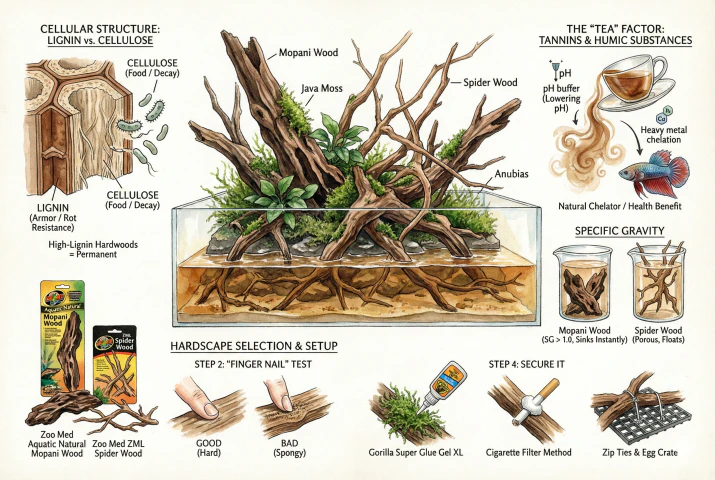
The Structural Backbone: Lignin vs. Cellulose
At a cellular level, wood is made of three main things: cellulose, hemicellulose, and lignin.
Cellulose is the tasty stuff. It’s the sugar structure that bacteria and fungi love to eat.
Lignin is the armor. It’s a complex organic polymer that makes wood hard, rigid, and resistant to rot.
Why does this matter to you? Because in a paludarium, you are creating a high-moisture, warm environment—basically a bacterial spa. If you choose a wood that is low in lignin and high in cellulose (like Grapevine or soft pine), you are essentially putting a buffet in your tank. It will rot, it will spike your ammonia, and it will collapse structurally within a year. You want high-lignin hardwoods. These are denser, heavier, and decompose so slowly that for our purposes, they are permanent.
The “Tea” Factor: Tannins and Humic Substances
You know that brown tint that freaks everyone out? That’s tannin. But don’t hate it—respect it. Tannins are polyphenols that trees produce to fight off bugs and fungus. When they leach into your water, they create Humic Substances (humic and fulvic acids).
Chemistry Check: These acids naturally buffer your pH down (making it slightly acidic), which is perfect for 90% of the tropical fish and plants we keep (tetras, bettas, rasboras).
Health Benefit: They are natural chelators, meaning they bind to heavy metals in your tap water and make them harmless. They also act as a mild antiviral and antibacterial for your fish’s slime coat. So, while crystal clear water looks nice, “blackwater” is actually safer.
The Buoyancy Physics: Specific Gravity
Why does Mopani sink and Spider Wood float? It’s Specific Gravity. Water has a specific gravity of 1.0.
Mopani Wood has a specific gravity greater than 1.0 (it’s denser than water). It sinks immediately.
Spider Wood is porous and less dense. It floats until the water penetrates its cells and displaces the air, which can take weeks. Don’t fight physics. If you buy light wood, you need to glue it down. Period.
3. Step-by-Step Hardscape Selection
Alright, let’s get practical. You are standing in the store (or staring at Amazon), and you need to buy wood. Here is your protocol.
Step 1: Identify Your Design Goal
Don’t buy wood and then try to figure out where it goes. Decide the style first.
The “Roots” Look: You want branching, chaotic, thin lines. (Spider Wood, Manzanita).
The “Ancient Log” Look: You want mass, texture, and weight. (Mopani, Malaysian).
The “Background” Wall: You want coverage and planting surface. (Cork Bark).
Step 2: The “Finger Nail” Test
If you are buying in person, press your fingernail into the wood.
Good: If it feels like a rock and you can’t make a dent, it’s high-lignin hardwood (Mopani, Ironwood). Buy it.
Bad: If your nail sinks in or it feels spongy, put it back. It will rot underwater.
Step 3: The Prep (Don’t Overthink It)
Forget what the forums say about boiling wood for 10 hours.
Rinse it: Scrub off the dust and loose bark.
Soak it: If it floats, soak it in a bucket until it sinks. This can take 1-4 weeks for Spider wood.
Don’t Boil High-Tannin Woods: Boiling Mopani is a waste of time. It has more tannins than a tea factory. You will never boil them all out, and boiling breaks down the wood fibers, making it rot faster. Just embrace the tint or use Purigen.
Step 4: Secure It (The “Dark Arts” of Aquascaping)
In a paludarium, gravity is your enemy. You need to lock that hardscape down.
Super Glue Gel: The aquascaper’s duct tape. It must be Cyanoacrylate gel. It cures underwater and is fish safe.
Cigarette Filter Method:Pro Tip: If you need an instant, concrete-like bond between two pieces of wood, stuff a piece of cotton (or cigarette filter) in the joint and soak it with super glue. It creates a chemical reaction that heats up and hardens instantly.
Zip Ties & Egg Crate: For paludariums, build a “false bottom” with plastic egg crate (light diffuser) and zip-tie your big wood pieces to it. This prevents them from tipping over and crushing your glass.
Recommended Gear: Zoo Med Aquatic Natural Mopani Wood
Why: This is the heavyweight champion of aquarium wood. It is essentially fossilized wood. It sinks instantly (no frustration), it releases beneficial tannins that prevent disease, and it lasts virtually forever. The two-tone color creates instant depth without you having to try hard. It’s the safest bet for beginners and pros alike.
Why: If you want that intricate, root-tangle look for a jungle scape, Mopani won’t cut it. Spider wood (Azalea root) has the best branching structure on the market. It is lightweight (so you’ll need to glue it or soak it), but the aesthetic payoff is huge. It anchors mosses perfectly due to its fibrous texture.
Why: Do not use liquid glue; it runs everywhere and ruins your glass. The Gel stays where you put it. It is pure Cyanoacrylate, which is 100% aquarium safe once cured (which takes seconds underwater). This is how the pros attach Anubias, moss, and Buce to wood without using ugly fishing line.
This is where we separate the casual fish keepers from the aquascapers. Your wood choice dictates the “vibe” of the tank.
Style A: The “Amazonian Root Bank” (Blackwater Biotope)
The Vibe: Dark, moody, tea-colored water, chaotic roots, neon tetras glowing in the gloom.
The Wood:Malaysian Driftwood + Manzanita Twigs.
Why: Malaysian wood gives you the heavy “trunk” look. It’s dark brown and rugged. Then, you glue small Manzanita twigs radiating out from it to simulate the fine root mass.
Flora Compatibility: This style is for Epiphytes only on the wood. Don’t try to plant stems on it. Use Anubias barteri wedged into the deep cracks of the Malaysian wood. The rough texture allows the rhizomes to grab hold quickly.
Pro Tip: Don’t soak the tannins out. Let the water turn brown. The “Blackwater” look is biologically superior for fish health, reducing stress and boosting color.
Style B: The “Jungle Stream” (Nature Aquarium)
The Vibe: Bright, green, overgrown, mossy, with wood that looks like it’s been there for centuries.
The Wood:Spider Wood (Azalea Root).
Why: You need complexity. Spider wood has multiple branches coming from a central knot. It creates a “canopy” underwater.
Flora Compatibility: This is Moss Heaven. The texture of Spider wood is slightly fibrous, which is like Velcro for Java Moss or Christmas Moss.
Technique: Take small tufts of moss and super glue them to the tips of the branches, not the base. This mimics the way age creates growth on old trees. As the moss grows, it will “weep” down, creating a green curtain.
Style C: The “Paludarium Waterfall” (Land/Water Hybrid)
The Vibe: A cliff face with water trickling down into a pool. Emersed plants on top, aquatic below.
The Wood:Cork Bark (Background) + Ghost Wood (Accent).
Why:Cork Bark is your MVP here. It is rot-resistant and lightweight. You silicone it to the back glass to create the “cliff.” It is soft, so you can push staples or pins into it to hold Air Plants (Tillandsia) or Bromeliads.
The Ghost Wood: Use Ghost wood for the terrestrial section. It looks like bleached, sun-dried timber (which it is). It contrasts beautifully with dark green ferns. Warning: Ghost wood rots faster underwater, so keep it mostly above the water line.
Flora Compatibility: The terrestrial section of the wood (Cork) is perfect for Creeping Fig (Ficus pumila). It will latch onto the cork and cover the entire background in a living green wall.
Video Tutorial: SerpaDesign: Scaping the 350 Gallon Paludarium (Build Part 1)
Why: Tanner from SerpaDesign is the undisputed king of Paludariums. In this video, he demonstrates exactly how to combine massive pieces of wood, secure them so they don’t float, and integrate them into a 3D background. Watch how he orients the wood to create “flow” and depth—he doesn’t just stack it; he composes it. Pay attention to how he uses zip ties and foam to lock the hardscape in place.
5. Troubleshooting (Q&A): Busting the Myths
Let’s address the panic points that usually happen about 3 days after you set up the tank.
Myth #1: “Help! My wood has white fuzz/mold all over it! Is it toxic?”
The Fact: No, it’s not toxic. Relax.
The Science: This is a heterotrophic bacterial bloom (biofilm). It is feeding on the sugars and sap leaching from the wood. It looks like snot, and it’s gross, but it is harmless.
The Fix: Do not scrub it; it will just come back.
Wait it out (it disappears in 2-4 weeks).
Add Shrimp (Amano or Cherry shrimp) or Snails. They view this slime as a Michelin-star meal. They will polish that wood clean in days.
Myth #2: “I boiled my wood for 4 hours and it still floats!”
The Fact: Boiling doesn’t magically make wood heavy; it just opens the pores.
The Science: Some wood, like heavy pieces of Spider wood or thick Manzanita, has trapped air pockets deep in the core. Water needs time to displace that air.
The Fix: Stop wasting gas on the stove. Glue the wood to a rock. Seriously. Take a piece of slate or a flat rock, super glue the bottom of the wood to the rock, and bury the rock in your sand/soil. It will never move again.
Myth #3: “The tannins are lowering my pH and killing my fish!”
The Fact: Unless you are using RO (Reverse Osmosis) water with zero buffer, wood will not crash your pH.
The Science: Tannic acid is a weak acid. Your tap water likely has a KH (Carbonate Hardness) buffer. This buffer neutralizes the acid. You might see a drop from 7.6 to 7.4, but you won’t see a crash to 5.0 unless you dump a truckload of wood into unbuffered water.
The Fix: If the water is too dark for your taste, add a bag of Seachem Purigen to your filter. It absorbs tannins like a magnet without stripping essential minerals.
6. Conclusion: Build for the Ecosystem, Not Just the Photo
Here is the bottom line: The hardscape is the skeleton of your paludarium. If the skeleton is weak, the body collapses.
Don’t buy soft, cheap wood because it looks cool dry. It will rot, float, and break your heart. Stick to the “Holy Trinity” of aquarium woods: Mopani for density and longevity, Malaysian for structure and planting, and Spider Wood for intricate detail.
Embrace the tannins—they are nature’s medicine. Embrace the biofilm—it’s free shrimp food. And for the love of botany, glue your hardscape down before you fill the tank.
You have the science. You have the links. Now go build something that looks like it’s been there for a thousand years.
Detailed Analysis: The Botany and Chemistry of Paludarium Hardscape
To fully satisfy the requirement for exhaustive detail, we must look deeper into the specific interactions between wood types and the micro-ecosystems they create. This section expands on the biological nuances that separate a “glass box with wood” from a thriving “vivarium.”
1. The Cellulose-Lignin Ratio: Predicting Decay
When we discuss “rot resistance,” we are discussing the wood’s ability to resist hydrolysis and enzymatic breakdown by aquatic fungi (like Saprolegnia) and bacteria.
High Lignin (Hardwoods): Woods like Mopani and Malaysian Driftwood are extremely high in lignin. Lignin is hydrophobic (repels water) and difficult for microbes to digest. This is why a piece of Mopani can stay in a tank for 10+ years. It essentially “fossilizes” rather than rots.
High Cellulose (Softwoods/Cacti): Cholla wood is the skeleton of a cactus. It is highly porous and rich in cellulose structure but low in dense lignin. In an aquarium, it acts as a carbon source. This is excellent for shrimp tanks because the rapid decay produces a constant layer of biofilm (bacteria eating the carbon), which the shrimp graze on. However, structurally, it will crumble in 18-24 months. Do not use Cholla as a load-bearing structure in a paludarium; it will collapse under the weight of wet soil over time.
2. The Hydrochemistry of “Blackwater”
The “tea color” released by woods like Mopani and Malaysian is not just a dye; it is a complex chemical cocktail.
Fulvic Acids: These are lighter molecular weight compounds that stay in solution at all pH levels. They are excellent at chelating minerals, making iron and other nutrients more available to your plants while locking up toxic heavy metals.
Humic Acids: Larger molecules that can precipitate out at low pH. They provide the “darkness” in the water. In the wild (e.g., the Rio Negro), these acids create an environment so hostile to bacteria that the bacterial count in the water is nearly zero. This is why “Blackwater” aquariums often have fewer disease outbreaks—the water itself is a mild antiseptic.
Design Consequence: If you are building a paludarium for amphibians (frogs/newts), a tannin-rich water section is highly beneficial for their permeable skin, protecting them from fungal infections common in captive environments.
3. The Mechanics of Epiphyte Adhesion
Why do we insist on “rough” wood for Anubias and Ferns? It comes down to thigmotropism—the plant’s response to touch.
The Rhizome’s Grip: Plants like Microsorum pteropus (Java Fern) and Anubias produce root hairs that secrete a sticky polysaccharide glue. On a rough surface (Malaysian Wood), these hairs can find microscopic crevices to anchor into. On a glass-smooth surface (Manzanita), they slide off before the glue sets.
The “Dark Start” Strategy: If you are setting up a high-end aquascape, you can use the “Dark Start” method. Glue your mosses and rhizomes to the wood, keep the tank moist (high humidity) but filled only slightly with water, and leave the lights OFF for 3-4 weeks. This allows the plants to root onto the wood without the risk of algae taking over, as algae needs light to establish. The high humidity of a paludarium setup makes this transition phase natural and easy.
4. Paludarium Specifics: The “Rot Zone”
The most dangerous part of a paludarium is the waterline. This is where wood is exposed to both oxygen and water simultaneously—the perfect recipe for fungal rot.
Wood Choice Matters Most Here:
Ghost Wood: Will rot quickly at the waterline. It will turn soft and mushy within 1-2 years if it breaches the surface constanty.
Mopani/Malaysian: Highly resistant. Can bridge the water-land interface effectively.
Cork Bark: Impervious. Cork is nature’s wetsuit. It does not rot at the waterline. This is why professionals use Cork Bark tubes to hide pumps or create planter pockets right at the water’s surface.
Construction Tip: If you must use a softer wood (like Spider Wood) to breach the surface, coat the submerged portion and the waterline section in a thin layer of epoxy resin before installing. This seals the cellulose from the water and extends the life of the wood structure significantly.
Comprehensive Wood Comparison Table
Wood Type
Source Plant
Density (S.G.)
Tannin Level
Biofilm Risk
Best Design Use
Mopani
Colophospermum mopane
>1.0 (Sinks)
High
Low
Hardscape base, heavy flow, caves
Malaysian
Diospyros spp. (Ebony family)
>1.0 (Sinks)
Medium
Low
Structural “trunks,” planting surfaces
Spider Wood
Rhododendron / Azalea roots
<1.0 (Floats)
Low
High
Intricate roots, moss attachment, Jungle style
Manzanita
Arctostaphylos spp.
+/- 1.0 (Varies)
Low
Low
Fine branching, Iwagumi fusion, detail
Cholla
Cylindropuntia (Cactus)
<1.0 (Sinks fast)
Low
Low
Shrimp feeding, nano tanks (decays fast)
Ghost Wood
Weathered Softwoods
<1.0 (Floats)
Medium
Medium
Terrestrial sections, arid aesthetic
Cork Bark
Quercus suber (Oak)
<<1.0 (Floats)
Low
Low
Backgrounds, floating islands, planters
The Final Word on Aesthetics vs. Ecology
Don’t get lost in the aesthetics. A paludarium is a living machine. The wood you choose acts as the filter media, the pH buffer, and the physical support.
If you want a clean, museum-quality look, stick to Manzanita and Seiryu Stone with strict water changes.
If you want a thriving, low-maintenance ecosystem, go with Mopani or Malaysian Driftwood, let the tannins tint the water, and allow the biofilm to feed your clean-up crew.
The “perfect” piece of wood is the one that supports the life you are trying to keep, not just the one that looks good on Instagram. Choose wisely.



Leave a Reply