Driftwood Black Water at Paludarium: The Ultimate Guide to Tannins & Tint
Master the art of Driftwood black water at Paludarium setups. Learn why tannins are beneficial, how to properly sink your wood, and the secrets to maintaining a healthy, tinted ecosystem for your fish and plants.
Summary
Driftwood transforms your aquarium into a chemically active blackwater environment by releasing humic substances that reduce fish stress and detoxify the water, rather than just being a “dirty” aesthetic.
While beginners often fear the “tint” and potential pH drops, these effects are chemically beneficial and serve as a natural antiseptic, easily managed with standard water buffers. Proper setup requires aggressive boiling to expel air for sinking, or mechanical anchoring with slate and super glue to force the wood to stay submerged.
Key Takeaways
The Tint is Medicine: The brown coloration comes from tannins and humic acids, which act as natural chelators to bind heavy metals and possess antimicrobial properties that protect fish health.
Physics of Sinking: Boiling wood helps it sink by expanding and expelling trapped air, but for stubborn pieces, gluing them to slate or rocks using cyanoacrylate (super glue) gel is the most reliable method.
Filtration Choice: To control the tint without stripping essential plant fertilizers, Seachem Purigen is superior to activated carbon because it specifically targets organic compounds and can be regenerated.
Embrace the Biofilm: The white slime that appears on new wood is harmless bacterial growth that serves as food for shrimp and snails, while terrestrial mold in paludariums should be managed by a cleanup crew of springtails.
1. Introduction: Why Your “Clean” Water Is Probably Boring
Many novices obsess over clinically clear water, often at the expense of their livestock. The reality is that if you are replicating an Amazonian or Southeast Asian biotope, you are dealing with nature, not a swimming pool. Sterile water rarely exists in the environments our fish actually come from.
In my experience, the introduction of driftwood is less about aesthetics and more about biochemistry. When you submerge wood, you initiate a release of tannins and humic substances that fundamentally alters the water column. Instead of fighting this “Blackwater” phenomenon, I’ve learned to harness it. Here is the science behind wood selection, buoyancy, and the chemical benefits of a tannin-rich environment.
2. The Science: It’s Not Dirt, It’s Biochemistry
Before we start boiling logs in your kitchen (and arguably ruining your spaghetti pot forever), you need to understand what is actually happening at a molecular level. Stop listening to the guy at the local fish store who tells you wood “poisons” the water. He’s wrong. But he’s wrong in a way that requires a bit of nuance to dismantle.
2.1. The Cellulose Skeleton and the Lignin Shield
Wood is not a rock. It is a biological tissue designed by evolution to move water against gravity and resist rotting while the tree is alive. The moment the tree dies, the clock starts ticking.
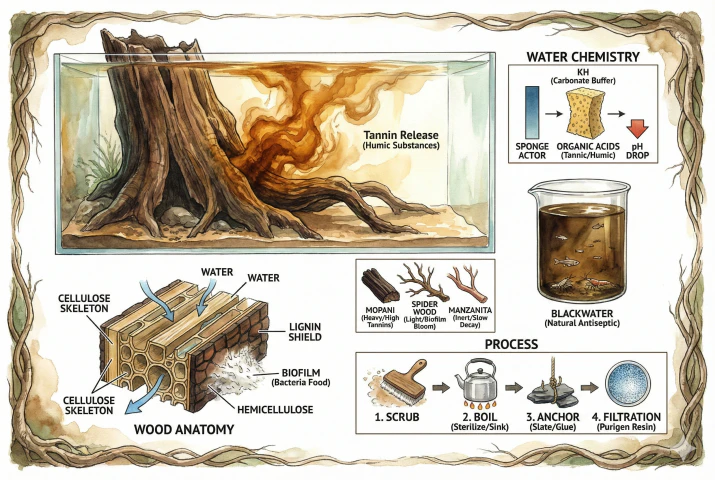
At its core, wood is composed of three main players: Cellulose, Hemicellulose, and Lignin.
Cellulose: This is the structural sugar. It’s the steel beams of the building. It is relatively stable but tasty to bacteria.
Hemicellulose: The weak link. This breaks down faster and is often what causes that initial slimy white fuzz (biofilm) everyone freaks out about.
Lignin: This is the MVP. Lignin is the concrete that reinforces the cellulose steel. It is incredibly resistant to degradation. Hardwoods like Mopani or Ironwood are dense with lignin, which is why they last for years underwater. Softwoods? They lack this armor, turn to mush, and foul your water faster than you can say “ammonia spike”.
When you submerge wood, you are essentially asking it to hold its breath forever. The water penetrates the cellular structure, displacing air (which we will get to in the sinking section), and begins to dissolve water-soluble compounds. This is where the magic—and the color—comes from.
2.2. The Chemistry of “The Tint”: Tannins, Humic, and Fulvic Acids
People see brown water and scream ‘Tannins!’
But that’s like calling every soda ‘Coke.’ The coloration is actually a cocktail of organic acids known collectively as Humic Substances.
Why does this matter? Because this “dirt” is actually medicine.
Heavy Metal Detox: Humic substances act as chelators. They bind to toxic heavy metals (like copper or zinc) and lock them up, making them safer for your shrimp and sensitive fish.
The Acid Shield: In nature, blackwater environments have incredibly low bacterial counts. Why? Because the acidity and the specific antimicrobial properties of tannins make it hard for common bacterial pathogens to thrive. It’s like living in a mild antiseptic.
Stress Reduction: Fish like Neon Tetras, Discus, and Bettas evolved in dark water. Bright light stresses them out. Tinted water acts as sunglasses for your fish, lowering cortisol levels and improving immune response.
2.3. The “pH Crash” Myth: Don’t Panic
Here is the biggest lie in the hobby: “Adding driftwood will crash your pH and kill everything.” This is utter nonsense 99% of the time.
Yes, tannic acid is an acid. But it is a weak organic acid. Your water (unless you are using pure Reverse Osmosis water) contains Carbonate Hardness (KH). KH is your safety net. It is a buffer.
Think of KH like a sponge that soaks up acid. As long as you have a KH above 3-4 degrees, the weak acids from the wood will be neutralized by the carbonates, turning into carbonic acid and off-gassing as CO2.
Your pH might drop from 7.6 to 7.4. It is not going to plummet to 4.0 overnight unless you have zero buffering capacity. So, stop stressing about the pH “swing” and start worrying about something real, like whether that log is going to float up and smash your aquarium lid.
3. The Setup / Process: Taming the Beast
You don’t just throw wood into a tank. Well, you can, but you’ll regret it when it floats for three months or turns your water into opaque coffee soup in 24 hours. Preparation is about control.
3.1. Sourcing: Don’t Be a Cheapskate (Unless You Know What You’re Doing)
You have two options: buy it or find it.
Option A: The Store Bought Route (Safe, Expensive) You are paying for density and dryness.
Mopani: The heavyweight champion. African hardwood. Two-tone (tan/dark brown). Sinks like a rock. Leaches tannins like a teabag for years.
Malaysian Driftwood: Dark, craggy, usually sinks instantly. Moderate tannins. The classic “aquarium wood”.
Spider Wood (Azalea Root): Twisty, branchy, looks amazing. Floats like a cork. Will grow a massive white fungus ball in week one. Be prepared.
Option B: The “I Found This Outside” Route (Risky, Free) I love free stuff, but listen closely: Do not use green wood. If you cut a branch off a live tree and put it in your tank, the sap and sugars will ferment. It will rot, cause a massive bacterial bloom, deplete oxygen, and kill your livestock.
Rule of Thumb: If you can snap it and it sounds like a gunshot, it’s dry. If it bends, throw it away.
Avoid: Pines, Yews, or anything with sticky aromatic sap (resin). It’s a mess you don’t want to clean up.
3.2. The Preparation Protocol (Step-by-Step)
So you have your wood. Now we need to make it sink and stop it from turning your tank into mud.
Step 1: The Scrub Down Get a wire brush. Scrub the wood aggressively. You want to remove soft spots, loose bark, and dirt. If it crumbles now, it will crumble in your tank later.
Tip: If you found it outside, scrub it harder. You are evicting bugs, dirt, and loose decay.
Step 2: The Boil (The Nuclear Option) Boiling does three things:
Sterilizes: Kills fungi, bacteria, and hitchhikers (looking at you, dragonfly nymphs).
Expels Air: Heat expands the air inside the wood cells, forcing it out. When it cools underwater, water gets sucked in to replace the air. This is how you make it sink.
Extracts Tannins: It’s like brewing a very intense tea. The more you boil, the less it will leach later.
Critical Warning: Do not use your spouse’s good pasta pot. The tannins will stain it forever, and you will be sleeping on the couch. Buy a dedicated stock pot.
Recommended Gear: Concord Cookware 40 Quart Stainless Steel Stock Pot
Why: You need volume. A standard kitchen pot won’t fit that majestic centerpiece stump. Stainless steel is non-reactive and durable enough for 4-hour boiling marathons. This commercial-grade beast handles the heat without warping.
Step 3: The Soak (The Patience Game) If the piece is too big to boil, you soak. Get a plastic tote bin (like a Rubbermaid). Fill it with hot water.
Hydrogen Peroxide Hack: Add 3-5% Hydrogen Peroxide to the soak. It oxidizes organic material (killing surface pathogens) and helps break down the outer structure slightly to aid water penetration. Unlike bleach, it breaks down into water and oxygen, so it’s safer.
Duration: 1 week to… infinity. Some wood (Manzanita) takes weeks to sink. Mopani usually sinks instantly.
Step 4: The Anchor (Cheating Physics) You soaked it for a month and it still floats? Stop waiting. Force it down.
The Slate Method: Get a piece of slate tile. Drill a hole in the slate. Drill a pilot hole in the bottom of the wood. Screw them together with a Stainless Steel screw. Bury the slate under your substrate. The weight of the sand holds the wood down.
The Super Glue Hack: If you are building a hardscape, use the “Sandwich” method.
Take a piece of paper towel or cotton wool.
Stuff it between the wood and a heavy rock.
Soak the cotton with Cyanoacrylate (Super Glue).
The cotton acts as a catalyst and filler. It cures instantly into a concrete-hard bond, welding the wood to the rock.
Recommended Gear: Gorilla Super Glue Gel XL
Why: You need the Gel version. Liquid glue runs everywhere underwater and makes a mess. The gel stays where you put it. It contains Ethyl Cyanoacrylate which is aquarium safe once cured. It’s the duct tape of the aquascaping world.
4. Deep Dive / Tips: Mastering the Blackwater Aesthetic
Now that the wood is in, let’s talk about managing the ecosystem. There is a difference between a “Blackwater Biotope” and a “Dirty Tank.” The difference is Clarity.
You want tinted water, not cloudy water.
4.1. Filtration: The Tint Manager
If you put Mopani wood in a tank, your water will be dark brown by Tuesday. If you like that, great! If you want it lighter, you need chemical filtration.
Activated Carbon: It works, but it’s annoying. It clogs fast (2 weeks max), and once it’s full, it stops working. It’s also messy to handle.
Seachem Purigen: This is the game-changer. It’s a synthetic resin that targets organic compounds (tannins) specifically.
The Magic: It doesn’t strip your fertilizer salts (Nitrates/Phosphates) as aggressively as carbon, but it inhales tannins.
The Visual: The white beads turn dark brown as they absorb tannins.
The value: You can regenerate it with bleach. Don’t throw it away. Soak it in 50/50 bleach/water, rinse it, dechlorinate it, and it’s new again.
Recommended Gear: Seachem Purigen 100ml
Why: It offers unparalleled water clarity (polishing) without stripping trace elements needed by your plants. The ability to regenerate it makes it infinitely cheaper than carbon in the long run. If you have driftwood, you need this.
Two weeks after you set up your tank, your beautiful expensive wood will look like it has a sinus infection. A thick, translucent, white slime will coat everything. Do. Not. Freak. Out. This is a heterotrophic bacterial bloom feeding on the sugars leaching from the wood. It is harmless.
The Fix: Buy shrimp (Amano shrimp or Neocaridina) or snails. They treat this slime like an all-you-can-eat buffet. It will be gone in a week.
4.3. The Paludarium Edge Case: Mold vs. Moss
In a paludarium, part of the wood is above water. This is the danger zone.
Submerged wood = Biofilm (Bacteria).
Emersed wood = Mold (Fungi). In the high humidity of a paludarium, terrestrial mold will grow on damp wood.
The Fix: You need a “Cleanup Crew” on land too. Springtails and Isopods. These tiny arthropods eat mold. If you don’t seed your terrestrial section with them, your beautiful driftwood stump will turn into a fuzzy green science experiment.
Planting: Use the wicking action of the wood. Glue Anubias or Java Moss right at the waterline. The wood pulls water up, keeping the plant wet, while the leaves enjoy the atmospheric CO2. It’s free growth.
Video Tutorial: “HUGE DRIFTWOOD For the 350 Gallon Paludarium”
Why: Watching SerpaDesign wrestle a tree stump into a tank is not just entertaining; it’s educational. He covers the structural engineering of large wood pieces, how to cut them to fit, and the reality of dealing with buoyancy on a massive scale.
5. Comparative Analysis of Aquarium Woods
Not all wood is created equal. Knowing the difference between Mopani and Spider wood can save you months of frustration. Here is the breakdown based on physical density and chemical leaching profiles.
Wood Type
Scientific Origin
Buoyancy (Sinking)
Tannin Release (Tint)
Rot Resistance
Notes
Mopani
Colophospermum mopane
Sinks Instantly
Extreme (High)
Excellent
Two-tone color. Very dense. Will tint water for years. Sandblast texture.
Malaysian
Various Diospyros spp.
Sinks Quickly
Moderate
Very Good
Dark, craggy, classic look. Soft enough for Plecos to chew but hard enough to last.
Spider Wood
Rhododendron roots
Floats (High)
Low
Moderate
Light color. Branchy. Needs to be weighted down for weeks. Prone to massive biofilm blooms initially.
Manzanita
Arctostaphylos spp.
Floats (Variable)
Low
Excellent
Smooth, twisty branches. Chemically inert. Extremely slow to decay. Takes a long time to waterlog.
Cholla
Cylindropuntia (Cactus)
Sinks quickly
Low
Poor
It’s a cactus skeleton. Soft. Degrades fast (6-12 months). Shrimp love it, but it’s not structural.
Insight: If you want a “Blackwater” tank, buy Mopani. If you want a clear tank and hate maintenance, buy Manzanita or Spider wood (and boil it well). Mixing them creates a nice textural contrast, but Mopani will always dominate the water chemistry.
6. Troubleshooting (Q&A): Busting the Myths
Let’s tackle the nonsense I see repeated on Reddit daily.
Myth #1: “You have to boil wood to remove the salt.”
The Reality: Unless you picked the wood up directly from a saltwater beach, there is no salt. And even if you did, the amount of salt that would leach out of a log into 20+ gallons of freshwater is negligible. Freshwater fish have kidneys. They can handle 0.01% salinity. You add more salt to your tank when you treat for Ich than a piece of driftwood could ever provide.
Myth #2: “The tannins are killing my bacteria/cycle.”
The Reality: People read that tannins are “antimicrobial” and assume they sterilize the filter. False. To kill beneficial nitrifying bacteria, you would need tannin concentrations so high the water would be black ink (>2000 ppm). In a normal aquarium, tannins actually protect fish by reducing the virulence of water-column bacteria (like Columnaris) without harming the biofilm in your filter.
Myth #3: “If I boil it enough, the tannins will stop.”
The Reality: You cannot boil the tannins out of Mopani wood. You are only extracting the surface layer. The center of that log is a dense, solid block of tannin-rich tissue. As the wood slowly expands and water penetrates deeper over the months, it will find new tannins. I have had Mopani wood leaching for 5 years. Learn to love the tint, or buy stock in Seachem Purigen.
7. Conclusion: Embrace the Rot
Here is the bottom line: Driftwood is not a static decoration. It is a slow-motion biological event. It changes your water chemistry, it feeds bacteria, it alters the light spectrum, and it eventually disappears (albeit over decades).
If you fight it—if you try to scrub every speck of algae, neutralize every drop of acid, and polish the water to a sterile shine—you are missing the point. The most successful paludariums work with these processes. They use the tannins to control algae. They use the biofilm to feed the cleanup crew. They use the rot to fertilize the plants.
So, go get that gnarly, dirty-looking stump. Boil it (if you must), glue it to a rock, throw it in, and let nature do its thing. Your fish will be happier, your plants will be greener, and once you get used to the tea-colored water, you’ll realize that ‘clean’ water actually looks kind of fake.


Leave a Reply