
1. Introduction
We’ve all seen the “zero-maintenance” apothecary jars on social media—lush, misty, and perfect. But if your reality is a jar of yellowing leaves and swampy odors, it’s because you’ve been fed bad advice.
Most online guides are written by content farms that don’t understand the first thing about plant physiology. Putting succulents in closed jars or using cheap, dense soil isn’t “gardening”; it’s a death sentence.
The truth is that a successful terrarium isn’t a magic trick—it’s a balancing act of physics, botany, and microbiology. To move from a “glass box of death” to a thriving ecosystem, you have to understand the mechanics beneath the surface.
2. The Science (The “Why”): It’s Not Magic, It’s Biology
Before you even think about buying another plant to sacrifice to the Terrarium Gods, you need to understand the fundamental laws of the universe you are trying to govern. A terrarium is a closed or semi-closed ecosystem. That means the margin for error is effectively zero. In a garden, nature fixes your mistakes. In a jar, your mistakes accumulate until everything dies.
2.1. The Gas Exchange Equation: Respiration vs. Photosynthesis
Most people think plants just “breathe in CO2 and breathe out Oxygen.” That’s only half the story, and believing it is why your plants are suffocating.
Plants operate on two cycles:
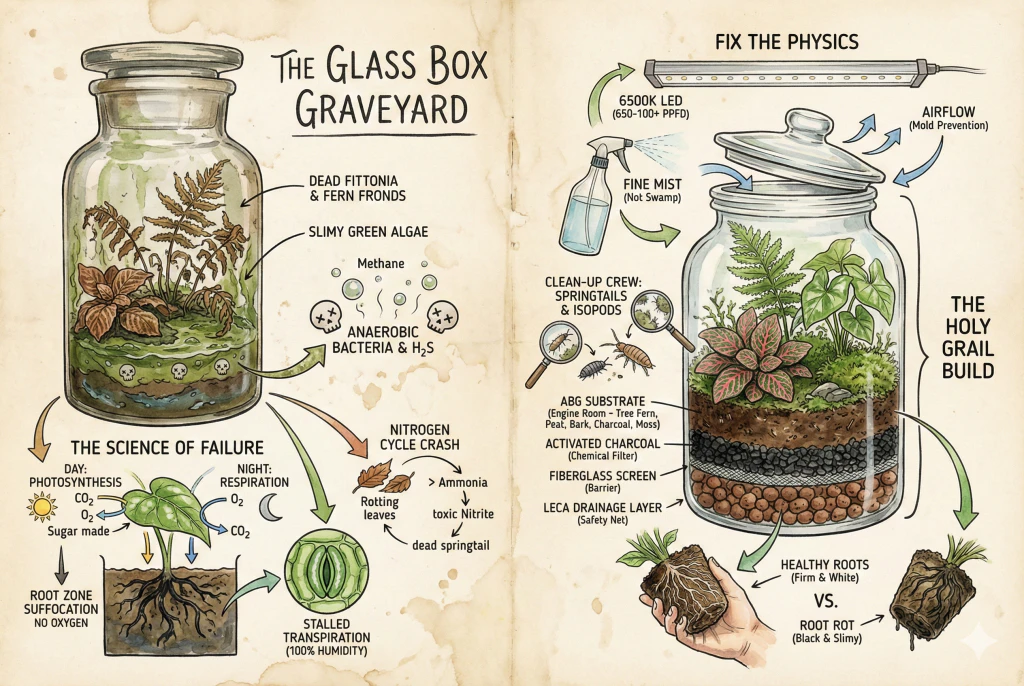
- Photosynthesis (Day Shift): Sunlight hits the chloroplasts. The plant takes Carbon Dioxide (CO2) and Water (H2O) and converts them into Glucose (sugar) and Oxygen (O2). 6CO2 + 6H2O + Light -C6H12O6 + 6O2
- Cellular Respiration (Night Shift): When the lights go out, the plant needs to eat. It burns that glucose for energy. To do this, it consumes Oxygen and releases Carbon Dioxide, just like you do.
The “Why” Behind the Death:
If your soil is dense mud, oxygen cannot diffuse to the roots. Roots must respire. If they can’t get oxygen, they switch to anaerobic respiration (fermentation). This produces toxic byproducts like ethanol and invites anaerobic bacteria that produce Hydrogen Sulfide (H2S). That rotten egg smell? That’s the smell of your roots dissolving into mush.
2.2. The Water Cycle: Transpiration, Not Just Evaporation
You think the water cycle in a terrarium is just “water evaporates, hits glass, falls down.” Wrong.
The primary driver of water movement is Transpiration.
- Roots suck water up via osmosis.
- Water travels up the xylem (the plant’s veins) driven by the “transpirational pull.”
- Stomata (tiny pores on the leaves) open to let water vapor out.
The “Why” Behind the Death:
For transpiration to work, there must be a Vapor Pressure Deficit (VPD). The air must be slightly drier than the leaf. If your terrarium is 100% humidity with zero airflow, transpiration stalls. The plant can’t pull nutrients up from the soil because the water “conveyor belt” has stopped. The plant starves while sitting in water.
2.3. The Nitrogen Cycle: Poop to Plant Food
If you have a “bioactive” terrarium (one with bugs in it), you are running a waste treatment plant.
- Ammonification: Dead leaves and bug poop decay into Ammonia (NH3). Ammonia is toxic.
- Nitrification: Bacteria (Nitrosomonas) turn Ammonia into Nitrite (NO2-). Nitrite is also toxic.
- Nitration: Bacteria (Nitrobacter) turn Nitrite into Nitrate (NO3-).
- Assimilation: Plants eat the Nitrate.
The “Why” Behind the Death:
If you don’t have the right soil surface area (like charcoal or porous substrates) for these bacteria to live, ammonia builds up. This causes “New Tank Syndrome,” chemically burning your plants’ roots and killing your cleanup crew.
3. The Setup / Process: The “Holy Grail” Build
Stop using “potting soil.” Stop grabbing dirt from your backyard unless you want a jar full of nematodes and aphids. To build a system that lasts 10 years instead of 10 weeks, you need to engineer the layers.
Recommended Watch: Before you start building, watch how the pros do it. This tutorial by SerpaDesign is the gold standard for bioactive setups.
Step 1: The Drainage Layer (The Safety Net)
The Physics: This layer prevents the “Perched Water Table” from drowning your roots. Gravity pulls water down; capillary action pulls it up. The drainage layer creates a void where excess water can sit away from the soil.
Material: LECA (Lightweight Expanded Clay Aggregate).
- Why: It’s porous, lightweight (doesn’t crack the glass), and holds a reserve of humidity without being “wet.”
- Myth: “Can I use gravel?” Sure, if you want your terrarium to weigh 50 pounds and crack if you look at it wrong. LECA is superior physics.
Why: Essential for drainage. These clay balls prevent your soil from becoming a swamp by creating a reservoir for excess water.
(https://www.amazon.com/Halatool-Reptile-Substrate-Clay-Terrariums/dp/B0FMRBJPGB)
Step 2: The Barrier Layer (The Separator)
The Logic: If you put dirt directly on top of rocks, gravity and water will eventually wash the dirt into the rocks. Then you just have muddy rocks, and your drainage layer is ruined.
Material: Fiberglass Window Screen or Horticultural Mesh.
- Do Not Use: Metal mesh (it rusts), Cheesecloth (it rots in 2 months and your system collapses).
Why: Use this to separate your soil from your drainage layer. It won’t rot or rust, keeping your layers distinct forever.
(https://www.amazon.com/Windows-Screen-Charcoal-Fiberglass-Rolling/dp/B0927SLHLR)
Step 3: The Chemical Filter (Charcoal)
The Chemistry: Activated Charcoal is a molecular sponge. It works via adsorption (binding stuff to its surface). It traps impurities, heavy metals from your water, and volatile organic compounds (stinky smells) from decay.
The Myth: “It filters the water forever.” No. It eventually saturates. But, it stays porous, providing a massive surface area for those nitrifying bacteria we talked about earlier. It’s a bacterial condo complex.
Why: Filters toxins and reduces odors. Don’t use BBQ charcoal (it has lighter fluid additives that kill plants).
(https://www.amazon.com/Horticultural-Soil-Amendment-Terrariums-Gardening/dp/B09S1DHV5N)
Step 4: The Substrate (The Engine Room)
The Gold Standard: ABG Mix (Atlanta Botanical Gardens Mix).
If you take nothing else from this report, take this: DO NOT USE POTTING SOIL. Potting soil is peat moss and prayer. It compacts into a dense brick that suffocates roots.
The ABG Recipe:
- 2 Parts Tree Fern Fiber: The structure. It takes years to break down.
- 1 Part Sphagnum Peat Moss: Acidifies the soil (plants love low pH) and holds water.
- 2 Parts Orchid Bark: Creates “macropores” (big air gaps) for root oxygenation.
- 1 Part Charcoal: Sweetens the soil.
- 1 Part Sphagnum Moss: Fluffiness and hydration.
This mix stays “airy” for years, even when wet. It mimics the forest floor of the tropics.
Why: The exact ratio used by pros. Saves you from buying 5 different bulk bags of ingredients.
(https://www.amazon.com/Joshs-Frogs-ABG-Quart-Gallon/dp/B00JJS9WOO)
Step 5: The “Clean-Up Crew” (Biological Warfare)
You need janitors. If a leaf dies in a sterile jar, it grows mold. If a leaf dies in a bioactive jar, bugs eat it and turn it into plant food.
- Springtails (Folsomia candida): Tiny white bugs that jump. They eat mold. They are non-negotiable. If you don’t have them, you will have mold. Period.
- Isopods (Trichorhina tomentosa / Dwarf White): They eat the bigger dead stuff. They also burrow, aerating your soil so you don’t have to.
Why: These guys are your anti-mold defense force. You simply cannot have a healthy closed system without them.
(https://www.amazon.com/Established-Springtail-Culture-Tropical-Springtails/dp/B092S85D6M)
Must Watch: Understand why these tiny bugs are critical for your ecosystem.
4. Deep Dive / Tips: The “Big Three” Killers
I’ve autopsied enough terrariums to know exactly how yours died. It wasn’t “bad luck.” It was physics.
4.1. Light: The Inverse Square Law is Beating You
Here is the biggest lie in houseplant care: “Bright, Indirect Light.”
What does that even mean? To a human, a room looks bright because our pupils dilate. To a plant, the corner of your room is a cave.
The Science of Etiolation:
If a plant doesn’t get enough PPFD (Photosynthetic Photon Flux Density), it thinks it’s buried under leaf litter. It produces hormones called auxins that accumulate on the shaded side of the stem, causing cells to elongate. The plant stretches, gets “leggy,” weak, and pale. This is etiolation. It is starving to death while stretching for a sun that isn’t there.
The Fix:
You need 6500K (Daylight) LED lights.
- Succulents: Need 400+ PPFD. You basically need a supernova.
- Tropicals (Fittonia/Ferns): Need 50-100 PPFD.
Street-Smart Tip: If your plant looks like it’s trying to escape the jar (long stems, huge gaps between leaves), it needs light yesterday.
Why: The sun in your living room isn’t enough. This light provides the specific blue/red spectrum plants need to photosynthesize.
(https://www.amazon.com/EWPJDK-Spectrum-Lights-Indoor-Growing/dp/B0CPBPR9KD)
4.2. Water: The “Tantalus” Effect
You are likely overwatering. In a closed system, water doesn’t leave. If you pour a cup of water in, that cup stays there forever.
The Diagnosis:
- Condensation 24/7: If you can’t see your plants because the glass is always fogged, it’s too wet. You are breeding rot bacteria.
- Rotten Egg Smell: That’s hydrogen sulfide. Your soil has gone anaerobic (no oxygen). Your roots are dead.
- Yellow/Mushy Leaves: The plant cells are bursting from osmotic pressure.
The Fix:
Open the lid. Let it breathe for 24 hours. You want a light mist in the morning and evening, and clear glass during the day.
Why: Dumps are for trucks, mists are for terrariums. This gives you an even coating without flooding the soil.
(https://www.amazon.com/Hula-Home-Continuous-Plastic-Sprayer/dp/B0948WBX9L)
4.3. Mold: The Fuzzy Death
Mold spores are everywhere. They are in the air you are breathing right now. In a stagnant, humid jar, they bloom.
The Fix:
- Springtails: Add more. They eat mold for breakfast.
- Airflow: Stagnant air is mold heaven. Open the lid occasionally to swap the air.
- Removal: If you see a fuzzy leaf, cut it out immediately with long tweezers. Don’t let it spread spores.
Why: Unless you have the hands of a surgeon and the size of a toddler, you can’t reach in there without wrecking things.
(https://www.amazon.com/EvaGO-Aquarium-Stainless-Carbonation-Protection/dp/B07WPD3HFF)
Visual Tutorial: Diagnosing Root Rot
Don’t just guess. Look at the roots. Healthy roots are firm and white/tan. Dead roots are black, slimy, and smell bad.
Why: Seeing “mushy roots” on video is way better than reading about it. This guide shows you exactly what to prune.
5. Troubleshooting (Q&A): Busting the Myths
Let’s tackle the bad advice you’ve read on generic gardening blogs.
Myth #1: “Succulents love terrariums!”
The Reality: This is a lie. Succulents are desert plants. They evolved for high wind, blistering sun, and bone-dry soil. A terrarium is a humid, stagnant, low-light box. Putting a cactus in a terrarium is like putting a penguin in a sauna. It will rot. It will stretch. It will die.
- Exception: An open dish garden with barely any water and a high-powered grow light. But a closed jar? Never.
Myth #2: “You don’t need a drainage layer if you are careful.”
The Reality: That’s like saying “You don’t need a seatbelt if you’re a good driver.” You are human. You will eventually pour too much water. Without a drainage layer (LECA), that water sits in the soil. The roots drown. The bacteria take over. Game over. The drainage layer is your insurance policy.
Myth #3: “Just use dirt from outside, it’s free!”
The Reality: Dirt from outside contains:
- Weed seeds.
- Fungal pathogens (Pythium).
- Predatory mites that eat your springtails.
- Centipedes that eat your isopods. Unless you bake that dirt in an oven at 200°F for an hour (which smells terrible), you are introducing a Trojan Horse into your pristine glass world.
Myth #4: “Activated Charcoal filters the water forever.”
The Reality: As mentioned, it saturates. However, it’s still crucial for soil structure and bacterial housing. Just don’t expect it to magically clean up toxic sludge after 5 years. It’s a buffer, not a magic wand.
6. Conclusion: Stop Killing, Start Observing
Terrariums are not “set it and forget it.” They are slow-motion pets.
If your plants are dying, it’s a feedback loop.
- Too much water? Draining layer is full.
- Too little light? Plants are leggy.
- Too much poop? Not enough springtails.
You have the science now. You know about the gas exchange, the photon flux, and the nitrogen cycle. You know that “potting soil” is the enemy and LECA is your friend.
Go look at your jar.
Is there condensation?
Are the bugs moving?
Is the soil airy?
Fix the physics, and the biology will follow. Now go save that Fittonia.
Detailed Technical Addendum: Comprehensive Analysis of Failure Vectors
7.0 Advanced Substrate Mechanics: The Physics of “Air” in Water
Most failures begin in the substrate. To understand why ABG Mix is superior, we must analyze bulk density and porosity.
- Bulk Density: The weight of the soil per unit volume. High bulk density (sand/mud) crushes roots. Low bulk density (peat/perlite) allows root penetration.
- Total Porosity: The volume of the soil that is not solid. This is divided into:
- Macropores: Large spaces that drain water and hold air. Oxygen diffusion occurs here.
- Micropores: Tiny spaces that hold water against gravity via capillary action. Water uptake occurs here.
The Failure of Potting Soil:
Standard potting soil has high microporosity but low macroporosity. When watered, the micropores fill up. Over time, the organic matter decomposes into “muck,” collapsing the few macropores that existed.
- Result: Anoxic zones (zero oxygen).
- Chemistry: In anoxic zones, reduction reactions occur. Nitrate is lost to denitrification (N2 gas), sulfates are reduced to Hydrogen Sulfide (rotten egg smell), and Manganese/Iron can reach toxic levels.
Why Tree Fern Fiber Wins:
Tree Fern Fiber contains high levels of lignin, a complex organic polymer that is extremely resistant to microbial decay. While peat moss decomposes in 1-2 years, tree fern fiber maintains its structural integrity (and thus macroporosity) for 5+ years. This keeps the “airways” of your soil open long-term.
8.0 The Microbiology of the “Crash”
A bioactive terrarium is an ecosystem. Ecosystems rely on energy transfer.
The Energy Pyramid:
- Producers: Your Plants (Photosynthesis).
- Primary Consumers: Springtails/Isopods (eating decaying plant matter/fungus).
- Decomposers: Bacteria/Fungi (breaking down waste).
The “Crash” Mechanism:
Often, a terrarium crashes because the CUC (Clean-Up Crew) starves.
If you set up a new terrarium with fresh soil and fresh plants, there is no decaying matter yet.
- Scenario: You add 50 isopods. There are no dead leaves.
- Result: The isopods starve and die.
- Cascade: The dead isopods rot. The sudden spike in protein decay causes an Ammonia spike. The bacteria can’t handle it. The soil becomes toxic. The plants die.
Expert Fix: You must feed your terrarium initially. Add “Leaf Litter” (dried Magnolia or Oak leaves) immediately. This provides food for the CUC and buffers the humidity.
9.0 Photobiology: Understanding PAR and Spectral Quality
We touched on light, but let’s go deeper. Plants do not “see” lumens (a measure of brightness for human eyes). They “count” photons.
The McCree Curve:
This curve shows the efficiency of photosynthesis at different wavelengths.
- Red (600-700nm): The most efficient driver of photosynthesis.
- Blue (400-500nm): Crucial for stomatal opening and morphological control (keeping plants short).
- Green (500-600nm): Often thought to be useless, but actually penetrates deeper into the leaf and canopy than red/blue, driving photosynthesis in lower layers.
Why Window Light Fails:
Glass filters light. A standard window pane cuts light transmission. Screens cut it further.
- Distance: The Inverse Square Law (Intensity = 1/Distance^2).
- If you move a plant from 1 foot away from the window to 2 feet away, it doesn’t get 50% of the light. It gets 25%.
- Move it 3 feet away? It gets 11%.
- Most “desk terrariums” are sitting in 5-10% of the light they need.
LED Selection Guide:
Don’t buy “purple” grow lights. They are outdated tech. Buy Full Spectrum White LEDs (Samsung LM301B diodes are the gold standard). They provide a balanced spectrum that looks good to your eye (high CRI) and hits the PAR peaks for the plants.
10.0 Hydrology: Water Chemistry and Osmotic Potential
Why is tap water the enemy? It’s not just the chlorine.
Total Dissolved Solids (TDS):
Tap water contains Calcium Carbonate, Magnesium, Sodium, and other salts. In a garden, rain flushes these salts out. In a closed terrarium, water evaporates (leaving salts behind) and condenses (as pure water).
- The Accumulation: Every time you water with tap water, you add more salt. It never leaves.
- The Result: The soil salinity increases.
- The Physics: Osmotic Potential. Water moves from low salt concentration to high salt concentration. If the soil becomes saltier than the plant roots, water will leave the roots and go into the soil. The plant dehydrates even though the soil is wet. This is “Fertilizer Burn” or “Saline Shock.”
The Solution:
Use Reverse Osmosis (RO) or Distilled Water. These have a TDS of nearly 0. You are adding pure H2O, preventing salt buildup.
11.0 Identifying Specific Plant Pathogens
When a plant dies, the way it dies tells you the killer.
Table: Terrarium Pathology Matrix
| Symptom | Likely Pathogen/Cause | Smell | Texture | Action |
|---|---|---|---|---|
| Black, slimy roots | Pythium (Root Rot) | Rotten Eggs/Sulfur | Mushy | Remove plant, dry soil. |
| Gray fuzzy mold on leaves | Botrytis cinerea (Gray Mold) | Musty/Damp | Dusty/Fuzzy | Increase airflow, cut leaves. |
| White cottony growth | Sclerotinia / Cobweb Mold | Mushroomy | Cotton-like | Hydrogen Peroxide swab. |
| Brown spots with yellow halos | Bacterial Leaf Spot | none | Wet/Blistered | Keep leaves dry (no misting). |
| Sudden collapse of seedlings | Rhizoctonia (Damping Off) | none | Shriveled stem | Sterilize soil next time. |
| Yellowing lower leaves | Nitrogen Deficiency OR Overwatering | none | Limp | Check soil moisture first. |
12.0 The Hierarchy of Plant Selection
You cannot put a Ferrari engine in a lawnmower. You cannot put a cactus in a jar.
Tier 1: The Survivors (High Success)
- Fittonia (Nerve Plant): Loves humidity, hates drying out. The canary in the coal mine (faints when dry).
- Syngonium (Arrowhead Vine): Indestructible, grows fast (needs pruning).
- Ficus pumila (Creeping Fig): Aggressive grower, covers backgrounds well.
- Biophytum sensitivum: Looks like a mini palm tree, reacts to touch. Very cool.
Tier 2: The Divas (Medium Success)
- Ferns (Maidenhair): Often die if the foliage gets wet, despite liking humidity. Need consistent moisture but air movement.
- Peperomia: Many rot easily. Peperomia prostrata (String of Turtles) is popular but melts if water sits on leaves.
- Begonias: Many thrive, but some melt if water sits on leaves. Begonia maculata is too big. Look for miniatures.
Tier 3: The Death Wish (Do Not Attempt)
- Succulents/Cacti: Just don’t.
- Herbs (Basil/Mint): They rot. They need massive airflow and sun.
- Carnivorous Plants (Venus Flytraps): They need winter dormancy (cold) and intense sun. They usually die slowly in terrariums unless specifically set up for them (bog style).
13.0 Advanced Troubleshooting: The “Smell Test”
A seasoned expert uses their nose.
- Petrichor / Earthy: Good. This is Geosmin, produced by healthy Streptomyces bacteria.
- Swamp / Sulfur: Bad. Anaerobic conditions.
- Ammonia / Cat Pee: Bad. Nitrogen cycle crash. Too much waste, not enough bacteria.
- Musty / Old Books: Mold outbreak.
If your terrarium smells like a swamp:
- Tilt the jar. Is water pooling in the LECA?
- If yes, use a turkey baster or syringe to suck the excess water out through the soil (dig a small pit).
- Leave the lid off for 3 days.
14.0 Conclusion Redux: Stewardship
We are playing god in a jar. It’s a responsibility. The plants are dying because the variables—light, water, soil, air—are out of balance.
You are not a passive observer. You are the weather. You are the sun. You are the rain.
Take control of the variables, and life will find a way.
Now, go fix your jar.

Leave a Reply