
Bucephalandra Ebb and Flow Fan Ventilation for Emersed Bins
Build an emersed Bucephalandra ebb and flow fan ventilation bin using simple timers to oxygenate rhizomes, balance VPD, and stop soft rot.
Marcus Hale · Published 2026-11-19 · 20 min read
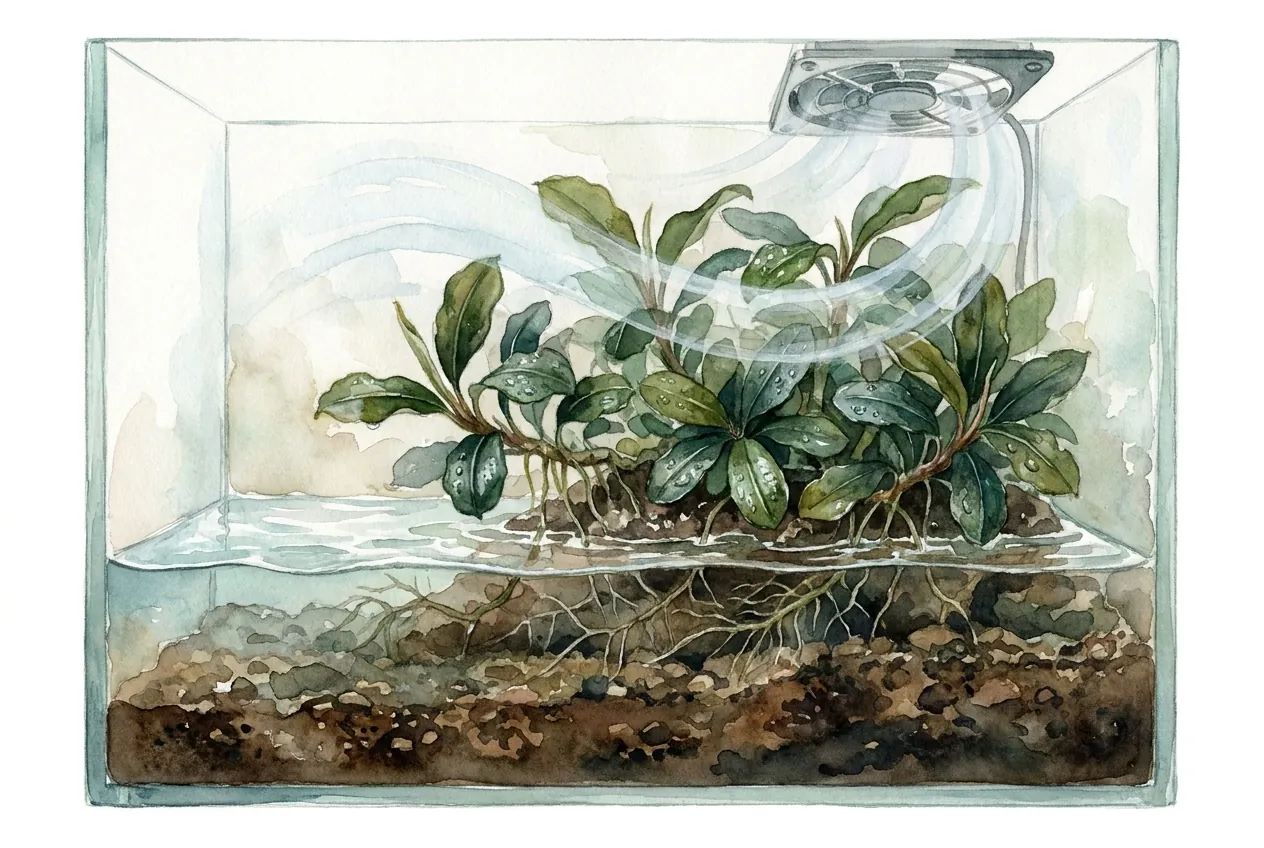
Key Takeaways
- Flood-and-drain cycles pull fresh air into root pores and prevent soft rot in emersed Bucephalandra.
- Intermittent fan pulses thin the leaf boundary layer so calcium reaches new shoots without drying leaves.
- Coarse mineral media like pumice or LECA keep root oxygen above 12% across repeated flood cycles.
- Two outlet timers, a lower reservoir, and an oversized standpipe replicate IoT control without code.
- Keep reservoir EC at 0.3 to 0.6 mS/cm, pH at 5.5 to 6.5, and LEDs at 30 to 50 PPFD below 26 °C.
Growing Bucephalandra emersed in a sealed plastic storage bin works right up until the morning half your rhizomes turn to translucent mush.
That sudden collapse happens because still, saturated air shuts down plant transpiration while standing moisture starves the rhizome of oxygen.
A September 2026 peer-reviewed cultivation study solved both failures at once by pairing scheduled ebb-and-flow subirrigation with closed-loop fan ventilation.
That integrated system kept 95.9% of Bucephalandra seedlings (209 out of 218) alive over a one-month trial in a hot tropical climate.
You do not need microcontrollers or custom software to get the same biological result at home.
Understanding how flood-and-drain cycles oxygenate roots and how gentle airflow manages leaf moisture lets you build a reliable two-tier bin using simple outlet timers.
Why Stagnant Sealed Bins Melt Emersed Bucephalandra
Sealed prop boxes trap Bucephalandra in 99 to 100% humidity and hypoxic water films, stalling shoot calcium delivery and triggering bacterial soft rot.
Most hobbyists treat emersed Bucephalandra like bog moss by misting heavily and snapping the lid shut.
That instinct clashes with the plant’s evolutionary biology and creates two separate physiological failures inside the same container.
Stream-Bank Rheophyte Biology vs. Static Prop Boxes
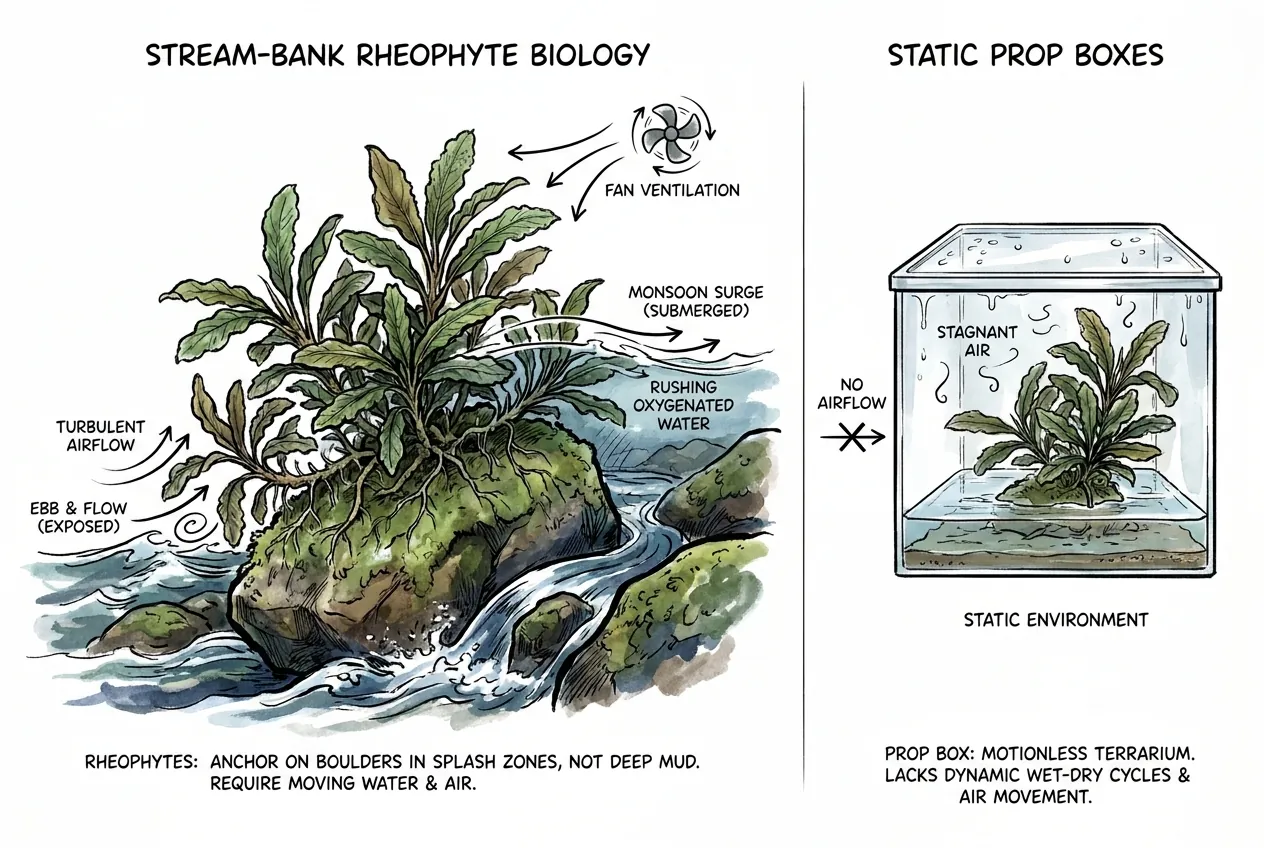
In nature, Bucephalandra is an endemic Bornean rheophyte, with 26 of its 32 recognized species native to swift Kalimantan forest streams.
These plants anchor onto bare boulders in the splash zone rather than rooting in deep, anoxic swamp mud.
During monsoon surges, rushing oxygenated water submerges the clumps. Between storms, turbulent forest air sweeps across their tough leaves and creeping rhizomes.
Replicating that habitat indoors requires dynamic wet-dry cycles and moving air, not a motionless terrarium.
How Zero VPD Starves Growing Tips of Calcium
When you seal a damp plastic bin tight, internal relative humidity quickly climbs to 99 or 100%.
At that point, the Vapor Pressure Deficit (VPD), which measures the drying pull of the air, drops near zero.
Without a moisture gradient between the leaf interior and the surrounding air, transpiration grinds to a halt.
Calcium moves upward almost exclusively through the xylem via transpirational pull. Stagnant high humidity therefore starves rapidly dividing shoot tips of calcium within several days.
New leaves emerge pale, distorted, or necrotic at the margins even when dissolved calcium is plentiful in the tray water.
High humidity (92% RH compared to 61% RH) also impairs stomatal closing responsiveness, while trapped ethylene in sealed vessels accelerates shoot tip necrosis.
Hypoxic Water Films and Bacterial Soft Rot
Standing water around the rhizome collar and condensation droplets on leaf blades create a second hazard.
Because oxygen dissolves poorly in water, waterlogged pores rapidly drop into environmental hypoxia (1 to 5% oxygen availability).
Deprived of oxygen, plant cells lose energy for wound repair and accumulate reactive oxygen species. At the same time, opportunistic soft-rot bacteria (Pectobacteriaceae) sense low oxygen and boost biofilm formation. Those bacteria then secrete pectinases and cellulases that dissolve plant cell walls into foul-smelling mush.
What the 2026 IoT Bucephalandra Trial Actually Measured
The September 2026 trial paired scheduled ebb-and-flow irrigation with 26 °C fan cooling, holding Bucephalandra in its 22 to 28 °C zone at 95.9% survival.
Researcher Al Barra Harahap published the study in Electrician (Volume 20, Issue 3). He built an automated cultivation platform using an ESP32-S3 microcontroller and a Jetson Nano edge node.
The platform ran Real-Time Clock (RTC) ebb-and-flow subirrigation alongside proportional fan ventilation.
| System Parameter | 2026 IoT Prototype | Home Timer Equivalent |
|---|---|---|
| Irrigation control | RTC-scheduled flood and drain (1 to 2 s clock accuracy) | Programmable 1-minute digital outlet timer |
| Ventilation control | Proportional fan control at 26 °C setpoint (1.54% overshoot) | Low-voltage fan on repeat-cycle timer plus lid vent |
| Environmental sensing | Linear-regression calibrated DHT22 and DS18B20 | Standalone calibrated digital hygrometer |
| Measured outcome | 95.9% one-month seedling survival (209 of 218) | Verified via drain-gap and leaf-droplet checks |
Because capacitive humidity sensors often drift in damp enclosures, the study calibrated its sensors using linear regression.
After calibration, the air sensor reached 99.16% temperature accuracy and 96.14% humidity accuracy, while the water probe reached 99.22% accuracy.
The proportional fan controller (gain Kp = 500) ramped airflow smoothly as temperatures approached 26 °C. It held overshoot to 1.54% without sustained oscillation. That thermal ceiling kept plants inside their 22 to 28 °C physiological range without blasting them with dry air.
The publicly accessible summary of the 2026 paper does not disclose exact flood minutes, drain intervals, or a target humidity percentage.
Pairing the verified 26 °C thermal ceiling with peer-reviewed benchmarks fills that gap cleanly.
Horticultural trials use 2 cm, 10-minute ebb-and-flow pulses. Bucephalandra tissue culture uses six 2 to 3 minute immersions daily with 80 to 90% RH vented acclimatization.
How Ebb-and-Flow Irrigation Oxygenates the Rhizome
Gravity drainage after each brief flood pulse actively pulls fresh air into substrate pores, avoiding the 10,000-fold drop in oxygen diffusion from standing water.
Instead of letting roots sit in a stagnant saucer or misting leaves from above, ebb-and-flow delivers water from underneath on a strict timer. Every cycle follows hydration with forced aeration.
Mass-Flow Air Draw vs. Standing Water and Misting
Oxygen diffuses roughly 10,000 times slower through water than through air. When substrate pores stay waterlogged, roots consume dissolved oxygen faster than it can diffuse downward. That oxygen shortage forces root cells from efficient aerobic respiration (~36 ATP per glucose) into anaerobic fermentation (~2 ATP per glucose) that accumulates toxic ethanol.
During an ebb-and-flow drain phase, the receding water column creates gentle negative pressure inside coarse porous media.
That falling water pulls stale carbon dioxide out and draws fresh atmospheric oxygen (roughly 21% oxygen in air) directly around the Bucephalandra roots.
| Irrigation Method | Root-Zone Oxygenation | Foliage Wetness | Rhizome Rot Risk |
|---|---|---|---|
| Ebb-and-flow subirrigation | Active mass-flow air draw during drain phase | Foliage stays dry | Low when drain gap is verified |
| Standing water tray | Diffusion-limited anoxic water around lower roots | Dry upper leaves but wet collar | High due to hypoxia and fermentation |
| Heavy manual misting | Unventilated pores with no root-zone flush | Prolonged leaf water films | High for both foliar biofilm and collar rot |
Subirrigation also keeps above-ground leaves dry, which lowers foliar disease pressure compared to overhead misting. Ideal soilless media maintain over 60 to 70% total porosity with at least 20 to 30% air-filled porosity.
They pair macropores (>75 µm) for fast drainage with micropores (0.2 to 30 µm) for capillary moisture.
Setting Flood Height and Calibrating the Drain-Gap Schedule
Set your tray’s overflow standpipe about 1 to 2 inches below the substrate surface. Rising water then reaches only the lower roots and media base, leaving the horizontal rhizome crown above the flood line.
In fast-draining mineral media, short daytime flood pulses (typically 5 to 10 minutes) separated by multi-hour drain intervals hydrate capillary micropores without drowning the rhizome. Water-retentive media require fewer cycles.
Generic care guides tell growers to keep media moist rather than soggy, which leaves too much room for guesswork while tray floors stay wet.
After a flood drains, I press a dry wooden skewer or blotting strip to the tray floor 1 cm from a rhizome for 10 seconds.
I record that baseline, then repeat with a fresh strip 15 minutes before the next flood across 3 cycles at steady room temperature.
If a strip shows a dark wet sheen over 5 mm high 15 minutes before the next flood, I extend the dry interval.
I add 30 to 60 minutes to the timer or lower the standpipe, and I also adjust if water pools at the collar.
If the top 2 cm feels dry and leaf margins curl inward before the next pulse, I shorten the dry interval by 30 minutes.
Because the 2026 IoT abstract does not specify a home dry-interval cutoff, this 5 mm sheen limit serves as a conservative working rule.
The 30 to 60 minute step prevents prolonged collar hypoxia without drying shallow roots. Always plug mains-powered pumps and timers into a GFCI-protected outlet with a drip loop, and never submerge non-submersible timer housings.
Balancing Fan Ventilation and VPD Without Desiccating Leaves
Gentle intermittent fan pulses thin the stagnant leaf boundary layer to restore gas exchange and cooling without stripping enclosure humidity below 70% RH.
Adding a fan to an emersed bin often scares growers who worry about drying out delicate foliage.
In practice, controlled air movement is what keeps humidity safe rather than lethal.
Thinning the Leaf Boundary Layer
Every Bucephalandra leaf is wrapped in a thin, motionless blanket of air called the boundary layer.
Water vapor leaving the stomata and carbon dioxide entering the leaf must diffuse across this still cushion.
In an unventilated prop box, transpired moisture pools inside a thick boundary layer right against the leaf surface.
That local saturation halts transpiration, blocks evaporative leaf cooling, and starves the leaf of carbon dioxide.
That stall happens even if a hygrometer mounted on the bin wall reads below 100%.
Directing gentle horizontal airflow across the canopy thins the boundary layer so gas exchange and convective heat transfer resume.
Why Intermittent Airflow Beats 24/7 Exhaust Fans
In a small home prop box, running an exhaust fan 24/7 pulls dry household air through vents faster than an ebb-and-flow tray can humidify it.
Conversely, long stagnant periods followed by aggressive air blasts create sharp VPD whiplash.
Controlled-environment research compared drastic VPD swings (0.63 to 1.63 kPa) against moderate swings (0.86 to 1.32 kPa).
Drastic fluctuations lowered stomatal conductance, reduced carbon dioxide assimilation, and increased light-harvesting damage (Photosystem II photodamage). Moderate, steady VPD bands preserved leaf expansion and gas exchange.
To match fan duty cycles to enclosure drying speed, I pair my cycle timer with a calibrated hygrometer at canopy height.
Thirty minutes after a fan-on pulse finishes, I inspect 3 representative clumps and the inner lid.
Thirty minutes after fan-off, I check again across 48 hours at steady room temperature. If leaf droplets persist, I add 5 minutes or widen the vent gap.
When new leaf tips turn papery or curl downward within 48 hours and RH drops below 70%, I shorten the fan duty cycle. Narrowing the lid vent gap also helps preserve moisture. This 70% RH floor and 5-minute adjustment step are conservative working rules, since the 2026 IoT study controlled fans around a 26 °C temperature setpoint.
Use low-voltage (5V USB or 12V DC) fans rated for damp enclosures, and keep all electrical splices and power bricks outside the wet zone.
When you are ready to compare fans, hygrometers, or automated humidity controllers, explore the plant cabinet humidity control kit chooser.
Inert Porous Media and Reservoir Water Chemistry
Rigid mineral aggregates keep root-zone oxygen above 12% across repeated flood cycles, while dilute nutrients at pH 5.5 to 6.5 prevent 10-fold surface salt buildup.
Ebb-and-flow trays subject growing media to constant wet-dry cycling and upward capillary evaporation. Choosing the wrong substrate or running full-strength fertilizer quickly turns a clean tray into a crusted, anaerobic mess.
Choosing Mineral Aggregates Over Organic Mixes
Plant roots require continuous oxygen, and root-zone oxygen below 12% prevents new root formation while 5 to 10% oxygen halts root growth completely.
Organic mixes like peat or packed sphagnum decompose under repeated flooding. They collapse into fine particles that choke macropores and turn hydrophobic if they ever dry out.
| Substrate Option | Structural Behavior | Flood-and-Drain Performance |
|---|---|---|
| Natural pumice | Durable volcanic mineral aggregate | Resists breakdown and holds internal pore moisture |
| Expanded clay (LECA) | Rigid kiln-fired clay granules | Does not float or decompose while keeping wide inter-particle air space |
| Lava rock (scoria) | Heavy porous volcanic rock | Anchors clumps firmly with rough surface texture for root grip |
| Organic peat or sphagnum | Decomposes over time and shrinks when dry | Compacts into fine particles under repeated flooding and loses aeration |
Rigid volcanic or kiln-fired aggregates preserve fixed macropores for instant drainage while holding thin moisture films inside internal micropores.
Choosing coarse 4 to 10 mm particles keeps oxygen well above the 12% floor between flood pulses.
Managing Reservoir EC, pH, and Salt Stratification
Because subirrigation pushes water upward without downward leaching, soluble fertilizer salts accumulate at the evaporation surface.
University subirrigation research shows electrical conductivity (EC) in the top substrate layer can climb up to 10 times higher than in middle and bottom layers.
Keep reservoir pH between 5.5 and 6.5 so essential macro- and micronutrients remain dissolved and bioavailable. Inert media have virtually no chemical pH buffering. Using reverse-osmosis (RO) or low-alkalinity water prevents bicarbonates from pushing pH above 7.0 and locking out iron.
Direct EC titration trials for emersed Bucephalandra are not yet published. A conservative target of 0.3 to 0.6 mS/cm (roughly 150 to 300 ppm TDS on a 500-scale meter) supplies steady nutrition without crusting exposed rhizomes.
Top off evaporated water with plain low-mineral water, and replace the full reservoir every 2 to 4 weeks.
Every 4 to 6 weeks, top-flush the bed to waste with plain RO water equal to twice (2x) the media volume to clear surface salts.
If you need inert mineral media, LECA, or water-testing meters for your build, check the semi-hydro conversion kit chooser.
Building a Low-Tech Home Ebb-and-Flow and Fan Bin
Two off-the-shelf outlet timers, a two-tier tray-and-reservoir stack, an oversized drain standpipe, and a low-voltage fan replicate the 2026 IoT system’s physics without microcontrollers.
In a climate-controlled home room (typically 20 to 25 °C), indoor temperatures swing far less than in tropical outdoor greenhouses.
Simple interval timers lock hydration and airflow to your light schedule reliably.
Mechanical Layout and Timer Setup
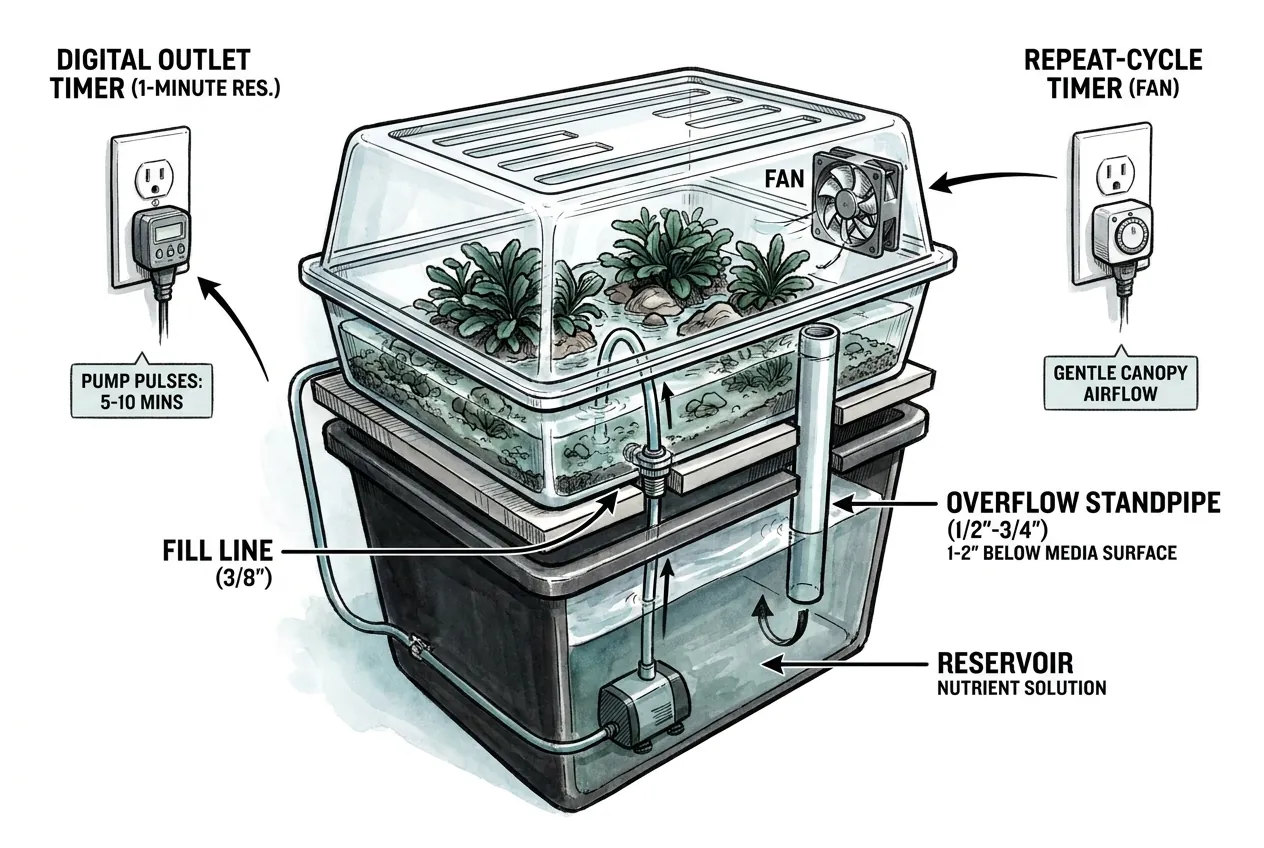
Stack a shallow clear grow bin (with a vented lid) on a shelf directly above an opaque lower reservoir.
Light-proofing the lower reservoir and tubing blocks algae growth in your nutrient solution.
Install two bulkheads in the upper tray floor, connecting a 3/8-inch fill line to a small submersible pump.
Fit a wider 1/2-inch or 3/4-inch vertical overflow standpipe cut 1 to 2 inches below the media surface.
Making the drain wider than the fill line guarantees excess water spills harmlessly back to the reservoir if the pump runs long.
Plug the pump into a 1-minute-resolution digital outlet timer rather than a coarse 15-minute mechanical dial.
That finer step lets you run brief 5 to 10 minute flood pulses. Put a low-voltage 5V USB or 12V DC circulation fan on a separate repeat-cycle timer angled gently across the canopy or off a bin wall.
Indoor Electrical and Spill Safeguards
Nutrient water conducts electricity easily, and indoor spills ruin floors fast. Build five physical safeguards into every home rack before plugging anything in.
- Plug all mains-powered pumps, timers, and light drivers into a GFCI-protected outlet or portable GFCI adapter, and test it monthly.
- Form a downward U-shaped drip loop below outlet height on every cord so condensation drips harmlessly away from wall sockets.
- Mount all AC power strips, timers, and low-voltage power bricks dry and outside the humid bin above the reservoir waterline.
- Drill a small 2 to 3 mm anti-siphon relief hole in the pump riser just above the reservoir’s maximum water level so drain-back stops cleanly without reverse-siphoning.
- Set the entire lower reservoir inside a waterproof catch pan sized to hold at least 110% of the upper tray’s flood volume.
Light, Temperature, and Acclimation Transitions
Keeping LEDs at 30 to 50 PPFD for 7 to 8 hours with an air gap holds 22 to 26 °C and reduces algae risk.
Lighting, heat, and acclimation stage all shift how fast your plants transpire. Treating them separately from your fan and flood timers leads to sudden bleaching or transition melt.
LED Heat, Photoperiod, and Temperature Limits
Even modern LEDs convert roughly 50 to 60% of their electrical input into heat at the fixture heatsink.
Mounting a bright light flat against an acrylic lid traps heat inside the bin. That trapped heat drives temperature up and humidity down until VPD spikes and forces stomata shut.
Because Bucephalandra evolved as a shaded forest-stream plant, excessive light overwhelms its photoprotective capacity. Too much intensity causes light stress (Photosystem I photoinhibition) and leaf bleaching while fueling cyanobacteria on damp rock.
Keep lights elevated with a 2 to 5 cm air gap above the lid at 30 to 50 PPFD for 7 to 8 hours daily.
Trigger fan cooling before air temperature passes 26 °C so you stay clear of bacterial soft rot’s peak 21 to 27 °C decay window.
When selecting an appropriately dimmed fixture for emersed trays, compare options in the planted tank LED light chooser.
Submersed-to-Emersed and Emersed-to-Submersed Acclimation
Bucephalandra are amphibious plants, yet individual mature leaves cannot rewrite their anatomy once formed. Submerged leaves lack thick waxy cuticles and functional stomata, whereas aerial leaves build both under abscisic acid (ABA) signaling at the shoot tip.
When moving newly bought submersed clumps into an ebb-and-flow bin, start with a nearly sealed lid (85 to 95% RH).
Keep airflow minimal for the first 10 to 14 days while dimming light near 30 PPFD.
Snip off yellowing submerged blades cleanly so they do not decay against the rhizome, then step up intermittent fan cycles over weeks 3 and 4.
Moving emersed clumps back into an aquarium reverses the process. Keep tank water cool (22 to 25 °C) with brisk circulation, and anchor rhizomes onto hardscape without burying them.
Prune shedding emersed leaves at the petiole base as thinner aquatic shoots emerge.
Troubleshooting Melt, Biofilm, and Over-Drying
Checking rhizome firmness, leaf age, and surface moisture separates soft rot from tipburn, desiccation, salt burn, and biofilm before you touch any timer.
Not every brown or collapsing leaf means the same thing. Misdiagnosing high-VPD drying or salt burn as bacterial melt often tricks growers into sealing the bin tighter and making the real problem worse.
| Diagnostic Clue | Bacterial Soft Rot | Stagnant-Air Ca2+ Tipburn | High-VPD Over-Drying | High-EC Salt Burn | Foliar Biofilm |
|---|---|---|---|---|---|
| Rhizome collar | Mushy, cream to black | Firm and healthy | Firm and healthy | Firm with browned roots | Firm |
| Odor | Strong foul smell | None | None | None | Musty or earthy |
| Affected zone | Base and petioles first | Youngest emerging tips | Exposed outer margins | Oldest lower margins | Upper leaf surfaces |
| Tissue texture | Water-soaked slime | Translucent then brown | Dry, papery, curled | Dry bronze with crust | Slimy green or teal film |
| First action | Excise rot and drain tray | Add gentle fan pulses | Shorten fan run or vent | Top-flush and lower EC | Stop misting and add airflow |
If you pinch a rhizome collar and find mushy, foul-smelling tissue, no chemical spray can cure the already-macerated cells. Pull the clump immediately before the next flood pulse washes Pectobacterium bacteria into your shared reservoir.
- Rinse the clump under cool running water to spot the exact line between soft decay and crisp green or white rhizome.
- Cut away all translucent or discolored tissue using a razor wiped with 70% isopropyl alcohol between every slice.
- Discard infected trimmings and contaminated media, and scrub the tray and reservoir if slime or odor is present.
- Let trimmed rhizomes rest in shaded, gently moving air for 1 to 2 hours until the cut face dries without wilting leaves.
- Return clumps to fresh mineral media and verify your drain-gap clearance and fan-drying checks before restarting timers.
Putting the Rhythm Together
Ebb-and-flow subirrigation and intermittent fan ventilation succeed because they respect Bucephalandra as a stream-bank rheophyte rather than a swamp plant.
Brief bottom-up flood pulses pull fresh oxygen around the roots during drainage. Gentle airflow then clears the stagnant leaf boundary layer so calcium keeps moving to new shoots.
Start with a two-tier mineral-media tray wired through a GFCI outlet, and set your standpipe below the rhizome crown.
Run the 3-cycle drain-gap check alongside the 48-hour fan-droplet check to replace guesswork with repeatable, healthier emersed growth.