
Why Monstera Albo White Leaves Turn Brown & How to Slow It
Learn why Monstera Albo white leaves turn brown, why misting worsens necrosis, and how light, VPD, and root care slow margin collapse.
Priya Patel · Published 2026-11-16 · 25 min read
Key Takeaways
- White sectors lack chlorophyll and import sugars from green tissue while still losing water via stomata.
- Misting fails to raise 24-hour humidity and creates a 3-to-10-hour wetness window for foliar pathogens.
- Target 120 to 250 µmol m⁻² s⁻¹ diffused light for 10 to 12 hours so green leaves can feed white sinks.
- Hold steady 0.8 to 1.0 kPa VPD with gentle airflow under 0.2 m s⁻¹ instead of chasing humidity spikes.
- Track brown borders for 14 to 21 days before trimming strictly inside a 1 to 2 mm dead buffer.
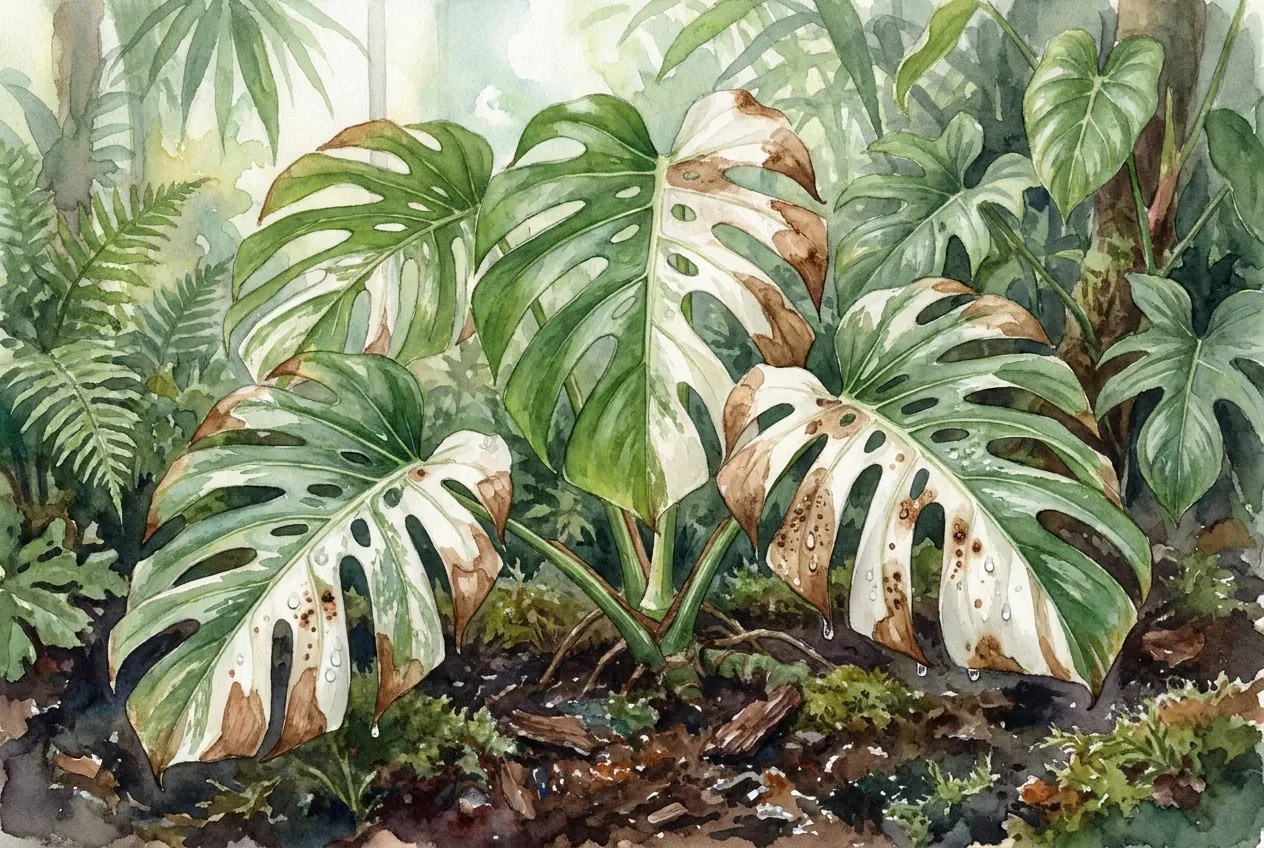
White sectors on Monstera deliciosa ‘Albo Variegata’ turn brown because they are non-photosynthetic carbon sinks that still transpire water while lacking chlorophyll and photoprotection.
When indoor light, ambient humidity, or root water delivery falls short, the plant sacrifices its high-maintenance white margins first. Foliar misting accelerates that collapse instead of preventing it.
Stopping white-sector browning requires stabilizing leaf-level carbon supply, vapor pressure deficit (VPD), and root oxygenation rather than spraying water onto the foliage.
Why White Sectors Fail Before Green Tissue
Variegated white tissue operates at a structural, metabolic, and hydraulic disadvantage compared with adjacent green lamina on the exact same leaf.
Understanding why those sectors break down first explains why common cosmetic fixes cannot halt the spread.
Chimeric Cell Layers and the Carbon Sink Tax
White patches on Monstera ‘Albo’ arise from a periclinal chimera in the shoot apical meristem, where concentric cell layers divide independently.
When a mutation disables chlorophyll synthesis in the sub-epidermal L2 layer while L1 and L3 remain normal, the leaf develops colorless mesophyll sectors.
Because green and mutant white cells divide at different speeds, they can displace one another at the growth point.
Axillary buds emerging from an all-white stem stripe often produce unsustainable pure-white shoots.
Inside those white mesophyll cells, plastids stall without organized thylakoid membranes or functional photosystems, leaving them incapable of fixing carbon.
Rather than sitting dormant, living white cells upregulate sucrose synthase (SUS) to import sugars continuously from neighboring green sectors.
Disrupted plastid-to-nucleus retrograde signaling also stalls palisade cell elongation. It correlates with downregulated cutin, suberin, and wax biosynthesis pathways in chlorophyll-deficient tissue.
| Cellular Trait | Green Source Sector | White Sink Sector |
|---|---|---|
| Plastid structure | Intact grana and thylakoid membranes | Absent or disorganized thylakoid lamellae |
| Carbon balance | Net carbon source exporting sucrose | Net carbon sink importing sucrose via SUS |
| Mesophyll shape | Expanded columnar palisade cells | Unexpanded palisade cells from stalled signaling |
| Surface barrier | Active cutin, suberin, and wax synthesis | Downregulated cutin and wax pathways |
Every square centimeter of white variegation is an energetic tax that the remaining green leaf area must feed through photosynthesis.
Uncompensated Transpiration and Outside-Xylem Collapse
White sectors are not hydraulically dormant just because they lack chlorophyll. In variegated ‘Gonggan’ mandarin leaves, net photosynthesis dropped by 59.53% and stomatal conductance fell by 73.20%.
Yet transpiration declined by only 44.80% while carotenoids fell to 12.30% of green-leaf levels.
In Hedera helix, white sectors lost stomatal responsiveness to red light up to 90 µmol m⁻² s⁻¹.
They still opened stomata under blue light and suffered more persistent drought aftereffects than green sectors.
Wild-type Monstera deliciosa green leaves belong to the lowest cuticular water permeability group among 24 tested species.
Stomatal transpiration and internal delivery bottlenecks drive water loss rather than a leaky green cuticle.
Across angiosperms, 75% to 100% of leaf hydraulic conductance decline during mild-to-moderate dehydration occurs in outside-xylem mesophyll tissues rather than main-vein xylem embolism.
White sectors hold lower soluble sugars and upregulate osmotic-stress proteins 2.2- to 6.1-fold to buffer turgor.
As a result, distal white margins collapse into catabolic senescence long before the central green lamina wilts.
Why Misting Makes Monstera Albo Browning Worse
Foliar misting does not raise meaningful 24-hour humidity around a Monstera ‘Albo’. Instead, liquid droplets on thin white tissue introduce gas-exchange bottlenecks, mineral stress, and pathogen entry. Managing humidity means controlling water vapor in the air, not wetting the leaf surface.
Droplet Physics and Why Room Air Erases the Spike
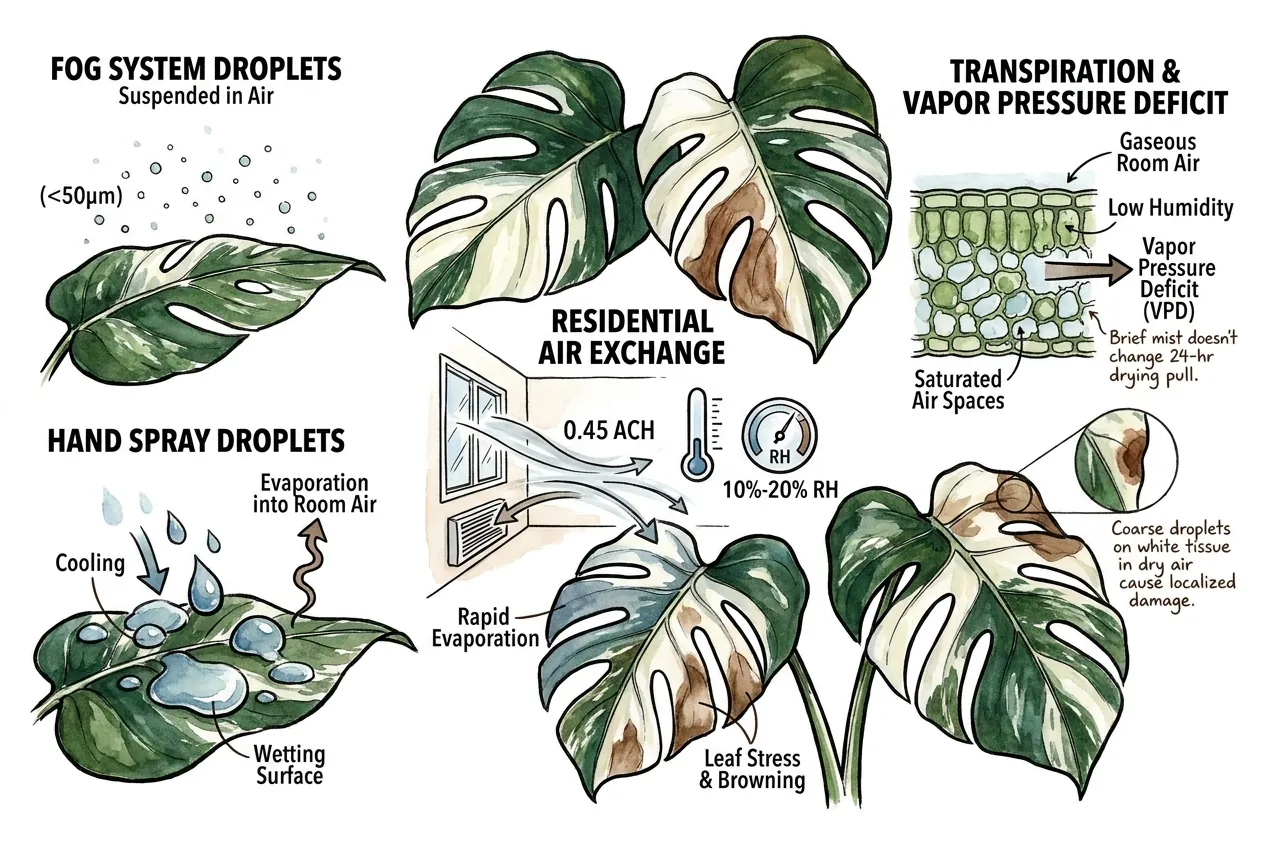
True greenhouse fogging systems produce droplets smaller than 50 microns so they remain suspended and evaporate in air without wetting foliage.
Hand spray bottles create much coarser droplets that land directly on the waxy leaf surface. They cool the epidermis briefly before evaporating into bulk room air.
In U.S. homes, residential air exchange averages 0.45 air changes per hour (with an ASHRAE baseline of 0.35 ACH). Forced-air heating mixes indoor air even faster. During winter heating seasons, indoor relative humidity often drops to 10% to 20% against the 40% to 50% baseline many houseplants prefer.
Iowa State University Extension notes that foliage dries quickly under these conditions without raising room humidity meaningfully.
Transpiration is driven by the vapor pressure deficit (VPD) between saturated intercellular air spaces and gaseous room air. A brief post-mist blip leaves 24-hour drying pull virtually unchanged.
How to Test Canopy Humidity Decay in Your Own Room
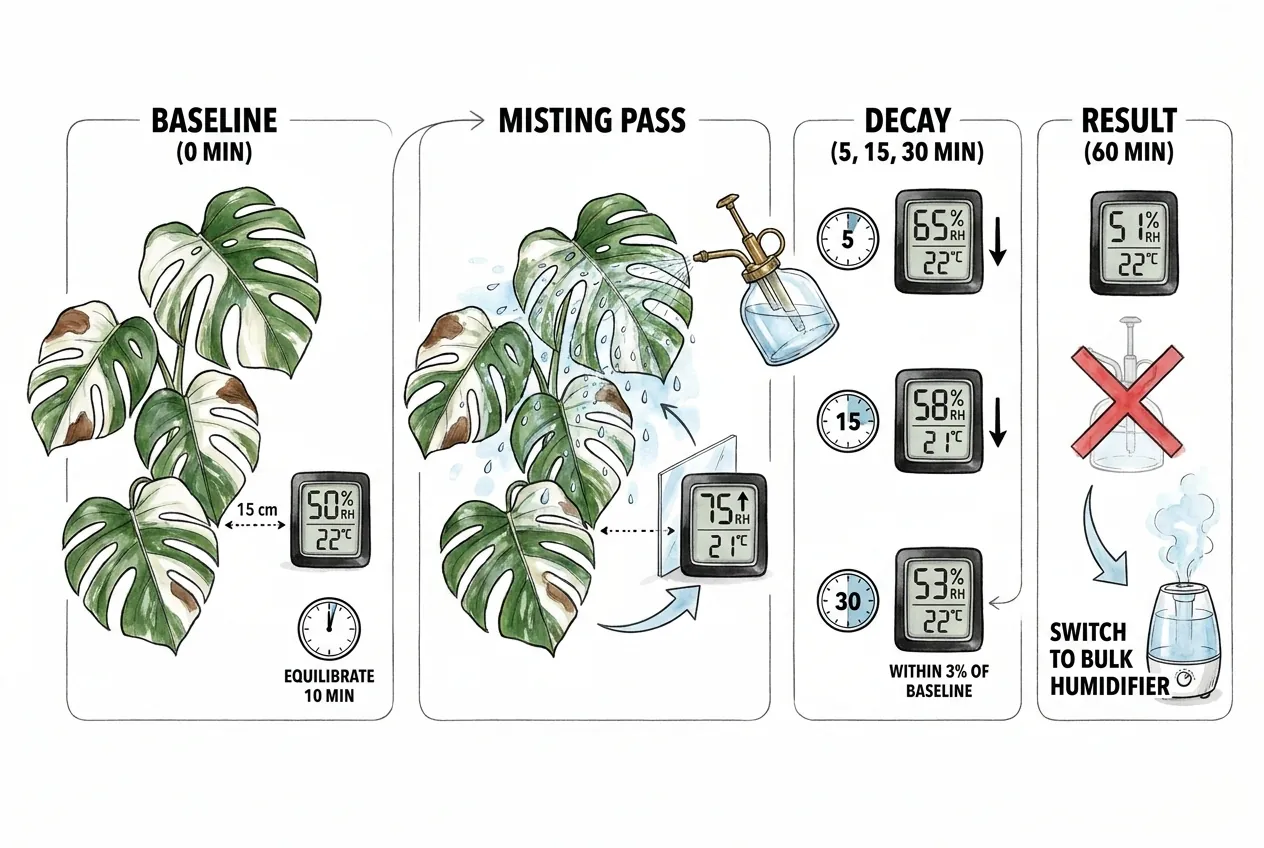
A hygrometer sitting next to a freshly sprayed plant often jumps dramatically for a few minutes.
That brief spike makes evaporative cooling easy to mistake for real humidity control. Before deciding whether misting helps in your room, I run a 60-minute canopy decay check under normal daytime conditions.
First, a digital thermo-hygrometer goes at leaf height 15 to 20 cm beside the Monstera ‘Albo’ without altering fans, doors, windows, or HVAC settings. After 10 minutes of equilibration, I record the pre-mist baseline.
Next, I make one normal misting pass over the foliage while shielding the sensor from direct spray, then log RH and temperature at 5, 15, 30, and 60 minutes.
Consumer hygrometers carry a typical tolerance of plus or minus 2 to 3 percentage points. As a conservative author rule chosen to exceed that noise, misting fails if canopy RH returns within 3 percentage points of baseline within 30 minutes.
When that happens, I stop foliar misting immediately and switch to bulk room or enclosed cabinet humidification instead.
Keep electronic sensors out of direct spray, and never trap the plant inside an unventilated plastic bag where stagnant 95%+ RH triggers soft rot.
Leaf Wetness Duration, Stomatal Bottlenecks, and Pathogen Entry
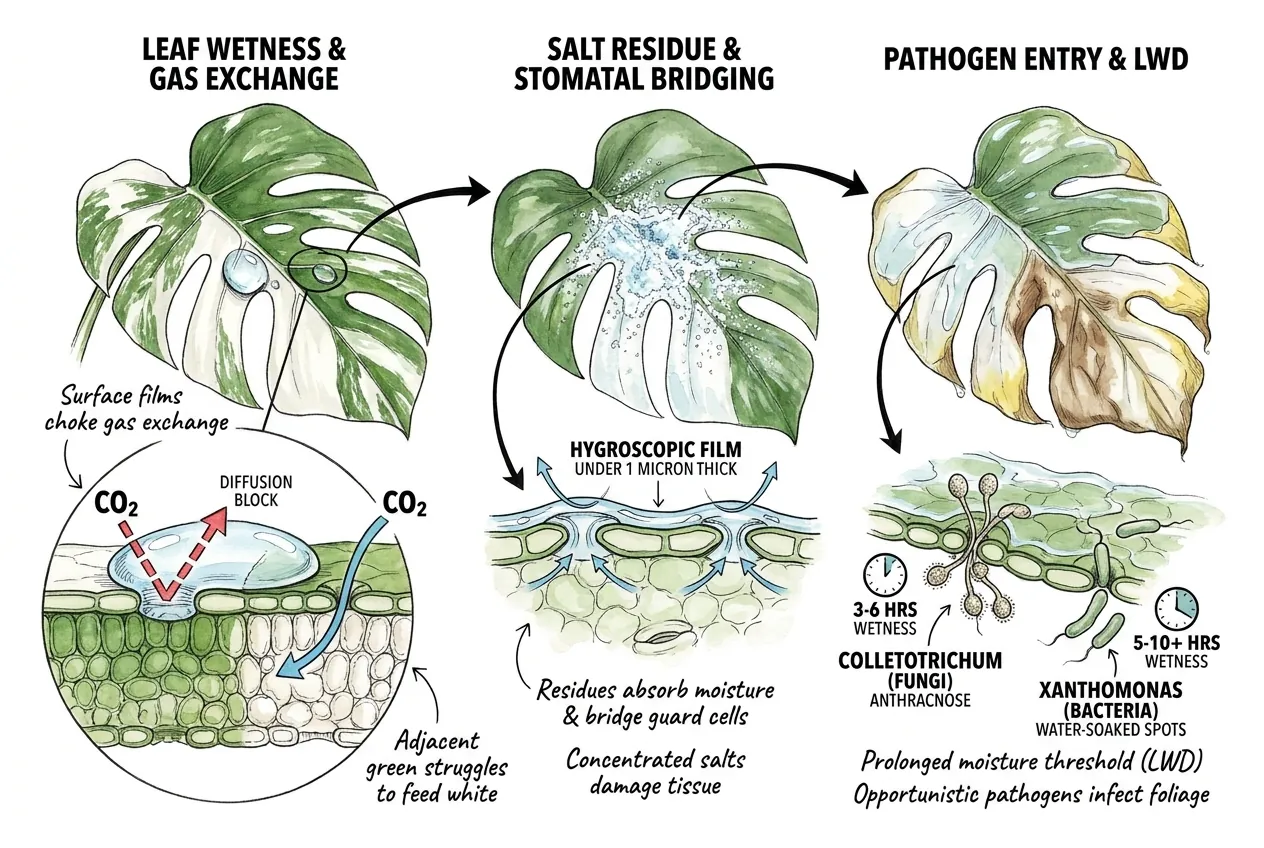
Liquid water sitting on a leaf is not harmless while it waits to evaporate. Because CO2 diffuses roughly 10,000 times slower in water than in air, surface films choke gas exchange. Adjacent green sectors then struggle to feed nearby white tissue.
As tap-water droplets evaporate, dissolved salts concentrate into hygroscopic residues. These residues absorb moisture below 100% RH and form microscopic liquid films under 1 micron thick that bridge stomatal guard cells.
Prolonged surface moisture also crosses the Leaf Wetness Duration (LWD) threshold that opportunistic pathogens need to infect Araceae foliage.
Fungal anthracnose (Colletotrichum species) needs at least 3 continuous hours of leaf wetness for conidial infection and over 6 hours for sporulation.
Bacterial Xanthomonas species need over 10 hours of wetness at 20°C, or 5 hours at 25°C to 35°C, to cause severe water-soaked spots.
Under cool, stagnant conditions where wet soil meets suppressed transpiration, excess internal pressure can also trigger edema blisters.
These roughly 1.6 mm (1/16 inch) blisters rupture into permanent brown corky scars.
Never mist Monstera ‘Albo’ foliage, because surface water blocks CO2 uptake, leaves mineral rings, and creates a 3-to-10-hour pathogen wetness window.
Calibrating Light, VPD, and Airflow Without Scorching White Margins
Once misting stops, slowing white-sector necrosis depends on balancing two atmospheric levers. Green sectors need enough diffused light to export surplus sucrose, while ambient humidity and gentle airflow must keep transpirational pull moderate without trapping surface moisture.
The Narrow Light Window for Variegated Monstera
Putting a Monstera ‘Albo’ in a dim corner to protect its white sectors backfires. The plant withdraws carbohydrate support from white sinks when total photosynthesis drops near its break-even point.
Controlled gas-exchange measurements across 12 tropical houseplants found light compensation points between 4 and 12 µmol m⁻² s⁻¹.
Non-variegated Monstera deliciosa saturated near 247 µmol m⁻² s⁻¹, while variegated ‘Thai Constellation’ saturated around 434 µmol m⁻² s⁻¹.
NC State Extension likewise advises that variegated cultivars need more sunlight than darker green cultivars, while still avoiding direct sunlight.
At the same time, white and chlorophyll-reduced aroid tissues cannot tolerate unfiltered sun or hot grow lights.
In variegated Epipremnum aureum, chlorophyll-reduced ‘Neon’ leaves showed roughly 55% lower Rubisco carboxylation and electron transport capacity than green ‘Jade’ leaves.
They also exhibited modest non-photochemical quenching (NPQ) and warmer canopies. Because white sectors carry lower ascorbate antioxidant reserves and elevated baseline oxidative-stress signaling, abrupt radiant heat scorches white edges first.
Peer-reviewed light-response curves specifically for Monstera ‘Albo’ are not yet published. Extrapolating from ‘Thai Constellation’ saturation and aroid photoprotection limits supports a conservative target of 120 to 250 µmol m⁻² s⁻¹ of diffused PPFD. Aim for 10 to 12 hours per day.
Step light intensity up gradually over 3 to 4 weeks when moving a plant from a dim room to a brighter window or LED timer.
Keep room temperatures within the 60°F to 85°F window recommended for Monstera deliciosa.
Managing VPD Stability and Gentle Airflow
Relative humidity alone can mislead indoor growers because warm air holds far more water vapor than cool air.
Controlled-environment guidelines establish 0.8 to 1.0 kPa as the optimum VPD range for most greenhouse crops (typically 50% to 80% RH).
VPD directly measures the drying force pulling water out of stomata. Rapidly swinging VPD harms plants more than steady moderate air. Alternating between 1.63 kPa and 0.63 kPa progressively depressed stomatal conductance and CO2 assimilation in controlled trials, whereas moderate fluctuations caused no decline.
Heating-season drops are especially hard on leaf edges because warming indoor air without adding moisture crashes RH and drops leaf water potential rapidly.
In closed plant-factory trials, lowering canopy RH from 90% to 70% triggered marginal leaf burn in 18.52% to 28.89% of seedlings. Control plants held at 90% RH showed 0% burn.
Gentle indirect air circulation under 0.2 m s⁻¹ thins the stagnant leaf boundary layer and can boost diurnal photosynthesis by 10% to 20%.
Direct fan or HVAC drafts strip that buffer and desiccate white margins.
| Humidification Method | Droplet or Vapor Behavior | Effect on 24-Hour VPD | Leaf Wetness Risk |
|---|---|---|---|
| Hand misting | Coarse droplets (>50 microns) settle on leaves | Negligible change after rapid evaporation | High (creates 3 to 10+ hour pathogen window) |
| Room humidifier | Vaporizes into bulk room air continuously | Lowers VPD for hours when sized to room | Low if positioned away from direct plume |
| Enclosed cabinet | Traps transpired vapor in low-ACH space | Holds steady 0.8 to 0.9 kPa with controller | Low when paired with gentle (<0.2 m s⁻¹) fan |
Steady moderate VPD with gentle indirect airflow protects white margins far better than high-peak humidity swings or direct misting.
Root-Zone Hydraulics, Salt Accumulation, and Substrate Aging
Even with ideal light and ambient VPD, white margins brown if the root zone cannot supply water steadily.
Overloading the transpiration stream with dissolved salts causes the same collapse. Both soggy, oxygen-starved mixes and dry, salt-concentrated substrates produce nearly identical marginal necrosis.
Hypoxic Roots and Organic Mix Breakdown
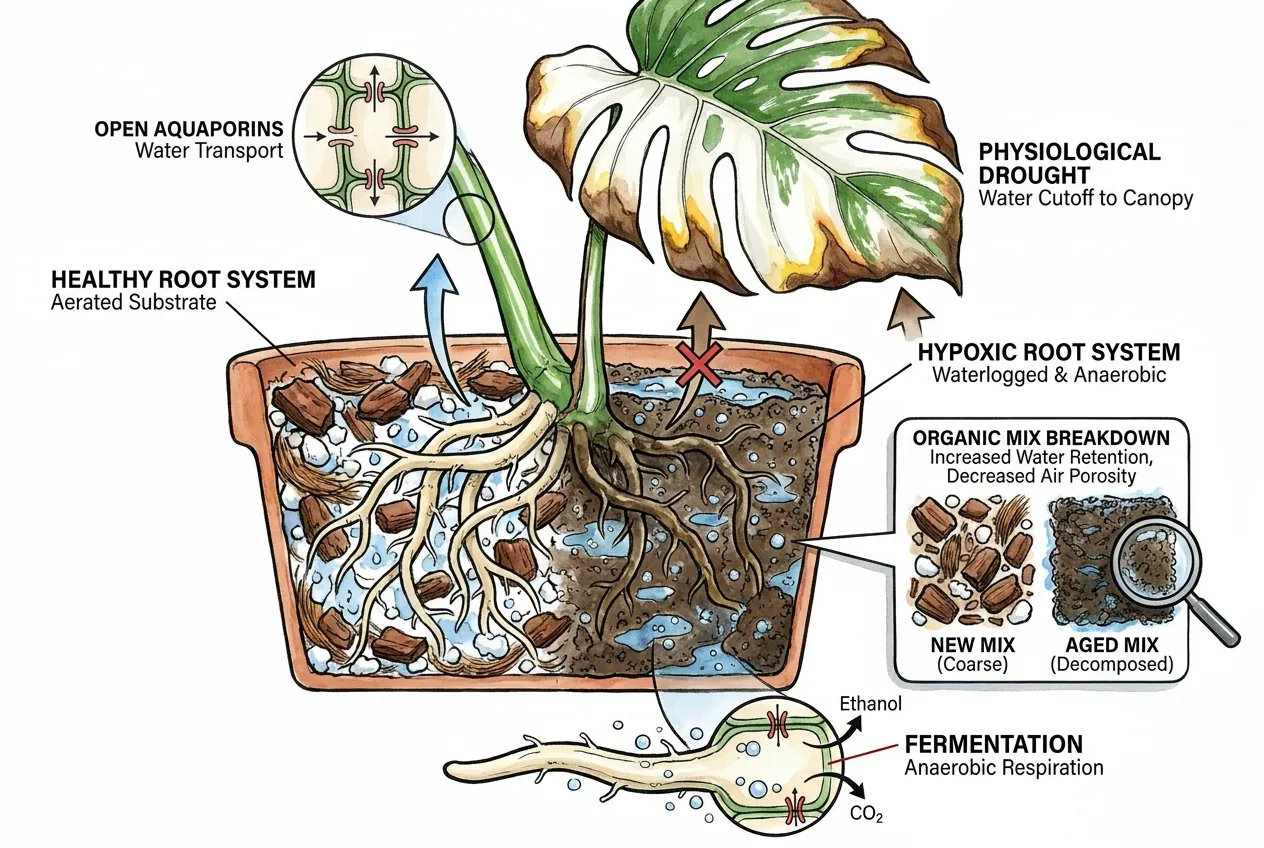
Roots require dissolved oxygen for aerobic respiration to power water transport. When water fills every substrate pore, oxygen diffusion drops and the root zone turns anaerobic within hours to a few days.
Cells shift into fermentation, consuming roughly 15 times more glucose per unit of ATP.
Simultaneously, root hypoxia downregulates and gates plasma-membrane aquaporin water channels, cutting root hydraulic conductance so the canopy experiences physiological drought in a wet pot.
Leaving a pot in runoff water for over 60 minutes risks root rot. Even careful waterers also get caught by substrate aging.
In physical-property testing of coir dust, aging increased water retention capacity from 59.6% to 71.1% while shrinking air-filled porosity from 30.1% down to 18.9%.
Coarse pine bark preserves essential macropore aeration, though NC State Extension notes that it resists re-wetting if allowed to dry completely. Refreshing degraded organic mixes periodically keeps hydraulic delivery consistent.
Fertilizer Salt Burn and Fluoride Sensitivity
Soluble fertilizer salts, softened-water sodium, and dissolved fluoride travel passively up the xylem transpiration stream and concentrate where water evaporates at leaf tips and margins. Salinity stress acts in two phases.
An immediate osmotic phase occurs when concentrated pore salts pull water away from roots. An ionic phase follows as accumulated ions kill marginal cells. University of Georgia Extension notes that over-fertilization leaves a whitish crust on the topsoil or pot rim alongside marginal and tip burn.
Fluoride presents a similar risk for aroids such as peace lily (Spathiphyllum) and variegated Monstera. NC State Extension warns that perlite contains fluoride that can injure sensitive indoor plants.
University of Missouri IPM advises leaching containers thoroughly and discarding drainage water rather than letting pots sit in runoff.
Using low-dose fertilizer only during active growth and switching to rainwater, distilled water, or reverse-osmosis water prevents marginal salt and fluoride accumulation.
Both hypoxic overwatering and un-leached salts starve white margins of water, so check substrate moisture and pot-rim crust before changing watering frequency.
What Silica Supplementation Can and Cannot Do
Soluble silicon supplements are widely marketed to prevent browning on variegated aroids, but plant physiology shows strict limits on what silica can achieve.
Silica is a modest preventative support for developing, living tissue and never a cure for already-browned cells.
Why Aroids Absorb Silicon Passively
Phylogenetic meta-analysis by Hodson et al. proves that high silicon accumulation concentrates in commelinid monocots like grasses (Poales) and palms (Arecales). It is not universal across all monocots.
As non-commelinid monocots, Monstera species belong to the order Alismatales and family Araceae. They lack the specialized grass-type active influx (Lsi1) and efflux (Lsi2) systems that load up to 10% shoot silicon in rice.
Instead, aroids rely primarily on passive, transpiration-driven uptake of uncharged monosilicic acid.
Once absorbed, monosilicic acid polymerizes in epidermal cell walls and beneath the cuticle. This reinforces physical barriers and primes antioxidant and pathogen-defense pathways. In hydroponic barley trials, adding 0.5 mM potassium silicate reduced dry senescent leaves compared with 0 mM controls.
Ornamental rose trials likewise evaluate root-zone silicon for post-harvest water retention and Botrytis resistance. Because uptake depends on active transpiration and polymerization is irreversible, silica cannot re-whiten or rescue dead brown margins.
Safe Mixing Order and pH Chemistry
Both alkaline potassium silicate and acid-stabilized monosilicic acid convert into the same plant-available monosilicic acid once diluted into root-safe water.
Below 20 ppm elemental silicon, monosilicic acid remains stable in solution for at least 5 weeks without polymerizing into insoluble gels.
To check bottle labels, multiply percent monosilicic acid by 0.2922 or percent SiO2 by 0.4674 to find elemental silicon concentration.
Never pour potassium silicate concentrate directly into acidic fertilizers or calcium concentrates. High local pH precipitates insoluble calcium silicate and strips nutrients out of solution. Follow a strict root-drench mixing sequence so foliage stays dry and roots avoid pH shock.
- Fill the watering vessel with plain water first.
- Add potassium silicate and stir thoroughly until completely dispersed.
- Add base nutrients and calcium concentrates separately.
- Measure and adjust final solution pH downward into a root-safe aroid range before watering.
Apply soluble silicon strictly as a properly diluted root drench for healthy new growth, never as a foliar spray on fragile white tissue.
Diagnosing the Cause and Confirming When Browning Has Stopped
Because dead white cells turn brown regardless of the trigger, treating the wrong cause often compounds the injury.
Separating abiotic stress, active pathogen lesions, and root-zone failure requires inspecting the advancing border and checking the substrate before changing care.
Visual and Tactile Diagnostic Map
Holding the leaf up to a bright indirect light source reveals border cues that are hard to see from above.
University of Missouri IPM notes that abiotic disorders show a sharply reduced or absent yellow transition zone along leaf tips and margins.
NC State Extension notes that bacterial spots from Xanthomonas or Pseudomonas begin as water-soaked, greasy lesions visible on undersides first, peaking above 80°F (26.7°C).
Fungal anthracnose (including Colletotrichum monsterae isolated from Monstera deliciosa) forms sunken spots that cross leaf veins with dark borders or concentric rings.
Because white sectors already lack chlorophyll, a yellow chlorotic halo is harder to spot on pure white tissue than on green lamina. Backlit water-soaked translucency is a more reliable indicator of infection.
Sunscald differs by appearing strictly on upper leaf surfaces angled toward a window or hot LED.
White sectors there face roughly twofold higher photosynthetic excitation pressure. Meanwhile, root hypoxia pairs marginal browning with soggy mix and generalized green-leaf yellowing, while soluble-salt burn pairs tip browning with white pot-rim crust.
| Diagnostic Pattern | Primary Location | Border and Halo | Root Check Needed | Immediate Action |
|---|---|---|---|---|
| Low-light or dry-air senescence | White margins and oldest white sectors | Crisp, abrupt edge with little or no halo | Only if mix stays wet | Raise diffused PPFD and stabilize ambient VPD |
| Bacterial spot (Xanthomonas or Pseudomonas) | Scattered mid-blade or vein-bounded spots | Translucent water-soaked rim when backlit | No | Stop misting, blot dry, increase gentle airflow |
| Fungal anthracnose (Colletotrichum) | Tips, margins, or cross-vein spots | Sunken center with dark border or rings | No | Stop leaf wetting, isolate plant, sanitize shears |
| Soluble-salt or fluoride burn | Tips and margins of both green and white | Sharp necrotic edge with pot-rim crust | Leach mix first | Flush with 3 to 4 times pot volume low-mineral water |
| Root hypoxia or root rot | White margins plus green-leaf yellowing | Irregular spreading edge in damp, heavy pot | Yes, immediately | Trim mushy dark roots and repot in airy aroid mix |
| Sunscald or light scorch | Upper leaf surface facing window or LED | Bleached tan patch matching light angle | No | Pull back from direct sun or add sheer diffusion |
Tracking the Brown-to-White Border Over 21 Days
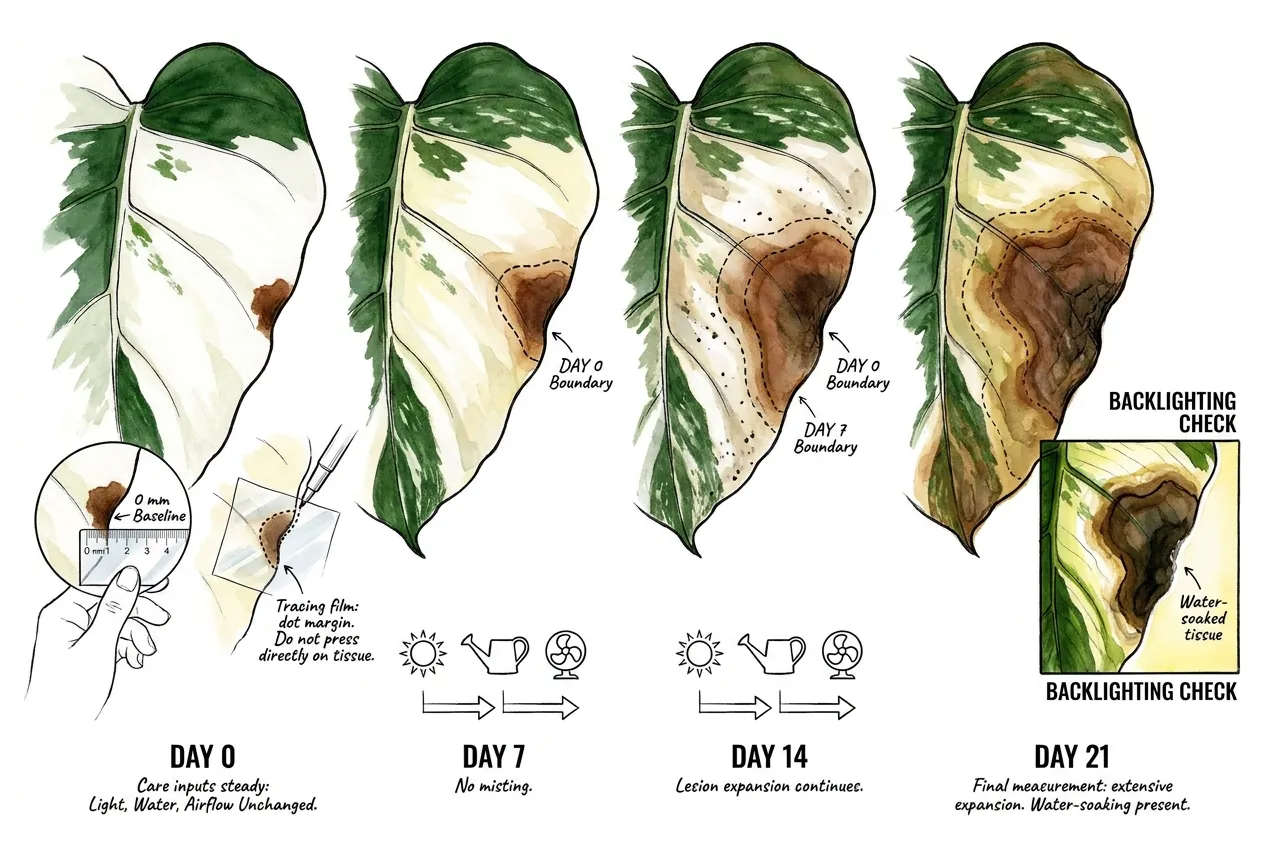
Dead white tissue cannot re-green, so a healed, stabilized scar looks identical on a single glance to an actively expanding problem.
To avoid stacking unnecessary repotting, flushing, and pruning on a recovering plant, I track one affected border over 21 days. During that window, I hold care inputs steady.
On Day 0, I hold a millimeter ruler flush beside the brown-to-white boundary for a fixed-angle, fixed-distance photo.
Alternatively, clear removable tracing film laid gently over the sector lets me dot the margin. Never press a pen, marker, or ruler edge directly onto thin white mesophyll, because puncturing the epidermis opens the tissue to secondary infection.
After stopping any misting, I keep light position, watering routine, and airflow unchanged. I then re-measure the same reference point at Day 7, Day 14, and Day 21 while backlighting the edge to check for water-soaking.
Pathology studies separate lesion formation from quantitative lesion expansion in millimeters per day, though extension guides set no universal millimeter cutoff for home Monstera monitoring.
I apply conservative author thresholds chosen to exceed normal photo and ruler measurement noise (~0.5 mm).
If the margin advances under 1 mm over 14 days without a water-soaked rim or yellow halo, necrosis has stabilized and needs no emergency changes.
If it expands 2 mm or more per week or develops a dark, translucent rim, I halt leaf wetting immediately and inspect root moisture, drainage, or substrate EC.
Never stack multiple emergency treatments on a single-day glance, because only a 14-to-21-day border check proves whether necrosis is still advancing.
Safe Trimming, All-White Shoots, and When to Upgrade Your Setup
Once you confirm that browning has stabilized, trimming becomes purely cosmetic, and persistent ambient failures signal when open-room adjustments have reached their physical limit.
Trimming Dead Margins Without Triggering New Browning
Slicing through living white cells to create a clean edge almost always triggers a fresh brown ring within days.
Mechanical cutting ruptures cellular compartments, letting polyphenol oxidase (PPO) enzymes oxidize phenolics into brown melanin pigments.
Wound-induced LsPPO gene upregulation confirms this response in cut leaf tissue.
Damaged cells also release damage-associated molecular patterns (DAMPs) that trigger calcium, reactive oxygen species (ROS), and jasmonic acid signaling. This cascade seals exposed, un-cutinized mesophyll with callose, lignin, and suberin.
Wait until the 14-day border check confirms stasis before trimming. First wipe sap and debris off your shears, then sanitize blades with undiluted 70% isopropyl alcohol or a 10% household bleach solution.
Cut strictly within the dead papery zone, leaving a 1 to 2 mm dry brown buffer intact so living white cells remain sealed.
Remove an entire leaf only if it is mostly necrotic, shows wet bacterial lesions, or belongs to three consecutive 100% white leaves.
When pure-white shoots persist, prune back to a lower node with balanced green-and-white stem striping to reset the growth point.
When Open-Room Tweaks Hit Their Physical Limit
In forced-air heated or air-conditioned homes, Colorado State University Extension notes indoor relative humidity frequently drops below 10% RH.
That sits far beneath the 70% to 90% RH native to tropical foliage plants.
Washington State University Extension similarly emphasizes that marginal necrosis persists whenever leaf water delivery falls short.
Drought, salt buildup, root rot, or dry heat all trigger that bottleneck.
When room humidifiers and plant grouping cannot hold canopy humidity steady during winter, an enclosed glass cabinet helps.
Managing it at 0.8 to 0.9 kPa VPD removes the open-room air-exchange bottleneck without wetting leaves.
You can evaluate enclosed humidity hardware using the Plant Cabinet Humidity Control Kit Product Chooser.
If repeated organic-mix compaction or wet-to-dry swings keep triggering root hypoxia and marginal burn, inert expanded clay offers another durable option.
You can compare setups in the LECA Conversion Product Chooser for Aroids in Semi-Hydro.
Trimming must stay inside the dead 1-to-2-mm buffer, while persistent winter VPD or mix swings call for enclosed humidity control or semi-hydro stability.
Next Steps for Stabilizing Your Monstera Albo
Start by stopping all foliar misting and verifying your room’s real VPD decay with the 60-minute canopy hygrometer check.
Next, position the plant under diffused bright light so green sectors can fund white-tissue respiration. Check substrate moisture and pot-rim salt crust before adjusting watering.
Track one brown-to-white boundary for 14 to 21 days to confirm stabilization before trimming inside the 1 to 2 mm dead buffer.
Move to an enclosed cabinet or LECA setup only if your home cannot hold steady conditions.