
Aroid Leaf Drop in Heating Season: Dry Air or Cold Roots
Philodendron dropping leaves in heating season from dry air or cold roots? Read the leaf, take two readings, and match the fix without the watering trap.
Elena Vargas · Published 2026-10-11 · 14 min read
Key Takeaways
- Mid-season aroid leaf drop is usually dry air or cold roots, and they need opposite fixes.
- Brittle crisp edges on a firm blade mean dry air. A soft droop on damp soil means cold roots.
- Measure room humidity and root-zone temperature at the coldest part of the day to settle it.
- Never water a cold-root plant more. Warm the root zone and wait until the pot feels lighter.
- When both drivers flag, fix the root first, raise humidity second, change one thing at a time.
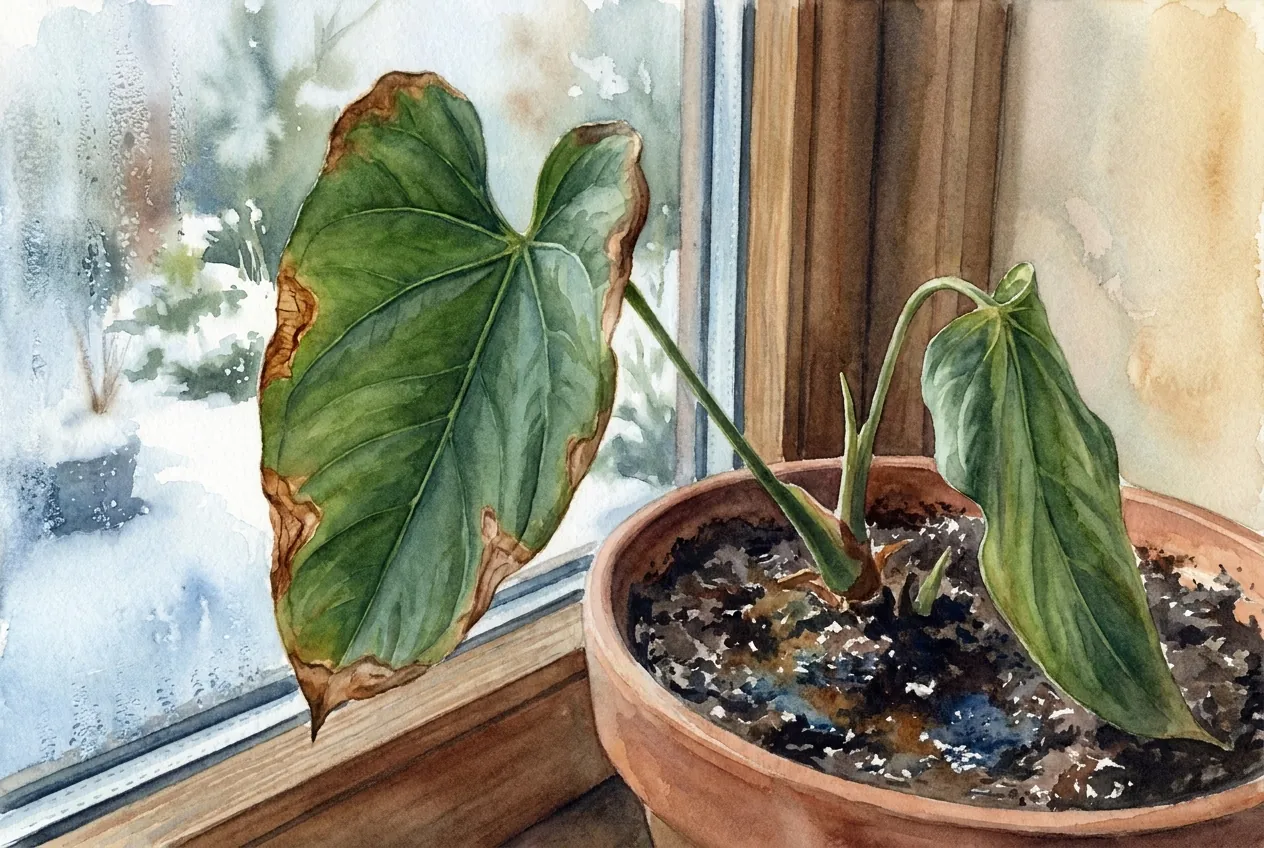
Your philodendron handled the first week of heating fine. Three weeks in, it is still shedding, and the usual advice to mist more has done nothing.
That is because leaf drop this far into the season almost always traces to one of two different problems that happen to look similar from across the room.
One is dry air pulling water out of the leaves faster than the roots can resend it.
The other is a cold root zone that has quietly stopped moving water at all. They need opposite fixes, and the fix for one makes the other worse.
This is a read-the-plant-then-measure problem, and two cheap readings settle most of it.
Why the leaf drop shows up weeks in, not on day one
Sustained leaf drop weeks after the furnace starts is the plant finally running out of buffer, not a fresh shock. The room did not change in one step. Heating dries the air and chills the floor and windows a little more each cold night, and the plant spends down its internal water reserves before it starts shedding.
A heated winter room runs much drier than the level most houseplants prefer, and the gap widens on cold nights when the furnace works hardest.
A plant can ride out that gap for a while by closing stomata and leaning on stored water.
When the shortfall persists, it drops older and lower leaves first to cut its water budget, which is why the loss arrives on a delay rather than overnight.
Cold roots work on a similar lag. Repeated cold cycles near an exterior wall or single pane progressively impair the root system until the plant can no longer keep up. The wilt or drop appears once the buffer is gone.
The delay is the tell that you are looking at a sustained seasonal driver, not a one-off cold draft or a single dry afternoon.
The two drivers are physically different problems
Before you fix anything, understand that dry air and cold roots fail the plant at opposite ends of its plumbing. One is a loss problem at the leaf. The other is a delivery problem at the root.
Dry-air transpiration stress works at the leaf
Dry heated air raises the vapor pressure deficit, which is the pull that drags water vapor out of the leaf.
Vapor pressure deficit is the gap between how much water the air could hold at its current temperature and how much it actually holds.
Warm the same winter air and it could hold far more moisture, so the deficit climbs and the leaf loses water faster.
For most plants the comfortable vapor pressure deficit band is about 0.8 to 1.2 kilopascals, which corresponds to a moderately humid room rather than a dry one.
A heated winter room pushes the deficit above that band. When the leaf loses water faster than the roots resupply it, the tissue farthest from the veins dies first, so margins and tips crisp and curl.
Crispy brittle leaf edges on a blade that is still otherwise firm are the fingerprint of dry-air loss, because that tissue has already finished drying out.
Cold-root shutdown works at the root
A cold root zone stops the plant from moving water even when the soil is soaking wet. Low root temperature does two things at once.
It thickens water slightly. Far more importantly, it drives the water channels in the root membranes, the aquaporins, to close, so the root loses most of its ability to pull water inward.
Below about 15 degrees Celsius the resistance to water crossing the root tissue climbs steeply. For chilling-sensitive tropical aroids the sharp drop in uptake shows up as the root zone slides toward the low teens Celsius.
The plant then wilts from the top down while sitting in damp soil, because the water is right there but the roots cannot take it up.
A soft, cool, whole-leaf droop on soil that is still wet from the last watering points to cold roots, not thirst.
Read the leaf signature before you measure anything
Start with the plant itself, because the leaf often tells you which driver dominates before you reach for a tool.
The trick is to read the right leaf at the right time and to use touch, not just sight.
Each morning before the furnace cycle peaks, I check the newest fully hardened leaf. For a reference I compare it against a leaf of the same age on a plant sitting in a warmer or more humid spot.
A fingertip run along the margin and tip tells me whether the edge is brittle or still pliable.
Then I press the blade flat against the back of my hand to feel its firmness and temperature.
A brittle crisp margin on a blade that is still firm reads as dry air. A soft cool blade with no brittle edge, sitting on soil that is still damp, reads as cold roots.
Why the newest hardened leaf and not the oldest? The youngest soft leaf and the oldest dying leaf both mislead you, one because it is still expanding and one because it is being shed on schedule. The newest mature leaf reflects current conditions most honestly.
Where the leaf signature is reliable and where it is not
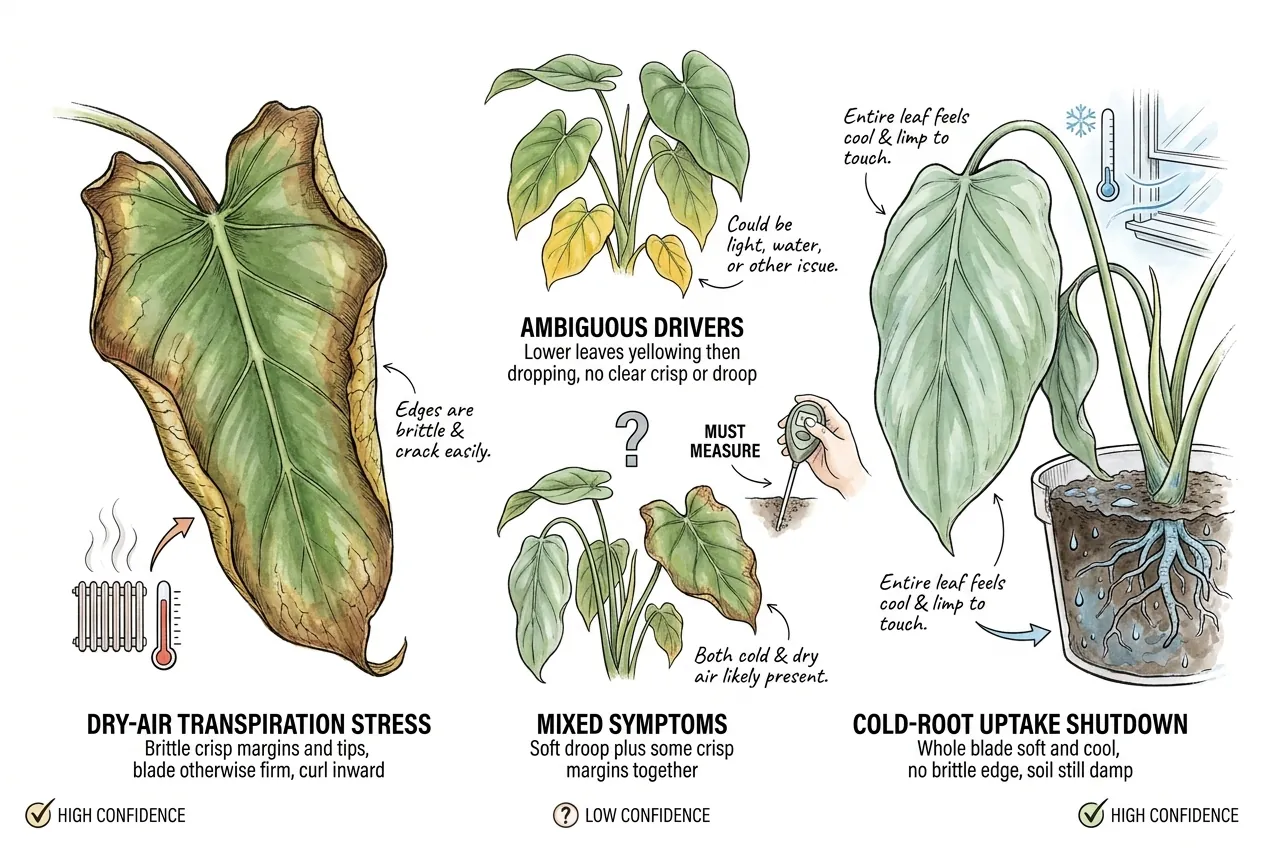
The clear cases are the two extremes, and the trap is the middle. Use this quick map, then confirm anything ambiguous with a measurement.
| What you see and feel | Likely driver | Confidence |
|---|---|---|
| Brittle crisp margins and tips, blade otherwise firm, curl inward | Dry-air transpiration stress | High |
| Whole blade soft and cool, no brittle edge, soil still damp | Cold-root uptake shutdown | High |
| Lower leaves yellowing then dropping, no clear crisp or droop | Either driver, or seasonal light drop | Low, must measure |
| Soft droop plus some crisp margins together | Both drivers likely present | Low, must measure |
Lower-leaf yellowing is the honest draw. It can come from mild chronic dry air, mild chronic cold roots, or simply a plant shedding leaves it can no longer light-fund in a dim winter. When the leaf signature is ambiguous, stop guessing and take the two readings below.
The two measurements that settle it
Two cheap readings resolve almost every ambiguous case. One is room relative humidity read against the comfortable band. The other is root-zone temperature, which almost nobody measures and which is exactly where cold-floor and windowsill plants fail.
I take both readings at the coldest part of the daily cycle, usually overnight into early morning, rather than at midday when the furnace and daylight have masked the low.
For humidity I place a hygrometer at plant height, away from heating vents and away from any humidifier plume.
A reading next to a vent does not describe the air the leaves actually sit in.
For the root zone I push a probe thermometer to mid-pot depth on the side facing the cold floor or the cold glass.
I let it settle and read it there, since that near-surface side is the coldest part of the pot.
Then I compare. If the root zone is running several degrees below the room air at the cold part of the cycle, that flags cold-root risk.
If the room relative humidity sits below roughly 40 percent at plant height, or the vapor pressure deficit holds above the comfortable band, that flags dry-air risk.
The within-plant gap is my working rule rather than a single published cutoff, because the exact critical temperature varies by species.
I trust the gap between root and room more than any one absolute number.
How to make each reading trustworthy
A reading taken in the wrong place or at the wrong time will send you after the wrong fix. The specifics matter more than the instrument.
| Reading | Where | When | Flag threshold |
|---|---|---|---|
| Relative humidity | Plant height, away from vents and humidifier plume | Coldest part of the daily cycle | Below about 40 percent, or VPD above the comfortable band |
| Root-zone temperature | Mid-pot depth, side facing cold floor or glass | Coldest part of the daily cycle | Several degrees below room air, drifting into the low teens Celsius |
If both readings flag at once, treat the cold root first, because a watering mistake on cold roots does fast damage while a humidity shortfall does slow damage.
To pick a hygrometer and a reliable way to watch humidity and temperature together, the humidity decision is laid out in the plant cabinet humidity control kit chooser.
The target-holding side of it is covered in the plant cabinet VPD chooser.
Match the fix to the driver, and avoid the one move that backfires
Each driver has its own fix, and the fastest way to kill a struggling plant is to apply the wrong one. Dry air calls for more moisture in the air. Cold roots call for warmth and less water, not more.
Fix dry air by raising humidity at plant height
Raise the humidity the leaves actually sit in, and keep the air gently moving so it does not go stagnant.
A room humidifier raises ambient humidity the most of any method, so it is the first move in a dry room.
Grouping plants creates a shared transpiration microclimate and adds only a small local bump, which works best with several plants in a smaller, low-airflow room.
A pebble tray gives only a small gain right at the water surface, so it helps but does not rescue a dry room on its own.
Pair any humidity increase with light continuous airflow. Raised humidity in still air invites fungal problems on leaves and substrate, so a quiet fan matters as much as the moisture.
Reach for a humidifier first and treat grouping and trays as support, not as the main lever.
Fix cold roots by breaking the cold path, not by watering more
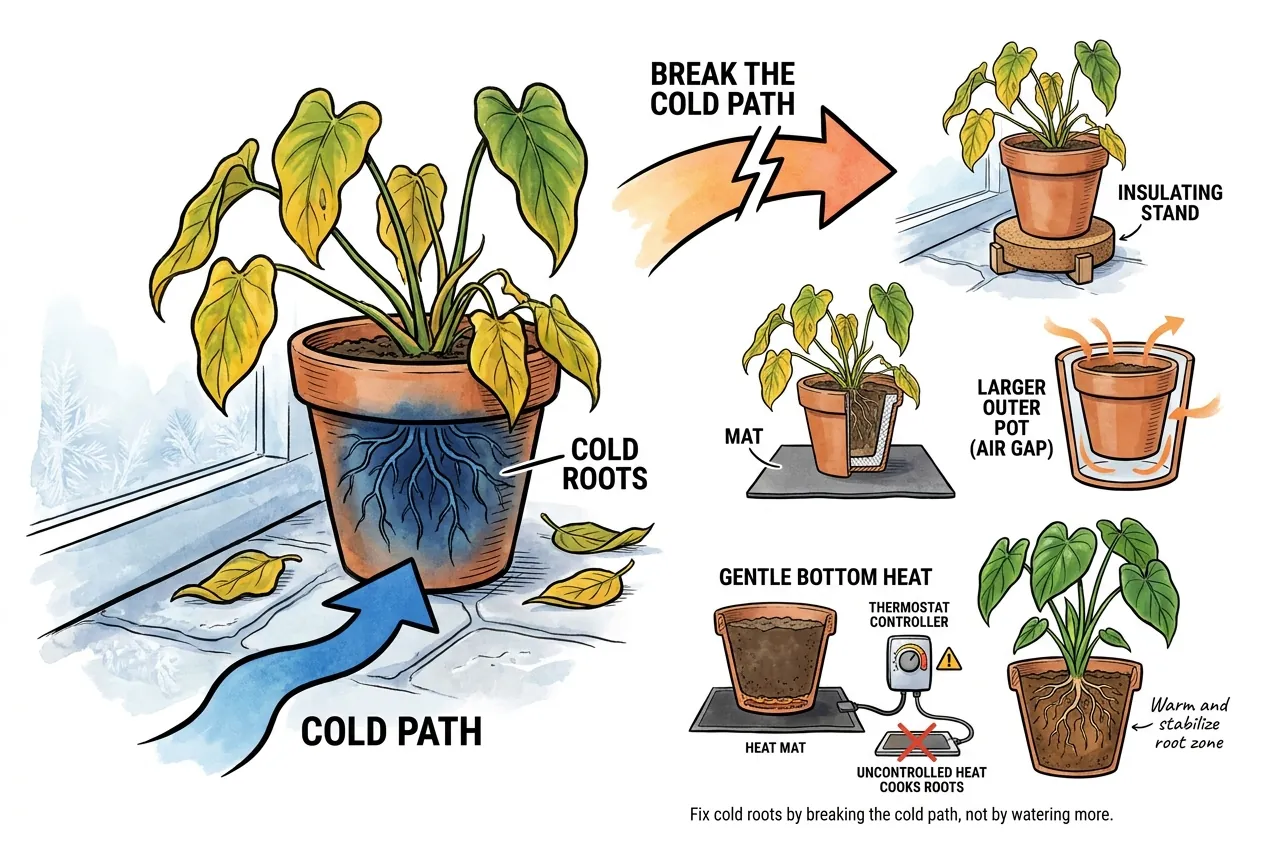
Warm and stabilize the root zone, then cut back watering until the roots can drink again. The cheapest, safest win is to break the cold conduction path.
Lift the pot off the cold floor onto an insulating stand or mat, move it off the cold windowsill into the room, and block the draft.
A larger pot or an outer pot with an air gap slows the overnight temperature swing at the roots.
Gentle controlled bottom heat is an option when relocation is not enough, but it must be controlled by a thermostat.
Uncontrolled bottom heat can cook roots or dry the substrate unevenly, so a controller is not optional here.
When relocation and insulation are not enough, the heat-mat-and-thermostat decision is covered in the heat mat and thermostat chooser.
If a warmer, better-draining mix is part of the fix, the aroid potting mix chooser handles that choice.
The watering trap that kills cold-root plants
Do not water a cold-root plant more because its droop looks like thirst. Cold roots cannot move standing water, so the extra water just sits in the substrate, drives out oxygen, and raises rot risk while the droop continues unchanged. The limp blade is an uptake failure, not a water shortage.
When the root zone reads cold, I judge watering by pot weight and finger-depth moisture, not by how the leaves look.
To decide, I lift the pot to feel its weight and probe two knuckles deep. I hold off watering while the pot still feels heavy and the probe comes up damp, even if the leaves look limp.
A normal watering rhythm resumes only after the root zone has warmed back into its comfort band.
That warm-back-first sequence is my own conservative rule rather than a published standard. I use it because a cold root simply cannot process the water a worried owner keeps adding.
A limp cold-root plant on damp soil needs warmth and patience, never another drink.
When both drivers hit at once, or neither one is obvious
Winter rooms are often dry and cold at the floor at the same time, so both drivers can run together.
When both your readings flag, sequence the repair rather than changing everything at once.
Warm and insulate the root zone and hold off watering first. Confirm the plant is drinking again by watching the pot return to its normal drinking weight, then raise humidity toward the comfortable band.
Changing both variables together makes it impossible to tell which fix actually helped.
A few ordinary things mimic these two drivers and deserve a quick rule-out before you blame the heater.
A recent repot causes its own temporary drop, so date it and set it aside.
Spider mites and thrips surge in dry heated air and cause stippling and leaf loss that overlaps the dry-air signature, so inspect the leaf undersides.
The pest side of the season is covered in the heating-season spider mite and thrips guide.
Shorter, weaker winter days also shrink the light budget, and a plant will shed leaves it can no longer support regardless of humidity or root temperature.
If your real question is wet-versus-dry collapse at the onset rather than sustained mid-season drop, the philodendron leaf rot wet-versus-dry breakdown separates those two failure modes.
When both drivers flag, fix the root zone first and the air second, and change only one variable at a time so the plant can tell you what worked.
What recovery looks like and when to stop worrying
Recovery shows up first as the shedding slowing down, not as a flush of new leaves.
Once you correct the right driver, the plant stops dropping to conserve water before it ever invests in new growth.
In low winter light new leaves may be slow or paused entirely.
Judge success by the newest leaves holding firm and by the absence of fresh crisping or fresh droop, not by old damage reversing.
Damaged tissue does not come back. A crisped margin is dead and will not re-green, and a leaf that fully yellowed and dropped is gone, so remove spent leaves and watch the new ones instead.
Winter is a holding pattern rather than a growth season. A stable plant keeps its canopy, drinks on a slower but steady schedule, and shows no new edge crisping or cold droop.
Consider the plant stabilized when three things hold at the cold part of the daily cycle.
The root zone sits in its comfort band and within a few degrees of room air.
The humidity holds near or above the low end of the comfortable band, and no new leaf has crisped or drooped across a full week of readings.
Once a full week passes with no new damage and steady readings, step back to normal monitoring and stop chasing individual old leaves.
If the onset phase is what you are actually chasing, the week-one version of this problem is explained in why aroids stop drinking when the heat turns on.
Holding a cabinet through the humidity cliff is covered in plant cabinet humidity cliff in heating season.
Key Takeaways
- Mid-season aroid leaf drop is usually dry air or cold roots, and the two need opposite fixes.
- Brittle crisp edges on a firm blade mean dry air. A soft cool droop on damp soil means cold roots.
- Measure room humidity and root-zone temperature at the coldest part of the day to settle ambiguous cases.
- Never water a cold-root plant more. Warm the root zone and hold off until the pot lightens.
- When both drivers flag, fix the root first, raise humidity second, and change one variable at a time.