
Variegated Aroid Reversion Product Chooser
A variegated aroid reversion product chooser: measure the light first, add a grow light only if a spot is genuinely too dim, cut reverted canes back to variegated tissue, and feed lightly. No product reverses reversion.
Jordan Cole · Published 2026-07-27 · 25 min read

Key Takeaways
- For chimeral variegation, once a shoot’s growing point is solidly green with no variegated tissue left, no product regrows the white on that shoot.
- Measure the light at the plant before buying anything. A budget lux meter is a cheap way to compare spots, though it reports a trend, not an exact photon count.
- A grow light supports plant health where a spot is genuinely too dim. It does not restore tissue already lost to an all-green tip.
- If a cane has gone fully green, cut it back with a clean, sharp tool to a stem point below a node that still shows variegation. The new bud may or may not be variegated.
- Feed a complete balanced fertilizer lightly to avoid deficiency. Do not expect fertilizer to prevent or reverse reversion.
Your variegated Monstera just pushed another all-green leaf, and the urge to buy something is strong.
Before you spend, it helps to know what a product can and cannot do. Nothing repaints white variegation onto tissue that has already gone solid green.
No product can restore variegation to tissue that has turned solid green. Spend money only where a measurement or clear need supports it. The precise reasons and speed of reversion vary by cultivar, so use risk factors as practical guidance rather than a guarantee.
What should I measure and buy to stop my aroid reverting?
Start With a Measurement
Measure the light first, then buy only what the reading and the plant show you need. You are managing the plant and supporting its health, not reversing tissue that has already turned green.
Once a shoot’s growing point is solidly green with no variegated tissue left on it, new leaves from that tip will be green.
The four-role shortlist is short on purpose. A light meter helps you judge the spot. Add a full-spectrum grow light only if the meter shows it is genuinely too dim.
Use a clean, sharp cutting tool with 70% isopropyl to remove reverted growth back to a node that still shows variegation, and a complete balanced fertilizer dosed lightly.
If you already own suitable tools, you may not need to buy new ones at all.
Adequate light supports the plant’s overall health and carbon balance. The cutting tool and feed are cleanup and routine care.
A light meter is inexpensive and worth starting with, because it tells you whether the spot is even in a reasonable range before you spend on a fixture.
I number each recent node on a full-stem photo and write the leaf-level meter reading and unit beside it. This keeps the variegation sequence, stem sector, and actual light history together instead of comparing a top-leaf reading with an older shaded node.
After any light or pruning change, I add the new shoot to the same image rather than starting a fresh gallery. The overlay shows whether a supposedly corrected setup reached the bud that actually activated.
Why can reverted tissue not be restored, and why does light matter?
Collector variegation in Monstera ‘Albo’, Philodendron Pink Princess, and Syngonium ‘Albo’ is usually described horticulturally as chimeral, meaning the plant carries more than one cell line in its shoot tip.
When solid-green tissue takes over a shoot’s growing point and no variegated tissue remains on it, that shoot stays green. A grow light does not bring the pattern back on that tip.
In a periclinal chimera, the shoot tip is built from stacked, genetically distinct cell layers, with one layer differing from those around it.
In dicot models such as the tomato graft chimera studied in the reference below, the shoot apex is described as three histogenic layers (L1 forming the epidermis, L2 the sub-epidermal layer and gametes, and L3 the inner tissue and vascular system).
That layered picture is general background. Aroids are monocots and their shoot-tip organization is not identical, and the exact affected layer, tissue, and underlying mutation have not been documented the same way for each of these three cultivars.
The color also differs (Albo shows white or cream sectors, while Pink Princess pink involves pigment chemistry as well as chlorophyll) so a single chlorophyll-free-layer description does not cleanly cover all three.
Because a chimeral pattern is carried in specific cell lines rather than blended, it generally does not come true from seed, so growers propagate vegetatively from a shoot that still shows variegation.
Even then, a node that looks variegated does not guarantee the bud at it carries the variegated cell line.
Why green tissue wins
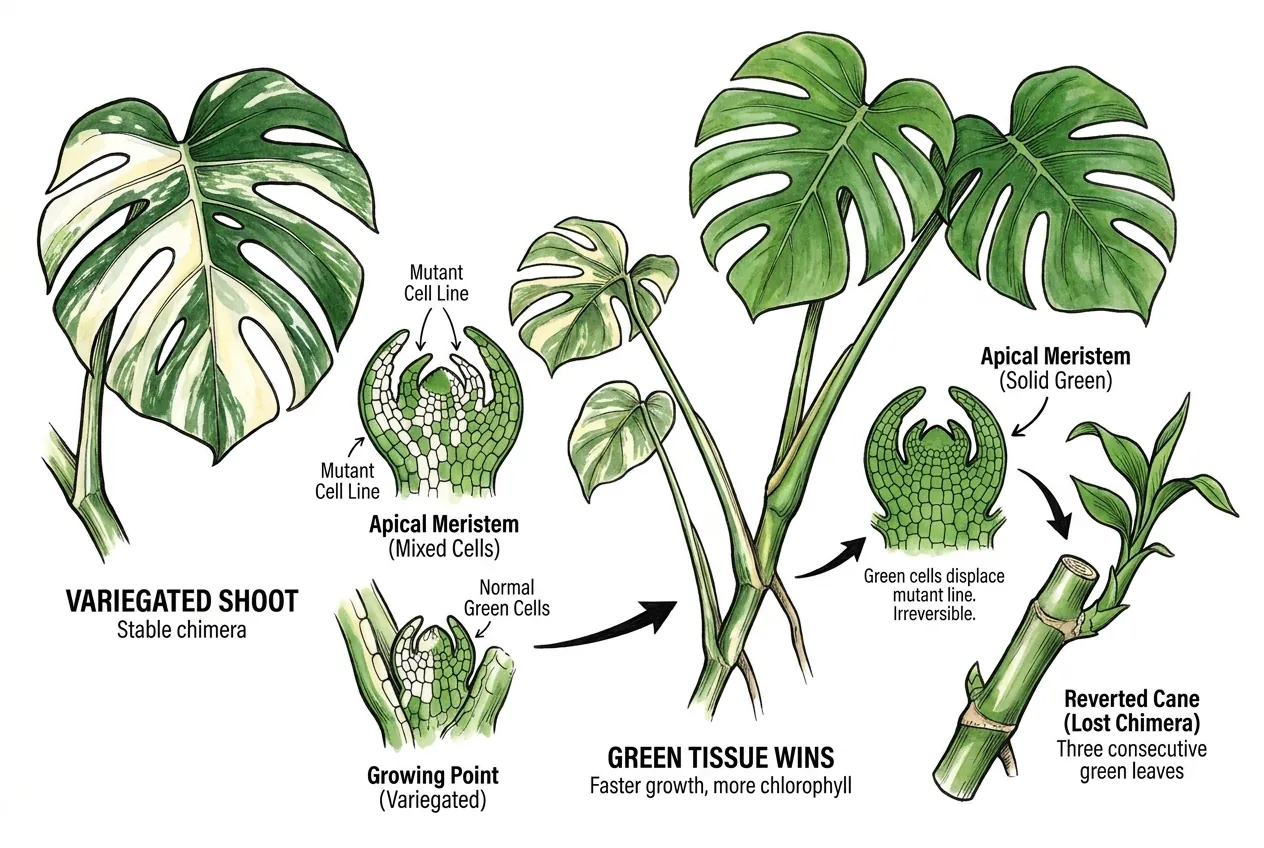
Fully green tissue has more chlorophyll and tends to grow more vigorously, so a reverted shoot can out-compete the variegated foliage and take over the plant if left in place.
Variegation stays visible while the variegated cell line keeps its position in the growing point.
Once the growing point is solidly green, there is no simple process that puts the variegated cell line back, so that shoot does not spontaneously re-variegate.
Judge whether a tip has reverted from the state of the active growing point and stem, not from a fixed number of green leaves alone. A run of green leaves is a warning sign, but confirm it against the growing tip rather than treating a leaf count as a diagnosis.
How light and carbon balance fit in
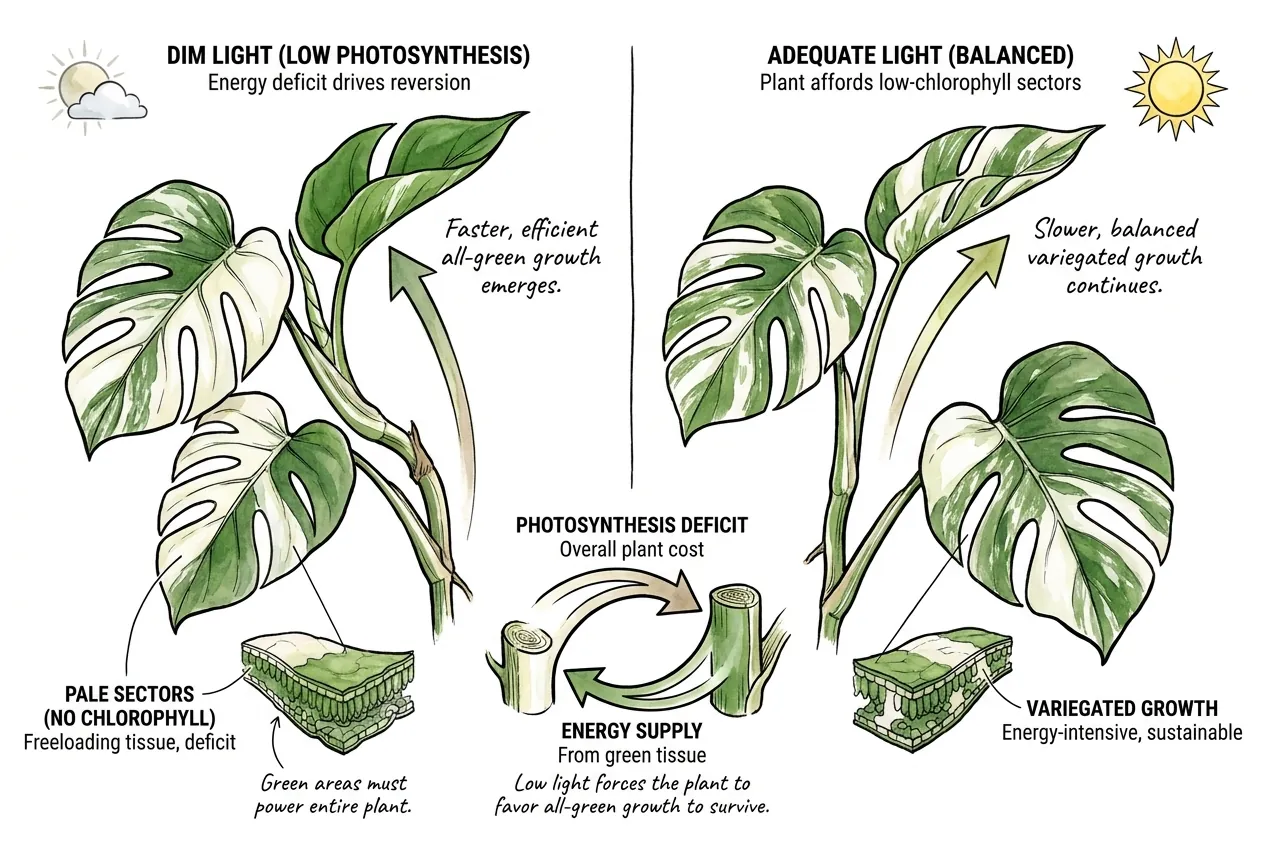
White or cream sectors carry little or no chlorophyll, so a heavily variegated plant produces less total photosynthate than an all-green one of the same size. Its green areas do most of the work.
Pink or cream sectors are not all equally non-photosynthetic, so treat this as a general carbon-balance picture rather than a precise measurement.
The common horticultural reasoning is that a plant short on light and carbon has less to invest in low-chlorophyll tissue, and that adequate light better supports the whole plant.
Whether low light directly causes reversion in these cultivars has not been shown in controlled tests, so the practical point is narrower. Give the plant enough light for general health, and understand that more light never adds new white variegation to green tissue.
If you own a Syngonium Albo showing this, there is a companion piece on the same care questions in why a Syngonium Albo keeps reverting to green.
Using a periclinal chimera to unravel layer-specific gene expression in plants
Genetic Selection. Chimera and Chimeral Reversion (University of Florida IFAS Plant Propagation)
Reversion in Variegated Plants (Elisabeth C. Miller Library, University of Washington Botanic Gardens)
Reversion in Plants (Royal Horticultural Society)
Variegation Explained. Why Light Does Not Create Variegated Leaves (Foliage Factory)
What specs actually separate a good buy from a waste of money?
Match the Tool to Its Role
For each role, one or two published specs do most of the work of separating a useful buy from a poor one, though they are not the only things that matter (calibration, fixture safety, tool geometry, and use conditions still count).
Look for the unit and stated accuracy on a meter, PPF or PPFD-at-distance on a light, a clean-cutting bypass action on a pruner, 70% on a disinfectant, and a complete balanced ratio on a feed.
| Role | Spec that matters | Threshold to demand | Why it matters |
|---|---|---|---|
| Light diagnostic | Unit and stated accuracy | PPFD in µmol/m²/s, or lux with ±3-5% and a range covering 0-20,000 lux | Plants respond to photons (PPFD), not eye-weighted brightness (lux). A stated accuracy makes the reading trustworthy |
| Grow light | PPF or PPFD-at-a-stated-distance | Enough to reach the medium foliage-plant DLI range (roughly 6-12 mol/m²/day) at your height and photoperiod, adjusted to the plant’s response | DLI, not wattage, is what the plant integrates. Two equal-watt lights deliver very different PPFD at the leaf |
| Clean cutting | Sharp bypass action, blade capacity | A sharp bypass tool (over anvil), capacity at or above your cane diameter | A bypass blade slices cleanly on living tissue. An anvil can crush a soft aroid stem, leaving a ragged wound that heals slowly |
| Disinfectant | Isopropyl concentration | Around 70% | 70% is a common working strength for disinfecting tools. The water content slows evaporation, and efficacy still depends on the organism and contact time |
| Balanced feed | Complete, balanced printed N-P-K | A complete feed near a 3-1-2 or 1-1-1 ratio, dosed lightly | A complete feed at a modest rate avoids deficiency. Heavy nitrogen can push soft, excessive growth generally, so keep the dose light |
The most important caveat lives in the meter row. A lux reading converts to PPFD only through a light-source-dependent factor, roughly 0.0185 for sunlight and 0.0135 for cool-white fluorescent, with no reliable universal factor for LED.
So a lux meter tells you the trend and rough magnitude, not the exact photon count.
A more useful target than instantaneous brightness is the daily light integral. DLI equals PPFD multiplied by 3,600, multiplied by photoperiod hours, divided by 1,000,000. For example, 150 µmol/m²/s for 12 hours is roughly 6.5 mol/m²/day, in the medium range that general references give for foliage houseplants.
That range is a starting point for plant health, not a validated threshold for preventing reversion in these particular cultivars, so adjust it to how your plant actually responds.
Calculating and Using Daily Light Integral (DLI). Virginia Cooperative Extension, SPES-720
Measuring Daily Light Integral (DLI). Purdue Extension HO-238-W
Fertilizing Houseplants. UConn Soil Nutrient Analysis Laboratory
Pruning Tools. University of Maryland Extension
How do I sanitize my pruning shears? Iowa State University Extension
Which specific products fit each role?
Measure light first, correct it if needed, cut reverted growth, then feed only if the plant needs it.
Choose a meter by whether you need a location comparison or a direct PPFD reading. Add a light only when the measured spot is too dim, and confirm the current product label or listing before buying.
Which light meter should I buy first?
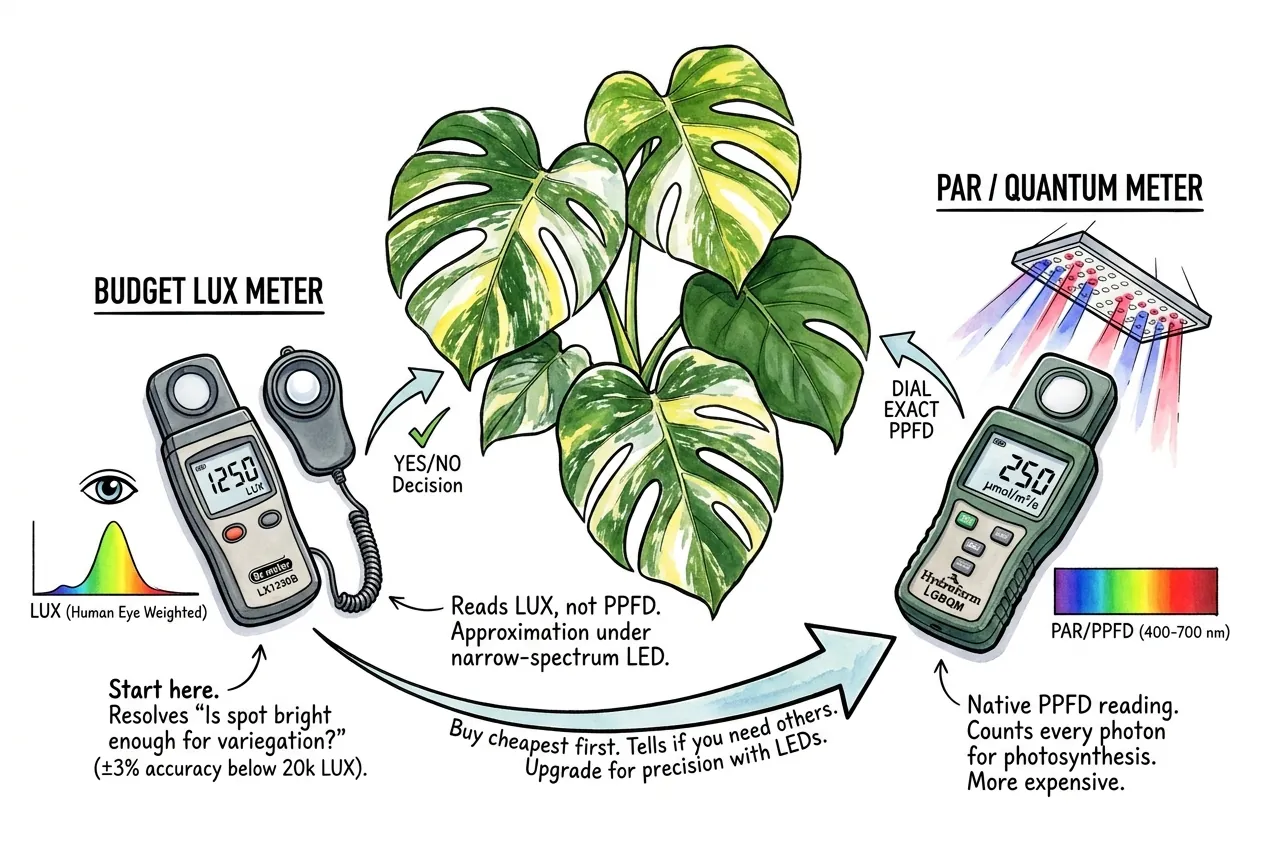
Start with the least expensive tool, because it helps you compare spots before you spend on a fixture.
A budget lux meter with a stated accuracy is enough to see how one location compares with another and whether a spot is roughly in a reasonable range.
It cannot, on its own, tell you a spot is bright enough to hold variegation. There is no measured cultivar threshold for that, and lux is a relative, source-dependent reading rather than an exact photon count.
A lux sensor is weighted to the human eye and under-counts the red and blue photons that drive photosynthesis.
A PAR or quantum meter is designed to respond across roughly 400-700 nm and reports PPFD in plant units, so it needs no lux-to-PPFD conversion, though real sensors still carry their own spectral error and calibration limits.
Dr.meter LX1330B is a reasonable first tool when you only need to compare one growing spot with another before spending on a fixture. It reads lux rather than PPFD, so do not use it alone to set an exact target under a narrow-spectrum LED.
Hydrofarm LGBQM suits an LED-grown plant when you need a direct PPFD reading instead of a converted lux estimate. It costs more than a lux meter, and a legacy-model listing should be checked carefully before purchase.
Apogee MQ-500 is for standardizing several grow stations when you need dependable readings across different light sources. For one plant near a bright window, it is more meter than the placement decision needs. Confirm the current calibration documentation before buying.
Apogee MQ-200 fits a grower who needs to assess daily light inside a canopy rather than take a single snapshot. Its separate sensor makes under-canopy placement easier, but the original model has been replaced, so verify the exact unit and supported data tools before buying. Like the MQ-500, it is more meter than a one-plant grower needs.
Take the reading at leaf height with the sensor facing the light. A few spot readings tell you relative brightness, but to know the daily dose (DLI) you need to sample PPFD across the day or use a meter that logs and integrates over time, since window light changes hour to hour.
As a rough starting target, foliage-light norms put many indoor plants around 150-250 µmol/m²/s during the lit hours, roughly 6-12 DLI.
Treat that as a general health range to adjust to the plant, not a measured threshold that prevents reversion in these cultivars.
Apogee Instruments. PPFD to Lux Conversion Reference
Apogee Instruments. MQ-500 Full-Spectrum Quantum Meter
Apogee Instruments. MQ-200 Quantum Meter (separate sensor + handheld)
When do I actually need a grow light?
Add a grow light only after the meter shows the spot is genuinely too dim, not in the hope of growing the white back.
A grow light supports a plant’s general health and photosynthesis. It does not restore tissue lost to an all-green growing point.
Set the fixture at a height where the meter reads roughly 150-250 µmol/m²/s at the top leaves.
Run it 12-14 hours on a timer, aim for a DLI in the medium foliage range, and match the footprint to the plant rather than the nameplate wattage.
SANSI 36W suits one plant under a nearby lamp. Its focused beam covers a small canopy well but is a poor fit for a wide shelf. Measure PPFD at leaf height, and check heat and fixture compatibility before use.
Spider Farmer SF1000 suits a shelf or a small cluster of variegated aroids. A panel of this size can be too much light, heat, and expense for one pot, so use the dimmer or choose a smaller fixture when only one plant needs help.
One safety note if you run a light near a humid plant shelf. Mains electricity near water is a shock hazard, so use GFCI protection on that circuit and test it regularly.
Keep drivers and plugs elevated above the plants, run a drip loop in the cord, inspect for damaged cords, and unplug before adjusting a fixture with wet or damp hands.
If you are unsure about the wiring, have a qualified electrician confirm it meets local code.
Dialing in the exact fixture, height, and photoperiod is its own decision, walked through spec by spec in the aroid grow light product chooser covering PPFD, DLI and verification.
Use this section as the quick pick and head there for the detailed walkthrough.
How to Determine How Much Supplemental Light to Provide for Indoor Plants. Iowa State University Extension
Purdue University HO-238-W. Daily Light Integral banding
What do I use to cut reverted growth safely?
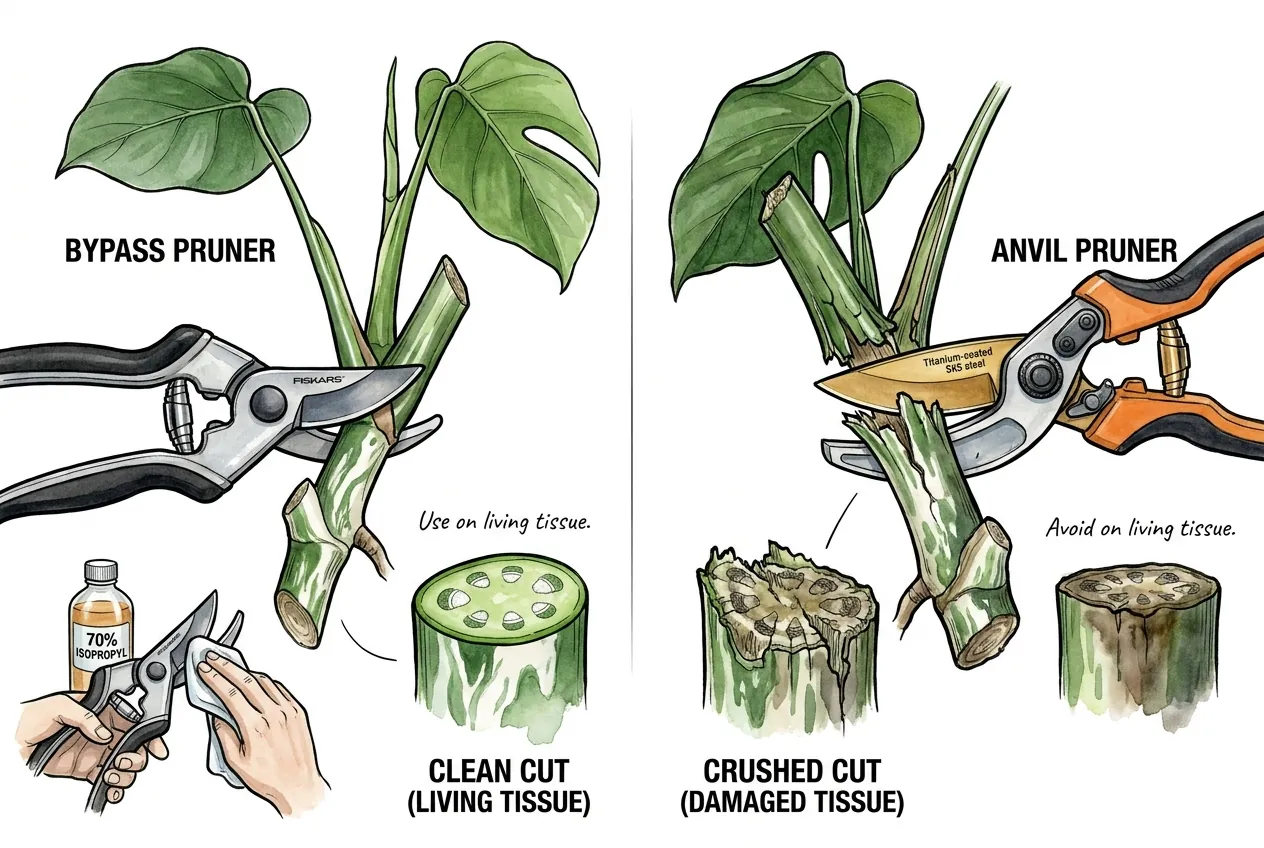
Cut the reverted all-green cane back to a stem point below a node that still shows variegation, using a sharp, clean bypass tool wiped with 70% isopropyl.
This removes the vigorous green apex so a lower bud can break instead. Bear in mind that a node with variegated-looking leaves does not guarantee its bud carries the variegated cell line, so the new shoot may come out green, white, or variegated.
Bypass works like scissors, a sharp blade slicing past a thicker hook for a clean cut on living tissue.
An anvil pruner presses the stem against a flat plate, which can crush and bruise a soft, water-filled aroid stem instead of slicing it. A ragged, crushed wound heals more slowly and gives rot an easier entry point.
A clean cut from any sharp, disinfected tool, bypass pruner, snips, or a sharp knife sized to the stem, is what matters most, so match the tool to the cane’s diameter and firmness.
Fiskars bypass shears suit a typical reverting Monstera or Philodendron cane. Skip them for a very slim stem, where snips are easier to place, or a thick cane, where a larger pruner fits better. If you already own a clean, sharp bypass tool that fits the stem, you do not need another.
gonicc bypass shears are an option for a cane too thick for a smaller everyday pruner. They are clumsy on slim stems, so reserve them for cuts where a smaller tool will not close cleanly.
Fiskars Micro-Tip suits a delicate stem where a full pruner is hard to aim. Cut the shoot stem just below a node that still shows variegation, not the leaf stalk. It is a precision snip, not a heavy cutter for thick canes.
Basics 70% Isopropyl Alcohol is labeled at 70%, within the 60-90% band commonly used to disinfect tools.
Wipe soil and sap off the blade first, since debris blocks contact, then apply the alcohol between cuts.
Alcohol is a disinfectant, not a sterilant, and does not kill every plant pathogen. For a known disease, check the specific product guidance for the organism and contact time.
It is also flammable, so keep it away from flame and let the blade dry.
Higher-proof isopropyl (91% or 99%) is not automatically better for this use. The water in a 70% solution slows evaporation and can aid protein denaturation, which is why 70% is a common default.
The right choice depends on the target organism, surface, and contact time, and higher concentrations can be diluted when a formulation calls for it.
Anvil vs. Bypass Pruners. University of Florida IFAS (GCREC)
What fertilizer should I feed a variegated aroid?
Feed a complete, balanced fertilizer at a light dilution, and do not expect it to prevent or reverse reversion.
Its role is ordinary nutrition without overfeeding. Before applying it, confirm that the plant is actively growing and that deficiency, rather than another problem, is the likely issue. If you already use a suitable complete fertilizer, you do not need a new one for this purpose.
Nitrogen promotes green, leafy growth and is part of the chlorophyll molecule. Heavy nitrogen tends to push soft, excessive growth in general, which is a reason to keep the dose light.
Whether high nitrogen specifically accelerates a chimera’s green takeover has not been tested in these cultivars, so treat that as a cautious inference rather than an established fact.
A complete feed that also supplies calcium and magnesium supports healthy tissue overall.
SUPERthrive Foliage-Pro 9-3-6 has a 9-3-6 guaranteed analysis and a complete formula that includes calcium and magnesium, marketed urea-free.
This product is now sold under the Superthrive brand, so a current bottle may say Superthrive rather than Dyna-Gro. The smaller 8 oz and larger Foliage-Pro (quart) listings show different label versions, so confirm the formula on the bottle you receive.
The value here is completeness and steady balance. A common label maintenance rate is around 1/4 teaspoon per gallon, but adjust to your water, medium, and season rather than treating one rate as fixed, and flush the medium periodically to avoid salt buildup.
Note that 9-3-6 is a relatively nitrogen-forward ratio, so if you are keeping nitrogen light, dose it modestly or space out feedings. Do not buy it expecting a fertilizer to stop reversion.
Grow 7-9-5 (also sold under the Superthrive brand) is another complete liquid. Its printed nitrogen figure is lower and its phosphorus higher than Foliage-Pro, but the nitrogen a plant actually receives depends on how much you dilute and how often you feed, so the label numbers alone are not a like-for-like comparison.
There is no good evidence that a phosphorus-forward ratio benefits variegated foliage, so for a foliage plant, Foliage-Pro is the more conventional choice. Treat Grow 7-9-5 as optional rather than a targeted pick for reversion.
Essential Plant Nutrients. Alabama Cooperative Extension System
What is the exact measure, correct, prune, feed protocol?
Run one ordered loop where each step is gated by the previous reading, so you never buy a step you do not need. The order is measure, correct, prune, feed, then wait.
Step 1. Measure
Take leaf-height readings at the growing tip at several times of day. To estimate DLI, sample PPFD through the day (or use a logging meter) rather than relying on one bright-hour snapshot. DLI equals average PPFD multiplied by photoperiod hours multiplied by 0.0036.
The question is whether the plant sits in a reasonable range for foliage plants, roughly 150-250 µmol/m²/s during lit hours, adjusted to how it responds.
Step 2. Correct
If the reading is low for the plant, move it closer to the window or add a supplemental LED, then re-measure.
Increase light gradually and let the plant acclimate rather than moving it into harsh direct sun.
White or cream sectors have little chlorophyll and can scorch more readily than green tissue, which is part of why white sectors on a Monstera Albo can sunburn first.
Step 3. Prune
If a cane has gone fully green at the tip, cut it back with a sharp, clean bypass tool to a stem point below a node that still shows variegation.
Wipe the blade with 70% isopropyl before and between cuts (this disinfects the tool. It does not sterilize it), so a lower bud has a clean chance to break.
The new shoot may or may not be variegated.
Step 4. Feed
If the plant is actively growing and needs feeding, use a complete, balanced liquid at a light dilution.
Keep nitrogen modest, since heavy nitrogen tends to push soft, excessive growth in general. Skip this step if the plant already gets adequate nutrition.
Step 5. Wait
New growth from a variegated node may or may not carry variegation. Reversion already committed at the meristem cannot be undone by any of the above.
Providing Supplemental Light to Indoor Plants. Iowa State University Extension
Removing Reverted Growth from Variegated Plants. University of Illinois Extension
Who should NOT buy each class of product?
Skip anything a measurement or a biological fact says you do not need. Each call below is tied to a spec or to how reversion works.
Skip the $300 PAR meter for one plant
An inexpensive lux meter, used as a relative trend tool, is usually enough for a single-plant owner comparing spots.
A lab-grade PAR meter buys precision that this decision does not need.
Skip the grow light if the meter reads in band
If the spot already reads in a reasonable range, the correction step is satisfied and a grow light solves a problem you do not have.
A full 100W panel over one windowsill pot is usually more coverage than needed, though a dimmable panel can be turned down if you already own one.
Skip anvil pruners and high-N grow-big feed
An anvil blade can crush a soft green stem where a sharp bypass tool makes a clean cut, so it is a poor fit for this job.
A high-nitrogen grow-big feed pushes soft, excessive growth in general, so keep to a light, balanced feed instead.
If you already own a suitable sharp cutter and a complete fertilizer, you may not need to buy anything here.
Buy nothing to un-revert a solid-green plant
If a shoot’s growing point is already fully green with no variegated tissue left on it, no meter, light, pruner, or feed brings variegation back on that shoot.
Other shoots lower on the plant, or a variegated cutting, are separate cases, so assess each shoot on its own before deciding it is a lost cause.
Nitrogen Excess. UC Statewide IPM Program (UC ANR)
How do I maintain the gear, and when does new growth still revert?
Maintain Tools, Not Expectations
Maintain each tool on a simple interval and accept the one failure mode no gear fixes. Good quantum sensors drift only slowly, Apogee, for example, cites on the order of 2% or less per year for its meters, so factory calibration typically holds for years of hobby use, though budget meters may vary. Check your meter’s own spec and recalibration guidance.
Treat a lux meter as a relative trend tool, not an absolute PPFD source.
Wipe blades with 70% isopropyl before and between cuts (removing soil and sap first), dry them to prevent rust, and keep an edge on them so a sharp bypass slices rather than tears.
Feed at a light dose and flush the medium with plain water periodically to limit salt buildup on an already stressed plant.
Even with good care, a chimeral plant can still send up green growth, because the two cell lines coexist in the shoot tip.
Prune reverted growth promptly and give the plant adequate light. Consistent care supports the plant but does not guarantee the variegation holds.
Frequently asked questions
Can I reverse reversion and bring my variegation back?
Not for chimeral types once solid-green tissue has taken over a shoot’s growing point with no variegated tissue left on it.
Fully green cells tend to grow more vigorously, so new leaves on that shoot come out green.
Your practical move is to cut the reverted cane back to a stem point below a node that still shows variegation and let a lower bud break. That gives a variegated bud a chance to grow, though it does not un-revert the green tissue, and the new shoot may still come out green.
Does a grow light or extra nitrogen do anything?
A grow light supports a still-variegated plant’s general health by preventing a light deficit. It does not regrow lost tissue or add new variegation.
Excess nitrogen does not cause the chimeral event. It tends to push soft, lush growth in general, and it is a reasonable caution to keep nitrogen modest, though a specific acceleration of chimeral takeover has not been demonstrated in these cultivars.
Feed a complete, balanced product at a light dilution, and give the plant adequate light for its overall health.
Is Thai Constellation the same as Albo?
They are generally treated as different in practice. Thai Constellation is propagated by tissue culture and is widely reported to hold its cream marbling more stably than Albo, with much less of the dramatic solid-green reversion collectors see in chimeral Albo.
Albo is usually described as a chimera whose green and variegated cell lines coexist and can shift, which is why the cut-back-below-a-variegated-node approach is aimed at Albo-type plants.
The exact genetics of Thai Constellation are not fully documented in the sources here, so treat more stable as a practical observation rather than a guarantee that it can never lose pattern.
Monstera Thai Constellation vs Albo Variegata (The Plant Runner)
Lux to PPFD conversion reference (growlightmeter.com)
Affiliate Disclosure
This article contains Amazon affiliate links. As an Amazon Associate I earn from qualifying purchases. If you use these links, the site may earn a commission at no extra cost to you. Product availability, price, and specifications can change. Check the current listing before buying.