
Anthurium Veitchii Leaf Sag: Mount Angle & Humidity Notes
A working hypothesis for why Anthurium veitchii pendant leaves bow at the midrib, and how mount angle and humidity swings may contribute. Framed as observations, not measured thresholds.
Jordan Cole · Published 2026-06-08 · 16 min read
Key Takeaways
- A downward midrib bow can be normal for a young or light-seeking pendant leaf, so check normal form before diagnosing stress. Root condition, petiole injury, pests, and disease can create similar symptoms.
- Mount geometry is a plausible contributor, but there is no measured safe angle for Anthurium veitchii. A stable, near-vertical mount with a gentle forward lean is a cautious starting point.
- Humidity swings can raise water demand, but no species-specific VPD or permanent-set threshold has been established. Treat air-side calculations as context rather than a diagnosis.
- Use symptom patterns as a checklist, not as proof of one cause. Compare the same leaves over time while checking roots, light, temperature, airflow, and humidity together.
- Correct conditions promptly and judge recovery over weeks. A healthy next leaf is encouraging evidence, but it does not prove what caused an earlier sag.
What is Anthurium veitchii leaf hammocking, and why does it matter?
“Hammocking” is used here as a descriptive label, not an established horticultural or plant-pathology term. It means a downward midrib bow that departs from the pendant leaf’s usual smooth cascade and forms a shallow U-shape along the leaf.
Before treating it as a problem, rule out normal variation first. A. veitchii naturally produces long, pendant, deeply corrugated blades, and a newly emerged leaf is soft and hardens over days to weeks.
Some curve is normal, and a leaf can also reorient toward its light source.
When the bow looks abnormal, identify changes in watering, humidity, root health, support, and light that happened before it appeared. The onset-to-symptom timing has not been measured for this species.
Sources disagree on mature leaf size, so use the plant’s own normal form as the comparison rather than an extreme size claim.
A large hydrated leaf places a bending load on the geniculum, the swollen joint between petiole and blade, but no species-specific measurement establishes how much load causes a bow.
The geniculum acts as an orientation joint in aroids generally, and turgor loss plausibly affects it and the midrib.
Which structure loses stiffness first in A. veitchii has not been measured, so the sequence below is a hypothesis, not a documented finding.
I hang a temporary plumb line from the petiole exit point and photograph the expanding leaf beside it without rotating the pot. The sequence helps me compare its natural drop with a sideways shift that tracks light direction or shelf contact.
Before the newest leaf hardens, I measure the free space below it. If the tip will reach a shelf or wet substrate, I raise or angle the pot early rather than trying to reshape a hardened blade.
Which structural element fails first?
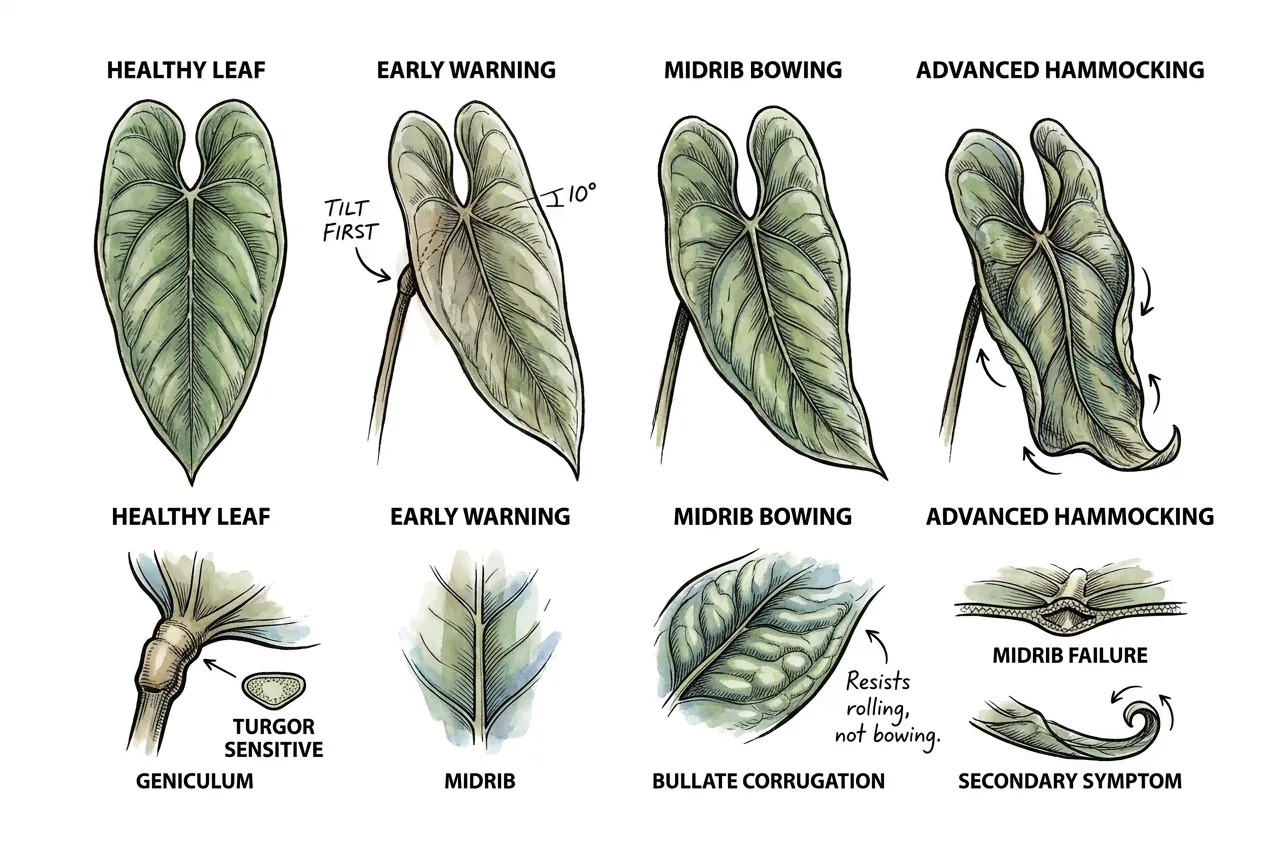
The geniculum is a turgor-sensitive joint, so water stress may show there before or alongside a midrib bow. The order of these changes has not been measured in A. veitchii, and a forward tilt can also be normal light reorientation.
Use a tilted geniculum as one clue only. Confirm it against root condition, watering, light direction, leaf age, and visible injury.
Why might pot angle contribute to hammocking?
Keep the Mount Near Vertical
Level the mount itself and support the root mass and stem, not the leaf petiole. An off-vertical mount can add uneven stress, but no measured angle predicts leaf failure for this species.
Check the board with a torpedo level or a phone level rather than judging a decorative pot rim. A near-vertical mount is a low-risk support practice, not a guarantee against leaf sag.
Directional gravity sensing in gravitropism. Morita, Annual Review of Plant Biology
What about forward tilt versus side tilt?
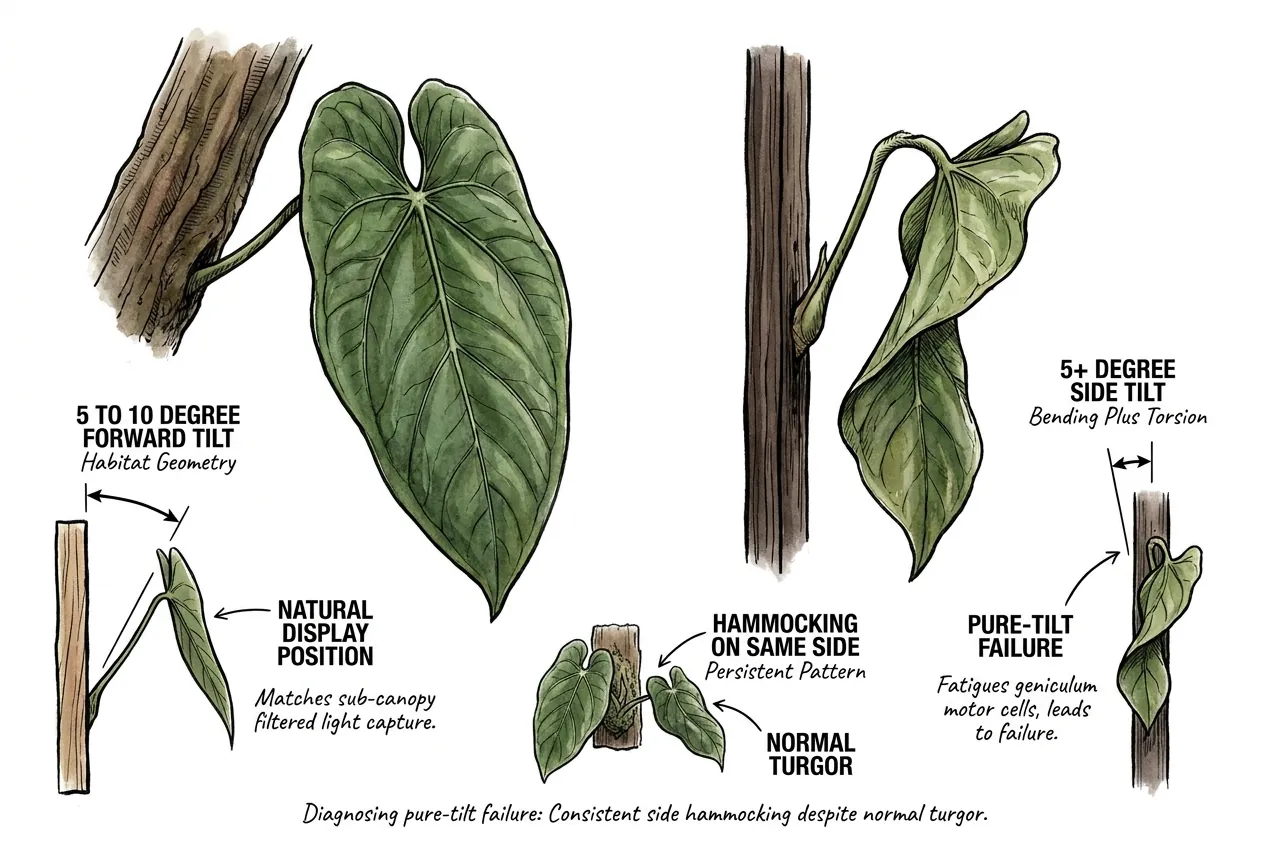
A slight forward lean can let a pendant blade hang outward, while a side lean may add twist. Treat this as a simple support choice, not a measured angle rule.
A. veitchii is an epiphyte from wet Colombian forest. That supports an outward-hanging habit but does not establish a specific mounting angle.
A gentle forward lean on your mount is a low-risk way to let the leaves hang naturally, but the more important factor is supporting the plant at the roots and stem rather than fixing on any precise angle.
Reading a possible tilt-only pattern
If the same leaves bow on the same side, week after week, largely independent of humidity, a crooked mount is worth suspecting. Treat this as a clue, not a confirmed diagnosis.
Before concluding it is the mount, rule out other one-sided causes. Uneven light, a localized petiole injury, asymmetric root distribution, or uneven support can all produce a consistent side bias.
Normal turgor on the unaffected leaves is a visual firmness judgment, not a measurement of water potential, so weigh it accordingly.
If levelling the mount resolves the pattern over time, that supports the idea, but it does not prove the mount was the sole cause.
Why might a humidity drop contribute to hammocking?
A sharp drop in humidity raises vapor pressure deficit (VPD), the drying pull of the air. If a leaf loses water faster than roots can replace it, it can lose turgor. No A. veitchii VPD threshold or collapse time has been measured.
It is more useful to think about VPD than raw relative humidity, because the same RH reading corresponds to different drying pull at different temperatures.
But VPD at the leaf also depends on leaf temperature, boundary-layer air movement, stomatal conductance, and how much water the roots can supply, so the air-side numbers below are a rough guide, not the deficit the leaf actually experiences.
Using the standard saturation curve and assuming leaf temperature equals air temperature, at 22 °C an air VPD works out to roughly 0.53 kPa at 80% RH, 1.06 kPa at 60%, and 1.59 kPa at 40%.
These are physics of the air, not a damage threshold for this plant.
Whether lower turgor appears as a midrib bow depends on the individual plant, its root health, acclimation, temperature, and airflow. Do not assume every plant will sag at the same relative humidity.
Stomatal responses to vapour pressure deficit. McAdam & Brodribb, Plant Physiology (2016)
What humidity does Anthurium veitchii actually need?
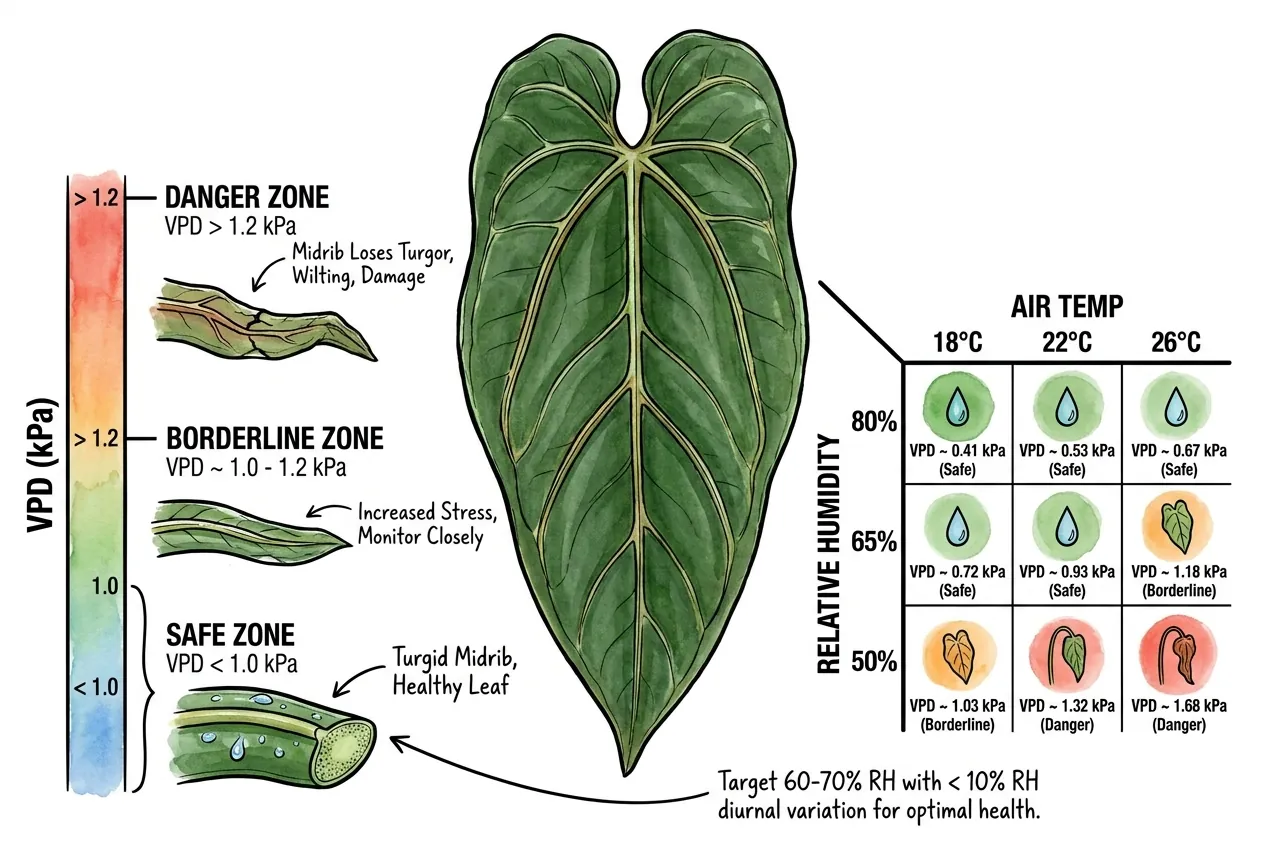
Keep humidity changes gradual instead of chasing an exact species-specific setpoint. This wet-forest epiphyte benefits from avoiding sharp swings, but no ideal room RH has been established for it.
Household Humidity Safety
US EPA and CDC guidance advises keeping household relative humidity at or below about 50% to limit mold, dust mites, and condensation on cold walls, windows, and furniture.
Running a whole room at 60 to 70% RH conflicts with that guidance and can damage your home and affect indoor air quality.
If you want to give this plant consistently high humidity, do it in a dedicated, properly ventilated plant enclosure with condensation control, not by humidifying a living space to those levels.
Reference VPD table at typical room temperatures
| Air Temp | 80% RH | 65% RH | 50% RH | 35% RH |
|---|---|---|---|---|
| 18 °C | 0.41 kPa | 0.72 kPa | 1.03 kPa | 1.34 kPa |
| 22 °C | 0.53 kPa | 0.93 kPa | 1.32 kPa | 1.72 kPa |
| 26 °C | 0.67 kPa | 1.18 kPa | 1.68 kPa | 2.19 kPa |
These are calculated air VPD values assuming leaf temperature equals air temperature. They are not measured turgor-loss thresholds and do not define a safe or unsafe cutoff for A. veitchii.
Read the VPD Table Directionally
The useful takeaway is directional. The same RH reading means very different drying pull at different temperatures.
For example, 60% RH gives about 0.83 kPa at 18 °C but about 1.34 kPa at 26 °C, nearly a 60% higher deficit, so warm, dry-ish air is harder on the leaf than the RH number alone suggests.
To know the deficit the leaf actually feels, you would need its leaf temperature, not just room RH.
Might the cuticle play a role?
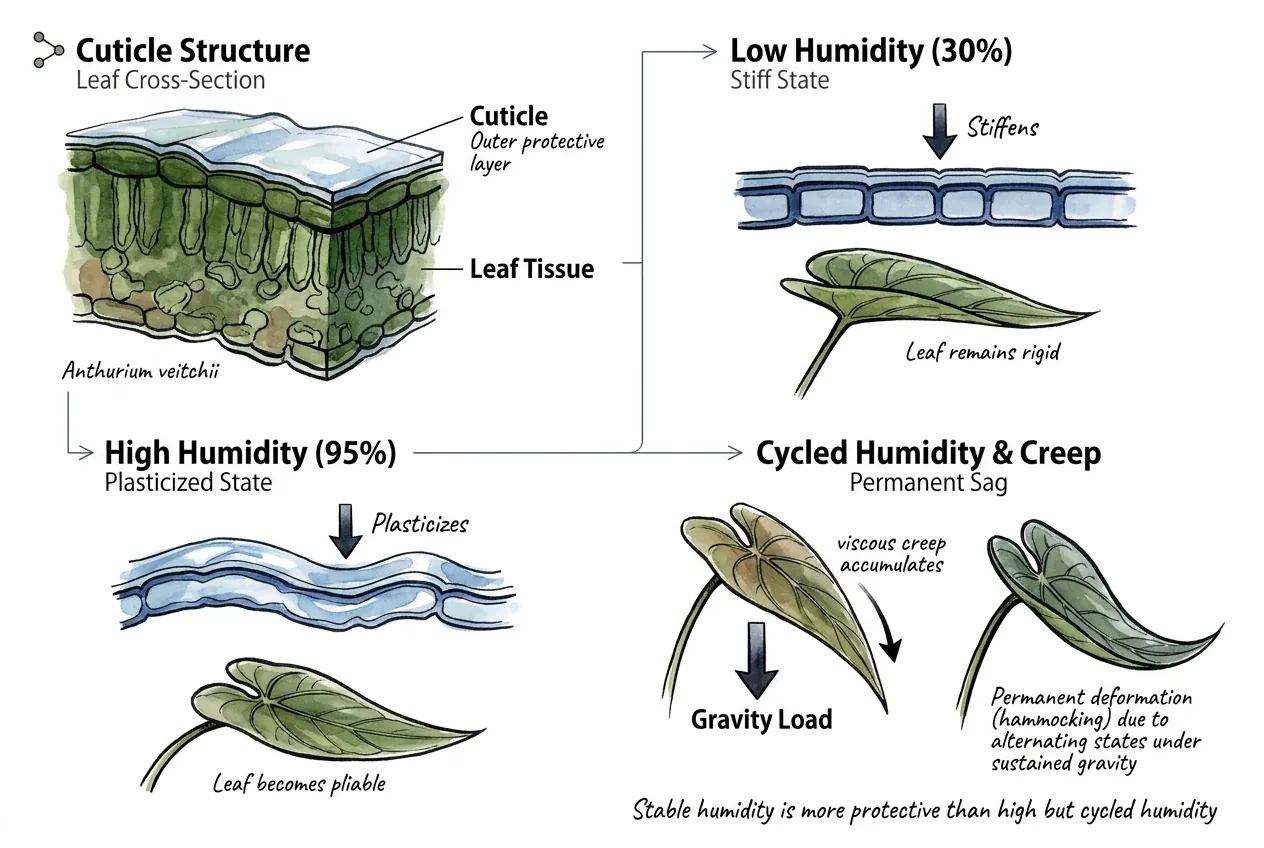
Possibly. Isolated plant cuticles can soften as hydration rises, but those results vary by species and organ and do not measure A. veitchii leaves in a room.
The effect of ambient humidity swings on a living leaf’s stiffness remains uncertain, so do not use cuticle mechanics to predict a bow or a recovery time.
Practical Humidity Principle
Reducing sharp humidity swings is a sensible general precaution, even though it is not a measured cure for this species.
Mechanical properties of cuticles and their primary determinants. Khanal & Knoche, Journal of Experimental Botany (2017)
When does sag become permanent deformation?
Correct the conditions promptly, then judge recovery over the following weeks rather than by a fixed deadline. No evidence defines when a sagged A. veitchii leaf becomes permanently set, so do not remove a healthy leaf solely because it has been bent for a certain number of hours or days.
Could two stressors combine, and how would I tell?
A slightly off-vertical mount and a humidity drop can plausibly add stress at the same time, but their frequency and timing have not been measured. Treat combined stress as a checklist prompt, not a diagnosis or a numeric safety margin.
Symptom patterns to note (not a diagnosis)
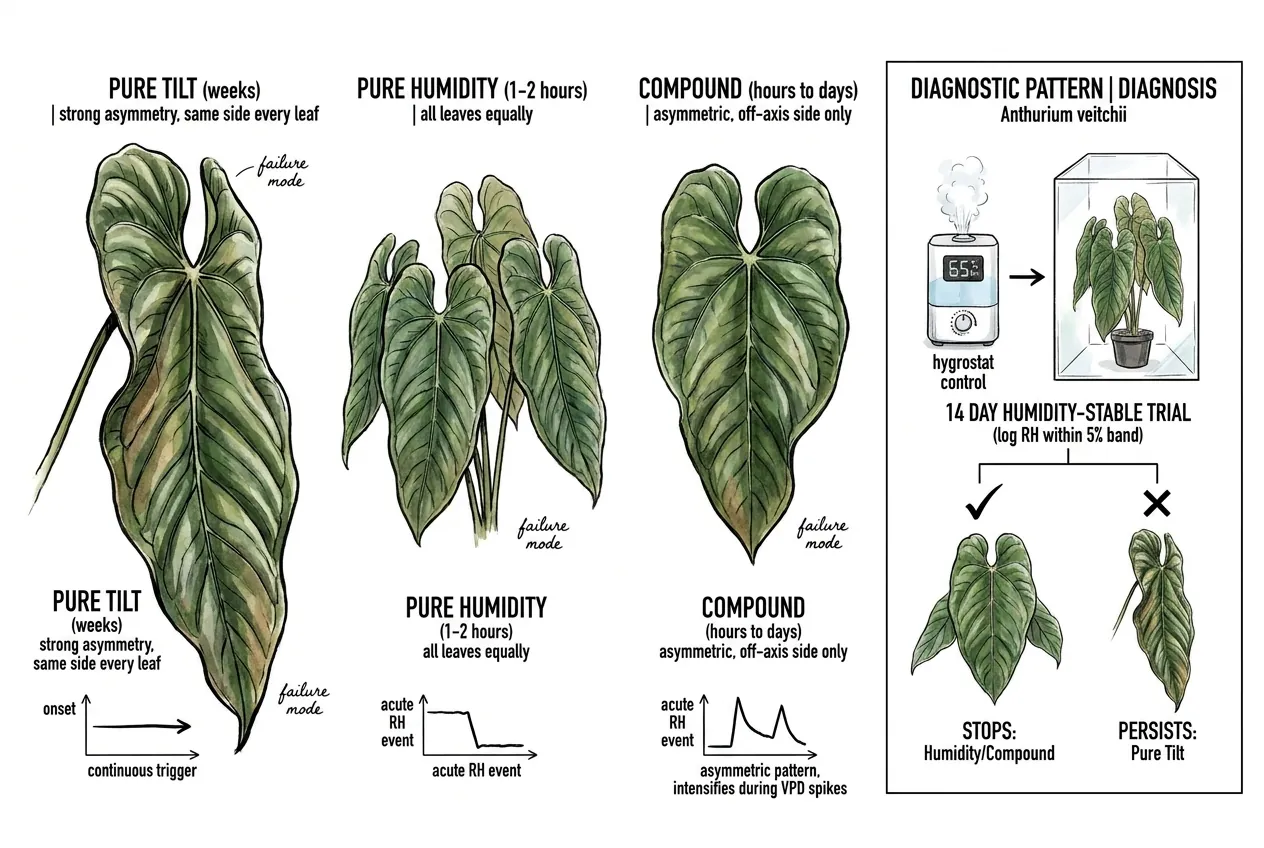
Root and water status, root disease, petiole injury, leaf age and hardening, light direction, heat, airflow, substrate salts, and pests can produce overlapping symptoms. Use these patterns to narrow possibilities, not to confirm one cause.
| Suspected pattern | Typical onset | Symptom asymmetry | Trigger |
|---|---|---|---|
| Mostly tilt | weeks | same side, same leaves | continuous |
| Mostly humidity | hours | most leaves, no strong side bias | acute dry spell |
| Compound | hours to days | asymmetric, off-axis side only | acute RH event |
A tilt-related pattern tends to hit the same leaves on the same side, fairly consistently over weeks.
A humidity-related pattern tends to affect many leaves around the same time during a dry event, with no strong side preference, though leaf age and hydraulic differences mean the response is rarely perfectly uniform.
A combined pattern might show up as a side bias that worsens during dry spells. These are tendencies, not exclusive categories.
If you want to test the humidity contribution, you can try holding humidity steadier for a couple of weeks and see whether the sagging eases.
Keep the trial within household humidity guidance at around 50% RH or below in a living space. Use a ventilated enclosure if you want higher, rather than driving a whole room to 65%.
Log RH so you can compare, but bear in mind a single consumer sensor has its own error, and that many other things such as watering, root disturbance, light, temperature, and new-leaf maturation can change at the same time.
If sagging eases, humidity was probably involved. If it persists, look harder at the mount and at the alternative causes above. A stable-humidity trial on its own cannot prove the mount is the cause.
How would I re-mount a plant that keeps sagging?
Build and level the mount before moving the plant, then anchor the root mass and stem against it with moist sphagnum. Do not tie or hang the plant by a leaf petiole, which can be compressed, abraded, or held wet against a narrow tie.
Step-by-step
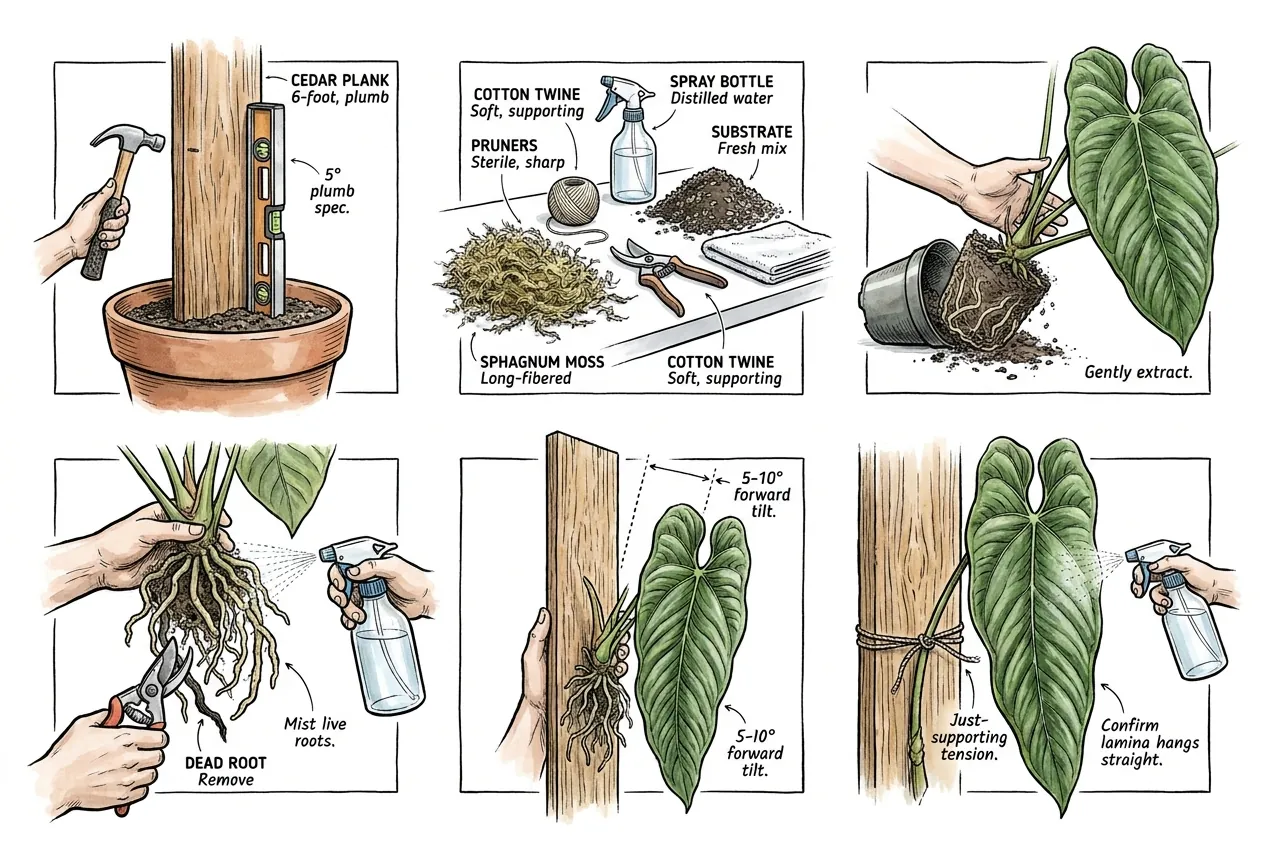
- Build the mount. Anchor a cedar board or plaque securely to a wall or heavy pot. It is not self-supporting in lightweight substrate. Use a torpedo level to check it in two axes and aim for roughly vertical. No exact failure angle is known for this species.
- Stage the workspace. Long-fibered sphagnum, soft broad ties (strips of cloth or fabric plant tape, not thin twine), sterile pruners, a spray bottle, fresh substrate, and a clean towel.
- Unpot. Tip the pot on its side and support the container and root ball. Do not use a large leaf’s petiole as a handle. Ease the root mass out.
- Inspect. Remove only clearly dead roots with sterile tools, avoid over-pruning, and keep the live roots from drying while you work. If you suspect root disease, isolate and treat that separately.
- Wrap and anchor. Pack moist long-fibered sphagnum around the root mass and press it against the board, holding the plant by the root ball and stem base, not by a leaf.
- Secure. Use broad, adjustable ties over the sphagnum and stem base to hold the root mass to the mount. Keep ties snug but not constricting, and leave the petioles free. A slight forward lean lets the leaves hang naturally.
- Verify. Re-check the mount is stable and roughly level. Do not soak the lamina. Wetting the blade does not aid recovery and only prolongs surface wetness.
- Aftercare. Judge watering and airflow by the plant, not the clock. Freshly disturbed, partly exposed epiphytic roots can dry out, so do not blanket-delay watering. Keep the sphagnum lightly moist and water when the root zone approaches dry. Reintroduce gentle air movement rather than sealing the plant in dead air, which favors pathogens.
Prepare hardware in advance so the roots stay hydrated and handling stays careful. Prioritize those conditions over a stopwatch target.
Cedar Mount Plaque
12-inch real cedar plaque suits a smaller plant or can form one part of a larger mount.
Mount Hardware Caveat
It has no published working-load rating, so use a taller, well-anchored board for an adult A. veitchii and check the current listing before buying.
Whatever board you use, it needs anchoring to a wall or heavy pot. Cedar is not self-supporting in lightweight substrate.
Skip a new mount entirely if you already have a wall-mounted moss totem or board of adequate height, strength, and root contact.
How do I stabilize humidity to prevent recurrence?
Use layers to reduce swings. Keep the root zone appropriately moist, use a humidifier and hygrometer to monitor the room, and use a dedicated ventilated enclosure if the plant needs more humidity than a living space can safely hold. Results still depend on room size, airflow, and outdoor climate.
Safety first, again. EPA and CDC guidance is to keep household RH around 50% or below. If your plant genuinely needs higher humidity, put it in a ventilated enclosure with condensation control rather than raising a whole room to levels that invite mold, dust mites, and window/wall condensation.
Moist long-fibered sphagnum around the root mass helps retain root moisture and may raise humidity only very close to the plant. Refresh it when it breaks down, stays soggy, or accumulates salts rather than on a fixed calendar.
Humidifier sizing depends on room volume, air exchange, ceiling height, and outdoor conditions. Pair any humidifier with a hygrometer and adjust from observed conditions instead of expecting a fixed output to hold a specific RH.
Levoit LV600S Smart Humidifier
The Levoit LV600S Smart Humidifier is useful when you need automatic output adjustments in a monitored room or ventilated enclosure. Its Auto mode is convenient, not precision climate control, and it should not be used to force a living room above safe household humidity.
Ultrasonic units can disperse minerals from tap water onto nearby surfaces, so EPA recommends distilled or demineralized water and frequent cleaning. Regular descaling alone does not eliminate the microbial risk of a standing tank.
In hard-water areas, an evaporative humidifier such as the Honeywell HCM350 leaves minerals in a replaceable wick rather than dispersing them.
Factor in the running cost. The wick needs periodic replacement (commonly on the order of every 1 to 2 months depending on water quality and use) plus routine cleaning, and evaporative units have their own practical ceiling on how high they raise RH.
GoveeLife H5179 Hygrometer
The GoveeLife H5179 is useful for logging temperature and humidity trends. A consumer sensor can show when conditions changed, but one reading cannot prove the cause of a leaf symptom. Placement and calibration still matter.
It needs 2.4 GHz Wi-Fi and the Govee app, so skip it if you prefer a fully offline analog hygrometer.
How do I assess whether a hammocked leaf will recover?
Take a baseline photo and note firmness and midrib angle, then check again after about a week, two weeks, and a month. These are observation points, not biological deadlines.
Early on, a recoverable leaf tends to firm up first (the geniculum tightens and the lamina feels less limp) before any change in the bow itself.
Over the following weeks you may see the midrib straighten partly, fully, or not at all. New growth, ongoing hardening of a young leaf, and a persistent-but-healthy geometry all coexist, so do not read a single date as a pass/fail line.
| Time after corrected conditions | Turgor | Geometric recovery |
|---|---|---|
| Day 1-2 | partial | minimal |
| Around a week | firming if recoverable | little change yet |
| Around two weeks | holding | some straightening if it is going to recover |
| Around a month | stable | most of whatever recovery will happen |
These rows are a qualitative log template, not measured percentages or fixed recovery endpoints.
Next Leaf as Evidence
The next leaf is the most useful follow-up sign. A straight leaf under corrected conditions is encouraging but does not prove the cause of the earlier sag. If the next leaf also bows, recheck species-normal form, roots, water, light, temperature, pests, and injury systematically.
When to remove a deformed leaf
Do not remove a leaf on a schedule. A healthy leaf, even a bent one, still photosynthesizes, so keep it unless there is a real reason to cut (disease or damage, or clear evidence it is shading and crowding new growth) and only after a healthy new leaf is established.
If you do remove one, use a sterile blade, cut cleanly near the leaf base, and avoid leaving a long stub that can rot. Anthurium sap can irritate skin, so handle cut tissue with care.
Whether a bent leaf actually harms new-leaf development depends on the real light overlap in your setup, so assess that directly rather than assuming it.
Key Takeaways
- “Hammocking” describes an abnormal midrib bow. First rule out normal pendant or corrugated form, young-leaf hardening, and light reorientation, while checking roots, water, disease, pests, and injury.
- Keep the mount close to vertical with a gentle forward lean, but do not treat a specific degree as a proven safe angle for this species.
- Steady, moderate humidity is easier on the leaf than sharp swings. Keep a living space around 50% RH or below per EPA/CDC guidance. Use a ventilated enclosure if you want higher. The VPD numbers here are air-side calculations, not a validated damage threshold.
- Tilt and a humidity drop may combine. Use the symptom patterns as a checklist, not a diagnosis.
- Correct conditions promptly, judge each leaf over weeks, and use the next leaf as an encouraging rather than conclusive sign.
Affiliate Disclosure
This article contains Amazon affiliate links. As an Amazon Associate I earn from qualifying purchases. If you use these links, the site may earn a commission at no extra cost to you. Product availability, price, and specifications can change. Check the current listing before buying.