Plants Spider Mites Guide: The Ultimate No-BS Way to Destroy Them
struggling with plants Spider Mites are attacking? Learn the science-based, no-nonsense methods to identify, kill, and prevent Spider Mites on plants for good.
1. Summary
Spider mites are rapid-reproducing arachnids that thrive in high heat, often developing resistance to chemicals due to their accelerated life cycles.
Effective eradication requires an Integrated Pest Management (IPM) strategy combining mechanical washing, “true” insecticidal soaps (not dish detergent), and biological controls like predatory mites.
Long-term prevention relies on strict quarantine protocols and avoiding systemic insecticides (like Imidacloprid), which can actually increase mite reproduction rates.
Key Takeaways
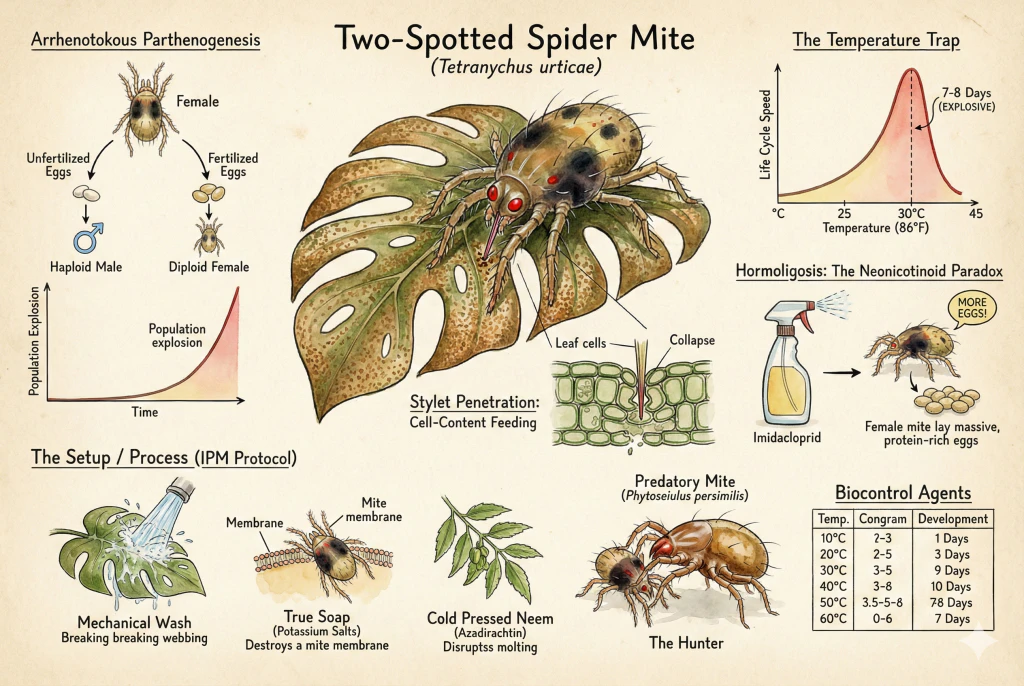
The Heat Factor: Spider mites are cold-blooded r-strategists. Their life cycle compresses from 30 days to just 7 days when temperatures rise from 15°C to 30°C, leading to explosive population growth.
The “Dry Air” Myth: High humidity does not kill spider mites; rather, dry air kills their natural predators. Maintaining humidity (60%+) is essential to keep beneficial predatory mites alive to fight the infestation.
Chemical Dangers (Hormoligosis): Avoid systemic neonicotinoids like Imidacloprid. These chemicals kill beneficial insects and trigger hormoligosis in mites, causing females to lay more eggs and worsening the outbreak.
Soap vs. Detergent: Do not use dish soap (detergents like Dawn), which strips the plant’s protective waxy cuticle. Use Potassium Salts of Fatty Acids (insecticidal soap) to disrupt the mite’s cell membranes safely.
Biological Warfare:
Use Phytoseiulus persimilis for rapid eradication of heavy infestations (requires high humidity).
Use Neoseiulus californicus for prevention and maintenance as they can survive longer without food.
Quarantine Protocol: Isolate all new plants for at least 30 days and remove nursery soil to prevent introducing eggs into your ecosystem.
2. The Science: Why Plants Spider Mites Target Are Doomed Without Help
To kill the enemy, you have to understand the enemy. And I don’t mean just knowing they have eight legs.
You need to understand the metabolic machinery that drives their destruction. Spider mites aren’t insects; they are arachnids. This isn’t just a trivial taxonomical difference; it dictates their entire physiology and how they react to chemicals.
The Stylet: A Cellular Straw
Most people think mites bite leaves like a caterpillar. Wrong. They are cell-content feeders. They possess a specialized mouthpart called a stylet—a retractable, needle-like structure that is essentially a hypodermic syringe.
Here is what happens to your plants Spider Mites are feeding on:
Penetration: The mite anchors itself and drives the stylet through the leaf epidermis. They often cheat by aiming for the stomata (the plant’s breathing pores) or the softer pavement cells to get easy access to the spongy mesophyll layer inside.
Injection: They don’t just suck; they spit. They inject saliva containing enzymes that pre-digest the cellular contents. This saliva is nasty stuff—it causes the cytoplasm (the cell jelly) to coagulate and clump.
Extraction: They suck the liquefied contents out, leaving the cell wall intact but completely empty.
This is why you see “stippling”—those tiny white or yellow dots. Each dot is a cluster of dead, air-filled cells that used to be full of green chlorophyll. As the population grows, these dots merge, the leaf turns bronze or yellow, and photosynthesis crashes. The plant literally starves to death because its solar panels have been smashed.
The Reproductive Mathematics of Nightmare Fuel
Spider mites are what biologists call r-strategists. In plain English, this means they prioritize speed and quantity over quality parenting. Their superpower is Arrhenotokous parthenogenesis.
Females don’t need dudes: A virgin female spider mite can lay eggs. These unfertilized eggs hatch into haploid males.
The Oedipus Complex: Those sons can then mate with their own mother.
The Explosion: Once mated, the female produces both daughters and sons (diploid females, haploid males).
The Ratio: The population is heavily female-biased (often 3:1), meaning almost every mite you see is an egg-laying machine.
This mechanism allows a single survivor—one gravid female hiding in a crevice of your pot—to restart an entire colony. It also allows them to lock in genetic resistance to pesticides at terrifying speeds.
The Temperature Trap
Spider mites are cold-blooded (poikilotherms), so their engine runs on heat.
At 60°F (15°C): They are sluggish. The life cycle from egg to adult takes about a month.
At 86°F (30°C): They go biological supernova. The life cycle compresses to just 7-8 days.
The Implication: If you run your grow tent hot to maximize plant growth, you are also creating a mite incubator. A population can multiply 100-fold in the time it takes you to notice the first web.
The “Dry Air” Myth vs. Biological Reality
You will hear this everywhere: “Humidity kills spider mites.” This is technically false, but practically true for reasons people misunderstand.
Mite Physiology: Spider mites actually possess mechanisms to survive wide humidity ranges. In fact, in dry air (high vapor pressure deficit), they just feed more voraciously to replace the water they lose through evaporation. They don’t explode if it gets dry; they just get thirsty and drink your plant faster.
The Real Factor: The reason outbreaks happen in dry air is because predatory mites (the good guys who eat the bad guys) have incredibly thin cuticles and eggs that shrivel up and die when humidity drops below 60%.
The Takeaway: High humidity doesn’t drown the spider mites; it keeps the police force alive so they can do their job.
Hormoligosis: The Neonicotinoid Paradox
Here is the biggest secret in the industry: Systemic insecticides like Imidacloprid (Bonide Systemic) can actually cause spider mite outbreaks.
This phenomenon is called hormoligosis. When you apply a neonicotinoid to kill thrips or aphids on plants Spider Mites are also inhabiting, two things happen:
Predator Death: It kills the beneficial insects that were keeping the mites in check.
Reproductive Boost: It fundamentally alters the plant’s physiology or the mite’s metabolism, causing female mites to lay more eggs that contain higher protein levels (vitellin).
Using a neonicotinoid on a mite infestation is like trying to put out a fire with gasoline.
3. The Setup / Process: Saving Plants Spider Mites Have Infested
Alright, enough theory. You have mites. You want them gone. Here is the battle plan. This is not a “try this and see” list. This is an integrated pest management (IPM) protocol for saving plants Spider Mites are destroying.
Phase 1: The Purge (Mechanical Control)
Before you spray a single drop of anything, you need to physically reduce the biomass of the enemy.
Triaging: If a leaf is more than 50% yellow/bronzed, cut it off. That leaf is a net energy drain on the plant and is likely harboring 80% of the egg population. Put it gently in a bag, seal it, and trash it. Do not compost it.
The Shower: Take your plants to the shower or use a hose. Mites hate water, but not because it drowns them (they can survive submersion by trapping air bubbles). The physical impact of the water knocks them off and, crucially, breaks the webbing.
Why this matters: The silk webbing is hydrophobic (repels water). It acts as an umbrella. If you spray pesticides on a webbed plant, the spray sits on top of the web while the mites laugh at you underneath. You must break the barrier.
Phase 2: The Chemistry (Soaps and Oils)
We need to hit them with contact killers. We are avoiding hard synthetic acaricides for now to prevent resistance. We are using physics and chemistry to dissolve them.
True Soaps (Potassium Salts of Fatty Acids):
The Science: You need a soap, not a detergent. Dish soap (like Dawn) is a detergent made of sodium lauryl sulfate. It strips the waxy cuticle off your plant leaves, causing dehydration and leaf burn. Insecticidal soaps are potassium salts of long-chain fatty acids. They penetrate the soft body of the mite and disrupt their cell membranes, causing them to leak and die.
Application: Spray to runoff. You must hit the underside of every leaf. If you miss the mite, it lives.
Why: This is a true potassium salt formulation. It effectively disrupts the lipoprotein matrix of the mite’s cuticle without stripping the plant’s protective wax layer like dish detergents do. It has low phytotoxicity and breaks down quickly.
The Science: Most “Neem Oil” sold in stores is “Clarified Hydrophobic Extract.” This is just the fat—it smothers mites (suffocation), which is good, but it lacks the active ingredient Azadirachtin.
The Good Stuff: You want Cold Pressed Neem Oil. This contains Azadirachtin, which acts as an Insect Growth Regulator (IGR). It messes with their hormones (ecdysone), preventing them from molting to the next stage, and acts as an anti-feedant.
Recommended Gear: Plantonix Organic Cold Pressed Neem Oil
Why: Unlike clarified extracts, this cold-pressed oil retains high levels of Azadirachtin, providing hormonal disruption (growth regulation) alongside the physical smothering effect of the oil. It attacks the pest on two biological fronts.
If you have a large collection or a vivarium where you can’t spray poisons, you bring in the mercenaries. Predatory mites are the gold standard for saving plants Spider Mites have colonized.
The Hunter (Phytoseiulus persimilis): These are the special forces. They only eat spider mites. They are fast, red, and voracious.
Use Case: High infestation “hot spots.” They will hunt down every single mite and then starve to death.
Requirement: High humidity (60%+) is non-negotiable.
The Guard (Neoseiulus californicus): These are the beat cops. They eat spider mites, but also pollen and other debris.
Use Case: Preventative or maintenance. They survive longer when food is scarce.
Requirement: Tolerates lower humidity and higher temps than persimilis.
Phase 4: The Routine
Spider mites have a 3-day egg hatching cycle. Spraying once does nothing because eggs are resistant to most sprays.
Day 1: Mechanical wash + Soap Spray.
Day 4: Oil Spray (to catch newly hatched larvae).
Day 7: Soap Spray (cleanup).
Day 14: Assess. If clear, release predatory mites for long-term protection.
4. Deep Dive: Keeping Plants Spider Mites Free
Now that you have the basic battle plan, let’s get into the advanced tactics that separate the pros from the hobbyists who keep buying new plants Spider Mites eventually kill.
The “SerpaDesign” Quarantine Protocol
You cannot fight what you don’t let in. Tanner from SerpaDesign has popularized a rigorous quarantine method for vivarium plants that is the gold standard for avoiding introduction.
De-potting: Never introduce nursery soil into your clean ecosystem. It is a vector for eggs and larvae. Remove all substrate.
The Bleach Dip (Optional/Risky): Some hardcore growers do a 1:20 bleach dip for hardy plants, but this can kill sensitive tissues.
Visual Inspection: Use a 60x jeweler’s loupe. Look at the undersides of the leaves. If you see movement, treat it before it enters the house.
The “Clean Room”: New plants Spider Mites might be hiding on live in a separate clear tote or a different room for 30 days. Why 30 days? That covers the full life cycle of almost every pest, ensuring that if an egg was there, it has hatched and shown itself.
Video Tutorial: How to Clean and Quarantine Terrarium Plants
Why: SerpaDesign provides a visual walkthrough of bare-rooting and processing plants to ensure no pests hitchhike into your setup. This is preventative medicine at its best.
Nutrient Management: Stop Feeding the Enemy
Did you know you can fertilize your plants into a mite infestation?
Nitrogen toxicity: Mites love lush, succulent, high-nitrogen growth. Plants pumped full of synthetic nitrogen have higher amino acid concentrations in their sap, which essentially supercharges mite reproduction.
The Fix: Switch to a balanced fertilizer and consider silica supplements. Soluble silicon accumulates in the cell walls (phytoliths), making the plant tissue physically harder to pierce with a stylet. It’s like armoring your plant.
The Acaricide Rotation (For Professionals Only)
If you are managing a commercial greenhouse or a high-value collection and biologicals aren’t an option, you might look at chemical acaricides (miticides).
Mode of Action (MoA): You must rotate modes of action to prevent resistance.
The Rule: Never use the same MoA twice in a row. Mites can develop resistance to a chemical in a single season if you span it continuously.
5. Troubleshooting: Myths About Plants Spider Mites and Treatment
Myth 1: “I’ll just turn up the humidity and they will explode/drown.”
The Reality: False. As discussed, spider mites are physiologically capable of handling high humidity. They possess osmoregulatory mechanisms to maintain homeostasis. While extreme humidity (near 100%) might slow down egg hatching slightly, it won’t kill them. The only thing high humidity reliably does is allow fungal pathogens (like Botrytis) to attack your plant and allow predatory mites to survive. So, do raise humidity, but do it to support the predators, not to drown the pest.
Myth 2: “Dish soap is a cheap, safe alternative to insecticidal soap.”
The Reality: Dangerous. “Dish soap” is a detergent designed to strip grease off ceramic plates. It contains surfactants like sodium lauryl sulfate. Plant leaves have a waxy cuticle that prevents water loss. Detergents strip this wax. The result is a plant that looks “clean” but desiccates rapidly under grow lights. It creates phytotoxicity (leaf burn) that looks remarkably like mite damage, confusing the diagnosis. Always use potassium salts of fatty acids (true soap).
Myth 3: “I treated them once and they are gone.”
The Reality: Impossible. No standard contact pesticide kills 100% of the eggs. Spider mite eggs are notoriously resilient. If you spray once and walk away, the eggs will hatch 3-5 days later. These larvae will mature and lay eggs within a week. You must disrupt the life cycle. You are not killing a standing army; you are fighting a generational war. You must treat at intervals (e.g., every 3-5 days) for at least 3 weeks to catch every hatching generation.
6. Conclusion
The presence of spider mites isn’t a sign of failure; it’s a sign of nature doing its job. They are efficient biological machines designed to exploit stressed plants in warm environments. We build warm, predator-free environments for our plants, so we shouldn’t be surprised when they move in.
Victory doesn’t come from a magic bottle. It comes from vigilance (using that loupe every week), discipline (quarantining every new arrival), and science (using the right chemistry and biology). Stop poisoning your plants Spider Mites are attacking with detergents and stimulating mites with systemic insecticides. Start washing your plants, fixing your humidity, and deploying the hunter-killer mites that nature designed to do the dirty work for you.
Now, go check your Calatheas. I bet you’ll find a web.
Detailed Biological & Ecological Data Appendix
To further equip you for this war, here is the raw data on how temperature dictates the speed of the enemy’s mobilization. This is why I keep telling you that heat is the enemy’s ally.
Temperature
Developmental Time (Egg to Adult)
R0 (Net Reproductive Rate)
Implication for Grower
15°C (59°F)
~30 Days
Low
Populations grow slowly; easy to manage.
20°C (68°F)
~14-20 Days
Moderate
Standard room temp; steady growth.
25°C (77°F)
~10-12 Days
High (Peak)
The danger zone. Populations double quickly.
30°C (86°F)
~7-8 Days
Moderate-High
Explosive. Life cycle is so fast, sprays miss generations.
35°C (95°F)
~6 Days
Declining
Heat stress begins to kill eggs, but survivors are super-fast.
Table 1: The influence of temperature on Tetranychus urticae development. Note the massive acceleration between 20°C and 30°C.
The Chemistry of Control Agents
Understanding what you are spraying is critical to not nuking your own ecosystem.


Leave a Reply