
Introduction
Listen to me closely because I’m about to save you from turning your expensive glass jar into a bacterial soup kitchen. You didn’t just buy a plant and shove it in a bottle; you decided to play god with a miniature ecosystem. That’s bold. But here is the reality check: most people kill their closed terrariums within three months. Why? Because they treat condensation like a smudge on a window instead of what it actually is—the dashboard of a biological engine.
If you can’t see your plants because the glass is foggy, you’re not necessarily failing—you might just be witnessing a high-pressure weather system in a jam jar. But if that fog turns into a torrential downpour that never stops, running down the sides like a sweaty soda can in July, you are actively drowning your ecosystem. There is a massive, canyon-sized difference between a healthy, self-sustaining water cycle and a swampy glass coffin.
You are here because you want to know if that water on the glass is a sign of life or a harbinger of rot. You want to know the “sweet spot.” As someone who has spent over a decade staring at jars of dirt, running experiments that would bore a normal person to tears, and reading the horticultural textbooks so you don’t have to, I can tell you this: Condensation is the single most accurate gauge for terrarium health. It tells you everything about temperature, humidity, root activity, and bacterial balance—if you know how to read it.
We are going to cut through the marketing fluff that promises “zero maintenance” (which is a lie, by the way) and get into the botany, biology, and thermodynamics of why your jar is sweating. Buckle up.
The Science: Why Your Jar is Sweating (And Why You Want It To)
You didn’t just put a plant in a jar; you built a solar-powered engine. The fuel is light, and the coolant is water. To understand condensation, and to stop freaking out every time you see a water droplet, you have to understand that your terrarium is constantly trying to reach equilibrium, but physics keeps messing with it.
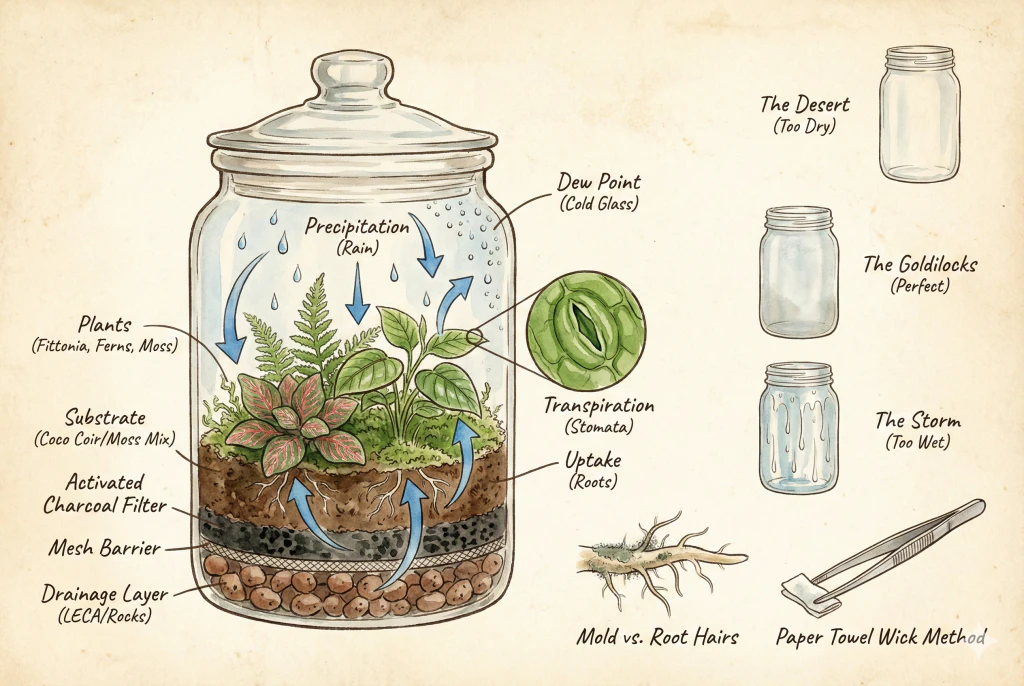
The Water Cycle 2.0 (The Glass Box Edition)
In the real world, the water cycle is vast. Water evaporates from the oceans, forms clouds in the troposphere, rains down on the mountains, and flows into rivers. It’s a global system. In a terrarium, we are compressing that entire planetary cycle into a few liters of space. This compression makes everything faster, more volatile, and more visible.
When you seal that lid, you are creating a Closed Loop System. Nothing enters, nothing leaves (except light and heat). This means every molecule of water you put in there on day one stays there forever, cycling through different states of matter.
1. Uptake (The Hydraulic Lift)
It starts in the dirt. Your substrate acts as a reservoir, holding water in its pores through capillary action. The roots of your plants—Fittonias, Ferns, Mosses—act as biological straws. They pull this water up into the plant tissue to transport nutrients. This is the hydraulic lift. Without this, your plant starves. If your soil is too dry, this lift fails, turgor pressure drops, and your plant wilts.
2. Transpiration (The Plant Sweat)
This is the part 90% of hobbyists forget. Plants “sweat.” Through tiny pores on the undersides of their leaves called stomata, plants release water vapor as a byproduct of photosynthesis. This process is called transpiration.
When the stomata open to let Carbon Dioxide (CO2) in for photosynthesis, water vapor escapes out. It’s a trade-off. This vapor increases the humidity inside the jar significantly. It is not just evaporation from the soil; the plants are actively pumping moisture into the air. This is why a jar full of plants will fog up faster than a jar with just dirt.
3. The Dew Point (The Critical Moment)
This is where the magic—and the confusion—happens. The air inside your jar warms up during the day because of the greenhouse effect (trapping solar radiation). Warm air is like a big sponge; it can hold a lot of water vapor.
However, the glass walls of your terrarium are in contact with the air in your room, which is usually cooler than the air inside the jar. Thermodynamics dictates that heat moves from hot to cold. The air inside the jar hits the cooler glass surface and rapidly cools down.
Here is the physics rule you need to tattoo on your brain: Cold air cannot hold as much moisture as warm air.
When that warm, humid internal air hits the cold glass, it reaches its Dew Point—the temperature at which the air becomes 100% saturated and can no longer hold the water in gas form. It is forced to release that excess moisture onto the glass in the form of liquid droplets. That is condensation.
4. Precipitation (The Rain)
Gravity takes over. The droplets get heavy, coalesce, slide down the glass, and water the soil again. The cycle completes. If this happens gently, it’s a perfect rain shower. If it happens aggressively, it’s a flood.
The Respiratory Rhythm: Day vs. Night
Here is the chemistry that dictates your condensation timing. It’s not random; it follows a circadian rhythm.
- Daytime (Photosynthesis): Plants are absorbing light and CO2, producing sugars, and releasing Oxygen and water vapor. They are pumping humidity into the air. The temperature inside the jar rises.
- Nighttime (Respiration): The lights go out. Photosynthesis stops. Plants switch to respiration. They burn the sugars they made during the day for energy, consuming Oxygen and releasing CO2. This metabolic activity produces a small amount of heat, but generally, the jar cools down.
This day/night fluctuation creates pressure and temperature differentials that drive the condensation cycle. You will often see the most condensation in the morning (after the cool night lowers the glass temperature) or late afternoon (when the internal temp is highest relative to the room).
The Takeaway: Condensation is proof that your plants are metabolizing. A bone-dry jar is a dead jar. A foggy jar is a working engine.
The Setup: Engineering the “Goldilocks” Environment
You cannot manage condensation if your foundation is garbage. If you dumped garden soil into a jar without a drainage layer, no amount of venting or wiping will save you. You need a buffer zone. You need to engineer the substrate to handle the water flow.
The Anatomy of Moisture Control
To regulate the water cycle effectively, your build needs specific layers designed to handle the movement of water. You are essentially building a water treatment plant in a jar.
1. The Drainage Layer (The Sump)
This is non-negotiable. You need 1-2 inches of inorganic material at the bottom. Gravel, LECA (Lightweight Expanded Clay Aggregate), or lava rock.
- The Physics: This layer creates a space for excess water to sit away from the soil. If you overwater, the excess drains down here via gravity.
- The Risk: If your soil sits directly on the glass bottom, the water pools there. The roots sit in that pool. Anaerobic bacteria (the bad kind that smell like rotten eggs) thrive in low-oxygen, waterlogged soil. They attack the roots, causing Root Rot. Once root rot starts, it’s game over.
2. The Barrier (The Separator)
You need something to stop the soil from falling into the rocks. A mesh screen, a piece of landscape fabric, or a layer of dried sphagnum moss.
- Why: If soil gets into the drainage layer, it acts like a wick. It creates a capillary bridge that pulls the dirty, stagnant water from the bottom back up into the roots, defeating the entire purpose of the drainage layer.
3. The Filter (Activated Charcoal)
This is your chemical sponge. It sits right on top of the drainage layer or mixed into the soil.
- The Chemistry: Activated charcoal has a massive surface area full of micropores. Through adsorption (not absorption), it traps chemical impurities, heavy metals, and toxins that might build up in a closed system. It also helps buffer moisture levels and, crucially, absorbs odors. If you skip this, your terrarium will eventually smell like a swamp.
Why: Standard BBQ charcoal contains additives and lighter fluids that will kill your plants instantly. You need activated horticultural charcoal to filter toxins and keep the closed loop smelling fresh.
4. The Sponge (The Substrate)
You want a mix that holds water but breathes. Garden soil is too dense; it compacts into mud. You need a “fluffy” mix.
- Coco Coir: Holds moisture but resists decay.
- Worm Castings: Provides nutrients.
- Sphagnum Moss: Increases water retention.
- Perlite/Vermiculite: Adds aeration and drainage. A good mix (often called the ABG mix in the vivarium hobby) allows water to flow through it while retaining enough dampness for the roots.
The Initial Watering (The Most Dangerous Moment)
The biggest mistake beginners make is the “flood.” They pour water in from a cup. Never pour. You cannot take water out easily, but you can always add it.
The Process:
- Moisten the soil before you put it in. It should feel like a wrung-out sponge—damp to the touch, but no water should drip out when you squeeze it.
- Build your layers.
- Plant your flora.
- Spray, don’t pour. Use a fine mister to settle the soil around the roots and clean the soil off the glass.
- Seal it.
- Wait 24 Hours. Do not touch it. Let the physics do the work. The heat of the day will start the cycle.
Why: Traditional trigger sprayers blast the soil with a heavy jet, displacing your carefully placed moss and digging holes in the substrate. A continuous mister creates a gentle, aerosol-like fog that coats leaves for absorption without waterlogging the soil structure.
Deep Dive: Reading the Glass (The Diagnostics)
You are now the weatherman of your micro-world. The glass tells you everything. You don’t need a hygrometer (though they help); you just need eyes and an understanding of the patterns.
The Three States of Terrarium Weather
I’ve compiled a diagnostic table to help you identify exactly what your jar is telling you based on the condensation patterns.
| State | Visual Sign | Time of Day | Diagnosis | Action Required |
|---|---|---|---|---|
| The Desert | Glass is completely clear. Soil looks light brown/grey. Moss is crunchy. | All Day | Too Dry. The ecosystem is dehydrated. Roots are stressed. | Mist heavily (10-15 sprays). Focus on moss. Seal and check in 24 hrs. |
| The Goldilocks | Light mist/fog on the glass. Plants look soft. Visibility is slightly hazy but possible. | Morning / Late Evening | Perfect. The cycle is active. Plants are transpiring, glass is cooling. | Do nothing. Enjoy the view. |
| The Storm | Heavy droplets covering >50% of glass. Water running down sides. Soil is dark mud. | All Day | Too Wet. Saturation is 100%. Anaerobic bacteria risk is high. | Vent the lid for 12-24 hours. Wipe glass dry. Repeat until ‘Goldilocks’. |
| The Uneven | Condensation only on one side (the side facing the window/light). | Day | Thermal Lag. One side is warmer than the other. | Rotate the jar 180 degrees. Move slightly away from cold/hot windows. |
Scenario A: The Foggy Morning (Healthy)
Signs: In the morning, there is a light mist on the glass. You can see the plants, but they look soft and hazy. By the afternoon, the glass clears up as the internal temperature equalizes with the room temperature.
Diagnosis: Perfect. This is the natural cycle. The plants transpired overnight and into the morning, the glass caught the dew, and now it’s cycling back down into the soil.
Action: Do nothing. Take a photo. Post it on Instagram.
Scenario B: The Rainforest Storm (Too Wet)
Signs: Large, heavy droplets cover the glass 24/7. Water is running down the sides in rivulets. The soil looks dark, almost black, and muddy. You cannot see the plants clearly at any time of day.
Diagnosis: Oversaturated. Your dew point is constantly being triggered because the relative humidity is near 100% and the water volume in the system is too high. This leads to root rot and mold explosions because there is no airflow to check fungal growth.
Action: Vent it.
- Open the lid.
- Leave it open for 12–24 hours. This allows the excess water vapor to escape into your room.
- Wipe the glass with a clean paper towel to manually remove that volume of water from the system.
- Reseal and observe for another 24 hours. Repeat this cycle until you hit Scenario A.
Why: Standard paper towels leave tiny paper fibers (cellulose) inside the jar. In a high-humidity environment, these fibers become a breeding ground for mold. Microfiber removes condensation cleanly and polishes the glass for better light penetration.
Scenario C: The Desert (Too Dry)
Signs: Zero condensation, ever. The soil is light brown or grey. The moss feels crunchy or prickly. The leaves look dull or are drooping.
Diagnosis: Under-watered. The air is too dry for the dew point to be reached on the glass surfaces. The plants are closing their stomata to preserve water, halting growth.
Action: Mist it.
- Give it 5-10 sprays using your continuous mister.
- Focus on the moss, as it has no root system to pull water from deep in the soil.
- Seal and wait 24 hours. If no fog appears the next morning, repeat.
Why: Sometimes you need to see the “squeeze test” and the visual difference between wet and dry substrate. SerpaDesign breaks down the visual cues of saturation perfectly, showing you exactly what “too wet” looks like.
Advanced Humidity Control: Thermodynamics & Interventions
Okay, you’re looking at the glass and it’s confusing you. It’s misting, but the soil looks dry? Or the soil is wet but the glass is clear? Let’s get into the nitty-gritty of Vapor Pressure Deficit (VPD) and thermal dynamics.
The “Thermal Lag” Effect
Condensation isn’t just about the amount of water; it’s about the temperature difference (Delta T) between the inside and outside of the jar.
- Summer: If your house is 70°F and your terrarium is 75°F (because it traps heat from the sun), you will get condensation on the slightly cooler glass.
- Winter: If you place your terrarium near a window in winter, the glass will be freezing (say, 50°F). The warm air inside (70°F) will dump all its water onto the cold glass. It will look like a torrential rainstorm inside, even if your soil is actually quite dry.
The Danger: If you see this “Winter Condensation” and think “Oh, it’s too wet, I should vent it,” you will open the lid, let the moisture escape, and effectively dry out your soil. Meanwhile, the glass is “stealing” all the moisture from the air, dehydrating your plants.
Pro Tip: Move the jar away from the cold window before you diagnose it. Let it acclimate to room temp (away from drafts) for 24 hours. Then check the condensation levels.
The “Paper Towel Trick” for Emergency Extraction
Let’s say you messed up. You panicked and poured a cup of water in, and now you have a swimming pool at the bottom in your drainage layer.
- Don’t try to pour it out. You will shift the soil, mix the layers, and destroy the landscape you spent hours building.
- The Wick Method: Twist a paper towel into a tight “rope” or “rat tail.”
- Insertion: Push one end down through the soil and into the drainage layer (use long aquascaping tweezers).
- Extraction: Leave the other end hanging out of the jar, resting on the table.
- Physics: Capillary action (wicking) will suck the water up the towel, over the rim of the jar, and drip it onto the table (or into a bowl). It acts like a siphon without the suction. It’s slow—it might take overnight—but it works without disturbing your plants.
Why: You need reach. You cannot shove your hand into a small jar to place the paper towel wick without crushing your ferns. Long stainless steel tweezers are the surgeon’s tool for the terrarium expert.
Troubleshooting (Q&A): Myths & Disasters
Let’s address the things that freak people out. I hear these questions every week.
Myth 1: “Condensation is bad and means rot.”
Fact: False. No condensation usually means death for tropicals. Fittonias (Nerve Plants) and Ferns—the classic terrarium choices—are native to the rainforest floor. They need high humidity (80%+). If the air is dry, their stomata close to save water, photosynthesis slows down, and they essentially hold their breath until they starve. You want some fog. It is the sign of a happy, humid environment.
Myth 2: “I should wipe the glass every day to keep it clean.”
Fact: Stop it. Every time you wipe the glass, you are physically removing water from the closed cycle. If you do this every day for a month, you will eventually desiccate your substrate. Only wipe if you are seeing too much water (Scenario B) or if there is algae/dirt obscuring the view. Otherwise, let the water drip back down. That water belongs to the soil, not your paper towel.
Problem: “There is white fuzz on my plants! It’s Mold!”
Correction: Maybe, maybe not. This is the number one panic inducer.
- Root Hairs: If the fuzz is exclusively at the base of a stem or looking like a tiny white brush on a root that is poking out, that is a root hair. It is the plant increasing its surface area to drink water. It is healthy. It looks uniform and organized.
- Mold: If the fuzz looks like a spiderweb, is grey/white, and is growing on a leaf, a dead stick, or spreading across the soil surface like a net, that is mold. It is chaotic and messy.
The Fix: If it’s mold, don’t nuke the tank with chemicals. You need a bioactive defense system. Add Springtails.
- What are they? Tiny, white micro-insects (Collembola) that eat mold and decaying matter. They are the janitors of the terrarium world.
- How they work: You dump a culture of them in. They disappear into the soil. They eat the mold. They poop out nutrients for your plants. They breed. They keep the mold in check forever. If you don’t have them, get them.
Why: Going bioactive is the only way to ensure long-term stability. Springtails eat mold, rot, and fungus, turning potential disasters into plant food. They are essential for condensation-heavy environments.
Problem: “My terrarium smells like rotten eggs.”
Correction: Anaerobic Bacteria. You have waterlogged the soil. The oxygen can’t get to the roots or the beneficial bacteria. The bad bacteria (that don’t need oxygen) are breeding and producing hydrogen sulfide (that sulfur smell).
The Fix: You need to dry it out now.
- Vent the lid for 24-48 hours.
- Aeration: Poke holes in the soil with a chopstick or skewer to create air tunnels down to the drainage layer. This introduces oxygen to the deep substrate.
- If it’s really bad (black mushy roots), you might have to pull the plants, cut off the rotting roots, and replant in fresh, drier soil.
Conclusion: The Art of Observation
Terrariums are not “set and forget.” That is a lie told to sell more jars. They are “set and observe.”
Condensation is your primary communication tool. It’s the heartbeat of the ecosystem.
- Light Fog: “I’m good. I’m breathing.”
- Heavy Rain: “I’m drowning. Help me.”
- Clear Glass: “I’m thirsty. Feed me.”
Don’t be afraid of the fog. Embrace the cycle. Understand that your jar is a living, breathing thing subject to the laws of thermodynamics. Respect the cycle, stop over-watering, and for the love of botany, get some springtails in there.
Now, go check your glass. Is it a rainforest or a desert? You know what to do.
Reference Index
Here are the sources used to verify the science and techniques in this guide. You can refer to these for deeper reading or visual demonstrations.
- SerpaDesign – Terrarium Updates (YouTube)
Use: Refer to this channel for visual examples of long-term terrarium health and how established ecosystems (some over 4 years old) manage condensation and mold naturally.
- Worcester Terrariums – Condensation Control (YouTube)
- Source:https://www.youtube.com/c/WorcesterTerrariums/videos
- Use: A great resource for specific visual tutorials on venting, wiping glass, and the “Goldilocks” zone of condensation.
- Monstera App – Closed Terrarium Maintenance
- Source: https://www.monstera-app.com/en/blog/care-tips/nine-tips-for-maintaining-your-closed-terrarium-01HESY3G6PY23G6G8HDCRJ9VGK
- Use: Provides written confirmation on the “venting” technique for overwatered terrariums and the importance of rotational lighting to prevent thermal lag on one side.
- Vaisala – Dew Point & Humidity Science
- Source: https://www.vaisala.com/sites/default/files/documents/Dew-point-frost-point-selection-B212716EN.pdf
- Use: This is the “hard science” reference for understanding Dew Point vs. Relative Humidity. It explains the physics of why condensation forms on cold glass even when the air isn’t “wet” enough to rain.
- Botanical Boys – Mold vs. Root Hairs
- Source: https://www.botanicalboys.com/pages/terrarium-care-guide
- Use: Use this guide if you are struggling to identify the “white fuzz” in your tank. It clearly distinguishes between saprophytic fungi (mold) and healthy root hairs.

Leave a Reply